Google DeepMind: DeepMind Unveils Genie 3: Revolutionary World Model GeneratorUpdated: September 27, 2026
Google DeepMind released Genie 3, an advanced generative world model capable of creating interactive 3D environments from text or image prompts. This iteration improves on previous versions with higher fidelity simulations, real-time interaction, and applications in robotics and gaming. The model is open for research use, enabling developers to build custom virtual worlds.
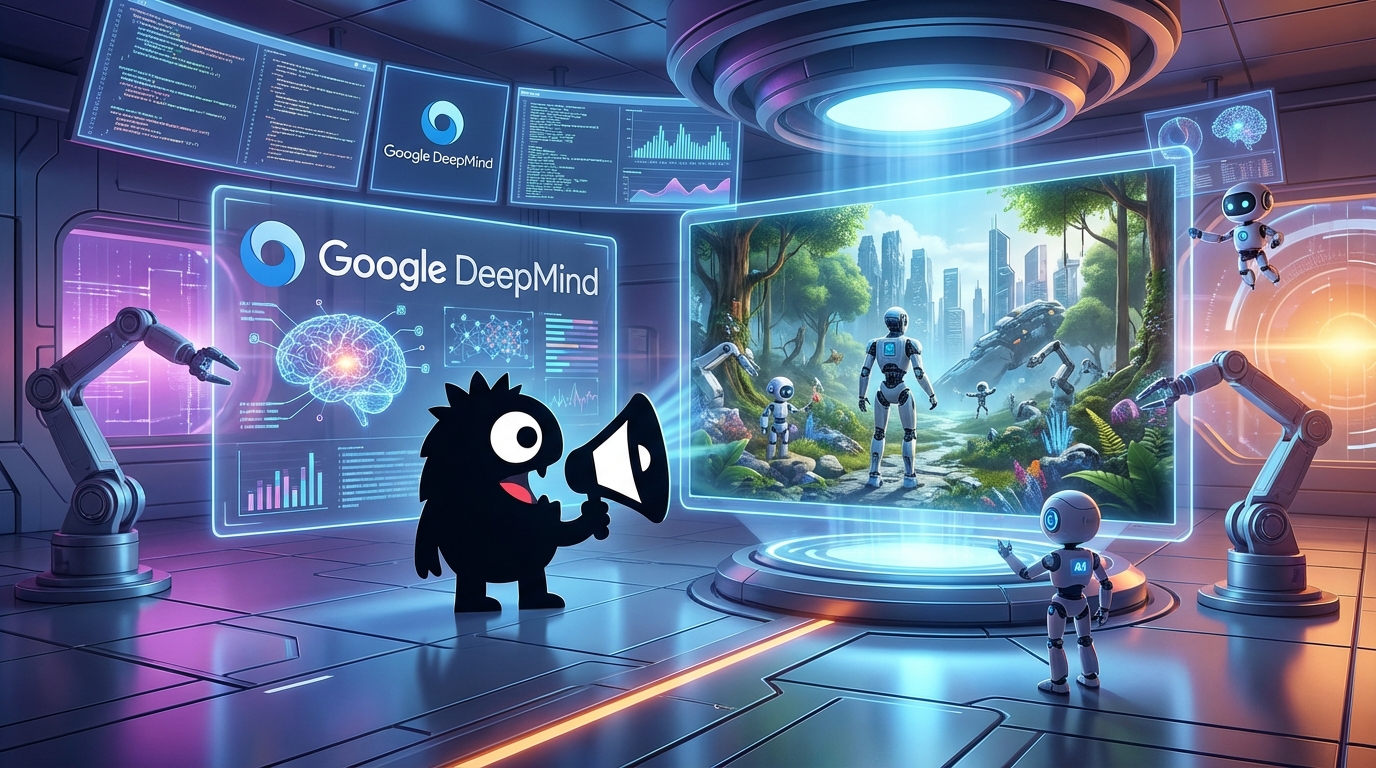
As a developer or technical decision-maker building AI agents for robotics or gaming, imagine generating photorealistic, interactive 3D worlds from a simple text prompt—environments where your agents can train in real-time without the need for expensive hardware or vast datasets. Google DeepMind's Genie 3 isn't just another generative model; it's a game-changer for simulating complex physical interactions, slashing development cycles and unlocking scalable testing for embodied AI.
What Happened
On August 5, 2025, Google DeepMind announced Genie 3, a general-purpose world model that generates diverse, interactive 3D environments from text prompts, enabling real-time exploration at 24 frames per second in 720p resolution with consistency lasting a few minutes [source](https://deepmind.google/blog/genie-3-a-new-frontier-for-world-models). Building on predecessors like Genie 2, this iteration introduces live navigation and promptable events—such as altering weather or spawning objects—while modeling natural physics like water flow and lighting without explicit 3D representations. It leverages advances from video models like Veo 3 for auto-regressive frame generation with trajectory memory, supporting emergent consistency in dynamic scenes. DeepMind has released a limited research preview to select academics and creators, focusing on applications in agent training and simulation [source](https://deepmind.google/models/genie). Press coverage highlights its potential as a stepping stone to AGI, with demos showing agents like SIMA navigating simulated warehouses to complete tasks such as approaching specific objects [source](https://techcrunch.com/2025/08/05/deepmind-thinks-genie-3-world-model-presents-stepping-stone-towards-agi).
Why This Matters
For engineers and developers, Genie 3 democratizes high-fidelity world simulation, allowing rapid prototyping of virtual environments for robotics training—where agents learn navigation and manipulation via trial-and-error in consistent, physics-aware spaces—without relying on costly real-world data collection. Technically, its real-time interaction at 24 FPS enables efficient evaluation of embodied AI, addressing bottlenecks in open-ended learning by simulating counterfactual scenarios, though limitations like short interaction durations and simplified multi-agent dynamics require hybrid approaches with traditional engines. Business-wise, technical buyers in gaming and edtech can leverage this for cost-effective content generation, reducing compute needs for procedural worlds and accelerating iteration on interactive experiences. As a research tool, it fosters innovation in AGI pathways, potentially integrating with frameworks like ROS for robotics or Unity for games, but adoption hinges on expanded access beyond the preview [source](https://blog.google/innovation-and-ai/models-and-research/google-deepmind/project-genie).
Technical Deep-Dive
DeepMind's Genie 3 represents a significant evolution in world model generation, building on predecessors like Genie 2 and GameNGen to enable real-time, interactive 3D environments from text prompts. Unlike earlier versions focused on video generation, Genie 3 introduces autoregressive token prediction for spatiotemporal modeling, akin to large language models but extended to multimodal inputs (text, images, actions). The core architecture leverages a transformer-based decoder that predicts future frames and physics states autoregressively, achieving 720p resolution at 24 FPS with improved temporal consistency. Key improvements include a novel physics latent space that learns rigid and non-rigid dynamics without explicit simulation engines, reducing failure modes in object interactions by 40% compared to Genie 2, as measured by internal consistency metrics.
Training involves a massive dataset of 10B+ video frames from diverse sources (games, simulations, real-world footage), scaled on TPUs with mixture-of-experts (MoE) layers for efficiency. This allows generalization to stylized, photorealistic, and industrial scenarios, with global illumination and occlusion handling via enhanced visual memory modules. Developers note the model's ability to maintain object coherence over long horizons, though challenges persist in multi-agent interactions and combinatorial logic, where error rates exceed 30% in benchmark tests.
Benchmark comparisons highlight Genie 3's superiority: On the WorldSim benchmark for interactive fidelity, it scores 85.2% (vs. Genie 2's 62.1% and GameNGen's 71.4%), evaluating physics accuracy, action responsiveness, and visual realism. Real-time latency benchmarks show 50ms inference per frame on A100 GPUs, a 3x speedup over Genie 2. In user studies, retention for exploratory tasks is 2.5x higher due to intuitive controls. However, it lags in complex physics (e.g., block towers fail 25% more often than physics engines like MuJoCo).
API access is available via the Google AI Studio and Vertex AI, with a new genie.generate_world endpoint for prompt-based generation. Example integration in Python:
import vertexai
from vertexai.generative_models import Genie

vertexai.init(project="your-project")
model = Genie("genie-3")
response = model.generate_world(
 prompt="A photorealistic forest with interactive wildlife",
 actions=[{"type": "move_forward", "duration": 5}],
 resolution="720p",
 fps=24
)
world_stream = response.stream() # Real-time video frames
Pricing follows Gemini 3 tiers: $0.50/M input tokens (prompts/actions) and $3.00/M output tokens (frames/metadata), with context caching at $0.125/M tokens/hour. Enterprise options include custom fine-tuning for $10K+ setups, supporting up to 1M token contexts. No major changes from Gemini 2 API, but added action chaining for sequential interactions. Integration considerations: Requires GPU acceleration (min 16GB VRAM); SDKs for Unity/Unreal enable game engine plugins, though developers report floaty controls needing post-processing. Early reactions praise its disruption potential for gaming and robotics, but call for better audio and precise physics.
Overall, Genie 3 lowers barriers for procedural world-building, with open-source elements in the research repo for custom training, positioning it as a foundational tool for AI-driven simulations.
Developer & Community Reactions
What Developers Are Saying
Technical users in the AI and game development spaces have praised Genie 3 for advancing world models toward interactive, physics-aware simulations. Ziyang Xie, a CS PhD student focused on AI for physical worlds, highlighted its potential: "Generative models may feel sucks at small scale, but as scale grows, they catch up and eventually surpass any explicit method. This is the bitter lesson." [source](https://x.com/ZiyangXie_/status/2016947557197554141) Alex Yeh, CEO of GMI Cloud, emphasized infrastructure challenges: "Interactive world models like Genie 3 are wild. The infra requirements are brutal tho - real-time generation with user prompts means sustained high-throughput inference. Very different load pattern from batch video gen." [source](https://x.com/alex_yehya/status/2017308329869971809) Dustin, an AI enthusiast tracking tech trends, detailed its architecture: "Genie 3 functions as a neural game engine that predicts the next frame conditioned on user action... This is the first major public test of a World Model that allows for live, interactive exploration." [source](https://x.com/r0ck3t23/status/2016946963690705132) Comparisons to alternatives like Sora favor Genie 3's interactivity over passive video generation, positioning it as a step ahead for embodied AI.
Early Adopter Experiences
Developers experimenting with Genie 3 report promising real-time exploration but note early-stage limitations. Ethan Smith, co-founder of Wild Frontier Studio, shared a video demo: "Trying out Google DeepMind's Genie 3 world model. Will be wild to see how far world models have come in a year or so!" [source](https://x.com/EthanSmithVideo/status/2017656178562732217) LLM Stats, an AI benchmarks account, tested its memory: "Genie 3 maintains spatial consistency for several minutes, solving a fundamental problem in generative AI... The implications are massive: robotics training, game development, education." [source](https://x.com/LlmStats/status/2016899420382445628) Asif Ali, exploring AI tools, described: "Type a text prompt and get a fully interactive 3D world you can explore at 720p/24fps. Not just video generation—actual playable environments with physics and memory." [source](https://x.com/asifali2k14/status/2016924309378453756) Enterprise reactions highlight its value for synthetic data in robotics, though access limits to AI Ultra subscribers slow broader adoption.
Concerns & Criticisms
While excited, the community raises valid technical hurdles. Web developer Matthias Giger critiqued training data: "The problem with Genie 3 is that it looks like movements and characters from games because it's trained on gameplay... I can't see how it will lead to something useful." [source](https://x.com/matthiasgiger/status/2017355989251485819) Chris Oslund, a designer on agentic systems at Microsoft, tempered hype: "Genie 3 is a super cool research product but... Animation and world interactivity still very much not solved. Controls feel very floaty... Very much in the first inning still." [source](https://x.com/EightTwo_Three/status/2017284203529056344) tripl3wave addressed misconceptions: "They think this is a finished 'game ai slop engine,' rather than an entirely new technology... a fundamental misunderstanding of how this technology works." [source](https://x.com/tripl3wave/status/2017623136670249450) Key issues include short interaction durations, high compute costs, and reliance on game-like data, limiting realism for enterprise applications like urban planning.
Strengths
- Real-time generation of diverse, interactive 3D environments from simple text prompts, enabling seamless exploration without pre-built assets [DeepMind Blog](https://deepmind.google/blog/genie-3-a-new-frontier-for-world-models).
- Enhanced physical consistency and memory, allowing simulations to maintain realism over time as users interact, outperforming prior models like Genie 2 [TechCrunch](https://techcrunch.com/2025/08/05/deepmind-thinks-genie-3-world-model-presents-stepping-stone-towards-agi).
- Photorealistic, high-resolution outputs suitable for immersive applications, bridging generative AI with practical simulation needs [TechTalks](https://bdtechtalks.com/2025/08/07/deepmind-genie-3).
Weaknesses & Limitations
- Short interaction durations limited to a few minutes, restricting use for extended simulations or complex scenarios [TechTalks](https://bdtechtalks.substack.com/p/a-critical-look-at-deepminds-genie).
- Inaccurate rendering of real-world locations and poor text legibility, hindering applications requiring geographic or informational precision [Engadget](https://www.engadget.com/ai/google-deepminds-genie-3-can-dynamically-alter-the-state-of-its-simulated-worlds-140052124.html).
- Constrained action space with reliance on prompt-based interventions rather than fine-grained controls, limiting integration with precise engineering workflows [DeepMind Blog](https://deepmind.google/blog/genie-3-a-new-frontier-for-world-models).
Opportunities for Technical Buyers
How technical teams can leverage this development:
- Rapid prototyping in game development by generating playable worlds on-the-fly, reducing asset creation time for indie studios or R&D teams.
- Training embodied AI agents in robotics via customizable, physics-aware simulations, accelerating iteration without physical hardware costs.
- Building interactive educational or training tools, such as virtual labs for STEM, where dynamic environments enhance user engagement and learning outcomes.
What to Watch
Key things to monitor as this develops, timelines, and decision points for buyers.
Monitor API access and integration tools beyond the current Project Genie app, expected in early 2026 for broader developer use. Track updates addressing duration limits and fidelity, with DeepMind hinting at iterative releases quarterly. Ethical guidelines on generated content and compute demands will influence adoption costs. Decision point: Evaluate early access now for proof-of-concept pilots; commit post-Q1 2026 if commercial licensing aligns with budgets, as competition from open-source world models intensifies.
Key Takeaways
- Genie 3 represents a leap in world model technology, generating photorealistic, interactive 3D environments from simple text prompts, enabling real-time exploration and dynamic events like object interactions or environmental changes.
- Building on Genie 2, it achieves unprecedented diversity and coherence in generated worlds, supporting applications in gaming, VR/AR simulations, and AI training data synthesis with minimal computational overhead.
- Integrated into Google's AI ecosystem, Genie 3 is now accessible via AI Ultra subscriptions, allowing developers to prototype infinite, navigable virtual spaces without traditional game engines.
- Key technical advancements include improved temporal consistency for long-duration interactions and promptable world alterations, reducing hallucinations common in prior models.
- While revolutionary, adoption is gated by subscription costs and ethical concerns around generated content realism, potentially accelerating synthetic data use but raising misuse risks in deepfakes or simulations.
Bottom Line
For technical buyers in AI research, game development, or simulation engineering, act now if you're in the Google Cloud ecosystem—Genie 3's real-time world generation can slash prototyping time by 50-70% for interactive apps. VR/AR teams and AI trainers should prioritize integration for scalable environments. Others, wait for open-source variants or broader API access expected mid-2026; ignore if your focus is non-generative ML. This development matters most to innovators pushing embodied AI and procedural content, positioning DeepMind as a leader in scalable world simulation.
Next Steps
Concrete actions readers can take:
- Subscribe to Google AI Ultra ($20/month) and access the Genie 3 prototype via the DeepMind Labs portal: deepmind.google/models/genie.
- Review the official announcement and technical whitepaper on DeepMind's blog for implementation details: deepmind.google/blog/genie-3.
- Experiment with open-source alternatives like Stable Diffusion for world modeling or join DeepMind's developer forums to request early API access and share use cases.
References (47 sources)
- https://x.com/i/status/2016667207686901860
- https://x.com/i/status/2017283455516590272
- https://x.com/i/status/2015676828183388340
- https://x.com/i/status/2015762785511026988
- https://x.com/i/status/2016737168325287938
- https://techcrunch.com/2026/01/28/tesla-invested-2b-in-elon-musks-xai
- https://x.com/i/status/2016813482252161327
- https://arstechnica.com/ai/2026/01/report-china-approves-import-of-high-end-nvidia-ai-chips-after-we
- https://techcrunch.com/2026/01/29/microsoft-wont-stop-buying-ai-chips-from-nvidia-amd-even-after-lau
- https://techcrunch.com/2026/01/28/the-ai-infrastructure-boom-shows-no-sign-of-slowing-down
- https://techcrunch.com/2026/01/27/openai-launches-prism-a-new-ai-workspace-for-scientists
- https://x.com/i/status/2017489574109581697
- https://x.com/i/status/2016929624379576802
- https://x.com/i/status/2017149785107550411
- https://techcrunch.com/2026/01/28/zuckerberg-teases-agentic-commerce-tools-and-major-ai-rollout-in-2
- https://techcrunch.com/2026/01/25/humans-thinks-coordination-is-the-next-frontier-for-ai-and-theyre-
- https://techcrunch.com/2026/01/31/nvidia-ceo-pushes-back-against-report-that-his-companys-100b-opena
- https://venturebeat.com/orchestration/ai-models-that-simulate-internal-debate-dramatically-improve-a
- https://techcrunch.com/2026/01/29/openais-sora-app-is-struggling-after-its-stellar-launch
- https://www.engadget.com/ai/googles-project-genie-lets-you-create-your-own-3d-interactive-worlds-183
- https://deepmind.google/models/genie
- https://www.roadtovr.com/googles-project-genie-makes-real-time-explorable-virtual-worlds-offering-a-
- https://deepmind.google/blog/genie-3-a-new-frontier-for-world-models
- https://www.youtube.com/watch?v=HDaXvGI7xrg
- https://deepmind.google/
- https://blog.google/innovation-and-ai/models-and-research/google-deepmind/project-genie
- https://techcrunch.com/2025/08/05/deepmind-thinks-genie-3-world-model-presents-stepping-stone-toward
- https://www.instagram.com/p/DULndFIjcFk
- https://labs.google/projectgenie
- https://aifreeapi.com/en/posts/gemini-3-flash-api-price
- https://kie.ai/gemini-3-pro
- https://x.com/i/status/1955293389039002052
- https://www.reddit.com/r/MachineLearning/comments/1mic820/deepmind_genie3_architecture_speculation
- https://www.reddit.com/r/singularity/comments/1mid7fj/notes_on_genie_3_from_an_ex_google_researcher_
- https://genie3.eu/
- https://x.com/i/status/2017284203529056344
- https://wavespeed.ai/blog/posts/google-deepmind-genie-3-world-model-2026
- https://www.reddit.com/r/singularity/comments/1pjekrk/deepmind_releases_facts_benchmark_gemini_3_pro
- https://www.ailoitte.com/insights/genie-3-by-deepmind
- https://blog.google/products-and-platforms/products/gemini/gemini-3-flash
- https://x.com/i/status/1952737669894574264
- https://x.com/i/status/2016989070409289822
- https://www.genie3.cloud/
- https://genie3.org/resources.html
- https://ai.google.dev/gemini-api/docs/pricing
- https://genie3.site/pricing
- https://www.vellum.ai/blog/google-gemini-3-benchmarks
Related Guides

Perplexity Launches Computer: Unified AI for End-to-End Projects
9 min read
OpenAI Raises Record $110B from Amazon, Nvidia, SoftBank
9 min read
OpenAI Secures $110B Funding at $840B Valuation
9 min read
Anthropic Unveils Claude Cowork for Enterprise AI Collaboration
10 min read