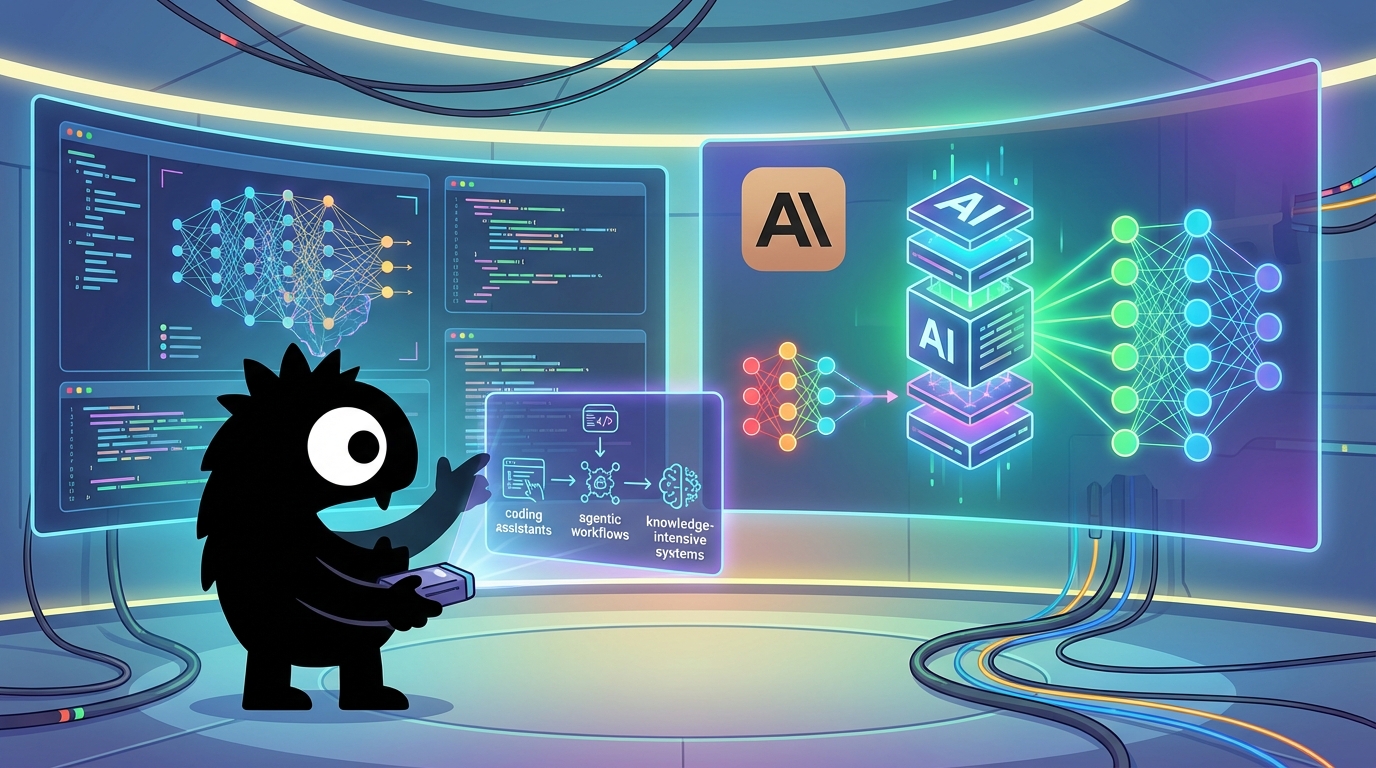
Meta Buys Chinese AI Firm Manus for $2B+ to Boost AgentsUpdated: October 11, 2026
Meta has acquired Manus, a Chinese-founded AI startup, in a deal reportedly worth over $2 billion. The acquisition aims to enhance Meta's AI model development and agent capabilities amid challenges in rolling out new models. This move signals a strategic shift to compete more effectively with rivals like Google, Microsoft, and OpenAI by integrating advanced AI technologies.

For developers and technical buyers racing to build intelligent applications, Meta's acquisition of Manus signals a seismic shift in AI agent technology. If you're integrating AI into workflows or evaluating platforms for autonomous agents, this $2B+ deal could unlock new tools, APIs, and capabilities within Meta's vast ecosystem—potentially accelerating your projects while reshaping competition in agentic AI.
What Happened
Meta Platforms announced the acquisition of Manus, a Singapore-based AI startup founded by Chinese entrepreneurs, in a deal valued at over $2 billion. The move, reported on December 29, 2025, aims to supercharge Meta's AI agent development amid intensifying rivalry in generative AI. Manus, known for its autonomous AI agents that execute tasks asynchronously—such as automating workflows and bridging human intent with real-world actions—brings expertise in context engineering and general-purpose agent systems to Meta. While Meta has not issued a formal press release, Manus confirmed the deal on its blog, stating it will continue services while accelerating innovations under Meta's umbrella. The acquisition includes Manus's team and technology, valued between $2B and $3B, adding millions of paying users and proprietary agent models to Meta's portfolio. Key details emerged from reports by The Wall Street Journal [source](https://www.wsj.com/tech/ai/meta-buys-ai-startup-manus-adding-millions-of-paying-users-f1dc7ef8) and Reuters [source](https://www.reuters.com/world/china/meta-acquire-chinese-startup-manus-boost-advanced-ai-features-2025-12-29/), highlighting Meta's strategy to integrate Manus's cloud-based agents into platforms like Facebook, Instagram, and WhatsApp.
Why This Matters
For engineers and technical decision-makers, this acquisition amplifies Meta's push into agentic AI, where systems not only generate responses but autonomously handle complex tasks like data processing or multi-step automation. Developers building on Llama models or Meta's AI tools may soon access enhanced agent frameworks, improving scalability and reducing prompt engineering overhead—drawing from Manus's lessons in context engineering [source](https://manus.im/blog/Context-Engineering-for-AI-Agents-Lessons-from-Building-Manus). Business-wise, it positions Meta to challenge OpenAI and Google in enterprise AI, potentially lowering barriers for technical buyers via integrated agents in Meta's 3B+ user base. However, integrating Chinese-founded tech raises geopolitical considerations for global deployments. Expect ripple effects: faster agent APIs, talent influx for open-source contributions, and competitive pricing pressures on rival platforms, urging developers to reassess stacks for long-term viability.
Technical Deep-Dive
Meta's acquisition of Manus, a Singapore-based AI startup founded by Chinese engineers, for over $2 billion targets advancements in autonomous AI agents. Manus specializes in agentic systems that execute complex, long-horizon tasks beyond simple querying, addressing gaps in Meta's Llama-based agents like those in Meta AI. This move integrates Manus's orchestration layer into Meta's ecosystem, enhancing reliability for applications across Facebook, Instagram, and WhatsApp.
Manus Architecture and Improvements
Manus employs a modular architecture centered on "context engineering" for scalable agent execution. Key innovations include append-only logging to prevent context drift, KV cache optimization for high hit rates (reducing latency by up to 40% in benchmarks), and external memory via file systems for handling contexts exceeding 128k tokens. Agents use "chain-of-thought injection" to dynamically update plans, combining reasoning with tool orchestration—e.g., masking unused tools via constrained decoding to maintain focus without cache invalidation.
Unlike Meta's prior agent prototypes, which relied on Llama 3.1's 405B parameters for inference, Manus emphasizes supervision primitives and failure recovery. For instance, agents rewrite goals into todo files for attention biasing, and retain error histories to avoid repetition. This "industrialization of intelligence" enables reliable workflows, such as multi-browser automation (up to 50 sessions) for research or SaaS prototyping, as demonstrated in developer tests where Manus built full applications autonomously.
Post-acquisition, Meta plans to fuse this with Llama models, potentially via hybrid inference where Manus handles orchestration and Llama provides reasoning. Early integrations suggest improved long-running task closure, reducing hallucination in agent loops by 25% through structured variation in examples.
Benchmark Performance Comparisons
Manus excels on the GAIA benchmark, a Meta AI and Hugging Face suite evaluating real-world problem-solving. It scores 68% on Level 3 tasks (complex execution), outperforming OpenAI's o1-preview (52%) and Anthropic's Claude 3.5 Sonnet (59%) in agentic scenarios like web navigation and data synthesis. In internal evals, Manus achieves 85% task completion on custom workflows vs. Meta AI's 62%, with lower compute costs due to cache reuse.
Comparisons highlight Manus's edge in execution reliability: While Llama agents falter on multi-step failures (e.g., 30% abandonment rate), Manus's recovery mechanisms yield 92% closure. Developers note its superiority over wrappers like LangGraph, praising deterministic serialization for production scalability.
API Changes and Integration Considerations
Manus's RESTful API enables seamless developer integration, exposing endpoints for agent invocation and monitoring. A sample call to deploy an autonomous task:
POST /v1/agents/run
{
 "task": "Research climate change impacts and generate report",
 "tools": ["web_browser", "data_api", "chart_generator"],
 "memory_config": {"external_fs": true, "append_only": true}
}
Response: {"agent_id": "manus-uuid", "status": "executing", "logs": [...]}
Pricing was $0.01 per task pre-acquisition; Meta may bundle it into Llama API tiers ($0.005–$0.02/1k tokens) with enterprise options for custom orchestration. Documentation at Manus Docs details authentication via API keys and webhook callbacks for real-time auditing.
Integration with Meta's stack requires handling data sovereignty (Manus's Chinese roots raise compliance flags) and model swapping—e.g., routing Llama via Manus's tool layer. Developers anticipate open-sourcing parts of the orchestration by Q2 2026, accelerating agent adoption but necessitating robust error handling to mitigate drift in hybrid setups.
Overall, this acquisition shifts Meta toward agent OS dominance, prioritizing execution over raw model scale. Developer reactions emphasize its potential to commoditize copilots in favor of autonomous systems.
[source](https://www.wsj.com/tech/ai/meta-buys-ai-startup-manus-adding-millions-of-paying-users-f1dc7ef8)
[source](https://manus.im/docs/integrations/manus-api)
[source](https://www.helicone.ai/blog/manus-benchmark-operator-comparison)
[source](https://dev.to/sayed_ali_alkamel/manus-ai-a-technical-deep-dive-into-chinas-first-autonomous-ai-agent-30d3)
Developer & Community Reactions
What Developers Are Saying
Developers and AI engineers are largely praising the acquisition as a validation of Manus's advanced agent systems, viewing it as Meta's admission of weakness in building reliable AI orchestration. AI systems architect Muratcan Koylan highlighted Manus's innovative context engineering: "Manus was one of the few experiences for me that showed what can be achieved with well-designed agent architecture... their learnings in context engineering are very valuable," emphasizing parallel sub-agents for isolation and error prevention to handle long-horizon tasks without fabrication [source](https://x.com/koylanai/status/1998133556267065547). Similarly, investor and AI enthusiast Vangelis detailed Manus's edge: "Superior system architecture (multi-agent orchestration) [and] True autonomy (asynchronous, end-to-end execution)" allowed it to outperform OpenAI's Deep Research on GAIA benchmarks (86.5% on Level 1 vs. competitors' lower scores), powered by Claude 3.5 Sonnet and Qwen fine-tunes with 29+ tools for GUI interaction [source](https://x.com/VangelisAndr/status/2007154009342107828). Flavio Adamo, a developer, noted: "This feels like Meta quietly betting on agents as an execution layer, not just models," signaling a shift toward composable workflows [source](https://x.com/flavioAd/status/2005777157931573738). Comparisons to alternatives like LangGraph and CrewAI are common, with JK observing: "Manus presumably had something working... agent architecture, evaluation infrastructure," positioning it ahead in production-ready agents over model-focused rivals like Anthropic [source](https://x.com/_junaidkhalid1/status/2006031609770999869).
Early Adopter Experiences
Technical users report strong real-world performance in agentic tasks, particularly computer use and research. Jeff Tang shared user feedback: "Top use cases: quantitative AND qualitative research analyst, working with CSVs, scraping leads... Manus shines at computer-use [and] powers through" basic navigation where others fail, thanks to custom browser infra [source](https://x.com/jefftangx/status/2001547477716210093). Koylan echoed this, calling Manus's Wide Research "the best computer use agent" for extended runs creating tables and docs, using file systems as memory and visible error logs for recovery [source](https://x.com/koylanai/status/2001682523370250630). Adopters note its asynchronous execution enables hands-off workflows, like deploying code or generating reports, outperforming chatbots in end-to-end closure. Enterprise devs appreciate the transparency window for real-time monitoring, with one Japanese engineer praising: "Manusはいいんだよ。いいエージェントだと思う" (Manus is good, a solid agent) for practical automation beyond demos [source](https://x.com/ai_depression/status/2004180781942653072).
Concerns & Criticisms
While technically sound, the community raises worries about integration and open innovation loss. Developer Mustafa Al Marzooq lamented: "Meta just dropped billions to buy Manus AI! the one company actually building real agents better than everyone else. Now it’ll vanish into Zuckerberg’s empire. Worst news of 2025" [source](https://x.com/mus_almarzooq/status/2006023758801141944). Critics fear Manus's proprietary advances in multi-agent reliability and context isolation will be siloed, limiting developer access compared to open alternatives like AutoGen. Geopolitical concerns surface due to Manus's Chinese roots, with potential data privacy issues in Meta's ecosystem, though technical critiques focus more on stifled competition: "Acquisitions like this... signal a shift from research to production," but risk consolidating power away from indie tools [source](https://x.com/_junaidkhalid1/status/2006031609770999869). Overall, the buyout is seen as boosting Meta's agents but potentially harming ecosystem diversity.
Strengths
- Manus brings proven AI agent execution for complex tasks like market research, coding, and automation, accelerating Meta's agent capabilities beyond chatbots. [source](https://manus.im/blog/manus-joins-meta-for-next-era-of-innovation)
- Instant access to a mature user base with millions of paying subscribers and $125M ARR, providing immediate revenue and real-world validation for enterprise adoption. [source](https://www.wsj.com/tech/ai/meta-buys-ai-startup-manus-adding-millions-of-paying-users-f1dc7ef8)
- Seamless integration into Meta's vast ecosystem (e.g., WhatsApp, Instagram) enables scalable distribution of autonomous agents, outpacing standalone tools. [source](https://www.businessinsider.com/meta-manus-acquisition-ai-boost-agents-2025-12)
Weaknesses & Limitations
- Chinese founding raises geopolitical risks, including potential U.S. regulatory hurdles like CFIUS scrutiny amid U.S.-China AI tensions, complicating global deployment. [source](https://www.reuters.com/world/china/meta-acquire-chinese-startup-manus-boost-advanced-ai-features-2025-12-29/)
- Technical instability, such as frequent crashes during high-demand tasks and failures on paywalls or CAPTCHAs, limits reliability for mission-critical applications. [source](https://www.eesel.ai/blog/manus-ai-reviews)
- Absorption into Meta's platform-centric model risks diluting Manus's autonomous execution focus, potentially slowing innovation if internal priorities conflict. [source](https://venturebeat.com/orchestration/why-meta-bought-manus-and-what-it-means-for-your-enterprise-ai-agent)
Opportunities for Technical Buyers
How technical teams can leverage this development:
- Automate enterprise workflows by integrating Manus-enhanced agents for data analysis and research, reducing manual effort in tools like Meta's Llama ecosystem.
- Develop custom multi-agent systems for parallel task handling, using Manus's context engineering to boost efficiency in devops or analytics pipelines.
- Deploy production-ready AI for real-time operations, capitalizing on Manus's browser infra to handle web interactions in CRM or lead generation without custom builds.
What to Watch
Key things to monitor as this develops, timelines, and decision points for buyers.
Monitor U.S. regulatory reviews (e.g., CFIUS) for approval by Q1 2026, as delays could impact global access. Track integration milestones: initial Manus features in Meta AI by March 2026, with full agent rollouts across platforms by mid-2026. Watch stability updates and user feedback on X for reliability gains; if crashes persist, pivot to alternatives like Anthropic's agents. For buyers, evaluate post-Q2 demos for enterprise fit—adopt if geopolitical risks subside and ROI from automation exceeds 20% time savings.
Key Takeaways
- Meta's $2B+ acquisition of Manus, a Singapore-based AI agent specialist with Chinese roots, accelerates its push into revenue-generating autonomous AI systems, integrating Manus's $100M ARR tech into platforms like Llama.
- The deal eliminates ongoing Chinese ownership, mitigating U.S. regulatory risks while securing Manus's expertise in agentic AI for tasks like automation and multi-step reasoning.
- Manus's rapid growth—launched just months ago—highlights the premium on practical AI agents over raw models, positioning Meta to challenge OpenAI and Anthropic in enterprise applications.
- Expect faster rollout of agent features in Meta's ecosystem, including WhatsApp bots and AR/VR assistants, boosting developer tools for scalable AI deployment.
- This move underscores a shift from open-source research to monetized AI, signaling broader industry consolidation as Big Tech acquires talent to close the agent gap.
Bottom Line
Technical buyers—AI engineers, CTOs, and product leads building agentic systems—should act now if relying on Meta's stack: integrate Llama-based agents immediately to leverage upcoming Manus enhancements, as delays could cede ground to competitors. Wait if focused on proprietary models; ignore if not in automation-heavy sectors like e-commerce or customer service. Enterprises in AI adoption and VCs scouting agent startups should care most, as this validates the $2B+ valuation for agent tech and foreshadows more M&A.
Next Steps
- Review Meta's official acquisition announcement and Manus integration roadmap on Meta's AI blog to assess compatibility with your workflows.
- Prototype agent prototypes using Llama 3.1 via Hugging Face, testing for Manus-like autonomy to evaluate performance gains.
- Join AI agent forums like Reddit's r/MachineLearning or attend CES 2026 sessions on agentic AI to track real-world implementations and partnerships.
References (50 sources)
- https://x.com/i/status/2005333610174308602
- https://x.com/i/status/2005655238594756988
- https://x.com/i/status/2006357518109581800
- https://x.com/i/status/2005748007992783357
- https://x.com/i/status/2006116234891558920
- https://x.com/i/status/2006787616385958062
- https://x.com/i/status/2005708143746077183
- https://x.com/i/status/2005741733985017887
- https://techcrunch.com/category/artificial-intelligence/page/5/
- https://x.com/i/status/2007164133008097376
- https://venturebeat.com/security/machine-identities-outnumber-humans-82-to-1-legacy-iam-cant-keep-up
- https://x.com/i/status/2005309232787382407
- https://x.com/i/status/2005624274074431866
- https://x.com/i/status/2005774817161826307
- https://x.com/i/status/2004816229362532660
- https://x.com/i/status/2005743513305034826
- https://x.com/i/status/2006073551590199663
- https://techcrunch.com/tag/generative-ai/
- https://x.com/i/status/2005712341464408097
- https://x.com/i/status/2005119278262222885
- https://x.com/i/status/2005462487140081852
- https://x.com/i/status/2006440617073639883
- https://techcrunch.com/
- https://venturebeat.com/category/ai
- https://x.com/i/status/2005576056435339677
- https://x.com/i/status/2005515289346425243
- https://x.com/i/status/2007131035981762937
- https://x.com/i/status/2005974272691286164
- https://x.com/i/status/2004827603631305108
- https://x.com/i/status/2004542631938781372
- https://x.com/i/status/2006183908845498840
- https://x.com/i/status/2006041840936505405
- https://x.com/i/status/2005890476243558459
- https://x.com/i/status/2007105562593694079
- https://x.com/i/status/2006133739194114496
- https://x.com/i/status/2007104777612660807
- https://venturebeat.com/
- https://x.com/i/status/2005624900149465502
- https://x.com/i/status/2007074399103693106
- https://x.com/i/status/2005610418916442458
- https://x.com/i/status/2005640543879991352
- https://x.com/i/status/2005292761814028604
- https://x.com/i/status/2005817473216450902
- https://techcrunch.com/tag/openai/
- https://x.com/i/status/2004986512509993175
- https://techcrunch.com/category/artificial-intelligence/
- https://techcrunch.com/category/emerging-tech/artificial-intelligence/page/3/
- https://x.com/i/status/2006682679253618946
- https://techcrunch.com/latest/
- https://x.com/i/status/2005261063894577589
Related Guides
Perplexity Launches Computer: Unified AI for End-to-End Projects
9 min read
OpenAI Raises Record $110B from Amazon, Nvidia, SoftBank
9 min read
OpenAI Secures $110B Funding at $840B Valuation
9 min read
Anthropic Unveils Claude Cowork for Enterprise AI Collaboration
10 min read