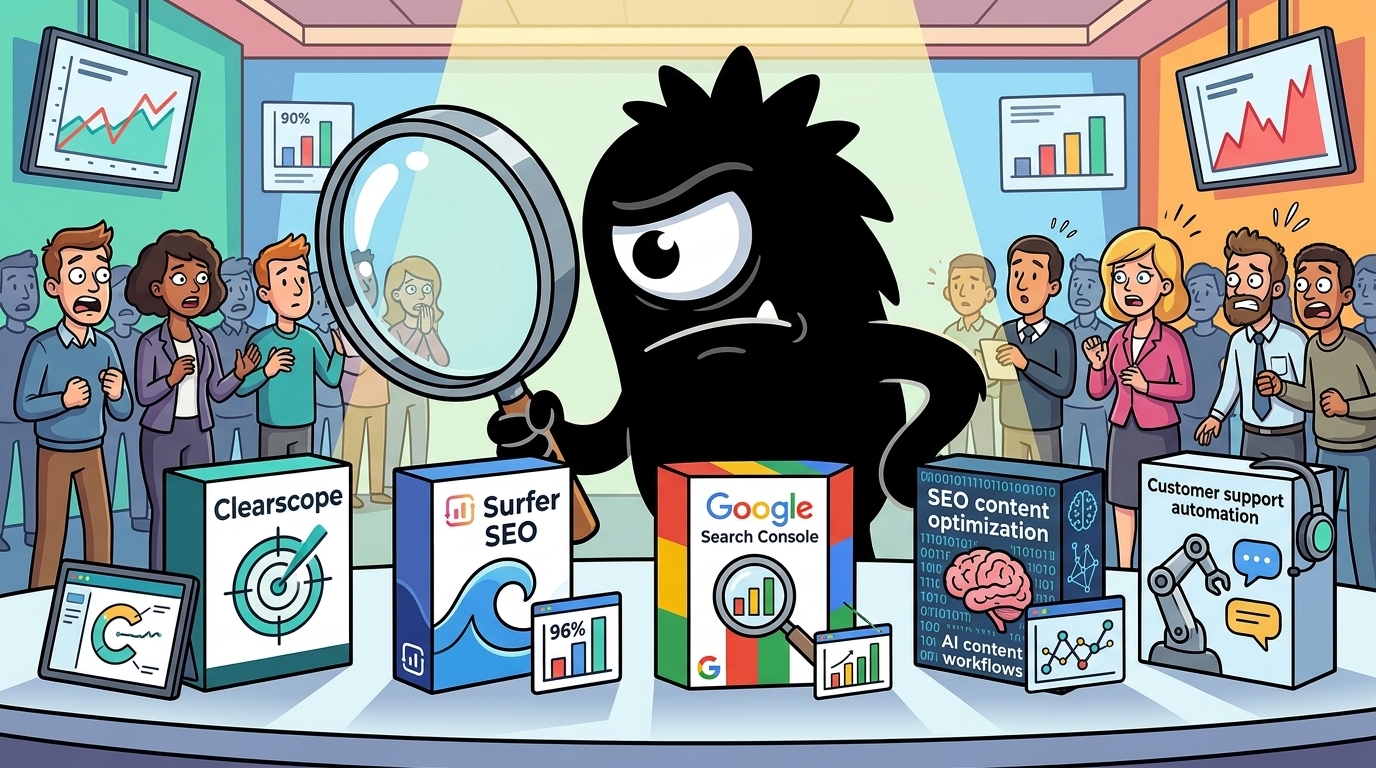
Clearscope vs Surfer SEO: Which Is Best for Customer Support Automation in 2026?Updated: October 04, 2026
Clearscope vs Surfer SEO for customer support automation: compare workflows, pricing, APIs, and fit for support content teams. Learn
Why Customer Support Automation Teams Are Even Comparing Clearscope and Surfer SEO
At first glance, this comparison sounds slightly off.
Clearscope and Surfer SEO are content optimization tools. Customer support automation usually means chatbots, ticket deflection, AI assistants, help centers, knowledge bases, and workflow tooling. They are not the same category.
But in practice, support teams are comparing them for a very real reason: modern support automation depends on findable, structured, trustworthy self-serve content.
If your help center articles do not rank, do not answer the right question, or do not map clearly to customer intent, your “automation” stack gets weaker fast. Your chatbot has worse source material. Your AI support assistant retrieves weaker passages. Your search experience returns thin answers. Your agents handle more repetitive tickets that should have been deflected by documentation.
That is why this comparison matters.
A lot of support leaders now operate like hybrid owners of documentation, search, and automation. They are not just asking, “Which tool gives me a better SEO score?” They are asking:
- Which tool helps us create better help articles faster?
- Which tool fits a knowledge-base workflow instead of just a blog workflow?
- Which one works better with Google Docs, WordPress, Contentful, or our CMS?
- Which one helps our AI support systems pull better answers from our published content?
- And increasingly: do we even need either one when Claude plus APIs can do so much of this cheaper?
That last point is not theoretical. It is exactly where the market conversation has moved.
Our favourite tools for SEO content automation: Surfer SEO, Clearscope, and MarketMuse. Comment “automation” for a free guide or dm us for a free digital audit #ContentAutomation #SEOtools #AIContentTools #ContentStrategy #SEOWorkflow #PrismDigital
View on XPractitioners are still grouping Surfer and Clearscope with “SEO content automation” tooling because both can make support content more structured and discoverable.
9. AI SEO Tools (SurferSEO / Clearscope) Automate content optimization for Google. Save hours of research and updates.
View on XBut the skepticism is rising just as quickly. Teams have seen what large models can do with search console exports, content audits, term extraction, rewrites, and even brief generation. The question is no longer whether Surfer and Clearscope are useful. The question is whether they are useful enough in a support-content operation to justify their subscription cost and workflow overhead.
That is especially true for customer support teams because they are usually not judged on “content score.” They are judged on outcomes such as:
- Ticket deflection
- Time to answer
- Search success rate
- Reduced duplicate tickets
- Better onboarding completion
- Lower support costs
- Higher customer satisfaction
This makes support a different decision context than marketing SEO.
A B2B marketing team might accept a pricey optimizer if it helps produce more top-funnel traffic. A support team needs a tighter business case. If an optimizer is added to the stack, it needs to improve the quality and discoverability of:
- Help center articles
- Troubleshooting pages
- Setup and onboarding guides
- FAQ pages
- Chatbot fallback answers
- Feature documentation
- Release-note explainers
And it needs to do so in a way that fits an operational publishing workflow, not just a one-off editor.
Official product materials reinforce this workflow angle. Clearscope positions integrations as a key part of its product experience, with support documentation centered on connected tools and editorial environments.[1] Surfer likewise emphasizes API and integration support as part of a broader content workflow rather than a standalone scoring interface.[6]
So this article will not compare the tools the way most generic SEO roundups do.
Instead, it will answer the practical question support teams actually have in 2026:
If your goal is better customer support automation through better self-serve content, which tool is more useful: Clearscope, Surfer SEO, or neither?
In March 2026, I cancelled every paid SEO
tool subscription I had.
Semrush: $129/month. Gone.
Surfer SEO: $89/month. Gone.
Clearscope: $170/month. Gone.
$388/month total. $4,656/year. Cancelled.
I replaced them with three free AI tools
and ran real client work for 60 days.
Here is the honest report card.
THE WINS (free stack beat paid tools):
On-page SEO audits: FREE WINS
Claude's PASS/WARN/FAIL audit is more
specific than Semrush's on-page checker.
Semrush gives you a score. Claude gives you
a rewrite. One takes 5 minutes to act on.
The other takes 5 seconds.
Schema markup generation: FREE WINS
Claude generates valid JSON-LD that passes
Google's Rich Results Test with zero errors
on the first attempt. Every time.
Paid tools occasionally produce deprecated fields.
GEO/AEO optimization: FREE WINS BY A LOT
No paid tool in my previous stack could evaluate
content from inside an LLM's perspective.
Claude can. Because it is one.
This capability did not exist in the $388/month
stack I was paying for.
GSC data interpretation: FREE WINS
Paste the 90-day CSV export into Claude.
Get the top 10 quick-win opportunities with
specific recommended actions per page.
2 hours of spreadsheet work in 10 minutes.
Competitor content research: FREE WINS
Perplexity reads what is currently ranking
and cites every source. Semrush's content
analysis tool shows historical data.
Current beats historical for content gaps.
THE FAILURES (paid tools still win):
Live rank tracking: PAID TOOLS WIN
GSC shows you your own site's performance.
It does not watch 5 competitor domains daily
and alert you when a ranking opportunity opens.
I missed 3 opportunities in 60 days.
This was the most painful gap.
Backlink analysis: PAID TOOLS WIN
No free AI tool has a live backlink database.
For new client onboarding, I need link profile data.
This is not optional. Paid tool required.
Keyword difficulty estimates: PAID TOOLS WIN
"Trust my SERP analysis" is a harder client
conversation than showing a 28 KD score.
The data layer matters here.
THE FULL REPORT CARD SCORE:
Free AI stack wins: 6 of 11 categories
Paid tools win: 4 of 11 categories
One genuine tie: content brief creation
THE CONCLUSION I DID NOT EXPECT:
The free stack is better than paid tools for
analysis, strategy, and content work.
Paid tools are better for data gathering only.
The stack I now recommend:
. GSC (free) — your data foundation
. Screaming Frog free — crawl data
. Claude free — audits, schema, GEO, briefs
. Perplexity free — research, statistics
. ONE paid tool for rank tracking and backlinks
(Ahrefs or Semrush — whichever you prefer)
Total cost: $100 to $130/month instead of $388.
Same capability for 80% of weekly SEO work.
Better capability for GEO and AI Mode optimization.
If you are paying for Surfer SEO, Clearscope,
or similar content optimization tools right now,
read this before your next billing cycle.
The full 60-day experiment with the complete
report card table is at the link in the first
comment.
What paid SEO tool do you think is hardest to
replace with free AI tools?
Drop it below. I will tell you whether it is
on the replaceable or irreplaceable list.
#SEO #AITools #ClaudeAI #DigitalMarketing
#SEOStrategy #SurferSEO #Semrush #Clearscope
#ContentMarketing #AIMarketing #B2BSEO
#MarketingTools #SEOTips #OrganicTraffic
#GEO #AEO #MarketingStrategy #FreeSEOTools
#SEOConsultant #AIMode
Cost, ROI, and the “Do I Even Need This?” Debate
If you spend any time around SEO operators on X right now, one thing is obvious: subscription fatigue is real.
People are not just comparing features anymore. They are doing stack triage.
They are adding up every monthly line item, asking what can be replaced with AI, and getting much more ruthless about what stays. That matters here because Clearscope and Surfer sit in one of the categories most exposed to replacement pressure: content optimization and briefing.
The mood is captured well by the simplest version of the complaint:
Too many expensive SEO tools... Surfer SEO - $79 Semrush - $139 Ahrefs - $129 As a SEO sucker I'm looking for free tools.
View on XAnd then you see the more detailed version from operators who actually cancelled tools and ran experiments.
In March 2026, I cancelled every paid SEO tool subscription I had. Semrush: $129/month. Gone. Surfer SEO: $89/month. Gone. Clearscope: $170/month. Gone. $388/month total. $4,656/year. Cancelled. I replaced them with three free AI tools and ran real client work for 60 days. Here is the honest report card. THE WINS (free stack beat paid tools): On-page SEO audits: FREE WINS Claude's PASS/WARN/FAIL audit is more specific than Semrush's on-page checker. Semrush gives you a score. Claude gives you a rewrite. One takes 5 minutes to act on. The other takes 5 seconds. Schema markup generation: FREE WINS Claude generates valid JSON-LD that passes Google's Rich Results Test with zero errors on the first attempt. Every time. Paid tools occasionally produce deprecated fields. GEO/AEO optimization: FREE WINS BY A LOT No paid tool in my previous stack could evaluate content from inside an LLM's perspective. Claude can. Because it is one. This capability did not exist in the $388/month stack I was paying for. GSC data interpretation: FREE WINS Paste the 90-day CSV export into Claude. Get the top 10 quick-win opportunities with specific recommended actions per page. 2 hours of spreadsheet work in 10 minutes. Competitor content research: FREE WINS Perplexity reads what is currently ranking and cites every source. Semrush's content analysis tool shows historical data. Current beats historical for content gaps. THE FAILURES (paid tools still win): Live rank tracking: PAID TOOLS WIN GSC shows you your own site's performance. It does not watch 5 competitor domains daily and alert you when a ranking opportunity opens. I missed 3 opportunities in 60 days. This was the most painful gap. Backlink analysis: PAID TOOLS WIN No free AI tool has a live backlink database. For new client onboarding, I need link profile data. This is not optional. Paid tool required. Keyword difficulty estimates: PAID TOOLS WIN "Trust my SERP analysis" is a harder client conversation than showing a 28 KD score. The data layer matters here. THE FULL REPORT CARD SCORE: Free AI stack wins: 6 of 11 categories Paid tools win: 4 of 11 categories One genuine tie: content brief creation THE CONCLUSION I DID NOT EXPECT: The free stack is better than paid tools for analysis, strategy, and content work. Paid tools are better for data gathering only. The stack I now recommend: . GSC (free) — your data foundation . Screaming Frog free — crawl data . Claude free — audits, schema, GEO, briefs . Perplexity free — research, statistics . ONE paid tool for rank tracking and backlinks (Ahrefs or Semrush — whichever you prefer) Total cost: $100 to $130/month instead of $388. Same capability for 80% of weekly SEO work. Better capability for GEO and AI Mode optimization. If you are paying for Surfer SEO, Clearscope, or similar content optimization tools right now, read this before your next billing cycle. The full 60-day experiment with the complete report card table is at the link in the first comment. What paid SEO tool do you think is hardest to replace with free AI tools? Drop it below. I will tell you whether it is on the replaceable or irreplaceable list. #SEO #AITools #ClaudeAI #DigitalMarketing #SEOStrategy #SurferSEO #Semrush #Clearscope #ContentMarketing #AIMarketing #B2BSEO #MarketingTools #SEOTips #OrganicTraffic #GEO #AEO #MarketingStrategy #FreeSEOTools #SEOConsultant #AIMode
View on XThat post resonated because it reflects a broader shift in how practitioners think about premium SEO software. Many now separate SEO work into two buckets:
- Data acquisition
- rank tracking
- backlink indexes
- keyword databases
- SERP monitoring
- Analysis and execution
- audits
- rewrites
- briefs
- clustering
- optimization suggestions
- planning
The first bucket still favors paid platforms because proprietary data is hard to replicate. The second bucket is increasingly vulnerable to Claude, GPT, Perplexity, Search Console exports, and custom API pipelines.
For support automation teams, this distinction is even sharper.
Most support organizations do not need the full classic SEO stack. They often care less about live rank tracking across hundreds of commercial keywords and more about:
- whether users can find the right answer
- whether articles cover the actual language customers use
- whether help content is up to date
- whether self-serve content reduces inbound ticket load
- whether AI support systems can retrieve strong source passages
So when a support team evaluates Surfer or Clearscope, the ROI question should not be, “Will this improve our organic growth program?” It should be:
- Will this reduce documentation production time?
- Will this improve article quality enough to increase self-service success?
- Will this help us systematically refresh stale support content?
- Will this reduce dependency on manual editorial review?
- Will it improve support content enough to justify the subscription versus custom AI workflows?
That is a different ROI lens than most SEO comparisons use.
Why Surfer often feels more “affordable,” and Clearscope more “premium”
In market perception, Surfer is usually seen as the more accessible option for leaner teams, while Clearscope is viewed as the more premium editorial tool. Some of that comes from historical pricing differences, and some from positioning. Surfer has pushed harder into broader workflow support and product expansion, while Clearscope has maintained a more focused reputation around content quality and optimization.
The pricing conversation on X reflects how intensely people now scrutinize these tools inside the broader SaaS stack.
梳理了一下目前付费的SaaS产品,保留了下面的 Ahrefs +2个席位 = $369/mo Majestic API = $399/mo AgencyAnalytics = $179/mo SEOGets = $29/mo Keyword. com = $130/mo ClickUp = $150/mo Relume = $58/mo Webflow =$29/mo CloudPress = $59/mo SurferSEO = $175/mo ClearScope = $399/mo 取消了下面的 jetOctopus $412/mo AirOps $349/mo PitchBox $420/mo 下个月继续清理,这些工具加起来费用也挺吓人的
View on XEven when teams still keep Surfer in the stack, they often frame it as one component in an AI-led workflow rather than the center of the system.
10 AI tools that replace a $5,000/month marketing team. Total cost: $263/mo.
Content: Claude Pro ($20) + Surfer SEO ($99)
Social: Buffer ($5) + Opus Clip ($15)
Design: Canva Pro ($13) + Midjourney ($10)
Video: HeyGen ($29) | Email: Beehiiv ($43)
Analytics: GA4 (free) | Ads: https://t.co/ZsHbg3se5A ($29)
These tools do 80% of what a $5K/mo marketing team does. The other 20% is your judgment.
Full setup guide inside a free founder community. Reply TOOLS or DM me.
That is the key shift.
A year or two ago, the question might have been, “Which optimization platform should we standardize on?” In 2026, it is more like, “If we already have Claude, Search Console, a CMS, and some APIs, where exactly does Surfer or Clearscope still earn its seat?”
Support ROI is not rankings-only ROI
This is where many comparisons go wrong.
A support team may publish excellent content that never targets classic high-volume SEO head terms, yet still create massive business value. If that content:
- resolves setup friction,
- reduces password-reset confusion,
- answers billing questions,
- helps users troubleshoot integrations,
- or improves product adoption,
then its value is operational, not just search-driven.
So if you are calculating ROI, look at:
- Deflected tickets: How many issues are solved without an agent?
- Average resolution time: Does better self-serve content reduce time to answer?
- Article freshness: Can the team update help content faster after product changes?
- Search success rate: Are users finding the right help article on the first try?
- Bot containment: Does the chatbot resolve more conversations using knowledge-base content?
- Documentation throughput: Can the team ship more accurate support articles per month?
If a $100-$200 per month tool materially improves those metrics, it may be worth it even if a free AI stack can imitate much of the output. But if the team already has strong prompts, editorial processes, and developer support, the margin narrows quickly.
The uncomfortable truth: optimization software is now easier to replace than execution systems
This is the subtext of a lot of posts right now.
People are not saying Surfer or Clearscope are bad. They are saying the category is less defensible than it used to be. Suggesting semantically related terms, recommending headings, and scoring draft completeness are valuable—but no longer rare capabilities.
What is harder to replace is:
- a stable publishing workflow
- strong governance
- integrations that reduce handoff friction
- refresh systems for old content
- content prioritization logic tied to business outcomes
- cross-functional adoption
That means the ROI case for either tool gets stronger when it is embedded in a real operating system, and weaker when it is just another dashboard writers visit before publishing.
For support automation teams, this leads to a blunt conclusion:
If you only want SEO-style optimization suggestions, you may not need either tool. If you need repeatable editorial operations around high-value support content, one of them may still be justified.
The rest of the comparison comes down to which flavor of value matters more:
- Surfer’s broader workflow and automation posture
- or Clearscope’s tighter editorial optimization experience
Surfer SEO vs Clearscope: The Core Product Difference That Matters in Support Content
Most side-by-side comparisons treat Surfer and Clearscope as if they are interchangeable “content optimization tools.” That is directionally true, but operationally incomplete.
For customer support automation teams, the more useful framing is this:
- Surfer is better understood as a workflow-oriented semantic content editor
- Clearscope is better understood as a more focused contextual optimization system
That distinction shows up clearly in how practitioners describe them.
12/ Tools for semantic SEO in 2026: - Surfer SEO (semantic content editor) - MarketMuse (topic modeling) - Clearscope (contextual optimization) - InLinks (entity SEO) - https://schema.org/ (structured data) - Google NLP API (entity analysis) Tools help, but strategy drives results.
View on XAnd in simpler form:
8. Clearscope It is an AI-powered tool that helps you optimize your content for better rankings.
View on XA related version of the same framing appears again in the semantic SEO conversation:
12/ Tools for semantic SEO in 2026:
- Surfer SEO (semantic content editor)
- MarketMuse (topic modeling)
- Clearscope (contextual optimization)
- InLinks (entity SEO)
- https://schema.org/ (structured data)
- Google NLP API (entity analysis)
Tools help, but strategy drives results.
What “semantic content editor” means in practice
For beginners, semantic optimization means helping content cover the concepts, terms, questions, and topic relationships that search engines expect to see when a page truly answers a query.
In Surfer’s case, that usually translates into an editor experience built around:
- keyword and term coverage
- suggested headings and structure
- content scoring
- length guidance
- optimization workflows connected to content production
For support content teams, this is useful when you are creating articles at scale and need consistency across many pages:
- “How to connect Slack”
- “How to reset MFA”
- “Why invoices fail”
- “How to configure SSO”
- “Troubleshooting API rate limits”
- “Setting up webhooks”
In these environments, Surfer’s style of optimization helps standardize article construction. It can push writers to include missing concepts, improve structure, and avoid thin or incomplete pages.
This matters because support content often suffers from the opposite of marketing fluff: internal shorthand. Teams know the product too well and omit the obvious context a user actually needs. A semantic editor can catch some of that by showing topic gaps and term undercoverage.
What “contextual optimization” means in practice
Clearscope’s reputation is more editorially focused. Rather than feeling like an all-purpose content production layer, it is often valued for cleaner optimization guidance around relevance, coverage, and refinement.
That can be especially useful for support content where the challenge is not volume, but clarity.
Examples:
- A high-traffic billing explainer that causes confusion if phrased loosely
- A migration guide where accuracy matters more than speed
- A support article surfaced by your chatbot in thousands of conversations
- A feature explainer that has to satisfy both novice and advanced users
- A help article that also ranks for branded troubleshooting searches
In those cases, support teams may prefer a tighter optimization experience that helps improve completeness without pushing the writing into awkward over-optimization.
Why this difference matters more in support than in marketing
Marketing content and support content have different failure modes.
Marketing content often fails because it is too generic, too competitive, or too weakly differentiated.
Support content often fails because it is:
- too vague
- too product-insider in tone
- too poorly structured for retrieval
- too fragmented across systems
- too stale
- too disconnected from the real wording customers use in tickets
That means support teams should care less about flashy SEO breadth and more about whether a tool improves the retrievability and usefulness of answers.
If your help center powers search, chatbot retrieval, onboarding, and agent macros, then content optimization is not just about ranking. It is about whether the article contains:
- the right troubleshooting entities
- the right synonyms
- the right user-language phrasing
- the right step structure
- the right contextual clues
In that setting, Clearscope’s contextual focus can be very attractive.
But support teams that publish a high volume of content updates may lean toward Surfer because the workflow support is broader and often easier to operationalize across many pages.
Neither tool replaces support intelligence
This is where people make expensive mistakes.
You cannot buy Surfer or Clearscope and expect them to tell you:
- which support issues drive the most ticket volume
- which feature confusion causes churn
- which articles your bot fails to resolve from
- which terms users type into your internal site search
- which regions or customer segments struggle with onboarding
- which release changes invalidated old docs
Those answers come from:
- support ticket analysis
- search console
- help-center analytics
- chatbot logs
- internal search queries
- product analytics
- customer interviews
The optimization layer only improves the asset after you know what asset to create or update.
That is why the most honest post in this whole conversation may be the shortest clause in Noel Ceta’s list: “Tools help, but strategy drives results.”
12/ Tools for semantic SEO in 2026: - Surfer SEO (semantic content editor) - MarketMuse (topic modeling) - Clearscope (contextual optimization) - InLinks (entity SEO) - https://schema.org/ (structured data) - Google NLP API (entity analysis) Tools help, but strategy drives results.
View on XFor support automation, I would sharpen that further:
Tools help, but support taxonomy, issue prioritization, and source quality drive outcomes.
If your knowledge base is poorly organized, out of date, or disconnected from ticket reality, neither Surfer nor Clearscope will fix that. They can improve the writing and relevance of individual pages. They cannot substitute for a support-content strategy.
How Each Tool Fits a Real Customer Support Automation Workflow
The easiest way to compare Clearscope and Surfer for support automation is not by feature tables. It is by following the actual lifecycle of a support-content operation.
A realistic workflow looks something like this:
- Issue discovery
- Topic prioritization
- Draft creation
- Optimization
- Publishing
- Refresh and maintenance
- Performance measurement
Let’s walk through both tools in that order.
1. Issue discovery: neither tool is the primary source of truth
The first thing support teams need is a way to identify what customers actually need help with.
This usually comes from:
- support ticket tags
- chatbot fallbacks
- internal search logs
- Search Console
- product release changes
- community forums
- agent escalations
Neither Surfer nor Clearscope is your main discovery engine here.
That matters because a lot of people unconsciously adopt marketing SEO workflows for support content. They start with keywords instead of support pain. That is backward for automation teams. The right sequence is usually:
support signal first, optimization second
Once the problem is identified, the tools become useful.
2. Topic prioritization: Surfer fits scale programs better
If you have dozens or hundreds of support articles to create or refresh, Surfer tends to align more naturally with a production-heavy operation.
Why? Because Surfer has spent more energy positioning itself as part of a scalable content workflow, with API and integrations that support content operations beyond a single editor.[6][7]
That makes it better suited to environments where support content behaves like a pipeline:
- issue comes in
- brief is generated
- draft is produced
- optimization recommendations are applied
- article is published
- future refreshes are triggered
This is exactly the kind of workflow people on X are increasingly building.
I try to automate what I do daily in SEO. Currently, I have content briefs and content writing based on them, off-site strategy generation based on budget and my own website's database, blog post ideas generation with internal links mapped out, e-commerce category content descriptions, quick wins analysis, and client report generation. Some of these use skills with MCPs like DataForSEO, Ahrefs, Search Console, and GA4; others are internal tools that leverage APIs and were created by Claude too. But yeah, looking at your post, I'm probably on the right side of improving my workflows. I always felt that if I understood programming basics, I could improve my SEO work drastically, but I always felt too dumb to learn it. Good that you can now chat with Claude and build custom stuff. 😅
View on XFor support teams trying to industrialize self-serve documentation, that matters more than elegance inside the editor.
3. Draft creation: both help, but Surfer maps more naturally to repeatable production
Support writers rarely start from zero anymore. Drafts come from product notes, old docs, AI generation, SME interviews, or ticket summaries.
Surfer is often used as the optimization layer on top of that drafting process. You see this in straightforward practitioner descriptions like:
i use SurferSEO to create SEO optimised articles, with all the relevant keyowrds, right length, etc. and i migrated my site from Webflow to Cursor to make it faster, more responsive and easy to use (good for technical seo and bounce)
View on XThat sounds basic, but it highlights the key operational truth: Surfer often sits comfortably in a “produce, optimize, publish” loop.
For support content, that can work well for:
- troubleshooting libraries
- feature setup guides
- repetitive integration docs
- programmatic support landing pages
- templated onboarding content
If your team wants to crank through lots of articles while enforcing a baseline of completeness and search relevance, Surfer is a better fit.
Clearscope can absolutely support draft refinement too, but it tends to feel better when the editorial process is more deliberate and less assembly-line oriented.
4. Optimization: Clearscope shines when article quality matters more than throughput
This is the stage where Clearscope’s strengths are easiest to appreciate.
When a support article is high stakes—because it receives massive traffic, powers chatbot retrieval, or addresses a critical workflow—support teams often need cleaner editorial guidance more than workflow complexity.
Think about articles like:
- “How to migrate your workspace”
- “Why your API token is invalid”
- “How SSO enforcement works”
- “Troubleshooting failed payouts”
- “Understanding role-based permissions”
These pages benefit from optimization that improves coverage and contextual clarity without making the writing feel mechanical.
This is where Clearscope often feels more like a careful editor and less like a production console.
5. Publishing: integrations matter more than scores
A support article does not create value when it gets a good content grade. It creates value when it is published in the systems customers actually use.
This is where official integrations become critical.
Clearscope’s support documentation emphasizes integration support for common editorial workflows, including environments relevant to publishing and collaboration.[1] Surfer also provides an integrations and API collection designed to connect with operational workflows rather than forcing every action through the web app.[6]
For support teams, the best tool is usually the one that reduces friction across:
- writer collaboration
- SEO review
- product review
- legal/compliance review if needed
- CMS publishing
- version updates
If the optimization workflow lives in a side system nobody wants to visit, adoption drops quickly.
6. Refresh and maintenance: Surfer has the stronger posture for repeated optimization cycles
Support content decays fast.
Every product launch, UI change, pricing update, policy revision, and API modification creates documentation drift. So the real challenge is not writing once. It is maintaining continuously.
Surfer has a stronger market posture around automation-oriented optimization cycles, including API-based workflows and product improvements focused on faster optimization and historical visibility.[7]
That matters if your team wants to:
- identify stale articles
- re-run optimization in batches
- refresh large support sections
- automate editorial tasks around recurring page types
For support automation, this can be a decisive advantage. A help center is a living system. Workflow support often beats purity of editor experience.
7. Performance measurement: neither tool is enough alone
This is where the limits become unavoidable.
To know whether support content is actually helping automation, you need to measure:
- ticket deflection
- article views tied to issue resolution
- zero-result searches
- bot containment rates
- article exit behavior
- search query match rates
- assisted conversion or adoption for onboarding docs
Neither Surfer nor Clearscope gives you a full answer here.
That is why the most mature teams use these tools as one layer in a broader support-content system. And that is also why practitioner conversations increasingly drift toward integrated workflows instead of single-product loyalty.
The “one workflow” idea shows up in simplified form here:
Jasper generates high-quality blog posts
Surfer SEO optimizes them to rank on Google
Pair them = content creation + SEO in 1 workflow
⚡ Result: Faster ranking, more traffic, less effort.
But real support automation requires extending that loop beyond ranking into maintenance, retrieval quality, and support outcomes.
Bottom line on workflow fit
If your support operation looks like a content factory with recurring templates, refresh cycles, and automation ambitions, Surfer fits more naturally.
If your support operation looks like a carefully governed documentation environment where article quality and contextual precision matter most, Clearscope often fits better.
The most important point, though, is this: neither tool is especially powerful as a standalone editor. Their value appears when they are embedded into a support-content lifecycle.
APIs, Integrations, and Agentic Workflows: Which Tool Is Easier to Automate?
This is the section that matters most to developer-led teams.
The loudest shift on X is not simply “AI can help with SEO.” It is that operators are moving from dashboard software toward agentic workflows: Claude Code, MCPs, APIs, custom scripts, CMS integrations, and content pipelines that run across systems.
That changes how Surfer and Clearscope should be evaluated.
The question is no longer only:
- Which one gives better optimization recommendations?
It is increasingly:
- Which one can be orchestrated inside a broader support-content automation stack?
Why automation readiness matters for support teams
Customer support automation teams already operate across multiple systems:
- help center CMS
- chatbot knowledge base
- CRM/support platform
- product docs
- analytics tools
- Search Console
- internal search
- sometimes BI systems
So a content optimization tool that requires heavy manual use in a web app may still be valuable, but it has less strategic upside than a tool that can be woven into an automated workflow.
That workflow might look like this:
- Pull top unresolved ticket intents from support platform
- Match them with weak or missing knowledge-base articles
- Generate or update drafts with AI
- Send drafts through optimization layer
- Push approved content into CMS
- Monitor Search Console and help-center search behavior
- Trigger refreshes automatically when performance drops
That is the kind of architecture people are building.
I built an SEO consultant inside Claude Code. Old way: you hire a consultant. They pull data from Ahrefs, manually cluster keywords, build your site map. Takes weeks. Costs thousands. New way: Claude connects to the same tools (@dataforseo or @ahrefs MCP), interviews you, finds actual competitors, builds your entire site map in 30 minutes. $3 in API calls via Ahrefs MCP or Data for SEO. Ran it on a local plumber site. It asked: local or commercial? When I said local residential, it filtered out commercial HVAC keywords before generating anything. Found 47 real competitors. Mapped 900+ pages. Delivered the full architecture. What's really cool is this system thinks like a consultant. It uses the same professional tools. It also adapts in real time and adjusts the methodology based on the data it finds. I've done SEO for 15 years. First time I've seen a tool act like it understands the business instead of just processing data. 👇 Video below for the full breakdown Comment Topical Map to make a puppy happy 🐾.
View on XClaude code saved me $5996. I couldn't afford to pay $1500/mo for a senior SEO strategist. So, I used: 1. DataForSEO API (+ skill by @nikhilbhansalis) 2. Google Search Console MCP 3. @superblog_ai MCP What Claude Code did: > Used Superblog MCP to pull published blog posts > Cross checked it with Google Search console MCP to get impressions, clicks, queries, page rankings > Analysed search volumes, keywords and SERP with DataForSEO API > Wrote a 4-month execution plan with suggested topics, pillars, keyword clusters, blog post titles, long-tail opportunities Wild part is that it cost like $4.
View on Xi can't express to you how stupidly powerful claude code is for SEO with an .env file containing your keywords everywhere API key and your dataforseo API key some things you can do for your saas company pull your full keyword universe using keywords everywhere's related keywords and people also search for endpoints then send that entire list to dataforseo's SERP API to see who's actually ranking and where the gaps are. full content calendar with clustering and prioritization generate programmatic landing pages at scale. if you're a saas serving 20 industries you hit keywords everywhere for the long tail variations per vertical then check dataforseo for difficulty and SERP features on each one and claude code just generates unique pages with the right semantic terms and schema markup already baked in link building using dataforseo's domain intersection endpoint that shows you every site linking to your competitors but not to you. pull backlink profiles for your top 5 competitors run the intersection find the gap scrape contact info and draft personalized outreach emails referencing the specific page they link to. entire pipeline in 8 minutes build internal linking maps using keywords everywhere's related keyword data to create topical relevance clusters then have claude code generate the actual linking structure across your site. not random links. real semantic relationships that google rewards run a full technical audit using dataforseo's on-page API and have claude code automatically generate the fix for every issue it finds. missing canonicals broken schema thin content orphan pages. it finds the problem and writes the code to fix it then track all of your SEO reporting in Graphed .com
View on XI was so tired of doing SEO research manually so I just made Claude Code a Senior SEO Engineer by giving it access to my Keyword Everywhere API key and my Data For SEO API key it just researched all the keywords related to my product like X vs Y X alternative X review etc. and I made a full Notion document guide for you with a tutorial It includes: 1. How to set up Claude Code and provide your API keys 2. How to get it to do initial research for you 3. How to get it to write the blog posts 4. How to get it to publish them 5. How to set up an AI data analyst to analyze your Google Search Console data to refresh those blog posts 6. How to track the signups from these blog posts via google tag manager and google analytics 4 everything above is just API calls and Claude Code doing the work for you like this post and comment "SEO" and I'll send the Notion document to you
View on XThose posts are mostly framed around SEO and content growth, but the same pattern maps cleanly to support operations. Replace “content calendar” with “knowledge-base backlog,” replace “blog post titles” with “support article drafts,” and the logic is identical.
Surfer’s automation story is more explicit and more mature
On official documentation, Surfer is clearer about programmatic access. Its API introduction describes official API support for creating and managing Content Editor queries without relying solely on the web application.[6] That is a meaningful capability for teams building custom workflows.
Its broader integrations and API documentation also suggests a product designed to participate in external workflows rather than forcing users into a closed interface.[7] On top of that, Surfer has publicly highlighted Auto-Optimize with full history and API access, reinforcing the idea that optimization can be integrated into larger systems rather than used only interactively.[8]
For developers and operations teams, this matters because it enables use cases like:
- creating optimization jobs from support-topic queues
- programmatically generating content briefs for documentation writers
- re-optimizing existing help articles in batch
- routing drafts from AI systems into structured editorial checks
- integrating optimization into internal tooling for docs teams
In support automation, Surfer’s API-first posture makes it easier to imagine a real pipeline instead of a human-only workflow.
Clearscope has integration paths, but the constraints matter
Clearscope also has API and integration options, but its automation posture is less commonly treated as the center of its value proposition.
The support center documents integration-related workflows, which is helpful for operational teams that want the product embedded into common editorial systems.[1] Third-party API tracking and tutorial sources also document Clearscope API access and integration approaches, which suggests that technical implementation is possible for teams willing to do the work.[2][4]
However, when teams start thinking in terms of fully agentic pipelines, practical questions matter more than “does an API exist?” They care about:
- how complete the endpoints are
- how stable the implementation feels
- how well the docs support production use
- what can be automated without awkward workarounds
- whether the workflow coverage extends beyond single-step calls
A tool can technically support automation and still be less ergonomic for developer-led orchestration than a competitor.
This is where Surfer generally appears stronger.
Integrations matter because support teams live in documents and CMSs, not SEO dashboards
A lot of customer support content is created or reviewed in:
- Google Docs
- WordPress
- Contentful
- internal documentation systems
- knowledge-base editors
So native or practical integrations are not a nice-to-have. They are central to adoption.
Clearscope’s support materials focus significantly on integration pathways, which supports its use in editorial environments where collaboration and polish matter.[1] Surfer likewise emphasizes connected workflows through its integrations and API collection.[7]
For support teams, the most important integration questions are usually:
- Can writers optimize where they already write?
- Can reviewers see the recommendations without learning a new system?
- Can approved content move cleanly into the CMS or knowledge base?
- Can we automate refreshes or content checks at scale?
- Can developers connect the tool to our internal support data?
On those questions, Surfer tends to score better for scale and automation. Clearscope tends to score better for editorial alignment when the workflow is more human-driven.
What developers should look for in automation suitability
If you are a developer or technical operations lead, do not stop at feature lists. Evaluate automation readiness across five layers:
1. Endpoint coverage
Does the API only create a query, or can it support the full lifecycle you need?
Surfer’s API documentation is explicit about content editor query management, which is a good sign for workflow integration.[6]
2. Documentation quality
Can your team implement this without reverse engineering behavior?
Official docs matter more than marketing copy in production environments.
3. Workflow fit
Can the tool be inserted into your actual support-content pipeline?
For example:
- draft creation in Docs
- optimization pass
- approval workflow
- CMS push
- performance-triggered refresh
4. Human override
Can support leads and content designers review the recommendations easily?
Agentic systems still need governance, especially in support content where factual errors create customer pain.
5. Integration breadth
Can the tool coexist with your CMS, analytics stack, and AI generation layer?
This is often where the difference between “works in a demo” and “works in production” shows up.
A note on agent access and AI-native positioning
There is also a newer evaluation layer emerging: whether a tool is “agent-friendly” or “AI-native” in a practical sense. Third-party tracking such as Agent Native Registry reflects this growing concern, even if such sources should be read more as ecosystem signals than primary product documentation.[5]
The reason this matters is simple: if your 2026 stack includes AI agents that write, audit, refresh, and publish support content, then your optimization layer needs to play nicely with that architecture.
Surfer looks closer to that future today.
Clearscope can still fit, especially when the automation layer is lighter and the editorial review loop is stronger. But if your team wants to build something that behaves more like an autonomous content operations system, Surfer is generally the easier starting point.
Where each tool fits in three automation models
Here is the clearest way to think about it.
Model 1: No-code or low-code support content team
- Writers work in Google Docs or CMS
- SEO specialist or documentation lead reviews
- Minimal developer involvement
Best fit: Clearscope or Surfer, depending on editorial preference
If the team values simple optimization and polish, Clearscope is attractive. If they want more workflow breadth, Surfer wins.
Model 2: Operational support team with repeatable publishing workflows
- Content templates
- Regular article refreshes
- CMS integrations
- Moderate automation ambitions
Best fit: Surfer
Its official API and workflow posture make it easier to standardize recurring optimization across many support pages.[6][8]
Model 3: Developer-led agentic content system
- Claude Code or similar agent layer
- Search Console and support data ingestion
- Automated backlog generation
- Programmatic draft creation and refresh
- Internal tooling around docs and publishing
Best fit: Often neither as the center; Surfer as an optional optimization component
In these environments, teams may use Surfer as a specialized semantic layer—or skip both tools if their AI + API stack already handles optimization well enough.
Final automation verdict
If your definition of “customer support automation” includes developers, APIs, CMS pipelines, and AI agents, Surfer is more automation-ready.
If your definition is closer to editorial collaboration with some integrations, Clearscope is still viable.
But this is also the section where the strongest caveat applies:
The more advanced your automation stack becomes, the easier it is to question whether you need either tool at all.
That is not a knock on either product. It is just the reality of where the market has moved.
Where Surfer and Clearscope Stop Being Enough
This is the part vendors never lead with, but support teams need to hear it clearly:
Neither Surfer nor Clearscope is a customer support automation platform.
They can improve support content. They can make articles more complete, structured, and discoverable. They can strengthen the raw material your chatbot, site search, and AI assistant rely on.
But they do not solve the full problem.
That boundary shows up clearly in the practitioner conversation.
Totally agree! Surfer and Clearscope are great for structure and relevance, but predictive traffic insights let you prioritize content that actually moves the needle. Have you tried layering link-building automation on top of those predictions yet?
View on XThat is exactly right. Structure and relevance matter. But support automation needs prioritization and business impact, not just optimization.
What these tools do not do on their own
Neither tool will give you:
- ticket intent clustering from your support platform
- bot-failure analysis
- article-to-resolution attribution
- internal site-search diagnostics
- page-level deflection reporting
- support content prioritization by case volume
- product-change detection for docs freshness
- internal linking strategy across a help center
- complete backlink or competitive intelligence stacks
- end-to-end publishing orchestration tied to business metrics
For those layers, teams usually need a wider stack.
Depending on maturity, that stack might include:
- Search Console
- GA4
- help-center analytics
- ticketing system data
- CRM data
- BI tools
- backlink or competitor tools
- internal search logs
- AI workflows for clustering and refresh planning
This is also why broader SEO ecosystem references still matter. Integrations between platforms like Semrush and Surfer show how optimization tools often sit alongside, rather than replace, data and analysis systems.[10] Community-curated SEO tooling lists tell the same story: optimization is one layer in a much bigger operational landscape.[11]
Mature support automation is a system, not a score
The most sophisticated operators now think in systems. That mentality is evident in the MCP/subagent workflows people are sharing publicly.
a bunch - mainly leveraging subagents + MCPs:
- SEO revenue optimizer to find high converting pages and coming up with new pillars to go after. Then creates blog post or programmatic SEO templates that sit in our CMS as drafts. It also finds page cannibalization issues as well as title/meta optimizations. MCPs: @ahrefs, GA4, Google Search Console
- Super recruiter for sourcing and screening talent. We're specific about looking for people that have at least 2 promotions at 2 different companies. This will use scrape the web and return candidates to us which we can then message. MCPs: Browserbase, Apify
- A/B test orchestrator to help come up with CRO ideas prioritized by ICE (Impact, Confidence, Ease). Test ideas come from analyzing our own data first. It even projects out revenue from each test and creates modals and landing pages. MCPs: GA4, Google Search Console
- Viral YouTube subagent to focus on videos that have over 100k views in the last 90 days in my niche. This provides YouTube packaging and hook ideas for stuff that's already working. All we need to do is add in our own stories and examples and we have a net new piece of content with a proven formula. MCPs: Browserbase, Apify
- Business intelligence report to give me actionable business insights and recommendations that I previously had to wait days or weeks for. Now, I can quickly see how we're trending on conversion rates, speed-to-lead, and pipeline health indicators.
It produces a comprehensive 47-section report that includes data validation, metric calculations, trend identification, correlation analysis, and an executive summary. The report provides high, medium, and long-term strategic recommendations (e.g., expanding AI tool suites, launching paid search campaigns, optimizing high-converting channels like ChatGPT referrals, creating content for high-volume keywords). MCPs: Gong, HubSpot, GA4
Made a video nerding out on it here: https://t.co/zTV5zbpPSv
Even though Eric Siu’s examples go beyond support, the architecture is the lesson: agents pull from multiple data systems, prioritize actions based on outcomes, and create operational outputs in the CMS.
That is the future support teams should be planning for.
In that world:
- Surfer and Clearscope may still be useful
- but they are not the moat
- and they are definitely not the whole workflow
The moat is the system that connects:
- customer intent
- content creation
- optimization
- publishing
- analytics
- refreshes
- business outcomes
If your team expects Surfer or Clearscope to provide all of that, you will be disappointed. If you treat them as a focused optimization layer inside that larger system, you can get real value.
Learning Curve, Team Fit, and Operational Friction
The “best” tool is often the one your team will actually use consistently.
That sounds obvious, but it is the hidden reason many support-content stacks fail. Teams buy something powerful, then discover it creates too much friction between support, docs, SEO, and product.
So the choice between Clearscope and Surfer is partly about features, but also about organizational fit.
Surfer tends to fit broader, faster-moving teams
Because Surfer is more closely associated with workflow breadth, scaling content operations, and API-accessible optimization, it often appeals to teams that want adoption across a wider content process.
That can include:
- support managers
- documentation specialists
- SEO leads
- content marketers helping support
- operations teams
- developers building internal tooling
If you need a tool that can participate in a more expansive system, Surfer is usually easier to justify organizationally.[6][8][12]
Clearscope tends to fit tighter editorial environments
Clearscope often lands better where the emphasis is on clean optimization guidance and high-confidence editorial refinement.
That makes it attractive for:
- content design teams
- enterprise documentation groups
- high-stakes knowledge-base teams
- organizations with fewer, more important support pages
- teams that value lower-sprawl tooling
If your support content process is centralized and quality-controlled, that can be the better fit.
The AI era changes the usability equation
There is a growing split between teams that want polished SaaS tools and teams that would rather build custom workflows around Claude plus APIs.
That split is not really about ideology. It is about capability and change management.
- If your team lacks technical ownership, a well-designed SaaS workflow may outperform a theoretically superior custom system.
- If your team has developers and operational discipline, the custom route can be cheaper and more flexible.
This is why Matt Kenyon’s point about the real moat matters so much here.
"If SEO is so easy thanks to AI, what's the moat?"
That was a comment on a recent @surfer_seo video. Here's how I responded:
"Great question, honestly.
I think the moat is a few things taken together:
1. Execution - lots of people will watch this, think it's cool, and maybe even dabble, but very few will actually do it.
2. Taste - the expertise, voice and tone, and experience of real people who know their audience and know what they want.
3. Packaging - how content is delivered to the user (video, static visuals, interactive surfaces) is still very much a spot where brands can differentiate themselves.
4. Systematization - it's easy to create/publish one piece of content per week. It's really hard to build systems that produce 10-20 pieces per week without losing quality.
4. Consistency - I just think (even with AI) most people give up way too easily."
Execution, taste, packaging, systematization, consistency—those are not tool features. They are organizational capabilities.
For support automation, that means:
- a simpler tool can win if it gets adopted
- a more automatable tool can lose if no one governs it
- a custom AI stack can underperform if it is brittle or undocumented
So when choosing between Clearscope and Surfer, ask not just “which is better?” but:
- Who will use it?
- How often?
- In which workflow?
- With what governance?
- And what happens when the product changes every two weeks?
Pricing, Best Use Cases, and the Final Recommendation
Now for the direct answer.
If your goal is customer support automation—meaning better self-serve content, more discoverable help articles, stronger knowledge-base retrieval, and more scalable documentation workflows—then Surfer SEO is the better default choice for most teams in 2026.
But that recommendation needs context.
Why Surfer wins for most support automation teams
Surfer is the better fit when you need:
- scalable support-content production
- repeatable optimization across many pages
- API support for automation workflows
- stronger alignment with integrated content operations
- a bridge between AI-generated drafts and publishable knowledge-base content
Its official API support for Content Editor workflows and broader integrations make it more adaptable to the kinds of automated or semi-automated systems support teams increasingly want to build.[6][7] Product updates around Auto-Optimize and API access further reinforce that positioning.[8]
In plain terms: Surfer feels more like a component in a machine.
That makes it more suitable for:
- SaaS help centers with hundreds of articles
- product-led growth companies with constant feature change
- teams refreshing docs continuously
- organizations connecting optimization to CMS and AI workflows
- support operations trying to industrialize deflection content
When Clearscope is the better choice
Clearscope is the better fit when your support operation is lower volume but higher editorial stakes.
Choose Clearscope if you care most about:
- contextual refinement
- cleaner editorial guidance
- focused optimization rather than workflow sprawl
- support content where clarity matters more than throughput
- collaborative writing processes in established editorial environments
Its integration-focused support materials suggest a product that fits into practical writing and publishing workflows even if it is less visibly positioned around agentic automation.[1]
In plain terms: Clearscope feels more like a careful editor than a content operations engine.
That makes it more suitable for:
- enterprise documentation teams
- support organizations with strong editorial governance
- knowledge bases where each article serves high-value or sensitive customer workflows
- teams that publish less often but care deeply about precision
When neither is the right answer
There are now many cases where the right answer is: buy neither.
That is especially true if your team has:
- developer talent
- strict cost controls
- strong prompt engineering habits
- access to Search Console and support analytics
- internal CMS automation
- willingness to build with APIs and MCPs
In that world, Claude plus APIs can handle a surprising share of:
- issue clustering
- content brief creation
- article auditing
- rewrite suggestions
- refresh planning
- schema generation
- prioritization
You may still need one paid data provider elsewhere in the stack. But the premium optimization layer becomes optional.
Scenario-based recommendations
1. Startup with a small support team
You have:
- limited budget
- a modest help center
- fast product changes
- no dedicated SEO hire
Recommendation: Start with custom AI workflows before buying either tool.
If you later need an optimizer, choose Surfer for broader workflow support.
2. SaaS company scaling self-serve support
You have:
- growing ticket volume
- many repetitive support topics
- a content backlog
- need for refresh cycles
- maybe a docs lead plus ops support
Recommendation: Choose Surfer.
This is the strongest fit for support automation at scale.
3. Enterprise documentation or support content design team
You have:
- stricter review processes
- fewer but more critical articles
- strong editorial ownership
- concern about precision and consistency
Recommendation: Choose Clearscope.
Its focused optimization experience is often a better cultural fit.
4. Agency supporting help-center SEO for multiple clients
You have:
- throughput pressures
- many drafts and refreshes
- need for standardized workflows
- mixed client CMS environments
Recommendation: Usually Surfer, unless the agency is explicitly premium editorial and low volume.
5. Developer-led automation team
You have:
- Claude Code or similar
- support data access
- CMS APIs
- appetite for custom pipelines
Recommendation: Build your own system first.
Add Surfer only if you find you need a specialized optimization layer and the API fits the stack.
The decision in one sentence
If you want the shortest possible verdict:
- Best for scalable customer support automation: Surfer SEO
- Best for tightly managed editorial support content: Clearscope
- Best for technical teams optimizing cost and flexibility: neither, at least initially
My final verdict
For the specific question in the title—Which is best for customer support automation in 2026?—the answer is Surfer SEO, with an asterisk.
The asterisk is important: Surfer wins not because it is magically better at support, but because support automation in 2026 is increasingly about systems, not standalone editors. Surfer’s workflow breadth, API support, and fit with repeatable content operations make it more practical for most support teams trying to turn knowledge content into an operational asset.[6][7][8]
Clearscope remains an excellent option for teams where support content is treated as a high-value editorial surface and where contextual refinement matters more than throughput.[1]
But if your team is asking the deeper X-era question—“Should we keep paying for this class of tool at all?”—then the honest answer is that many support organizations should test an AI-plus-API workflow before committing.
Because the real competition is no longer just Clearscope vs Surfer.
It is Clearscope vs Surfer vs your own automation system.
Sources
[1] Support Center - Clearscope — https://www.clearscope.io/support?topic=integrations
[2] Clearscope API - Docs, SDKs & Integration — https://apitracker.io/a/clearscope-io
[3] Clearscope AI Integrations: Complete List & Guides | SolomonSignal — https://www.solomonsignal.com/launch-school/integrations/clearscope-ai
[4] Clearscope AI API Tutorial: Integration Guide - SolomonSignal — https://www.solomonsignal.com/launch-school/tutorials/clearscope-ai-api-tutorial
[5] Clearscope Agent Native Score — https://agentnativeregistry.com/tools/clearscope
[6] Surfer API Introduction — https://docs.surferseo.com/en/articles/5700335-surfer-api-introduction
[7] Integrations & API — https://docs.surferseo.com/en/collections/3932030-integrations-and-api
[8] Auto-Optimize: Smarter, Faster, with Full History and API access — https://surferseo.com/updates/auto-optimize-smarter-faster-with-full-history-and-api-access
[9] Surfer SEO Acquired By Positive Group — https://www.searchenginejournal.com/surfer-seo-acquired-by-positive-group/558918
[10] Integration with Surfer SEO: Simplify Your Competitor Backlink Analysis — https://www.semrush.com/news/243003-integration-with-surfer-seo-simplify-your-competitor-backlink-analysis
[11] serpapi/awesome-seo-tools — https://github.com/serpapi/awesome-seo-tools
[12] Surfer vs Clearscope: Which Content Optimization Tool Delivers Better Results? — https://surferseo.com/blog/surferseo-vs-clearscope
References (15 sources)
- Support Center - Clearscope - clearscope.io
- Clearscope API - Docs, SDKs & Integration - apitracker.io
- Clearscope AI Integrations: Complete List & Guides | SolomonSignal - solomonsignal.com
- Clearscope AI API Tutorial: Integration Guide - SolomonSignal - solomonsignal.com
- Clearscope Agent Native Score - agentnativeregistry.com
- Surfer API Introduction - docs.surferseo.com
- Integrations & API - docs.surferseo.com
- Auto-Optimize: Smarter, Faster, with Full History and API access - surferseo.com
- Surfer SEO Acquired By Positive Group - searchenginejournal.com
- Integration with Surfer SEO: Simplify Your Competitor Backlink Analysis - semrush.com
- serpapi/awesome-seo-tools - github.com
- Surfer vs Clearscope: Which Content Optimization Tool Delivers Better Results? - surferseo.com
- Clearscope vs. SurferSEO: Let's Set the Record Straight - clearscope.io
- Surfer SEO vs Clearscope: Which Tool Is Better? - chad-wyatt.com
- Clearscope vs Frase.io vs MarketMuse vs Surfer SEO [2026 Review] - growthmarketingpro.com
Related Guides
The Odds on AI Supremacy: What a $2.3M Polymarket Bet Reveals About the Frontier Model Race in 2026
20 min read
What Is Framer? A Complete Guide for Developers in 2026
20 min read
The Best AI Market Signals in 2026: What Polymarket's Bubble-Burst Odds Reveal
18 min read
JetBrains AI Assistant vs Zed vs Cline: Which Is Best for Developers in 2026?
21 min read