Meta Llama vs Groq vs Cohere: Which Is Best for Code Review and Debugging in 2026?Updated: September 13, 2026
Meta Llama vs Groq vs Cohere for code review and debugging: compare speed, accuracy, RAG fit, and cost to choose the right stack. Learn
Why Meta Llama, Groq, and Cohere Are Being Compared in the First Place
This comparison only makes sense if you first separate model, inference layer, and retrieval layer.
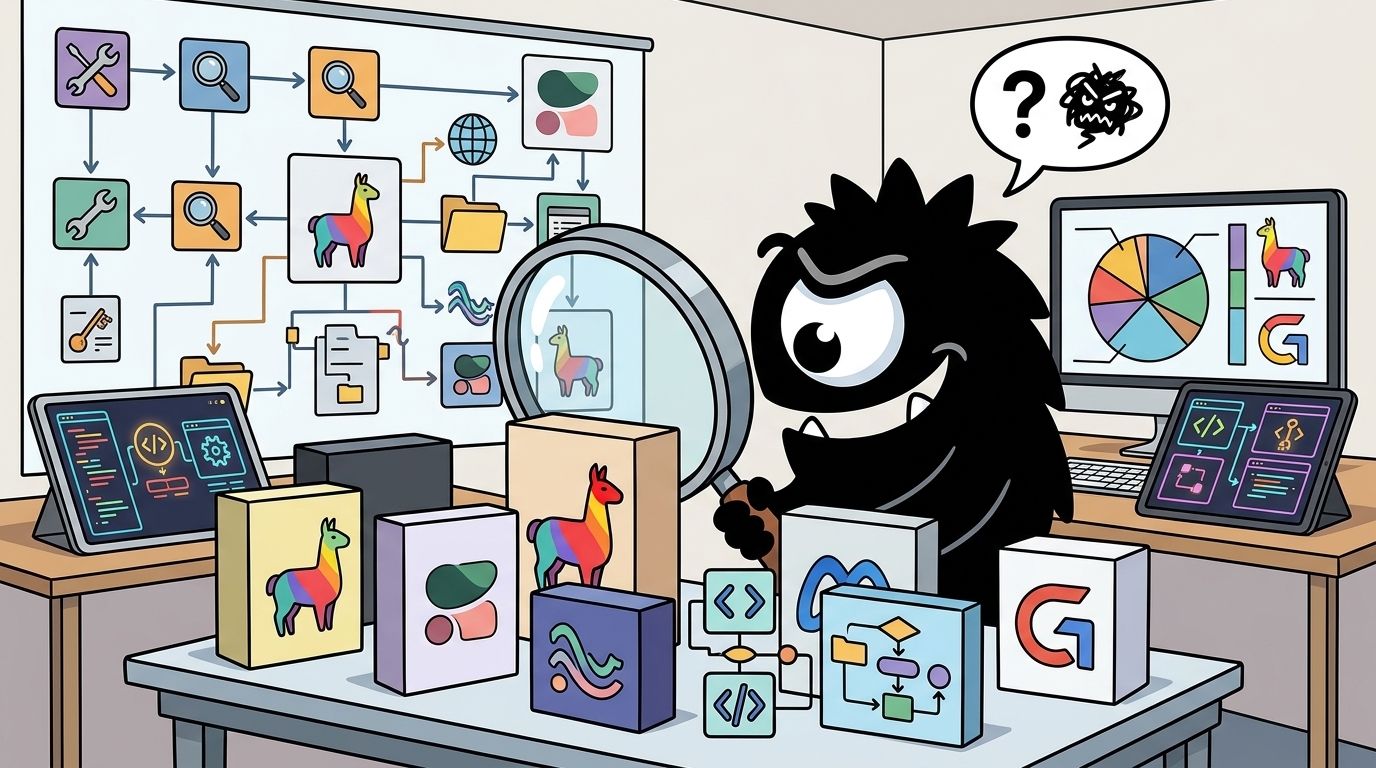
Meta Llama is a family of open models. In this context, that usually means Code Llama as the coding-oriented base model Meta released with infilling, code completion, and debugging-focused positioning.[1] Groq is different: it’s primarily an inference platform that hosts supported models behind a fast API.[7] Cohere sits in a third category: it offers models, embeddings, and retrieval tools, and in this conversation its strongest signal is not “best coding model” so much as best retrieval helper inside a code-review stack.[12]
That stack mentality is exactly how practitioners are talking now. They’re not asking “which single model wins?” They’re assembling workflows. One post captures the mood almost perfectly:
This is literally my new workflow now: Real-time research/search → Grok 4 Planning & Reasoning → Grok 4 Heavy Coding → Claude 4 Sonnet w/ Claude Code Write Test Cases → Gemini 2.5 Pro Run Test Cases → Codex Debug →Grok 4 Bookmark this.
View on XAnd at the implementation level, developers are increasingly grounding prompts in real project artifacts rather than asking a model to improvise from scratch:
Step 4: Pass it to Groq LLaMA with the user message.
Step 5: LLM builds a specific prompt on top of the real template.
The LLM is no longer guessing. It is working from your actual library.
That distinction matters because code review and debugging are not one-shot generation tasks. They reward:
- Low latency for repeated test-fix-review cycles
- Reliable structured output for automation
- Strong retrieval and reranking across large repos
- Controllability through prompts, tools, and state
- Deployment flexibility when privacy or customization matter
So the practical question for 2026 is not “Llama vs Groq vs Cohere” in the abstract. It’s more like:
- Do you want deep model control?
- Do you need human-speed interactive debugging?
- Are you reviewing code with repo-scale retrieval and multilingual context?
Those are different buying decisions, and the rest of this comparison should be read through that lens.
Speed vs Reliability: The Debate Driving Groq Adoption
Groq is winning attention for one simple reason: developers can feel the speed immediately.
If your current coding assistant takes eight seconds to answer, cutting that to two seconds changes behavior. You ask more questions. You test narrower hypotheses. You stop batching issues into giant prompts and start iterating. That’s why comments like this resonate:
Which means if Meta's Llama 3.3 model takes 8s to respond, with groq as its inference provider will take approximately 2s. So if you are thinking of integrating LLMs into your app, just for little reasoning but faster response check out groq hosted models. @GroqInc
View on XGroq’s platform is built around low-latency inference and exposes supported models through a developer-friendly API.[7][9] For code review and debugging, that matters because modern workflows increasingly involve multiple model calls per task, not one. A planner call, a code-edit call, a test-result interpretation call, maybe a formatting or summarization pass after that. Latency multiplies across the loop.
But the live debate is not “speed good, end of story.” It’s whether speed is still worth it when reliability drops. Theo’s deployment note is more revealing than most marketing pages because it describes the actual tradeoff teams run into:
Last changes before bed.
- Fixed title generation (models were so fast they finished before title was generated lol)
- New model picker modal
- Experimental labels on less reliable models
- Switched the Llama 3.3 Groq deployment from "specdec" to "versatile" (less fast but way lower error rates)
g'night nerds
That post is worth taking seriously for two reasons.
First, it confirms the obvious but often ignored reality: not all hosted configurations behave the same in production, even for the same underlying model. Second, it shows that teams will often accept a little more latency in exchange for fewer failures, because broken automation is worse than slower automation.
For code review, reliability problems show up in a few nasty forms:
- malformed JSON that breaks your pipeline
- partial outputs that miss key defects
- flaky tool invocation
- inconsistent severity ratings across similar findings
- “review noise” that wastes developer attention
In a toy demo, fast-but-flaky can look fine. In CI or pull-request review, it’s expensive. Engineers stop trusting the bot, and once trust is gone, the latency advantage stops mattering.
The right conclusion is not that Groq is overhyped. It’s that Groq’s real value emerges when you redesign the workflow around speed while preserving guardrails for reliability. If you do that, low latency is not a vanity metric. It enables a qualitatively different style of review: shorter loops, more retries, and tighter integration with test execution.[10]
One-Shot Review Is Fading: Iterative Debugging Loops Are the New Baseline
The biggest workflow shift in this conversation is that serious practitioners are moving beyond “paste code, ask for review.”
Instead, they’re building iterative loops: a model plans the next step, another step writes or edits code, a runner executes tests, and a critic evaluates the result before the cycle repeats. That pattern shows up explicitly here:
Here's a clearer step-by-step flow for the self-correcting coding loop:
1. **Planner** – LLM reviews the task + current state/errors and outputs the next focused action or sub-step.
2. **Coder** – LLM writes or edits the code file based on the plan.
3. **Runner** – Use Python's subprocess to execute tests (pytest, etc.) and capture stdout/stderr.
4. **Critic** – LLM reviews the run results. If green → exit early. If not, summarize the exact failure and suggested fix.
Wrap it in a while loop (max 5 iterations). After each cycle, save code + history to a JSON file so the next round starts from where it left off.
Use Ollama locally (free) or cheap APIs like Groq/DeepSeek. Specialize each prompt for its role. This creates reliable iteration instead of hoping one prompt works.
And in a more applied form here:
Peter shared the actual example here: https://t.co/C0sztTIPHl
He wrote a skill that runs `codex /review` in a loop until no "booboos" left. Caveat: still needs a strong master model (BRAIN) for architecture.
The thread was the reminder only. This iterative review-until-clean pattern (plus scratch logs for refactors) is what he’s shown elsewhere. Repo evolved to autoreview skills: https://t.co/bNSvQ43glI
Simple pattern: supervisor loop keeps feeding review output back as next prompt until clean. Want a ready-to-use template?
This is the right mental model for debugging because bugs are rarely solved by one perfect answer. They are usually narrowed through evidence:
- inspect the code
- propose a likely fix
- run the tests or reproduction
- inspect failure output
- revise
A one-shot prompt can simulate that process, but a looped system actually executes it.
Practically, the planner-coder-runner-critic pattern beats static review prompts because it separates concerns:
- Planner reduces ambiguity and picks the next smallest useful action.
- Coder focuses on producing code, not also managing the entire reasoning tree.
- Runner introduces external truth through tests and subprocess output.
- Critic converts failure signals into precise next-step guidance.
That decomposition matters no matter what vendor you choose, but each platform fits a different role:
- Groq is best when you want many cheap, fast loop iterations.
- Meta Llama is the underlying reasoning/coding model in many of those loops, especially when hosted through Groq or run in your own environment.
- Cohere is strongest upstream, improving what context gets surfaced before generation or review.
For teams building autonomous or semi-autonomous review systems, the production safeguards are now fairly clear:
- cap iterations, often at 3–5
- exit early on green tests
- persist state to JSON between rounds
- separate “architecture review” from “fix this failing test”
- route large refactors to a stronger supervisory model
This is also why “fast inference” matters more than benchmark chest-thumping. A model that is slightly worse in one-shot coding benchmarks can still be more useful in practice if it enables four grounded review cycles in the time another stack enables one.[10][11]
Where Meta Llama Still Shines for Code Review and Debugging
A lot of the praise around Groq-hosted coding experiences is, in reality, praise for Llama models delivered quickly. So it’s worth isolating what value comes from Meta’s side.
Code Llama was explicitly designed for coding use cases, including code generation, completion, and debugging, and Meta highlighted infilling as a key capability for inserting code into existing files rather than always generating from the end.[1] That matters in code review because many real fixes are surgical: patch a branch, adjust a type, insert a guard, modify a test.
The research paper also positioned Code Llama as a strong open foundation model for code tasks, with variants tailored for instruction following and Python-specific work.[3] For practitioners, that yields three enduring strengths:
1. Open-weight control
If you need privacy, offline use, domain adaptation, or tight control over deployment, Llama remains attractive. You can self-host, inspect behavior more directly, and integrate with internal tooling without depending entirely on a third-party runtime.[2]
2. Good fit for code-editing patterns
Infilling is still underrated. In debugging and code review, the job is often not “write a whole service,” but “repair this function without touching everything else.” Code Llama’s training and product framing align well with that use case.[1]
3. Stack composability
Because Llama is a model family rather than a monolithic product experience, teams can pair it with different inference providers, vector stores, and review orchestration frameworks.
That said, you should not romanticize open models. The limitations are real.
Self-hosting means operational overhead: provisioning, scaling, observability, prompt-format tuning, throughput constraints, and potentially worse tail latency than a managed inference platform. Even Meta’s own inference code underscores that using the models effectively requires real engineering, not just a pip install and a dream.[2]
And while practitioners still push these models hard, they are also raising the bar for what “good review” means. The expectation now is closer to this:
“Now debug; FULL, COMPREHENSIVE, GRANULAR code audit line by line—verify all intended functionality. Loop until the end product would satisfy a skeptical Claude Code user who thinks it’s impossible to debug with prompting.”
View on XThat level of granular, looped auditing is possible with Llama, but the quality you get depends heavily on hosting, prompting, and surrounding workflow. Which brings us to the subtle but important point Theo’s post also implied: when people rave about “Groq,” they are often consuming Llama as a service, not replacing the model’s contribution altogether.
Last changes before bed. Fixed title generation (models were so fast they finished before title was generated lol) New model picker modal Experimental labels on less reliable models Switched the Llama 3.3 Groq deployment from "specdec" to "versatile" (less fast but way lower error rates) g'night nerds
View on XGroq's Best Use Case: Interactive Debugging at Human-Speed
If Meta Llama is the flexible base layer, Groq is the thing that makes repeated debugging loops feel alive.
Groq exposes an OpenAI-compatible API and supports a menu of hosted models, which makes it relatively easy to slot into existing IDE assistants, bots, and agent frameworks.[7][8] That interoperability is a huge practical advantage. Most teams do not want to rewrite their whole integration to test a faster inference backend.
The more interesting development is that Groq isn’t just about raw token speed anymore. It’s adding features that make structured automation more viable:
The week just keeps getting better. Updates for DeepSeek R1 Distill Llama 70B on GroqCloud:
🛠️Tool use
💻 JSON mode
🧠Reasoning parsing
Details in our docs: https://console.groq.com/docs/reasoning
Those three features map directly to code review pipelines:
- Tool use helps the model call test runners, repo search, or static analysis tools.
- JSON mode reduces brittle parsing in automated review systems.
- Reasoning parsing helps separate internal reasoning artifacts from usable outputs in applications that need structure.
This is exactly why “interactive debugging” is Groq’s best category. It improves three concrete workflows:
IDE assistant loops
A developer asks for a failing-test diagnosis, gets a fast response, applies a fix, asks for a narrower follow-up, and keeps going without losing flow.
CI review bots
A bot can run several quick passes: style, likely regressions, security smells, and failure-summary generation, each with bounded latency.
Autonomous debug agents
Planner-runner-critic systems become more practical when five iterations feel like one conversational turn rather than a coffee break.
The emerging best practice is not to expect Groq to magically make weak prompts strong. It is to exploit its speed for many constrained, evidence-driven calls. As one post puts it, the loop itself is the product:
Start simple: write a Python while loop that calls any LLM API in cycles.
Steps inside the loop: planner breaks task -> coder writes code -> run tests with subprocess -> critic feeds errors back for fixes. Cap at 5 iterations + early exit on green tests.
Near zero cost: Ollama local (free). For speed: Groq or DeepSeek APIs, usually pennies per feature. Save state in a JSON file. This replaces one-off prompts with a self-correcting system.
That’s the strongest case for Groq in 2026. Not that it hosts the single smartest model, but that it makes rigorous, multi-step debugging cheap enough and fast enough to become default behavior.
Cohere's Edge: Retrieval Quality, Reranking, and Multilingual Teams
Cohere’s place in this comparison is easy to misunderstand if you evaluate it only as a direct code-generation rival.
In the current practitioner conversation, Cohere stands out more as a retrieval and language layer than as the default coding brain. And for repo-scale code review, that is a serious advantage.
Here’s the cleanest real-world signal in the set:
We use Cohere's Rerank in Octopus Review's RAG pipeline to score retrieved code chunks before the LLM reviewer sees them. Quality-to-latency ratio is genuinely the best we tested. @cohere @Nils_Reimers @itsSandraKublik
View on XThat lines up with how retrieval-heavy review systems work. Before a model can judge a bug, anti-pattern, or regression risk, it has to see the right code chunks: the changed file, the helper it calls, the interface it implements, the test it breaks, and maybe the old pattern it should match. If your retrieval layer surfaces the wrong neighborhood of the repo, the reviewer never had a chance.
That’s where reranking matters. Initial retrieval can fetch 20 or 50 plausible chunks; reranking then reorders them by likely relevance to the current question. In practice, better reranking can outperform brute-force “just stuff more context in the prompt,” because it reduces distraction and preserves context budget.[12]
For multilingual teams, Cohere also has a distinct appeal. Whether you are reviewing comments, docs, issue threads, or mixed-language code explanations, language coverage matters more than many English-first tool builders assume. Posts like this are jokey, but they point at a real operational need:
🚀👩💻 Cohere just dropped Tiny Aya models in 70+ languages! Now you can debug in Klingon, comment in Dothraki, and code-switch like a multilingual ninja! 🤓💻 Who needs sleep when you can dream in Python AND Elvish? #CodeAllTheLangs #MultilingualMagic #DevLife 🌐✨
View on XCohere’s challenge is integration complexity. Its platform spans embeddings, reranking, generation, and enterprise-oriented retrieval features, which is powerful but can introduce implementation friction. And yes, payload quirks are part of the story in the wild:
@AWSSupport Haha, had a hard time debugging the payload structure for Cohere Embed v4 interleaved image data input requests. ref: https://docs.aws.amazon.com/bedrock/latest/userguide/model-parameters-embed-v4.html
View on XSo the right way to think about Cohere for code review is:
- not the loudest choice for raw coding hype
- a very credible choice for RAG quality
- especially useful when repo retrieval and multilingual context are first-order needs
If your review system already has a coding model you like, Cohere may improve results more by fixing context selection than by replacing the generator.
Prompting Still Matters More Than Vendor Marketing Suggests
The least fashionable truth in AI tooling is also one of the most durable: workflow and prompting quality still dominate outcomes.
You can give the same model two different review setups and get “generic linty fluff” from one and “actionable defect analysis” from the other. That is not an edge case. It is the norm.
Practitioners are explicitly sharing instruction scaffolds that force planning, testing, self-critique, and bounded output structure rather than trusting the model to do that spontaneously.
Custom instructions for Grok4 to maximize code generation accuracy and quality.
Based on 2025 research (e.g., surveys on LLM code gen [arXiv:2406.00515], multi-agent/debugging [arXiv:2505.02133], RLHF/SFT trends [Revelo 2025], prompt engineering insights [PromptHub 2025]):
>>>
Prompt Analysis: Before coding, analyze user prompt for clarity. If ambiguous, infer intent via chain-of-thought (CoT) reasoning. Keep internal prompts <50 words for better accuracy.
Step-by-Step Planning: Break tasks into steps: (a) Understand requirements, (b) Plan structure/symbols, (c) Generate code, (d) Simulate execution mentally.
Multi-Agent Simulation: Emulate agents: Analyst (review logic/errors), Coder (write code), Tester (check edge cases via pseudocode tests).
Self-Debugging: After generation, verify with runtime simulation (e.g., mental trace for syntax/semantics). Fix hallucinations using compiler-like feedback.
Quality Alignment: Prioritize readability, efficiency, standards compliance. Use RLHF-style self-critique: Rate code (1-10) on accuracy/reliability; iterate if <8.
Error Handling: Include robust checks, comments explaining choices. Avoid specialized domains without context; suggest human review if uncertain.
Output Format: Provide code with explanations, tests, potential fixes. Limit verbosity; focus on executable, correct Python/other as specified.
<<<
Likewise, targeted prompts for buried complexity and anti-pattern detection remain valuable because they push the model to inspect the kinds of risks that default code-review personas often miss:
Grok 4 Heavy is extremely good at finding buried complexity in your code. Here's a prompt you can give it with code that you're trying to refactor. Grok anti-pattern code analysis prompt:
View on XThis applies across all three stacks:
- Llama benefits from clear prompt formats and role separation, especially when self-hosted or routed through custom tooling.[5]
- Groq benefits when you exploit speed for narrower, specialized prompts instead of giant omnibus instructions.[8]
- Cohere benefits when retrieval results are paired with templates that tell the reviewer exactly how to use ranked evidence.[12]
Three prompt design principles matter most in production code review:
- Ground the model in repo reality
Feed changed files, relevant dependencies, test failures, coding standards, and architectural constraints.
- Demand exactness, not vibes
Ask for failing path, affected function, confidence, evidence lines, and minimal fix options.
- Tie output to execution
Make the next step testable: patch suggestion, command to run, or explicit reason to escalate.
Prompting is not a substitute for testing, retrieval, or tool use. It is the control surface that makes those layers work together.
Pricing, Learning Curve, and Which Stack Fits Which Team
For most teams, the real decision is not philosophical. It is operational.
Meta Llama usually wins when you want control. Open models let you self-host, customize, and keep sensitive code inside your environment, but you pay in infrastructure, tuning, and maintenance effort.[2] The learning curve is higher for small teams, especially if they lack platform engineering support.
Groq usually wins when latency is the constraint. If your goal is fast review loops, cheap repeated calls, and quick integration via familiar APIs, Groq is the easiest way to make iterative debugging feel good in practice.[7][8] The tradeoff is that you are relying on a hosted inference platform and must actively monitor reliability across model/deployment options.
Cohere usually wins when retrieval quality is the bottleneck. If your reviewers miss issues because they are seeing the wrong chunks—or if your team works across languages, docs, and mixed repositories—Cohere’s reranking and broader language capabilities can produce outsized gains.[12]
The cleanest way to think about fit is by team type:
Choose Meta Llama if:
- you need self-hosting or private deployment
- you want open-weight flexibility
- you have the engineering capacity to own inference and orchestration
- your code review system is part of a larger internal platform
Choose Groq if:
- you want the fastest path to interactive debugging
- your developers benefit from many short review cycles
- you’re building IDE assistants, CI bots, or autonomous fix loops
- you can tolerate some provider dependency in exchange for UX gains
Choose Cohere if:
- your biggest problem is repo-scale retrieval accuracy
- you need strong reranking before generation
- your code review includes multilingual docs, tickets, or comments
- you already have a preferred generator and want better context feeding it
Choose a hybrid stack if:
- you want the best practical outcome rather than vendor purity
For many teams, the strongest architecture is:
- Llama as the coding/reasoning model
- Groq as the low-latency inference layer
- Cohere Rerank/Embeddings for retrieval
That combination matches the actual practitioner conversation better than any simplistic “winner” narrative.
And the deciding factor should be your failure mode:
- If reviews are too slow, start with Groq.
- If reviews are too generic or miss repo context, start with Cohere.
- If reviews are hard to control or hard to deploy privately, start with Llama.
One final lesson from the X discussion: trust comes from useful output, not branding. A model can deliver a strong senior-level review when the stack around it is designed well.
I think I did pretty well on Grok's review of the llmff codebase: https://grok.com/share/c2hhcmQtNQ_def80429-ecbf-4ba4-abac-29e8a1ec74a7
Overall Rating: 8/10
This is strong senior-level Rust code for a v1.x specialized tool. It is well above the typical open-source side project or indie CLI, and it shows clear engineering discipline, domain understanding, and production-minded thinking. It is not AI slop, nor does it exhibit common junior mistakes.
So which is best for code review and debugging in 2026?
- Best standalone foundation for control: Meta Llama
- Best inference layer for iterative debugging speed: Groq
- Best retrieval layer for repo-aware review: Cohere
- Best overall production setup for many teams: a hybrid, especially Llama on Groq with Cohere reranking
That is not a dodge. It is the architecture the market is already converging toward.
Sources
[1] Introducing Code Llama, a state-of-the-art large language model for coding — https://ai.meta.com/blog/code-llama-large-language-model-coding/
[2] meta-llama/codellama: Inference code for CodeLlama models — https://github.com/meta-llama/codellama
[3] Code Llama: Open Foundation Models for Code — https://arxiv.org/html/2308.12950v3
[4] 10X coders beware: Meta's new AI model boosts coding and debugging — https://arstechnica.com/information-technology/2023/08/meta-introduces-code-llama-an-ai-tool-aimed-at-faster-coding-and-debugging/
[5] Other Models | Model Cards and Prompt formats — https://www.llama.com/docs/model-cards-and-prompt-formats/other-models/
[6] Meta Code Llama on Snowflake Testing — https://www.snowflake.com/en/blog/meta-code-llama-testing/
[7] Overview - GroqDocs — https://console.groq.com/docs/overview
[8] API Reference - GroqDocs — https://console.groq.com/docs/api-reference
[9] Supported Models - GroqDocs — https://console.groq.com/docs/models
[10] groq-api-cookbook — https://github.com/groq/groq-api-cookbook
[11] Building an Autonomous Code Review Workflow with LangGraph, Groq, and Qwen-2.5 — https://medium.com/@gauravsaini.728/building-an-autonomous-code-review-workflow-with-langgraph-groq-and-qwen-2-5-fc1c053c553f
[12] Cohere Documentation | Cohere — https://docs.cohere.com/
[13] Cohere's Command R Model — https://docs.cohere.com/docs/command-r
[14] The Future of Coding: AI Code Generation Explained — https://cohere.com/blog/ai-code-generation
References (15 sources)
- Introducing Code Llama, a state-of-the-art large language model for coding - ai.meta.com
- meta-llama/codellama: Inference code for CodeLlama models - github.com
- Code Llama: Open Foundation Models for Code - arxiv.org
- 10X coders beware: Meta's new AI model boosts coding and debugging - arstechnica.com
- Other Models | Model Cards and Prompt formats - llama.com
- Meta Code Llama on Snowflake Testing - snowflake.com
- Overview - GroqDocs - console.groq.com
- API Reference - GroqDocs - console.groq.com
- Supported Models - GroqDocs - console.groq.com
- groq-api-cookbook - github.com
- Building an Autonomous Code Review Workflow with LangGraph, Groq, and Qwen-2.5 - medium.com
- Tracing a Groq Application - arize.com
- Cohere Documentation | Cohere - docs.cohere.com
- Cohere's Command R Model - docs.cohere.com
- The Future of Coding: AI Code Generation Explained - cohere.com
Related Guides
Adobe Express vs ConvertKit: Which Is Best for Customer Support Automation in 2026?
14 min read
Traders Are Betting 96% on Anthropic: What Polymarket's $3.2M AI Model Market Signals for 2026
20 min read
Supabase vs Webflow vs Linear: Which Is Best for Building SaaS in 2026?
22 min read
The Best AI Model in 2026: What Polymarket's 96% Anthropic Bet Reveals About the AI Race
21 min read