Meta Llama vs Hugging Face vs Replicate: Which Is Best for Automating Business Workflows in 2026?Updated: September 13, 2026
Meta Llama vs Hugging Face vs Replicate for business workflow automation: compare setup, cost, control, and deployment tradeoffs. Discover
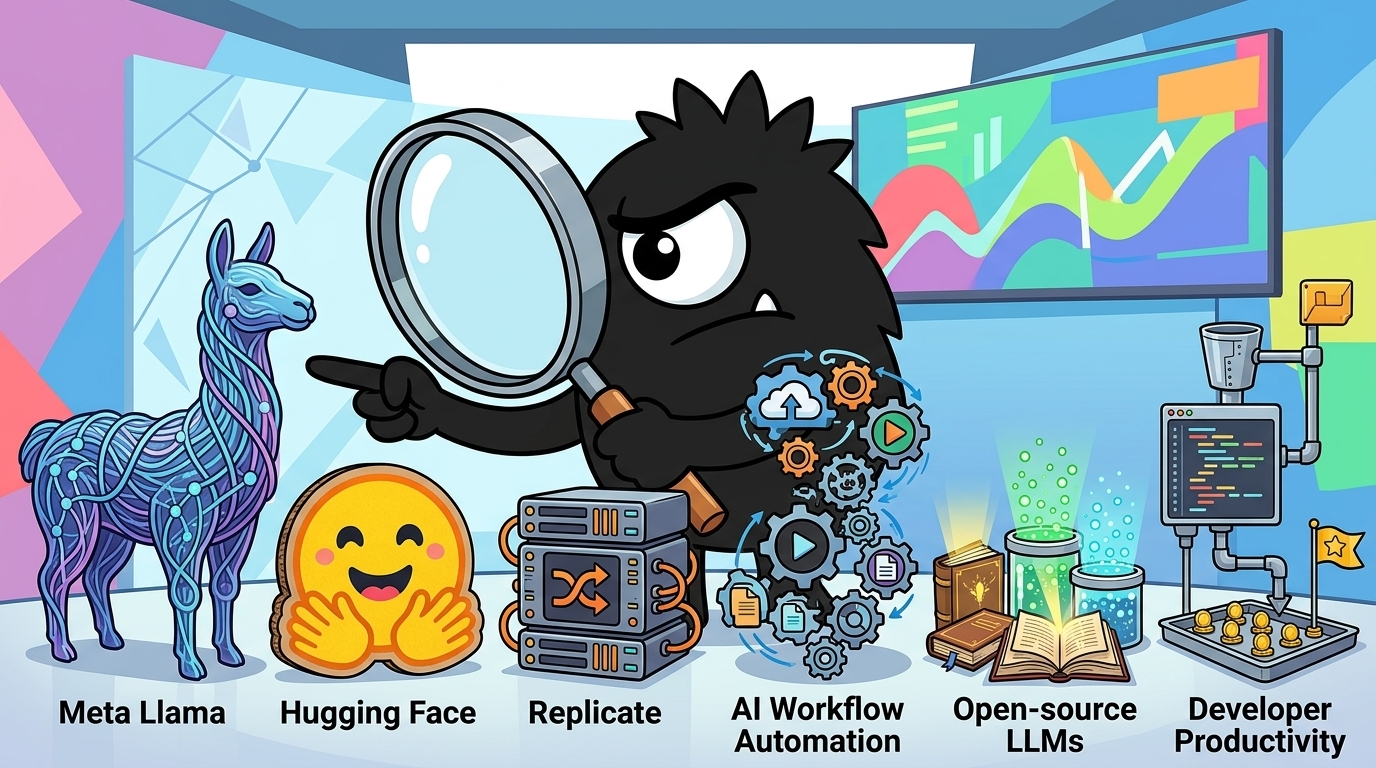
Why this comparison matters now: businesses want workflows, not just models
The market has moved past “Which model is smartest?” The practical question in 2026 is: Which stack helps me automate an actual business process without creating a maintenance nightmare?
That shift is obvious in the current builder conversation. People are talking less about one-off prompts and more about event-driven agents, document pipelines, ETL, multi-step actions, and systems that can survive production load.
Today we’re launching a repo that lets you setup a production ETL pipeline for your RAG/LLM app 💫
Index thousands of documents in seconds ⚡️ (and orders of magnitude faster than running on your laptop).
It’s a full architecture which bundles LlamaIndex with other popular backend services:
✅ Deploy @huggingface text embedding inference server for fast embedding inference
✅ Deploy @RabbitMQ to process massive volumes of incoming data + distribute to consumer workers
✅ Deploy @llama_index ingestion workers to ETL data into @weaviate_io
✅ Deploy on AWS EKS clusters with replicas and load balancing ⚖️
✅ Get an API endpoint via AWS lambda
Results: Get 4x speedup times vs. running on your laptop.
We are fully open-sourcing this project. As your RAG app moves from notebook to production, this will be a great resource (especially if you’re using AWS!)
Full credits to @LoganMarkewich for driving this idea.
Check out our blog: https://t.co/jwPg77bDZy
Repo:
That is why Meta Llama, Hugging Face, and Replicate keep getting compared, even though they are not direct substitutes.
- Meta Llama is primarily a family of open-weight foundation models and an expanding set of official tooling and deployment resources.[1][7]
- Hugging Face is a broad ML platform: model hub, datasets, training, fine-tuning, inference, deployment, and increasingly agentic workflows across many model families, including Llama.[2][8]
- Replicate is a hosted API layer that turns open-source models and workflows into callable services with minimal infrastructure work.[3]
That distinction matters because the buyer question is rarely “Which brand wins?” It is usually one of three things:
- Do I need ownership and portability?
- Do I need a full ecosystem for experimentation and ML operations?
- Do I need the fastest path to shipping automation?
The X conversation has gotten much more concrete about this.
WorkflowLLM enables LLMs to handle 70+ action workflows, a 10x improvement over current capabilities An LLM that can orchestrate real-world automation workflows at production scale Original Problem 🤔: Current LLMs can only handle small workflows with around 6 actions and simple logical structures. This falls short of real-world needs where applications like Apple Shortcuts involve 70+ actions and complex branching/looping patterns. ----- Solution in this Paper 🛠️: → Created WorkflowBench - a dataset with 106,763 workflow samples covering 1,503 APIs from 83 applications → Collected real workflows from Apple Shortcuts and RoutineHub, converted to Python code, added hierarchical thoughts using ChatGPT → Used ChatGPT to generate diverse task queries and expand dataset coverage → Trained an annotator model on collected data to generate workflows for new queries → Fine-tuned Llama-3.1-8B on this dataset to create WorkflowLlama ----- Key Insights from this Paper 💡: → Data quality and scale are crucial for workflow orchestration capability → Three-phase data construction ensures diversity and complexity → Hierarchical thought generation improves model understanding → Quality confirmation steps maintain dataset integrity ----- Results 📊: → Outperformed all baselines including GPT-4 → Handled complex workflows with 70+ actions vs 6 actions for GPT-4 → Demonstrated strong generalization to unseen APIs and instructions → Achieved 77.5% F1 score on out-of-distribution T-Eval benchmark
View on XToday we’re introducing a new way to build agents as event-driven systems 🤖🚨
We’ve launched workflows, a way of defining event-driven orchestration that will soon be the default way we handle all LLM orchestration in @llama_index - build simple-to-complex RAG pipelines, structured extraction, single agents, and multi-agents.
It’s a more intuitive UX than a graph-based approach. We originally tried building a DAG-based orchestration toolkit with our Query Pipelines abstraction, but ended up deprecating it - defining the edges was cumbersome and led to many edge cases that were hard for end users to reason about, especially once we tried adding loops.
Huge shoutout to @LoganMarkewich, Massi for working on this.
FAQ: How does this relate to llama-agents?
Great question. Llama-agents represents a way to convert your agents into microservices, and is also event-driven. We are working on a direct integration with llama-agents as the next step. Define your agent workflow in @llama_index, then easily translate to a service that you can deploy on k8s with llama-agents!
Blog post: https://t.co/tnEUgYqpMh
Core Module Guide: https://t.co/tNolgSm48v
RAG Guide: https://t.co/ikklpBlDde
Agent Guide:
Meta Llama vs Hugging Face vs Replicate: where each sits in the stack
Before comparing them, you need a clean mental model.
Meta Llama: the model layer plus an increasingly opinionated open stack
Meta’s Llama offering starts with the models themselves: open-weight large language models designed for use across cloud, edge, and self-hosted environments, with official docs, inference code, and deployment guidance.[1][7][10] Meta has also been building out a more self-sufficient Llama ecosystem through its own documentation and software resources.[7][10]
The key point: Llama is not a hosted platform by default. It is a model family you can run in many places.
"You can now start using Llama with just one line of code."
Chris Cox, Chief Product Officer, Meta - LlamaCon, April 29 2026
→ One billion downloads. No API key signup friction. No pricing surprises. Models you can take anywhere.
Meta is not trying to beat Claude or ChatGPT on benchmarks. They are trying to make the infrastructure of AI open enough that no one company controls the stack.
Hugging Face: the ecosystem layer
Hugging Face is where much of the open-model world gets discovered, fine-tuned, versioned, and deployed. Llama models are available in the Hugging Face ecosystem through Transformers docs, model pages, and deployment patterns.[8][11][14] For many teams, Hugging Face is the operational bridge between raw open models and usable production systems.
Llama 2 by @Meta is already integrated with @huggingface transformers, TGI, inference endpoints, PEFT and much more. Time for builders to build! https://t.co/qCjdGR9qEo
View on XIf you want one environment for model discovery, datasets, evaluation, training, inference endpoints, and collaboration, Hugging Face is the most complete option in this comparison.
Replicate: the API convenience layer
Replicate sits closer to application developers who want to call open-source models the same way they would call any managed API. It hosts popular models, including Meta Llama variants, and abstracts away a lot of deployment overhead.[9][15]
I find it so interesting (and smart) that Meta / LLaMA is eliminating the dependence of their models on the HuggingFace stack.
The LLaMA models now:
- Have their own website to download weights.
- Have one of the best LLM cookbooks that's available.
- Provide extensive documentation / tutorials.
- Can be finetuned easily via torchtune.
- Have several hosting / deployment frameworks (ExecuTorch, TorchChat, OLLaMA, etc).
- Are portable to numerous different environments and application setups (RAG, agents, etc.) via LLaMAStack.
The open-source language model landscape has been tightly coupled with HuggingFace for a long time. Personally, I've used HuggingFace for nearly every project I've worked on since ~2018 (back in the pytorch-pretrained-bert days!). I still think HuggingFace is an incredibly useful tool, but this competition is valuable. It forces everyone to build better-and more user friendly-software.
Why is this important? Research and development in the AI space has always followed and been accelerated by the available tooling and resources. For example:
- ImageNet propelled computer vision for years.
- PyTorch drastically accelerated and democratized deep learning research via its simplicity.
- HuggingFace made downloading and finetuning (L)LMs incredibly simple, encouraging research / participation over the last 6 years.
If we have easy to use tools and many resources available, more people will participate, more ideas will be proposed, and the field will generally evolve faster!
The LLaMA ecosystem seems to be becoming the new standard. It's so extensive that, similarly to HuggingFace in 2018-2020, it is becoming difficult to release a successful model that is not compatible with LLaMA software tools. It's not just the models / weights that are important, the tooling is a moat of its own!
That makes Replicate appealing when your goal is not to build an ML platform, but to ship a feature.
The overlap is what confuses people: you can use Llama on Hugging Face, and you can use Llama on Replicate. But that doesn’t make Meta, Hugging Face, and Replicate interchangeable. One provides the model family, one provides the broad operating system for open ML, and one provides the easiest hosted access path.
If your goal is speed: which platform gets a business workflow live fastest?
If your team is trying to launch an internal assistant, a document classifier, or a workflow step inside an existing app, speed-to-first-value matters more than philosophical purity.
In that race, Replicate usually wins.
It gives developers a straightforward way to access complex open models through simple APIs, which is exactly why it keeps showing up in automation prototypes and productized workflows.[3][4] When you do not want to provision GPUs, optimize containers, or tune serving stacks, the value proposition is obvious: call the model and move on.
I just dropped Llama 3.1 405B into the Replicate ComfyUI custom nodes repo. So now you can run 405B straight from your ComfyUI: https://github.com/replicate/comfyui-replicate Example workflow included in repo.
View on XReplicate is especially strong when the workflow spans more than plain text. Its appeal is not just LLM access; it is the ability to compose packaged community models and multimodal pipelines quickly. That matters for real business automation because many workflows include OCR, classification, generation, extraction, image transforms, or custom visual steps rather than a single prompt.
Hugging Face can also be fast, but it is a different kind of fast.
For teams already comfortable with the platform, Hugging Face offers multiple accelerated paths: hosted inference, model endpoints, Spaces, and integrations with external inference providers.[3][8] That flexibility is powerful, but it assumes you are willing to think in platform terms. You are not just making one API call; you are choosing among deployment modes, providers, models, and artifacts.
BOOM! Huge update for AI app developers by @huggingface
you can now deploy models directly from Hugging Face with Gradio while choosing your preferred inference provider from @SambaNovaAI, @hyperbolic_labs, @togethercompute, @FireworksAI_HQ, @replicate, @FAL, @nebiusai, @novita_labs
Additionally, you can choose to require Space users to log in, ensuring that inference usage is billed to their accounts
That makes Hugging Face faster for teams that expect to iterate across models and environments, but not always faster for a small app team trying to ship a workflow next week.
Using Llama directly is usually the slowest path to the first production workflow unless you already have ML infrastructure talent. Meta provides strong docs and official resources for inference and deployment,[1][7][10] but direct Llama adoption still means you are responsible for more of the stack: serving, scaling, observability, security, and often orchestration around the model.
That’s why the “one line of code” narrative around Llama needs context.
BOOM! Huge update for AI app developers by @huggingface
you can now deploy models directly from Hugging Face with Gradio while choosing your preferred inference provider from @SambaNovaAI, @hyperbolic_labs, @togethercompute, @FireworksAI_HQ, @replicate, @FAL, @nebiusai, @novita_labs
Additionally, you can choose to require Space users to log in, ensuring that inference usage is billed to their accounts
A useful rule:
- Choose Replicate if you need a workflow running this sprint.
- Choose Hugging Face if you want to move fast and keep room for broader ML operations.
- Choose direct Llama if speed matters less than long-term control.
If your goal is control: who gives you the most customization, portability, and ownership?
This is where the comparison becomes more strategic.
If your company cares about data residency, regulatory constraints, latency predictability, custom fine-tuning, or avoiding platform lock-in, then Meta Llama is the strongest option in this group. The entire value of open-weight models is that you can move them across environments, fine-tune them for your own workloads, and avoid being trapped in a single hosted vendor relationship.[1][6][7]
Open source AI is the way forward and today we're sharing a snapshot of how that's going with the adoption and use of Llama models. Read the full update here ➡️ https://ai.meta.com/blog/llama-usage-doubled-may-through-july-2024/?utm_source=twitter&utm_medium=organic_social&utm_content=image&utm_campaign=llama 🦙 A few highlights • Llama is approaching 350M downloads on @HuggingFace. More than 10x compared to this time last year. • Llama has been downloaded 20M times in the last month. This makes Llama hands down the leading open source model family. • Cloud service providers are seeing huge demand for Llama. Token usage across our largest cloud providers has more than doubled since May. • Llama models are being adopted across the industry. @Accenture, @ATT, @DoorDash, @GoldmanSachs, @Infosys, @KPMG, @NianticLabs, @Nomura, @Shopify, @Spotify and @Zoom are just a handful of strong examples. Open source AI is how we ensure that the benefits of AI extend to everyone, and Llama is leading the way.
View on XThat post captures the important subtext: Meta is not just releasing models. It is helping build a portable open stack around them. For enterprise buyers, that is not ideology — it is leverage.
The tradeoff is obvious: ownership means responsibility. If you self-host or deeply customize Llama, you own uptime, performance tuning, infrastructure cost management, and security boundaries. For sophisticated platform teams, that is acceptable. For most startups, it is a burden.
Hugging Face occupies the middle ground better than anyone else.
It supports Llama and many other models while giving teams managed services and broad interoperability.[8][11] That makes it attractive for organizations that want flexibility without starting from raw infrastructure. You can prototype quickly, fine-tune with established tooling, and then decide whether to stay managed or move to a more controlled deployment model.
That middle-ground positioning is why Hugging Face remains so central despite Meta’s efforts to expand the standalone Llama ecosystem. The practitioner value is not just hosting — it is portability across models, providers, and workflow stages.
Replicate, by contrast, is intentionally less about deep infrastructure control. That is not a flaw; it is the product design. Replicate is optimized for convenience, not maximum customizability.[3][6] If your workflow depends on custom schedulers, private networking rules, specialized fine-tuning pipelines, or tight integration with internal MLOps standards, Replicate will feel limiting faster.
Still, for many enterprise teams, “less control” is acceptable if it buys faster delivery. The real question is not whether control is good; it is whether your workflow actually needs it.
The LlamaParse MCP got a new face, and it is now easier than ever to run document processing workflows from your agents🚀
We refactored our MCP to have:
- Direct integration with our Parse, Classify and Split services🦙
- A smoother authentication flow using @WorkOS🔒
- Seamless support for file uploads⬆️
- Observability, rate-limiting and fast deployments with @vercel and @AxiomFM
📝 Of course, building a production MCP server means encountering challenges along the way, and you can read about them all in the blog post we wrote: https://t.co/dbXW3IaS13
👩💻 GitHub repo:
That post points to the reality often ignored in high-level comparisons: once you move into document pipelines, agent servers, and production integrations, the hard parts are authentication, observability, deployment, rate limits, and operational design. Open models help, but the surrounding system determines success.
Beyond chatbots: how each platform supports agents, orchestration, and business process automation
This is the most important section because business workflow automation is not a single model call.
A production automation system typically includes:
- event triggers
- retrieval or ETL
- one or more model calls
- tool use or external API actions
- human approval checkpoints
- retries and fallback logic
- logging and observability
- deployment and scaling patterns
That is why so much of the current conversation has shifted toward workflows, microservices, and orchestration.
Deploying advanced RAG is challenging. We make it a simple 3-step process:
1. Write your advanced RAG workflow in Python
2. Deploy it as API services with persistence and message queues through llama_deploy
3. Run it!
@pavan_mantha1 has an excellent tutorial showing you how to build a RAG pipeline with in-built reflection/filtering/retries, and then deploy them as services through llama_deploy. It’s great weekend reading if you’re looking to not only code a workflow in a notebook, but put it behind an API server
Meta Llama: a strong reasoning layer, not the whole workflow by itself
Llama models are increasingly the reasoning engine inside broader systems: RAG assistants, coding copilots, multilingual support tools, structured extraction, and workflow planners.[1][11] In other words, Llama often powers the cognitive step, while other tools handle orchestration.
The growing research and builder interest in workflow-capable Llama fine-tunes reflects that trajectory.
HUGGING FACE JUST OPEN-SOURCED THE ML INTERN EVERY RESEARCHER HAS DREAMED OF No more spending days reading papers and writing training scripts. ml-intern is an autonomous agent that reads ML papers, discovers datasets, trains models, debugs failures, keeps iterating, and ships production-ready models to the Hub all by itself. It automates the entire end-to-end post-training workflow using the full Hugging Face ecosystem. This is the agent that turns "I have an idea" into a working model while you sleep. What it actually does: → Reads arXiv papers and understands the latest research → Finds or creates the right datasets → Writes clean training code and runs it on real compute → Evaluates results and iterates automatically → Packages and uploads everything to HF Hub with proper structure Built on smolagents with proper tool access, context compaction, and safety checks. One prompt. Real results. No hand-holding. 5.8k stars in days and still exploding. The future of machine learning research just became open source. 100% Open Source.
View on XHugging Face: strongest for ML-heavy workflow systems
Hugging Face’s advantage is breadth. It can support not only inference, but the upstream and downstream machinery around model-driven workflows: datasets, post-training loops, packaging, collaboration, and deployment choices.[8][11]
HUGGING FACE JUST OPEN-SOURCED THE ML INTERN EVERY RESEARCHER HAS DREAMED OF
No more spending days reading papers and writing training scripts.
ml-intern is an autonomous agent that reads ML papers, discovers datasets, trains models, debugs failures, keeps iterating, and ships production-ready models to the Hub all by itself.
It automates the entire end-to-end post-training workflow using the full Hugging Face ecosystem.
This is the agent that turns "I have an idea" into a working model while you sleep.
What it actually does:
→ Reads arXiv papers and understands the latest research
→ Finds or creates the right datasets
→ Writes clean training code and runs it on real compute
→ Evaluates results and iterates automatically
→ Packages and uploads everything to HF Hub with proper structure
Built on smolagents with proper tool access, context compaction, and safety checks.
One prompt. Real results. No hand-holding.
5.8k stars in days and still exploding.
The future of machine learning research just became open source.
100% Open Source.
That is a glimpse of where Hugging Face is heading: beyond model hosting into workflow-native ML systems. For teams automating research, document understanding, internal evaluation loops, or custom post-training tasks, Hugging Face increasingly looks like a platform for end-to-end automation, not just a hub.
This matters because a lot of “business workflows” are really ML operations workflows in disguise: collecting data, retraining, validating outputs, promoting artifacts, and exposing them to applications.
Replicate: best when workflows depend on many packaged model components
Replicate is strongest when automation means stitching together heterogeneous open-source models without wanting to own the serving layer. That is especially true for multimodal systems and custom pipelines where the business value comes from composition rather than one foundation model.[9][15]
I've been working on a new model on Replicate that lets you run any ComfyUI workflow with an API. It supports all the popular controlnets, base weights, preprocessors, photomaker, animatediff, LCM, upscalers, IPAdapters. Details in 🧵
View on XThat pattern is underappreciated in enterprise discussions. A lot of useful automation — marketing asset generation, image moderation, media enrichment, synthetic content pipelines, visual QA — depends on combining niche models and workflow runners. Replicate reduces the friction of turning those into APIs.
It is also why multi-provider architecture is becoming the default design pattern rather than an advanced one. Teams want to use the best tool for each step, not pledge loyalty to a single stack.
Phase 1 update to my AI workflow engine:
→ Multi-provider support (Hugging Face + Replicate)
→ Model switching (FLUX fast/dev)
→ Visual DAG-based execution
Building towards a system where prompts become pipelines
Feedback welcome!
#buildinpublic #AI #SaaS #indiehacker
My take: Hugging Face is the best platform if workflow automation includes serious ML lifecycle work. Replicate is the best if workflow automation means shipping composable model-backed services fast. Llama is the best foundation if you want to own the intelligence layer long term.
Pricing, scaling, and operational tradeoffs: cheap experiments vs predictable production
There is no honest universal answer to “Which is cheapest?”
Direct Llama deployments
If you have steady volume and competent infra engineers, direct Llama deployments can become highly cost-efficient at scale because you are not paying convenience premiums on every request.[1][6] But you are taking on GPU procurement or cloud configuration, autoscaling, monitoring, upgrades, and performance optimization.
For large internal copilots or high-throughput document pipelines, that can be the right economic choice. For intermittent workloads, it often is not.
Hugging Face
Hugging Face gives you more pricing and deployment modes than Replicate, which is both a strength and a complexity cost.[3][6] You can stay hosted for convenience, use third-party inference providers, or align with more self-managed setups depending on the workload.
This flexibility is valuable when a project evolves from prototype to production and the economics change over time.
Replicate
Replicate is often the best fit for early-stage, bursty, or uncertain workloads. You get clean API access and avoid standing up serving infrastructure.[3][4] The downside is familiar: per-call convenience can become expensive if usage scales and stays predictable.
🤝 New in EvalOps: Full model provider integration
You can now securely connect:
• OpenAI
• Anthropic
• Google AI
• Claude
• Cohere
• OpenRouter
• Groq
• Replicate
• Hugging Face
...and more.
🔐 Keys encrypted & stored server-side
⚡ Instant plug-and-play for evals
The operational subtext in posts like that is important. Once you introduce evals, multiple providers, and governance, the winning architecture often becomes a mixed one. Replicate may remain a component, but not the entire platform.
🚨BREAKING: Hugging Face just open-sourced an AI intern that reads ML papers, trains models, and ships the final model for you.
It’s called ML Intern.
And this is not another AI coding demo that prints a broken PyTorch script and disappears.
You give it the goal.
It researches.
Writes code.
Runs experiments.
Uses Hugging Face datasets.
Launches jobs.
Pushes the final model.
All from your terminal.
`ml-intern "fine-tune llama on my dataset"`
That’s the entire command.
The crazy part is how deep this goes:
→ reads HF docs and research
→ searches papers and datasets
→ uses Hugging Face jobs
→ searches GitHub code
→ runs local and sandbox execution
→ streams every step back to you
→ asks approval before risky actions
→ keeps working for up to 300 iterations
This is the first open-source AI intern I’ve seen that feels built for actual ML work.
Not chat.
Execution.
4K stars already.
100% Open Source.
That kind of excitement around execution tooling is a reminder that the market now values operational leverage as much as model quality. Buyers should too.
Use case by use case: internal copilots, document automation, ETL, and multimodal workflows
Internal knowledge assistants and RAG
If you want an internal copilot over company docs, direct Llama is attractive when privacy, customization, and predictable scaling matter most. Hugging Face is often the better choice when you want a broader experimentation and deployment surface around that assistant. Replicate works well when the assistant is one feature among many and you need fast implementation, not a custom AI platform.[2][3]
Code Llama with @huggingface🤗 Yesterday, @MetaAI released Code Llama, a family of open-access code LLMs! Today, we release the integration in the Hugging Face ecosystem🔥 Models: 👉 https://huggingface.co/codellama blog post: 👉 https://huggingface.co/blog/codellama Blog post covers how to use it!
View on XDocument and agent workflows
Document-heavy automation usually fails not because of the base model, but because of ingestion, parsing, retries, queues, and deployment. That is where surrounding ecosystem matters more than raw benchmark scores. Hugging Face is stronger when the workflow touches training, evaluation, and hosted deployment options; Llama is stronger when you want the reasoning model under your own control.
ETL and production ingestion pipelines
If your automation resembles a real data pipeline — bulk ingestion, embeddings, workers, message queues, vector storage, APIs — then you should think in system architecture, not model shopping.
The LlamaParse MCP got a new face, and it is now easier than ever to run document processing workflows from your agents🚀
We refactored our MCP to have:
- Direct integration with our Parse, Classify and Split services🦙
- A smoother authentication flow using @WorkOS🔒
- Seamless support for file uploads⬆️
- Observability, rate-limiting and fast deployments with @vercel and @AxiomFM
📝 Of course, building a production MCP server means encountering challenges along the way, and you can read about them all in the blog post we wrote: https://t.co/dbXW3IaS13
👩💻 GitHub repo:
Multimodal and creative automation
This is where Replicate often has the clearest advantage. If the workflow depends on packaged community models, visual chains, or quick access to specialized open-source components, Replicate usually gives the shortest path from idea to deployed automation.[5][15]
I just dropped Llama 3.1 405B into the Replicate ComfyUI custom nodes repo.
So now you can run 405B straight from your ComfyUI:
https://github.com/replicate/comfyui-replicate
Example workflow included in repo.
Who should use Meta Llama, Hugging Face, or Replicate?
The best answer is not one winner. It is fit.
- Choose Meta Llama if you want open-model ownership, self-hosting flexibility, fine-tuning freedom, and long-term independence from any one platform.[1][7]
- Choose Hugging Face if you want the broadest ecosystem for discovery, experimentation, training, deployment, and model-centric workflow automation across many providers and model families.[2][8]
- Choose Replicate if you need the fastest path to shipping workflow automation on top of open-source models with minimal DevOps.[3][9]
The most realistic recommendation for 2026 is a hybrid pattern:
- Use Llama as the core model family where openness and portability matter.
- Use Hugging Face for experimentation, packaging, datasets, and deployment flexibility.
- Use Replicate for targeted workflow components or fast-moving product features where convenience is worth the premium.
That is where the market is clearly heading: not toward one stack to rule them all, but toward multi-provider architectures built around business workflows rather than model loyalty.
Sources
[1] Introducing Llama 3.1: Our most capable models to date — https://ai.meta.com/blog/meta-llama-3-1
[2] Which AI Model Is Best for Your Business Needs? — https://www.stack-ai.com/blog/what-is-the-best-ai-model-llm-for-your-business
[3] Hugging Face vs Replicate: From Model Discovery to Deployment — https://www.digitalocean.com/resources/articles/hugging-face-vs-replicate
[4] Hugging Face vs Replicate: A Hands-On Comparison for Data Scientists — https://medium.com/@heyamit10/hugging-face-vs-replicate-a-hands-on-comparison-for-data-scientists-460cb214f548
[5] Top 12 Best AI API Platforms in 2025 (Latest Updated) — https://github.com/uplabzh/best-ai-api-tools
[6] 7 best Hugging Face alternatives in 2026: Model serving, fine-tuning & full-stack deployment — https://northflank.com/blog/huggingface-alternatives
[7] Docs & Resources | Llama AI — https://www.llama.com/docs/overview
[8] Llama — https://huggingface.co/docs/transformers/en/model_doc/llama
[9] meta/meta-llama-3-70b-instruct | Readme and Docs — https://replicate.com/meta/meta-llama-3-70b-instruct/readme
[10] meta/meta-llama: Inference code for Llama models — https://github.com/meta-llama/llama
[11] Llama 3.1 - 405B, 70B & 8B with multilinguality and long context — https://huggingface.co/blog/llama31
[12] Introducing Meta Llama 3: The most capable openly available LLM to date — https://ai.meta.com/blog/meta-llama-3
[13] GitHub - meta-llama/llama3: The official Meta Llama 3 GitHub site — https://github.com/meta-llama/llama3
[14] Meta Llama — https://huggingface.co/meta-llama
[15] Large Language Models (LLMs) — https://replicate.com/collections/language-models
References (15 sources)
- Introducing Llama 3.1: Our most capable models to date - ai.meta.com
- Which AI Model Is Best for Your Business Needs? - stack-ai.com
- Hugging Face vs Replicate: From Model Discovery to Deployment - digitalocean.com
- Hugging Face vs Replicate: A Hands-On Comparison for Data Scientists - medium.com
- Top 12 Best AI API Platforms in 2025 (Latest Updated) - github.com
- 7 best Hugging Face alternatives in 2026: Model serving, fine-tuning & full-stack deployment - northflank.com
- Docs & Resources | Llama AI - llama.com
- Llama - huggingface.co
- meta/meta-llama-3-70b-instruct | Readme and Docs - replicate.com
- meta-llama/llama: Inference code for Llama models - github.com
- Llama 3.1 - 405B, 70B & 8B with multilinguality and long context - huggingface.co
- Introducing Meta Llama 3: The most capable openly available LLM to date - ai.meta.com
- GitHub - meta-llama/llama3: The official Meta Llama 3 GitHub site - github.com
- Meta Llama - huggingface.co
- Large Language Models (LLMs) - replicate.com
Related Guides

The Best Signal on the AI Bubble in 2026: What Prediction Markets Reveal for Founders and SaaS Buyers
26 min read
Adobe Express vs ConvertKit: Which Is Best for Customer Support Automation in 2026?
14 min read
Traders Are Betting 96% on Anthropic: What Polymarket's $3.2M AI Model Market Signals for 2026
20 min read
Supabase vs Webflow vs Linear: Which Is Best for Building SaaS in 2026?
22 min read