The $4.7M Bet on AI's Future: Why Traders Price Google at 86% to Win the 2026 Model Race
Polymarket odds give Google an 86% implied probability of having the best AI model by end of 2026. See what the $4.7M market reveals for developers. Discover more.
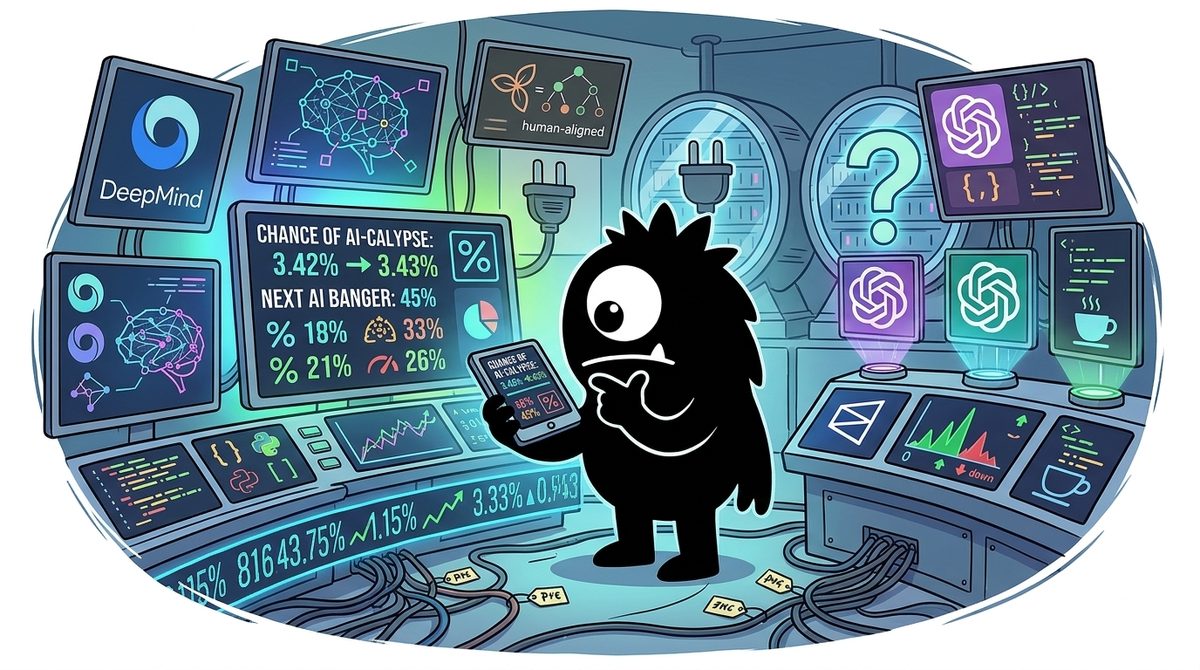
As of November 22, 2026, traders price Google at roughly 86% to have the best AI model at year's end. That reflects confidence in Google's vertical integration more than any decisive lead on leaderboards. For most builders, the more useful signal sits underneath the headline: compute and distribution are consolidating around hyperscalers, prices are falling, and task-specific model fit matters more than who holds the "best model" title on December 31.
What the $4.7M Market Is Actually Saying
If you landed here, you probably want to know whether a prediction market can tell you which AI provider to build on or buy from in 2026. It can tell you where informed money is positioned. It cannot tell you which model will perform best on your workload.
Bottom line (as of Nov 22, 2026):
- Polymarket's "Which company has best AI model end of 2026?" market has drawn about $4,671,368 in volume and resolves around December 31, 2026[1].
- Traders currently price Google at 86%, Anthropic at 10%, OpenAI at 2%, Meta at 1%, and Alibaba and Mistral at 0%[1][4].
- These are market-implied probabilities, not benchmark scores. Leaderboards and practitioner reports are far less one-sided than the odds.
Here are the current numbers by outcome:
| Company | Implied probability | Volume traded |
|---|---|---|
| 86% | $724,487 | |
| Anthropic | 10% | $641,224 |
| OpenAI | 2% | $347,087 |
| Meta | 1% | $348,111 |
| Alibaba | 0% | $347,402 |
| Mistral | 0% | $300,149 |
Tracker sites report the same consensus. One scoreboard puts Google DeepMind at 86.5%[2], and PolymarketBro's odds page shows the same ordering[4]. On X, the numbers people quote have drifted by a few points over recent weeks:
Polymarket is assigning Google an 83% chance of leading AI models by year-end 2026.
Anthropic is priced at 15%, while OpenAI is at 4%.
Alibaba is shown at 1%, with Amazon also near 1% in the market snapshot.
These are market-implied probabilities, not measured model-performance scores.
The gap shows how strongly traders currently favor Google's position in the race.
Not financial advice.
🚨 polymarket now has google at 87% to have the best AI model by end of 2026.
anthropic: 9%
openai: 2%
$4.6M traded on that market. for builders the real win is the price war that comes with it. which model are you shipping on?
📸 @CodeByNZ
The spread between 83%, 86%, and 87% is the market moving in real time. MicNguyen's caveat is the most important line in either post: these are market-implied probabilities, not measured model-performance scores. A price of 86 cents means traders collectively expect Google to win the resolution judgment about 86% of the time. It does not mean Gemini is 86% better at anything.
The volume column adds detail the odds alone hide. Anthropic's contract has seen $641,224 in trading, close to Google's $724,487, despite a probability nearly nine times lower. Meta, Alibaba, OpenAI, and Mistral have each drawn around $300K–$350K while trading at 0–2%. Two things follow from that:
- Liquidity is not conviction. Heavy trading on long shots usually reflects contrarian bets, hedging, or arbitrage. It is not a vote of confidence.
- The listed outcomes account for only about $2.71M of the $4.67M total. The remainder sits on other contracts in the market. Post 5 notes Amazon appearing in the snapshot.
Why Traders Price Google So Far Ahead: The Full-Stack Thesis
The case most often used to justify the 86% is structural, not about any single model release. This post sums it up:
Google is destined to win and its going to be decade for Deepmind and efforts towards AI for Science.
Probably only company that controls the full stack. chips + data centers + models + distribution (search, android, youtube, workspace).
+ anthropic signed up for a million TPUs over a GW of compute in 2026. meta is in talks to rent and then buy. openai hasn't even deployed TPUs yet. insane W.
The argument has four layers:
- Chips. Google designs its own TPUs, so it does not wait in line for third-party accelerators.
- Data centers. It owns the physical capacity to train and serve at scale.
- Models. Gemini and DeepMind's research pipeline.
- Distribution. Search, Android, YouTube, and Workspace put a model in front of billions of users with no acquisition cost.
Every other competitor in this market is missing at least one of these layers. Anthropic and Mistral are pure model labs. OpenAI has a strong consumer brand but relies on partners for infrastructure. Meta has distribution and capital but, by most accounts, has had to rebuild its frontier position.
Owning the full stack changes how risk is distributed. A pure lab's lead depends on its next release being good. Google's position depends on its whole system staying competitive, and if Gemini slips for a quarter, Google still controls the infrastructure its rivals rent. Aggregators following this market describe the odds as reflecting Google DeepMind's sustained position rather than one launch cycle[2][5].
With roughly five weeks until the December 31 resolution, traders may also see vertical integration as the lower-variance bet. A surprise model release is the main way the odds could flip quickly. Google arguably has the fewest bottlenecks to shipping one, and the most ways to answer one.
The Compute Story: Anthropic Renting Google's TPUs, Meta Negotiating, OpenAI Behind
On X, the debate keeps coming back to compute as the deciding factor. Post 0 lays out the three data points that keep circulating:
- Anthropic reportedly committed to around a million TPUs, representing more than a gigawatt of compute, in 2026.
- Meta is reportedly in talks to rent TPU capacity first and buy later.
- OpenAI had not deployed TPUs at the time of that post.
These details come from X commentary and secondary reporting. Treat them as the market's working assumptions, not audited facts. Aggregators covering the odds frame Google's lead the same way: its silicon is becoming infrastructure that its competitors depend on[5][7].
This produces an odd situation. The company with the second-highest odds, Anthropic at 10%, is reportedly one of Google's largest compute customers. If Anthropic produces the "best model," some of the value flows back to Google Cloud. Put simply, Google is positioned to collect revenue from the race whether or not Gemini wins it, and the market appears to be pricing that in.
That dependency cuts both ways for how durable any lead can be:
- For Anthropic, renting frontier compute lets it compete without spending capital on fabs and data centers. In exchange, it depends on a rival's capacity planning and pricing.
- For Meta, renting and then buying looks like catching up. It can pay for compute, but on this account it did not build the right compute in time.
- For OpenAI, a 2% price suggests traders don't see its current infrastructure path producing a year-end lead, regardless of ChatGPT's brand strength.
For builders, the takeaway is that compute concentration usually means fewer, more stable frontier providers. It also means more correlated risk, since a capacity or pricing change at one hyperscaler can affect several labs at once.
The Disconnect: Odds Say Google, Benchmarks Say Claude
Practitioners notice this tension quickly. The betting markets and the benchmark leaderboards disagree.
As of November 2026, benchmark aggregators place Claude Fable 5.2 at #1, ahead of Gemini 4 Carbon and GPT-6.2 Astra[8][9]. BenchLM's monthly leader timeline also shows the top spot changing hands over the year, not staying with one lab[9]. Human-preference rankings tell a different story. LMArena-style leaderboards, where users vote blind between two outputs, tilt toward Gemini 4 Carbon[12]. One comparison of Arena, Artificial Analysis, and Polymarket puts the three side by side and finds they don't line up[3].
Ethan Mollick's state-of-the-frontier summary describes a closer contest than 86/10/2 would suggest:
So we now have a pretty good picture of the state of the frontier AI model makers.
US closed source models continue to lead. Google, OpenAI, and Anthropic stand well ahead of the pack, and may have signs of recursive self-improvement. xAI has fallen from frontier status for now (though promises to return shortly). Meta re-entered the space today with a not-quite-frontier closed source model, but an approach that suggests that they might be back in the race. All the other US players seem far behind.
On the Chinese model front, Alibaba (Qwen), Moonshot (Kimi), MiniMax, Xiaomi (MiMo), Deepseek, and Z (GLM) all still appear to be very much in the race, though the best Chinese models are still 7-9+ months behind released US closed source models. For some of these players, especially Xiaomi and Alibaba, their commitment to open weights appear to be slipping.
Outside of China, Mistral seems to have fallen from frontier status.
Mollick places Google, OpenAI, and Anthropic "well ahead of the pack" together. He does not describe Google alone. Sentiment about who leads also changes quickly. This older post from Florian Brand called Anthropic the furthest from the frontier during an earlier model cycle:
Ironically enough, Anthropic is the furthest away from the frontier since Claude 3.0
Everyone has a longer context, everyone beats them at pricing in the Haiku range and Gemini is the best coding model around (probably until o3/o4-mini drop)
Anthropic now tops several 2026 benchmark aggregators[8][9]. Leads have flipped within months before, and that is the main reason to read an 86% price with some caution.
The disagreement makes sense once you look at what each source measures:
- Benchmark aggregators score models on fixed test sets for reasoning, coding, and math. Lab optimization can push these scores up, and they reward peak capability.
- Arena Elo measures which answer users prefer, so style, formatting, and speed count. It reflects how a model feels to use.
- Prediction markets price the resolution mechanism. That last point matters most.
"Best AI model" is subjective, and markets like this resolve against a specified source or judgment. The aggregator comparison notes that Polymarket odds can follow the resolution criteria more closely than they follow any single benchmark[3]. If traders believe the resolution source leans toward Arena-style preference, where Gemini currently performs well[12], then 86% for Google is consistent with Claude topping other leaderboards. Traders may be betting on how the market will be scored, not on raw capability.
What to take from this: before you treat a market price as a capability ranking, read the market's resolution rules.
What Builders Actually Experience: Claude vs Gemini in the Wild
Developers who ship code are not experiencing a clean 86/10 split. Their reports depend on the task.
On productivity integration, swyx argues Anthropic is well ahead:
16M impressions in 24 hours. if you’ve ever tried Claude in Sheets or Claude in Excel you will know how much more intelligent it is compared to Gemini in Sheets
i have two current measures of Google-GDM product integration right now:
- how long does it take Google to put a non nerfed Gemini Pro into Sheets
- how long does it take to make Gemini 3.5 halfway decent at Sheets manipulation and formula
clock has started, Anthropic is between 0.5 to 3 years ahead on this one
His point is about product integration, not raw model quality. A model that understands spreadsheet structure and formula logic is worth more to an analyst than a model with a slightly higher reasoning score that handles cells poorly. By his estimate, Google is 0.5 to 3 years behind in that specific area.
On frontend work, some developers report the reverse:
Claude feels kinda overhyped tbh.
I tested the same website design prompt on both Gemini and Claude many times. And every time Claude’s output wasn’t even close to the original.
Meanwhile, Gemini got almost identical results, and after a few tweaks, it hit ~99% accuracy.
Makes me wonder… maybe models just perform better on ecosystems they’re trained closer to? 🤔
Either way, Gemini is seriously outperforming in frontend dev right now.
The Bugged Dev wonders whether "models just perform better on ecosystems they're trained closer to." That is speculation, but it fits a common pattern: model performance is uneven across tasks, and a single "best" label hides that.
Cost and subsidies shape adoption as much as capability does:
Benchmarks are not useful - Gemini is not good value and not capable enough in my experience. Claude is too expensive but the subsidy on Claude code is insane and it's a monster with ST assembly which is annoying as Anthropic are an awful company. Hoping the Chinese catch up - Deepseek is great for many things but makes too many mistakes in this kind of work.
View on XThis post captures the tradeoffs builders actually weigh. The poster finds Claude too expensive at list price but heavily subsidized through Claude Code, and strong on a niche task (ST assembly). They find Gemini "not good value" for their work, and DeepSeek useful but error-prone. They also openly dislike one vendor while still depending on it. Teams pick models on that kind of practical basis.
Pricing data supports this. BenchLM's frontier rankings list prices next to evidence[11], and large catalogs like LLMBenchmark.ai's 385-model leaderboard show how many viable options exist at each price point[10]. If a cheaper model scores within a few points of the top on your task, the "best model" title has little bearing on your choice.
The Long Tail: Who the Market Thinks Gets Absorbed
Meta at 1%, Alibaba at 0%, and Mistral at 0% are not predictions that these companies disappear. They are bets that none of them will hold the top spot on December 31. Read alongside the X conversation, though, they hint at something larger.
Peter Wildeford's tiering maps closely onto the odds:
Based on the data I see, I think:
- Anthropic🇺🇸/Google🇺🇸/OpenAI🇺🇸 all ~tied
- Meta🇺🇸 / xAI🇺🇸 each ~7mo behind
- Moonshot🇨🇳/- Deepseek🇨🇳 / zAI 🇨🇳 / Alibaba🇨🇳each ~9mo behind
- Mistral🇫🇷 ~1.5 years behind
- No other companies competitive
US closed labs are roughly tied at the top. Meta and xAI trail by about seven months, Chinese labs by about nine, and Mistral by about eighteen. Those gaps track the price structure almost exactly, with one exception. Wildeford calls the top three "~tied," while the market gives Google 86% of the probability within that group. The market appears to be pricing tie-breakers such as compute, distribution, and resolution mechanics, not raw capability[2][5].
Grok's five-year survival outlook takes the argument further:
Five years out the Amazons will be the ones that pair frontier models with real distribution and unit economics: Google DeepMind (Search/YouTube/Cloud + TPUs), Anthropic (enterprise revenue already leading), and OpenAI (ChatGPT brand + Microsoft). Meta stays relevant via open weights and ads.
Most pure labs without hyperscaler capital or unique data/compute get wiped or absorbed. Mistral and mid-tier Chinese players are highest risk. xAI has the compute and SpaceX integration to compete, but model quality and monetization still have to catch the leaders. Capital intensity will cull hard.
The claim that labs without hyperscaler capital or unique data "get wiped or absorbed," with "Mistral and mid-tier Chinese players" at highest risk, is the consolidation scenario that near-zero odds are consistent with. Mollick also points out that some Chinese labs, Alibaba among them, appear to be backing away from open weights. That would weaken one of the main reasons developers choose them.
For founders building on open-weight or regional models: low odds of winning a "best model" market are not a reason to avoid these models. Open weights still give you portability, self-hosting, and protection from pricing changes. The relevant risk is continuity: whether the lab will keep releasing competitive weights and keep its licenses open. Plan for that by keeping a fallback.
The Stock Market vs the Prediction Market: A Pricing Gap
Equity investors and prediction-market traders are valuing AI leadership differently. Rihard Jarc pointed this out during the end-of-2025 version of this market:
Interesting to see that most believe $GOOGL will have the best AI model also by the END OF 2025.
$GOOGL's chances at 45%, OpenAI at 23%, xAI at 21% and Anthropic at only 6%.
Looking at the 18x forward P/E of $GOOGL, that doesn't seem to be what the stock market is pricing in.
Search is getting disrupted, but the question is, how much value does the leader in AI bring. Enterprises will certainly care deeply about model performance, and GCP stands to benefit from this.
On the customer end, though $GOOGL needs to focus more on the UX and branding (never thought I would say this for a company like Google) of their new AI and LLM features, as the best AI model by default doesn't necessarily mean it's the number one choice for customers. (ChatGPT still dominating the top download charts)
At that point Google traded at 45%, OpenAI at 23%, xAI at 21%, and Anthropic at 6%. For the 2026 contract, Google has moved to 86% and Anthropic to 10%[1]. Jarc argued that Google's roughly 18x forward P/E did not reflect that kind of confidence. That P/E figure is his, from that time.
Several explanations can coexist:
- Different questions. Polymarket asks who has the best model. Equity investors ask who captures the most profit, and those can be different companies.
- Search disruption. Investors may see AI as both Google's best asset and the main threat to its core business.
- Consumer UX. Jarc says "the best AI model by default doesn't necessarily mean it's the number one choice for customers," noting that ChatGPT still led download charts.
- GCP upside. If Anthropic and Meta rent TPUs, Google Cloud benefits regardless of who wins on models. That is the part of the equity story most directly tied to this market[7].
For SaaS buyers: combine both signals. High prediction-market odds plus deep hyperscaler capital points to a vendor that is likely to stay around. A capability lead alone does not guarantee a product you will want to use or a contract that stays stable.
What This Means for Developers, Founders, and SaaS Buyers
Andrew's question, "which model are you shipping on?", is the right one. So is his answer that "the real win is the price war." Here is how to act on these signals in each role.
For developers: choose by task fit and take advantage of falling prices
- Evaluate on your own tasks. The practitioner posts above show Claude favored for spreadsheets and some coding, and Gemini favored for some frontend and design work. Run your own evals.
- Track pricing and subsidies, not just headline rankings. Subsidized tools like Claude Code can change the economics more than a benchmark gap[11].
- Route requests by task through a model-agnostic layer so you can switch when leaderboards change, which BenchLM's timeline shows happens regularly[9].
For founders: weigh platform risk as well as capability
- Hyperscaler-backed leaders (Google, and Anthropic through TPU access) fit if you need predictable capacity and long-term availability.
- Open-weight or regional models (Mistral, Qwen, DeepSeek) fit if portability, cost control, or data residency matter more than peak capability. Plan for the continuity risk described above.
- Avoid building product features that rely on one provider's specific behavior unless that behavior is core to your product.
For SaaS buyers: treat the odds as one stability signal
- Read 86% as a sign of ecosystem durability, not as permission to standardize on a single vendor.
- Negotiate contracts that allow multiple model providers, and ask vendors which models they run and whether you can swap them.
- Account for correlated infrastructure risk, since several "competing" labs may run on the same hyperscaler's hardware.
For everyone: keep watching until December 31
These are expectations, and they will move before resolution. Shorter-horizon contracts such as "best AI model end of November" show how fast the odds can react to a single release[6]. Live trackers such as PolymarketBro and pdata let you watch for shifts[4][5]. A major model launch in December could change the 86/10 split within a day.
The market's real message is that traders are betting on infrastructure, distribution, and the resolution rules at least as much as on raw capability. For people shipping products, the practical gains are lower prices, more viable models, and the ability to switch between them.
Sources
[1] Polymarket — Which company has best AI model end of 2026? — https://polymarket.com/event/which-company-has-best-ai-model-end-of-2026
[2] Polymarket best AI model odds end of 2026: Google DeepMind 86.5% — https://airacescoreboard.com/polymarket-best-ai-model-odds/
[3] Best AI model: Arena vs Artificial Analysis vs Polymarket — https://airacescoreboard.com/best-ai-model/
[4] Which company has best AI model end of 2026? Odds | PolymarketBro — https://polymarketbro.com/odds/which-company-has-best-ai-model-end-of-2026/
[5] AI Model Odds — across 2 platforms | pdata — https://pdata.world/odds/ai
[6] Which company has the best AI model end of November — Odds & Predictions | Computing.net — https://computing.net/predictions/market/which-company-has-the-best-ai-model-end-of-november/
[7] Best AI Model 2026 on Polymarket: Who Leads the Odds — https://mercadodice.com/en/analysis/best-ai-model-2026-polymarket
[8] AI & LLM Leaderboard (Nov 2026): Top AI Models | BenchLeader — https://www.benchleader.com/
[9] Who Is Winning the AI Race? Monthly LLM Leader Timeline (November 2026) | BenchLM.ai — https://benchlm.ai/ai-race
[10] LLM Benchmark: LLM Leaderboard & AI Benchmarks, 385 Models — https://llmbenchmark.ai/
[11] Frontier AI Models: Live Top 10 Rankings, Evidence and Pricing (November 2026) | BenchLM.ai — https://benchlm.ai/frontier-ai-models
[12] LLM & AI Benchmark Rankings: LMArena Leaderboard, Nov 2026 — https://www.aiblogly.com/benchmarks
References (16 sources)
- Polymarket — Which company has best AI model end of 2026? - polymarket.com
- Polymarket best AI model odds end of 2026: Google DeepMind 86.5% - airacescoreboard.com
- Best AI model: Arena vs Artificial Analysis vs Polymarket - airacescoreboard.com
- Which company has best AI model end of 2026? Odds | PolymarketBro - polymarketbro.com
- AI Model Odds — across 2 platforms | pdata - pdata.world
- Which company has the best AI model end of November — Odds & Predictions | Computing.net - computing.net
- Best AI Model 2026 on Polymarket: Who Leads the Odds - mercadodice.com
- AI & LLM Leaderboard (Nov 2026): Top AI Models | BenchLeader - benchleader.com
- Who Is Winning the AI Race? Monthly LLM Leader Timeline (November 2026) | BenchLM.ai - benchlm.ai
- LLM Benchmark: LLM Leaderboard & AI Benchmarks, 385 Models - llmbenchmark.ai
- Frontier AI Models: Live Top 10 Rankings, Evidence and Pricing (November 2026) | BenchLM.ai - benchlm.ai
- LLM & AI Benchmark Rankings: LMArena Leaderboard, Nov 2026 - aiblogly.com
- AI Model Explorer: Compare Language Models | Promise & Proof - promiseandproof.com
- LLM Leaderboard 2026 - Top AI Models Ranked | LM Market Cap - lmmarketcap.com
- AIModelRace · The living scoreboard for AI models - aimodelrace.com
- LLM Rankings: All 120 AI Models Ranked (November 2026) - llmbenchmark.ai