The Best AI Model Bet: What Polymarket's 72% Google Odds Reveal for Developers in 2026
Polymarket's 72% Google odds for the best AI model of 2026 reveal where traders think the AI race is heading. See what it means for builders. Discover more.
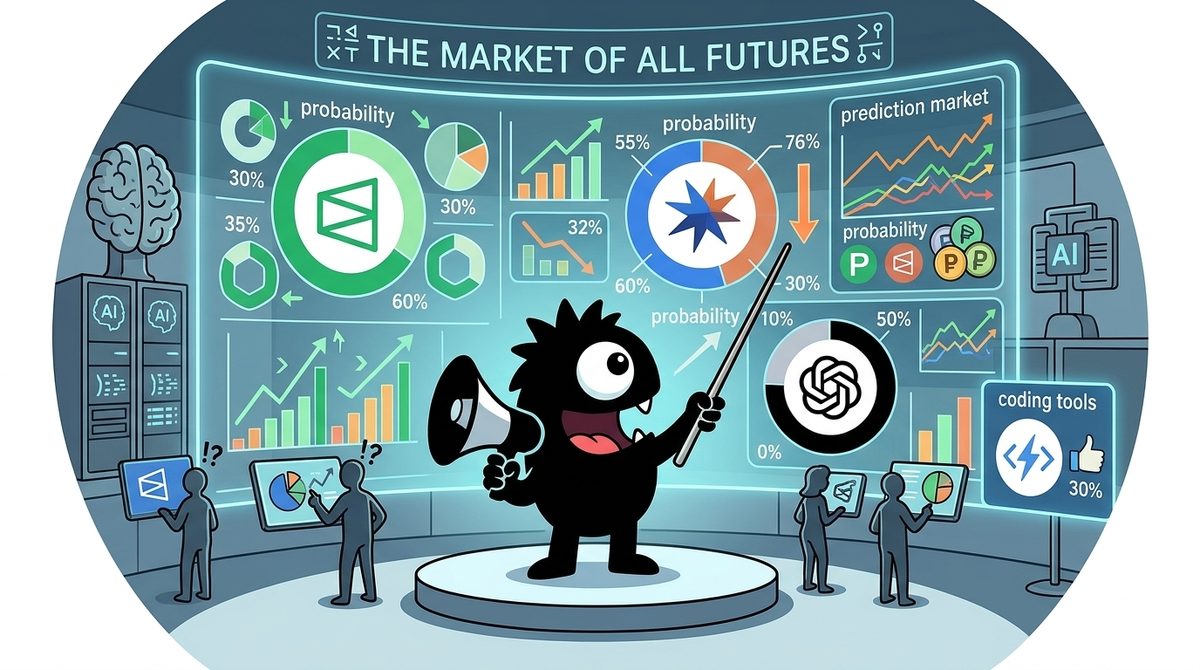
As of November 11, 2026, the question many developers and founders are asking is which AI lab is actually winning, and whether they should rebuild their stack around it. One of the clearest real-time signals is Polymarket's "Which company has best AI model end of 2026?" market[1]. Traders currently price Google as the heavy favorite at 72%, with Anthropic at 22% and OpenAI at just 2%.
The short answer is that the market expects Google to hold the #1 spot on one specific leaderboard on one specific date. It is not a verdict on which model will serve your workload best. For agentic coding and enterprise deployments, the evidence suggests Anthropic's position is stronger than 22% implies. Price-per-token claims also need testing on your own tasks before they drive a switch.
Bottom line (as of Nov 11, 2026):
- Google 72% / Anthropic 22% / OpenAI 2% / Meta 1% / Mistral 0% / Alibaba 0%. That is the market's implied probability of each company holding the top LMArena text ranking around December 31, 2026[1][2].
- Google's lead reflects Gemini 4 Carbon's benchmark run and aggressive launch pricing[12][8].
- Anthropic's lower odds understate its lead in coding agents and enterprise spend.
- The odds measure a narrow leaderboard outcome. Use them as a directional signal, not a procurement decision.
The Market as a Scoreboard: Reading Polymarket's $4.3M AI Race Bet
Polymarket is a prediction market. Traders buy "Yes" or "No" shares on an outcome, and each share pays $1 if the outcome resolves true. A share price of 72¢ therefore translates roughly into a 72% implied probability.
As of November 11, 2026, about $4,278,272 has been traded in the year-end market, which resolves around December 31, 2026[1]. Third-party trackers show Google hovering around 71.5–72%[2].
Current implied probabilities and trading volume per candidate:
| Company | Implied probability | Volume traded |
|---|---|---|
| 72% | $640,418 | |
| Anthropic | 22% | $568,954 |
| OpenAI | 2% | $314,374 |
| Meta | 1% | $307,941 |
| Mistral | 0% | $300,064 |
| Alibaba | 0% | $281,865 |
The settlement mechanism matters more than most casual readers realize. This market does not ask which model is smartest, or which one has the most users. It resolves on the top position of the LMArena text leaderboard, a crowd-sourced, human-preference ranking built from head-to-head model comparisons[4][5].
That makes the market a bet on one scoreboard at one moment. That narrowness is exactly why the conversation on X treats it as entertainment with real stakes:
people keep arguing over which lab is actually winning the ai race but right now the market on @polymarket for who has the best model by the end of november has google way out front at about 73% while anthropic sits around 24 and openai is basically an afterthought at 4.
every time a new arena score drops the odds twitch a bit and over 800k has already gone into it with another 35k just in the last day so traders are putting real cash on who tops that leaderboard instead of just arguing in replies.
feels like watching a bunch of overconfident models get ranked by people who actually have skin in the game.
That post refers to the sister end-of-November market, but the dynamic is the same one driving the year-end contract.
The volume table also holds a non-obvious detail. Mistral and Alibaba, both priced at 0%, have each traded nearly as much as OpenAI and about half as much as Google. Volume does not mean conviction. Much of the activity in near-zero contracts is likely market-making, hedging, and traders collecting fractions of a cent on "No." The more telling number is the price.
Why Traders Price Google at 72%: The Gemini 4 Carbon Effect
The single biggest driver behind Google's odds is Gemini 4 Carbon. Reporting on its launch describes it beating GPT-6 Astra and Claude Opus 5.5 on most benchmarks[12]. Composite trackers put it at or near the top of the frontier as of November 2026[8].
Google's lead was not always this wide. Odds-history data shows the race was much closer weeks ago[3], and the weekly standings posts on X capture how fast it widened:
Monday standings, 9 Nov:
1. Google DeepMind 100
2. Anthropic 81.3 (-5.4)
3. OpenAI 64.7
Polymarket 2026 odds widen: Google 65.5%, Anthropic 29% (was 53.5% vs 36.5%).
On @arena, Meta's Muse Wonder passed Claude Opus 5.5 for #3.
https://airacescoreboard.com/?utm_source=x&utm_medium=social&utm_campaign=standings-2026-11-09
The contracts moved from 53.5% vs. 36.5% to 65.5% vs. 29%, and then to today's 72% vs. 22%. That is a sustained repricing, not a one-day spike.
The same post notes that Meta's Muse Wonder passed Claude Opus 5.5 for #3 on Arena. That helps explain why Meta holds a 1% sliver rather than zero.
Leaderboard performance is only part of the picture. Practitioners running independent evaluations have flagged Google's computer-use models as especially strong on web-agent tasks:
The new Computer-Use model from @GoogleDeepMind has been crushing it in trusted benchmarks,
We benchmarked the model against the new models from @AnthropicAI as well as @OpenAI on Online Mind2Web & Web Voyager.
Gemini crushes them all in accuracy, speed, and cost (by a lot).
Treat this as one team's benchmark on specific suites (Online Mind2Web and WebVoyager), not a universal result. Still, it reinforces a pattern: Google is competing on accuracy, speed, and cost together.
There is also a strategic angle that traders may be pricing beyond the leaderboard itself. This argument was being made about last year's market too:
Over the last few days, on Polymarket, $GOOGL's lead as the best AI model by the end of 2025 has increased even further.
Anthropic odds have also risen, while those of OpenAI and xAI have decreased.
While $GOOGL's market share in LLM search will be much lower than the market share it has on traditional search on the enterprise side if $GOOGL turns out to be the best model provider and on top of it offers them via GCP on their TPU infrastructure, GCP's value could be much more than the market current anticipates.
The logic is vertical integration. If Google owns the top-ranked model, the TPU silicon it runs on, and the GCP distribution channel, then "best model" compounds into infrastructure leverage that pure-play labs cannot easily match. That doesn't guarantee a leaderboard win on December 31. It does explain why traders are comfortable paying 72¢.
One caveat: at least one composite summary describes Gemini 4 Carbon's top-ranked configuration as "restricted" (see the Grok summary embedded below). The model topping the board is not necessarily the one every developer can call today.
Anthropic at 22%: Second on the Board, First in the Enterprise?
If you only read the odds, Anthropic looks like a distant runner-up. Practitioner benchmarks and spending data on X tell a different story.
On coding tasks, Anthropic's models have posted results that rivals have struggled to match:
Anthropic is obliterating OpenAI
Claude Mythos 77.8% on SWE-Bench Pro
20% higher than GPT-5.4-xhigh
Composite rankings echo this. Claude models lead many agentic and coding categories even when they don't hold the overall #1 spot[8][11].
The more interesting debate is whether "which Claude model?" is even the right question anymore:
Most people are still asking:
Opus or Sonnet?
That may already be the wrong question.
Claude is starting to look less like an AI model and more like an AI operating layer.
The models are only one part of it.
Around them, Anthropic is building the pieces required to move AI from a chat window into real software:
→ Reasoning models
→ MCP and tool connectivity
→ Agent frameworks and SDKs
→ APIs and managed agents
→ Memory and context systems
→ Security and permissions
→ Evaluation pipelines
→ Governance and observability
→ Production deployment infrastructure
And that changes what it means to be good at AI engineering.
Prompting is becoming table stakes.
The harder skill is understanding how an agent gets context, remembers what matters, accesses tools safely, evaluates its own output, survives failures, and operates reliably inside a production system.
That is a very different skillset from simply knowing which model tops a benchmark.
In 2026, the advantage may not belong to the person who knows the best model.
It may belong to the person who understands how the entire AI stack fits together.
Claude’s evolution is a good preview of where AI engineering itself is heading.
This "operating layer" thesis is the key to reading Anthropic's 22% correctly. The LMArena market rewards one model winning one human-preference vote. Anthropic's commercial moat increasingly sits elsewhere:
- MCP tool connectivity
- Agent SDKs
- Memory and context systems
- Permissions
- Production deployment infrastructure
None of these show up in an arena Elo score.
The economics reinforce the point. Coding agents consume far more tokens than chat sessions, so the lab that wins agentic coding wins disproportionate revenue:
Claude Code enabled Anthropic to defeat OpenAI.
Average monthly spend, Q3 2026
- Enterprise user without Claude Code: under $75
- Top 5% of Claude Code users: $1,500
Agents burn far more tokens than chat, so a coding agent can read and write millions of tokens in 1 afternoon.
Large businesses run thousands of them.
This is why Anthropic is nearing profitability, while OpenAI is years from it.
Those spend figures come from the poster and should be read as a claim, not audited data. The underlying mechanism is sound, though. An agent that reads and writes millions of tokens per afternoon, multiplied across thousands of seats, is a fundamentally different revenue base from a chatbot subscription.
The synthesis: the market is pricing "best model on the arena." Builders care about "best model for shipping real software." Those two questions have different answers, and the 22% reflects only the first.
OpenAI at 2%: An Afterthought on the Board, or a Coiled Spring?
OpenAI's 2% is the starkest number in the market, especially since GPT-6 Astra still ranks near the top of several composite leaderboards[9][10]. As of early November, one widely shared summary placed it in the top three:
As of Nov 6 2026, composite leaderboards (BenchLM, BenchLeader, AA Index) put Gemini 4 Carbon (Google, restricted) first, followed closely by Claude Opus 5.5 (Anthropic) and GPT-6 Astra (OpenAI). GPT-6.1 Sol ranks next as strong value. Claude Opus 5.5 leads available models on agentic tasks and many human-preference arenas. Exact order shifts by benchmark.
View on XSo why does the market price OpenAI so low? Being third on composite indices doesn't help much when the contract pays out only for #1 on a single board. That is a winner-take-all structure.
The bear case has been building for a while. A year ago, the All-In podcast framed it as a pair trade:
Jason's AI Pair Trade: Short OpenAI. Long Google, xAI, and Anthropic.
Why? OpenAI's competition is fierce.
"They're facing a Google firing on all cylinders, Anthropic, and Grok beating them in the leaderboards pretty consistently."
Polymarket has Google's Gemini 3 at ~87% to finish 2025 as the top-ranked LLM.
Over the last six months, Gemini has started to shrink ChatGPT's massive lead in traffic share.
Recorded at the @VenetianVegas!
That quote references the 2025 market, which priced Google at about 87% to finish that year on top. It is a useful precedent. Traders have now leaned toward Google two years running, and the "fierce competition" thesis has hardened rather than faded. The defirate odds page reflects the same consensus positioning for 2026[5].
The contrarian view deserves airtime, though, because it is grounded in how developers actually buy:
OpenAI will win this round
- Mythos is way too expensive
- Gemini generally isn't great for agentic loops
GPT 5.6 will hit the sweet spot - FANTASTIC PRICE FOR PERFORMANCE
That post refers to earlier models, but its core argument still applies: the leaderboard-winning model is not always the one teams adopt at scale. Composite trackers flag GPT-6.1 Sol as a strong value option[10]. Price-for-performance, not peak capability, is what drives default choices in production.
What traders may be underweighting is the gap between leaderboard rank and market share. A 2% chance of holding #1 on December 31 is entirely compatible with OpenAI remaining a top-tier vendor by usage.
The Hidden Variable: Price Per Token vs. Cost Per Task
Pricing is where the headline odds can mislead buyers most:
Google rolled out Gemini 4 Carbon yesterday at $2 per million input tokens and $10 per million output tokens. The Verge says that's about a fifth of GPT-6 Astra's price and a quarter of Claude Fable 5.2's.
One thing people miss when they compare prices: models use different numbers of tokens for the same task. A cheaper rate can still cost more if the model writes more.
Test it on your own workload before you switch. The intro price doubles at the end of November.
On list price, Gemini 4 Carbon at $2/$10 per million tokens (input/output) is dramatically cheaper than the alternatives. Anthropic's Claude Fable 5.2 lists at $8/$40 per million tokens, with cheap cache reads and a 50% batch discount.
That post also contains the warning that matters most: models consume different numbers of tokens for the same task. A model that reasons verbosely, retries tool calls, or writes longer outputs can wipe out a 4–5× rate advantage.
The same idea shows up from the other direction:
I’m convinced Claude’s biggest advantage isn’t what it can do. It’s how efficiently it gets there.
In my experience, open-weight models like GLM 5.3 can solve the same problems, but they need more tokens and time to do so.
The real opportunity is reading how Claude strategises and performs this, and copying and pasting it into your other model.
Obviously, that's time-consuming, and you would have to do it for many types of tasks, which is basically what people at Anthropic may do for us. Still, you can get the same performance for specific tasks using cheaper models.
This is the real framework for evaluating model economics:
- Measure cost per completed task, not cost per token. Run a representative sample of your workloads and record total tokens, wall-clock time, and success rate.
- Factor in retries. A cheaper model that fails 15% more often on agentic loops may cost more once you count re-runs and human review.
- Account for pricing windows. The poster says Gemini 4 Carbon's intro price doubles at the end of November. If that applies to both rates, it would still undercut Fable 5.2's list price, but the gap narrows.
Benchmark aggregators that publish pricing alongside scores are useful starting points[8][11]. Your own eval harness is the only number that actually matters.
Polymarket vs. Kalshi: When the Same Race Has Two Prices
Polymarket isn't the only venue pricing this race, and the venues don't always agree:
Same AI race, two prices.
Best AI model at end of 2026, Google (Gemini):
Kalshi YES 64.9¢
Polymarket NO 29¢
Total 93.9¢ for a $1 payout, ~4.7% net after fees.
Both settle on the LMArena text leaderboard, but check times and tiebreaks differ.
https://arbprediction.com
This divergence is instructive. Both markets settle on the LMArena text leaderboard. Differences in check times and tiebreak rules mean they are not pricing exactly the same event.
For example, a model that briefly ties for #1, or overtakes the leader hours before one venue's snapshot, could resolve differently on each platform. Those mechanics create arbitrage, and they also signal genuine uncertainty about edge cases.
Independent analyses of the 2026 market reach a similar conclusion: the odds are a probabilistic read on a narrowly defined outcome, not a forecast of industry dominance[4][5]. Sub-markets with shorter horizons show how quickly sentiment can swing. In late October, Polymarket was calling an 83% chance that Google would dethrone Anthropic for the end-of-October contract:
BREAKING: Google projected to dethrone Anthropic as the company with the best AI model at the end of October.
83% chance.
https://polymarket.us/event/company1-2026-10-31
Earlier in the cycle, the year-end odds looked very different. Google had only just crept past Anthropic, at 43%:
BREAKING: Google overtakes Anthropic in the odds to lead the AI race at year-end, worrying investors ahead of Anthropic’s IPO.
43% chance.
How to read these markets critically:
- Price shows direction; it is not prophecy. A move from 43% to 72% tells you informed traders updated hard on new evidence.
- Thin markets twitch. About $4.3M is meaningful but not deep, and single arena-score drops can move prices several points.
- Read the resolution rules. Snapshot times and tiebreaks are where surprises hide.
Why the Odds Keep Moving: A Race Accelerating on Itself
A 72% lead with seven weeks to resolution sounds safe. Release cadence in 2026 suggests leads are perishable. The X conversation this week has focused on a claim about how fast frontier labs are now iterating:
AI is officially building AI.
METR's 11-week audit shows Anthropic's R&D is running up to 3x faster—with internal AI driving ~80% of that speedup.
Recursive self-improvement is no longer theoretical. It's live in production.
This figure comes from the poster's summary of a METR audit, and it should be weighed accordingly. If even part of that acceleration is real, release cycles are compressing. Launches are already arriving in quick succession, including Anthropic's latest pair of models:
Anthropic releases Claude Fable 5.2 and Claude Mythos 5.2.
Fable 5.2 is Anthropic’s most capable generally available model. It is built for demanding reasoning and long-horizon agentic work such as multi-day coding sessions, deep research, scientific analysis, and complex technical projects.
Mythos 5.2 is the same underlying model with lighter cybersecurity and biology safeguards. It is only available to verified organizations through Anthropic’s Cyber or Life Sciences Verification Programs.
Key specs:
• Model ID: claude-fable-5-2
• Context window: 1 million tokens
• Max output: 128,000 tokens
• Knowledge cutoff: June 2026
• Thinking: Adaptive (always on), controlled by effort level
• Inputs: Text and images
• Output: Text
Pricing:
• Standard: $8 per million input tokens / $40 per million output tokens (20% lower than Fable 5.1)
• Cache reads: $0.20 per million tokens
• Optional fast mode (up to 2.5× faster): $16 input / $80 output per million tokens
• Batch API: 50% off
Performance and speed:
• Outputs up to 30% faster than Fable 5.1
• Clearer communication reported by testers
• Available on Claude API and apps, Amazon Bedrock, Google Cloud, and Microsoft Azure / Foundry
Benchmark highlights (Anthropic’s published numbers):
• FrontierCode 2.0: 49.1% (highest of any released model they tested)
• FrontierSWE v2: 69.9%
• Terminal-Bench-Science 0.1: 74.6% (Mythos 5.2: 75.3%)
• RoboDojo Sim: 64.9%
• Humanity’s Last Exam (with tools): 74.2%
• Remote Labor Index: 41.3%
• OSWorld 2.1 (partial): 89.3%
• Chartography: 73.4%
It leads or is highly competitive against Opus 5.5, GPT-6 Astra, and Gemini 4 Carbon on most coding, science, and agentic benchmarks. It trails slightly on AutomationBench (business workflows).
Per that post, Anthropic's own published benchmarks show Fable 5.2 leading or competitive with Opus 5.5, GPT-6 Astra, and Gemini 4 Carbon on most coding and agentic evals. Notably, it trails slightly on business-workflow automation.
Composite trackers reshuffle as these launches land[8][9]. Every reshuffle is a potential repricing event for the market.
For anyone signing long-term vendor commitments, the takeaway is uncomfortable but clear. The model that leads today may not lead next quarter. Contracts, architectures, and roadmaps should assume the frontier will keep rotating.
What Should Developers, Founders, and SaaS Buyers Do With These Odds?
The practical question running under every thread is the same: which lab should I bet my stack on right now? The market's answer is narrower than that question, so here are decision criteria by role.
For developers: which model should you build on?
- Choose by task, not by leaderboard. Based on current evidence:
- Anthropic is the strongest fit for long-horizon agentic coding and complex tool use.
- Google stands out for cost-sensitive workloads, speed, and computer-use or web-agent tasks.
- OpenAI's GPT-6.x variants are worth evaluating when price-for-performance on general tasks is the priority[10].
- Build a cost-per-task eval. Track tokens consumed, latency, and success rate on your real workloads before switching for a lower per-token rate.
For founders: how do you avoid betting on the wrong lab?
- Architect for portability. With odds swinging 20+ points in weeks, single-vendor lock-in is a strategic risk.
- Use abstraction layers and open protocols like MCP, so swapping models is a configuration change rather than a rewrite.
- Watch pricing leverage. If Google keeps pairing top-tier capability with aggressive pricing, competitors may respond. That benefits founders who can switch quickly.
For SaaS buyers: how much weight should the odds carry?
- Treat the odds as a directional signal of where capability and pricing leverage are concentrating in late 2026. Do not treat them as a guarantee of who wins[1].
- Ask vendors which models they route to and why. A product built on the "winning" model isn't automatically better for your use case.
- Remember what "winner" means. The market resolves on the LMArena text leaderboard around December 31, 2026. That outcome may have little to do with agentic reliability, enterprise security, or total cost.
The prediction market is a sharp, real-money read on one scoreboard. Traders currently price Google as the clear favorite to top it. The more useful lesson is that the AI race now has several finish lines, and the one that matters depends on what you're building.
Sources
[1] Polymarket — Which company has best AI model end of 2026? — https://polymarket.com/event/which-company-has-best-ai-model-end-of-2026
[2] Which company has best AI model end of 2026? Odds: Google 71.5% | Polymarket Odds Today — https://polymarkettrader.com/odds/which-company-has-best-ai-model-end-of-2026/
[3] Polymarket AI odds history: best AI model end of 2026 — https://airacescoreboard.com/polymarket-ai-odds-history/
[4] Best AI Model 2026 on Polymarket: Who Leads the Odds — https://mercadodice.com/en/analysis/best-ai-model-2026-polymarket
[5] Best AI Model 2026 Odds: Who Will Be #1 at Year-End? — https://defirate.com/odds/best-ai-model-2026/
[7] Which company has the best AI model end of November — Odds & Predictions — https://computing.net/predictions/market/which-company-has-the-best-ai-model-end-of-november/
[8] Frontier AI Models: Live Top 10 Rankings, Evidence and Pricing (November 2026) | BenchLM.ai — https://benchlm.ai/frontier-ai-models
[9] All AI models: full benchmark table | Fanetti AI — https://www.fanettiai.com/benchmarks/all/
[10] Best AI Models in 2026: The Complete Ranking | The AI Rankings — https://theairankings.com/best-ai-models/
[11] Generative AI Model Ranking Matrix · Veso Research — https://veso.ai/research/ai-models
[12] Google Launches Gemini 4 Carbon, Beats GPT-6 Astra, Claude Opus 5.5 On Most Benchmarks — https://officechai.com/ai/gemini-4-carbon-benchmarks/
References (16 sources)
- Polymarket — Which company has best AI model end of 2026? - polymarket.com
- Which company has best AI model end of 2026? Odds: Google 71.5% | Polymarket Odds Today - polymarkettrader.com
- Polymarket AI odds history: best AI model end of 2026 - airacescoreboard.com
- Best AI Model 2026 on Polymarket: Who Leads the Odds - mercadodice.com
- Best AI Model 2026 Odds: Who Will Be #1 at Year-End? - defirate.com
- Which company has the best AI model end of November Odds: Prediction Market Favorites (November 2026) - windailysports.com
- Which company has the best AI model end of November — Odds & Predictions - computing.net
- Frontier AI Models: Live Top 10 Rankings, Evidence and Pricing (November 2026) | BenchLM.ai - benchlm.ai
- All AI models: full benchmark table | Fanetti AI - fanettiai.com
- Best AI Models in 2026: The Complete Ranking | The AI Rankings - theairankings.com
- Generative AI Model Ranking Matrix · Veso Research - veso.ai
- Google Launches Gemini 4 Carbon, Beats GPT-6 Astra, Claude Opus 5.5 On Most Benchmarks - officechai.com
- AI Benchmarks 2026: All 256 LLM Benchmarks Explained - benchleader.com
- Claude Overtakes GPT in AI Model Adoption as Market Heads to $5.3 Trillion - futurumgroup.com
- 2026: The State of Enterprise AI - menlovc.com
- LLM Market Share by Company & Category (Q4 2026) - respan.ai
Related Guides

What Is Cloudflare Workers? A Complete Guide for 2026
22 min read
The Best AI Model Tools in 2026: What Polymarket's $4.2M Bet Reveals About Where AI Is Heading
19 min read
Cursor vs Aider vs Claude Code: Which AI Coding Tool Should Solo Founders Bet On?
15 min read
The Best AI Model Tools in 2026: What Polymarket's $4M Bet on Google Reveals
17 min read