The Best AI Model in 2026: What $4.5M in Polymarket Bets Reveals About the Race
Polymarket odds put Google at 83% to have the best AI model by end of 2026. Discover what traders, benchmarks, and the full-stack bet imply for builders. Learn more.
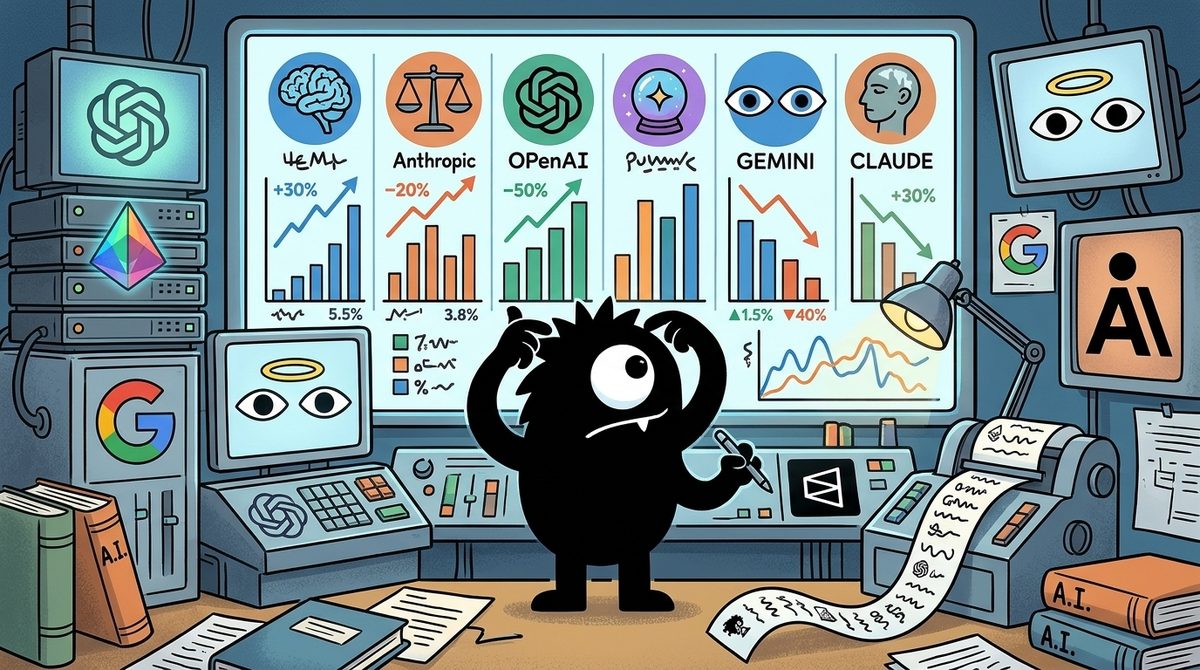
The question behind the Polymarket market "Which company has best AI model end of 2026?" is simple: who is actually winning the AI race, and should that change which model you build on or buy?
As of November 19, 2026, the market implies Google is the overwhelming favorite at 83%, with Anthropic far behind at 11%[1]. That number is not a verdict on which model is smartest. It is a bet on which company tops one specific leaderboard on one specific date. On most independent intelligence indices, the gap between Google, Anthropic, and OpenAI is only a few points. For practitioners, the useful signal is not "Google is best." It is that traders believe Google has the momentum, shipping cadence, and structural advantages to hold the top slot through year-end.
Bottom line (as of Nov 19, 2026):
- Polymarket traders currently price Google at 83%, Anthropic 11%, OpenAI 3%, Meta 1%, Alibaba and Mistral 0%, on roughly $4.47M in volume[1].
- The market resolves around December 31, 2026, based on a leaderboard ranking. It measures who ranks #1, not who is best for your workload.
- Independent benchmarks disagree on the leader. Claude, GPT-6.2, and Gemini 4 each top a different index.
- For buyers, cost per task and task fit matter more than the market's favorite.
The Market Has a Favorite, and It's Not Close
Here is the live board as of November 19, 2026[^1]:
| Company | Implied probability | Volume traded |
|---|---|---|
| 83% | $678,797 | |
| Anthropic | 11% | $603,144 |
| OpenAI | 3% | $330,144 |
| Meta | 1% | $336,201 |
| Alibaba | 0% | $315,457 |
| Mistral | 0% | $300,149 |
Total market volume sits around $4,472,825. The listed contracts account for only part of that, and the remainder is spread across other outcomes on the board. Aggregators tracking the same contract have recently shown Google as high as 84%[2]. Cross-platform odds trackers show a similar consensus forming across prediction venues[6].
The paradox is easy to state. An 83% favorite usually implies a dominant competitor. Yet the frontier models themselves are separated by single-digit points on most intelligence indices. That tension is what the X conversation keeps returning to:
GOOGLE IS DOMINATING THE AI RACE. BUT FOR HOW LONG?
@Google's odds of having the best AI model by the end of 2026 have surged to 76% on prediction markets.
> @AnthropicAI sits at 19%.
> @OpenAI - Just 3%.
But...
Anthropic's Claude Opus 5.5 is just 15 points behind the leader.
One major update could be enough to flip the rankings.
With weeks left until the end of 2026, is Google's 76% confidence really justified? 👀
DOXA's question, whether Google's confidence is "really justified" when "one major update could be enough to flip the rankings", is the right one. The answer depends on understanding what the market is actually pricing.
This matters beyond trading. Prediction markets compress a lot of dispersed information into one number: release calendars, leaked benchmarks, compute deals, and trader sentiment. Developers choosing a default model, founders picking an inference vendor, and SaaS buyers negotiating multi-year contracts can all use that number as a momentum and vendor-risk gauge, as long as they don't mistake it for a quality ranking.
Why Do Polymarket AI Odds Swing So Violently?
How fast have Google's odds moved in late 2026?
Google's position was not always this commanding. Earlier snapshots of the same market showed Google at around 69%[4]. Historical tracking shows a steep climb from there into the high 70s and then past 80% as November's flagship releases landed[7]. Claudiu Micu's Monday standings captured one of the sharpest moves:
Monday standings, 16 Nov:
1. Google DeepMind 89.5 (+4.5)
2. Anthropic 77.9 (-3.4)
3. OpenAI 64.5
Polymarket 2026 odds swing again: Google 76.5%, Anthropic 17.5% (was 65.5% vs 29%).
On @arena WebDev, Claude Fable 5.2 debuts at #1.
https://airacescoreboard.com/?utm_source=x&utm_medium=social&utm_campaign=standings-2026-11-16
That is a swing from 65.5% to 76.5% for Google, and from 29% to 17.5% for Anthropic, in a short window. Three days later, the market sits at 83% versus 11%[1]. Anthropic lost more than half its implied probability in roughly a week, during the same period that Claude Fable 5.2 debuted at #1 on Arena's WebDev board.
What is the market actually betting on?
The volatility is not irrational. It follows from three mechanics:
- Resolution is tied to a single leaderboard ranking at a fixed date. Per the market's rules, this contract resolves based on which company holds the top spot on an arena-style leaderboard at year-end[1]. Traders are not voting on "best model" in any holistic sense. They are forecasting one ranking on one day.
- Timing risk dominates capability risk. A model released on December 20 matters more than one released in October, because it is fresher on the leaderboard and harder to answer before resolution. Every rumored drop gets priced instantly.
- Near-term markets anchor long-term ones. A sister market on which company will have the best model at the end of November priced Google at roughly 95% as of November 19[3][5]. When traders are near-certain about the next 11 days, the year-end contract inherits much of that confidence. The remaining ~17% is essentially the market's estimate that someone ships something decisive in December.
Practitioner takeaway: read big swings as reactions to release events and ranking changes, not as shifts in underlying model quality. A 10-point move in a week usually means a new model hit the leaderboard, not that a vendor got meaningfully worse at your tasks.
The Leaderboards Don't Agree: Which "Best" Is the Market Betting On?
If you've seen confident claims on X about who's #1, you've probably noticed that everyone cites a different #1. That isn't spin. It reflects real disagreement between indices.
Artificial Analysis Intelligence Index: Claude Fable 5.2 leads at roughly 64.6 to 65. Gemini 4 Neon sits at 61, and GPT-6.2 Sol is in the high 50s to low 60s depending on configuration[8][12].
Epoch's ECI: GPT-6.2 Astra edges out Claude Fable 5.2 and Gemini 4 Carbon in the latest leaderboard aggregations[9][10].
Arena and task-specific boards: Claude Fable 5.2 debuted at #1 on WebDev. Gemini leads long-context and computer-use workflows, and holds strong positions on the text arena[11][12].
Here's how one commentator summarized the mid-November landscape:
AI Progress Nov 2026: Still Climbing, Not Plateaued
Part 1/6 — Current Landscape (as of Nov 14)
The frontier is tight at the top.
Closed leaders:
• Claude Fable 5.2 (Anthropic, Nov 9) — #1 on most indices (ECI ~173-174, AA 65). Strongest on agentic coding, research, computer use.
• Gemini 4 Carbon (Google) — Close second, wins some workflows.
• GPT-6 Astra / 6.1 Sol (OpenAI) — Competitive on price/perf.
• Claude Opus 5.5 — Still excellent.
Best open: Kimi K3.1 Pro (~161 ECI). Gap to closed ~6-12 pts (~6 months).
Biggest jumps now in agentic reliability & longer task horizons, not raw knowledge.
#AI #LLM #Claude #Gemini #GPT
The detail that matters most is "biggest jumps now in agentic reliability & longer task horizons, not raw knowledge." The leaderboards are diverging partly because they measure different things. Some reward knowledge and reasoning. Some reward human preference in chat. Others reward performance on long agentic tasks.
Gemini 4 Neon's launch on November 19 shows why headline scores can mislead:
BREAKING: Google DeepMind just shipped Gemini 4 Neon.
61 on the Artificial Analysis Index. Claude Opus 5.5 sits at 59, GPT-6.2 Sol at 57.
Priced at $3 per million input tokens and $15 per million output.
The numbers that matter most for builders aren't the headline score.
Long context (GraphWalks, 256k to 1M): 95.2% vs 66.8% for Opus 5.5 and 80.1% for Sol.
Knowledge work (AutomationBench): 56.3% vs 42.5% and 41.3%.
Neon sits between Carbon and Hydrogen in the Gemini 4 lineup. Hydrogen landed November 12. Neon a week later. Google is now shipping frontier models on a weekly cadence and pricing them to be the default.
According to Guillermo Flor, Gemini 4 Neon scores 95.2% on long-context GraphWalks (256K to 1M tokens), versus 66.8% for Opus 5.5 and 80.1% for Sol. On AutomationBench knowledge work, Neon scores 56.3% versus 42.5% and 41.3%. A model that is three or four points behind on a composite index can be 15 to 30 points ahead on the task you actually care about.
The lesson for buyers: "best" is a function of the benchmark, and the benchmark should be a function of your workload. The Polymarket contract picks one resolution source. You should pick the evaluation that mirrors your production traffic. Several 2026 leaderboard aggregators now let you filter by use case for exactly this reason[9][14][16].
Smartest vs. Cheapest: Is Intelligence Per Dollar the Real Race?
The most energized practitioner debate on X right now isn't about who's #1. It's about whether #1 even matters commercially. John McKeown's post crystallized it:
Everyone is discussing whether GPT-6.2 beats Claude.
Wrong question IMO.
On Artificial Analysis, Claude scores 65 and costs $26.54 a task. OpenAI's new model scores 62 for $4.
$4 DOLLARS!!!!!!!!!!
That means OpenAI is going straight for enterprise budgets. CFOs don't buy the smartest model, they are business people and the one that's good enough at a sixth of the price will win.
That's Anthropic's whole business during it's IPO.
I'd be scared if I were them.
The numbers he cites: Claude scores 65 at about $26.54 per task on Artificial Analysis, and OpenAI's new model scores 62 at about $4. That is a roughly 6.6x cost difference for a 3-point intelligence gap. For a team running millions of agentic tasks per month, the difference is between a rounding error and a line item that reaches the board.
Google is competing on the same axis. Timurs Jeparskis broke rankings down by price tier:
If we divide all AI models into different price segments, the intelligence rankings currently look like this:
🥇 Flagship — Claude Fable 5.2 (Anthropic)
The smartest, but also an extremely expensive model! Scores 64.6 points on the Artificial Analysis Intelligence Index.
🥈 Mid-range — Gemini 4 Neon (Google)
An absolute beast for its price! Scores 61 points, outperforming GPT-6.2 Sol and Claude Sonnet 5.5.
🥉 Fast and affordable — Gemini 4 Hydrogen (Google)
An excellent balance of intelligence and cost! Scores 53.9 points, beating GPT-6.1 Terra.
🏅 Ultra-fast and ultra-cheap — Claude Haiku 5.5 (Anthropic)
Scores 36.5 points, almost tied with Meta Muse Ember.
Final score:
🟢 Google — 2 wins
🟠 Anthropic — 2 wins
⚫ OpenAI — 0 wins
His tally gives Google two tier wins (Gemini 4 Neon in mid-range, Gemini 4 Hydrogen in fast and affordable) and Anthropic two (Fable 5.2 at the flagship tier, Haiku 5.5 at ultra-cheap). OpenAI gets zero, despite McKeown's cost-per-task argument. Even the "intelligence-per-dollar" framing produces different winners depending on how you slice tiers.
Maha's weekly LLM Watch named the theme directly:
🧠 𝗟𝗟𝗠 𝗪𝗮𝘁𝗰𝗵 — 𝗧𝗵𝘂𝗿𝘀𝗱𝗮𝘆, 𝗡𝗼𝘃 𝟭𝟵
Google, OpenAI and Alibaba all shipped new flagships this week with cost per task as the common battleground, while Tencent and SenseTime pushed efficient open-weight models.
🔥 𝗧𝗢𝗣 𝗠𝗢𝗗𝗘𝗟 𝗡𝗘𝗪𝗦
⚡ 𝗚𝗼𝗼𝗴𝗹𝗲 𝘀𝗵𝗶𝗽𝘀 𝗚𝗲𝗺𝗶𝗻𝗶 𝟰 𝗡𝗲𝗼𝗻
Neon sits between Carbon and Hydrogen in the Gemini 4 lineup, with a 1M-token context window at $3 per million input and $15 per million output tokens. Google says it scores 61 on the Artificial Analysis Intelligence Index (#3 overall), ranks #2 on the Vals Index, and costs roughly 50-80% less per task than top competing frontier models.
"Cost per task as the common battleground" describes where the industry is heading. Google says Neon costs roughly 50 to 80% less per task than top competing frontier models, at $3 per million input tokens and $15 per million output tokens[8][12].
Does the prediction market undervalue the companies winning on cost?
Here's the non-obvious implication. A market keyed to a single "best model" leaderboard structurally ignores price. If OpenAI wins enterprise budgets with a "good enough at a sixth of the price" strategy, it could gain significant market share while still being priced at 3% in this contract. The market answers "who ranks first," not "who wins the most revenue." Founders building SaaS on top of these models should care far more about the second question.
For SaaS buyers budgeting 2026–2027 inference spend:
- High-stakes, low-volume tasks (complex code generation, legal or financial analysis): paying for the flagship tier can be justified.
- High-volume, moderate-difficulty tasks (support, summarization, extraction): mid-tier models like Gemini 4 Neon or GPT-6.2 Sol likely deliver better economics.
- Latency-sensitive, simple tasks: the ultra-cheap tier (Haiku 5.5 and peers) is good enough.
Why Is Anthropic Only at 11%? The Narrative and the IPO Question
Anthropic's position is the strangest on the board. Claude Fable 5.2 leads the Artificial Analysis index, debuted #1 on WebDev, and Anthropic has a long record of dominating coding benchmarks. Yet traders currently price it at just 11%.
Part of the explanation is mechanical: the resolution leaderboard, Google's release cadence, and December timing risk. Part of it shows up in a skeptical thread circulating on X:
GPT-6.2 Astra/Sol launch with significant efficiency gains, yet the discourse quickly pivots to why Claude is supposedly superior.
Coincidence? Possibly.
But with Anthropic approaching an IPO, there's an obvious financial incentive to establish Claude as the undisputed frontier leader.
I'm not alleging a proven coordinated campaign. I'm asking whether the AI community is scrutinizing the incentives behind the narratives it amplifies.
If a model delivers comparable or better results at a fraction of the cost, dismissing it as inferior is not serious analysis.
Show independent evaluations, disclosed conflicts of interest, transparent methodologies, and real-world cost comparisons.
The author is careful: "I'm not alleging a proven coordinated campaign." The demand for "independent evaluations, disclosed conflicts of interest, transparent methodologies, and real-world cost comparisons" is reasonable regardless of where you stand. When a company is approaching a public offering, the story that its model is the undisputed frontier leader has direct financial value.
The counter-thesis is that Claude's lead in agentic coding is real and long-standing. Earlier in 2026, posts like this were common:
Anthropic is obliterating OpenAI
Claude Mythos 77.8% on SWE-Bench Pro
20% higher than GPT-5.4-xhigh
Grok's neutral summary of the head-to-head, posted this week, reflects a common practitioner view:
Claude (Anthropic) currently edges pure intelligence and coding benchmarks (SWE-bench etc.) plus long-document coherence and natural instruction-following. ChatGPT (OpenAI) wins on native image generation, voice, and broader consumer tools/ecosystem.
Alignment: Claude leans harder on Constitutional AI (self-critique against explicit principles). ChatGPT more on classic RLHF from human prefs. Both run ~1M context and $20/mo plans. Use Claude for code or careful writing; ChatGPT for multimodal or general versatility. Most power users run both.
"Use Claude for code or careful writing; ChatGPT for multimodal or general versatility. Most power users run both." That last line is the most honest data point in the whole debate.
The financial stakes explain why narrative matters so much. Theo's post on expected run rates made the rounds:
Anthropic 2026 expected run rate - ~$110B (24x)
OpenAI 2026 expected run rate - ~$70B+ (5.4x+)
Meta 2026 expected run rate - ~$295B (1.5x)
I'm so tired.
The figures he lists are about $110B for Anthropic at roughly 24x, about $70B+ for OpenAI at roughly 5.4x+, and about $295B for Meta at roughly 1.5x. Theo is listing the multiple alongside each run-rate estimate, and the spread is the point. Reporting on the Anthropic–OpenAI race has highlighted how quickly Anthropic's enterprise revenue has scaled relative to its rivals[11]. A steep multiple implies investors are paying for continued frontier leadership, and that is exactly what an 11% market price questions.
The reconciliation: Anthropic can lead on coding and agentic work while also being a poor bet to top a general arena leaderboard on December 31. Both things can be true. The market isn't saying Claude is bad. It's saying Claude probably won't be #1 on this scoreboard on that date.
Why Are Traders Really Betting on Google? The Full-Stack Moat
If benchmarks are this close, why 83%? The deepest thread in the X conversation argues that traders aren't betting on Gemini alone. They're betting on Google's structure.
Google is destined to win and its going to be decade for Deepmind and efforts towards AI for Science.
Probably only company that controls the full stack. chips + data centers + models + distribution (search, android, youtube, workspace).
+ anthropic signed up for a million TPUs over a GW of compute in 2026. meta is in talks to rent and then buy. openai hasn't even deployed TPUs yet. insane W.
The thesis: Google is "probably the only company that controls the full stack": chips, data centers, models, and distribution through Search, Android, YouTube, and Workspace. The compute-dependency claims stand out. Anthropic reportedly signed up for a million TPUs and over a gigawatt of compute in 2026, Meta was reportedly in talks to rent and then buy, and OpenAI hadn't deployed TPUs. If your closest competitor runs on your silicon, you have a cost and capacity advantage that doesn't appear on any benchmark.
This changes how to read Google's earlier "weak" moments. When Gemini 3.6 Flash trailed in coding, some argued Google was falling behind. Others disagreed:
A lot of people are saying Google is falling behind after Gemini 3.6 Flash.
I think they're reading it the wrong way.
To me, Google has changed its strategy.
Yes, Gemini is behind GPT-5.6 Luna, Grok 4.5, and Claude Sonnet 5 in coding.
But it leads in computer use, visual understanding, and long context. At 1 million tokens, it scores more than twice as high as Gemini 3.5 Flash.
That doesn't look like a company that is losing.
It looks like a company building for real work.
"It looks like a company building for real work." The argument holds up in hindsight. The areas Google prioritized (long context, computer use, visual understanding) are the capabilities agentic products depend on, and Gemini 4 Neon's 95.2% long-context score is the result. Earlier Gemini 4 releases showed the same pattern of strong arena placement with aggressive pricing:
google team cooked harder with this model
almost all benchmark scores are live now and gemini 4 argon is ranked first or second on most of them and model:
> has lowest hallucination rate
> tops vals index
> ranked first on text arena
> scored 53 on AA, same as astra
> cheaper than astra, sonnet, fable and opus per task
> not token efficient sadly
i don’t trust benchmarks much, but these numbers look are looking good man
if someone from google team is reading this, please gib access, wanna test model and post about it
is this google comeback?
That post cites lowest hallucination rate, top of Vals index, first on text arena, and cheaper per task than Astra, Sonnet, Fable, and Opus. It also notes "not token efficient sadly." Even enthusiasts flag tradeoffs.
Add the cadence Flor noted (Hydrogen on November 12, Neon a week later) and the 83% looks less like a judgment on current model quality and more like structural confidence[2][6]. Traders appear to believe Google can answer any rival release before December 31 because it owns the compute, the pipeline, and the distribution to ship again quickly. The odds measure the ability to respond, not just the current lead.
What Do Meta, Alibaba, and Mistral's 0–1% Odds Really Mean?
Look at the volume column again. Meta has $336,201 traded at 1%. Alibaba has $315,457 at 0%. Mistral has $300,149 at 0%[1]. That's close to $1M in combined action on outcomes the market treats as near-impossible.
Volume does not equal probability. Heavy trading on a near-zero contract usually means traders are actively selling "No" positions or buying cheap lottery tickets. They are betting these companies won't hold the #1 arena slot. The money signals engagement, not belief.
That doesn't make these players irrelevant to builders. Maha's November 19 roundup noted Alibaba shipping a new flagship, with Tencent and SenseTime pushing efficient open-weight models. The best open model, Kimi K3.1 Pro, sits roughly 6 to 12 ECI points behind the closed frontier, which is about six months of progress by one estimate. For teams that need self-hosting, data residency, or fine-tuning control, that gap is often an acceptable price.
Meta shows the gap between scale and leaderboard position most clearly. A company with an estimated ~$295B run rate and enormous AI spend is priced at 1% to have the best model. Scale buys distribution and infrastructure. It doesn't automatically buy the top leaderboard slot. Cross-platform odds tracking shows similarly low pricing for these players across venues[6].
What Should Developers, Founders, and SaaS Buyers Actually Do?
Treat the market's odds as expectations, not instructions. Here's how to translate them into decisions.
1. Buy the model that wins your task, not the market's favorite.
- Agentic coding, careful long-form writing: Claude (Fable 5.2 at the top end, Sonnet tier for volume) remains the default many practitioners cite[8].
- Long-context retrieval, computer use, document-heavy agents: Gemini 4's long-context numbers are hard to ignore.
- Cost-sensitive enterprise workloads at scale: GPT-6.2 Sol and Gemini 4 Neon compete hardest on cost per task.
- Self-hosted or regulated environments: evaluate open-weight options like Kimi K3.1 and recent Alibaba and Tencent releases.
2. Use prediction-market odds as a momentum and procurement-risk signal. An 83% price tells you where traders think shipping velocity and leaderboard position are heading[1]. It's useful context when negotiating contracts or deciding which vendor's roadmap to align with. It is not a quality benchmark.
3. Hedge against lock-in. The frontier reshuffles monthly. Anthropic's odds halved in a week while it held the #1 WebDev slot. Build model-agnostic abstractions, keep evals for your own tasks, and assume your best model in Q1 2027 may differ from today's.
4. Watch compute and distribution, not just benchmarks. If you're forecasting which vendor stays dominant through 2027, follow who owns chips, who rents them, and who controls distribution. Reporting on the Anthropic–OpenAI race shows how quickly revenue positions can shift[11], and the full-stack thesis is the clearest explanation for why traders give Google so much benefit of the doubt.
The market currently implies Google is the likely year-end leader on one scoreboard. Your job is to work out which scoreboard actually matches your workloads, and that answer probably isn't 83% anyone's.
Sources
[1] Polymarket — Which company has best AI model end of 2026? — https://polymarket.com/event/which-company-has-best-ai-model-end-of-2026
[2] Polymarket best AI model odds end of 2026: Google DeepMind 84% — https://airacescoreboard.com/polymarket-best-ai-model-odds/
[3] Which company has the best AI model end of November odds: Google 95% (19 Nov) — https://predictrips.com/odds/q/which-company-has-the-best-ai-model-end-of-november
[4] Which company has best AI model end of 2026? Odds: Google 69% — https://polymarkettrader.com/odds/which-company-has-best-ai-model-end-of-2026/
[5] Which company has the best AI model end of November — Odds & Predictions — https://computing.net/predictions/market/which-company-has-the-best-ai-model-end-of-november/
[6] AI Model Odds — across 8 platforms — https://pdata.world/odds/ai
[7] Polymarket AI odds history: best AI model end of 2026 — https://airacescoreboard.com/polymarket-ai-odds-history/
[8] Best AI Models in 2026: The Complete Ranking — https://theairankings.com/best-ai-models/
[9] LLM Leaderboard & AI Model Benchmarks — Nov 2026 — https://benchlm.ai/
[10] AI benchmarks — https://www.fanettiai.com/benchmarks/
[11] Anthropic vs. OpenAI: Who's Winning the AI Race? — https://www.visualcapitalist.com/frontier-ai-model-race-anthropic-openai/
[12] AI Leaderboard November 2026: Best AI Models Ranked — https://hyzenpro.com/ai-leaderboard/
[14] LLM Leaderboard (Nov 2026): Top AI Models | BenchLeader — https://www.benchleader.com/
[16] AI leaderboards, by what you actually need | AIVIO News — https://aivionews.com/leaderboards/
References (16 sources)
- Polymarket — Which company has best AI model end of 2026? - polymarket.com
- Polymarket best AI model odds end of 2026: Google DeepMind 84% - airacescoreboard.com
- Which company has the best AI model end of November odds: Google 95% (19 Nov) - predictrips.com
- Which company has best AI model end of 2026? Odds: Google 69% - polymarkettrader.com
- Which company has the best AI model end of November — Odds & Predictions - computing.net
- AI Model Odds — across 8 platforms - pdata.world
- Polymarket AI odds history: best AI model end of 2026 - airacescoreboard.com
- Best AI Models in 2026: The Complete Ranking - theairankings.com
- LLM Leaderboard & AI Model Benchmarks — Nov 2026 - benchlm.ai
- AI benchmarks - fanettiai.com
- Anthropic vs. OpenAI: Who's Winning the AI Race? - visualcapitalist.com
- AI Leaderboard November 2026: Best AI Models Ranked - hyzenpro.com
- LLM Leaderboard: AI Model Benchmark Rankings - unifybench.ai
- LLM Leaderboard (Nov 2026): Top AI Models | BenchLeader - benchleader.com
- LLM Leaderboard (November 2026): AI Model Rankings & Benchmarks | WriteWorks - writeworks.ai
- AI leaderboards, by what you actually need | AIVIO News - aivionews.com
Related Guides
Perplexity AI vs Azure OpenAI vs xAI Grok: Which Is Best for SEO and Content Strategy in 2026?
24 min read
The Best AI Model Bet: What Google's 78% Odds for 2026 Reveal About the Industry
21 min read
Zed vs JetBrains AI Assistant: Which Is Best for Enterprise Teams in 2026?
17 min read
The Best AI Model Tools in 2026: What Polymarket's $4.4M Market Reveals About the Frontier Race
18 min read