The Best AI Model in 2026: What Polymarket's $2.1M Market Reveals About the Frontier
Polymarket's $2.1M best-AI-model-2026 market prices Anthropic at 48% and Google at 42%. Discover what the odds reveal for developers, founders, and SaaS buyers.
The real question for developers, founders, and SaaS buyers is not whether Anthropic or Google will “win” AI in 2026. It is whether today’s market expectations should change which models, clouds, and contracts they choose now.
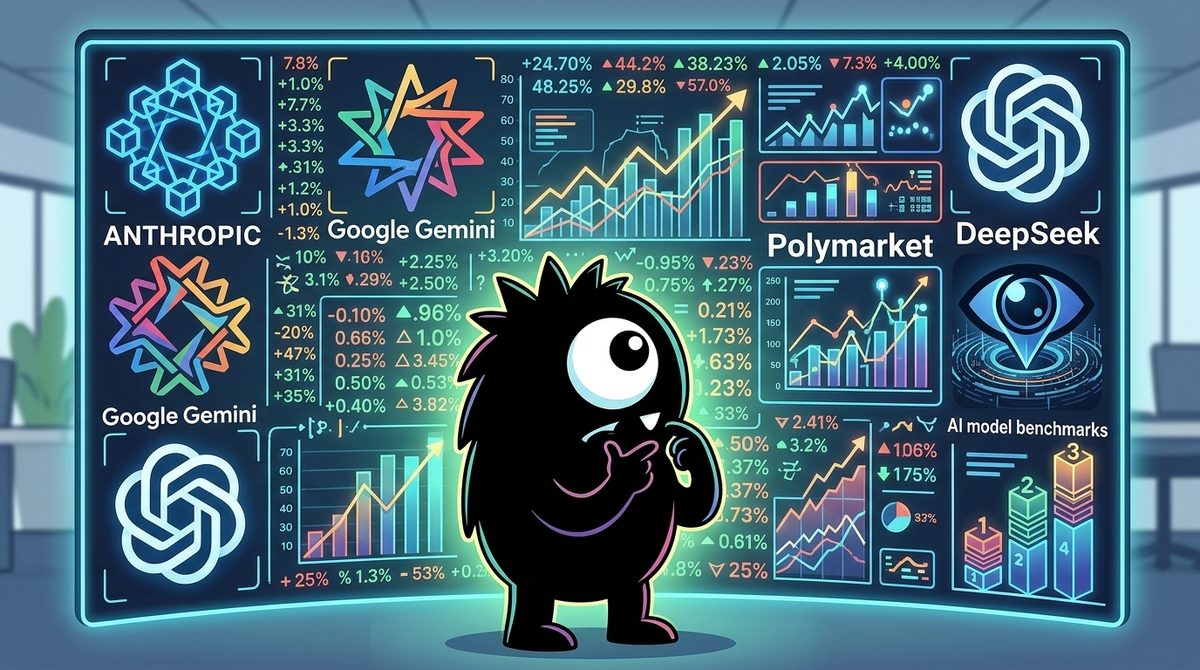
As of October 5, 2026, Polymarket traders imply a two-company race: Anthropic at 48% and Google at 42%, followed by OpenAI at 5%, xAI at 1%, and Alibaba and DeepSeek at roughly 0%. About $2,129,388 has been traded in the market, which is expected to resolve around December 31, 2026.[1]
The useful signal is not that Anthropic will necessarily finish first. It is that traders currently price Anthropic’s product-level capability and Google’s infrastructure advantage as substantially more important than OpenAI’s incumbent brand. For practitioners, the practical response is to preserve model portability, measure total inference cost, and avoid treating any current leaderboard lead as a durable platform monopoly.
Bottom line
>
- The market implies a 90% combined probability for Anthropic or Google.
- Anthropic is the capability favorite, but its cost structure is the central risk.
- Google is the full-stack hedge: chips, cloud, models, and distribution.
- OpenAI’s 5% price reflects skepticism about this specific year-end leaderboard—not irrelevance as a platform.
- The market resolves on a narrow Chatbot Arena result, so its odds should not determine production architecture by themselves.
The $2.1M question: What do the live 2026 odds actually say?
Polymarket’s “Which company has best AI model end of 2026?” market currently shows:
| Company | Implied probability | Reported trading volume |
|---|---|---|
| **Anthropic** | **48%** | **$305,633** |
| **Google** | **42%** | **$218,365** |
| **OpenAI** | **5%** | **$188,208** |
| **xAI** | **1%** | **$153,911** |
| **Alibaba** | **~0%** | **$133,588** |
| **DeepSeek** | **~0%** | **$130,895** |
These percentages represent market prices, not scientific forecasts. In a prediction market, a contract priced near $0.48 is commonly read as an implied 48% probability because a winning contract settles at $1. Prices move as traders buy and sell based on new releases, benchmarks, rumors, and their interpretations of the resolution rules.[1][2]
Volume adds context. Anthropic has both the highest odds and the most outcome-specific trading. But OpenAI, xAI, Alibaba, and DeepSeek have attracted meaningful capital despite low current prices. That indicates contested positions and repricing—not that traders collectively stopped paying attention to them.
The live X conversation treats these markets as a continuously updated industry indicator:
I think we should keep an eye on this market on Polymarket.
Check: https://polymarket.com/event/which-companies-will-have-a-1-ai-model-by-december-31?r=unvint
This market is asking which company's AI model acquired the #1 rank in the Chat Arena not in the coding and other heavy work
Google already resolves to YES
So as you know, the top AI companies Google, Anthropic, and OpenAI built heavy models to make work faster and easier.
While other companies build models that are only best for chats yeah, sometimes more cool so we have to check them.
- xAi with 13% chance
- Meta with 11% chance
- Zai with an 8% chance and so on.
Those are the companies that release their model, and most of the time its only best for chats but after seeing the chances not going in but I will keep an eye
That post discusses a related Arena market rather than this exact winner-take-all contract, but it captures the correct instinct: watch the market while also reading what it measures. Odds can reveal changing expectations faster than annual analyst reports, but only within the boundaries of their settlement criteria.
What does “best AI model” mean—and why is the headline misleading?
The biggest analytical mistake is interpreting “Anthropic 48%” as a universal 48% probability that Anthropic will have the smartest, fastest, or most economically useful AI system.
This market is tied to a year-end lmarena.ai/Chatbot Arena leaderboard snapshot, with the specified style-control setting defined in the market’s rules.[1][3] Chatbot Arena relies on users comparing model responses. It is valuable because it captures human preference at scale, but it does not directly answer every production question.
Polymarket has a market titled "best AI model, end of 2026"
Right now: Anthropic 70%. Google 11%. Thirteen others split the rest.
Read that as "70% chance Anthropic has the best model" and you already misread it.
Here is what the market actually resolves on. Not vibes. Not benchmarks.
One thing: the Chatbot Arena leaderboard, snapshot on Dec 31, Style Control OFF.
Style Control is Arena's own toggle.
ON, it strips out the effect of formatting and answer length to isolate raw capability.
OFF, it leaves that in. Longer, cleaner, better-formatted answers score higher.
Not necessarily smarter ones.
The market chose OFF.
So the honest translation is:
"70% chance Anthropic tops one leaderboard, in the mode Arena built a correction for, and this market declined to use."
That is not a shot at Anthropic. Claude has led that board for months.
It is a shot at how you read the number.
The probability is real. The question it answers is narrower than the label.
Every prediction market is only as good as its resolution source.
Read the Rules tab before you read the odds.
The gap between the headline and the fine print is where retail loses money it thinks it understands.
The Style Control distinction matters. With style effects left in, response length, organization, formatting, tone, and perceived polish can influence preference. Those qualities matter in customer-facing assistants, but they are not identical to correctness, software-engineering performance, tool reliability, latency, or cost.
Consequently, this market is best understood as a bet on which company will top a particular human-preference leaderboard under a particular configuration at a particular time.
That makes it useful for:
- Consumer chat and AI assistant teams
- SaaS products where users directly judge response quality
- Companies monitoring model brand and perceived polish
It is less decisive for:
- Coding agents evaluated by repository-level task completion
- High-volume inference where cost dominates
- Regulated workflows requiring domain-specific accuracy
- Browser agents, computer use, or long-running tool execution
The odds combine capability, release timing, user preference, and presentation. They are not a universal model-quality index.
Why does the market price Anthropic at 48%?
The bullish case for Anthropic begins with a simple expectation: traders appear to believe its current model lead is more likely than not to remain competitive through the resolution date.
Practitioner anecdotes on X reinforce that perception. One founder described a large difference between Claude Opus 5.5 and GPT-6.1 Sol on two operational tasks:
Dude Anthropic is so far ahead of open ai in model capability AND speed it’s INSANE.
I used Claude opus 5.5 to find me 2 emails of customers that recently purchased one of my products and see which country they purchased from and update my vibe coded usage bar. Claude took 2.5 mins to perform BOTH tasks… gpt 6.1 sol took 26 mins and didn’t do ANY OF THEM until eventually I simply got tired of waiting and canceled the codex run. Both models ran at Xhigh.
The difference is so insane I wonder wtf I would do if Claude didn’t exist…
I guess most likely use models like DeepSeek which in my opinion are MUCH faster than OpenAI models.
That is one user report, not a controlled benchmark. Still, it illustrates why the market narrative has shifted. Developers care about time to completed work, not merely tokens per second or scores on isolated tests. A model that finishes an agentic task reliably can be cheaper in practice even if its nominal token price is higher.
Independent ranking discussions point in the same direction. Posts citing Bank of America’s Frontier AI Tracker describe Claude as leading in intelligence, Anthropic as capturing 65% of AI spending, and DeepSeek as leading usage share.[7][9]
CLAUDE TOPS AI RANKINGS AS COSTS FALL
Bank of America launched its Frontier AI Tracker, monitoring model intelligence, usage, token prices and hardware costs.
Anthropic’s Claude Opus 5 ranks #1 for intelligence, followed by Claude Fable 5 and OpenAI’s GPT-5.6 Sol.
DeepSeek leads usage share at 30%, while Anthropic dominates AI spending at 65%.
Meanwhile, AI token prices fell 9% month-over-month, helped by major OpenAI price cuts, while GPU rental costs remained broadly stable.
Other benchmark summaries likewise place Anthropic at or near the frontier, although rankings differ according to tasks, weights, and model settings.[7][10] One X analysis says Opus 5.5 ranks first across six Artificial Analysis capability categories:
Claude Opus 5.5 is #1 in all six @ArtificialAnlys Capability Indices v1.1.
Closest race is Legal: Gemini 4 Argon scores 60.0 vs 63.3, at about a quarter of the cost per task ($1.04 vs $4.11). Widest gap is Healthcare: GPT-6 Astra 51.7 vs 60.5.
One default setting per model.
The deeper advantage may be the Claude Code workflow, not just a single model checkpoint. Coding tools create feedback loops: models generate work, developers reveal failures, and those interactions inform subsequent product and model improvements. An integrated agent can also accumulate organizational adoption through configuration, permissions, prompts, and internal tooling.
That makes Anthropic the logical current choice for teams that prioritize:
- Complex coding and agentic workflows
- High-value work where completion quality outweighs token price
- Fast adoption of frontier releases
- A polished model experience over infrastructure consolidation
The 48% price implies traders think these advantages could persist long enough to win the specified snapshot. It does not imply they are permanent.
Could token economics erase Anthropic’s capability lead?
Anthropic’s strongest bearish argument is not that Claude suddenly becomes weak. It is that the cost of delivering the lead becomes commercially difficult to sustain.
Prediction: Claude has massively taken the lead right now because they offer a better product, but that comes at a massive cost.
Buyers have not realized that included in a Claude subscription is not enough tokens to get real work done and that overages will cost $400 to $1,000 per day per user. Anthropic will need to buy significantly more compute, but because they don't own their own data centers, the cost to serve will continue to go up.
Spend will shift gradually and then quickly back to OpenAI, who can offer comparable models but at a much lower cost basis because they own their own data centers. Cost of inference will become the only competitive advantage making this market a race to the bottom.
Apple or Google will buy or merge(!!!) with Anthropic.
The post’s $400-to-$1,000 daily overage estimate is a commentator’s claim, not a universal price applicable to every workload. But the underlying concern is real for SaaS economics: subscription pricing can hide the marginal cost of intensive agents until usage expands.
Long-running coding and research agents may consume far more compute than ordinary chat. For a developer whose agent produces valuable work, that can still be rational. For a SaaS vendor serving thousands of low-margin users, it can destroy gross margins.
Pricing data also show how quickly the competitive floor is moving. The Bank of America tracker discussion reported a 9% month-over-month decline in token prices, while GPU rental costs were broadly stable.[9] Attic Standard’s assessment, meanwhile, characterized Opus 5.5 as cheaper than its predecessor on input, output, and cached input while remaining among the more expensive flagship offerings:
Claude Opus 5.5 from @AnthropicAI enters our assessment 20% below Opus 5 on input and output, 60% on cached input. It still sits at the top of the flagship market: 3rd highest of 23 on input at 2x spot, top 5 on output at 3.3x.
https://www.atticstandard.com/
#AtticStandard
This produces an important split:
- Anthropic may dominate spend because customers assign high value to its strongest models.
- Lower-cost models may dominate usage because they can process many more requests per dollar.
Founders should therefore track cost per successful outcome, not cost per million tokens alone. That calculation includes retries, tool failures, latency, human review, prompt length, cache discounts, and the percentage of jobs completed without intervention.
The market’s 48% expectation can fall even without a dramatic capability reversal. A competitor could release a model close enough in quality, materially cheaper to operate, and better tuned for Arena preferences.
Why do traders give Google a 42% chance?
Google’s 42% implied probability represents a different thesis. Anthropic is the product-lead bet; Google is the full-stack economics and distribution bet.
Google controls or operates across accelerators, data centers, model research, cloud delivery, and consumer distribution through products including Search, Android, YouTube, and Workspace. That integration can shorten deployment loops and reduce reliance on an outside infrastructure supplier.[6][7]
Google is destined to win and its going to be decade for Deepmind and efforts towards AI for Science.
Probably only company that controls the full stack. chips + data centers + models + distribution (search, android, youtube, workspace).
+ anthropic signed up for a million TPUs over a GW of compute in 2026. meta is in talks to rent and then buy. openai hasn't even deployed TPUs yet. insane W.
The Anthropic-TPU point makes Google’s position unusual. If Anthropic uses more Google infrastructure, Google can benefit as a supplier even if Anthropic’s model tops the leaderboard. If Gemini leads, Google can potentially capture model, cloud, and application value simultaneously.
Google also has credible performance signals outside general chat. A post discussing DeepMind’s computer-use model says it outperformed competing systems on Online Mind2Web and WebVoyager in accuracy, speed, and cost:
The new Computer-Use model from @GoogleDeepMind has been crushing it in trusted benchmarks,
We benchmarked the model against the new models from @AnthropicAI as well as @OpenAI on Online Mind2Web & Web Voyager.
Gemini crushes them all in accuracy, speed, and cost (by a lot).
That does not establish who will win the Arena snapshot, but it matters for enterprise buyers. The economically important “best” model may be the one that completes browser and business-process tasks reliably—not the one preferred in a conversational comparison.
Anecdotes about internal adoption add to the bullish sentiment:
Google engineers are picking Gemini 4 Argon over Claude internally. the people who can run literally anything are choosing the home model. that's a bigger signal than any benchmark
View on XInternal preference is difficult for outsiders to verify and can reflect availability, tooling, security, or organizational incentives. It should not outweigh transparent evaluations. Nevertheless, traders may interpret it as a weak signal that Google’s model and infrastructure stack is becoming competitive enough for demanding internal workloads.
If Google captured the leaderboard position, the strategic upside could extend into GCP. Enterprises already buying cloud infrastructure could consolidate model inference, governance, identity, and data services with one vendor.[2][6]
Over the last few days, on Polymarket, $GOOGL's lead as the best AI model by the end of 2025 has increased even further.
Anthropic odds have also risen, while those of OpenAI and xAI have decreased.
While $GOOGL's market share in LLM search will be much lower than the market share it has on traditional search on the enterprise side if $GOOGL turns out to be the best model provider and on top of it offers them via GCP on their TPU infrastructure, GCP's value could be much more than the market current anticipates.
Google is therefore the stronger fit for buyers that prioritize:
- Cloud and AI procurement from one supplier
- TPU economics and large-scale inference
- Workspace or Android distribution
- Enterprise governance and existing GCP integration
- Computer-use and multimodal workflows
Its risk is that infrastructure strength does not automatically produce the highest human-preference score. Distribution can win markets without winning Arena—and winning Arena does not guarantee application adoption.
Why are OpenAI at 5% and xAI at 1%?
OpenAI’s 5% implied probability is the market’s most striking judgment. It does not mean traders think OpenAI has only a 5% chance of remaining commercially important. It means they currently assign it a low probability of satisfying this market’s specific year-end condition.
The prevailing X narrative is that OpenAI’s DevDay releases did not reclaim the perceived model lead:
So at DevDay, OpenAI released GPT-6.1 Sol and GPT-6 Astra Ultrafast, which is supposed to be the most cost-efficient and responsive model on the market.
But Anthropic's Claude 5.5 models are the ones getting the praise.
Opus 5.5 >> GPT-6.1 Sol + GPT-6 Astra
Sonnet 5.5 >> GPT-6 Astra Ultrafast
So much for the comeback.
If GPT-6.1 Astra isn't a good answer, Anthropic has won 2026 even without releasing Fable 5.5
OpenAI continues to position its models around frontier intelligence and scalable product use.[8] Yet prediction markets discount brand recognition and announcements when traders do not expect them to produce the required leaderboard result.
OpenAI’s $188,208 in reported outcome volume is important. It shows that its low price emerged amid substantial trading, not complete neglect. Some participants may also believe OpenAI has stronger unreleased systems:
the biggest difference between google and openai/anthropic is what they have internally
i think openai and anthropic both have significantly stronger models than what they've released so far. i don't get that same impression from google
gemini 4 might actually be the best model google's own researchers have access to right now
Markets usually discount “hidden model” theories because settlement depends on what is publicly eligible and ranked by the deadline. An internal breakthrough has no effect if it is not released in time, accessible under the rules, and successful on the resolution leaderboard.
xAI’s 1% price reflects a still steeper catch-up challenge. The skeptical case emphasizes compute, research depth, data pipelines, and the absence of mature coding-agent feedback systems comparable to Codex or Claude Code:
I would genuinely love for this to happen
but many people think that OpenAI and Anthropic are already in a positive feedback loop
and as we have seen with Gemini 3 Pro: a ~5 trillion param reasoning model won't magically be AGI
(or for that matter a 6T param Grok-5)
my base case is that OpenAI and Anthropic will pull further ahead
xAI has less compute, less researchers, less data (no Codex, no Claude Code) and does not have access to models that literally speed up research (behind ~6 months)
Google on the other hand is still in the race, being only ~3 months behind. they have the most compute, researchers, an infinite money glitch and the data
Those are debated assessments, not settled facts. But they explain why traders distinguish between the ability to train a large model and the ability to repeatedly ship frontier systems that win a specific public evaluation.
For developers, the conclusion should not be “avoid OpenAI or xAI.” OpenAI may remain appropriate where its APIs, ecosystem, enterprise controls, or existing integrations reduce operational risk. The odds only say traders currently see a low chance of a particular leaderboard victory.
Why are DeepSeek and Alibaba near 0% despite their price advantage?
DeepSeek exposes the difference between best, most used, and best value.
The cited Frontier AI Tracker discussion puts DeepSeek at 30% usage share while Anthropic accounts for 65% of spending.[9] If those measures use different denominators and datasets—as such trackers commonly do—they can coexist: inexpensive models can handle large volumes while premium models capture more revenue.
The X conversation claims DeepSeek v4 Flash exceeded an older Claude flagship across coding benchmarks while costing far less:
For context
> Claude Haiku is Anthropic's cheapest model line up
> Claude Opus 4.5 was the best model in the world up until Feb 2026 (6 months ago)
> Deepseek v4 flash is better than Opus 4.5 on every single coding benchmark out there
> v4 flash is up to 11x cheaper than Haiku 👀
Even accepting the cited benchmark comparison, that does not make DeepSeek likely to win this Polymarket contract. Coding is only one capability category, and the market resolves through a chat-preference leaderboard rather than a coding suite.
Near-zero odds may also reflect traders’ expectations about release timing, Arena eligibility, user exposure, Western distribution, or performance under the precise resolution settings. They do not imply DeepSeek and Alibaba lack commercial importance.
Indeed, low-cost models may exert more pressure on SaaS than the Arena winner. They establish a cost floor, make routing economically attractive, and reduce the premium customers will tolerate for routine workloads.
DeepSeek or Alibaba can fit teams that have:
- Very high inference volumes
- Strong internal evaluation and model-operations skills
- Price-sensitive coding, classification, or batch workloads
- The ability to handle deployment, compliance, and integration tradeoffs
Anthropic may win more high-value tasks while DeepSeek wins more tokens. Those outcomes are not contradictory.
What does the financialization of AI leadership tell us?
AI model competition is becoming a tradable narrative. Prediction markets now sit alongside private-company valuation proxies, perpetual contracts, and event markets.
One X post describes $38.5 million in long exposure through an Anthropic-linked perpetual contract, plus separate markets tied to a possible IPO valuation:
$38.5M is already long a stock that doesn't exist.
That's the @entropyIO $ANTH perp. Longs pay 16% a year just to hold the position. Demand that size doesn't stay on one venue. It wants a second way in.
Until today the odds on Anthropic's IPO lived on Polymarket while the capital sat on Hyperliquid. Different chain, different collateral, different tab.
This morning @Outcomexyz closed that gap. Five books on first-day market cap, above $1.5T to $2.5T, resolving Jan 1. $100 a day in LP rewards on each.
Same USDC, two ways to express the trade. Perp for the hold, binary for the call. No bridging.
As soon as the books get some depth, I'm quoting all five.
Whatever the eventual outcomes, the structure is revealing. Capital is no longer waiting for public listings to express opinions about AI companies. Traders can take positions on model rankings, corporate events, and synthetic valuations across different venues.[4]
This creates a real-time sentiment layer. Developers can monitor it for abrupt expectation changes around releases. Founders can use it as an input into vendor-risk discussions. Investors can compare model expectations with cloud or equity valuations.
But prediction markets have serious limitations:
- Resolution design dominates the result. A narrow Arena snapshot is not a comprehensive test.
- Prices can reflect liquidity and positioning. They are not equivalent to a representative industry survey.
- Herd behavior can amplify release narratives.
- Deadline effects matter. A model released too late may have little time to accumulate Arena results.
- Commercial leadership and benchmark leadership diverge.
Historical market commentary demonstrates how quickly the narrative can move:
Interesting to see that most believe $GOOGL will have the best AI model also by the END OF 2025.
$GOOGL's chances at 45%, OpenAI at 23%, xAI at 21% and Anthropic at only 6%.
Looking at the 18x forward P/E of $GOOGL, that doesn't seem to what the stock market is pricing in.
Search is getting disrupted, but the question is, how much value does the leader in AI bring. Enterprises will certainly care deeply about model performance, and GCP stands to benefit from this.
On the customer end, though $GOOGL needs to focus more on the UX and branding (never thought I would say this for a company like Google) of their new AI and LLM features, as the best AI model by default doesn't necessarily mean it's the number one choice for customers. (ChatGPT still dominating the top download charts)
The lesson is not that earlier expectations were wrong in some universal sense. It is that odds are snapshots of belief under specific rules and information. They should be monitored as changeable signals, not treated as vendor roadmaps.
What should developers, founders, and SaaS buyers do now?
The combined 90% market expectation for Anthropic and Google is strategically meaningful, but it is not a reason to hard-code an application around either provider.
Developers: Optimize for switching cost, not prediction accuracy
Use a model abstraction layer, preserve raw evaluation inputs, and maintain task-specific test sets. Separate prompts, tool schemas, and application logic from provider-specific API calls where practical.
Gemini 4 Argon illustrates why access matters as much as benchmark performance:
Google released a frontier model better than all of OpenAI models (including flagship)
but we can't use yet
here's my review.
1 → Gemini 4 Argon
- what Google said it’s for
long coding, enterprise work (legal, finance), cyber defense.
2 → better than the last public Gemini?
on paper, yes. first new Gemini frontier since 3.1 Pro.
3 → rank in its field
Artificial Analysis ~53, level with GPT-6 Astra and 5 points behind Claude Opus 5.5.
4 → worth switching from Sol or Sonnet 5.5?
only Fairwind cyber defenders can use it for now
5 → models still above it
Claude Opus 5.5. it's side by side with Claude Fable 5.1.
6 → price vs last Gemini Pro
price per 1M tokens is $2/$10 (input/output)
A strong model that is unavailable for your workload cannot be your production dependency. Evaluate models on quality, availability, latency, rate limits, and cost under your own traffic.
Founders: Route workloads by economic value
Use premium frontier models for tasks where failures are expensive and lower-cost models for classification, extraction, drafts, and batch processing. Track cost per completed workflow, including retries and review.
For an early-stage team, model portability is usually more valuable than negotiating a deep single-provider commitment. At larger scale, committed spend may make sense—but only with exit clauses, price protections, and measurable service levels.
SaaS buyers: Negotiate for a portfolio, not a winner
Enterprises should ask whether vendors support multiple models, how quickly they can switch providers, and whether customer data is entangled with proprietary model features.
A sensible procurement matrix includes:
- Task-level accuracy
- Total cost per successful outcome
- Data residency and retention
- Tool and agent reliability
- Latency under peak load
- Model substitution rights
- Auditability and human-review controls
The Stanford AI Index’s technical-performance coverage reinforces the broader point that model evaluation is multidimensional and moving quickly.[12] No single leaderboard should determine a multi-year contract.
As of October 5, 2026, traders currently price Anthropic as the narrow favorite and Google as a close challenger. The more durable market signal is that capability leadership and infrastructure power have separated: Anthropic represents the strongest current product expectation, while Google represents the strongest vertically integrated challenge.
The right operational bet is therefore not to predict the winner. It is to build a system that benefits from whichever provider improves fastest—and can leave when price, performance, or availability changes.
Sources
[1] Which company has best AI model end of 2026? Trading Odds & Predictions — Polymarket
[2] Best AI Model of 2026 Odds: Who Will Be #1 at Year-End? — DeFi Rate
[4] Best AI Model Odds — The Top Markets and Outcomes — Casino.org
[5] The Best AI Model in 2026: An Expert Analysis of the $2M Polymarket Odds — AdTools
[6] Best AI Model Predictions: Anthropic, Gemini and OpenAI Odds — DeFi Rate
[7] Generative AI Model Ranking Matrix — Veso Research
[8] GPT-5.6 — OpenAI
[9] AI Model Benchmarks: Intelligence, Coding, Speed & Price — Tech Times
[10] Frontier AI Models: Live Top 10 Rankings, Evidence and Pricing, October 2026 — BenchLM.ai
[11] LLM Leaderboard: AI Model Benchmark Rankings — UnifyBench
[12] Technical Performance: The 2026 AI Index Report — Stanford HAI
References (15 sources)
- Which company has best AI model end of 2026? Trading Odds & Predictions | Polymarket - polymarket.com
- Best AI Model of 2026 Odds: Who Will Be #1 at Year-End? - defirate.com
- Polymarket Assigns 74 Percent Probability to Anthropic for Best AI Model at 2026 Close - sccgmanagement.com
- Best AI Model Odds - The Top Markets and Outcomes - casino.org
- The Best AI Model in 2026: An Expert Analysis of the $2M Polymarket Odds - adtools.org
- Best AI Model Predictions: Anthropic, Gemini and OpenAI Odds - defirate.com
- Generative AI Model Ranking Matrix · Veso Research - veso.ai
- GPT-5.6: Élvonalbeli intelligencia, amely az ambícióiddal együtt skálázódik | OpenAI - openai.com
- AI Model Benchmarks — Intelligence, Coding, Speed & Price | Tech Times - techtimes.com
- Frontier AI Models: Live Top 10 Rankings, Evidence and Pricing (October 2026) | BenchLM.ai - benchlm.ai
- LLM Leaderboard: AI Model Benchmark Rankings | UnifyBench - unifybench.ai
- Technical Performance | The 2026 AI Index Report | Stanford HAI - hai.stanford.edu
- Top Models — AI Model Leaderboards - vercel.com
- The top 10 LLMs in production - lowtouch.ai
- LLM Leaderboard 2026 - Top AI Models Ranked | LM Market Cap - lmmarketcap.com
Related Guides
DALL-E 3 vs Ideogram vs Later: Which Is Best for AI Content Creation in 2026?
14 min read
The Best AI Model in 2026: An Expert Analysis of the $2M Polymarket Odds
22 min read
Sprout Social API vs DALL-E 3: Which Is Best for Building SaaS Products in 2026?
20 min read
The Best AI Model Tools in 2026: What Polymarket's $2M Bet Reveals About the Frontier Race
21 min read