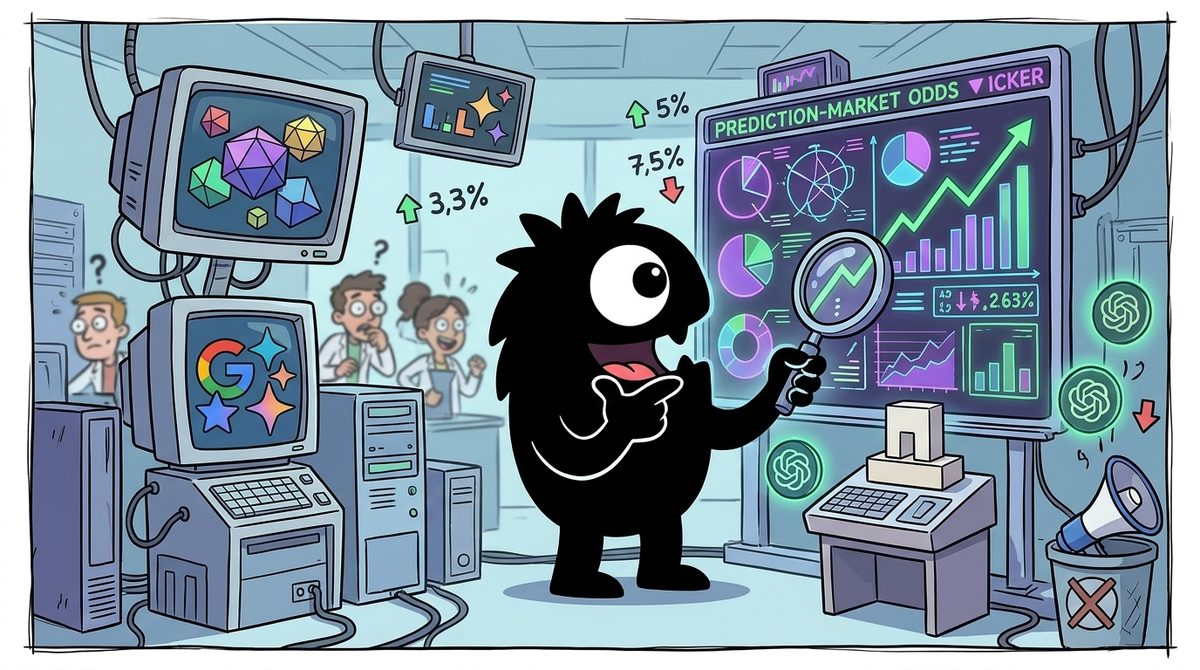
The Best AI Model in 2026: What Polymarket's 96% Anthropic Bet Reveals About the AI Race
Updated: October 25, 2026
Polymarket odds put Anthropic at 96% to hold the best AI model by end of September 2026. See what traders' bets reveal about the AI and SaaS race. Discover why.
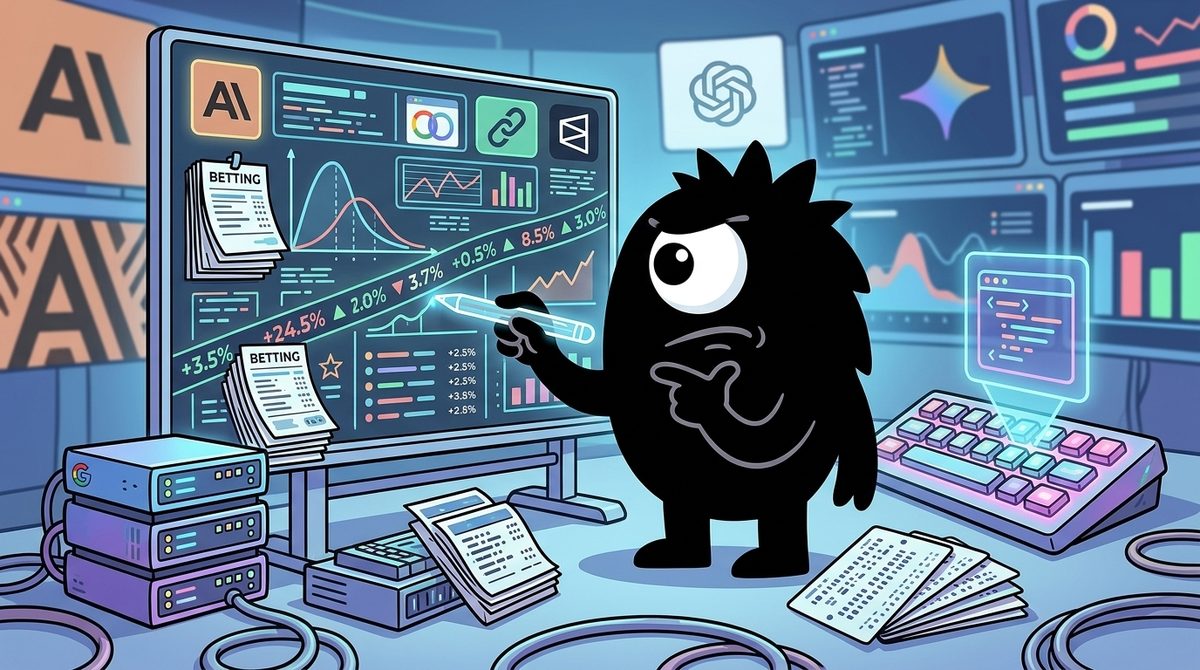
The practical question for developers, founders, and SaaS buyers is not whether Anthropic has permanently won the AI race. It is whether the prediction market’s overwhelming near-term confidence in Anthropic should change technology and procurement decisions today.
The answer: treat the 96% price as a strong, time-boxed signal about the public model most likely to lead one specific leaderboard at the end of September 2026—not as proof of durable platform dominance. The market currently implies that Anthropic is best positioned to win this narrowly defined contest, while giving OpenAI, Google, Meta, SpaceXAI, and Alibaba little time to change the outcome before resolution around October 1.[1]
The short version
>
- Anthropic: 96% implied probability, with $688,730 traded
- Google: 2%, with $275,086 traded
- OpenAI: 1%, with $601,093 traded
- Meta, SpaceXAI, and Alibaba: approximately 0%
- The signal favors Anthropic for the next few weeks, but production buyers should still optimize for cost per completed task, tool quality, reliability, and portability, not one leaderboard result.
What does Polymarket’s 96% Anthropic price actually mean?
As of September 12, 2026, traders have put roughly $3,174,908 into Polymarket’s “Which company has the best AI model end of September?” market. The reported company-level prices are:
| Company | Market-implied probability | Reported traded volume |
|---|---|---|
| Anthropic | **96%** | **$688,730** |
| **2%** | **$275,086** | |
| OpenAI | **1%** | **$601,093** |
| Meta | **~0%** | **$331,446** |
| SpaceXAI | **~0%** | **$277,859** |
| Alibaba | **~0%** | **$177,286** |
The percentages are rounded, which is why they need not add neatly to 100%. More importantly, these are market prices, not measured probabilities produced by a scientific model. A 96-cent contract roughly represents a market-implied 96% chance of paying out under the stated rules.[1] Market trackers and prediction-market analysis pages provide additional views of the same contest and its changing prices.[2][3][4]
The resolution mechanic matters enormously. The market is expected to resolve around October 1, 2026, using the specified arena.ai Text Arena leaderboard. Traders are therefore not answering the broad philosophical question, “Which company possesses the most advanced artificial intelligence?” They are pricing the narrower question: Which eligible company is most likely to hold the relevant public leaderboard position at the deadline?
That distinction is why daily movements attract attention. Earlier AI prediction markets have moved sharply as releases, leaderboard results, and distribution narratives changed:
Over the last few days, on Polymarket, $GOOGL's lead as the best AI model by the end of 2025 has increased even further.
Anthropic odds have also risen, while those of OpenAI and xAI have decreased.
While $GOOGL's market share in LLM search will be much lower than the market share it has on traditional search on the enterprise side if $GOOGL turns out to be the best model provider and on top of it offers them via GCP on their TPU infrastructure, GCP's value could be much more than the market current anticipates.
Trading volume also should not be confused with conviction. OpenAI has attracted $601,093 in traded volume despite sitting at only 1% implied probability. Volume measures turnover—the amount exchanged as traders enter, exit, hedge, or speculate. It does not mean $601,093 is currently “backing” OpenAI. High volume at a low price can reflect a failed comeback trade, active disagreement, or demand for a cheap asymmetric bet.
Why does the market favor Anthropic so heavily in September 2026?
The simplest explanation is that traders believe Anthropic has the best combination of current leaderboard position, third-party benchmark credibility, coding performance, and insufficient time remaining for rivals to displace it.
That view is visible across benchmark trackers and the live X conversation. BenchLM’s September 2026 Anthropic rankings and other Claude benchmark summaries position the Fable and Opus families as leading models across important technical evaluations.[8][10] Anthropic’s own Opus 5 announcement and release notes add vendor-reported evidence, although those claims should be distinguished from independent evaluation.[7][9]
Anthropic currently holds a slight edge. Claude Fable 5.1 tops independent indexes like Artificial Analysis for overall intelligence, reasoning, and complex coding (e.g. SWE-bench). OpenAI's GPT-6 Astra is close behind and stronger on pure math plus some agentic tasks. For programming, reasoning and problem-solving as a whole, Anthropic's best paid models lead on most third-party evals, though results vary by specific workload.
View on XFor practitioners, coding performance is especially influential because software engineering creates repeatable, economically useful workloads. A model that can navigate repositories, edit multiple files, use a terminal, recover from errors, and complete an issue is more valuable than one that merely produces an impressive isolated answer.
The market may also be pricing Anthropic’s product harness, not just its base model. Claude Code wraps the model in tooling, context management, command execution, and agentic workflows. That can increase completed-task performance even when two underlying models appear close on a static benchmark. Comparisons of models used through Claude Code likewise emphasize differences in pricing, latency, and task fit rather than treating intelligence as a single number.[11]
The competitive landscape shifted.
Anthropic's ARR: ~$65B vs OpenAI's ~$40B. Q2 2026 was the first quarter Anthropic surpassed OpenAI in revenue ($11.6B vs $6.7B). Anthropic also posted a small operating profit while OpenAI's loss widened to $12.3B.
Four frontier labs shipped major models within 72 hours: Claude Fable 5.1, Gemini 3.8 Flash, Muse Spark 1.3, and GPT-6 Astra. On coding benchmarks, Astra and Fable 5.1 effectively tie.
Meanwhile, OpenAI's IPO is targeting a ~$1T valuation. September listing. Goldman, Morgan Stanley, JPMorgan advising.
The revenue figures in that post are part of the current market narrative, but they should not be treated as independently established by the benchmark sources cited here. Their significance is directional: traders may view claimed revenue acceleration and operating leverage as evidence that Anthropic can fund more training, inference, and product integration.
That creates a reinforcing loop:
- Better coding performance attracts developers.
- Developer use generates revenue and workflow feedback.
- Revenue supports more compute and product investment.
- Better tooling increases the effective performance of the next model.
- Leaderboard strength supports the market’s confidence.
For this particular contract, however, the last link is decisive. Anthropic does not need to prove it has the best enterprise business. It only needs to satisfy the market’s resolution rules at the deadline.
Why is OpenAI at 1% despite the GPT-6 Astra comeback narrative?
OpenAI presents the clearest counterargument to the market consensus. GPT-6 Astra has been accompanied by claims of market-leading performance in software engineering, science, cybersecurity, mathematics, and agentic work. But traders currently appear unconvinced that those claims will translate into the required Text Arena lead before resolution.
🚨BREAKING: OpenAI claims its new GPT-6 Astra has OVERTAKEN Anthropic as the world's most intelligent AI model.
The $852 BILLION company says Astra is "market-leading in software engineering, science and cyber security," but released NO standard benchmark comparisons.
Anthropic's Claude Fable 5 currently leads both BenchLM and SWE-bench rankings against OpenAI's existing models.
What OpenAI did show: Astra scored 100% on a cyber exploit benchmark and solved 10 DECADES-OLD math problems no AI had cracked before.
OpenAI's own safety team rated the model "Critical," its most dangerous tier.
President Brockman suggests it could be AGI, but calls AGI "more of a spiritual concept."
OpenAI's BILLION-dollar deals with Microsoft and Amazon contain AGI clauses that could reshape the partnerships if AGI is officially declared.
The controversy is not necessarily that Astra’s reported accomplishments are meaningless. It is that vendor-selected results and contract-relevant leaderboard results are different evidence classes. A model can dominate a cybersecurity suite, solve difficult mathematics problems, or perform strongly on internal evaluations without overtaking a rival on the arena used to resolve this market.
The most dramatic Astra claims circulating on X illustrate the problem:
GPT-6 ASTRA SCORED 98.6% ON ARC-AGI-3, AND EVERY OTHER MODEL ON THE CHART ISN'T EVEN CLOSE.
Side by side release notes, GPT-6 Astra next to Claude Fable 5.1 and Mythos 5.1, September 2026.
The benchmark table: ARC-AGI-3, Astra 98.6% vs GPT-5.6 Sol 7.8%. FrontierMath Tier 4, Astra 97.6%, Claude Fable 5.1 and Fable 5 both at 87.8%. Agents' Last Exam, Astra 59.3%, Claude Opus 5 at 52.7%. AutomationBench, Astra 41.4% vs Claude Fable 5.1's 31.4%. Terminal-Bench Science, Astra 64.6% vs 52.6%. ExploitBench, Astra hits 100.0%, GPT-5.6 Sol trails at 78.5%.
GPQA Diamond stays tight across the board, low-to-mid 90s for everyone. HealthBench Professional puts Claude Fable 5 slightly ahead of Astra, 60.9% to 63.4% margin closer than anywhere else on the sheet.
One row at the bottom reads 0% for Astra, 0.29% for Sol, dashes for the rest, a benchmark hard enough that nothing on the chart has cracked it yet.
Those figures, even if accurately transcribed from release materials, do not automatically determine the Polymarket outcome. Benchmark configuration, scaffolding, tool access, inference budget, pass count, contamination controls, and grading methodology can all change a score. A 98.6% result is attention-grabbing, but traders care about whether the result predicts the named leaderboard on the named date.
OpenAI’s $601,093 of volume at 1% nevertheless shows substantial interest in the comeback thesis. At a very low price, a surprise leaderboard jump can offer a large payoff relative to stake. Some participants may also have purchased OpenAI earlier at higher prices and subsequently sold as Anthropic’s position strengthened. Without complete trader-level position data, volume alone cannot distinguish fresh conviction from abandoned conviction.
There is also a deeper strategic difference between the companies. The X conversation characterizes Anthropic as willing to use larger models and more inference tokens, while OpenAI prioritizes efficiency and deployment across an enormous user base:
anthropic doesn't have enough compute to publicly release mythos
the api pricing also suggests it could be far larger than gpt-5.5 base model
anthropic has always reached the frontier by using bigger models and more tokens -- while openai focuses more on efficiency and serving billions of users
That distinction could matter more to SaaS economics than the final leaderboard rank. A smaller or more efficient model may be preferable for high-volume customer support, classification, extraction, or autocomplete even if a larger rival wins difficult reasoning tests. Conversely, teams automating high-value engineering or research tasks may tolerate higher inference costs for a greater completion rate.
OpenAI therefore remains relevant to buyers even if traders price only a 1% chance of winning this contract. Market odds answer the contract question; they do not calculate return on investment for each workload.
Which AI benchmarks should developers and SaaS buyers trust?
The benchmark conflict around Astra and Claude demonstrates why no single score should drive a production decision. Practitioners need to separate four layers of evidence.
1. Vendor benchmarks show possibility, not neutral comparison
Vendor results are useful for understanding what a lab optimized and what it considers differentiating. They are less reliable for comparing models when test selection, prompting, compute budgets, or harnesses differ.
Anthropic’s product announcements, for example, provide detailed claims about Opus 5, while independent benchmark and pricing summaries offer another perspective.[9][12] Neither should be read in isolation.
2. Third-party leaderboards provide comparability
Independent arenas are valuable because they impose a more consistent comparison framework. That explains why prediction traders anchor to them—and, in this case, why the market rules explicitly do so.
But arenas have limits. User preferences may reward style rather than correctness. Category composition can change. A model can perform differently with tools, long-running agents, private data, or structured outputs.
3. Workload tests reveal economic value
The most useful evaluation asks whether a model can complete your task at an acceptable cost, latency, and failure rate. One X comparison focused on generating complex HTML scenes and reported fewer tokens and lower cost for Astra:
GPT Astra just cooked Claude Fable 5.1 — for a lower price!
OpenAI just rolled out GPT‑6 Astra — we put it against Anthropic's Fable 5.1
Both models got the same four briefs: Earth colliding with Mars, a tall ship sucked into a giant whirlpool, Godzilla leveling downtown, a mega-tsunami swallowing a city. One self-contained HTML file per scene, one shot, no edits.
GPT Astra: 25,159 tokens, $1.67
Claude Fable 5.1: 37,767 tokens, $2.51
both models live on aimlapi[.]com — 1000+ models, one key.
Another highlighted tests inside SolidWorks rather than a text-only description of CAD:
GPT-6 Astra was put through CAD work in SolidWorks 2026, using the MecAgent harness
This is the setup that actually tests whether a model can operate real CAD software, not just talk about parametric design, but drive the tool end to end.
Early results show Astra handling real modeling tasks inside SolidWorks, not a simplified sandbox version of it.
CAD has been one of the hardest environments for AI to touch, this is a real attempt at closing that gap.
These examples are not universal verdicts. They show the right evaluation direction: test the complete workflow. For a SaaS buyer, the relevant metric is often:
Cost per successful task = total inference and tooling cost ÷ number of acceptably completed tasks
That calculation should include retries, human review, latency, integration work, and failures—not merely input and output token prices.
4. Prediction markets aggregate expectations
Prediction markets add a different type of signal. Traders can synthesize release schedules, benchmark trends, rumors, and expected leaderboard movement into one price. Because being wrong can cost money, the resulting forecast may be more disciplined than social-media enthusiasm.
Prediction markets are even becoming an evaluation environment for AI systems themselves:
We just gave five SOTA models $10K in real cash to make bets on @Kalshi. Introducing Prediction Arena.
Prediction markets are a rare, concrete way to eval whether AI can reason about the most probable outcomes over time. Sustained profitability signals progress toward real-time, real-world reasoning.
The starting players are:
@OpenAI GPT 5.2
@GoogleDeepMind Gemini 3 Pro
@AnthropicAI Claude Opus 4.5
@xai Grok 4.1 Fast
@Zai_org GLM 4.7
Still, markets are not oracles. Prices can be distorted by thin liquidity, concentrated positions, ambiguous rules, access restrictions, or short time horizons. The 96% Anthropic price is most informative when combined with the leaderboard, release notes, independent testing, and actual workload results.
What can’t Polymarket see about the private AI frontier?
The contract measures the public, eligible frontier. It cannot directly price models that exist inside a laboratory but have not been released or placed on the relevant arena.
Some practitioners argue that public models trail internal systems by three to six months:
I really need you to internalize this:
- the current public frontier is in terms of historical progress 3-6 months behind the private frontier
- most benchmarks are still single-agent and only using a few million tokens, while the latest frontier models are trained for multi-agent operations
OpenAI and Anthropic are both 1.5-2 model iterations ahead, meaning something like GPT-6.1-Astra and Mythos 5.2
they are continuing to race internally
That estimate is not independently verifiable from public leaderboards, but the concept is plausible: labs routinely train, distill, evaluate, and safety-test models before broad release. They may also operate internal systems with more expensive inference settings than a public API can economically support.
Compute availability can widen the gap. Training a model is only the first hurdle; serving it reliably to millions of users requires inference capacity, acceptable latency, and sustainable economics. Anthropic and OpenAI may therefore make very different release decisions even when both possess stronger internal systems.
It's all very insider baseball type stuff, but the compute footprint and model deployment differences between OpenAI and Anthropic can really be felt when comparing their current-release frontier models side-by-side - remarkably distinct...
View on XThis leads to a critical interpretation of the odds: the market implies a 96% chance that Anthropic wins the specified public contest, not a 96% chance that Anthropic possesses the strongest private model inside any lab.
A surprise release could still alter the market, but the short time to resolution reduces the probability. A new model would need to ship, become eligible, accumulate sufficient arena evidence, and overtake the leader before the deadline. Traders currently price that sequence as unlikely.
Why are Google, Meta, SpaceXAI, and Alibaba near zero?
The long tail of the market should not be interpreted as an industry obituary.
Google: 2% for the contract, much higher strategic relevance
Traders currently give Google only 2% implied probability of winning this September contest, with $275,086 traded. Yet Google has distribution advantages that a leaderboard does not capture: Gemini products, Google Cloud, TPUs, enterprise relationships, search, and productivity software.
The market’s opinion can also reverse quickly. Google led earlier prediction-market narratives, and commentators connected its model progress to GCP and TPU economics:
Jason's AI Pair Trade: Short OpenAI. Long Google, xAI, and Anthropic.
Why? OpenAI's competition is fierce.
"They're facing a Google firing on all cylinders, Anthropic, and Grok beating them in the leaderboards pretty consistently."
Polymarket has Google's Gemini 3 at ~87% to finish 2025 as the top-ranked LLM.
Over the last six months, Gemini has started to shrink ChatGPT's massive lead in traffic share.
For enterprises already standardized on Google Cloud or Workspace, Gemini can be the rational choice even at 2% contract odds. Security integration, procurement simplicity, data residency, latency, and committed cloud spend may outweigh marginal benchmark differences.
Meta and SpaceXAI: approximately 0%, but for different reasons
Meta has $331,446 traded and an implied probability rounded to 0%. SpaceXAI has $277,859 traded and is also around 0%. Current commentary depicts Meta as re-entering the race without yet matching the leading closed models, while xAI is viewed as having slipped from the immediate frontier:
So we now have a pretty good picture of the state of the frontier AI model makers.
US closed source models continue to lead. Google, OpenAI, and Anthropic stand well ahead of the pack, and may have signs of recursive self-improvement. xAI has fallen from frontier status for now (though promises to return shortly). Meta re-entered the space today with a not-quite-frontier closed source model, but an approach that suggests that they might be back in the race. All the other US players seem far behind.
On the Chinese model front, Alibaba (Qwen), Moonshot (Kimi), MiniMax, Xiaomi (MiMo), Deepseek, and Z (GLM) all still appear to be very much in the race, though the best Chinese models are still 7-9+ months behind released US closed source models. For some of these players, especially Xiaomi and Alibaba, their commitment to open weights appear to be slipping.
Outside of China, Mistral seems to have fallen from frontier status.
Those assessments are snapshots, not permanent rankings. Meta’s distribution and model-control strategy can matter even without winning Text Arena. SpaceXAI could similarly regain relevance through a release, proprietary data, consumer distribution, or tighter integration with its broader product ecosystem.
Alibaba: near 0% does not mean strategically irrelevant
Alibaba has $177,286 traded and an implied probability near 0% for this contract. Chinese and open-weight models may still appeal to organizations that prioritize self-hosting, customization, regional deployment, or control over data and infrastructure.
A “best model” contract systematically understates those advantages. It rewards one leaderboard winner, whereas companies buy systems based on price, governance, availability, and integration.
What should developers, founders, and SaaS buyers do with these odds?
The correct action depends on workload, company stage, and switching costs.
Developers building high-value coding agents
Choose Anthropic first when repository-scale coding, tool use, and agent orchestration are central, and when the higher probability of strong task completion matters more than minimizing token cost. The market’s 96% price reinforces the case for putting Claude on the initial shortlist.
Claude Code’s harness is repeatedly cited as a differentiator even by users who criticize particular model releases:
Spending most of my "LLM time" in whatsapp now cos of Hermes Agent.
But something just broke on my server.
And wow you re-realise what an incredible product Claude Code actually is...
The latest Opus's went a bit wrong for Anthropic but their harness is the best in the industry (that I've used)... it's just so slick...
Reported benchmark gains around code honesty, SWE-bench, computer use, and parallel subagents also help explain that loyalty:
Claude Opus 4.8 is here — and honesty is the headline 🧠
Anthropic's new Opus is ~4x less likely to let flaws in its own code go unmentioned. It tops SWE-Bench Pro at 69.2% (vs 64.3% Opus 4.7, 58.6% GPT-5.5), scores 1890 on GDPval-AA knowledge work, and hits 83.4% on OSWorld computer use.
Same price as 4.7: $5/$25 per million tokens. Plus "dynamic workflows" in Claude Code — hundreds of parallel subagents in one session.
But developers should keep an adapter layer for OpenAI, Google, and at least one open-weight option. Store prompts, tool schemas, and evaluation cases outside vendor-specific interfaces where possible.
Early-stage founders
Use the strongest managed model when speed matters more than infrastructure control. A small team should not spend months self-hosting if a closed API can validate demand in weeks.
However, founders should avoid embedding one provider’s assumptions throughout the product. Four major releases in a 72-hour period, as discussed on X, illustrate how quickly comparative advantage can move. Build routing and observability early enough that switching is an engineering task, not a company rewrite.
Recommended minimum:
- A provider-neutral model interface
- Versioned prompts and system policies
- Workload-specific evaluation sets
- Per-model cost, latency, and success tracking
- Fallbacks for outages or policy changes
- Contract terms covering data use and service changes
Large SaaS and enterprise buyers
Run a competitive bake-off rather than buying the market winner. Evaluate real tickets, documents, codebases, and approval flows. Include human review time and failure severity.
Enterprises should weight governance, capacity guarantees, regional availability, identity integration, auditability, and procurement leverage alongside intelligence. Recent analysis of enterprise model competition argues that procurement teams must adapt as model leadership and commercial terms change rapidly.[15]
Research teams and regulated organizations
Consider open-weight or self-hosted models when control is the requirement. The immediate capability ceiling may be lower, but ownership can reduce exposure to API policy changes, silent behavior modifications, data restrictions, and service withdrawal.
If you’re a researcher who uses Claude Code or Codex for your daily work, consider using open models instead.
Recent events have shown why owning the entire stack is so important. While OpenAI and Anthropic currently offer the strongest models, using them means working on their terms. OpenAI and Anthropic have shown they are not afraid to alter model output, service, and access if user interests conflict with their business interests.
OpenAI:
- Sep 2026: accused of using Codex data from Buckmaster and Alpöge to race to a solution to Navier-Stokes using their massive compute advantage. OpenAI later admitted that they “cannot rule out that de-identified data derived from their usage of our products helped improve our models”.
- Aug 2026: announced removal of all OpenAI models on Cursor after their SpaceX acquisition
- Dec 2025: injected ads into ChatGPT conversations, even for users paying $200/mo subscriptions
Anthropic:
- Jun 2026: launched Fable 5 with safeguards that limit Claude’s effectiveness at ML research tasks through interventions that are not visible to the user
- Apr 2026: removed subscription coverage for third-party tooling such as OpenClaw and Pi
- Jan 2026: cut off xAI engineers’ Claude access in Cursor
The only way to protect yourself from these kinds of interventions by the labs is to own the model, the tooling, and the data. This is particularly important for researchers, who often work on confidential projects and with sensitive data.
You should do research on your terms, with tools you control and work that remains yours.
That is not a blanket argument against Anthropic or OpenAI. It is a decision criterion: if confidential workflows, reproducibility, or guaranteed access matter more than the last increment of frontier performance, model control may be worth the operational cost.
How should companies read the market without betting the company?
Polymarket’s September 12 pricing delivers a clear near-term message: traders currently view Anthropic as overwhelmingly likely to finish the month atop the contract’s designated public leaderboard. Anthropic stands at 96%, compared with Google at 2%, OpenAI at 1%, and Meta, SpaceXAI, and Alibaba near 0%.[1]
But the strategic lesson is not “standardize everything on Anthropic.” It is that model leadership has become measurable, monetizable, and extremely short-lived.
Practitioners should use four signals together:
- Prediction-market prices for aggregated near-term expectations.
- Independent leaderboards for standardized comparison.
- Revenue and compute indicators for a lab’s ability to sustain progress.
- Private workload evaluations for actual business value.
For September 2026, the market implies stability at the top through the resolution date. For a multi-year SaaS architecture, the evidence points in the opposite direction: expect leadership to rotate, keep model access diversified, and optimize for completed work rather than brand allegiance.
The best operational response is straightforward: monitor the arena named in the contract, rerun evaluations after major releases, preserve a provider abstraction layer, and negotiate procurement terms that keep alternatives viable. Respect the 96% signal—but do not turn a one-month forecast into a permanent platform dependency.
Sources
[1] Polymarket — Which company has the best AI model end of September?
[2] Polymtrade — Which company has the best AI model end of September?
[3] Lines.com — Which Company Has the Best AI Model in September 2026?
[4] CryptoSlate — Which company has the best AI model end of September odds and analysis
[7] Claude Help Center — Release notes
[8] BenchLM — Best Anthropic Models, September 2026
[9] Anthropic — Introducing Claude Opus 5
[10] MorphLLM — Claude Benchmarks 2026
[11] TokenCost — Best LLM for Claude Code, September 2026
[12] AI Hub — Claude Opus 5: Benchmarks, Pricing, and What’s New
[15] Creedtec — Enterprise AI Model Competition Just Entered a New Phase
References (15 sources)
- Which company has the best AI model end of September? Trading Odds & Predictions 2026 | Polymarket - polymarket.com
- Which company has the best AI model end of September? — Polymarket odds | Polymtrade - polym.trade
- Which Company Has the Best AI Model in September 2026? Winner Odds | Lines.com - lines.com
- Which company has the best AI model end of September Odds & Prediction Market Analysis | CryptoSlate - cryptoslate.com
- Odds On: Which company will be able to claim best AI model in September? | Markets Insider - tipranks.com
- Which company has best AI model end of 2026? · Anthropic 70% (+6pp) — Polymarket odds - pdata.world
- Release notes | Claude Help Center - support.claude.com
- Best Anthropic Models (September 2026) — Ranked by Benchmark Data | BenchLM.ai - benchlm.ai
- Introducing Claude Opus 5 | Anthropic - anthropic.com
- Claude Benchmarks (2026): Opus 5, Sonnet 5, and Fable 5 at 95% SWE-bench Verified - morphllm.com
- Best LLM for Claude Code (September 2026): Rankings, Pricing and Benchmarks | TokenCost - tokencost.app
- Claude Opus 5: Benchmarks, Pricing, and What’s New | AI Hub - overchat.ai
- Anthropic vs Google vs OpenAI — AI Company Comparison | Sector HQ - sectorhq.co
- The Price of Entry to the Frontier | Tomasz Tunguz - tomtunguz.com
- Enterprise AI Model Competition Just Entered A New Phase—Procurement Teams Need To Catch Up | Creedtec.Online - creedtec.online
Related Guides
The Best Signals in the AI Bubble Debate for 2026: What Polymarket's Odds Reveal
18 min read
Perplexity AI vs Hugging Face: Which Is Best for Marketing Automation in 2026?
15 min read
The Best AI Model Prediction Market in 2026: An Expert Analysis of What Polymarket's Odds Reveal
20 min read
CrewAI vs Copilot Studio vs Dify: Which Is Best for Marketing Automation in 2026?
14 min read