The Best AI Model Prediction Market in 2026: What $2.6M in Traders' Odds Reveals About the AI Race
Polymarket odds price Google at 72% and Anthropic at 24% for the best AI model. Discover what these probabilities mean for developers and SaaS buyers. Find out.
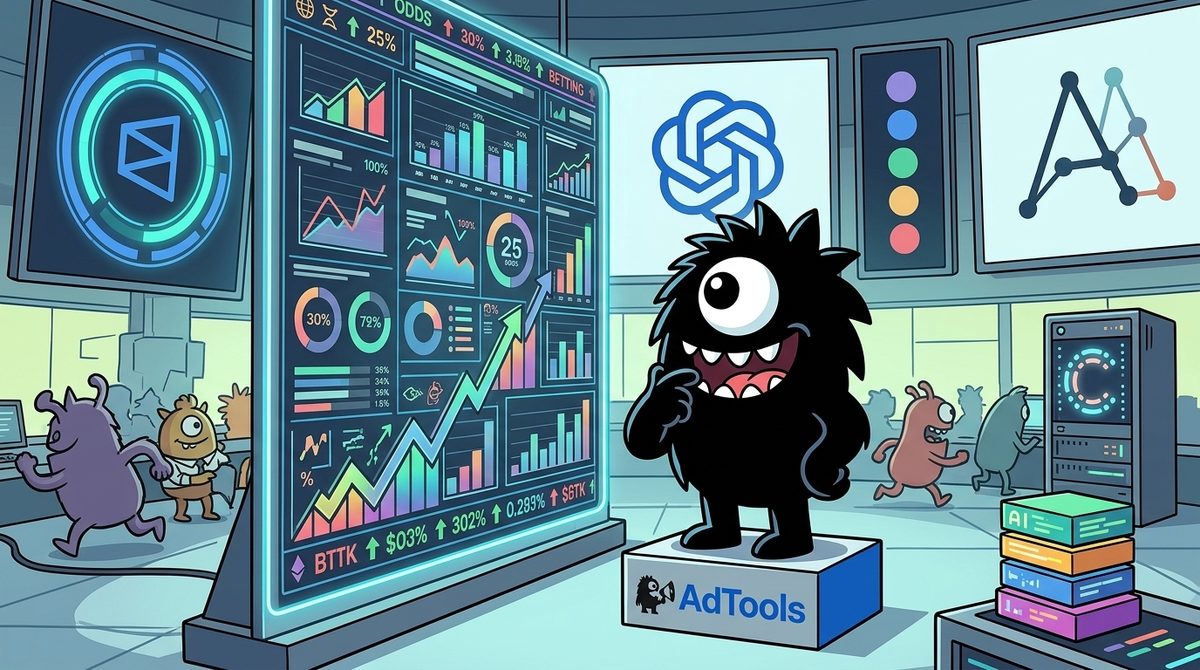
The practical question is not simply “Will Google win?” It is: How much should developers, founders, and software buyers change their plans because traders currently price Google as the favorite to have the best AI model at the end of October 2026?
The short answer: treat the market as a useful signal about release timing and leaderboard momentum—not as a verdict on which model will create the most value in production. As of October 16, 2026, the market implies a 72% probability for Google and 24% for Anthropic, while pricing OpenAI at 1% and Meta, SpaceXAI/xAI, and Alibaba at roughly 0% each.[1] But this contract resolves against a particular leaderboard snapshot around October 31. It does not measure coding economics, agent reliability, openness, enterprise integration, or long-term research leadership.
Bottom line
>
- The market currently implies Google is the clear favorite, but Anthropic remains the only substantial alternative.
- The odds primarily forecast one leaderboard result at one point in time, not universal model superiority.
- Trading volume shows more disagreement than the headline probabilities suggest.
- For practitioners, the larger signal is that value is moving from base models toward agents, model routers, workflow data, and orchestration.
What is the $2.6 million prediction market actually pricing?
As of October 16, roughly $2,631,908 has been traded in Polymarket’s “Which company has the best AI model end of October?” market, which is expected to resolve around October 31, 2026.[1] The displayed implied probabilities and reported trading volumes are:
| Company | Market-implied probability | Reported volume traded |
|---|---|---|
| **72%** | **$589,334** | |
| Anthropic | **24%** | **$575,522** |
| OpenAI | **1%** | **$356,984** |
| Meta | **0%** | **$332,521** |
| SpaceXAI/xAI | **0%** | **$308,582** |
| Alibaba | **0%** | **$145,303** |
The displayed percentages are rounded, and market prices can move continuously. Contemporary market trackers have likewise shown Google near 71% while identifying Anthropic as its principal challenger.[2][3][4]
A 72% price does not mean traders “know” Google will finish first. It means the market collectively prices a Google resolution at roughly seven chances in ten, subject to liquidity, contract rules, fees, and the information available at that moment. It also leaves approximately a 28% market-priced chance that another outcome wins.
The more revealing number may be volume. Google and Anthropic have attracted almost identical reported trading activity—about $589,000 versus $576,000—even though their implied probabilities are far apart. OpenAI, Meta, and xAI have also generated substantial turnover despite being priced near zero.
That suggests contested conviction rather than universal agreement. Traders may be repeatedly repositioning around release rumors, benchmark updates, and interpretation of the resolution rules. Volume measures activity, not net belief: the same capital can trade several times, and both “yes” and “no” positions contribute to price formation.
Prediction-market odds have nevertheless become part of the broader industry narrative. The All-In Podcast’s “pair trade” framing—long Google, Anthropic, and xAI while short OpenAI—shows how leaderboard momentum is being translated into a strategic view of company prospects.
Jason's AI Pair Trade: Short OpenAI. Long Google, xAI, and Anthropic.
Why? OpenAI's competition is fierce.
"They're facing a Google firing on all cylinders, Anthropic, and Grok beating them in the leaderboards pretty consistently."
Polymarket has Google's Gemini 3 at ~87% to finish 2025 as the top-ranked LLM.
Over the last six months, Gemini has started to shrink ChatGPT's massive lead in traffic share.
Recorded at the @VenetianVegas!
That is understandable, but it compresses several different questions into one: best chatbot, best coding model, best agent, strongest distribution, and most valuable AI company are not interchangeable categories.
Why does the October 2026 market depend so heavily on one leaderboard snapshot?
The contract’s central limitation is also its most important feature: “best” has a narrow resolution definition. It is tied to the relevant Text Arena or LMSYS-style leaderboard reading at the resolution point, rather than a blended judgment across benchmarks, price, openness, coding, and production reliability.[1][2]
As one X thread notes, this changes the entire trade:
1/7
POLYMARKET GIVES ANTHROPIC ~94% ODDS OF HAVING THE “BEST AI AGENT” BY OCT 31.
But the market isn't measuring “best” in the abstract.
It's betting on one leaderboard snapshot at one exact time.
That changes the whole trade. 🧵
Arena-style leaderboards generally capture human preference through side-by-side model comparisons. That is useful because it measures whether people prefer one answer over another. But it is not the same as measuring whether a model can repair a large repository, operate a browser for hours, follow a company’s security policy, or produce the lowest cost per completed task.
The rule also explains why the market can price a technically formidable company near zero. Meta may offer an 816-billion-parameter model and the strategic benefit of open weights, but those attributes receive no extra credit if the designated Arena table is the only scoring surface.
816 billion parameters, and Polymarket still has Meta at 0.4% to own the top AI model at the end of October.
That market reads one table, https://arena.ai Text Arena leaderboard. Open weights get no bonus points there.
For a developer, open weights can mean local deployment, fine-tuning, data control, or lower dependence on an API provider. For the prediction contract, those advantages matter only if they translate into the top position on the specified leaderboard.
The snapshot design also creates release-timing risk. A model launched shortly before October 31 could change the ranking without having established stable production performance. Conversely, a strong model released just after the cutoff would be irrelevant to this contract.
Therefore, the market may be forecasting three things simultaneously:
- Current Arena preference;
- Which labs are likely to release or update models before the deadline;
- How quickly those models will receive enough evaluations to affect the table.
That is much narrower than forecasting the AI industry’s long-term winner.
Why do the prediction-market odds disagree with broader AI benchmarks?
The apparent contradiction is straightforward: different measurements produce different “best” models.
As of October 2026, independent leaderboard and model-comparison sites aggregate intelligence, coding, speed, context, price, and other benchmark families rather than relying on a single human-preference table.[8][10][12] BenchLeader, for example, places Claude Opus 5.5 first on its intelligence index at 57.6, ahead of Gemini 4 Argon and GPT-6 in that particular aggregation.[8] Other ranking matrices also separate general capability from coding, efficiency, and specialized performance.[9][11]
Those findings do not invalidate the prediction market. They show that the market is answering a different question.
Arena preference is not production utility
A conversational model can perform exceptionally well in blind human comparisons while another model is better at tool use, code modification, or long-running agents. Arena voters may reward clarity, tone, formatting, directness, and perceived helpfulness. Engineering teams tend to care about additional variables:
- Successful tool calls;
- Tests passed after a code change;
- Retry and failure rates;
- Latency at the 95th percentile;
- Cost per accepted output;
- Schema and instruction adherence;
- Performance on private, domain-specific data.
This distinction helps explain why traders currently favor Google while many developers in the X conversation strongly prefer Claude for coding.
The harness can matter nearly as much as the model
A harness is the surrounding system that prompts the model, allocates compute, retries failures, supplies tools, manages context, and converts outputs into actions. Two evaluations can use the same model weights but produce very different results because the harness differs.
The sharpest illustration in the current conversation is the reported ARC-AGI-3 result for Gemini 4 Argon:
arc prize verified gemini 4 argon at 97.5% on arc-agi-3 with google's own harness vs 49.8% on the standard one. same weights, and the score roughly doubles. half the "which model is best" fights are really harness fights tbh, and it's probably why people get such different results from argon depending on where they run it
View on XIf the reported 97.5% result with Google’s harness and 49.8% result with a standard harness are comparable, the implication is profound: many “model” comparisons partly measure post-training systems, inference strategy, and tooling. Benchmark directories covering hundreds of models reinforce the need to compare configurations rather than brand names alone.[10][15]
For buyers, that means asking not only “Which model?” but also “Which model, through which API, with what system prompt, tools, context policy, and retry strategy?”
Why does Anthropic still command a 24% probability?
Anthropic’s 24% implied probability makes it the market’s only serious alternative to Google. The bullish case is based on focus: traders and engineers may expect Anthropic’s concentration on coding, reasoning, and agentic work to translate into continued frontier performance.
Recent discussion around Claude Opus versions emphasizes state-of-the-art results on SWE-Bench, ARC-AGI, computer use, and especially coding. John Coogan frames Anthropic’s narrower product strategy as an advantage rather than a deficiency:
Yesterday, Anthropic released Claude Opus 4.5 and it delivered strong results across major benchmarks (SOTA on ARC-AGI, SWE-Bench, Computer Use, etc.). The model performed especially well on coding tasks. Gemini 3 had just set high bars in nearly every benchmark but the one that it couldn’t really crack was SOTA performance in coding (worse than Sonnet 4.5 on SWE-Bench Verified).
It feels like Anthropic is a real lesson in the value of focus, the team hasn’t spread its attention across multiple (frankly quite lucrative) opportunities in productizing a leading AI foundation model (or lab that churns them out). The long-term thesis is still this idea that coding prowess will deliver AGI. The clarity there has created a talent magnet, a focused product in a profitable and new (but enormous) market, and staved off attacks from bigger companies with more funding.
They haven’t even launched an AI image generator. Sholto Douglas, a researcher at Anthropic who came on the show yesterday, had a funny quote about it: “We believe there is no shortage of AI images.” Now to be clear, Anthropic does think that image understanding is important. Just as you’d want your human coworker to be able to look at the website they are building and see the results, Claude can look at a screenshot and understand what’s going on.
Also notable is that they didn’t vaguepost about the launch. This strategy was basically created by OpenAI to create buzz around new launches and honestly it’s a lot of fun. I still think it’s funny to read into what Sam meant by posting a Death Star picture before launching GPT-5. DeepMind recently picked up the practice of vague posting and had some fun with it, but Anthropic eschewed the opportunity and ran a pretty by the book launch plan. A blog post with some clear benchmarks, a video explaining some of the results and early findings, etc.
On AI safety, I’ve shifted my thinking a lot over the past year. I’ve come to appreciate safety research because of its applications related to understanding foreign influence that may occur from open-source models and the effects of long chatbot discussions with people who are under psychological stress. Neither of these scenarios was on my list of potential negative side effects years ago, but now they seem very real and worth taking seriously. Yesterday, Sholto highlighted a tradeoff Anthropic has been wrestling with around biology. No one wants a terrorist to build a bioweapon in their garage, but we all want top cancer researchers to be able to accelerate their workflows with helpful AI assistants. It’s very hard to put concrete timelines together for negative scenarios like “AI helps someone create a bioweapon” but I think it’s very good to have companies wrestling with these issues early and often.
It’s clear that all that moral wrestling is a cultural feature, not a bug. The most widely viewed clip from our interview with Sholto was about Anthropic’s writing-focused culture. Apparently Dario is regularly posting essays on Slack threads explaining his full chain of thought on various issues facing the company. Shawn Wang from Cognition said, “this is the single strongest reason to join ant i have ever read.”
Tyler on our team had some extra thoughts on the day, saying “Anthropic still feels very underhyped. Google is just now receiving its flowers in the public markets, and OpenAI has taken up most of the AI mindshare since the original ChatGPT launch. If you are AGI-pilled, Anthropic is probably where you want to work.”
This is a different corporate bet from Google’s. Google can combine frontier models with search, cloud infrastructure, productivity software, Android, video, custom chips, and enormous distribution. Anthropic’s case depends more heavily on building a model that developers will pay to use because it completes valuable work reliably.
First-pass accuracy can outweigh token price
The most persuasive pro-Anthropic argument is economic, not ideological. A model with a higher nominal token price can still be cheaper if it produces more accepted outputs and requires fewer retries.
I spent two years believing Claude was an overpriced luxury model while OpenAI was the default value play.
Daily production runs completely changed my math.
On paper, Anthropic token rates look expensive. In real engineering workloads, Claude Sonnet delivers the highest return on capital across the market.
First-pass accuracy dictates cost.
Cheaper models appear cost-effective until an autonomous coding agent fails a tool call, drops an import, and burns four consecutive retry cycles attempting to debug its own synthetic syntax errors. You burn 60% more tokens cleaning up after an inexpensive model than you spend on one clean Claude execution.
Subscription mechanics reveal the second divide. Heavy developer sessions hit ChatGPT rate limits within forty-five minutes. Claude rolling five-hour allowances and weekly throughput sustain deep agentic workflows without hard interruptions.
Gemini offers massive raw context at bargain rates, but access to their true frontier reasoning tier remains fragmented across confusing developer consoles.
Nominal token price is a vanity metric. Real cost is total tokens consumed per completed task.
Cheap tokens are expensive.
That distinction matters for autonomous and semi-autonomous coding. If a cheaper model fails a tool call, introduces a broken import, and consumes several rounds debugging its own output, its advertised token price understates the cost of the completed task.
Teams should therefore calculate:
Effective task cost = model charges + retry cost + tool execution cost + review time + failure remediation
Anthropic fits teams where code generation, repository work, and tool reliability dominate spending. Google may fit organizations that value multimodal breadth, large-context workflows, ecosystem integration, and access through an established cloud stack.
The X conversation also contains a striking—but not independently established—claim that some DeepMind engineers use Claude daily and strongly resisted losing access:
Anthropic used more coding data in their training runs, so Claude is better at coding. DeepMind now knows this and sees agentic coding taking off exponentially in terms of revenue, so they will use more coding data for future Gemini models to catch up in capability.
"DeepMind engineers use Claude as a daily tool. Most of the rest of Google does not. When the question of equalizing access came up internally, the proposed response was to remove Claude for everyone — which DeepMind objected to so strongly that several engineers reportedly threatened to leave."
Even treated cautiously, the anecdote captures an important procurement principle: sophisticated teams often use a rival’s model when it performs better for a specific workload. Internal usage preference and leaderboard leadership do not necessarily align.
The market may still favor Google because Arena rewards broad conversational appeal. Anthropic’s coding concentration can make it the preferred production tool without making it the most likely winner under the contract’s exact rules.
Is the real value moving from the base model to the orchestration layer?
The most consequential interpretation of the market is that its core question may already be becoming outdated.
A base model generates outputs. An orchestration layer decides which model receives a task, what context it sees, which tools it can use, when it should retry, and how its work is checked. If an agent dynamically routes each step to the model most likely to succeed, no single provider needs to be “best” at everything.
Reports discussed on X suggest Google’s Gemini agent can place Claude beside Gemini in its model picker and select a model for each step:
Google's new Gemini agent puts Anthropic's Claude beside Gemini in its model picker.
By default it picks a model for each step of a job.
A leaked test might explain why. An early Gemini 4 Argon reportedly scored 57.4% on Terminal Bench 4.0, while Claude Opus 5.5 hit 66.4%. On a second benchmark, Gemini came out ahead.
Would you let one agent mix models from two rival companies?
Or would you rather know exactly which one touched your files?
That design would convert rival models from all-or-nothing substitutes into components inside the same workflow. Claude could handle repository changes, Gemini could process a long multimodal context, and another model could perform browser or image work.
The strategic consequence is captured directly here:
Google's new Gemini agent will run your task on Anthropic's Claude if Claude is the better model for the job.
The company that spends the most on frontier model training just told enterprise customers the model underneath doesn't matter, only the agent on top does.
Value is sliding up a layer, whoever owns the orchestration decides which models survive demand, not the other way around.
That's the real fight in enterprise AI right now, not the next benchmark release.
This is the bet beneath the prediction-market bet. Google’s 72% implied probability may matter less commercially if the winning agent layer can route demand to Anthropic, OpenAI, or an open-weight model whenever they perform better.
For SaaS companies, defensibility is therefore more likely to come from:
- Proprietary workflow and customer context;
- Evaluations based on real user outcomes;
- Reliable tool integrations;
- Permissioning, audit logs, and security controls;
- Model routing and fallback logic;
- Data generated from accepted and rejected outputs.
A product that merely wraps the current leaderboard leader remains exposed to a price cut or new release. A product that knows which model to use, verifies the result, and integrates deeply into a workflow has a stronger position.
What do OpenAI, Meta, and xAI’s near-zero prices really mean?
OpenAI at 1%, with Meta and SpaceXAI/xAI displayed at 0%, looks dramatic. It should not be read as evidence that those companies lack frontier capability.
It means traders currently see little probability that each will satisfy this contract’s precise resolution condition at this deadline. OpenAI can be top-tier on other leaderboards—GPT-6.1 Sol appears in practitioner tier lists and broader model comparisons—without being favored to occupy the required Arena position on October 31.[8][13]
current AI models tier list:
S - Opus 5.5 & GPT-6.1 Sol : insanely smart, fast and efficient... this is my best experience ever with AI, i literally can't complain
F - everything else
jokes aside, you literally don't need anything else... at this point usage is pretty much unlimited on a $200 plan
and if you combine both Claude and ChatGPT subs, you get:
- best writing model (Opus)
- best designing model (Opus)
- best coding model (Opus)
- best model and harness at browser & computer use (Sol)
- best image generation model (Images-2.5)
Likewise, Meta’s open-weight strategy may create ecosystem value that the contract does not capture. xAI may be competitive on selected tests without being expected to lead the specified table at the cutoff.
Prediction-market information can be informed—and distorted
Prediction markets can aggregate distributed knowledge quickly, but they are not immune to concentration, rumor, or strategic trading. Claims of wallet clusters apparently anticipating OpenAI announcements have circulated on X:
OpenAI insiders on Polymarket dont even try to hide
I’m tracking a "God Mode" cluster on Polymarket betting on OpenAI.
Their winning bets:
OpenAI Browser by Oct 31
OpenAI Social App in 2025
GPT-5 & Open Source model predictions
Gemini 3.0 Release (?)
Current Play: They are aggressively buying "Yes" on the New Frontier Model release 👉https://t.co/5esgqmqXGt
OpenAI salaries must be lower than I thought.
Dropping the wallet list in the replies 👇
That allegation is not proof of insider trading, and wallet behavior alone cannot establish identity or information source. It does highlight a real interpretive risk: a market price may reflect informed flow, rumor-chasing, hedging, or a few concentrated accounts. High cumulative volume does not automatically guarantee deep liquidity at every price.
The short horizon also encourages traders to overweight launch calendars and underweight durability. Longer-dated markets have shown much more balanced expectations—for example, a separate end-of-2026 contract has priced Anthropic materially higher than this October snapshot does.[7] Different deadlines produce different favorites because research progress is discontinuous.
Roon’s broader warning is that the history of AI competition will probably be longer and less linear than current narratives imply:
everyone assumed it would be google that would unseat or threaten openai’s lead on models but the one that gave them a run for their money was an (at the time) smaller company called anthropic
it is now in the interests of both incumbents to say, and possibly true: RSI is at hand, join or become irrelevant. but i would wager while the fortunes and misfortunes of research could shift the immediate race in either’s favor or a third large company like meta or xai, history is always longer than people account for
first, as A\ proved, huge amounts of compute are more elastic than some previously thought. there is some inference bid for which major giants will give up some of their frontier training ambitions and rent you parts of their compute buildout (google, spacexai etc )
a company betting on something radically different in research or execution could gain a major foothold especially as so much of the stack becomes autocatalytic— in other words you could use a frontier model to help build the parts of your platform you’re not good at. if you’re not constrained by American law you can even distill Claude and GPT to close the gap
small experimental labs are likely a bigger threat to OpenAI and anthropic than large companies
it is game theoretically hard to not serve your frontier model - if your competitor is willing to launch then you may lose a huge chunk of your revenue. if safety concerns supersede that, all of this potentially flips if everyone at the frontier uniformly keeps the strongest models hidden or nerfs their AI R&D capabilities for many months behind the frontier. that may lead to closed loop RSI & runaway advantages. even a huge breakthrough in compute efficiency won’t matter if the labs have private engines of autocatalysis
There is also a gap between benchmark intelligence and dependable autonomy. An X summary of long-horizon research reports that the best tested setup produced only 27.3% of average human performance over a year-long interconnected task:
This paper is a brutal reality check for long-horizon AI. Give an agent a year of interconnected decisions, delayed feedback, and consequences from its own past actions, and its performance collapses relative to humans.
The researchers tested eight leading models, including GPT-5.6 Sol and Claude Opus 4.8. Yet the best-performing setup, Qwen3.7-Max with Hermes, ended with only 27.3% as much money as the average human participant.
A system that finishes a year-long task at barely a quarter of human performance is nowhere near dependable long-horizon execution.
Whatever model tops a late-October leaderboard, traders are not resolving whether it can safely run a company, maintain a codebase for a year, or manage delayed consequences without supervision.
What should developers, founders, and SaaS buyers do with the 2026 odds?
The odds are useful when matched to the right decision. They are dangerous when treated as a universal procurement ranking.
Developers: choose by workload and test the whole system
Use Claude when coding accuracy, repository navigation, and agentic tool use are central. Consider Gemini when multimodal breadth, large contexts, Google integration, or broad conversational performance matters. Evaluate OpenAI and other providers where browser operation, image generation, existing tooling, or specific benchmark strengths match the task.
Most importantly, run a private evaluation containing representative work. Measure completion rate, retries, latency, review burden, and cost per accepted result—not tokens alone. Public leaderboard aggregations are useful for creating a shortlist, not making the final choice.[8][9]
Founders: design for model portability
Startups should avoid coupling their product’s core value to one provider’s temporary lead. Build an abstraction layer that supports:
- Multiple model APIs;
- Versioned prompts;
- Workload-specific routing;
- Automatic fallback;
- Quality and cost telemetry;
- Human escalation;
- Regression tests before model upgrades.
Early-stage teams do not need a complex router on day one. They do need clean boundaries so a model can be replaced without rewriting the product. As usage grows, routing becomes economically meaningful and can become proprietary infrastructure.
SaaS buyers: treat the market as sentiment, not a specification
Enterprise buyers should interpret Google’s 72% implied probability as evidence of strong expectations around Google’s near-term Arena position. It is not sufficient reason to standardize on Gemini.
Procurement should instead examine security, data retention, regional availability, identity controls, auditability, support, total task cost, and integration with existing systems. Regulated buyers should also require visibility into routing: if an agent can send files to several model providers, customers need to know which provider touched which data.
Investors and industry watchers: separate four races
The AI market is not one competition. It is at least four:
- Leaderboard leadership — the race Polymarket is directly pricing;
- Developer preference — where Anthropic’s coding focus may carry more weight;
- Distribution and infrastructure — where Google has unusually broad leverage;
- Orchestration ownership — where agents and SaaS platforms decide which models receive demand.
The October market currently implies Google is most likely to win the first race at the specified snapshot. It does not establish that Google will capture the most developer spend, produce the best coding economics, or own the most valuable application layer.
That is the clearest industry signal in the $2.6 million market: base-model leadership remains valuable, but it is becoming temporary, workload-specific, and increasingly mediated by software above the model.
Sources
[1] Polymarket — Which company has the best AI model end of October?
[2] Polymarket Trader — Which company has the best AI model end of October? Odds
[3] CryptoSlate — Which company has the best AI model end of October Odds & Prediction Market Analysis
[4] DeFi Rate — Best AI Model Predictions: Anthropic, Gemini and OpenAI Odds
[7] pdata.world — Which company has best AI model end of 2026?
[8] BenchLeader — LLM Leaderboard, October 2026
[9] Veso Research — Generative AI Model Ranking Matrix
[10] BenchLM — LLM Leaderboard & AI Model Benchmarks, October 2026
[11] Promise & Proof — Frontier AI Models, Compared Across Every Lab
[12] AIBARS — AI Model Leaderboard
References (16 sources)
- Polymarket — Which company has the best AI model end of October? - polymarket.com
- Which company has the best AI model end of October? Odds: Google 70.9% | Polymarket Odds Today - polymarkettrader.com
- Which company has the best AI model end of October Odds & Prediction Market Analysis | CryptoSlate - cryptoslate.com
- Best AI Model Predictions: Anthropic, Gemini and OpenAI Odds - defirate.com
- Why Google Is Now Favored to Win the 2026 AI Race Over Anthropic | Markets Insider - tipranks.com
- Google vs Anthropic AI Prediction Markets 2026 - shattered.io
- Which company has best AI model end of 2026? · Anthropic 46% (+1pp) — Polymarket odds - pdata.world
- LLM Leaderboard (Oct 2026): Top AI Models | BenchLeader - benchleader.com
- Generative AI Model Ranking Matrix · Veso Research - veso.ai
- LLM Leaderboard & AI Model Benchmarks — October 2026 - benchlm.ai
- Frontier AI Models, Compared Across Every Lab | Promise & Proof - promiseandproof.com
- AI Model Leaderboard - LLM Benchmarks, Pricing & Context | AIBARS - aibars.net
- LLM Leaderboard (October 2026) — Intelligence, Coding & Speed Benchmarks · modelgrep - modelgrep.com
- LLM Leaderboard 2026 - Top AI Models Ranked | LM Market Cap - lmmarketcap.com
- All 950 AI Models Compared — LLM Directory 2026 | BenchLM.ai - benchlm.ai
- AI model rankings, prices and new releases — Artificials - artificials.net
Related Guides
AI Safety and Alignment: A Complete Guide for Builders in 2026
19 min read
The Best AI Model Tools in 2026: What Polymarket's $2.6M Bet Reveals About Google, Anthropic, and OpenAI
21 min read
The Reality of Microsoft Copilot's Enterprise Adoption in 2026: An Expert Analysis
24 min readThe Best AI Model of 2026: What Polymarket's $2.5M Market Reveals for Developers
20 min read