What Is Cloudflare Workers? A Complete Guide for 2026Updated: September 27, 2026
Cloudflare Workers explained: learn how edge computing, Durable Objects, Workers KV, and Workers AI work in 2026, with trade-offs and real use cases. Discover more.
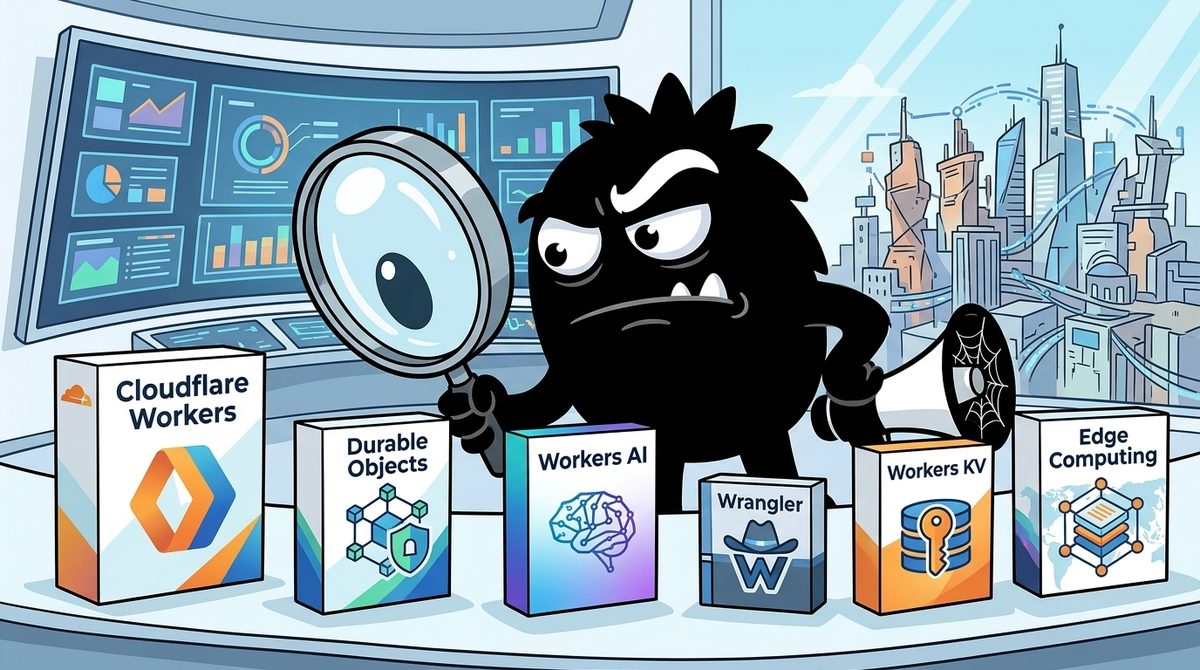
If you are evaluating Cloudflare Workers in 2026, the real question is not simply whether it can run JavaScript at the edge. It is whether Workers can replace enough of your API, serverless, storage, real-time, and AI infrastructure to justify adopting Cloudflare’s execution model—and its proprietary stateful services.
The short answer: Workers is an excellent fit for latency-sensitive APIs, edge middleware, globally distributed applications, real-time coordination, and lightweight AI inference. It is a weaker fit for long-running jobs, memory-intensive computation, unrestricted Node.js workloads, or systems designed around a conventional server and database.
The 2026 bottom line
>
- Choose Workers when requests are short-lived, globally distributed, and built around web APIs.
- Add Durable Objects when you need strongly coordinated state, WebSockets, or one authoritative instance per entity.
- Use KV for read-heavy global configuration, D1 for relational records, and R2 for files and large objects.
- Treat Workers AI as an inference platform, not a substitute for model training or every centralized AI API.
- The greatest lock-in comes from Cloudflare’s stateful primitives—not from ordinary Fetch-based Worker code.
Why Does Cloudflare Workers Exist When Traditional Serverless Already Works?
Traditional serverless platforms solved an operational problem: developers could deploy functions without managing servers. But they did not eliminate geography. A function normally runs in a selected cloud region, so a user on another continent still pays the network round-trip cost before the function does useful work.
That architecture is often acceptable for internal tools, regional products, and applications whose database is already centralized. It becomes more visible in global authentication, API routing, personalization, feature flags, security checks, and other operations performed on nearly every request.
Cold starts create a second source of latency. Conventional function platforms commonly initialize a container or similar isolated environment when no warm instance is available. The impact varies by language, package size, configuration, and platform, but the underlying issue is architectural: creating a relatively heavyweight execution environment takes time.
Cloudflare Workers approaches the problem differently. It runs applications across Cloudflare’s network using V8 isolates, which are lightweight JavaScript execution contexts rather than one container per application instance. Multiple isolates can run within the same process while remaining logically separated. This makes them faster and less expensive to create than full virtual machines or containers.
That changes the meaning of serverless. Instead of asking, “Which region should host this function?” developers can begin with, “Can this request be handled close to the user?”
The answer is not automatically yes. A Worker that immediately queries a database in one distant region merely moves the first few milliseconds of execution closer to the user. To realize the architectural benefit, the application’s data access, caching, and coordination model must also account for geography.
When does edge execution materially help?
It helps most when the Worker can complete the request using:
- The incoming request and locally available logic
- Cached content or globally distributed data
- A nearby storage or inference service
- A Durable Object placed near the relevant workload
- Parallel calls that reduce sequential network round trips
For a regional application backed by a regional database, traditional serverless may remain simpler. Edge compute matters when geography is a product requirement, not merely a deployment label.
How Do Workers Actually Run?
A Worker is application code executed by Cloudflare’s workerd runtime. Its programming model is centered on web-standard interfaces such as Request, Response, fetch, URLs, streams, and cryptographic APIs.
That model is important for both performance and portability. An HTTP handler written around Fetch APIs is conceptually closer to code that can run in browsers, other edge runtimes, or compatible server environments than code tightly coupled to a specific server framework.
How are isolates different from containers?
A container generally packages an operating-system-level environment, dependencies, and a process. An isolate shares a process with other isolates but receives a separate JavaScript heap and execution context.
The practical outcomes are:
- Faster startup: less environment initialization is required.
- Higher density: many applications can share underlying runtime resources.
- Stricter constraints: code does not receive an unrestricted operating system, process model, or filesystem.
- A request-oriented lifecycle: applications should not assume that one in-memory instance will remain alive indefinitely.
Global variables can be useful for caching immutable objects or initialized clients, but they are not durable state. An isolate can disappear, restart, or serve different requests over time. Anything that must survive belongs in a storage service.
Workers also impose CPU, memory, request-duration, and subrequest constraints. Exact allowances depend on the plan and product configuration, so production sizing should use the current limits rather than assumptions carried over from Lambda or containers. Waiting on network I/O is different from consuming CPU, but a Worker is still not the natural home for video encoding, large compilers, model training, or sustained numerical computation.
Does Workers support Node.js applications?
Node.js compatibility has expanded the range of packages that can run on Workers, but compatibility should not be confused with a complete conventional Node environment.
Packages built primarily from JavaScript and standard networking or utility APIs are more likely to fit. Packages may fail or require adaptation when they depend on:
- Native binaries or operating-system-specific extensions
- Child processes
- A persistent local filesystem
- Unsupported low-level networking behavior
- Assumptions about a long-lived Node server
- Large memory footprints or long synchronous tasks
For an existing Node application, audit dependencies before treating migration as a configuration change. The safest architecture keeps core business logic separate from runtime-specific adapters.
How Do Durable Objects Make Serverless Stateful?
Ordinary serverless functions are designed to be stateless and horizontally replicated. That is convenient until multiple requests need to agree on something immediately.
Durable Objects provide one logical, addressable object for a given identifier. Requests for the same object are coordinated through its authoritative instance, giving developers a single-threaded programming model for state associated with that identity.
An identifier might represent:
- A chat room
- A collaborative document
- A game session
- A customer or tenant
- A rate-limit bucket
- A device connection
- An inventory item requiring coordination
This is more than attaching a database to a function. The object combines compute, coordination, and persistent storage. SQLite-backed storage makes it possible to maintain structured data alongside the object’s logic rather than treating every state change as a remote database transaction.
Why does that change application architecture?
Consider a collaborative editor. In a conventional serverless design, the team might need functions, a database, a lock or transaction strategy, a WebSocket service, and perhaps a message broker. A Durable Object can become the authority for one document: it accepts connections, serializes changes, stores state, and broadcasts updates.
The same pattern works for multiplayer rooms and real-time presence. WebSocket connections can be routed to the object representing the room, ensuring that participants interact with the same coordinator.
Rate limiting is another natural fit. If every edge location increments an eventually consistent counter, clients can exceed a global limit during synchronization delays. Routing a key to one Durable Object creates a clear authority for that key.
What are the trade-offs?
The coordination guarantee can become a bottleneck. If every request in a large application targets one object, the architecture has effectively created one hot server.
The correct pattern is usually sharding by domain identity: one object per room, document, tenant, account, or other independently coordinated unit. Durable Objects work best when contention is naturally partitionable.
They also require a mental-model shift. Developers must reason about object placement, object identifiers, concurrency, storage transactions, reconnection, and migration. Teams comfortable with actors or stateful services will recognize the model; teams expecting stateless functions plus SQL may need time to adapt.
Use Durable Objects when coordination is central to correctness. Do not use them merely because state exists somewhere in the application.
Should You Use KV, D1, R2, or Durable Objects?
Cloudflare’s storage catalog can look like unnecessary sprawl until it is viewed through access patterns. These services are not interchangeable database tiers. Each optimizes for a different job.
| Service | Best for | Consistency and access pattern | Poor fit |
|---|---|---|---|
| **Workers KV** | Configuration, feature flags, routing tables, cached API responses | Globally distributed, read-heavy, eventually consistent | Counters, locks, immediate read-after-write requirements |
| **D1** | Users, orders, metadata, application records | Relational SQLite model and SQL queries | Large binary objects or high-contention global coordination |
| **R2** | Images, documents, backups, datasets, generated assets | Object storage with an S3-compatible API and no egress fees | Relational queries, tiny mutable records, coordination |
| **Durable Objects** | Sessions, rooms, documents, counters, per-entity authority | Strong coordination through one logical object | Broad analytical queries or one globally hot object |
Choose KV for data that is read far more often than it changes
KV is useful when global read availability matters more than immediate propagation. Examples include feature configuration, localization data, public keys, redirect maps, and cached content.
Its eventual consistency is not an incidental caveat. It should shape the data model. If one request writes a value and the next request anywhere in the world must observe it immediately, KV is the wrong authority.
Choose D1 when the problem is relational
D1 provides a familiar SQLite and SQL model for structured application data. It fits records with relationships, indexes, constraints, and query requirements: users and teams, product catalogs, project metadata, or content-management records.
The deciding question is whether the application needs relational querying—not simply whether the data is “important.” If the core challenge is coordinating simultaneous operations on one entity, Durable Objects may be the better owner, with D1 used for broader records or reporting.
Choose R2 for bytes, not rows
R2 is the natural destination for files and large objects. Its S3-compatible interface reduces the conceptual migration cost for teams accustomed to object storage, while the absence of egress fees can materially affect systems that serve or process substantial volumes of data.
Store metadata in D1 if it requires relational queries; store the underlying image, document, audio file, or archive in R2.
Combine services deliberately
A production application may use all four:
- KV holds edge-readable configuration.
- D1 stores users, projects, and searchable metadata.
- R2 stores uploaded files.
- A Durable Object coordinates each active collaborative session.
That is not inherently overengineered. It becomes overengineered when data is duplicated without a declared source of truth. For every record, document which service is authoritative, which copies are caches, and what consistency users can observe.
Is Workers AI Really “AI at the Edge”?
Workers AI lets Worker applications invoke models on Cloudflare’s GPU-backed inference infrastructure. The important distinction is inference, meaning running an existing model to produce an output. It is not an environment for training frontier models or arbitrary long-running GPU jobs.
“Edge AI” also should not be interpreted as a guarantee that every model runs in the exact data center handling the incoming HTTP request. GPU capacity is more specialized than ordinary Worker execution. The practical advantage is integration with Cloudflare’s network and developer platform, with routing handled by the service rather than by an application manually operating GPU infrastructure.
Potential use cases include:
- Text classification and extraction
- Embeddings for semantic search
- Summarization
- Image-related inference
- Content moderation
- Lightweight generation
- AI features embedded in APIs or edge workflows
Vectorize can provide vector retrieval for retrieval-augmented generation, while AI Gateway can sit between applications and model providers to support observability and control. Together, these services make Workers useful as an AI control plane, even when every inference request does not use a Workers AI model.
When does Workers AI make sense?
It is strongest when the team values deployment integration, network proximity, and operational simplicity more than access to one specific proprietary model.
It is less compelling when the application requires:
- A model unavailable on the platform
- Custom training or fine-tuning workflows beyond supported options
- Guaranteed dedicated GPU capacity
- Very large or long-running inference jobs
- Provider-specific features that cannot be abstracted
- Tight control over hardware, batching, and serving software
Cost and latency comparisons must be workload-specific. Prompt size, output length, model choice, concurrency, cacheability, and user geography can outweigh the headline distinction between “edge” and “centralized” inference.
What Is the Developer Experience With Wrangler and Local Development?
Wrangler is the primary command-line interface for creating, configuring, developing, and deploying Workers projects. Configuration defines the Worker entry point and the bindings that connect code to services such as KV, D1, R2, Durable Objects, and AI.
A typical workflow is:
- Create or import a project.
- Declare service bindings and environment configuration.
- Run the Worker locally using the Workers runtime tooling.
- Test storage and external integrations.
- Deploy to a preview or production environment.
- Inspect logs, errors, traces, and service metrics.
Local development benefits from using workerd-based tooling rather than a generic Node process. That narrows the gap between local and deployed runtime behavior. But local emulation cannot perfectly reproduce a globally distributed system.
The hardest differences are usually not JavaScript semantics. They are topology and managed-service behavior: propagation delays, object placement, remote data, network routing, production scale, and platform limits.
Remote bindings can improve fidelity by allowing locally running code to interact with managed resources. They also introduce risk. Development environments should not point casually at production databases, buckets, or Durable Objects.
What should production teams standardize?
Mature teams should define:
- Separate development, staging, and production resources
- Explicit secrets handling
- Versioned schema migrations
- Automated deployment through CI/CD
- Rollback and compatibility procedures
- Structured logs and request identifiers
- Alerts for errors, latency, and resource limits
- Tests for runtime compatibility, not only business logic
Workers makes the initial deploy loop fast. Production readiness still depends on operational discipline.
How Serious Is Cloudflare Workers Vendor Lock-In?
The lock-in question has two different answers.
A Worker built around fetch, standard Request and Response objects, streams, and portable application logic can be relatively easy to adapt to another runtime. A system whose architecture depends on Durable Object identities, KV semantics, D1 bindings, R2 integration, Vectorize, and Workers AI is substantially more coupled to Cloudflare.
The distinction is between runtime lock-in and architecture lock-in. The second is more consequential.
Durable Objects illustrate the trade-off. Their coordination model can remove databases, queues, lock services, and WebSocket infrastructure from an application. Recreating those guarantees elsewhere may require several services and an architectural rewrite. That is real lock-in—but it may still be economically rational if the primitive removes enough operational complexity.
How can teams preserve migration options?
- Keep domain logic independent from Worker request handlers.
- Wrap platform bindings behind narrow interfaces.
- Use standard SQL and object-storage APIs where practical.
- Maintain export and backup procedures for persistent data.
- Avoid making KV the authority for consistency-sensitive records.
- Document the guarantees expected from each Durable Object.
- Test core logic in an ordinary JavaScript environment as well as the Workers runtime.
- Price the replacement architecture, not just code-porting effort.
Abstraction has a cost. Building a universal storage layer before product-market fit can slow a small team without producing meaningful portability. Early-stage teams may rationally accept more coupling; regulated or infrastructure-heavy organizations should demand stronger exit plans.
Traditional containers or regional cloud services still win when applications need unrestricted processes, native dependencies, long jobs, private networking patterns, specialized hardware, or deep integration with an existing cloud estate.
Who Should Build on Workers in 2026—and Who Shouldn’t?
Workers is a strong choice for:
- Global APIs with short request handlers
- Authentication, authorization, redirects, and request transformation
- Multi-tenant API gateways and security middleware
- Real-time rooms, collaboration, and WebSocket coordination
- Content delivery backed by R2
- Globally read-heavy configuration
- AI gateways, retrieval pipelines, and lightweight inference
- Small teams that want broad infrastructure without operating servers
Workers is usually a poor primary runtime for:
- Long-running background computation
- Video transcoding or sustained CPU-heavy processing
- GPU training
- Applications dependent on native Node modules
- Monoliths that assume a writable local filesystem
- Systems centered on one large, highly contended stateful process
- Teams whose data and networking are deeply embedded in another cloud
For an existing Lambda or Node team, start with an edge-shaped workload rather than migrating the entire backend. Good first candidates include authentication checks, caching, redirects, webhook validation, API proxying, image access control, or an AI gateway. This exposes runtime and operational differences without putting the system of record at risk.
For a new application, a pragmatic stack is:
- Workers for HTTP and application logic
- D1 for relational records
- R2 for files
- KV for read-heavy configuration
- Durable Objects only where coordination is required
- Workers AI or AI Gateway where inference belongs in the request path
Cloudflare Workers is production-ready in 2026 for workloads that match its model. The key decision is not whether the platform has enough products. It is whether your application can benefit from short-lived edge execution, web-standard APIs, and purpose-built distributed state. If it can, Workers can replace surprising amounts of conventional infrastructure. If it cannot, forcing a server-shaped workload into an isolate-shaped platform will trade one kind of operational complexity for another.
Sources
No external sources were provided.
Related Guides

Aider vs Cline: Which Is Best for AI Pair Programming in 2026?
15 min read
The Best AI Model Tools in 2026: An Expert Comparison Through a $4M Polymarket Bet
25 min read
What Is Replit? A Complete Guide for 2026
19 min read
Traders Are Betting on Anthropic: What Polymarket's 99% AI Model Odds Reveal for Developers in 2026
20 min read