AgentOps vs Vertex AI Agents vs CrewAI: Which Is Best for AI Content Creation in 2026?
AgentOps vs Vertex AI Agents vs CrewAI compared for AI content creation: orchestration, observability, pricing, and learning curve. Find out which wins.
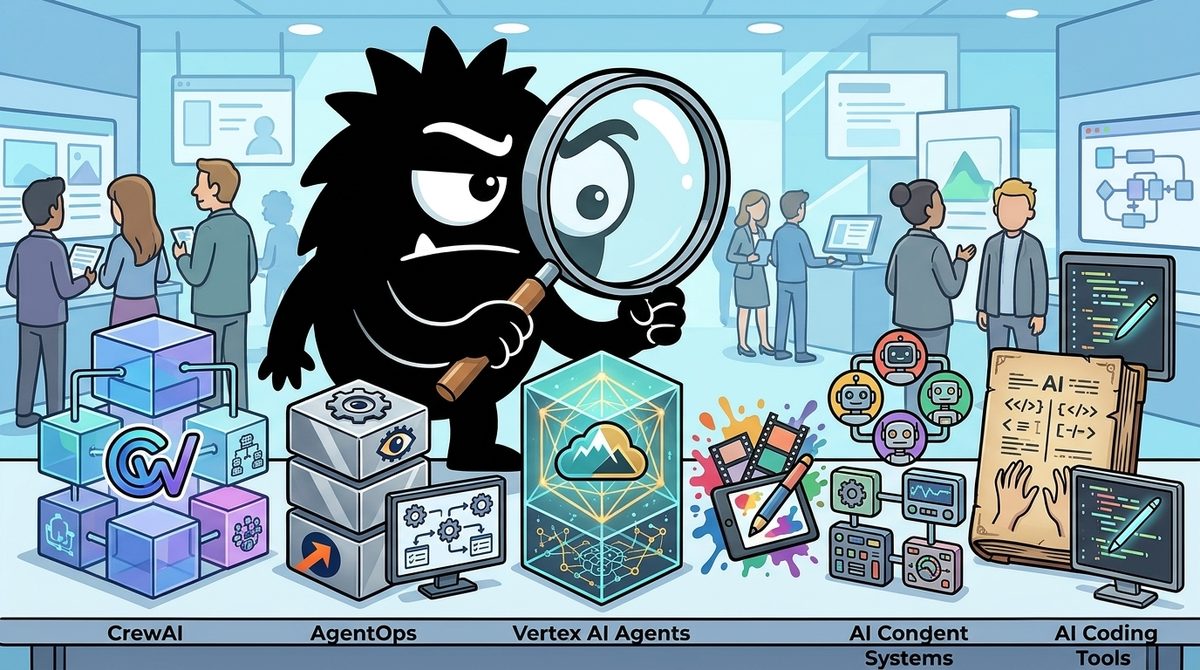
The real question behind "AgentOps vs Vertex AI Agents vs CrewAI" is usually: what should I use to build an AI system that researches, writes, edits, and publishes content, and will it hold up once real readers or clients depend on it? The short answer is that these three tools aren't competing for the same job. CrewAI orchestrates the agents that do the writing. AgentOps monitors and evaluates those agents so you can trust them. Vertex AI Agents is Google Cloud's managed platform for deploying and governing agents at enterprise scale.
Most content teams in 2026 should start with CrewAI. They should add AgentOps the moment output goes live without a human reading every piece. Vertex AI becomes relevant when governance, security, and scale matter more than flexibility.
Bottom line (as of mid-2026):
- CrewAI is the multi-agent orchestration framework. It's the fastest way to build researcher → writer → editor content crews, open-source and Python-first.
- AgentOps is the observability and evals layer. It adds cost tracking, session replay, and evaluations, and integrates natively with CrewAI. Use it to make pipelines production-safe.
- Vertex AI Agents (Agent Builder / Agent Engine) is Google Cloud's managed platform. It's best for enterprises that need governed, scalable deployment, at the cost of some flexibility and cloud lock-in.
- Most mature stacks combine them rather than choosing one.
Start With the Goal, Not the Framework: What Does an AI Content Pipeline Need?
An automated content pipeline has four jobs:
- Research: gather sources, scrape pages, query a knowledge base.
- Drafting: turn research into structured copy.
- Editing: check tone, accuracy, and format.
- Scheduling and publishing: push the output to a blog, newsletter, or social channel.
Practitioners on X are already shipping the whole loop. Akshay Pachaar's build is a good example of what "AI content creation" means to builders right now:
I just created an agentic-workflow to automatically write and publish content for me!
It's powered by CrewAI Flows and Llama 3.2, running 100% locally.
Tech stack:
- @CrewAIInc to build an agentic workflow
- FireCrawl for web scraping
- Typefully for scheduling
Here's how it works:
- You provide a link to a website.
- It scrapes and saves the data as markdown.
- A router triggers the desired Crew of agents.
- The Crew prepares a ready-to-publish draft.
- Finally, use Typefully to post it to your socials.
Totally hands-off and 100% automated!
In this video, I provide a deep dive into how it actually works!
Find the link to all the code in the next tweet!
Enjoy the video! 🥂
Look closely at that stack. CrewAI handles orchestration, FireCrawl handles ingestion, and Typefully handles distribution. Nothing in it watches whether the agents are behaving, and nothing in it governs who can deploy what. That gap explains why newcomers get confused when they see these three tools compared.
CrewAI describes itself as a framework for orchestrating role-playing, autonomous agents[7]. Comparison guides covering Google's Vertex AI Agent Builder against CrewAI's commercial AMP platform treat Vertex as a managed enterprise offering instead of a library you pip-install[3]. AgentOps sits on top of either one as a monitoring SDK.
So "which is best" really depends on two things:
- Where you sit on build-vs-buy. Do you want code you control, or a platform someone else operates?
- Where you sit on prototype-vs-production. Is this a weekend experiment, or something a client pays for?
CrewAI: Why Multi-Agent Content Crews Caught Fire
On X, CrewAI dominates the content-creation conversation. The reason is that its mental model matches how editorial teams already work.
CrewAI's core building blocks are:
- Agents: a role, a goal, and a backstory.
- Tasks: discrete units of work assigned to agents.
- Tools: external capabilities like search, scraping, or vector retrieval.
- Crews and processes: coordination of agents either sequentially or hierarchically, where a manager agent delegates.
CrewAI's collaboration docs describe how agents can delegate work and ask each other questions within a crew[8]. That is what lets an editor agent push back on a writer agent instead of rubber-stamping its draft.
Victoria Slocum's breakdown captures why this feels approachable:
𝗖𝗿𝗲𝘄𝗔𝗜 𝗺𝗮𝗱𝗲 𝗺𝘂𝗹𝘁𝗶-𝗮𝗴𝗲𝗻𝘁 𝘀𝘆𝘀𝘁𝗲𝗺𝘀 𝗮𝗰𝗰𝗲𝘀𝘀𝗶𝗯𝗹𝗲
(and it’s making complex analysis way easier)
Complex tasks often need more than one perspective. That's where multi-agent systems come in - instead of relying on a single agent to do everything, you create a crew of specialized agents that all have their own expertise and tools.
@crewAIInc makes this super accessible by letting you orchestrate collaborative AI agents. Here's how it works:
1️⃣ 𝗔𝗴𝗲𝗻𝘁𝘀: Each agent has a specific role, goals, and backstory for context. Think of them as team members with different specialties.
2️⃣ 𝗧𝗮𝘀𝗸𝘀: Define what each agent needs to accomplish - these are the granular units of work that get assigned to specific agents.
3️⃣ 𝗧𝗼𝗼𝗹𝘀: Agents can access external resources. This is where @weaviate_io comes in 😉
4️⃣ 𝗖𝗿𝗲𝘄𝘀: The orchestration layer that coordinates how agents work together - either sequentially or hierarchically.
𝗖𝗿𝗲𝘄𝗔𝗜 𝘄𝗶𝘁𝗵 𝗪𝗲𝗮𝘃𝗶𝗮𝘁𝗲
By giving agents access to the WeaviateVectorSearchTool, they can search through your vector database to retrieve relevant context before completing their tasks. This means your agents aren't just generating responses from their base knowledge - they’re looking at your actual answer to generate data.
𝗛𝗲𝗿𝗲'𝘀 𝗮 𝗰𝗼𝗻𝗰𝗿𝗲𝘁𝗲 𝗲𝘅𝗮𝗺𝗽𝗹𝗲: three research agents, each from a different industry lens - biomedical, healthcare, and finance. Each agent uses the same tools (Weaviate vector search + web search via Serper), but brings their specialized knowledge to the analysis.
The biomedical agent focuses on genomic applications and research efficiency. The healthcare agent examines EHR integration and patient engagement. The finance agent analyzes fraud detection and compliance automation. Same feature, three distinct perspectives - something a single agent wouldn’t be able to deliver with the same depth.
Check out the full implementation in this blog: https://t.co/nhG92ndUok
Shoutout to @eshorten300 and @tonykipkemboi for the awesome resources on this!
Her example is analytical: three industry-lens researchers sharing Weaviate vector search and Serper web search. The same structure maps directly onto content work. You can swap the industry lenses for a researcher, a writer, and an editor and get the canonical content crew. Open-source examples confirm the pattern. The content-creators-crewai repository on GitHub packages a multi-agent content generation system with a Streamlit interface on top[9]. A Medium walkthrough builds a similar multi-agent content system on Google Gemini models[11].
Crews vs. Flows: which one runs your content pipeline?
This distinction trips up beginners. A Crew is a team of collaborating agents. A Flow is an event-driven workflow that controls when crews run, manages state, and routes between steps. CrewAI's "Build Your First Flow" guide walks through combining the two[12].
In Akshay's pipeline, the Flow scrapes a URL, saves it as markdown, and then a router decides which crew to trigger. That's the architecture to copy. Flows handle the deterministic plumbing, and crews handle the creative, non-deterministic work.
Learning curve and model flexibility
CrewAI is Python-first and quick to prototype. Tutorials aimed at 2026 builders walk through a working agent in a single session[10]. It is also model-agnostic. Akshay ran Llama 3.2 fully locally, and the Medium example uses Gemini. That flexibility matters for content work: you can draft with a cheap or local model and reserve a frontier model for the editing pass.
The Demo-to-Production Gap: Where AgentOps Earns Its Keep
Most X threads skip a hard part. A content crew that produces a great draft in a demo can produce a confidently wrong one on its fortieth run. Non-determinism is tolerable when a human reads every output. It becomes dangerous once you wire in auto-publishing.
This is the gap Alex Fazio flagged after watching AgentOps demonstrated on CrewAI agents:
This demo is wild:
@AlexReibman from @AgentOpsAI showed off their tools using @crewAIInc agents. In minutes, he demonstrated how AgentOps can help make your agents more deterministic and ready for real-world use.
The seamless integration of Evals and agents was eye-opening - definitely worth checking out for anyone interested in Agentic workflows.
What AgentOps actually does
According to its GitHub repository, AgentOps is a Python SDK for AI agent monitoring, LLM cost tracking, benchmarking, and more. It integrates with most LLMs and agent frameworks, including CrewAI, Agno, OpenAI Agents SDK, LangChain, Autogen, AG2, and CamelAI[1]. The CrewAI integration page documents how to instrument a crew so its sessions are captured[2]. That makes it additive to your existing CrewAI code, not a replacement for it.
How content pipelines fail without observability
Here is how observability maps onto concrete failure modes:
- Hallucinated facts: the researcher agent invents a statistic, and the editor agent doesn't catch it. Session replay lets you trace exactly which agent introduced the claim and from which tool call.
- Cost blowups: a hierarchical crew loops through delegation, or a scraper returns a huge page that gets stuffed into context. Per-session cost tracking surfaces this before your monthly LLM bill does.
- Silent failures: a tool errors out, the agent improvises, and the published post is subtly broken. Without traces, you find out from a reader.
Why evals unlock auto-publishing
Monitoring tells you what happened. Evals tell you whether it was good. If you score drafts against criteria such as citation presence, length, banned claims, and format compliance, an auto-publishing pipeline can publish only when the scores clear a threshold and route everything else to human review. That routing is what "more deterministic" means in practice. The LLM doesn't become deterministic. The system around it does.
Vertex AI Agents: The Managed, Governed Path for Enterprise Content
Siva Surendira's taxonomy explains where Google's platform fits:
There are three classes of agents, and you need to know them so that you can plan your enterprise AI adoption journey better.
Class A - these are mostly the traditional agents that call an LLM, a tool, a knowledge base, and complete a task. The best example is the Microsoft Copilot Agent. Almost 90% of the agent estate in an enterprise is filled with these Class A agents. People build them for their personal productivity, which is why, in spite of the sheer number of agents and LLM token spend, enterprises do not realize the overall effect.
Class B - these are multi-agent workflows wherein a bunch of agents work as a team, share tasks between them, and complete an end-to-end process. Workflows like document processing or customer support ticket triage are very good examples. Often, agents built using LangGraph, CrewAI, Microsoft AI Foundry, and n8n fall under this category. This is where you will start realizing some early effects of AI-led productivity.
Class C - these are the new phenomenon: the always-on agents. These agents are proactive and always on, and they are in a sandbox. They have built-in computer use capabilities and can do headless operations. Grokbot, Muse, Claude Duet fall in this category. In the enterprise space, Lyzr's GitAgent (used by one of the world's largest banks) and LangChain's DeepAgents are good examples.
The more your team and your organization build and adopt Class B and Class C agents, the more you will see the productivity needle move.
Content pipelines are textbook Class B agents: multi-agent workflows that complete an end-to-end process. Surendira names CrewAI explicitly in that class. The open question for enterprises is what happens when a Class B content workflow has to run across departments, under compliance review, at high volume. That is the point where teams tend to move from DIY frameworks to managed platforms.
What Vertex AI offers
Google's documentation describes Vertex AI Agent Engine as a managed service for deploying, managing, and scaling agents in production[14]. In 2026, Google also introduced its Gemini Enterprise Agent Platform, positioning agent building and governance as an enterprise-wide capability[13]. Comparisons of Vertex AI Agent Builder and CrewAI AMP frame the core contrast this way: Google offers deep Gemini integration and Google Cloud's security and governance controls, while CrewAI offers framework flexibility[3].
Multi-framework comparisons that evaluate CrewAI, AutoGen, Vertex AI, and LangGraph side by side place Vertex as the managed, cloud-native option[4]. Buyer's guides for 2026 note that Vertex suits teams already invested in Google Cloud[5].
The trade-offs
- More guardrails, less freedom. You gain managed deployment, IAM, and logging. You give up some of the "swap anything" flexibility of a pure open-source stack.
- Cloud lock-in. Your content operation becomes tied to Google Cloud's pricing, regions, and roadmap.
- Ecosystem gravity. Gemini is the natural default, though Google's stack does support other models. The Google Cloud talk referenced below demonstrates Claude models running through Vertex AI.
Best fit: regulated or high-volume content operations, such as financial services marketing, healthcare communications, and large publishers. For these teams, audit trails and access control are requirements, not nice-to-haves.
They're Not Really Rivals: How to Stack CrewAI, AgentOps, and Vertex Together
The community treats these tools as composable layers, and the integrations confirm it. AgentOps ships a native CrewAI integration[2]. Deployment platforms are also courting CrewAI users directly:
Integrating powerful AI frameworks with agents? Check this 👇
We're making it easier to build innovative AI agents using @crewAIInc and deploy them on https://www.fetch.ai/ @Agentverse_ai. This lets you leverage multi-agent frameworks for complex tasks with ease.
With @crewAIInc integration, you can:
→ Define roles, goals, and backstories for specialized AI agents within a crew
→ Use 'tasks' to assign responsibilities and 'processes' to orchestrate agent collaboration
→ Create agents that can generate highly specific outputs, like tailored job descriptions
→ Register and deploy your CrewAI agents directly onto the Agentverse
Example:
→ A user requests a custom job description for a "Senior AI Engineer."
→ A CrewAI agent, consisting of a 'Recruitment Specialist' and 'Technical Writer', works together.
→ The crew generates a precise, optimized job description, which is then served via your @Agentverse_ai agent.
This unlocks a new dimension of multi-agent capabilities, allowing for powerful, specialized teams of AI to tackle intricate problems.
👉 Read more in @Fetch_ai_IL Resource Library:
Fetch.ai's example of a "Recruitment Specialist" and "Technical Writer" crew generating job descriptions is itself a content-creation workflow. It runs as CrewAI logic and gets served through a separate deployment layer. A 2026 roundup of agent frameworks reaches the same conclusion: frameworks like CrewAI and LangGraph define agent logic, while separate runtimes and SDKs handle hosting and operations[6].
A reference architecture for a content stack
| Layer | Tool | Job in the content pipeline |
|---|---|---|
| Orchestration | CrewAI (Crews + Flows) | Research → draft → edit, with routing between steps |
| Observability and evals | AgentOps | Cost tracking, replay, quality gates before publish |
| Deployment and governance | Vertex AI Agent Engine, Agentverse, or your own cloud | Hosting, scaling, access control |
| Distribution | Typefully, CMS APIs | Scheduling and publishing |
When to add each layer
- Week one: CrewAI alone, running locally, with a human publishing manually.
- When you automate publishing: add AgentOps. You need visibility before you remove the human from the loop.
- When multiple teams, clients, or compliance reviewers depend on it: move to a managed deployment layer.
Pricing, Learning Curve, and Time-to-First-Article in 2026
The X conversation is full of beginners turning agent builds into client revenue. That makes cost and ramp-up time decision-critical. Treat the revenue figures in threads like the one below as marketing claims rather than verified data. The underlying point still stands: people are shipping agents for clients without long apprenticeships.
Anthropic's Claude Ai Agents Team just Educated how to build production AI agents in under 30 mins.
For Free. From the engineers who built the stack.
CANCEL Your Weekend Plans, and Learn to Build AI Agents Today.
Bookmark it. Watch it. Build your first production agent this weekend.
$5,000/month. $7,000/month. $12,000/month.
People are building agents for clients and charging $$$ as Beginners. You're still stuck in the thinking about AI phase.
This video fixes that tonight.
Follow @codewithimanshu for more high-signal content that actually moves your AI engineering career forward.
↓
Ivan Nardini runs Developer Relations for AI at Google Cloud. He just gave away the entire production agent stack in 30 minutes.
This is the talk that separates people deploying AI agents that actually scale from people whose agents break the moment they leave localhost.
Here's everything inside.
I break down a production AI video like this every week. Follow @codewithimanshu.
↓
The 4-part agent stack that actually scales.
Most devs are duct-taping frameworks together and calling it an "AI agent."
Ivan lays out the real stack:
Agent Development Kit (ADK): open-source, code-first framework for building, evaluating, and deploying agents. Supports Claude models through Vertex AI directly.
Model Context Protocol (MCP): lets your agent talk to any tool or data source with one standard. Vertex AI Agent Engine: managed platform for deploying, monitoring, and scaling agents in production. No DevOps headaches.
Agent-to-Agent Protocol: open protocol so agents built on different frameworks can actually work together.
This is the stack replacing every hacky agent setup in production right now.
Full MCP + Claude breakdowns drop weekly on @codewithimanshu.
↓
Building your first real agent.
Ivan builds a birthday planner agent live.
LLM Agent class. Name it. Define instructions. Pick the model.
He uses Claude 3.7 Sonnet. You could use Opus 4.7 for better reasoning.
Full agent built in minutes. Not weeks.
Watch the build once and you'll never structure an agent the wrong way again.
I post agent architectures people pay $500 courses to learn. @codewithimanshu.
↓
Multi-agent systems without the chaos.
Single agents are easy. Multi-agent systems are where 99% of builders fail.
Ivan extends the birthday planner by:
Adding a calendar service through MCP tools Creating an orchestrator agent to route requests between agents Handling state and context across agent handoffs
This is production multi-agent architecture. Clean. Scalable. Debuggable.
Most tutorials hand-wave this part. This one shows you every step.
Multi-agent orchestration content drops weekly on @codewithimanshu.
↓
Deployment without the DevOps nightmare.
This is where most AI projects die.
You build a cool agent locally. It works. You try to deploy it. Everything breaks.
Vertex AI Agent Engine fixes this:
Minimal code deployment Automatic monitoring of latency, CPU, and memory Built-in observability and logging No infrastructure setup needed
You provide config and requirements. The platform handles the rest.
This is how agents actually get to production.
Deployment guides for Claude agents post every week. @codewithimanshu.
↓
Agent-to-Agent Protocol: the future nobody's talking about.
Most people don't know this exists yet.
The A2A Protocol lets agents built in different frameworks communicate seamlessly.
Your Claude agent. My LangChain agent. Someone else's CrewAI agent.
All talking to each other. All solving parts of the same problem. All without custom integration code.
This is the infrastructure layer of the coming AI economy.
Getting in early on A2A Protocol is like getting in early on HTTP in 1995.
A2A deep dive coming soon. @codewithimanshu.
↓
30 minutes from the team shipping this in production.
You'll learn more from this than from 6 months of YouTube tutorials made by people who've never deployed an agent past localhost.
People who watch this understand production AI agents at the architect level.
People who skip it keep hacking together frameworks that break every time an API updates.
Save the video. Watch it tonight. Build a real agent this weekend.
Follow @codewithimanshu for more high-signal content that actually moves your AI engineering career forward.
That thread summarizes a Google Cloud developer relations talk on the stack that pairs Google's open-source Agent Development Kit (ADK) with Vertex AI Agent Engine for deployment. Among the benefits it lists for Agent Engine are minimal-code deployment, automatic monitoring, and built-in logging. It also highlights the Agent-to-Agent (A2A) protocol, which lets agents built in different frameworks, including CrewAI, communicate. That supports the "complementary layers" view, and it suggests Google is building its platform to host multi-framework systems.
What each tool costs
- CrewAI: the core framework is open-source. Your main cost is LLM tokens, which can be zero beyond hardware if you run local models as Akshay did. CrewAI also offers a commercial platform, CrewAI AMP, for teams that want managed features; see the 2026 comparison for how it stacks up against Vertex[3].
- AgentOps: the SDK is open-source on GitHub[1]. Hosted observability is a paid service, so check AgentOps' current plans, since tiers change frequently.
- Vertex AI: consumption-based Google Cloud pricing for models and runtime. Google Cloud Marketplace also documents several pricing models for partner AI agents sold through it, including usage-based and subscription options[15]. Expect real setup overhead in IAM, projects, and billing before your first article ships.
Realistic time to a first working pipeline
These are rough estimates based on the cited tutorials and threads, not benchmarks:
- CrewAI: a basic researcher → writer → editor crew in an afternoon. A Flow-based scrape-to-publish pipeline in a few days.
- AgentOps: instrumentation is a small code addition. Designing meaningful evals for content quality takes longer, and that is where the real effort goes.
- Vertex AI: quick if your organization already runs on Google Cloud. Otherwise, budget for cloud onboarding and governance review on top of the agent build.
Who Should Use What: A Decision Guide for AI Content Teams
There's no single winner. What you should use depends on who you are and what you publish. Quamrul Hoda's 2026 project list gets the mindset right:
🚀 Stop Building Basic Chatbots!
Here are 10 Hands-On AI Agent Projects to Build in 2026.
From beginner-friendly automation to advanced Multi-Agent Systems.
Learn by building, not just watching tutorials.
... [Advanced Projects]
10. Agentic RAG Pipeline with CrewAI
Tech Stack: CrewAI, FAISS, Groq, Python
Skills to Learn: Intelligent query routing, document retrieval, web scraping, agentic workflows, response synthesis.
You don't necessarily need to build all 10 projects or learn every framework. Pick a project that interests you, understand how the individual components work, and gradually introduce more complex capabilities.
Once you've built something, experiment with error handling, evaluation, response accuracy, latency, and deployment. Getting an agent to work consistently is arguably a bigger learning experience than building the initial prototype.
His closing line is the most important sentence in this whole conversation: "Getting an agent to work consistently is arguably a bigger learning experience than building the initial prototype." That's the CrewAI-to-AgentOps transition in one sentence.
Solo creators and indie builders: start with CrewAI alone
Use CrewAI with a cheap or local model, and publish manually at first. Add AgentOps the day you turn on auto-publishing. A Gemini-powered CrewAI content system like the one on Medium is a solid template[11].
Agencies serving clients: CrewAI plus AgentOps
Once clients pay for content, two things become your job: per-client cost tracking and an audit trail when a client asks "why did the post say this?" AgentOps' native CrewAI integration provides both without rewriting your crews[1][2].
Enterprises with compliance needs: Vertex AI Agents, with evaluation built in
If legal, brand, and security reviewers sit between your agents and the public, a managed platform's governance is worth the lock-in. Google's 2026 comparisons and buyer's guides position Vertex for exactly this profile[3][5]. You can still prototype crews in CrewAI first and decide later whether to port them to ADK or deploy them alongside Google's stack.
A starter roadmap for your first AI content pipeline
- Build a three-agent CrewAI crew (researcher, writer, editor) with one search tool.
- Wrap it in a Flow that ingests a URL and routes to the crew, following CrewAI's first-flow guide[12].
- Instrument it with AgentOps and review ten sessions for cost and failure patterns.
- Write three evals, such as factual grounding, format, and banned claims, and gate publishing on them.
- Only then move to managed deployment, whether that's Vertex AI, Agentverse, or your own infrastructure.
Build the crew, watch the crew, then scale the crew. The X builders already shipping these pipelines suggest that this order, more than any single framework choice, is what separates working content systems from demos.
Sources
[1] GitHub - AgentOps-AI/agentops: Python SDK for AI agent monitoring, LLM cost tracking, benchmarking, and more — https://github.com/agentops-ai/agentops
[2] CrewAI - AgentOps — https://docs.agentops.ai/v2/integrations/crewai
[3] Google Vertex AI Agent Builder vs CrewAI AMP (2026) — https://www.itechguides.com/compare/google-vertex-ai-agent-builder-vs-crewai-amp/
[4] Let's Compare CrewAI, AutoGen, Vertex AI, and LangGraph Multi-Agent Frameworks — https://infinitelambda.com/compare-crewai-autogen-vertexai-langgraph/
[5] LlamaIndex vs CrewAI vs Vertex AI Agents: Which Is Best for Full-Stack Web Apps in 2026? — https://adtools.org/buyers-guide/llamaindex-vs-crewai-vs-vertex-ai-agents-which-is-best-for-full-stack-web-apps-in-2026
[6] AI Agent Frameworks 2026: LangGraph vs CrewAI vs SDKs — https://agentmelt.com/blog/ai-agent-frameworks-compared-2026/
[7] CrewAI Documentation — https://docs.crewai.com/
[8] Collaboration - CrewAI — https://docs.crewai.com/en/concepts/collaboration
[9] GitHub - alfredang/content-creators-crewai — https://github.com/alfredang/content-creators-crewai
[10] How to Build an AI Agent with CrewAI (2026) | RapidDev — https://www.rapidevelopers.com/build-ai-agent/how-to-build-an-ai-agent-with-crewai
[11] Building a Multi-Agent Content Creation System with CrewAI and Google Gemini | Medium — https://medium.com/@shivashishbhardwaj/building-a-multi-agent-content-creation-system-with-crewai-and-google-gemini-982742693e61
[12] Build Your First Flow - CrewAI — https://docs.crewai.com/en/guides/flows/first-flow
[13] Introducing Gemini Enterprise Agent Platform | Google Cloud Blog — https://cloud.google.com/blog/products/ai-machine-learning/introducing-gemini-enterprise-agent-platform
[14] Vertex AI Agent Engine overview | Google Cloud — https://cloud.google.com/vertex-ai/generative-ai/docs/agent-engine/overview
[15] Pricing models for AI agents from Google Cloud Marketplace — https://docs.cloud.google.com/marketplace/docs/partners/ai-agents/pricing-models
References (15 sources)
- GitHub - AgentOps-AI/agentops: Python SDK for AI agent monitoring, LLM cost tracking, benchmarking, and more. Integrates with most LLMs and agent frameworks including CrewAI, Agno, OpenAI Agents SDK, Langchain, Autogen, AG2, and CamelAI - github.com
- CrewAI - AgentOps - docs.agentops.ai
- Google Vertex AI Agent Builder vs CrewAI AMP (2026) - itechguides.com
- Let's Compare CrewAI, AutoGen, Vertex AI, and LangGraph Multi-Agent Frameworks - infinitelambda.com
- LlamaIndex vs CrewAI vs Vertex AI Agents: Which Is Best for Full-Stack Web Apps in 2026? - adtools.org
- AI Agent Frameworks 2026: LangGraph vs CrewAI vs SDKs - agentmelt.com
- CrewAI Documentation - CrewAI - docs.crewai.com
- Collaboration - CrewAI - docs.crewai.com
- GitHub - alfredang/content-creators-crewai: Multi-agent AI content generation system using CrewAI with a Streamlit interface - github.com
- How to Build an AI Agent with CrewAI (2026) | RapidDev - rapidevelopers.com
- Building a Multi-Agent Content Creation System with CrewAI and Google Gemini | by Shivashish Bhardwaj | Medium - medium.com
- Build Your First Flow - CrewAI - docs.crewai.com
- Introducing Gemini Enterprise Agent Platform | Google Cloud Blog - cloud.google.com
- Vertex AI Agent Engine overview | Generative AI | Google Cloud - cloud.google.com
- Pricing models for AI agents from Google Cloud Marketplace | Google Cloud Marketplace Partners | Google Cloud Documentation - docs.cloud.google.com
Related Guides

The Best Signal in AI Right Now: What a $12.7M NVIDIA CEO Bet Reveals in 2026
19 min read
Kiro vs Cursor: Which Is Best for Building SaaS Products in 2026?
17 min read
The Best Signal in AI Right Now: What Polymarket's OpenAI IPO Odds Reveal in 2026
16 min read
Meta Llama vs Mistral AI: Which Is Best for Startup Founders in 2026?
20 min read