LlamaIndex vs CrewAI vs Vertex AI Agents: Which Is Best for Full-Stack Web Apps in 2026?Updated: September 27, 2026
LlamaIndex vs CrewAI vs Vertex AI Agents for full-stack web apps: compare architecture, pricing, UX, and deployment tradeoffs. Learn
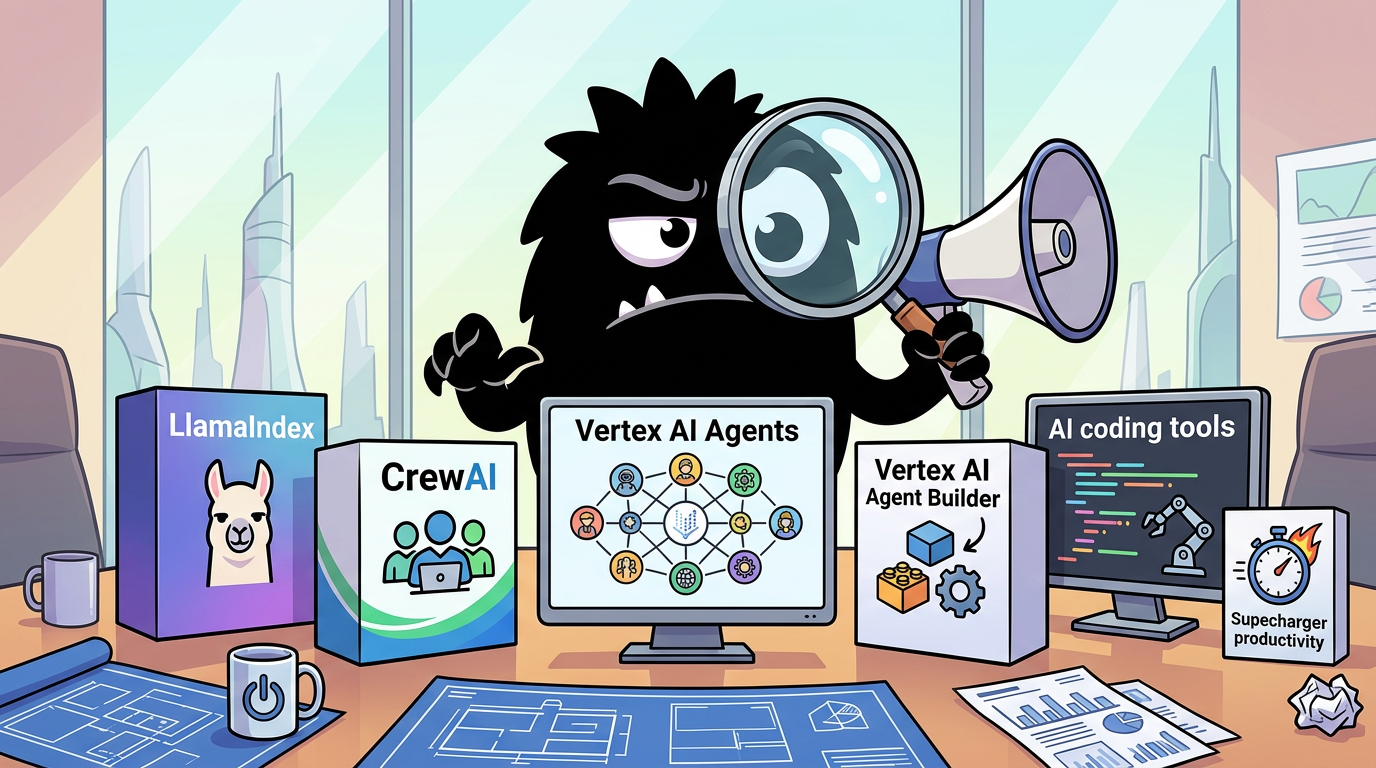
Why this comparison matters now: the market is shifting from agent demos to full-stack web apps
The biggest change in the agent ecosystem isn’t that there are more frameworks. It’s that the center of gravity has moved from “look, I made an agent in a notebook” to “how do I ship a web product people can actually use?”
That sounds obvious, but it changes the comparison completely.
If your goal is a toy demo, almost any modern framework can get you there. If your goal is a full-stack web app with authentication, document ingestion, chat or task UI, observability, deployment, memory, governance, and some confidence that you can maintain it six months from now, then the differences between LlamaIndex, CrewAI, and Vertex AI Agents become much more consequential.
That shift is visible in the way vendors themselves are talking. LlamaIndex has been explicit that the next phase is productionization, not just experimentation.
2025 is the year of productionizing agents.
@llama_index has the best tooling + services to help you build custom knowledge agents over your data.
Here’s a comprehensive set of tools to help you get started building agents 👇
LlamaIndex workflows - our core agent framework: https://t.co/XvggKSYCIH
Template for a multi-agent concierge service (generalizable to customer service, HR, IT, etc.) https://t.co/C1tR5zTZ5F
Deploy workflows to production with llama-deploy - https://t.co/NKMEk3PoUd
You can then interface with any of our data services for higher quality applications:
LlamaParse: https://t.co/NldQN580hl
LlamaCloud: https://t.co/yQGTiRSNvj
LlamaReport: https://t.co/WHFiIhKqXO
We’re going to be making huge product releases and enhancements in this direction. If you’re interested get in touch:
Spot on, Sunny! Though it's worth noting Vertex AI has evolved from a traditional ML platform and now provides a full-stack of models and tools you can use to build AI applications like agents.
View on XAt the same time, practitioners are getting impatient with framework tribalism. One of the more accurate summaries of the moment came from Maryam Miradi:
I've taught AI Agents to 2,300+ engineers.
The framework debate wastes more time than anything else.
Picking the wrong AI Agent framework won't kill your project. Debating it for weeks will.
LangGraph, CrewAI, PydanticAI, Swarm, and MCP are not competitors.
They are Python libraries, each with different depth, different abstractions, and different strengths.
You don't debate NumPy vs Pandas. You ask what you're building. Same rule applies here.
LangGraph
- Stateful pipelines, loops, branching, production-grade, full control
- Use it when failure is not an option
CrewAI
- Multi-agent teams, role-based, readable code, fast to ship
- Use it when the problem needs a team, not a tool
PydanticAI
- Structured outputs, type-safe, validation-first, native Python feel
- Use it when bad data is not an option
OpenAI Swarm
- Minimal abstraction, agent internals exposed, best for learning
- Use it when you want to understand, not just ship
MCP (Model Context Protocol)
- Connects agents to real-world tools, works across every framework above
- Use it when your agent needs to reach beyond itself
Fraud detection, medical pipelines, compliance systems, research agents each one maps to a different framework.
The right library depends entirely on what you are building not on what is trending.
What are you building? and which framework did you reach for first?
---
Join 46,000+ engineers building AI agents. Access Free 30-min training + 2 guides 👇
So let’s set expectations clearly.
This is not a clean apples-to-apples fight between three identical products. These tools overlap, but they operate at different layers:
- LlamaIndex is fundamentally a developer framework for building knowledge-centric applications, agent workflows, and retrieval-heavy systems.[1][2]
- CrewAI is fundamentally an orchestration framework for role-based multi-agent collaboration, with a strong emphasis on agents, tasks, and crews.[7][8]
- Vertex AI Agents / Agent Builder / Agent Engine is fundamentally a managed Google Cloud platform for building, deploying, and operating agents and conversational AI systems at production scale.[12]
That distinction matters because full-stack web apps are never “just agents.” They are bundles of concerns:
- app scaffolding
- backend APIs
- retrieval and indexing
- multi-agent coordination
- deployment
- memory
- cloud integration
- security and governance
- cost control
- maintainability
A team picking the wrong layer to optimize for will feel it quickly. If you choose purely for elegance of orchestration, you may end up doing more deployment glue work than expected. If you choose purely for managed infrastructure, you may lose flexibility in application logic. If you choose purely for RAG quality, you may still need another system for collaboration patterns among agents.
That’s why this comparison matters now. In 2026, the winning move is usually not “pick the hottest framework.” It’s “pick the stack whose boundaries match your product architecture.”
And that architecture is increasingly web-native: user-facing frontends, API backends, document pipelines, async jobs, long-running workflows, and cloud services stitched together into something customers can rely on.
The rest of this article will compare these options in that real context: not as abstract agent frameworks, but as tools for building and operating full-stack web apps.
What each tool actually is, and where it sits in the stack
Before comparing features, it helps to separate categories that people often mash together on X.
A lot of posts list CrewAI next to Vertex AI next to LangChain next to agent builders as if they were equivalent menu items.
Don't miss the AI breakthrough tools saving you $100 on cloud spend.
✸ LangChain
✸ LangGraph
✸ CrewAI
✸ OpenAI Swarm
✸ Pydantic AI
✸ AutoGen
✸ Vertex AI Agent Builder
These LLM frameworks power AI agents across GPT‑4, Claude, and LLaMA 3.
Boost your AI skills now and qualify for top AI era salaries.
A cleaner mental model looks like this.
LlamaIndex: a framework for knowledge-heavy application logic
LlamaIndex started life in many developers’ minds as “the RAG framework,” but that undersells where it has gone. Its current OSS docs position it around workflows, agents, data connectors, and knowledge-centric application building.[1][6] In practice, LlamaIndex is strongest when your web app’s core value comes from one or more of the following:
- retrieval over private or domain-specific data
- document parsing and indexing
- composable query engines
- agent workflows grounded in knowledge tools
- structured application logic around data-intensive tasks
That makes it especially compelling for products like:
- enterprise document copilots
- research assistants
- financial analysis tools
- support knowledge systems
- legal or compliance review apps
- OCR-to-workflow pipelines
The important thing to understand is that LlamaIndex is not merely “an agent wrapper.” It is a broad developer toolkit for turning external knowledge into usable application components. Its workflows and agents sit on top of that foundation rather than replacing it.[1][3]
That’s why LlamaIndex often feels closest to a developer framework for backend intelligence. You can use it to build agentic behavior, but its deeper advantage is that it treats data ingestion, retrieval, workflow control, and tool composition as first-class application primitives.
CrewAI: a framework for role-based multi-agent orchestration
CrewAI’s conceptual model is much narrower and, for many teams, much easier to grasp.
You define:
- agents with roles, goals, and tools
- tasks with expected outputs
- a crew that coordinates how those agents work together
That role-based abstraction is the reason CrewAI has spread so quickly. The docs position it as a framework for orchestrating autonomous AI agents in collaborative workflows.[7] Its GitHub repo and website reinforce the same pitch: multi-agent systems built around teamwork, delegation, and process.[8][9]
The attraction is obvious. A lot of business workflows naturally map to a team model:
- a researcher gathers facts
- an analyst interprets them
- a writer produces output
- a reviewer checks quality
- a supervisor routes the next step
For product teams, that model is highly legible. It matches how stakeholders already think about work. It also tends to produce code that is easier to explain in a demo than lower-level graph abstractions.
This is why posts like the following resonate with beginners and product-minded engineers:
If you have NEVER built an Agent before, check this code.
It took me just 1 minute to build this Agent👇
I used CrewAI, an open-source framework to build production-ready agent systems.
The process is as follows:
• Specify the LLM to be used.
• Create an agent with a clear role, a backstory, and the tools it can access.
• Define a task for the agent with the expected output.
• Create a Crew by combining the agent and task.
• Run the Workflow.
Done!
Why CrewAI?
☑ Full control over Agent's roles and behaviors.
☑ Highly reliable architecture with robust error handling.
☑ Collaborative Intelligence to build seamless agent teamwork.
☑ Easy task management to define agentic tasks with high precision.
☑ Agent Orchestration with sequential, hierarchical, and custom workflows.
But that simplicity comes with a tradeoff. CrewAI is best thought of as an orchestration layer first. It is not, by itself, a full opinionated answer for retrieval architecture, web app scaffolding, hosting, frontend generation, memory infrastructure, or enterprise operations. You can absolutely use it in production, but you’ll often pair it with other components to complete the stack.
Vertex AI Agents: a managed cloud platform, not just another Python library
This is where confusion gets worst.
People often compare Vertex AI Agents as though it were just another local framework, but the more accurate framing is: Vertex AI is a managed application platform for agent systems on Google Cloud.[12][14] It includes tools for building conversational agents and search-based experiences, and Google has continued expanding it with deployment, enterprise integration, and managed operational capabilities.[12][13]
That’s why some practitioners describe Google’s ADK and Vertex stack in hybrid terms — part orchestration experience, part infrastructure substrate, part managed production platform.
ADK = LangChain + CrewAI + Vertex AI infra — but simpler, scalable & production-ready.
I tried it in Google Cloud Lab (GENAI104): created an agent using the Google Search tool, ran it via web UI, CLI, & Python.
Try it : https://cloud.google.com/
#AIagents #GenAI #GoogleADK
LangChain on Vertex AI Vertex AI Agent Engineにリネーム
Vertex AI Agent Engine、LangGraph, Langchain, AG2, and CrewAIのフレームワーク含んでいる。
This distinction matters:
- If LlamaIndex is primarily application logic + retrieval framework
- and CrewAI is primarily multi-agent orchestration
- then Vertex AI is primarily managed runtime + deployment + cloud services for agents
That doesn’t mean Vertex lacks developer abstractions. It does mean you should evaluate it differently. The questions are less about “Is this the nicest way to express an agent role?” and more about:
- How do I deploy and scale this?
- How much infrastructure does Google manage for me?
- How well does this fit my existing cloud environment?
- Can I plug in third-party frameworks?
- What is my path to governance, memory, and enterprise controls?
The stack-position summary
If you’re deciding quickly, use this shorthand:
- LlamaIndex: best seen as the brains and knowledge layer for data-intensive AI apps
- CrewAI: best seen as the teamwork/orchestration layer for multi-agent collaboration
- Vertex AI Agents: best seen as the managed production and cloud operations layer
Those boundaries blur in practice. LlamaIndex now offers workflow abstractions and app templates. CrewAI increasingly talks about production readiness. Vertex AI supports external frameworks and richer agent development patterns.[7][12][13]
But blurring is not the same as sameness.
If you compare them without respecting what each was designed to optimize, you’ll make bad decisions. You’ll either underrate managed infrastructure, overrate elegant orchestration, or confuse retrieval quality with application completeness.
For full-stack web apps, the most useful question is not “Which one is best?” It’s “Which layer do I need to own myself, and which layer do I want someone else to own?”
For shipping a full-stack web app quickly, which tool gets you from idea to UI fastest?
If your actual goal is “I want a working web app this week, not just an agent object in Python,” the comparison gets sharper.
This is where LlamaIndex has done something smart that many framework vendors still haven’t fully internalized: it recognized that full-stack AI development is a scaffolding problem as much as a model problem.
LLM/RAG dev in a notebook is hard, but “full-stack” LLM development is even harder 🧑💻
We have three core tools in the @llama_index ecosystem to help you build a full-stack LLM application, and we’ve now centralized it into a core guide 👇
✅ create-llama: create a full-stack app using a CLI command + @vercel SDK. We’ve created additional advanced templates here, e.g. w/ embedded tables and multi-document agents.
✅ SEC Insights: an advanced multi-document app over 10K filings
✅ LlamaIndex Chat: a full-stack chatbot that supports personality customization + file upload
All of these are fully open-source and MIT license. You can find links / tutorials to all of these projects through the guide below.
Guide:
LlamaIndex has the clearest full-stack starter story
For speed from idea to browser-based product, LlamaIndex currently has the most explicit and opinionated story of the three.
Its tooling and examples increasingly revolve around create-llama, web app templates, and workflow-driven backends.[2][5] The notable point isn’t merely that templates exist. It’s that they are designed to reduce the gap between “agent workflow” and “web application skeleton.”
That matters because most teams waste time on the same set of chores:
- wiring a backend framework
- setting up API routes
- deciding how the frontend talks to the agent
- creating upload flows
- handling async execution
- organizing prompt/tool/workflow code into maintainable files
LlamaIndex’s recent messaging leans directly into this pain point: a FastAPI backend, Next.js frontend, and a minimal source-file structure that puts the workflow logic in one place.
Build a full-stack agent application (e.g. deep research) in a single line of code 💫
We made a massive upgrade to create-llama, our CLI tool that lets you spin up a web application with a FastAPI backend, @nextjs frontend.
✅ It creates just 5 source files which form the backbone of a fully functional web application
✅ The agentic workflow defined with the core @llama_index framework is within just one file so it’s super easy to setup and customize.
✅ We have ready-made templates like financial reporting, data analysis, report generation that you can directly use.
All credits to @MarcusSchiesser.
Create-llama repo: https://t.co/xFsws3l1RE
Build agent workflows with @llama_index:
That’s a good design choice for teams trying to move quickly. It gives you:
- A real web architecture early
- You are not stuck in notebook-land.
- You make frontend/backend boundaries explicit.
- You can hand the app to product or design sooner.
- A maintainable mental model
- Workflow logic lives in one obvious place.
- Retrieval and tool logic can evolve separately.
- The app begins to look like software, not an experiment.
- A better collaboration surface
- Frontend engineers can work on the Next.js side.
- backend/ML engineers can work on FastAPI and workflows.
- The stack resembles familiar web patterns.
For startups and internal-product teams, that is a real advantage. The issue is not whether you could build this with any framework. Of course you could. The issue is how many architectural decisions you must make before you can even show a usable product.
LlamaIndex minimizes those decisions better than most.
CrewAI is fast for agent logic, less opinionated for the app shell
CrewAI has the opposite profile.
It is often faster than LlamaIndex to get from zero to “I have agents collaborating.” That is a genuine strength, especially for Python-first builders. The role/task/crew abstraction is intuitive, and you can create something demo-worthy with very little code.[7][8]
That’s why the “I built an agent in a minute” genre of post keeps circulating.
If you have NEVER built an Agent before, check this code.
It took me just 1 minute to build this Agent👇
I used CrewAI, an open-source framework to build production-ready agent systems.
The process is as follows:
• Specify the LLM to be used.
• Create an agent with a clear role, a backstory, and the tools it can access.
• Define a task for the agent with the expected output.
• Create a Crew by combining the agent and task.
• Run the Workflow.
Done!
Why CrewAI?
☑ Full control over Agent's roles and behaviors.
☑ Highly reliable architecture with robust error handling.
☑ Collaborative Intelligence to build seamless agent teamwork.
☑ Easy task management to define agentic tasks with high precision.
☑ Agent Orchestration with sequential, hierarchical, and custom workflows.
But here is the crucial caveat for full-stack products: CrewAI gets you to agent orchestration fast, not necessarily to a complete app architecture fast.
Once you move beyond the demo, you still need to choose or build:
- your web framework
- your API layer
- your frontend
- your file ingestion pipeline
- your auth pattern
- your persistent state model
- your deployment topology
- your observability stack
None of that is a knock on CrewAI. It’s simply not the problem CrewAI was primarily designed to solve.
If your app is mostly a thin UI over a multi-agent workflow, CrewAI can still be extremely fast. But you will likely need to make more decisions yourself about the surrounding product shell. For a strong engineering team, that flexibility is fine. For smaller teams, it can slow time-to-value.
Vertex AI helps most once deployment and enterprise integration matter
Vertex AI’s speed story is different again.
It can absolutely accelerate delivery, but usually not in the same “single CLI command gives me a local full-stack starter” sense. Its leverage comes later and deeper:
- managed services
- integration with Google Cloud
- easier production deployment
- enterprise-friendly controls
- access to Google tooling and infrastructure[12][13]
If you are already in Google Cloud, that can be a huge accelerator. You may move slower on day one than with a lightweight OSS starter, but faster on day 30 when deployment, scaling, monitoring, IAM, and integration start dominating your backlog.
This is the classic local-vs-managed tradeoff:
- Local-first scaffolding feels faster for prototyping
- Managed deployment infrastructure feels faster for productionizing
For many startups, Vertex will feel heavier at the very beginning. For many enterprise teams, it will feel lighter precisely because so much of the platform work is already standardized.
So who is fastest to a usable web app?
If we define “fastest” as idea to local full-stack app with a browser UI and minimal setup, the current edge goes to LlamaIndex.
Why?
- It explicitly addresses full-stack app scaffolding.
- It provides opinionated templates.
- It acknowledges the frontend/backend split.
- It treats workflows as application code, not just experimental code.[2][5]
If we define “fastest” as idea to multi-agent proof of concept, the edge goes to CrewAI.
Why?
- Its mental model is simple.
- Its core abstractions are easy to explain.
- You can get task delegation working with little ceremony.[7]
If we define “fastest” as idea to organization-approved production deployment in a Google-centric enterprise, the edge often goes to Vertex AI.
Why?
- Managed services reduce ops burden.
- Cloud integration is already there.
- Deployment, governance, and scaling fit an existing enterprise lane.[12][13]
That means the practical answer is contextual:
- Solo founder or startup trying to ship a demoable app fast: start with LlamaIndex, especially if retrieval or documents matter.
- Python team exploring whether multi-agent collaboration is the right product interaction: CrewAI is often the fastest way to learn.
- Google Cloud team building a serious internal or customer-facing system with compliance and operational constraints: Vertex AI may save more time overall, even if it feels less lightweight on day one.
The mistake is to collapse those three meanings of “fast” into one.
Multi-agent RAG, tool use, and workflow design: where the differences become real
This is where the comparison gets interesting, because this is where the architectural center of your app starts to show.
The hottest practical discussion right now is not “Should I use agents?” It’s “How do I combine agents with retrieval, tools, and domain-specific workflows without creating an unmaintainable mess?”
LlamaIndex is strongest when knowledge grounding is the product
If your application revolves around documents, proprietary data, or complex retrieval, LlamaIndex has the clearest advantage.
Its architecture is built around the idea that model outputs become useful when grounded in external knowledge systems: indexes, query engines, retrieval pipelines, and structured document workflows.[1][3] That makes LlamaIndex especially well-suited to multi-agent RAG systems where agents need access to differentiated knowledge sources rather than generic internet search.
This is also why the LlamaIndex team keeps emphasizing agentic document workflows and multi-document applications.[3] In a real web app, those capabilities show up as concrete product features:
- upload a corpus and ask grounded questions
- route queries across multiple knowledge bases
- produce reports over many documents
- combine OCR, retrieval, and reasoning
- let one agent retrieve while another synthesizes
When people say “RAG,” they often mean “a chatbot with a vector DB.” But in production applications, retrieval becomes a workflow design problem:
- Which source should be queried?
- How should retrieved context be filtered or summarized?
- When should the system call tools instead of retrieve text?
- How should agents share retrieved evidence?
- How do you preserve citations and provenance?
LlamaIndex has been building toward exactly that level of control.
CrewAI is strongest when collaboration is the product metaphor
CrewAI shines when your problem naturally decomposes into roles.
That matters more than many developers admit. Plenty of app experiences are not primarily about deep retrieval logic. They’re about workflow decomposition:
- a lead-research app with separate prospecting and scoring roles
- a marketing tool with strategist, researcher, and copywriter agents
- a recruiting assistant with screener, interviewer, and scheduler roles
- a financial reporting system with analyst, reviewer, and presenter roles
In these cases, CrewAI’s role-based abstraction is not just easy to code. It is often the most intuitive representation of the business process itself.[7][10]
And that’s why examples of real use cases keep proliferating across the community.
THE FRAMEWORKS
And it is organized by the framework you actually use.
↳ CrewAI agents for email automation, lead scoring, marketing strategy, recruitment, stock analysis, and 20+ more
↳ AutoGen agents for multi-agent collaboration, code generation, RAG, web scraping, SQL queries, and multimodal tasks
↳ LangGraph agents for customer support, hierarchical teams, adaptive RAG, reflection loops, and plan-and-execute workflows
↳ Agno agents for finance analysis, legal documents, research, YouTube summarization, and Airbnb search
One repo.
Four frameworks.
500+ use cases with working code.
CrewAI’s main strength is that it turns “multi-step LLM workflow” into something stakeholders can reason about in organizational terms. That has product and governance value:
- PMs can understand the architecture
- domain experts can validate the role definitions
- teams can inspect handoffs between agents
- it’s easier to explain why the system failed
The downside is that retrieval and data grounding are not the native center of gravity in the same way they are for LlamaIndex. You can absolutely add those capabilities, but they are often integrated into a CrewAI workflow rather than being the deepest substrate of the framework.
The key insight: you often should not choose one exclusively
This is where the real market conversation is smarter than the “framework wars” framing.
LlamaIndex and CrewAI are not always substitutes. In many architectures, they are complements. The LlamaIndex team has shown this directly: use CrewAI for role-based multi-agent coordination, and plug LlamaIndex query engines or tools into the agents.
Building Multi-Agent RAG with LlamaIndex + @crewAIInc 💫
CrewAI is one of the most popular and intuitive frameworks for building multi-agent systems - define a “crew” of agents with different roles that work together to solve a task.
You can now easily augment these agents with external knowledge or with a rich set of third-party tools through @llama_index integrations:
1. Easily plug in an advanced RAG query engine for any agent to use
2. Easily plug in any tool from LlamaHub for crewAI
We created a simple LlamaIndexTool integration in the crewai_tools repo to make this possible.
Check out our full cookbook. Thanks to @joaomdmoura for the reviews!
That is a very practical design pattern.
You let:
- CrewAI handle who does what and in what order
- LlamaIndex handle how knowledge is retrieved, structured, and exposed as tools
The result is often better than trying to force one framework to be everything.
The financial analyst example highlighted by LlamaIndex captures this pattern well: CrewAI organizes top-level agent collaboration, while LlamaIndex provides the query-engine grounding that gives those agents access to real data.
Build a Financial Analyst Agent System using @crewAIInc and @llama_index 📈🤖
Here’s a neat tutorial by @Pavan_Belagatti showing you how to build a multi-agent system. Starting with CrewAI, you can define a top-level financial analyst agent as well as a content strategist that synthesizes the final report. Our @llama_index integration lets you plug in any query engine as a tool into this agent.
YouTube: https://t.co/CMaAuA2S4s
Notebook:
From a systems-design perspective, that split is clean:
- orchestration layer: task delegation, handoffs, role semantics
- knowledge layer: retrieval, indexing, query tools, evidence gathering
That composability is arguably one of the biggest changes in the ecosystem. Teams are becoming less tribal and more modular.
Workflow design differences in practice
For a full-stack app, the workflow implications are significant.
If you choose LlamaIndex-first
Your app architecture often looks like:
- Ingest documents or structured data
- Build indexes/query engines
- Define workflows or agents that call retrieval and tools
- Expose the workflow via API
- Present results in a web UI
This is ideal when the app’s quality depends on high-fidelity grounding and domain knowledge.
If you choose CrewAI-first
Your app architecture often looks like:
- Define business roles
- Assign tools and tasks to each role
- Create a crew execution pattern
- Wire the crew to backend endpoints
- Present collaborative results in the UI
This is ideal when the app’s value depends on decomposing work across specialist agents.
If you choose Vertex AI-first
Your architecture tends to start from platform concerns:
- Decide the agent or framework approach
- Integrate with Vertex services
- Deploy into managed infrastructure
- Add memory, tools, and enterprise integrations
- Expose the result to internal or external application surfaces
This is ideal when cloud-managed runtime, governance, and deployment are central requirements.
The real decision point
Ask this one question:
Is my product’s main differentiation in knowledge grounding, agent collaboration, or managed operations?
- If it is knowledge grounding, favor LlamaIndex.
- If it is agent collaboration, favor CrewAI.
- If it is managed operations, favor Vertex AI.
- If you need all three, design a composed system intentionally instead of hoping one framework magically becomes the whole stack.
That answer will tell you far more than any feature checklist.
Production readiness: deployment, memory, scalability, and managed infrastructure
Prototype success is cheap. Production success is where the bill arrives.
This is the section where Vertex AI becomes much harder to dismiss, because many of the ugliest problems in agent apps show up only after users arrive:
- conversations need persistence
- agents need long-term memory
- systems need scaling behavior
- failures need tracing
- permissions need enforcement
- deployment cannot depend on one engineer’s laptop
Vertex AI’s managed memory and deployment story is a real differentiator
Google has been pushing exactly on this pain. The launch of Memory Bank on Agent Engine is notable not because “memory” is a new concept, but because teams are exhausted by implementing it themselves.
Vertex AI Memory Bank is OUT on Agent Engine!
Interacting with AI agents can sometime feel like talking to something with the "memory of a goldfish", as they treat every conversation as if it were the first.
We're fixing that.
On Vertex AI Agent Engine, we just released Memory Bank in public preview! With Memory Bank, you give your agents persistent, long-term memory to build truly personalized experiences.
TL;DR
✅ Managed memory service (no more DIY)
✅ Cost-effective alternative to context windows
✅ Gemini-powered to smartly manage facts
✅ Integrates w/ ADK, LangGraph & CrewAI
Check out the blog post with tutorials & docs to get started.
> Blog: https://t.co/9NxERx9re7
>Tutorials: https://t.co/yIhMg23Dhr
> Docs:
That sentiment matters. Persistent memory in production is not just “save chat history.” It raises real design questions:
- what should be stored long term?
- how should facts be summarized or merged?
- what is user-scoped vs app-scoped memory?
- how do you control cost versus giant context windows?
- how do you govern retention and access?
A managed memory service is compelling because it removes one entire category of infrastructure glue. As Richard Seroter put it, this is attractive precisely because it “just works,” including with external frameworks like CrewAI.
Sweet. A managed memory service for your AI agents that "just works" when you deploy ADK agents to @googlecloud Vertex AI Agent Engine.
Oh, and it works with other agent frameworks like LangGraph and CrewAI too.
From a platform perspective, that is a major signal. Vertex is not merely saying, “Use our native stack.” It is increasingly saying, “Bring your framework, and we’ll provide the production substrate.” That is a stronger enterprise position than many people realize.[12][13]
The managed-platform value proposition becomes especially strong in teams that care about:
- uptime and reliability
- security and IAM alignment
- cloud-native deployment
- centralized governance
- scaling without custom ops scaffolding
And Google continues to invest in the build-run-deploy path around agents, including workshops and codelabs focused on running, testing, and deploying agents on Vertex AI.[15]
Build Multi-Agent Systems with ADK
Co-organized with GDG Cloud Munich, this workshop brought together an amazing community to explore multi-agent systems 🙌
Participants learned to run, test & deploy agents on Vertex AI.
👏 Thanks to everyone who joined!
#BuildWithAI #GDG
LlamaIndex gives you strong building blocks, but you still own more architecture
LlamaIndex has made meaningful progress toward production tooling. Its workflows are much more serious than the “just use a notebook” era, and the ecosystem includes deployment-oriented tooling and services for document-heavy applications.[2][5]
But for most teams, using LlamaIndex still means accepting a more self-managed architecture:
- you choose where workflows run
- you choose how state is persisted
- you choose deployment patterns
- you choose your monitoring and tracing approach
- you choose how memory is implemented or integrated
That is not necessarily a disadvantage. In fact, for teams that want flexibility and control, it is often the right tradeoff. You can tune the system to your exact needs, use your preferred infrastructure, and avoid deep platform dependence.
Still, it does mean the burden shifts back to the team. LlamaIndex can accelerate application logic, but it does not remove the need to design application operations.
CrewAI is production-capable, but your operational model depends on what surrounds it
CrewAI increasingly presents itself as production-ready, and there is no reason to treat it as a toy.[7][8][9] But in practice, its production readiness is highly dependent on the surrounding architecture you choose.
CrewAI can orchestrate sophisticated systems. The harder questions are:
- Where are those crews running?
- What persists between runs?
- How do you inspect failures?
- How do you handle retries and idempotency?
- What are the scaling boundaries?
- How are tools secured?
Because CrewAI is an orchestration framework rather than a managed platform, production quality depends heavily on deployment discipline. A mature engineering team can absolutely do this well. A smaller team may discover that the “easy to start” path becomes “more to operationalize” later.
This is not unique to CrewAI; it is a pattern across many OSS frameworks. They make the logic approachable, but the system remains your responsibility.
Memory is becoming the dividing line
If there is one production feature likely to separate platforms over the next year, it is memory.
For many real web apps, memory is not optional:
- customer support agents need account context
- personal assistants need user preferences
- research apps need project continuity
- internal copilots need organizational memory
- educational apps need learning history
The naive implementation is to keep shoving history into the context window. That gets expensive and brittle quickly. Managed memory services are attractive because they promise:
- persistence
- summarization
- retrieval efficiency
- lower token costs
- personalization at scale
Vertex AI’s push here is important precisely because it attacks a problem many teams would rather not solve alone.[12][13]
Scalability and governance: where managed platforms win
When traffic grows, the concerns become more ordinary and more important:
- request spikes
- concurrency management
- latency budgets
- auditability
- change management
- environment promotion
- cost controls
This is where cloud-managed platforms typically outperform framework-only stacks. Not because they are more elegant, but because they reduce the number of operational decisions a team has to own.
For startups, that may feel constraining. For enterprises, it often feels liberating.
So the production-readiness verdict is fairly direct:
- Vertex AI has the strongest out-of-the-box story for managed deployment, memory, and platform operations.[12][13]
- LlamaIndex has a strong story for production-grade application logic and knowledge workflows, but you will usually own more infrastructure decisions.[1][2]
- CrewAI can absolutely be used in production, but your true readiness will depend on the runtime, persistence, monitoring, and deployment architecture you wrap around it.[7][8]
If your team is tired of stitching together memory, hosting, and operational tooling, Vertex AI’s appeal is real. If your team wants maximum control over core logic and doesn’t mind owning the system, LlamaIndex or CrewAI may be a better fit.
The hidden winner may be the hybrid stack: when to combine LlamaIndex, CrewAI, and Vertex AI
Here is the blunt truth: many of the best full-stack AI apps in 2026 will not choose one of these tools. They will combine them.
The ecosystem is already pointing that way.
LlamaIndex has public integrations with CrewAI for multi-agent RAG.
Building Multi-Agent RAG with LlamaIndex + @crewAIInc 💫
CrewAI is one of the most popular and intuitive frameworks for building multi-agent systems - define a “crew” of agents with different roles that work together to solve a task.
You can now easily augment these agents with external knowledge or with a rich set of third-party tools through @llama_index integrations:
1. Easily plug in an advanced RAG query engine for any agent to use
2. Easily plug in any tool from LlamaHub for crewAI
We created a simple LlamaIndexTool integration in the crewai_tools repo to make this possible.
Check out our full cookbook. Thanks to @joaomdmoura for the reviews!
Let's build & deploy production grade Gemini AI Agents in 3 simple steps using Google Cloud Vertex AI Engine.
Works with LangChain, LlamaIndex, and other Agent frameworks.
🦙 LlamaIndex + Vertex AI Vector Search! 🚀
It's now easier than ever to build production-ready, scalable RAG applications with our new Vertex AI Vector Search integration in LlamaIndex.
https://developers.llamaindex.ai/python/examples/vector_stores/VertexAIVectorSearchDemo/
#LlamaIndex #VertexAI #VectorSearch #GoogleCloud #RAG #GenAI
That is not accidental. It reflects a broader market reality: framework boundaries are blurring, while platform boundaries are becoming more composable.
The most practical hybrid pattern
A very common and very sensible architecture now looks like this:
- LlamaIndex for document ingestion, retrieval, query engines, and workflow-heavy knowledge logic
- CrewAI for role-based agent coordination and task delegation
- Vertex AI for managed deployment, memory, and cloud operations
This is not theoretical. It directly maps to how these systems are strongest.
For example:
- a support automation app uses LlamaIndex to retrieve from product docs and tickets
- CrewAI coordinates a triage agent, resolution agent, and escalation agent
- Vertex AI handles deployment, memory, and managed runtime services
Or:
- a research app uses LlamaIndex for multi-document search and summarization
- CrewAI assigns researcher, analyst, and editor roles
- Vertex AI provides scalable serving in a Google Cloud environment
In these systems, each tool owns a layer it is naturally good at.
Why Vertex gets stronger in a hybrid world
Some teams still view Vertex AI as a competitor to open frameworks. Increasingly, that’s the wrong lens.
If you’re already committed to Google Cloud, Vertex’s role as a managed substrate becomes more compelling precisely because it can sit under third-party frameworks instead of forcing a full rewrite.[12][13] That’s why posts showing “deploy production-grade Gemini agents with LangChain, LlamaIndex, and other frameworks” matter.
Let's build & deploy production grade Gemini AI Agents in 3 simple steps using Google Cloud Vertex AI Engine.
Works with LangChain, LlamaIndex, and other Agent frameworks.
In other words, Vertex’s value proposition is increasingly:
- keep your preferred app logic and orchestration tools
- use Google Cloud for managed serving and operations
That is a strong enterprise story because it lowers migration friction.
Hybrid stacks reduce lock-in, but add design complexity
Of course, composability is not free.
A hybrid stack means you must define ownership boundaries very clearly:
- Which layer owns tool definitions?
- Which layer owns memory?
- Which layer owns retries and control flow?
- Which layer owns observability?
- Which layer owns retrieval evaluation?
- Which layer owns deployment packaging?
If you do not answer those questions early, your stack becomes confusing fast. Developers end up duplicating concepts across frameworks. Tracing becomes fragmented. Failures become harder to debug.
The rule for hybrid systems is simple:
Compose by responsibility, not by novelty.
Use multiple tools only when each one has a clear job that materially reduces effort or improves outcomes.
When hybrid is the right answer
Choose a hybrid architecture when:
- your app needs both sophisticated retrieval and intuitive role-based coordination
- your team wants OSS flexibility but managed cloud deployment
- you already have partial investments in one layer and don’t want to replace it
- your product has enough complexity that best-of-breed tools are worth the integration cost
Avoid a hybrid architecture when:
- your team is small and needs minimal moving parts
- your use case is simple enough for one framework
- you lack clear ownership over app, infra, and data layers
- your debugging and observability strategy is immature
One X post about an AI-powered study buddy captures the reality of this new era: product ideas are increasingly described in composed stacks, not single frameworks.
2. AI-powered Study Buddy
•Google Vertex AI + Firebase
•Use Strands or CrewAI agents for “researcher” + “teacher” roles
•App suggests summaries, quizzes, flashcards
Perfect for students (and a portfolio win). 📚
That’s where the market is going. The winners are not just tools with the biggest feature list. They are tools that can play a clean role in a broader architecture.
Pricing, learning curve, and team fit: what the docs and community signals suggest
Exact pricing is hard to compare cleanly because usage varies by model, hosting, traffic, vector storage, and supporting services. But the more useful exercise for technical decision-makers is not sticker price. It is total cost of ownership, including:
- developer time
- infra complexity
- operational burden
- cloud spend
- rework risk
- onboarding time
CrewAI has the lowest conceptual barrier for many teams
CrewAI’s biggest advantage may be educational as much as technical.
The abstractions are intuitive:
- define an agent
- assign a role
- give it tools
- define tasks
- run the crew
For Python-first teams or founders trying to validate an idea, that simplicity lowers time-to-first-success considerably.[7][8] That is why the “1-minute agent” meme lands so well. It captures a genuine truth: CrewAI makes multi-agent experimentation feel accessible.
The hidden cost comes later if the app grows into a broader platform and you need to standardize deployment, retrieval, state management, and governance around it.
So CrewAI is often cheapest in initial learning cost, but not always cheapest in lifecycle cost.
LlamaIndex has a steeper curve, but pays off for knowledge-heavy products
LlamaIndex asks more of the developer upfront because it exposes more of the knowledge and application stack:
That can feel like a lot if your only goal is “make agents talk to each other.” But if your product is fundamentally a knowledge system, those are exactly the knobs you want.
This is the classic “higher surface area, higher leverage” tradeoff.
For a document-heavy app, LlamaIndex often lowers total cost because it gives you native ways to solve the hard part of the product. For a lightweight agentic assistant with little private knowledge, it may feel heavier than necessary.
Vertex AI often looks expensive until you price in operations
Managed cloud services trigger a predictable reaction: this seems expensive. Sometimes that reaction is right. Sometimes it ignores the cost of doing the same work yourself.
Vertex AI can be the more expensive line item on paper, especially for smaller teams and low-scale projects. But it can be the lower total cost option when you factor in:
- infrastructure engineering time
- deployment maintenance
- security reviews
- IAM and governance alignment
- managed memory
- scaling and reliability overhead[12][13]
This is especially true in larger organizations where “just run it ourselves” is never actually free. It often means weeks of platform work, approval processes, and integration effort.
Team-fit heuristics
If you want a practical shortcut, use this matrix.
CrewAI is usually the best fit for:
- Python-first startup teams
- rapid experimentation with multi-agent roles
- products where workflow decomposition matters more than deep retrieval
- teams that want a very readable orchestration model
LlamaIndex is usually the best fit for:
- teams building document-heavy or knowledge-centric products
- apps where retrieval quality determines user trust
- teams that want stronger control over data and workflow logic
- developers willing to invest in a richer framework for longer-term leverage
Vertex AI is usually the best fit for:
- Google Cloud-aligned organizations
- enterprise teams with compliance and ops requirements
- apps that need managed deployment and platform services
- teams that prefer buying operational maturity rather than building it
Don’t confuse beginner-friendliness with long-term fit
One reason framework debates become noisy is that people optimize for the first hour instead of the first year.
A framework that is delightful in a tutorial may become awkward in a production architecture. A managed platform that feels heavyweight on day one may save months of effort in quarter two.
That’s why community excitement around standards and managed connectivity matters too.
🚨 BREAKING: Google releases Web Model Context Protocol. The open-source standard allows AI agents to access web APIs via Vertex AI without custom code. This establishes a technical framework for autonomous agent interaction with web data.
#AI #WebMCP
The right question is not “Which feels easiest today?” It’s “Which will make my team fastest over the lifespan of this product?”
Who should use what? A decision framework for founders, startup teams, and enterprise developers
Let’s end where the best X commentary keeps landing: stop debating abstractions and choose based on what you are actually building.
Here is the clearest practical guidance.
Choose LlamaIndex if your app is fundamentally a knowledge system
Pick LlamaIndex if the heart of your product is:
- documents
- proprietary data
- retrieval
- knowledge workflows
- multi-source grounding
- structured query and synthesis
This is the right choice for products like:
- research assistants
- contract analysis apps
- financial intelligence tools
- support knowledge copilots
- OCR-to-insight systems
Why? Because LlamaIndex’s real strength is not generic “agentiness.” It is turning external knowledge into application-grade components and workflows.[1][2][6]
For full-stack web apps, it also has the best starter path if you want a tangible frontend/backend app quickly.
Choose CrewAI if your product maps naturally to a team of specialized agents
Pick CrewAI if your product’s core metaphor is collaborative work among roles:
- researcher
- planner
- analyst
- writer
- reviewer
- coordinator
This is a strong fit for:
- content production apps
- sales research assistants
- recruiting workflows
- market intelligence systems
- internal automation products with distinct stages and responsibilities
Why? Because CrewAI gives you a simple and legible way to express specialized collaboration.[7][8] It is especially useful when stakeholder comprehension matters and when you want to test multi-agent workflow patterns quickly.
Choose Vertex AI Agents if you need managed deployment, memory, and governance
Pick Vertex AI if your priorities are:
- managed infrastructure
- cloud-native deployment
- memory services
- enterprise integration
- governance and scale
- Google Cloud alignment
This is a strong fit for:
- enterprise internal assistants
- customer support systems at scale
- regulated environments
- products already embedded in GCP
- teams that would rather buy ops than build it
Why? Because Vertex’s advantage is not merely agent abstraction. It is the managed operational envelope around the agent system.[12][13]
Choose a hybrid stack when your app genuinely needs multiple strengths
A hybrid stack is the right answer when:
- you need best-of-breed retrieval
- you want intuitive multi-agent role coordination
- you also want managed deployment and memory
A common recommendation in that case is:
- LlamaIndex for retrieval and knowledge workflows
- CrewAI for orchestration
- Vertex AI for managed runtime and platform services
That combination is powerful, but only if your team is disciplined about boundaries.
The short version
If you want the blunt 2026 answer:
- Best for knowledge-heavy full-stack web apps: LlamaIndex
- Best for intuitive multi-agent collaboration: CrewAI
- Best for managed production infrastructure: Vertex AI Agents
- Best for sophisticated teams building serious products: often a hybrid of all three
There is no universal winner because these are not purely competing categories. They are increasingly composable parts of a modern AI application stack.
The real winner is the team that chooses based on product architecture, not framework hype.
Sources
[1] Introduction | LlamaIndex OSS Documentation — https://developers.llamaindex.ai/python/llamaagents/workflows
[2] LlamaIndex | AI Agents for Document OCR + Workflows — https://www.llamaindex.ai/
[3] Agentic Document Workflows: A Practical Guide - LlamaIndex — https://www.llamaindex.ai/blog/introducing-agentic-document-workflows
[4] Diving into LlamaIndex AgentWorkflow: A Nearly Perfect Multi-Agent Orchestration Solution — https://dev.to/qtalen/diving-into-llamaindex-agentworkflow-a-nearly-perfect-multi-agent-orchestration-solution-285c
[5] GitHub - run-llama/workflows-py — https://github.com/run-llama/workflows-py
[6] Agents | LlamaIndex OSS Documentation — https://developers.llamaindex.ai/python/framework/use_cases/agents
[7] Introduction - CrewAI Documentation — https://docs.crewai.com/en/introduction
[8] GitHub - crewAIInc/crewAI: Framework for orchestrating role-playing ... — https://github.com/crewaiinc/crewai
[9] The Leading Multi-Agent Platform — https://crewai.com/
[10] Multi-Agent AI: Scaling Intelligence Through Collaboration with CrewAI — https://medium.com/@othmanebelmou/multi-agent-applications-unlocking-the-power-of-collaboration-with-crewai-dd41cdc80caf
[11] Vertex AI Agent Builder overview | Google Cloud Documentation — https://docs.cloud.google.com/agent-builder/overview
[12] Vertex AI Agent Builder | Google Cloud — https://cloud.google.com/products/agent-builder
[13] More ways to build and scale AI agents with Vertex AI Agent Builder — https://cloud.google.com/blog/products/ai-machine-learning/more-ways-to-build-and-scale-ai-agents-with-vertex-ai-agent-builder
[14] Building AI Agents with Vertex AI Agent Builder - Google Codelabs — https://codelabs.developers.google.com/devsite/codelabs/building-ai-agents-vertexai
References (15 sources)
- Introduction | LlamaIndex OSS Documentation - developers.llamaindex.ai
- LlamaIndex | AI Agents for Document OCR + Workflows - llamaindex.ai
- Agentic Document Workflows: A Practical Guide - LlamaIndex - llamaindex.ai
- Diving into LlamaIndex AgentWorkflow: A Nearly Perfect Multi-Agent Orchestration Solution - dev.to
- GitHub - run-llama/workflows-py - github.com
- Agents | LlamaIndex OSS Documentation - developers.llamaindex.ai
- Introduction - CrewAI Documentation - docs.crewai.com
- GitHub - crewAIInc/crewAI: Framework for orchestrating role-playing ... - github.com
- The Leading Multi-Agent Platform - crewai.com
- What is crewAI? - IBM - ibm.com
- Multi-Agent AI: Scaling Intelligence Through Collaboration with CrewAI - medium.com
- Vertex AI Agent Builder overview | Google Cloud Documentation - docs.cloud.google.com
- Vertex AI Agent Builder | Google Cloud - cloud.google.com
- More ways to build and scale AI agents with Vertex AI Agent Builder - cloud.google.com
- Building AI Agents with Vertex AI Agent Builder - Google Codelabs - codelabs.developers.google.com
Related Guides
The Best AI Agents in 2026: What Polymarket's 98% Anthropic Bet Reveals About Where SaaS Is Heading
24 min read
Framer vs Railway vs Figma: Which Is Best for Code Review and Debugging in 2026?
15 min read
The Best AI Model in 2026: What Polymarket's $4M Bet Reveals About Where AI Is Heading
17 min read
Aider vs Cline: Which Is Best for AI Pair Programming in 2026?
15 min read