What Is OpenClaw? A Complete Guide for 2026Updated: September 27, 2026
OpenClaw setup with Docker made safer for beginners: learn secure installation, secrets handling, network isolation, and daily-use guardrails. Learn
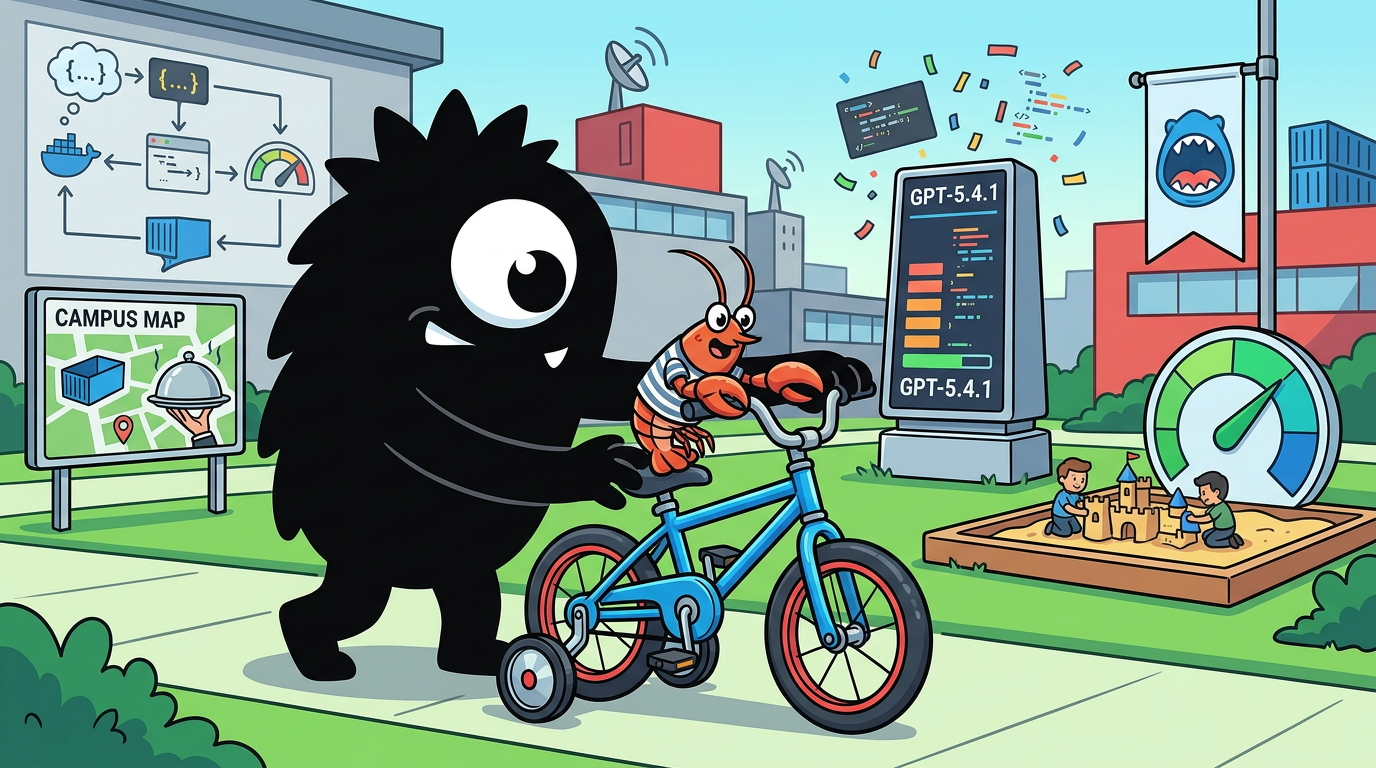
Why a Safety-First OpenClaw Guide Is Necessary
OpenClaw is easy to misunderstand because the demos are seductive. You see an AI agent reply in Telegram, file issues, write code, maybe even operate a trading workflow, and it looks like another consumer AI app with a slightly geekier install step. It is not that.
In practical terms, OpenClaw is a self-hosted AI agent runtime. It combines a gateway, model connections, skills/tools, persistent workspace state, and one or more communication channels so an agent can receive instructions, remember context, and act on your behalf.[1] That’s exactly why people are excited about it. It’s not just chat. It’s an execution environment for automation.
That excitement is visible everywhere in the current X conversation. OpenClaw is being used for side projects, business workflows, bots, and multi-agent experimentation. Some people are clearly getting real value fast. Others are treating it like a toy when it behaves much more like a small internet service you’re now responsible for operating.
OpenClaw just exploded across the internet. Here’s exactly how to set it up in 3 simple steps:
View on XThat “three simple steps” framing is the first reason a safety-first guide is necessary. OpenClaw can be set up quickly. But “can be installed quickly” is not the same thing as “can be deployed safely with almost no prior knowledge.”
A more grounded practitioner view on X captures the operational reality better:
openclaw'a başlamadan önce bilmen gereken 3 şey:
1. bu bir sunucu kurulumu... "indir çalıştır" değil. docker, network, port bilgisi gerekiyor.
2. güvenlik varsayılan olarak açık değil... sen ayarlamazsan kimse ayarlamaz. api key'lerini düz metin olarak saklamak, en yaygın hata.
3. bedava değil... openclaw açık kaynak ama kullandığın ai modeli (claude, gpt) için api ücreti ödüyorsun. aylık maliyetin kullanımına göre $5-$100+ arası değişir.
kimse bunları söylemiyor çünkü "5 dakikada kur para kazan" daha çok tıklanıyor.
That post gets three critical things right.
First, OpenClaw is a server deployment. Even if you run it on your laptop, you are still standing up software that listens, stores credentials, connects to external systems, and may expose an interface over a port or channel. That means host security, network policy, update hygiene, and secrets handling matter from day one.
Second, security is not automatic. If you mount the wrong directories, expose the wrong port, run the container with too much privilege, or leave the gateway reachable from the public internet without proper access control, you are not just risking a broken install. You are risking an agent service with your keys and your workflows attached.
Third, the cost of mistakes is asymmetric. A sloppy blog post can tell you to paste an API key into a shell command or map a dashboard directly to 0.0.0.0, and everything may seem fine—until bots find the port, a leaked key gets abused, or a skill does something you did not intend.
The attraction is understandable. People want coding help, internal copilots, messaging assistants, task automation, research agents, and even multi-agent work orchestration. The business case is also moving from speculative to concrete. A lot of users are no longer asking “Can it do anything useful?” They’re asking “Can I trust it enough to connect it to real work?”
That shift matters. Once OpenClaw is connected to Slack, Telegram, email, browser automation, code repositories, exchange APIs, or internal business data, the security model stops being optional polish and becomes part of the product itself. The safest OpenClaw setup is not the one that boots fastest. It is the one whose blast radius is intentionally constrained.
That’s where Docker enters the picture. For beginners, Docker is the most practical default starting point—not because it makes OpenClaw magically safe, but because it gives you meaningful isolation and operational control with far less overhead than a full virtual machine.[1][9] You can constrain filesystem access, avoid polluting the host, manage explicit ports and volumes, and tear down or rebuild the environment more cleanly than with a direct host install.
Recent OpenClaw releases make that approach more attractive. Practitioners on X are calling out slimmer Docker builds, SecretRef authentication improvements, and restart-safe bindings as changes that matter for real deployment—not just changelog cosmetics.
Anyone can set up OpenClaw on a VPS. Took me 10 minutes, I just chatted with Claw the whole time. Full setup in the video below 👇 🖥️ Spin up a VPS 🔐 SSH login ⚡ Run the OpenClaw command 🔁 If it fails, just run it again ✅ Choose recommended options 🔑 Add your Anthropic API key 🤖 Create a Telegram bot & paste the token OpenClaw installed. Now the fun part 🌍 Asked Claw to set up a custom domain 🧩 Got the web token to connect the UI 🛠️ Fixed the web UI Done. Total setup cost: $0.68 🚀
View on XThose improvements help, but they do not remove the need for operator judgment. Better images and stronger authentication features reduce friction and risk; they do not absolve you from understanding what the service can access, what ports are reachable, and what credentials are in play.
So the core thesis of this guide is simple:
If you are new to OpenClaw, run it in Docker, start with local or private-network-only access, expose as little as possible, and delay “cool” integrations until the boring security basics are in place.
That is the right beginner default. Not because Docker is perfect. Because the alternatives are usually worse:
- A direct install on your main machine gives the agent runtime more ambient access than most beginners realize.
- A hastily exposed VPS gives attackers exactly the kind of always-on, cred-bearing service they love to scan for.
- A copy-paste setup from a thread or video often omits the unglamorous but essential parts: firewall rules, user separation, secrets handling, and verification steps.
If you remember one thing from this article, make it this: OpenClaw is powerful enough that you should deploy it like infrastructure, not like a novelty app.
Docker vs Direct Install: What Isolation Really Buys You
The most common beginner security question in the X discussion is some version of: Is Docker isolated enough? Usually that question comes from someone deciding between running OpenClaw directly on a Mac mini, on a VPS, or inside some more hardened sandbox.
This post captures the uncertainty perfectly:
原想另买一台Macmini来跑openclaw
但AI推荐我在现有mini上用Docker(容器)运行,
因为隔离效果接近虚拟机,资源消耗小,与主系统完全隔离,网络、文件系统都可以精确控制权限。16GB内存完全够用。
Really?
The short answer is: Docker gives you real security benefits, but not complete isolation. It is usually the right default for beginners, but you should understand both what it protects and what it does not.
What Docker actually isolates
A container is not a full virtual machine. It does not emulate separate hardware or run a separate kernel. Instead, it uses operating-system-level isolation primitives—namespaces, cgroups, filesystem layering, and network boundaries—to make a process think it has its own environment.[7]
In plain language, Docker helps by isolating:
- Processes: the OpenClaw runtime runs as a contained process set rather than mingling directly with the host’s normal software.
- Filesystem access: the container sees its own filesystem plus only the host directories you explicitly mount.
- Network exposure: you decide which ports are published and whether the service is reachable only locally, on a private overlay, or publicly.
- Dependencies: the app’s packages and runtime live inside the image, reducing host contamination and making rebuilds easier.
For beginners, that’s a substantial improvement over installing OpenClaw directly on the host. It gives you a smaller, more legible trust boundary.
What Docker does not isolate
Here’s the catch: containers share the host kernel.[5][8] If the container is given excessive privileges, broad host mounts, or dangerous capabilities, the line between “inside Docker” and “on the host” gets thin very quickly.
This is why experienced operators keep repeating a basic rule:
OpenClaw safety pattern:
Don’t give agents full access to your host OS. Run them inside a Docker container or VM and keep their only way out as a narrow API surface.
You still get autonomous agents, but if something goes sideways, the blast radius stays inside the sandbox.
If you’re experimenting with self-directed agents, start here — not with sudo on your laptop.
That post is correct and more important than many newcomers realize. If you hand a container:
- privileged mode,
- the Docker socket,
- broad write access to host directories,
- host networking,
- root inside the container plus lax host controls,
then “it’s in Docker” stops meaning much from a risk perspective.
Direct install vs Docker vs VM vs sandboxed microVM
Let’s break down the practical options.
1. Direct host install
This is the highest-convenience option and usually the worst beginner security default.
Pros
- Fastest setup path
- Fewer moving parts
- Good for disposable local experimentation
Cons
- More ambient access to your user account and system
- Harder to reason about what the agent can touch
- Messier upgrades and removals
- Greater chance of accidental credential sprawl
If OpenClaw will access real accounts, channels, or automations, direct install is usually not the right first choice.
2. Docker container
This is the best default balance for most beginners.[1][3]
Pros
- Real process, filesystem, and network isolation
- Easy to rebuild and update
- Easier to constrain volumes and ports
- Good fit for local testing and modest VPS deployments
Cons
- Not full hardware isolation
- Easy to weaken through bad configuration
- Requires some understanding of volumes, networking, and secrets
This is where most people should start.
3. Full virtual machine
A VM provides stronger isolation because it runs a separate guest OS and kernel boundary.
Pros
- Stronger tenant separation
- Better blast-radius control for sensitive workloads
- Useful when host trust is low or risk is high
Cons
- More resource overhead
- More setup and maintenance complexity
- Slower iteration for beginners
If you are running OpenClaw against sensitive business systems, regulated data, or high-value credentials, a VM is often the better baseline than plain Docker.
4. Docker Sandboxes / microVM approaches
The more security-focused container options aim to keep Docker ergonomics while adding stronger isolation. Docker’s own guidance around running OpenClaw in Docker Sandboxes emphasizes microVM isolation, controlled networking, and private local AI workflows.[5]
Running OpenClaw locally? Do it safely. This walkthrough shows how to run it inside Docker Sandboxes with Docker Model Runner: - Isolated microVM - No exposed API keys - Controlled network access - Fully private, local AI setup Secure agent workflows in ~2 commands. Read → https://t.co/RZh2qp7eSi
View on XThis is an appealing path for local workflows where you want tighter containment than a standard container but don’t want to manage a full VM stack yourself. For entry-level users, it can be a strong option if the tooling is supported in your environment.
The real decision is about blast radius
The biggest conceptual mistake beginners make is asking, “Is Docker secure?” as if the answer were a yes/no label.
The better question is: How much damage can this OpenClaw instance do if a model makes a bad decision, a skill is malicious, a key leaks, or the service is exposed?
Docker helps by reducing blast radius. It does not replace:
- host hardening,
- least-privilege access,
- secret management,
- careful port exposure,
- skill scrutiny,
- runtime approvals.
Microsoft’s guidance on running OpenClaw safely frames the problem around identity, isolation, and runtime risk, which is exactly right.[8] Isolation is only one layer. If your agent has unconstrained credentials and broad authority, you still have a dangerous system—just one inside a neat container.
A practical recommendation matrix
For most readers, here is the advice I would actually give.
Local laptop or desktop testing
Use Docker, bind services to localhost only, and do not connect important personal or business accounts yet.
Home lab or Mac mini
Use Docker, separate data volumes, no host networking, no Docker socket mount, and remote access only through a private overlay such as Tailscale or equivalent if needed.
Basic VPS deployment
Use Docker on a dedicated VPS, not on a machine doing unrelated sensitive work. Lock down SSH, use a firewall, expose only the required port, and prefer reverse proxy plus auth or private-network access.
Sensitive production workflows
Use stronger isolation than default Docker—a VM, sandboxed container stack, or managed environment—with explicit identity controls, auditing, and approval gates.[5][8][9]
And if you’re ever tempted to let an autonomous agent run with effectively broad host access because “it’s only internal,” don’t. That shortcut is how experiments turn into incidents.
Before You Run Anything: The Secure Prerequisites Beginners Usually Skip
A lot of OpenClaw setup advice starts too late. It begins at docker run or docker compose up, when the real security decisions were already made earlier: what machine you chose, how it is patched, who can SSH into it, what ports are reachable, where your keys live, and whether you’re using trustworthy images.
The more sober voices on X keep coming back to this point: OpenClaw is not just “download and run.” It is server setup.
Alrighttt, been messing around with openclaw for about 4 weeks now, here is my setup from scratch running Openclaw in Docker, all ports blocked + tailscale and telegram set up with whisper tiny. Openclaw tutorial 👇👇
View on XThat post is more useful than the average “10-minute setup” claim because it quietly highlights what safe deployment actually looks like: Docker, blocked ports, private-network access, and a deliberate communications channel. That is an operator mindset.
1. Prepare the host like it matters—because it does
Whether you run OpenClaw on a local Linux box, a Mac mini, or a VPS, your first task is not installing OpenClaw. It is preparing the host.
At minimum:
- Patch the operating system fully before deployment.
- Create a non-root user for administration.
- Disable password SSH login if you are on a VPS; use keys only.
- Disable direct root SSH access.
- Enable a host firewall with a default-deny inbound policy.
- Install Docker from trusted sources and keep it updated.
If this is a VPS, strongly consider making it a dedicated box for OpenClaw or adjacent agent services, not a general-purpose server that also hosts unrelated internal tools. Isolation starts with workload separation.
Repello’s deployment checklist emphasizes basic host hardening and environment preparation for OpenClaw, and that advice is not glamorous but it is foundational.[11] A weak host makes every later decision worse.
2. Decide whether the service should be internet-facing at all
Beginners routinely expose services because that feels like the shortest path to “working.” In reality, public exposure should be a late-stage choice, not a default.
Ask yourself:
- Do I actually need to access OpenClaw over the public internet?
- Could I keep it local and use only a messaging channel?
- Could I put it behind a private network overlay such as Tailscale?
- Could I bind the web interface to localhost and tunnel access when needed?
For first deployments, the safest answer is usually: do not expose the OpenClaw UI or gateway publicly. Bind to localhost or a private address first. Add remote access only after authentication and transport protections are in place.[7][11]
The Nebius hardening guide and Microsoft’s safety guidance both stress that identity and network exposure are core control planes, not afterthoughts.[8][9]
3. Open only the ports you can explain
If you cannot explain why a port is open, it should not be open.
For a beginner deployment, that usually means:
- SSH open only if required, ideally restricted by source IP or private overlay
- OpenClaw app port bound to
127.0.0.1initially - No dashboard or API bound to all interfaces unless there is a deliberate access plan
- No host networking unless you have a specific, unavoidable reason
This is exactly where “easy mode” guides often fail users. They optimize for frictionless reachability rather than controlled reachability.
4. Treat secrets as toxic assets
The single most common beginner mistake is not a bad model setting. It is sloppy credential handling.
API keys, bot tokens, exchange credentials, and service auth secrets should never be:
- pasted into shell commands that will persist in history,
- committed into Git,
- dropped into screenshots,
- stored in world-readable config files,
- sprayed across multiple
.envcopies with unclear ownership.
On X, practitioners keep warning about plaintext key storage because they’ve seen the pattern repeat.
here: https://rasulkireev.com/openclaw-with-docker-practical-setup-guide/ just some tips that helped me get it deployed. i know that you are x20 more experiences than I am, but hopefully, still some useful stuff. official docker setup is confusing and is plain wrong, i think. let me know if you need help :D
View on XEven when you do use environment files, use them carefully:
- Store them outside public repos
- Restrict file permissions
- Keep one canonical source, not multiple ad hoc copies
- Avoid logging environments during troubleshooting
If you move beyond personal testing, you should look at stronger secret handling mechanisms and OpenClaw’s newer gateway security features rather than relying indefinitely on plain environment variables.[7]
5. Trust only images and docs you can justify trusting
Open source ecosystems move fast, and community images often appear before the official docs catch up. That does not mean you should pull the first image you see in a thread.
Prefer:
- official OpenClaw Docker documentation,[1]
- official or clearly recognized image sources,[2]
- reproducible examples from reputable practitioners,[3]
and be cautious with random one-click wrappers unless you understand exactly what they install, what they expose, and what defaults they choose on your behalf.
OpenClaw’s official Docker docs and Docker Hub image should be your baseline trust anchor.[1][2] Community guides are useful, but they are not substitutes for understanding the deployment surface.
6. Know what “dedicated” really means
If you are running OpenClaw on your personal daily-use laptop, the risk isn’t only remote compromise. It is also local entanglement:
- your SSH keys,
- browser sessions,
- personal documents,
- messaging apps,
- password manager accessibility,
- synced cloud folders.
A dedicated VPS or dedicated local machine for experimentation is often safer than “just using my main computer” because the environment starts cleaner and the blast radius is smaller.
7. Make a preflight checklist and actually use it
Before you run a single OpenClaw container, be able to say yes to this list:
- OS fully updated
- Non-root admin user created
- SSH locked down
- Host firewall enabled, default deny inbound
- Docker installed from trusted source
- OpenClaw image source verified
- Planned ports documented
- API keys prepared without shell-history leakage
- Initial bind target set to localhost or private network
- No unnecessary host mounts planned
If that feels like overkill for a beginner guide, good. The entire point is to replace hype with discipline. OpenClaw rewards careful operators and punishes casual ones.
Step-by-Step: A Beginner-Friendly Secure OpenClaw Docker Setup
Now for the part most people actually came for: a secure, understandable OpenClaw-in-Docker setup path that does not assume you are already a Docker power user.
The frustration on X is real. People want Docker to be the sane default, but many beginners find the official flow confusing or too terse.
here: https://rasulkireev.com/openclaw-with-docker-practical-setup-guide/
just some tips that helped me get it deployed.
i know that you are x20 more experiences than I am, but hopefully, still some useful stuff.
official docker setup is confusing and is plain wrong, i think.
let me know if you need help :D
That critique is fair. Official docs are necessary, but practitioners often need a setup sequence that explains not just what to type, but why each choice affects safety.
This section gives you a minimal, safer baseline. It is not the fastest possible install. It is the install I would want a beginner to follow if they intend to keep using the instance after the first demo.
The deployment model we’re aiming for
We want:
- OpenClaw running in Docker
- persistent data stored in explicit volumes
- no unnecessary privileges
- no public exposure by default
- access bound to localhost or a private address first
- a clean place to inspect logs, health, and status before adding channels or risky skills
We do not want:
- host networking,
- privileged containers,
- broad host directory mounts,
- secrets pasted into one-liner shell history,
- dashboard/API exposed to the whole internet “just to test it.”
Step 1: Prepare a project directory
Create a dedicated directory on the host for your deployment artifacts, such as:
compose.yaml.envor equivalent secret file- a directory for persistent data if you choose bind mounts
Do not store this inside a public Git repository.
If you use bind mounts rather than named Docker volumes, set permissions intentionally. If you’re a beginner, named volumes are usually safer and simpler because they reduce accidental leakage into random host paths.[3]
Step 2: Pull the official image
Start from the official Docker documentation and recognized image distribution points.[1][2]
The official docs provide the supported Docker installation route.[1] The Docker Hub listing is the trust anchor for the image you are about to run.[2] If you find a community image or wrapper script that seems easier, stop and ask what defaults it is hiding.
Recent releases have improved image footprint and deployment ergonomics, which helps both local development and multi-instance scenarios.
GPT-5.4 support on day one. Pluggable context engines is the sleeper feature here — that’s the foundation for proper agent memory architectures.
Slim Docker builds matter too. Running OpenClaw in Docker for multi-instance scaling and smaller images = faster deploys.
Shipping fast 🦞
Slimmer images are not just a quality-of-life improvement. They reduce pull time, speed updates, and make rebuilding safer and faster in practical operations.
Step 3: Use Docker Compose, not a giant one-liner
You can run OpenClaw with a long docker run command, but Compose is usually better for beginners because it makes the configuration visible and repeatable.
A secure beginner Compose file should reflect these principles:
- publish only the needed port
- bind it to
127.0.0.1first, not0.0.0.0 - run with read/write access only where necessary
- avoid extra Linux capabilities
- restart on failure, but not in a way that hides repeated crash loops
- mount only the data OpenClaw actually needs
Even if a thread advertises a one-liner install, your long-term security posture improves when the setup lives in a readable config file you can audit later.
1/ 🛠️ The ultimate setup guide — from install to advanced config in one thread. One-liner install, onboarding wizard, dashboard, channels & skills. The clearest end-to-end walkthrough I've seen. If you haven't set up OpenClaw yet, start here 👇 https://t.co/BtHQyDSgS8
View on XThat kind of walkthrough is useful for product orientation, but the operational lesson is this: clarity beats convenience. If you cannot read your deployment config and explain what each line grants, you are not ready to expose the service.
Step 4: Create explicit persistent storage
OpenClaw stores workspace state, models/config references, and other runtime data depending on the installation mode.[1][3] You want persistence, but you want it explicitly defined.
Good options:
- Named Docker volumes for most beginners
- Dedicated bind-mounted directories if you need direct host inspection or backup tooling
Bad option:
- mounting your home directory or a broad project root “to keep things simple”
The reason is obvious once stated plainly: every mounted host path is part of the agent’s reachable environment. Mount only what is required.
Step 5: Put secrets in a dedicated env file, carefully
For a beginner setup, an environment file is acceptable if handled with discipline:
- create it manually, not via shell echo with secret values in command history
- restrict file permissions
- never commit it
- avoid naming it something generic that gets copied around casually
Populate only the variables required for initial startup—typically model/provider keys and any startup auth tokens the docs specify.[1][7]
If you are on a team or moving toward production, this is the point where you should start thinking beyond .env files toward managed secret stores and OpenClaw-native controls like SecretRef, which we’ll cover next.
Step 6: Bind to localhost first
This is the most important beginner safety move and the easiest one to skip.
When publishing your service port, bind it to:
127.0.0.1:PORT:PORT
not:
0.0.0.0:PORT:PORT
Why? Because localhost binding means only the local machine can reach the service directly. That gives you space to verify startup, complete onboarding, inspect logs, and configure access controls before any remote client can try talking to it.
If you need remote access later, add it consciously:
- via reverse proxy with authentication and TLS,
- via private overlay network,
- or by selectively exposing the port after security controls are configured.
Step 7: Start the container and verify the basics
Bring the stack up and resist the urge to immediately connect channels, install skills, or automate something expensive.
First, verify:
- Container status
- Is it running?
- Is it restarting repeatedly?
- Did it exit with config errors?
- Logs
- Are there auth failures?
- Are there missing env vars?
- Are secrets appearing in logs?
- Health and diagnostics
- Use OpenClaw’s status and probe commands where supported to verify runtime health and service reachability.[1][3]
The command surface practitioners share on X is useful here because it shows what to check after boot, not just how to install.
openclaw cheatsheet core commands • openclaw gateway • openclaw gateway start | restart • openclaw channels add • openclaw channels list • openclaw status --probe • openclaw onboard • openclaw setup • openclaw doctor • openclaw models list | set | status • openclaw auth setup-token workspace anatomy • https://t.co/pugvEKScXk (instructions) • https://t.co/BRysp7LL03 (persona) • https://t.co/oAGOUgXchi (preferences) • https://t.co/RWYaNk5GdM (name / theme) • https://t.co/IFLeL1QlXb (long-term) • https://t.co/98pH0CQmMG (logs) • https://t.co/dNvlqnAi1i (checks) • https://t.co/1r0xVY5NTo (startup) • root: .openclaw/workspace memory & models • vector search • model switch • auth setup • models list hooks & skills • clawhub • hook list • clawhub install <slug> in-chat slash commands • /status • /context list • /model <id> • /compact • /new • /stop • /tts on|off • /think quick install • npm install -g openclaw@latest • openclaw onboard • openclaw setup --install-daemon channel management • whatsapp (login / qr) • telegram (add channel) • discord (add channel) • slack (add channel) • imessage (macos native) voice & tts • openai / elevenlabs • edge tts (free) troubleshooting • no dm reply • silent group • auth expired • gateway down • memory bug • memory index automation & research • browser • subagents • cronjobs • heartbeat
View on XThe key commands in that cheatsheet—status probes, doctor-style diagnostics, model checks, auth setup—matter precisely because a “running” container is not the same thing as a securely configured system.
Step 8: Complete onboarding before connecting real channels
OpenClaw’s onboarding flow exists to establish core runtime behavior and access configuration.[1] Complete that on a localhost-bound or private-only instance before you attach Telegram, Discord, Slack, browser automation, or anything involving money or external write access.
At this stage, verify:
- model provider connection works,
- workspace is created where expected,
- auth tokens are configured,
- no unexpected ports are listening,
- data persistence survives a restart.
If you can restart the container and your bindings, config, and workspace remain intact, you’re on firmer ground. Recent releases improved restart-safe ACP bindings, which matters in practice if you don’t want channels or runtime associations to break on routine restarts.[7]
Step 9: Add one channel only
Beginners often add several channels and skills immediately, then have no idea which component caused the first problem.
Instead:
- add one communication channel,
- test it thoroughly,
- review logs,
- confirm permissions and expected behavior,
- only then expand.
The same principle applies to model providers and skills: one at a time. Complexity compounds faster than most first-time operators expect.
Step 10: Snapshot the known-good state
Once you have:
- a working container,
- persistent storage,
- functioning auth,
- one tested channel,
capture the baseline:
- save the Compose file
- document image tag/version
- note which ports are open
- note which secrets are in use
- back up the workspace/persistent data
- record the expected healthy log patterns
This is not bureaucratic overhead. It is what makes updates and incident recovery possible later.
A secure minimal deployment checklist
Before you move on from setup, confirm all of this is true:
- Running inside Docker, not directly on host
- No privileged mode
- No host networking
- No Docker socket mount
- Service bound to localhost or private network only
- Explicit data volume(s) only
- Minimal env file, handled carefully
- Startup successful with no secret leakage in logs
- OpenClaw health/status checks pass
- One channel max connected initially
- No high-risk skills installed yet
That is the beginner-friendly secure baseline. It may not look like “set up in 3 minutes,” but it is the difference between a controlled deployment and an attractive nuisance.
Secrets, Authentication, and Safe Defaults Inside OpenClaw
A lot of security mistakes happen after the container starts. The operator feels relief—OpenClaw is running, the dashboard loads, the model responds—and then the dangerous shortcuts begin. Keys stay in plain environment variables forever. Gateway auth remains loosely configured. Logs become a graveyard of accidentally exposed secrets.
This is why the recent discussion around SecretRef, gateway auth, and release-level security improvements matters.
今天安装了QQBot后,顺便更新了OpenClaw到2026.3.7 新版本 🦞
现在版本迭代好快,看了本次版本升级内容:
这次更新主要集中在 模型能力、架构扩展和稳定性提升:
⚡ 接入 GPT-5.4 + Gemini 3.1 Flash-Lite
🤖 ACP 绑定机制升级,重启不再丢失连接
🐳 更轻量 Docker 构建
🔐 新增 SecretRef 网关认证
🔌 可插拔上下文引擎架构
📸 支持 HEIF 图像格式
💬 修复 Zalo 通道问题
整体来看,这一版本重点在于 稳定性与扩展能力的增强。
OpenClaw 2026.3.7 is the kind of release that actually helps teams ship: GPT-5.4 + Gemini 3.1 Flash-Lite, restart-safe ACP bindings, slimmer Docker builds, and SecretRef auth. If you run agents in production, this update cuts both risk and friction.
View on XThose release notes are not just for enterprise teams. They represent the maturation of OpenClaw from an exciting agent framework into something people are increasingly trying to operate in production.
Docker-level secrets vs OpenClaw-level secrets
It helps to distinguish two layers.
Layer 1: Docker and host secret handling
This is about how credentials enter the runtime. Examples:
- environment files,
- Docker secret mechanisms,
- mounted secret files,
- external secret managers.
The main risk here is accidental leakage through:
- shell history,
- repository commits,
- filesystem permissions,
- process inspection,
- crash logs and debug output.
Layer 2: OpenClaw gateway and internal auth controls
This is about how OpenClaw itself gates access once it is running:
- setup tokens,
- gateway authentication,
- internal references to secrets,
- controlled exposure of provider credentials.
The OpenClaw gateway security docs are clear that authentication and secret handling are first-class controls, not optional extras.[7]
Why plain env vars are only a transitional solution
Environment variables are popular because they’re easy. They are also easy to overuse. For a personal test instance, an env file with strict permissions may be acceptable. For anything more serious, you should treat plain env vars as a stopgap.
Problems with overreliance on env vars:
- they often get duplicated across systems,
- operators log them by accident,
- container inspection can reveal them,
- troubleshooting scripts sometimes dump them,
- they create long-lived secrets with unclear rotation paths.
A stronger pattern is to minimize direct plaintext secret exposure and use OpenClaw’s more structured secret handling where available. SecretRef is important because it moves toward referencing secrets rather than scattering them around configuration surfaces.[7][12]
Lock down the gateway before remote access
One of the easiest ways to turn a manageable OpenClaw deployment into a liability is to expose the gateway before authentication is correctly configured.
The safe order is:
- Start locally or on a private network
- Configure gateway auth/setup token
- Verify who can reach it and how
- Only then consider broader access
The OpenClaw docs cover gateway security settings and setup-token-based onboarding controls.[7] Use them. Do not assume “obscure port” or “it’s just my VPS IP” counts as access control.
Reduce leakage through logs and files
A few practical rules go a long way:
- Never paste secrets into commands that will be stored in shell history.
- Do not screenshot dashboards or terminal output until you know what is visible.
- Check startup logs for echoed configuration values.
- Restrict permissions on env files and mounted config paths.
- Rotate anything you accidentally exposed, even if exposure was brief.
If a key appears in terminal history, a Git commit, a support paste, or a shared log, treat it as compromised.
Use shorter-lived, narrower credentials whenever possible
Not all credentials are equal. If you can choose between:
- a master API key with broad billing and account control,
- or a narrower token with limited permissions,
choose the narrower token.
If you can separate:
- model provider access,
- channel bot tokens,
- external business integrations,
do it. Credential compartmentalization is one of the simplest ways to reduce damage when something leaks.
New security features matter because production use is real now
There was a time when OpenClaw security discussions could be dismissed as premature hardening around a mostly experimental tool. That time has passed. People are connecting OpenClaw to workflows that matter, and newer features like SecretRef and restart-safe bindings reduce both operational fragility and secret sprawl.[7][12]
The right takeaway is not “OpenClaw is now secure by default.” It is:
OpenClaw is getting better security primitives. You should use them, and you should still assume the human operator remains the final control point.
Hardening the Agent: Skills, Tool Access, and Runtime Guardrails
Infrastructure security is only half the story. You can lock down ports, isolate the container, and handle secrets carefully—and still create a dangerous system if the agent itself is overpowered.
This is the point many of the sharpest X warnings are making. The real risk is not only exposed instances. It is what happens when an agent can install dubious skills, reach too many systems, or act without meaningful approval boundaries.
"guvenlik kismi cok onemli ve cogu kisi atliyor.
openclaw'da su ana kadar 7 cve yayinlandi, 30K+ acik instance tespit edildi,
clawhub'daki 10K+ skill'in 824'u zararli bulundu. 'kur calistir unutʼ yaparsan
baskasinin agent'i oluyorsun.
docker + network bilmiyorsan kiloclaw mantikli ama self-hosted'in kontrolunu
kaybediyorsun.
ozetlemissin iyi, ozellikle 'para kazanma vaatleri gercegi yansitmiyor' kismi
dogru.
That post is blunt, but the core point is right: if you treat OpenClaw as “install it and forget it,” you can end up operating an agent with someone else’s priorities, code, or attack path embedded in its behavior.
Skills are part of the attack surface
Beginners often hear “skills” or “plugins” and think “capabilities.” Security-minded operators hear “supply chain.”
Every skill or tool you add changes the attack surface by potentially introducing:
- new code,
- new dependencies,
- new network calls,
- new permission scopes,
- new data flows,
- new prompt injection pathways.
That means skill installation should be treated less like downloading an app and more like granting execution authority.
Follow least privilege for tool access
An OpenClaw agent does not need universal authority to be useful.
Good beginner practice:
- give it access to one task domain at a time
- use read-only access where possible
- avoid filesystem write access unless required
- avoid payment, exchange, or credential-management permissions on day one
- separate experimental agents from production agents entirely
If your first instinct is to connect OpenClaw to every messaging platform, code repo, and browser session at once, slow down. The safest agent is the one with the smallest meaningful authority set.
Vet third-party skills and installation sources
If you install from a public skill marketplace or community registry, ask:
- Who maintains this?
- Is the source visible?
- How active is the project?
- What permissions does it need?
- What external services does it call?
- Is there evidence others have reviewed it?
Security guidance from practitioners and hardening checklists consistently stresses supply-chain awareness, install-source allowlists, and operator review for high-risk extensions.[8][11][12]
Add pre-action approvals for high-risk operations
This is one of the most important operational habits you can build: not all actions deserve autonomy.
High-risk actions should require explicit approval, including:
- money movement,
- hiring/purchasing,
- deleting or overwriting files,
- pushing code,
- sending external communications on your behalf,
- changing system config,
- installing new skills.
This becomes especially important once you see how quickly some operators are trying to push OpenClaw into business-critical roles.
just created the ultimate openclaw setup guide. lots of founders are struggling to find use cases for it, I have it running my business 24/7. Even using my card info to hire designers on Contra. inside the doc, i’ll cover… -> how to install and run the first boot. -> the mandatory first boot checklist. -> workspace files so it knows how to behave. -> creating your agent’s philosophy with SOULmd. -> uploading your information with USERmd. -> how to add skill stacks. -> setting up your communication channel. -> some basic automations to save you HOURS. -> multi-agent routing. -> ensuring security is set up properly. also uploaded all the code so you can just plug-n-play. just RT + comment “CLAW” and I’ll send it to you (must be following)
View on XIf an agent is using card information or interacting with third-party services in financially meaningful ways, you are no longer in “harmless experimentation.” You are in delegated authority territory. That demands confirmations, guardrails, and auditability.
Use behavioral blacklists and structured defense layers
The most concrete public guidance in the current discussion comes from SlowMist’s security practice framing, which breaks defenses into pre-action, in-action, and post-action layers.
⚠️ Running an AI Agent like @openclaw with root/terminal access is powerful but inherently risky. How do we ensure controllable risk and auditable operations without sacrificing capability?
Recently, we released the OpenClaw Security Practice Guide — a structured defense matrix designed for high-privilege autonomous agents running in Linux Root environments. cc @evilcos
📖GitHub Version:
👉https://t.co/GAYwq7rUKQ
🛡️ 3-Tier Defense Matrix
🔹Pre-action — Behavior blacklists & strict Skill installation audit protocols (Anti-Supply Chain Poisoning)
🔹In-action — Permission narrowing & Cross-Skill Pre-flight Checks (Business Risk Control)
🔹Post-action — Nightly automated explicit audits (13 core metrics) & Brain Git disaster recovery
🛠️ Built around four core principles:
• Zero-friction operations
• High-risk requires confirmation
• Explicit nightly auditing
• Zero-Trust by default
🚀 Zero-Friction Flow:
1️⃣ Drop the guide directly into your #OpenClaw chat
2️⃣ Ask the Agent to evaluate reliability
3️⃣ Instruct it to deploy the full defense matrix
4️⃣ Use the Red Teaming Guide to simulate an attack and ensure the Agent correctly interrupts the operation
🚨 Honest limitation: this guide is intended for human operators and AI Agents with foundational Linux system administration capabilities, and is particularly designed for OpenClaw operating in high-privilege environments. As AI models and their underlying service environments vary, the security measures provided in this guide are for defensive reference only. Final responsibility always remains with the human operator. Please assess and execute cautiously based on your own environment and capabilities.
🤝 If you have new findings, lessons learned, or improvement suggestions from real-world deployment, we welcome you to share them with the community via Contributions, Issues, or Feature Requests. Special thanks to @leixing0309 for the professional contribution.
As we continue unlocking #AI capability, may we remain vigilant and clear-headed about risk.🫡
That three-tier framing is excellent because it matches how real incidents happen.
Pre-action controls
- install-source allowlists
- skill review and approval
- blocked action categories
- explicit restrictions on sensitive targets
In-action controls
- permission narrowing
- pre-flight checks across tools/skills
- confirmation prompts for risky operations
- anomaly detection around unusual sequences
Post-action controls
- logs and audit trails
- scheduled reviews
- rollback/recovery plans
- credential rotation after suspicious behavior
For beginners, you do not need a giant governance program. But you do need some version of this layered mindset. “I trust the model” is not a control.
Logging is not optional if the agent can act
If OpenClaw is doing anything beyond answering chat messages, you want auditable logs of:
- who initiated actions,
- what tool or skill was used,
- what external target was touched,
- what result occurred,
- whether approval was given.
Without logs, you cannot tell the difference between:
- a model mistake,
- a malicious skill,
- a prompt injection event,
- an operator misunderstanding.
Separate experimentation from production
This is the line many teams blur too early.
Experimental OpenClaw
- can tolerate looser controls
- should use fake or low-stakes accounts
- should not handle money or sensitive data
- should live in a more disposable environment
Production OpenClaw
- needs narrower permissions
- should use stronger identity boundaries
- needs logging, review, and recovery plans
- should avoid unvetted skill churn
The mistake is not being ambitious with OpenClaw. The mistake is deploying experimental habits into production workflows.
Daily Operations: Updating, Monitoring, and Recovering Safely
A secure day-one setup can become an insecure month-three setup surprisingly fast. OpenClaw releases are moving quickly, Docker images are changing, and the operational challenge is no longer just installation. It is staying current without introducing downtime or drift.
The release cadence is visible in the X discussion:
OpenClaw Crypto Lab - Day 1
✅ VPS deployed
✅ Docker installed
✅ Freqtrade running
✅ Binance dry-run connected
Bot status: RUNNING
Pair: BTC/USDT
Strategy: SampleStrategy
Mode: Dry-run
Next step:
Test better strategies.
That post is about a crypto workflow, but it highlights the real trend: OpenClaw is not just being tested in sandboxed toy scenarios. It is being connected to running systems and adjacent automation. Once that happens, updates and monitoring matter a lot more.
Build a safe update routine
At minimum, your update routine should include:
- Read release notes first
- look for auth, secret, networking, or binding changes
- note breaking config changes
- Pin or record your current image tag
- so you know what you are running now
- Back up persistent data
- workspace
- config
- any bound storage
- Pull the new image intentionally
- not as an accidental side effect of some broader host update
- Restart and verify
- container healthy
- logs normal
- status probes pass
- channels reconnect as expected
- Keep a rollback path
- old image tag noted
- backup restorable
- previous Compose version saved
The Docker image distribution and release notes ecosystem make this workflow feasible, but only if you treat version changes as operational events, not background noise.[2][7]
Monitor health after every change
After any restart, upgrade, or config edit, check:
- container status
- OpenClaw health/status probes
- model connectivity
- channel connectivity
- logs for auth errors or repeated retries
Do not assume “the container is up” means “the service is healthy.” A surprisingly large class of failures in agent systems are partial failures: the process is alive, but bindings are broken, auth expired, or a channel silently stopped working.
Rotate keys and review enabled integrations
On a schedule—and immediately after any suspected leak—rotate:
- model API keys,
- bot tokens,
- external service credentials,
- setup/auth tokens.
Also review what remains enabled. It is common to accumulate old channels, skills, and test credentials that nobody actively uses but that still represent risk.
Keep a mini incident-response playbook
You do not need an enterprise SOC runbook. You do need a short checklist for the obvious bad days:
If a key leaks
- revoke or rotate it immediately
- inspect logs for misuse
- update the secret source
- restart affected services if needed
If the instance was accidentally exposed
- close the port or bind locally
- rotate setup/auth tokens
- inspect access logs and runtime actions
- review installed skills and recent changes
If behavior seems suspicious
- disable external actions
- snapshot logs and config
- review recent prompts, installs, and integrations
- rotate any reachable credentials
- rebuild from known-good configuration if confidence is low
Security is a maintenance practice, not a setup checkbox
This is the uncomfortable truth hidden by many “ultimate setup guide” threads: the secure part of OpenClaw is not the first boot. It is the operating discipline you maintain after the novelty wears off.
Who Should Self-Host OpenClaw in Docker—and Who Should Choose Something Else
By now, the better question is not “Can you run OpenClaw in Docker securely?” Yes, you can. The better question is whether you specifically should.
The X conversation is evolving in exactly that direction. The debate is no longer only Docker versus bare-metal install. It’s also whether OpenClaw’s architecture is even the right fit for your current problem.
The real tradeoff isn't Docker vs no-Docker. It's orchestration vs single-agent. OpenClaw's sub-agents + co-work mode = multiple AI workers coordinating on one task. Claude Code = one smart assistant. Different tools for different jobs. Running 5 agents on a data pipeline vs asking Claude to write a script. Both valuable.
View on XThat is a useful corrective. OpenClaw shines when you need agent workflows, not just smarter chat. If you want sub-agents, coordination, channels, tool use, and autonomous or semi-autonomous task execution, it can justify the added operational complexity. If what you actually need is a single assistant to help write code or answer questions, a simpler tool may be safer and cheaper.
You should self-host OpenClaw in Docker if…
- you want control over the environment,
- you are willing to learn basic Docker and networking,
- you can maintain host and image updates,
- your early use case is moderate-risk,
- you value local or private deployment over managed convenience.
For builders, learners, and technical operators, Docker self-hosting is a strong default because it gives you isolation, repeatability, and control without the heavier cost of a full VM-first stack.[5][8][9]
You should choose stronger isolation or managed options if…
- you handle sensitive customer or business data,
- the agent will access high-value credentials,
- the workflow can move money or make commitments,
- you cannot commit to ongoing security maintenance,
- you need auditability and tighter governance from day one.
In those cases, standard Docker may still be part of the answer, but probably not the whole answer. A VM, sandboxed runtime, or managed environment with stronger controls may be more appropriate.[5][8]
A safe beginner action plan
If you are just starting, here is the path I recommend:
- Run OpenClaw in Docker only
- Bind it to localhost or a private network
- Use one model provider and one channel
- Mount only explicit persistent storage
- Keep secrets out of shell history and repos
- Do not install random skills on day one
- Do not grant payment, trading, or broad file authority immediately
- Document your known-good config before you expand
And here is what you should never do on day one:
- expose OpenClaw publicly without auth,
- run it privileged,
- mount broad host directories,
- connect your main personal machine’s sensitive environment casually,
- give it high-value credentials before you understand the runtime.
OpenClaw is real infrastructure now. That’s the good news and the warning. It is powerful enough to be useful—and powerful enough to hurt you if you deploy it like a gimmick.
The safest beginner posture is not fear. It is disciplined curiosity: use Docker, reduce blast radius, add capabilities slowly, and assume that every new skill, token, and port is a security decision.
Sources
[1] Docker - OpenClaw — https://docs.openclaw.ai/install/docker
[2] alpine/openclaw - Docker Image — https://hub.docker.com/r/alpine/openclaw
[3] Running OpenClaw in Docker — https://til.simonwillison.net/llms/openclaw-docker
[4] AAAbiola/openclaw-docker: Run your AI assistant effortlessly with ... — https://github.com/AAAbiola/openclaw-docker
[5] Run OpenClaw Securely in Docker Sandboxes — https://www.docker.com/blog/run-openclaw-securely-in-docker-sandboxes
[6] Deploying OpenClaw using Docker: Compilation, Migration, and ... — https://jxausea.medium.com/deploying-openclaw-using-docker-compilation-migration-and-token-configuration-779b92543350
[7] Security - OpenClaw Docs — https://docs.openclaw.ai/gateway/security
[8] Running OpenClaw safely: identity, isolation, and runtime risk — https://www.microsoft.com/en-us/security/blog/2026/02/19/running-openclaw-safely-identity-isolation-runtime-risk
[9] OpenClaw security: architecture and hardening guide — https://nebius.com/blog/posts/openclaw-security
[10] OpenClaw Security: Best Practices For AI Agent Safety — https://www.datacamp.com/tutorial/openclaw-security
[11] OpenClaw Security Best Practices: A Technical Deployment Checklist — https://repello.ai/blog/technical-best-practices-to-securely-deploy-openclaw
[12] knownsec/openclaw-security: OpenClaw Security Guide — https://github.com/knownsec/openclaw-security
[13] openclaw/docs/install/docker.md at main · openclaw/openclaw — https://github.com/openclaw/openclaw/blob/main/docs/install/docker.md
[14] How to Run OpenClaw with DigitalOcean — https://www.digitalocean.com/community/tutorials/how-to-run-openclaw
[15] How to deploy OpenClaw with Docker: step by step — https://cybernews.com/best-web-hosting/how-to-deploy-openclaw-with-docker
Further Reading
- [Google DeepMind: DeepMind Unveils Genie 3: Revolutionary World Model Generator](/buyers-guide/ai-news-google-deepmind-genie-3-release) — Google DeepMind released Genie 3, an advanced generative world model capable of creating interactive 3D environments from text or image prompts. This iteration improves on previous versions with higher fidelity simulations, real-time interaction, and applications in robotics and gaming. The model is open for research use, enabling developers to build custom virtual worlds.
- [Nvidia / OpenAI: Nvidia Confirms Major Stake in OpenAI Funding Round](/buyers-guide/ai-news-nvidia-openai-investment-confirmation) — Nvidia CEO Jensen Huang confirmed the company's participation in OpenAI's latest funding round, calling it a 'very good investment' and potentially Nvidia's largest ever, though smaller than the reported $100B figure. Discussions have been ongoing since September 2025, pushing back against claims the deal stalled. This underscores deepening ties between AI hardware leader Nvidia and frontier model developer OpenAI.
- [Moonshot AI Unveils 1T-Param Open-Source Kimi K2.5 Model](/buyers-guide/ai-news-moonshot-ai-kimi-k2-5-release) — Moonshot AI released Kimi K2.5, a groundbreaking 1-trillion-parameter open-source multimodal model optimized for agentic AI with swarm capabilities enabling 4.5x faster task handling. The model excels in image recognition (78.5% on MMMU Pro) and supports local deployment on high-end hardware like Mac Studios. Source code and weights are publicly available for fine-tuning and integration into developer workflows.
- [OpenAI Launches Codex Mac App for Multi-Agent Coding](/buyers-guide/ai-news-openai-codex-app-release) — OpenAI released the Codex app for macOS on February 2, 2026, serving as a command center for developers to manage multiple AI coding agents. The app enables parallel execution of tasks across projects, supports long-running workflows with built-in worktrees and cloud environments, and integrates with IDEs and terminals. Powered by GPT-5.2-Codex model, it includes skills for advanced functions like image generation and automations for routine tasks.
- [OpenAI Unveils GPT-5.3-Codex: Coding AI Breakthrough](/buyers-guide/ai-news-openai-gpt-5-3-codex-release) — OpenAI released GPT-5.3-Codex, a advanced coding model achieving 57% on SWE-Bench Pro, 76% on TerminalBench 2.0, and 64% on OSWorld benchmarks. It introduces mid-task steerability, live updates, faster token processing (over 25% quicker), and enhanced computer use capabilities. This launch follows Anthropic's Claude Opus 4.6, intensifying competition in AI coding tools.
References (15 sources)
- Docker - OpenClaw - docs.openclaw.ai
- alpine/openclaw - Docker Image - hub.docker.com
- Running OpenClaw in Docker - til.simonwillison.net
- AAAbiola/openclaw-docker: Run your AI assistant effortlessly with ... - github.com
- Run OpenClaw Securely in Docker Sandboxes - docker.com
- Deploying OpenClaw using Docker: Compilation, Migration, and ... - jxausea.medium.com
- Security - OpenClaw Docs - docs.openclaw.ai
- Running OpenClaw safely: identity, isolation, and runtime risk - microsoft.com
- OpenClaw security: architecture and hardening guide - nebius.com
- OpenClaw Security: Best Practices For AI Agent Safety - datacamp.com
- OpenClaw Security Best Practices: A Technical Deployment Checklist - repello.ai
- knownsec/openclaw-security: OpenClaw Security Guide - github.com
- openclaw/docs/install/docker.md at main · openclaw/openclaw - github.com
- How to Run OpenClaw with DigitalOcean - digitalocean.com
- How to deploy OpenClaw with Docker: step by step - cybernews.com
Related Guides
Aider vs Cline: Which Is Best for AI Pair Programming in 2026?
15 min read
The Best AI Model Tools in 2026: An Expert Comparison Through a $4M Polymarket Bet
25 min read
What Is Replit? A Complete Guide for 2026
19 min read
Traders Are Betting on Anthropic: What Polymarket's 99% AI Model Odds Reveal for Developers in 2026
20 min read