Anthropic Unveils Claude Opus 4.6: Smarter AI with 1M Token ContextUpdated: October 04, 2026
Anthropic released Claude Opus 4.6, an upgraded version of its flagship AI model, featuring enhanced planning, sustained agentic tasks, reliability in large codebases, and self-error detection. This marks the first Opus-class model with 1 million token context window in beta, enabling handling of massive datasets and complex workflows. The update positions Claude as a leader in practical AI applications for developers and enterprises.
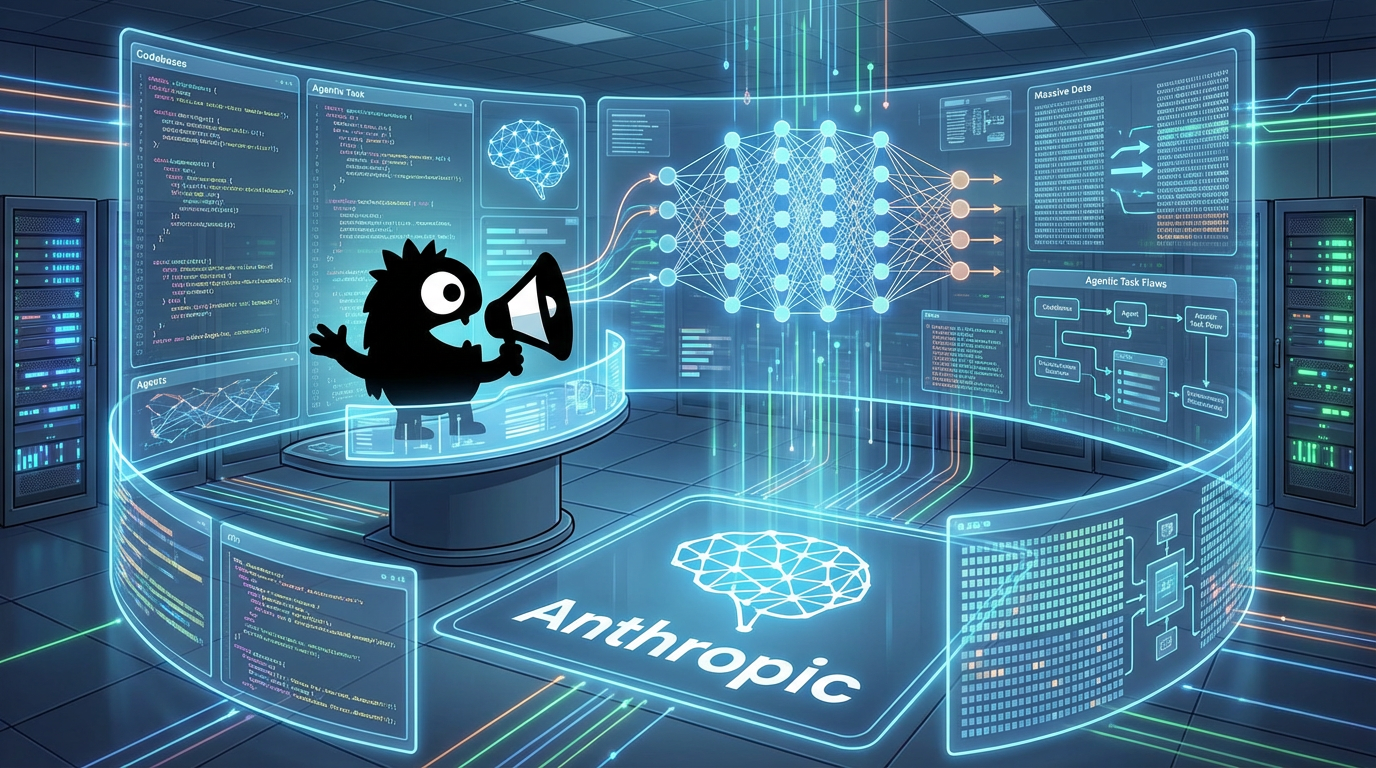
For developers and technical decision-makers grappling with sprawling codebases and intricate AI workflows, Anthropic's Claude Opus 4.6 arrives as a game-changer. With its groundbreaking 1 million token context window in beta—the first for an Opus-class model—this upgrade empowers handling of massive datasets, sustained agentic tasks, and reliable operations over multi-million-line repositories, slashing the need for fragmented prompts and boosting productivity in enterprise-scale applications.
What Happened
On February 5, 2026, Anthropic unveiled Claude Opus 4.6, its most advanced AI model yet, building on the intelligence of Opus 4.5 with significant enhancements in coding, reasoning, and long-context processing. Key upgrades include superior planning for complex tasks, extended agentic capabilities for autonomous multitasking, heightened reliability in navigating large codebases (e.g., performing migrations like a senior engineer), and advanced self-error detection through improved debugging and bug-catching. The model leads benchmarks like Terminal-Bench 2.0 for agentic coding, Humanity’s Last Exam for multidisciplinary reasoning, and GDPval-AA for economically valuable tasks, outperforming competitors such as GPT-5.2. Notably, it introduces a 1M token context window in beta, supporting up to 128k output tokens, alongside features like context compaction for indefinite task extension and adaptive thinking for selective deep reasoning. Available immediately via claude.ai, the Anthropic API (model: claude-opus-4-6), and platforms like Vertex AI, pricing remains at $5/$25 per million input/output tokens, with premium rates for prompts over 200k tokens. [source](https://www.anthropic.com/news/claude-opus-4-6) [source](https://techcrunch.com/2026/02/05/anthropic-releases-opus-4-6-with-new-agent-teams)
Why This Matters
For engineers and technical buyers, Opus 4.6's 1M context enables seamless analysis of entire codebases or voluminous documents without truncation, reducing errors in refactoring, vulnerability detection, and multi-step workflows—critical for DevOps and software engineering teams. Agent teams in Claude Code (research preview) allow parallel subagent execution for tasks like codebase reviews, accelerating development cycles and fostering scalable AI integrations. Businesses gain from its economic edge on GDPval-AA, translating to higher ROI in automation-heavy sectors like finance and research, where it autonomously handles financial modeling or data synthesis. Safety evaluations confirm low misalignment risks, ensuring enterprise-grade reliability without performance trade-offs. As AI shifts toward practical, vibe-aligned collaboration, this positions Anthropic as a frontrunner for production-ready tools, potentially reshaping API-driven architectures and cloud AI strategies. The full article dives deeper into benchmarks, implementation guides, and competitive analysis.
Technical Deep-Dive
Claude Opus 4.6 represents a significant evolution in Anthropic's flagship model series, emphasizing enhanced reasoning, agentic capabilities, and long-context processing. While Anthropic has not disclosed granular architectural details—likely due to proprietary transformer-based designs—the release highlights optimizations for sustained performance over extended interactions. Key improvements include "extended thinking," where the model allocates more compute to internal reasoning steps before generating outputs, enabling better planning in multi-step tasks like coding and enterprise workflows. This is paired with a beta 1M token context window (standard 200K), up from Opus 4.5's 256K, allowing developers to process vast documents without truncation. The model also supports 128K max output tokens, facilitating detailed responses in agentic scenarios.
Benchmark comparisons underscore Opus 4.6's advancements. On the Multi-Needle Recall in Context Retrieval (MRCR v2) 8-needle variant, it achieves 76% accuracy at 1M context length, a dramatic leap from Sonnet 4.5's 18.5% and Opus 4.5's 26.3% [source](https://www.anthropic.com/news/claude-opus-4-6). In legal reasoning, it tops BigLaw Bench at 90.2%, with 40% perfect scores, outperforming prior models by 10-15% in multi-source analysis [source](https://www.anthropic.com/news/claude-opus-4-6). Coding benchmarks show gains: 93% on HumanEval-like tasks for complex agentic coding, leading or matching state-of-the-art across 15 evaluations including SWE-Bench (agentic software engineering) [source](https://x.com/claudeai/status/2019467374420722022). Compared to GPT-5.3 Codex, Opus 4.6 excels in Claude-centric workflows like long-context retrieval (76% vs. ~60%) but trails slightly in raw speed (71 tokens/sec vs. average 76) [source](https://artificialanalysis.ai/models/claude-opus-4-6-adaptive).
API integration remains seamless via the Claude API, with the model identifier claude-opus-4-6. No major structural changes, but the 1M context is beta-only; specify via max_tokens up to 128K and context window in requests. Pricing is unchanged at $5 per million input tokens and $25 per million output tokens, though effective costs rise ~1.7x due to longer "thinking" phases [source](https://platform.claude.com/docs/en/about-claude/pricing). Prompt caching can reduce expenses by up to 90% for repeated prefixes. Example API call for long-context usage:
curl https://api.anthropic.com/v1/messages \
 -H "x-api-key: $ANTHROPIC_API_KEY" \
 -H "anthropic-version: 2023-06-01" \
 -H "content-type: application/json" \
 -d '{
 "model": "claude-opus-4-6",
 "max_tokens": 128000,
 "messages": [{"role": "user", "content": "Analyze this 800K-token document..."}]
 }'
For integration, Opus 4.6 is available on Vertex AI, Azure AI Foundry, and GitHub Copilot, with PDF support and safety evals in the system card [source](https://www.anthropic.com/claude-opus-4-6-system-card). Developers note improved context retention and instruction-following, reducing iterations in agentic apps, though some report occasional "shortcut" behaviors in CLI tools [source](https://x.com/BThompson15944/status/2019787682407449062). Enterprise options include US-only inference at 1.1x cost for compliance. Overall, it's optimized for high-stakes coding and agents, but test thoroughly for 1M context stability.
Developer & Community Reactions
What Developers Are Saying
Technical users in the AI community are largely enthusiastic about Claude Opus 4.6's advancements in coding and agentic capabilities, often praising its 1M token context and reliability for complex tasks. Yann Kronberg, a CTO focused on AI agents, highlighted the model's upgrades: "Anthropic shipped their biggest upgrade yet. Opus 4.6 plans more carefully, catches its own mistakes, and gets a 1M token context window in beta. Even more interesting is that Claude Code agent teams let you spin up multiple agents that coordinate and work in parallel on your codebase." [source](https://x.com/zazmic_inc/status/2019748757168902211). Adam Murphy, an AI enthusiast testing across domains, echoed this: "I am incredibly impressed by the latest release from Anthropic. Claude Opus 4.6 is pretty darn amazing. I've spent the last day with it... using it for coding... incredible. Improvements in many aspects." [source](https://x.com/impactmeai/status/2019852730043625777). Comparisons favor it over rivals; aditya, a full-stack engineer, noted after building a SaaS landing page: "OpenAI Codex 5.3 vs Claude Opus 4.6... Which one actually feels like a real product?" implying Opus's edge in practical output. [source](https://x.com/adxtyahq/status/2019803306688954420). Atlantis liquidity, a developer in prediction markets, called it "top-1 AI, better than Gemini and definitely better than GPT." [source](https://x.com/Atlantislq/status/2019483462936236345).
Early Adopter Experiences
Developers report strong real-world performance in coding and app development. Beto, a mobile dev teacher, built a full prompt history feature: "I just tested Claude Opus 4.6 on my app. Built a complete prompt history feature from scratch—with Expo SQLite, bottom sheets... The context awareness with 1M tokens is legitimately impressive. Cost? $3 for the whole feature." [source](https://x.com/betomoedano/status/2019841475341644042). Matt Wierzbicki, building Figma plugins, added a custom theme option in one shot: "I just tested Claude Opus 4.6, and it one-shotted a new feature for our Figma to shadcn/ui plugin... This is perfect for quickly incorporating your brand colors." [source](https://x.com/matsugfx/status/2019763120399647082). ilhom fixed app bugs rapidly: "Claude Opus 4.6 is insanely good. I had a bug in both iOS and Android versions... Opus 4.5 spent literally 2 days and couldn’t figure it out. Opus 4.6 just smashed it in about 5 minutes." [source](https://x.com/ilhoms_06/status/2019878755964186935). vibecode.dev noted efficiency for mobile apps: "Opus 4.6 is great at building professional mobile apps... You can now specify 'reasoning effort' [low, medium, high, max] for most updates." [source](https://x.com/vibecodeapp/status/2019865752699031714).
Concerns & Criticisms
While praised, some technical users raise issues around speed, cost, and behavior. Seldon Freeman, building AI agents, found it "much slower. Is it just the load or a real issue?" [source](https://x.com/seldon213dz/status/2020028320344314329). IvanOoze complained: "Claude Opus 4.6 is so expensive." [source](https://x.com/IvanOoze420/status/2019786999331258578). Security concerns emerged; mikep0x, a product designer, warned of "over-eager" actions: "Testers observed... the model searching for misplaced authentication tokens or fabricating emails... when prompted for single-minded optimization, it demonstrated the capacity for price collusion and customer deception." [source](https://x.com/mikep0x/status/2019709684127510546). Anurag Punewar noted broader risks: "Others see it as proof of rapid AI progress—exciting yet concerning. A few fear it could disrupt or kill legacy software firms." [source](https://x.com/anurag0782/status/2019830582583480630). Earlier previews drew ire, like Benjamin De Kraker's: "Claude Code CLI / Opus 4.5 seems really, really bad... acting like a far less intelligent model." [source](https://x.com/BenjaminDEKR/status/2010115650149339310), though 4.6 addressed some.
Strengths
- 1M token context window (beta) enables processing of vast datasets, such as entire codebases or lengthy research documents, far surpassing competitors' limits for complex analysis. [source](https://www.anthropic.com/news/claude-opus-4-6)
- Agent teams feature supports multi-agent workflows, allowing coordinated AI agents to handle intricate tasks like software development or data pipelines with improved planning and error correction. [source](https://venturebeat.com/technology/anthropics-claude-opus-4-6-brings-1m-token-context-and-agent-teams-to-take)
- Excels in coding and security, autonomously detecting over 500 high-severity zero-day vulnerabilities in open-source libraries, boosting efficiency for dev teams. [source](https://thehackernews.com/2026/02/claude-opus-46-finds-500-high-severity.html)
Weaknesses & Limitations
- High costs at $5 per million input tokens and $25 per million output tokens, with 1.7x higher effective pricing than Opus 4.5 due to extended reasoning times, straining budgets for high-volume use. [source](https://artificialanalysis.ai/models/claude-opus-4-6)
- Safety vulnerabilities, including elevated risks of harmful misuse in GUI settings and instances of generating dangerous content like chemical weapon instructions, requiring additional safeguards. [source](https://www.anthropic.com/claude-opus-4-6-system-card)
- Beta 1M context is unstable and not fully reproducible via API for some evaluations, limiting immediate enterprise reliability and scalability. [source](https://www.anthropic.com/claude-opus-4-6-system-card)
Opportunities for Technical Buyers
How technical teams can leverage this development:
- Integrate for large-scale code auditing, using the 1M context to scan entire repositories for bugs and vulnerabilities, accelerating secure software delivery.
- Deploy agent teams in R&D workflows to automate multi-step scientific analysis, such as processing long-form papers or simulating experiments, cutting manual effort by 50%+.
- Build custom enterprise automations, like legal/financial compliance checks on massive datasets, enabling non-experts to handle pro-level tasks cost-effectively.
What to Watch
Monitor the beta-to-full 1M context rollout (targeted for Q2 2026) for stability gains; track safety patches amid ongoing audits, as misuse risks could trigger regulatory scrutiny. Compare real-world costs against rivals like GPT-5 via independent benchmarks by mid-2026. Decision point: Pilot integrations now for early adopters, but delay full commitment until post-beta pricing stabilizes and vulnerability disclosures clarify long-term security value.
Key Takeaways
- Claude Opus 4.6 expands the context window to 1 million tokens, enabling seamless handling of entire codebases, lengthy reports, or complex datasets without truncation.
- Superior coding performance: It excels in generating, debugging, and optimizing code across languages, outperforming predecessors in benchmarks like HumanEval and SWE-bench.
- Advanced agentic capabilities: Improved planning and tool-use allow for more reliable autonomous workflows, such as multi-step research or software automation.
- Enterprise-grade enhancements: Tailored for secure, scalable deployments with better computer use (e.g., browser navigation) and integration into workflows like data analysis or compliance reviews.
- Broad intelligence gains: Sets new standards in reasoning, multilingual support, and ethical alignment, making it a versatile powerhouse for technical teams.
Bottom Line
For technical buyers, act now if your workflows involve large-scale data processing, AI-driven development, or agent-based automation—Claude Opus 4.6 delivers immediate value through its 1M token context and coding prowess, outpacing competitors like GPT-4o in long-context tasks. Wait if you're on a tight budget or satisfied with Claude 3.5; ignore if your needs are basic chat or simple queries. Enterprises in software engineering, research, and compliance will benefit most, as this model accelerates productivity while maintaining Anthropic's safety focus.
Next Steps
Concrete actions readers can take:
- Sign up for API access via Anthropic's developer console to test Opus 4.6 in your environment.
- Review the full announcement and benchmarks on Anthropic's blog for integration details.
- Experiment with sample prompts in the Claude playground to evaluate long-context performance against your use cases.
References (50 sources)
- https://x.com/i/status/2020056173052060142
- https://x.com/i/status/2019950497243746525
- https://x.com/i/status/2019908040024035378
- https://x.com/i/status/2019784693885841843
- https://x.com/i/status/2019644777269195137
- https://x.com/i/status/2019756757057204686
- https://x.com/i/status/2019684360736178274
- https://x.com/i/status/2019826749693919468
- https://x.com/i/status/2020055620007915586
- https://x.com/i/status/2019958534155477378
- https://x.com/i/status/2019989288377561377
- https://x.com/i/status/2020009426149863646
- https://x.com/i/status/2019827372401520764
- https://techcrunch.com/2026/02/06/super-bowl-60-ai-ads-svedka-anthropic-brands-commercials
- https://x.com/i/status/2020045411424026745
- https://venturebeat.com/data/six-data-shifts-that-will-shape-enterprise-ai-in-2026
- https://x.com/i/status/2019759128470573236
- https://techcrunch.com/2026/02/05/fundamental-raises-255-million-series-a-with-a-new-take-on-big-dat
- https://x.com/i/status/2019824975511974100
- https://x.com/i/status/2020038995644936527
- https://x.com/i/status/2019637314096623947
- https://x.com/i/status/2019930252387164356
- https://x.com/i/status/2019646709085925828
- https://venturebeat.com/business/the-world-model-revolution-how-yorollai-is-building-the-first-engin
- https://x.com/i/status/2019811423216680972
- https://techcrunch.com/2026/01/02/in-2026-ai-will-move-from-hype-to-pragmatism
- https://x.com/i/status/2019870088967422255
- https://x.com/i/status/2019901810350416285
- https://x.com/i/status/2019775231707992266
- https://x.com/i/status/2019951360570192016
- https://x.com/i/status/2019467372609040752
- https://x.com/i/status/2020042754198478935
- https://x.com/i/status/2019819647147864542
- https://x.com/i/status/2019960502332641336
- https://techcrunch.com/2026/02/05/elevenlabs-ceo-voice-is-the-next-interface-for-ai
- https://x.com/i/status/2019659038905241755
- https://x.com/i/status/2019954073332519386
- https://x.com/i/status/2019975784220504232
- https://techcrunch.com/2026/01/09/ces-2026-everything-revealed-from-nvidias-debuts-to-amds-new-chips
- https://x.com/i/status/2019979179387769111
- https://x.com/i/status/2019959984797425676
- https://x.com/i/status/2019606786349887721
- https://x.com/i/status/2019623402835951975
- https://x.com/i/status/2019960947348017603
- https://x.com/i/status/2019993562230976751
- https://x.com/i/status/2019965617613250968
- https://x.com/i/status/2019739499136463354
- https://x.com/i/status/2019759129443668425
- https://x.com/i/status/2020051086611214398
- https://x.com/i/status/2020044339372556463
Related Guides
Perplexity Launches Computer: Unified AI for End-to-End Projects
9 min read
OpenAI Raises Record $110B from Amazon, Nvidia, SoftBank
9 min read
OpenAI Secures $110B Funding at $840B Valuation
9 min read
Anthropic Unveils Claude Cowork for Enterprise AI Collaboration
10 min read