Anthropic Launches Claude Opus 4.6 with Multi-Agent TeamsUpdated: October 04, 2026
Anthropic debuted Claude Opus 4.6, its flagship AI model upgrade featuring multi-agent collaboration for complex workflows, enhanced long-context reasoning, and superior performance in agent systems and automation tasks. The model is now live and accessible through APIs like DGrid, enabling seamless integration for developers building sophisticated AI applications.
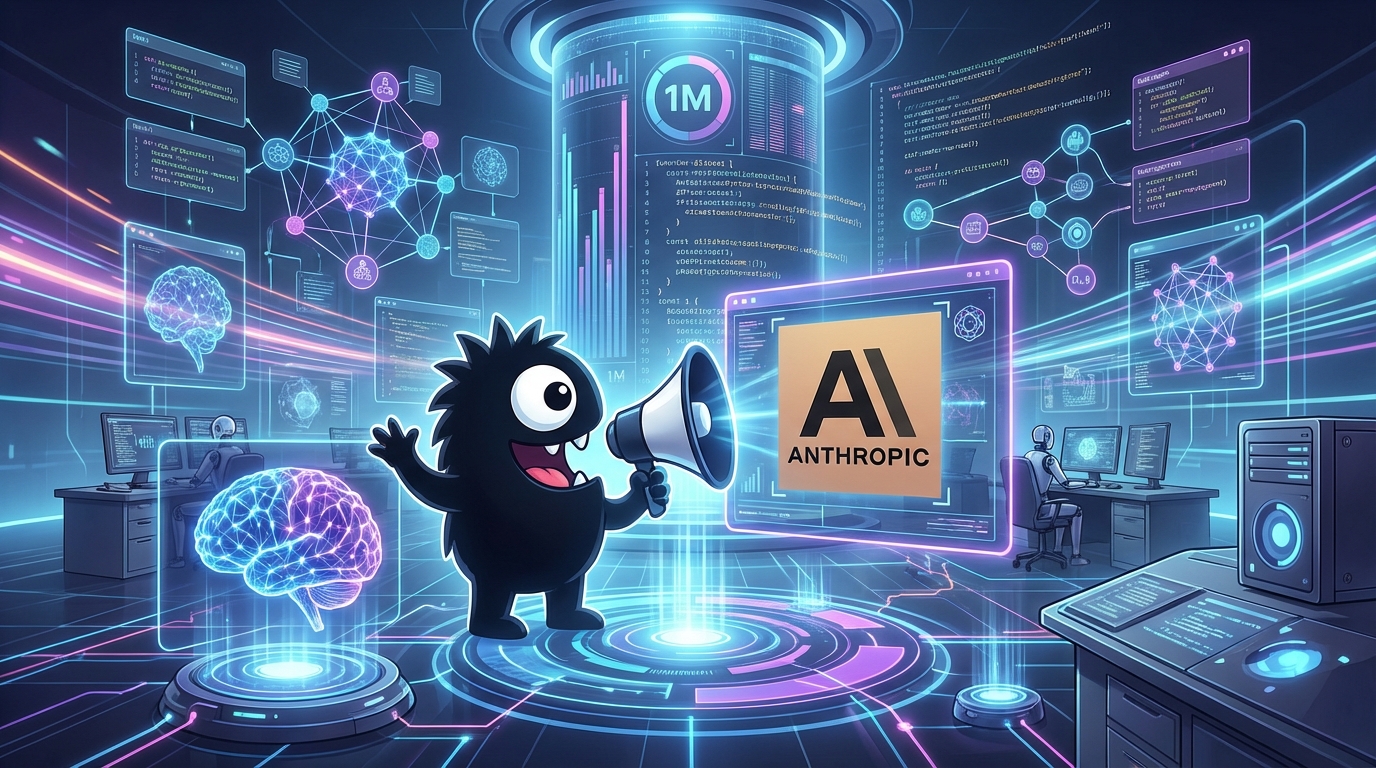
For developers and technical decision-makers building next-generation AI applications, Anthropic's Claude Opus 4.6 launch represents a pivotal advancement in agentic AI systems. With multi-agent teams enabling parallel task execution and a beta 1M token context window, this upgrade empowers you to tackle complex, long-horizon workflows—like autonomous codebase reviews or multi-step automation—without the fragmentation that plagues current models, potentially slashing development cycles and boosting reliability in production environments.
What Happened
On February 5, 2026, Anthropic announced Claude Opus 4.6, the latest iteration of its flagship model, focusing on enhanced agentic capabilities and reasoning over extended contexts. Key highlights include the introduction of multi-agent teams in Claude Code (research preview), where developers can orchestrate autonomous subagents for parallel processing of tasks such as code reviews and debugging, with seamless human intervention via keyboard shortcuts. The model also debuts a 1M token input context window in beta on the Developer Platform, paired with context compaction to maintain coherence in prolonged interactions, and supports up to 128k output tokens. Performance benchmarks show leadership in agentic coding (top on Terminal-Bench 2.0), long-context retrieval (76% on MRCR v2 1M variant), and multidisciplinary reasoning (highest on Humanity’s Last Exam). It's available immediately via the Claude API (model ID: claude-opus-4-6), claude.ai, and major cloud platforms like AWS and Azure, with unchanged pricing at $5/$25 per million input/output tokens and premium rates for large prompts. New controls like effort levels (low to max) and adaptive thinking allow fine-tuned intelligence and cost management. [source](https://www.anthropic.com/news/claude-opus-4-6) [source](https://techcrunch.com/2026/02/05/anthropic-releases-opus-4-6-with-new-agent-teams)
Why This Matters
Technically, Opus 4.6's multi-agent framework and extended context reduce bottlenecks in agent systems, enabling developers to build scalable, reliable automations for enterprise workflows—think coordinated agents handling cybersecurity probes or legal document analysis with 10%+ accuracy lifts over predecessors. For engineers, the 1M token window minimizes "context rot," improving information retention in massive codebases and supporting frontier-level planning without custom tooling. Business-wise, technical buyers gain cost-efficient scaling via API integrations, with unchanged pricing and US-only inference options lowering latency for high-stakes apps. This positions Anthropic competitively against rivals like OpenAI's GPT series, offering superior Elo gains (190 points over Opus 4.5 on GDPval-AA) for ROI-driven deployments in coding, research, and automation. Early adopters report reduced oversight needs, accelerating time-to-market for AI-native products. [source](https://www.anthropic.com/news/claude-opus-4-6) [source](https://www.cnbc.com/2026/02/05/anthropic-claude-opus-4-6-vibe-working.html) [source](https://www-cdn.anthropic.com/14e4fb01875d2a69f646fa5e574dea2b1c0ff7b5.pdf)
Technical Deep-Dive
Claude Opus 4.6 represents a significant evolution in Anthropic's flagship model, emphasizing agentic capabilities through Multi-Agent Teams while enhancing core architecture for sustained, complex tasks. This release builds on Opus 4.5 with refined transformer-based scaling, incorporating denser mixture-of-experts (MoE) layers for improved efficiency in long-context reasoning and parallel processing. Key architectural shifts include a 1M token context window (beta), enabled by advanced rotary positional embeddings and hierarchical attention mechanisms that mitigate "context rot." Server-side compaction now triggers at user-defined thresholds (default 150K tokens), generating structured summaries in <summary> blocks focusing on state, next steps, and learnings—customizable via API prompts to preserve code snippets or decisions. This reduces token bloat by up to 80% in extended sessions, outperforming prior versions where summarization led to 20-30% performance drops [source](https://www.anthropic.com/news/claude-opus-4-6).
The standout feature, Multi-Agent Teams, introduces a distributed orchestration layer in Claude Code. A "Team Lead" (primary Opus 4.6 instance) spawns autonomous "Teammates"—each a full, independent Claude session with its own 1M context. Communication occurs via peer-to-peer inbox messaging and a shared JSON-based task list (~/.claude/teams/{team}/config.json) tracking dependencies (e.g., states: pending, in-progress, completed). Teammates self-assign tasks, challenge outputs adversarially, and unblock dependencies automatically, ideal for parallel workflows like UI/UX design, backend implementation, and security reviews. No nested teams or session resumption for teammates; limited to one team per session. To enable: Add {"env": {"CLAUDE_CODE_EXPERIMENTAL_AGENT_TEAMS": "1"}} to settings.json. Example invocation in Claude Code:
Lead: Build a C compiler. Spawn a team: UX Designer, Senior Architect, 4 Engineers.
[Team Lead spawns: Teammate1 (UX) briefs on interface; Teammate2 (Arch) outlines modules; Engineers parallelize parsing/optimization.]
Teammate1: <inbox> to Teammate2: Proposed wireframes attached. Feedback?
[Dependency: UI complete → Engineers unblock.]
Benchmarks highlight Opus 4.6's edge in agentic and coding domains. On Terminal-Bench 2.0 (command-line tasks), it scores 65.4% vs. Opus 4.5's 59.8% and Gemini 3 Pro's ~55%, excelling in multi-step simulations [source](https://www.vellum.ai/blog/claude-opus-4-6-benchmarks). Multi-Needle Recall Challenge (MRCR v2, 8-needle) reaches 93% at 256K context and 76% at 1M, dwarfing Sonnet 4.5's 10.8% at 1M—critical for agent coordination [source](https://www.digitalapplied.com/blog/claude-opus-4-6-release-features-benchmarks-guide). BigLaw Bench hits 90.2% (40% perfect scores), leading Claude series for legal reasoning. However, SWE-Bench Verified dips slightly to ~62% from 4.5's 64%, attributed to specialization in parallel agents over solo coding [source](https://alirezarezvani.medium.com/i-tested-every-major-claude-opus-4-6-feature-heres-what-actually-matters-6daa7d3bea52). Vs. GPT-5.3 Codex, Opus 4.6 wins on usability for multi-tool workflows, per developer tests [source](https://www.tensorlake.ai/blog/claude-opus-4-6-vs-gpt-5-3-codex).
API access via model="claude-opus-4-6" remains compatible with prior SDKs (Python/JS), but adds team orchestration endpoints: POST /v1/teams/spawn with payload {"lead_prompt": "Build app", "teammates": ["UX", "Engineer"]}. Pricing holds at $5/M input tokens, $25/M output—67% cheaper than Opus 4.1—but premiums apply: $10/$37.50 for >200K input or 1M beta; fast mode ($30/$150) yields 2.5x latency reduction. Prompt caching saves 90% on repeated inputs; batch API for teams cuts costs 50% [source](https://docs.anthropic.com/en/docs/about-claude/models/overview). Enterprise options include Foundry on Azure integration for scaled workflows [source](https://azure.microsoft.com/en-us/blog/claude-opus-4-6-anthropics-powerful-model-for-coding-agents-and-enterprise-workflows-is-now-available-in-microsoft-foundry-on-azure).
Integration favors developers building agentic systems: Use tmux splits for direct teammate interaction (Shift+Up/Down). Limitations include high token burn (2-5x for teams) and no cross-session persistence—mitigate with local JSON exports. Developers praise the shift to true peer communication, enabling "dev teams in terminals" for rapid prototyping, though sequential tasks remain inefficient [source](https://x.com/kargarisaac/status/2019766902311067784). Overall, Opus 4.6 prioritizes infrastructure for hours-long, collaborative AI over raw benchmarks, transforming enterprise coding pipelines.
Developer & Community Reactions
What Developers Are Saying
Developers and technical users in the AI community have shared mixed but enthusiastic reactions to Anthropic's Claude Opus 4.6 launch, particularly praising its multi-agent capabilities for coding and complex workflows. Eric Hartford, an AI model developer, noted that while GPT-5.3 Codex may edge out in raw coding benchmarks, "Claude Code with Opus 4.6 is better and faster at getting work done than Codex CLI with GPT-5.3 Codex. 2x-3x faster. (measured in how much work I get done per hour)" [source](https://x.com/QuixiAI/status/2020351235849875616). Similarly, Runtime Notes highlighted its shift from assistant to "senior colleague," stating, "better on coding + knowledge work than GPT‑5.2, while OpenAI races with its own agentic Codex update" [source](https://x.com/runtime_note/status/2020574307739656481). Comparisons to alternatives like OpenAI's models are common, with Tanul Mittal observing that Opus 4.6 "feels more hype than value at its price" compared to GPT-5.3 Codex, which "outcodes Opus in real workflows for way less" [source](https://x.com/soundhumor/status/2020606818654011775). On the positive side, 99Ad recommended using Claude Opus 4.6 "for any hard code" alongside other tools like Grok and ChatGPT [source](https://x.com/AD90346705/status/2020209415757139978).
Early Adopter Experiences
Early adopters report tangible productivity gains in real-world usage, especially with multi-agent teams for debugging and documentation. Bobby Thompson shared, "spent last night building with Claude Opus 4.6... shipped a new feature in half the time it would have taken last week," crediting improved context holding and instruction-following [source](https://x.com/BThompson15944/status/2019787682407449062). Wei-wei from Momentic AI, after early testing, emphasized its strengths in reliable end-to-end coverage but noted areas for improvement [source](https://x.com/wuweiweiwu/status/2019595501906362729). Japanese Android engineer akihiro_genai, after a month using Claude Code (with Opus 4.5 transitioning to 4.6), found it effective for personal development but requiring more oversight than Codex: "ClaudeCode is quite a good choice... but for non-engineers, Codex is recommended as it corrects mistakes automatically" [source](https://x.com/akihiro_genai/status/2018330969762357267). Camsoft2000 preferred Codex CLI for its efficiency, calling Claude Code "too lazy" and needing more steering [source](https://x.com/camsoft2000/status/2018091025361772854). Overall, adopters see it accelerating agentic tasks like code review and presentations.
Concerns & Criticisms
While praised for agentic features, technical users raise valid concerns about reliability, cost, and interface issues. Gabriel reported a disappointing experience: "200 dollars later... it’s overly agreeable, doesn’t read the docs, skips steps... Give me 4.5 back" [source](https://x.com/gvtnomad/status/2019752485309866452). Jerry Tworek from OpenAI critiqued the tool's UI: "oh, how bad and slow and resource hungry the tui is" despite the model's strengths [source](https://x.com/MillionInt/status/2018343670081343740). Dave de Céspedes found it "not drastically different" from prior versions after initial testing [source](https://x.com/NotionCoach/status/2019570503284060385). Clifton Clowers noted Codex's superiority for ML projects in Rust and PyTorch over Opus 4.6 [source](https://x.com/fozlolah/status/2020204985800384552). Enterprise reactions highlight integration challenges, with some devs worried about over-reliance on multi-agent teams without robust error-handling, potentially amplifying bugs in production.
Strengths
- Enables parallel task execution across multiple agents, drastically reducing time for complex projects like building a C compiler with 16 agents working autonomously on a shared codebase [source](https://arstechnica.com/ai/2026/02/sixteen-claude-ai-agents-working-together-created-a-new-c-compiler).
- 1M token context window supports handling large-scale workflows without chunking, ideal for enterprise coding and analysis [source](https://www.anthropic.com/news/claude-opus-4-6).
- Outperforms competitors on benchmarks, e.g., 90.2% on BigLaw Bench and 144 Elo points over GPT-5.2 in knowledge work, enhancing reliability for technical tasks [source](https://techcrunch.com/2026/02/05/anthropic-releases-opus-4-6-with-new-agent-teams).
Weaknesses & Limitations
- Currently in research preview within Claude Code, limiting scalability and requiring VSCode integration, which may not suit all environments [source](https://www.anthropic.com/engineering/building-c-compiler).
- Lacks per-agent tool restrictions, raising security risks in sensitive codebases where agents inherit full permissions and could accidentally modify files [source](https://x.com/Rubix161/status/2019547328504279218).
- Relies on self-claiming task lists, which can lead to mismatches in heterogeneous workflows and potential lead agent bottlenecks from synthesizing results [source](https://www.reddit.com/r/ClaudeAI/comments/1qwvp6g/anthropic_used_agent_teams_and_opus_46_to_build_a).
Opportunities for Technical Buyers
How technical teams can leverage this development:
- Accelerate software development by deploying agent teams for parallel coding, testing, and debugging, turning week-long tasks into hours without constant oversight.
- Automate compliance and vulnerability scanning in regulated industries, using multi-agents to process large codebases and documents autonomously at scale.
- Build hybrid AI systems integrating Opus 4.6 teams with existing tools, enabling persistent memory for multi-session projects like estate planning platforms.
What to Watch
Monitor progression from research preview to full release, expected in Q2 2026 per Anthropic updates, alongside pricing details for enterprise access via API or Azure integration. Track real-world benchmarks against OpenAI's Codex 5.3, focusing on context durability in long-running tasks. Decision points include beta access sign-ups now for early testing, but delay adoption until tool restrictions and nested teams are added to address security gaps—vital for production use by mid-2026.
Key Takeaways
- Claude Opus 4.6 introduces Multi-Agent Teams, enabling parallel coordination of specialized agents for complex tasks like codebase reviews and cybersecurity investigations, boosting efficiency by up to 2x in multi-step workflows.
- Superior agentic coding performance, leading benchmarks like Terminal-Bench 2.0 and GDPval-AA, with reliable handling of large codebases and autonomous debugging across languages.
- Expanded 1M token context window in beta, reducing context rot and supporting long-horizon tasks in tools like Excel and PowerPoint for financial analysis and document creation.
- Advanced reasoning with adaptive thinking and effort controls, excelling in multidisciplinary domains such as legal reasoning (90.2% on BigLaw Bench) and computational biology.
- Robust safety profile with low misaligned behavior and over-refusals, making it suitable for enterprise deployment without compromising reliability.
Bottom Line
For technical buyers in AI development, software engineering, or enterprise automation, act now: Claude Opus 4.6's Multi-Agent Teams represent a leap in scalable AI orchestration, ideal for teams tackling intricate, parallelizable workflows. Developers and AI engineers should prioritize integration if building agentic systems; enterprises in finance, legal, or research will gain from its autonomous multitasking. Ignore if your needs are basic NLP—wait for broader accessibility if budget-constrained. This development matters most to those scaling AI beyond single-model limits, positioning Anthropic as a leader in collaborative AI.
Next Steps
Concrete actions readers can take:
- Sign up for the Claude API research preview at anthropic.com/api to test Multi-Agent Teams on your codebase (free tier available for developers).
- Experiment with Opus 4.6 in Claude Code via the web console; start with a sample multi-agent task like vulnerability scanning to evaluate parallel gains.
- Review the full technical report and benchmarks on Anthropic's announcement page (anthropic.com/news/claude-opus-4-6) and join their developer forum for integration guides.
References (50 sources)
- https://x.com/i/status/2020889803957665877
- https://x.com/i/status/2021472961069212067
- https://x.com/i/status/2021487787690819784
- https://x.com/i/status/2021314923440083027
- https://www.theverge.com/news/874214/is-the-spacex-xai-x-public-offering-just-going-to-be-a-bailout-
- https://x.com/i/status/2021508224701141387
- https://x.com/i/status/2021491780248834128
- https://www.theverge.com/x-ai
- https://venturebeat.com/ai/sam-altman-at-ted-2025-inside-the-most-uncomfortable-and-important-ai-int
- https://www.reddit.com/r/ArtificialInteligence/comments/1qyde7v/what_happened_in_ai_today_feb_07_202
- https://x.com/i/status/2020947463306346914
- https://www.marketingprofs.com/opinions/2026/54257/ai-update-february-6-2026-ai-news-and-views-from-
- https://finance.yahoo.com/news/prediction-overlooked-artificial-intelligence-ai-223500960.html
- https://venturebeat.com/ai/openai-updates-chatgpt-to-new-model-based-on-user-feedback
- https://www.marketwatch.com/press-release/ai4-2026-to-spotlight-the-brilliant-minds-leading-the-ai-p
- https://www.trigyn.com/insights/ai-trends-2026-new-era-ai-advancements-and-breakthroughs
- https://hai.stanford.edu/news/stanford-ai-experts-predict-what-will-happen-in-2026
- https://aiinaction.substack.com/p/ai-in-action-february-4-2026
- https://x.com/i/status/2020885629052346766
- https://x.com/i/status/2020999650912907507
- https://www.youtube.com/watch?v=1CFBOepzH5I
- https://www.theverge.com/archives/space/2026/2/1
- https://x.com/i/status/2021509577544532057
- https://x.com/i/status/2020973997660438918
- https://x.com/i/status/2021488022076920173
- https://x.com/i/status/2021472146078282204
- https://www.linkedin.com/pulse/action-era-why-february-2026-month-ai-starts-working-you-jagadeesh-jg
- https://x.com/i/status/2021509685380071426
- https://x.com/i/status/2021063564438442045
- https://www.theverge.com/archives/ai-artificial-intelligence/2026/2/2
- https://news.microsoft.com/source/features/ai/whats-next-in-ai-7-trends-to-watch-in-2026
- https://x.com/i/status/2021414699666112572
- https://x.com/i/status/2020969130657186118
- https://x.com/i/status/2016391255891312967
- https://x.com/i/status/2021380561663820105
- https://x.com/i/status/2021506323159089397
- https://x.com/i/status/2021046821880004813
- https://www.cnbc.com/2026/02/09/ai-spending-is-spooking-investors-but-history-shows-thats-when-you-w
- https://www.crescendo.ai/news/latest-ai-news-and-updates
- https://www.abc.net.au/news/2026-02-10/ai-disrupts-tech-boom-shares-drop/106323844
- https://techcrunch.com/2025/04/11/openai-is-winding-down-its-gpt-4-ai-model-in-chatgpt
- https://x.com/i/status/2021507574806581563
- https://www.theverge.com/ai-artificial-intelligence/875550/openais-super-bowl-ad-claims-you-can-just
- https://x.com/i/status/2021487551194989061
- https://www.infoworld.com/article/4108092/6-ai-breakthroughs-that-will-define-2026.html
- https://x.com/i/status/2021508309149450416
- https://x.com/i/status/2021487469364117718
- https://www.innovationnewsnetwork.com/2026-the-year-ai-moves-from-experimentation-to-execution/64945
- https://venturebeat.com/ai/ask-your-assets-anything-state-streets-generative-ai-lets-investors-chat-
- https://x.com/i/status/2021406537705717937
Related Guides
Perplexity Launches Computer: Unified AI for End-to-End Projects
9 min read
OpenAI Raises Record $110B from Amazon, Nvidia, SoftBank
9 min read
OpenAI Secures $110B Funding at $840B Valuation
9 min read
Anthropic Unveils Claude Cowork for Enterprise AI Collaboration
10 min read