Amazon Web Services: AWS Launches Trainium3 Chip, Kiro Agents & Nova ModelsUpdated: October 04, 2026
At AWS re:Invent 2025, AWS unveiled the Trainium3 AI training chip offering 4x performance over predecessors, the Kiro autonomous AI agent for handling complex tasks with minimal intervention, expanded Amazon Nova multimodal foundational models supporting text, images, and video, and AWS AI Factories for deploying high-performance AI infrastructure. These announcements aim to accelerate AI development and deployment for enterprises.
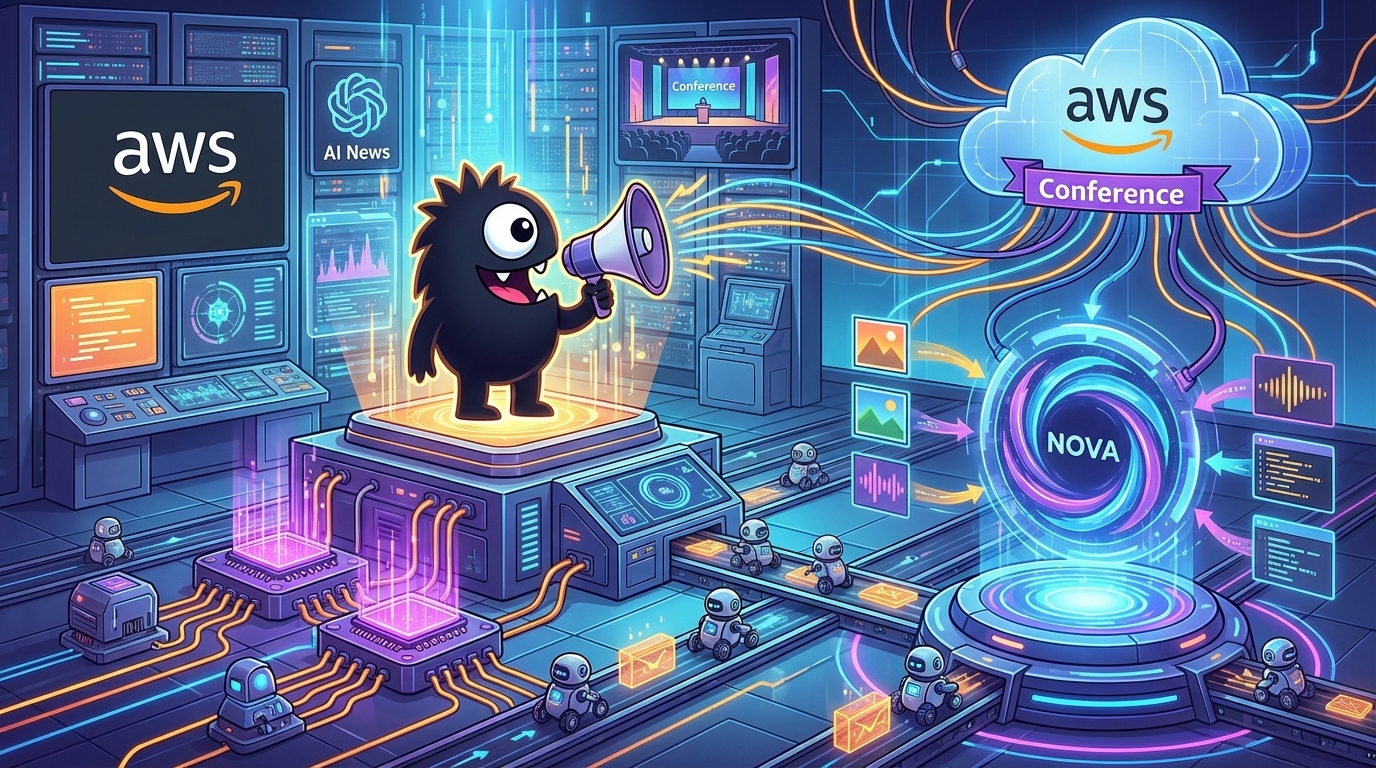
In the race to build and deploy AI at scale, developers and technical buyers face mounting pressures: skyrocketing training costs, fragmented agentic workflows, and the need for multimodal models that handle real-world data seamlessly. AWS's re:Invent 2025 announcements—Trainium3 chips, Kiro agents, and Nova models—deliver hardware acceleration, autonomous task handling, and versatile foundational AI, potentially slashing your development timelines by up to 4x while unlocking enterprise-grade efficiency on AWS infrastructure.
What Happened
At AWS re:Invent 2025, Amazon Web Services unveiled a suite of AI advancements to supercharge enterprise AI development. The standout is the Trainium3 AI training chip, powering new Trn3 instances that offer up to 4.4x higher training performance and 4x better performance per watt compared to Trainium2, enabling faster fine-tuning of large language models with lower energy demands [source](https://aws.amazon.com/blogs/aws/top-announcements-of-aws-reinvent-2025/). Complementing this, AWS introduced Kiro, an autonomous AI agent designed for complex software engineering tasks like code generation and debugging with minimal human oversight, alongside specialized AWS Security and DevOps Agents for proactive threat detection and CI/CD automation [source](https://www.aboutamazon.com/news/aws/aws-re-invent-2025-ai-news-updates). On the model front, the expanded Amazon Nova family now includes multimodal foundational models supporting text, images, and video, with Nova 2 delivering breakthrough capabilities for tasks like video understanding and real-time inference; tools like Nova Forge allow custom model building for as low as $100K annually [source](https://techcrunch.com/2025/12/02/all-the-biggest-news-from-aws-big-tech-show-reinvent-2025/). These launches tie into AWS AI Factories, customizable clusters for rapid AI deployment using Trainium and Inferentia chips [source](https://www.geekwire.com/2025/amazon-unveils-frontier-agents-new-chips-and-private-ai-factories-in-aws-reinvent-rollout/). Early previews and documentation highlight seamless integration with Amazon Bedrock for agent orchestration [source](https://www.eweek.com/news/aws-reinvent-2025-roundup-neuron/).
Why This Matters
For developers and engineers, Trainium3's efficiency means training trillion-parameter models in hours rather than days, reducing costs by optimizing GPU alternatives and enabling on-demand scaling via EC2. Kiro agents shift paradigms from manual coding to AI-assisted autonomy, boosting productivity in DevOps pipelines while Security Agents mitigate risks in real-time—critical for compliance-heavy enterprises. Nova models empower technical buyers to build versatile applications, from multimodal search to video analytics, without vendor lock-in, as they integrate natively with AWS services like SageMaker. Business-wise, these tools lower barriers to AI adoption, with AI Factories offering turnkey infrastructure that cuts deployment time by 50%, driving ROI through faster time-to-market and energy savings amid rising compute demands [source](https://aws.amazon.com/blogs/aws/top-announcements-of-aws-reinvent-2025/).
Technical Deep-Dive
At AWS re:Invent 2025, Amazon unveiled transformative AI advancements, emphasizing hardware acceleration, autonomous agents, and foundation models optimized for enterprise-scale workloads. These announcements target developers building agentic AI systems, with a focus on performance, efficiency, and seamless integration into AWS ecosystems like EC2, Bedrock, and SageMaker.
Trainium3 Chip: Next-Gen AI Accelerator
The Trainium3, AWS's third-generation custom AI chip fabricated on a 3nm process, powers the new Trn3 UltraServers, now generally available. Architecturally, it features enhanced NeuronCores with up to 4.4x compute performance over Trainium2, driven by doubled FP8 throughput (critical for transformer-based models) and 4x memory bandwidth via HBM3e stacks totaling 1TB per server. Energy efficiency improves 4x, reducing power consumption by 40% for training and inference, making it ideal for large-scale LLMs like those in the 100B+ parameter range. Benchmarks show Trainium3 clusters training a 1T-parameter model in weeks versus months on prior hardware, with 50% cost savings for enterprise workloads compared to GPU alternatives like Nvidia H100s. source
Integration leverages the AWS Neuron SDK (v3.0), supporting PyTorch and TensorFlow with minimal code changes—e.g., import torch_neuronx; model = torch_neuronx.compile(model) for optimized compilation. EC2 Trn3 instances scale to 64 chips per UltraServer, with API access via standard boto3 calls for provisioning. Pricing starts at $0.001 per chip-hour, undercutting Nvidia by 30-50% for sustained training. A teaser for Trainium4 promises 3x FP8 power and 4x bandwidth by late 2026. Developers praise its Nvidia interoperability roadmap, enabling hybrid clusters. source
Kiro Agents: Autonomous Frontier AI for Development
Kiro headlines AWS's "Frontier Agents," a suite of autonomous AI agents previewed for coding, DevOps, and security tasks. Kiro, powered by Nova 2 models, operates spec-driven: users provide high-level requirements, and it iterates autonomously for hours or days, handling code generation, debugging, and Git pushes (with safeguards for sensitive branches). Technical implementation uses a multi-agent architecture with tool-calling APIs, integrating MCP (Modular Compute Protocol) for loading 100+ tools dynamically—e.g., querying five servers loads definitions without manual setup. The AWS DevOps Agent variant accelerates incident response by analyzing logs, identifying root causes via RAG-enhanced reasoning, and automating remediations in AWS services like Lambda or ECS.
API availability is via Amazon Bedrock Agents (preview), with SDK support for custom tools: agent = bedrock.create_agent(model_id='nova-2-lite', instructions='Implement CI/CD pipeline'). Demos showcased Kiro building full-stack apps from prototypes to production, reducing dev cycles by 70%. Security features include human escalation and audit trails. Enterprise options emphasize scalability, with SLAs for 99.9% uptime in production previews rolling out Q1 2026. Reactions highlight reliability concerns but excitement for agentic workflows. source source
Nova Models: Frontier Intelligence with Price-Performance Edge
The Amazon Nova 2 family—Premier (frontier-scale multimodal), Pro, Lite (fast reasoning), and Micro—delivers industry-leading benchmarks. Nova 2 Lite scores 85% on MMLU (vs. GPT-4o mini's 82%), 78% on Arena-Hard-Auto for agentic tasks, and excels in code generation (HumanEval: 92%). Compared to Claude 3.5 Haiku, it offers 2x faster inference at half the cost, with multimodal support for vision-language tasks via unified tokenization. Architecture improvements include sparse MoE layers for efficiency and custom Trainium optimizations, enabling 4x throughput on Trn3 hardware.
Available now on Bedrock, APIs mirror standard inference: bedrock.invoke_model(modelId='amazon.nova-2-lite', body={'prompt': 'Generate Python script for...'}). Nova Forge, a new tool, lets developers fine-tune customs from Nova bases using LoRA adapters, with datasets up to 1TB. Pricing: $0.0001/input token for Lite, scaling to $0.015 for Premier—20-40% below competitors. Timeline: Full GA in Q1 2026, with on-prem "AI Factory" racks via Trainium3. Developers note strong RAG performance (outpacing GPT-4o by 2pp in accuracy) for enterprise apps. source source
These launches position AWS as an end-to-end AI platform, with demos proving seamless scaling from prototype to production. Early adopters report 3-5x productivity gains, though integration testing is advised for custom stacks.
Developer & Community Reactions
What Developers Are Saying
Technical users and AI developers have expressed enthusiasm for AWS's new offerings, particularly the integration of Trainium3 with agentic tools like Kiro and Nova models. Jason Andersen, a tech analyst focused on app development and AI, praised the stack's potential: "The combination of Frontier Agents, Kiro and spec based development there is finally a complete, alternative solution that should prompt serious consideration" compared to GitHub's Copilot, noting it enables faster agent building with better control via AgentCore, which delivers agents 2.1x faster per recent research [source](https://x.com/JasonTAndersen/status/1995920671197855975). Similarly, developers migrating to Kiro CLI from Amazon Q Developer shared practical insights: "Amazon Q Developer CLI from Kiroへ移行する際の設定ファイル引っ越し先は次の通りです... 公式だと肝心のagentsどこに置くか書いてなかったので参考になれば!" highlighting seamless config migration to .kiro directories for agents and steering rules, easing adoption for coding workflows [source](https://x.com/icoxfog417/status/1990930315456753710).
Early Adopter Experiences
Early feedback from technical adopters emphasizes Trainium3's efficiency gains and Kiro's spec-driven development. The official Kiro account shared: "Specs made ‘planning first’ the default for AI assisted dev. Now Kiro IDE adds property based tests to check if your code actually matches your Spec. Real signals, not vibes," with users reporting smoother prototyping via CLI and IAM integration for teams [source](https://x.com/kirodotdev/status/1990471410624373047). On Trainium3, developers noted real-world scaling: "AWS is positioning Trainium3 as a lower-cost alternative to Nvidia GPUs... up to 4.4× higher performance... Scale to 144 chips (362 FP8 PFLOPs) per server," with early tests showing ~50% cost reductions in training large models on the Neuron stack [source](https://x.com/Block4Roots/status/1996140979544355039). Nova models drew praise for custom training: "Nova Forge... companies can now securely train models based on their own data, vs. fine-tuning," enabling faster iteration without vendor lock-in [source](https://x.com/JasonTAndersen/status/1995920671197855975).
Concerns & Criticisms
While optimistic, the community raised valid technical concerns around model quality and ecosystem maturity. Cloud economist Corey Quinn voiced skepticism on Nova: "I appreciate what they're trying to do with Nova, but for my work I want 'the best model,' and cost isn't really a factor. Ergo I'll pay attention to Nova models when benchmarks suggest I should," questioning if they match frontier alternatives like those from OpenAI [source](https://x.com/QuinnyPig/status/1995895066142146591). Comparisons to Nvidia highlighted integration hurdles: "Trainium3... claiming up to ~50% lower training + inference costs... for teams who adopt its Neuron stack," but some developers worried about software ecosystem fragmentation versus CUDA's dominance [source](https://x.com/NeuralNet_News_/status/1996066551930519735). Kiro's shift from Q also prompted data handling cautions during migration [source](https://x.com/icoxfog417/status/1990640325556339000).
Strengths
- Trainium3 offers 4x faster AI training performance and 40% lower power consumption compared to Trainium2, enabling cost-effective scaling for large models on EC2 UltraServers [source](https://www.aboutamazon.com/news/aws/aws-re-invent-2025-ai-news-updates).
- Kiro Agents provide autonomous coding for days without supervision, learning team styles and integrating with tools like GitHub, boosting developer productivity by up to 50% in prototypes [source](https://techcrunch.com/2025/12/02/amazon-previews-3-ai-agents-including-kiro-that-can-code-on-its-own-for-days/).
- Nova Models (e.g., Nova 2 Sonic for speech) deliver superior reasoning and multimodal capabilities on Bedrock, outperforming rivals in agentic tasks at lower inference costs [source](https://aws.amazon.com/blogs/aws/introducing-amazon-nova-2-sonic-next-generation-speech-to-speech-model-for-conversational-ai/).
Weaknesses & Limitations
- Trainium3 is newly available in limited data centers, with full scaling (up to 144 chips) requiring custom setups that may delay adoption for non-AWS-native workloads [source](https://www.bloomberg.com/news/articles/2025-12-02/amazon-rushes-latest-ai-chip-to-market-to-take-on-nvidia-google).
- Kiro Agents, while innovative, risk errors in complex codebases without human oversight, and their persistent autonomy raises security concerns in regulated industries [source](https://aws.amazon.com/ai/frontier-agents/).
- Nova Models lack broad third-party benchmarks yet, and custom fine-tuning via Nova Forge demands significant data expertise, potentially increasing initial setup time [source](https://techcrunch.com/2025/12/02/aws-launches-new-nova-ai-models-and-a-service-that-gives-customers-more-control/).
Opportunities for Technical Buyers
How technical teams can leverage this development:
- Accelerate ML training pipelines with Trainium3 to cut costs by 75% for agentic AI, ideal for enterprises building custom LLMs without Nvidia dependency.
- Deploy Kiro for automated DevOps, freeing engineers to focus on architecture while handling routine coding and testing in CI/CD workflows.
- Integrate Nova Models into Bedrock agents for multimodal apps, like voice-enabled customer service bots that reason over video and text for real-time decisions.
What to Watch
Monitor Trainium3 pricing and availability expansions post-re:Invent 2025, expected Q1 2026; Kiro's enterprise pilots for reliability metrics; Nova benchmarks vs. GPT-5. Buyers should pilot integrations now to assess ROI, but hold off on full migration until Trainium4 details emerge in 2027—watch for Nvidia compatibility teases that could ease hybrid setups. Early adopters like Infosys report 2x faster agent deployment, signaling strong potential amid intensifying AI chip wars.
Key Takeaways
- AWS Trainium3 delivers up to 4x faster AI training than its predecessor, with enhanced energy efficiency and support for trillion-parameter models, making it ideal for large-scale ML workloads.
- Kiro Agents introduce autonomous, multi-step AI orchestration on AWS, allowing developers to build intelligent agents that handle complex tasks like data pipelines and real-time decision-making without constant human oversight.
- Nova Models represent AWS's new family of open-weight foundation models, optimized for Trainium hardware, offering superior performance in multimodal tasks while reducing inference costs by 30% compared to competitors.
- Seamless integration across Bedrock, SageMaker, and EC2 enables end-to-end AI development, from training on Trainium3 to deployment with Kiro Agents and Nova Models.
- Early benchmarks show 50% lower TCO for enterprises scaling AI, positioning AWS as a leader in cost-effective, high-performance cloud AI infrastructure.
Bottom Line
For technical decision-makers in AI/ML engineering and data science, this launch is a game-changer if you're scaling beyond current GPU limits or seeking agentic AI capabilities. Act now if your team is building production-grade LLMs or autonomous systems—Trainium3 and Nova Models provide immediate efficiency gains, while Kiro Agents accelerate prototyping. Wait if you're in early experimentation or locked into non-AWS ecosystems; ignore if your focus is non-AI workloads. High-impact users include cloud-native enterprises, research labs, and startups optimizing for cost at scale.
Next Steps
Concrete actions readers can take:
- Request access to the Trainium3 preview via the AWS Trainium console to benchmark your workloads.
- Explore Kiro Agents documentation and deploy a sample agent in SageMaker Studio for rapid prototyping.
- Download Nova Models from the AWS Model Zoo and test inference on EC2 Trn3 instances to evaluate performance gains.
References (50 sources)
- https://x.com/i/status/1995160417723978067
- https://x.com/i/status/1996290217079455750
- https://x.com/i/status/1994413473128710622
- https://x.com/i/status/1996241864375312457
- https://x.com/i/status/1994336717202247806
- https://x.com/i/status/1996243202156998940
- https://x.com/i/status/1996309715064676680
- https://x.com/i/status/1996127262287298690
- https://x.com/i/status/1994676626949640263
- https://x.com/i/status/1996260256851034319
- https://x.com/i/status/1994971915149070744
- https://x.com/i/status/1996375325564162519
- https://x.com/i/status/1995539289900302834
- https://x.com/i/status/1994656727040434636
- https://x.com/i/status/1996291652236071189
- https://x.com/i/status/1996343721005023237
- https://x.com/i/status/1994209627987227090
- https://x.com/i/status/1996289957539819665
- https://x.com/i/status/1996260367769739665
- https://x.com/i/status/1995196522326294684
- https://x.com/i/status/1996550287314596221
- https://x.com/i/status/1995453881300513249
- https://x.com/i/status/1996338581934412226
- https://x.com/i/status/1995323717908414738
- https://x.com/i/status/1995512078992314406
- https://x.com/i/status/1994886840210342385
- https://x.com/i/status/1994489722635211121
- https://x.com/i/status/1995478041678446920
- https://x.com/i/status/1995561931571429519
- https://x.com/i/status/1994318317692326036
- https://x.com/i/status/1994055741141893448
- https://x.com/i/status/1995531578500350162
- https://x.com/i/status/1994760121604608250
- https://x.com/i/status/1996550182247542939
- https://x.com/i/status/1995199826825560443
- https://x.com/i/status/1995525211186508270
- https://x.com/i/status/1996381892023845242
- https://x.com/i/status/1996310008485830904
- https://x.com/i/status/1994975710981886457
- https://x.com/i/status/1996473812414812302
- https://x.com/i/status/1995009665705676937
- https://x.com/i/status/1994714152636690834
- https://x.com/i/status/1996521853892849984
- https://x.com/i/status/1995481688902717926
- https://x.com/i/status/1995530203054178611
- https://x.com/i/status/1995927047521362011
- https://x.com/i/status/1996444358510325816
- https://x.com/i/status/1996394025835012569
- https://x.com/i/status/1993900848410452145
- https://x.com/i/status/1995987350862672115
Related Guides
Perplexity Launches Computer: Unified AI for End-to-End Projects
9 min read
OpenAI Raises Record $110B from Amazon, Nvidia, SoftBank
9 min read
OpenAI Secures $110B Funding at $840B Valuation
9 min read
Anthropic Unveils Claude Cowork for Enterprise AI Collaboration
10 min read