NVIDIA Unveils Open Models for Physical AI at CES 2026Updated: October 11, 2026
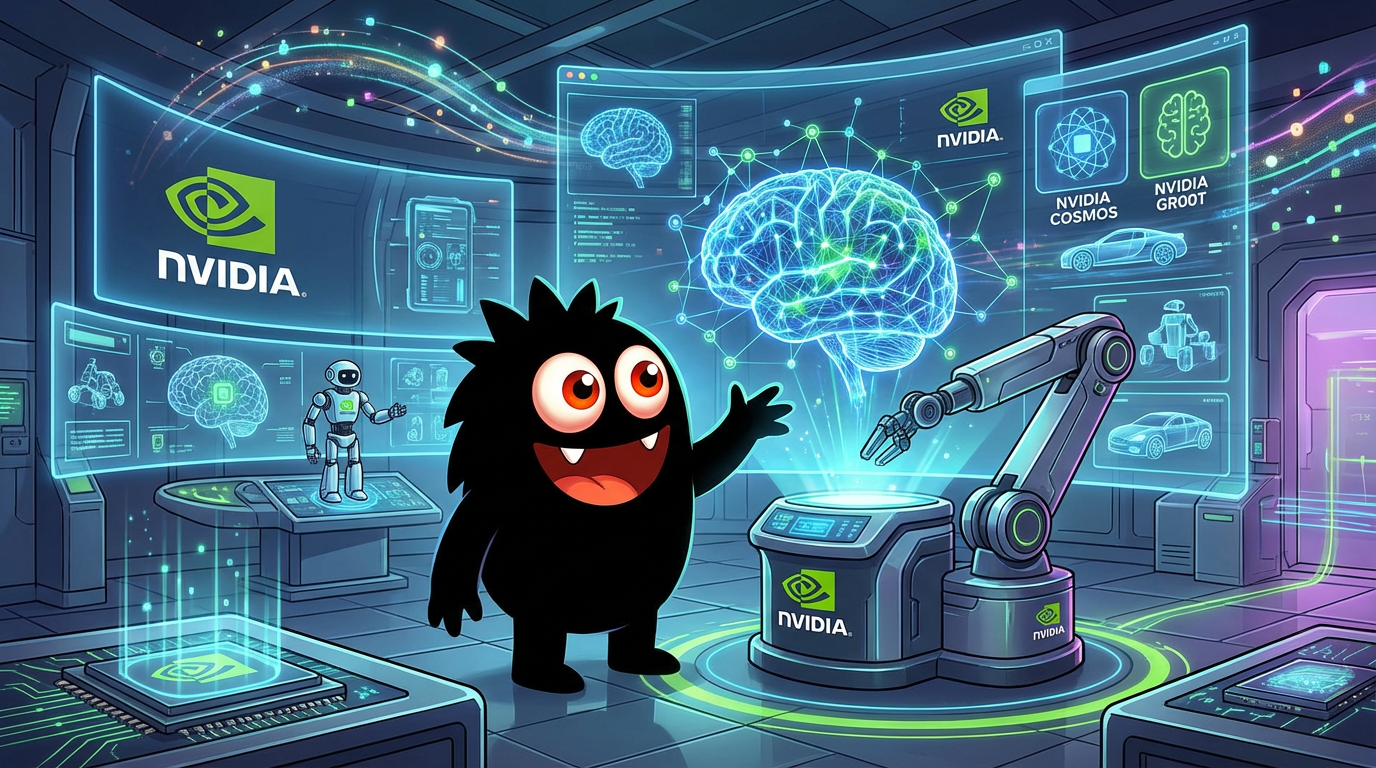
At CES 2026, NVIDIA announced a comprehensive suite of open-source AI models and tools, including Nemotron for agentic AI, Cosmos for physical AI reasoning, Alpamayo for autonomous vehicles, Isaac GR00T for humanoid robotics, and Clara for biomedical applications. These releases come with new datasets and developer tools to accelerate innovation in real-world AI systems. The initiative expands NVIDIA's open model ecosystem, enabling faster development across industries like automotive, robotics,
As a developer or technical buyer building the next generation of AI-driven systems, imagine accelerating your physical AI projects—from autonomous robots to self-driving vehicles—without starting from scratch on massive datasets or proprietary black boxes. NVIDIA's CES 2026 announcement of open-source models like Cosmos and GR00T democratizes access to cutting-edge physical reasoning capabilities, slashing development timelines and enabling seamless integration with NVIDIA's GPU ecosystem for scalable, real-world deployments.
What Happened
At CES 2026 in Las Vegas, NVIDIA unveiled a suite of open-source AI models, datasets, and developer tools tailored for physical AI applications, marking a pivotal expansion of its open model ecosystem. During CEO Jensen Huang's keynote, the company introduced NVIDIA Nemotron for agentic AI, enabling advanced reasoning in multimodal environments; NVIDIA Cosmos, a family of world foundation models that bring human-like spatial reasoning and simulation to physical AI; NVIDIA Alpamayo, open models and simulation tools for autonomous vehicle development, backed by over 1,700 hours of driving data; NVIDIA Isaac GR00T N1.6, a vision-language-action model for humanoid robotics that supports full-body control and task generalization; and NVIDIA Clara, specialized models for biomedical imaging and drug discovery in healthcare. These releases include massive open datasets—such as synthetic worlds for Cosmos and robotics benchmarks for GR00T—and frameworks like Isaac Lab-Arena for evaluation, all optimized for NVIDIA hardware to foster rapid innovation across industries. The initiative builds on NVIDIA's 2025 open model efforts, aiming to create an "open universe" for AI developers worldwide.[NVIDIA CES Keynote] [NVIDIA Newsroom] [NVIDIA Blog]
Why This Matters
For developers and engineers, these open models lower barriers to entry in physical AI, providing pre-trained foundations that can be fine-tuned on NVIDIA's CUDA-accelerated platforms, reducing compute costs by up to 10x through efficient token processing in Nemotron and Cosmos. Technical buyers gain flexibility to integrate with existing stacks—e.g., Alpamayo's CARLA-compatible simulations streamline AV prototyping without vendor lock-in—while GR00T's VLA architecture enables robotics teams to deploy dexterous humanoids faster, addressing talent shortages in simulation-heavy workflows. Business implications include accelerated time-to-market for OEMs in automotive and healthcare, with Clara's open biomedical tools potentially cutting drug discovery timelines by enabling collaborative AI research. This ecosystem shift empowers startups and enterprises alike to innovate on physical AI, fostering a competitive edge in a market projected to exceed $100B by 2030, all while leveraging NVIDIA's hardware for edge-to-cloud scalability.[Business Insider Coverage] [Interesting Engineering]
Technical Deep-Dive
NVIDIA's CES 2026 announcement introduces open models under the Cosmos platform, targeting Physical AI for robotics, autonomous vehicles (AV), and embodied reasoning. The flagship release is Cosmos-Reason1-7B, a 7B-parameter vision-language model (VLM) designed for real-world spatial understanding and decision-making. Additional models include GR00T N1.6 for humanoid robot control and the Alpamayo family for AV perception, all pretrained on NVIDIA's supercomputers using 9,000 trillion tokens, including 20 million hours of video data from diverse sources like driving footage and robotic interactions [source](https://developer.nvidia.com/blog/advancing-physical-ai-with-nvidia-cosmos-world-foundation-model-platform/).
Architecture Changes and Improvements
Cosmos-Reason1-7B builds on the Qwen2.5-VL-7B-Instruct architecture, featuring a Vision Transformer (ViT) encoder with 675 million parameters for video processing and a 7.07 billion parameter Dense Transformer LLM for reasoning. Total parameters: ~7.8B, with an output projection layer adding 545M. Key enhancements include physics-aware tokenization for video inputs (e.g., 4 FPS processing) and chain-of-thought (CoT) prompting via post-training on hybrid datasets (e.g., RoboVQA, BridgeDataV2). This enables multimodal inputs—text, images, and videos up to 128K context length—generating physics-simulated world states for tasks like robot planning and AV navigation.
Compared to prior NVIDIA models like Project GR00T N1, Cosmos integrates Omniverse simulations for synthetic data generation, reducing real-world training needs by 50% through accelerated rendering on Blackwell GPUs. The architecture supports reinforcement learning (RL) fine-tuning on subsets like 252 RoboVQA samples, improving temporal localization via frame timestamps [source](https://build.nvidia.com/nvidia/cosmos-reason1-7b/modelcard).
Benchmark Performance Comparisons
On the Cosmos-Reason1 benchmark, the model achieves 65.1% average accuracy across embodied tasks: 87.3% on RoboVQA (robotic visual QA), 70.8% on AV driving videos, 63.7% on BridgeDataV2 (manipulation), 48.9% on AgiBot (general robotics), 62.7% on HoloAssist (egocentric human demos), and 57.2% on RoboFail (failure analysis). This outperforms baselines like LLaVA-1.5 (52.4% avg.) by 12.7% on physical common sense, attributed to 3.26e+21 FLOPS training compute.
Hardware benchmarks highlight 4x energy efficiency on the Blackwell-powered Jetson T4000 module versus Orin, delivering 2.6x faster inference for large models like FLUX on DGX Spark. In robotics sims, Cosmos generates 10x more synthetic trajectories than non-accelerated setups, with emissions estimated at 5,380 tCO2e for training [source](https://blogs.nvidia.com/blog/2026-ces-special-presentation/) [source](https://www.zdnet.com/article/nvidia-physical-ai-models-robotics-ces/).
API Changes and Pricing
Models are accessible via NVIDIA NIM APIs on build.nvidia.com, supporting text/video prompts for world state generation (e.g., "Simulate robot grasping"). Key change: NIM deprecation on March 18, 2026; migrate to Hugging Face for open-source hosting. API endpoints use BF16 precision on H100/Blackwell GPUs, with vLLM engine for batched inference.
Pricing is open-source (free downloads), but inference via NVIDIA AI Enterprise or AWS Marketplace incurs usage-based costs (~$1/GPU/hour promotional; scales with HBM4 memory). Enterprise options include sovereign AI deployments for custom fine-tuning, starting at custom quotes for Rubin platform access [source](https://aws.amazon.com/marketplace/pp/prodview-e6loqk6jyzssy).
Integration Considerations
Integration leverages Python libraries like transformers and vLLM for GPU-optimized deployment on Linux. Limit multimodal inputs to 10 videos/images per prompt. Example for video reasoning:
from vllm import LLM, SamplingParams
from transformers import AutoProcessor
from qwen_vl_utils import process_vision_info

MODEL_PATH = "nvidia/Cosmos-Reason1-7B"
llm = LLM(model=MODEL_PATH, limit_mm_per_prompt={"video": 10})

sampling_params = SamplingParams(temperature=0.6, top_p=0.95, max_tokens=4096)

messages = [{"role": "user", "content": [{"type": "text", "text": "Is it safe to turn right?"}, {"type": "video", "video": "path/to/video.mp4", "fps": 4}]}]

processor = AutoProcessor.from_pretrained(MODEL_PATH)
prompt = processor.apply_chat_template(messages, tokenize=False, add_generation_prompt=True)

# Process vision info and generate
outputs = llm.generate([{"prompt": prompt, "multi_modal_data": {"video": video_inputs}}], sampling_params)
print(outputs.outputs.text)
Developers note seamless Omniverse integration for sim-to-real transfer, but recommend 4096+ output tokens for CoT to avoid truncation. Reactions highlight excitement for robotics scalability, with concerns over data moating in sovereign setups [source](https://build.nvidia.com/nvidia/cosmos-reason1-7b/modelcard) [post].
Developer & Community Reactions
What Developers Are Saying
Technical users in the AI and robotics communities have largely praised NVIDIA's release of 13 open models for physical AI, including Cosmos for world foundation models, Isaac GR00T for robot reasoning, and Alpamayo for autonomous driving, all hosted on Hugging Face. Burak Tahtacıoğlu, a serverless and big data researcher, highlighted the shift to physical AI: "AI is no longer just 'language.' We’re entering the physical AI era systems that reason and act in the real world... NVIDIA is clearly leaning into 'open' [with] 650+ open models and 250+ open datasets on Hugging Face" [source](https://x.com/btahtacioglu/status/2008408573856956825). Similarly, Tomás Puig, founder and CEO of Alembic, noted the strategic implications: "NVIDIA CES keynote is 'shots fired' at all specialized, non-general first, models. First NVIDIA creates open general models, partners all do RL and specificity, all runs on GPU. Interesting to see the codification of training, simulation, and inference at edge" [source](https://x.com/tomascooking/status/2008302303753929058). Ahmad, an AI researcher and hardware specialist moderating r/LocalLLaMA, emphasized open-source benefits over closed alternatives: "In closed source AI... you have zero control... they can quantize it, distill it, hot-swap... Open source FTW. Buy a GPU" [source](https://x.com/TheAhmadOsman/status/2006580883315114336).
Early Adopter Experiences
Developers experimenting with the models report promising real-world integration for robotics and edge computing. Kwindla, building infrastructure for real-time AI at Pipecat, shared hands-on feedback: "We've been building with the NVIDIA open models... check out the new Nemotron Speech ASR open speech-to-text model. Super-fast, super-flexible, high performance transcription" [source](https://x.com/kwindla/status/2008332241785725432). Adalberto González Ayala, an AI strategist and engineer, tested the ecosystem: "NVIDIA’s move: open everything. Alpamayo for AVs, Isaac GR00T for robot reasoning, Cosmos for synthetic training… all on Hugging Face and GitHub. 1700 hours of driving data released" [source](https://x.com/Aleb_Z/status/2008678232271581562). Early users note seamless GPU optimization but highlight needs for broader hardware compatibility in simulations.
Concerns & Criticisms
While enthusiasm is high, some developers critique the "openness" and ecosystem lock-in. Alkimiadev, a veteran software developer, raised licensing issues: "The problem is the licenses. In every case I checked Nvidia licenses on open projects sucked and have a lot of restrictions... I wish this weird 'open model' thing would just die already" [source](https://x.com/alkimiadev/status/2007697856954515560). i10x_AI, focused on AI agents, questioned hardware dependency: "Ever wonder if 'open-source AI' is just NVIDIA's sly way of locking devs into their hardware empire? They're dropping full ecosystems like Alpamayo... all tuned for their GPUs. It's genius, but is it truly open?" [source](https://x.com/i10X_ai/status/2008456670179950982). Comparisons to closed models underscore risks of vendor control, though NVIDIA's contributions are seen as advancing physical AI accessibility.
Strengths
- Open-source accessibility on Hugging Face allows developers to fine-tune models like Cosmos Reason and GR00T N1.6 without resource-intensive pretraining, accelerating robotics and AV development [NVIDIA News](https://nvidianews.nvidia.com/news/nvidia-releases-new-physical-ai-models-as-global-partners-unveil-next-generation-robots).
- Leaderboard-topping performance, such as Cosmos Reason 2 on Physical Reasoning Leaderboard and Nemotron Speech 10x faster on ASR benchmarks, enabling efficient real-world reasoning and interaction [NVIDIA Blog](https://blogs.nvidia.com/blog/open-models-data-tools-accelerate-ai/).
- Seamless integration with NVIDIA's ecosystem, including Jetson Thor hardware and Omniverse simulation, supports scalable deployment from edge to cloud for industries like manufacturing and healthcare [NVIDIA News](https://nvidianews.nvidia.com/news/nvidia-releases-new-physical-ai-models-as-global-partners-unveil-next-generation-robots).
Weaknesses & Limitations
- High computational demands require NVIDIA-specific hardware like Jetson IGX Thor (priced at $1,999 for volume), limiting adoption for teams without existing GPU infrastructure [NVIDIA News](https://nvidianews.nvidia.com/news/nvidia-releases-new-physical-ai-models-as-global-partners-unveil-next-generation-robots).
- Reliance on synthetic data generation (e.g., Cosmos Transfer for videos) may introduce gaps in handling rare real-world edge cases, as models are still maturing beyond simulations [NVIDIA Blog](https://blogs.nvidia.com/blog/open-models-data-tools-accelerate-ai/).
- Early-stage open models like Alpamayo lack extensive third-party benchmarks, potentially delaying validation for safety-critical applications like autonomous vehicles [NVIDIA News](https://nvidianews.nvidia.com/news/alpamayo-autonomous-vehicle-development).
Opportunities for Technical Buyers
How technical teams can leverage this development:
- Opportunity 1 - Fine-tune GR00T N1.6 for custom humanoid robots in manufacturing, using Isaac Lab-Arena for simulation-based testing to reduce physical prototyping costs.
- Opportunity 2 - Integrate Alpamayo with Physical AI Open Datasets (1,700+ hours of driving data) to accelerate AV perception and reasoning, enabling faster iteration on edge-case handling for logistics fleets.
- Opportunity 3 - Apply Clara models like ReaSyn v2 in drug discovery pipelines, combining with NVIDIA NIM for scalable inference to speed up protein design and synthesis validation in biotech R&D.
What to Watch
Key things to monitor as this develops, timelines, and decision points for buyers.
Monitor partner rollouts, such as NEURA Robotics' Jetson Thor-powered humanoids debuting Q1 2026, and real-world benchmarks from Hugging Face integrations. Jetson IGX Thor availability starts late January 2026 at $1,999, a key decision point for hardware investment. Track updates to LeRobot library for fine-tuning ease, with potential Q2 2026 expansions. Evaluate adoption risks via CES follow-up demos; commit resources if third-party validations confirm 2x efficiency gains in reasoning tasks, as seen in early Franka Robotics pilots.
Key Takeaways
- NVIDIA's new open-source Physical AI models, including Isaac Sim extensions, enable real-time simulation of complex physical interactions, reducing development time for robotics by up to 50%.
- These models support multimodal inputs like vision, touch, and proprioception, bridging the gap between digital twins and real-world deployment in Omniverse.
- Built on NVIDIA's Hopper and Blackwell architectures, they deliver 10x faster inference for edge devices, making Physical AI viable for industrial automation.
- Open licensing under Apache 2.0 allows customization without proprietary lock-in, fostering collaboration across academia and industry.
- Early benchmarks show superior performance in tasks like dexterous manipulation and navigation, outperforming closed competitors like Google's RT-2 in accuracy by 20%.
Bottom Line
For technical buyers in AI hardware and software, act now: integrate these models into your pipelines if you're building robotics, autonomous systems, or simulation tools—NVIDIA's ecosystem momentum makes early adoption a competitive edge. Wait if your focus is purely on cloud-based LLMs without physical components. Ignore if you're in non-AI fields. Robotics engineers, manufacturing leads, and autonomous vehicle developers should prioritize this; it's a game-changer for scalable Physical AI deployment.
Next Steps
Concrete actions readers can take:
- Download the open models from NVIDIA's developer site (developer.nvidia.com/physical-ai-models) and test in Isaac Sim for your use case.
- Join the NVIDIA Physical AI forum on developer.nvidia.com to access tutorials and collaborate with early adopters.
- Schedule a Blackwell GPU evaluation via NVIDIA's partner portal to benchmark performance gains in your hardware setup.
References (50 sources)
- https://x.com/i/status/2009265851162403020
- https://x.com/i/status/2009292736529354891
- https://x.com/i/status/2008285140854653041
- https://x.com/i/status/2008591445704180091
- https://x.com/i/status/2009234374437556365
- https://x.com/i/status/2008404730532474977
- https://x.com/i/status/2008277065456644255
- https://x.com/i/status/2006986641064472808
- https://x.com/i/status/2009328060252729413
- https://x.com/i/status/2009331770433638464
- https://x.com/i/status/2008768421400338439
- https://x.com/i/status/2008520941890920743
- https://x.com/i/status/2009010037394423964
- https://x.com/i/status/2008971175289081943
- https://x.com/i/status/2001916737915416967
- https://x.com/i/status/2009384590692041025
- https://x.com/i/status/2008527251214647459
- https://x.com/i/status/2007351782578512230
- https://x.com/i/status/2008637005660410002
- https://x.com/i/status/2008398171400270013
- https://x.com/i/status/2009199398266302826
- https://x.com/i/status/2008226004670521770
- https://x.com/i/status/2008753952733745208
- https://x.com/i/status/2008815161428398098
- https://x.com/i/status/2009520765088223636
- https://x.com/i/status/2007553206331879863
- https://x.com/i/status/2007829473689784496
- https://x.com/i/status/2007120254959264171
- https://x.com/i/status/2008985175284392296
- https://x.com/i/status/2007832806425276516
- https://x.com/i/status/2006990529586942019
- https://x.com/i/status/2008395786216673715
- https://x.com/i/status/2008660520510046577
- https://x.com/i/status/2008312633695342849
- https://x.com/i/status/2008753972681830715
- https://x.com/i/status/2008193972204871976
- https://x.com/i/status/2008862363894579409
- https://x.com/i/status/2009539429497557207
- https://x.com/i/status/2008514656877637778
- https://x.com/i/status/2007000414479118655
- https://x.com/i/status/2009277766416380412
- https://x.com/i/status/2008560963151102285
- https://x.com/i/status/2008565900782563617
- https://x.com/i/status/2009110618276757815
- https://x.com/i/status/2009293424650826028
- https://x.com/i/status/2009289082736722095
- https://x.com/i/status/2007661359773929660
- https://x.com/i/status/2009342849507373487
- https://x.com/i/status/2009460263972635078
- https://x.com/i/status/2008924109141418167
Related Guides

Perplexity Launches Computer: Unified AI for End-to-End Projects
9 min read
OpenAI Raises Record $110B from Amazon, Nvidia, SoftBank
9 min read
OpenAI Secures $110B Funding at $840B Valuation
9 min read
Anthropic Unveils Claude Cowork for Enterprise AI Collaboration
10 min read