OpenAI Preps New Audio Model for Device LaunchUpdated: October 04, 2026
OpenAI is revamping its audio AI models with a new voice architecture releasing in Q1 2026 to power an upcoming audio-first personal device. The upgrades enable more natural, emotional speech, faster responses, and improved real-time interruption handling for proactive user assistance. Internal teams have merged to accelerate development, positioning this as a key step toward companion-style AI.
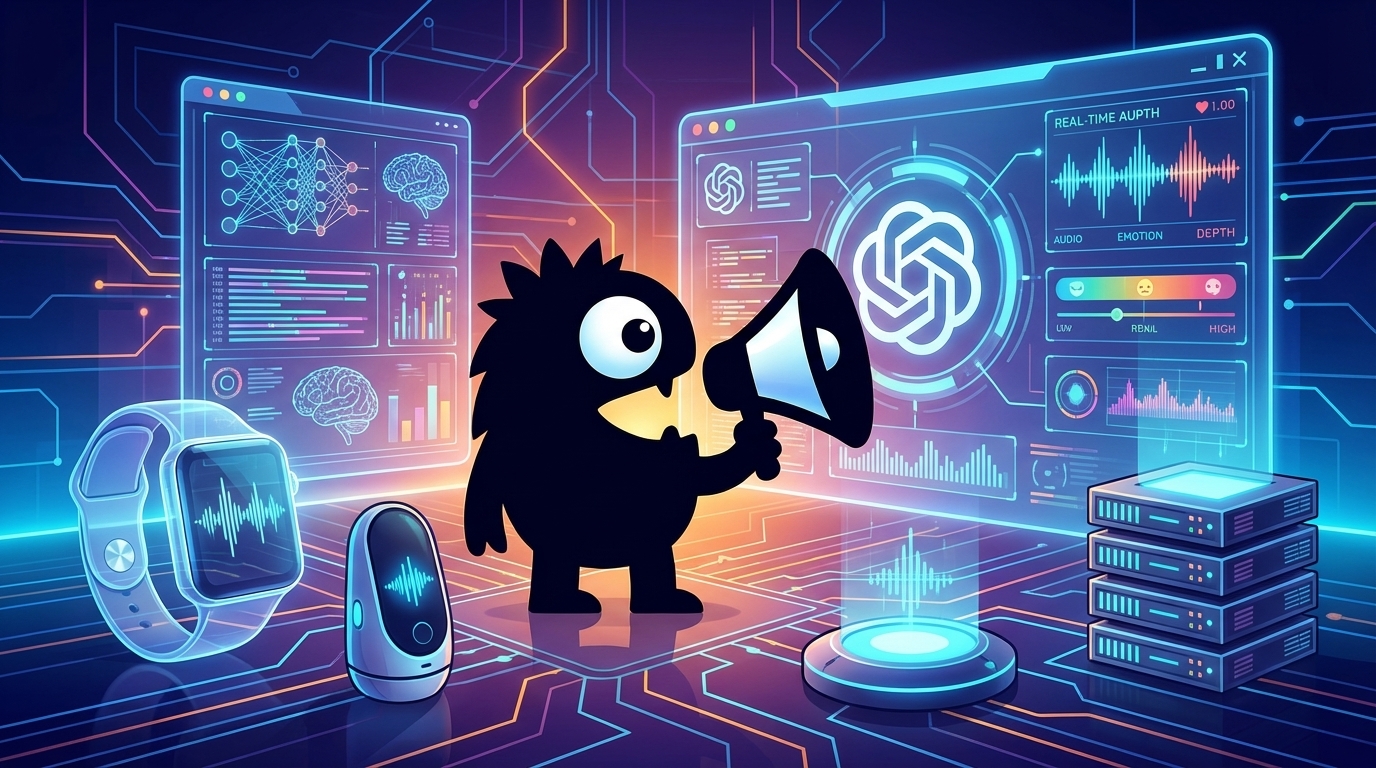
As a developer or technical decision-maker building voice-enabled applications, imagine deploying AI that not only responds faster but anticipates interruptions with human-like nuance—unlocking seamless, proactive interactions in wearables, smart assistants, and beyond. OpenAI's impending audio model upgrade could redefine how you integrate conversational AI, offering lower latency and emotional depth to elevate user experiences in real-time edge computing scenarios.
What Happened
OpenAI is accelerating its audio AI capabilities with a revamped voice architecture set for release in Q1 2026, designed to power an upcoming audio-first personal device. Reports indicate the company has merged internal teams to streamline development, focusing on enhancements like more natural and emotional speech synthesis, sub-200ms response times, and advanced real-time interruption handling for proactive assistance. This positions the model as a foundational step toward companion-style AI, potentially integrating with hardware like wearables for always-on, context-aware interactions. While OpenAI has not issued an official announcement, industry leaks suggest the device launch could follow closely, emphasizing screenless, voice-centric computing [source](https://techcrunch.com/2026/01/01/openai-bets-big-on-audio-as-silicon-valley-declares-war-on-screens/) [source](https://siliconangle.com/2026/01/01/report-openai-plans-launch-new-audio-model-first-quarter/) [source](https://www.reddit.com/r/singularity/comments/1q16mc9/openai_preparing_to_release_a_new_audio_model_in/).
Why This Matters
For engineers and developers, this upgrade promises API-level improvements in audio processing, enabling low-latency, multimodal applications with reduced computational overhead—critical for battery-constrained devices. Technically, advancements in emotional prosody and interruption detection could enhance natural language understanding (NLU) pipelines, allowing for more robust dialogue systems that handle overlapping speech without resets, ideal for IoT integrations or virtual agents. Business-wise, technical buyers stand to benefit from expanded OpenAI ecosystem access, potentially including device-specific SDKs that lower barriers to entry for custom voice hardware. As Silicon Valley shifts toward audio primacy, this could disrupt markets dominated by visual UIs, opening revenue streams in proactive AI services while challenging competitors like Google and Amazon to innovate faster [source](https://www.mobileappdaily.com/news/openai-audio-ai-model-q1-2026-device-plans) [source](https://mezha.net/eng/bukvy/openai-advances-audio-ai-with-new-device-launch-in-2026/amp/).
Technical Deep-Dive
OpenAI's preparation for a new audio model ties into its Q1 2026 device launch, focusing on a voice-first companion device. The upcoming architecture overhaul merges engineering, product, and research teams to address limitations in current audio models, which lag behind text-based counterparts in accuracy and speed. Key improvements include native support for low-latency processing, natural turn-taking, emotional intonation, and interruption handling—enabling overlapping speech and proactive suggestions. This builds on recent API updates, such as the December 2025 snapshots (e.g., gpt-realtime-mini-2025-12-15), which introduce an upgraded decoder for consistent, natural voices in noisy environments and short utterances. The new stack processes audio end-to-end via a single model, reducing latency from multi-model pipelines and preserving nuances like laughs or accents [source](https://developers.openai.com/blog/updates-audio-models).
Benchmark performance shows substantial gains. On ASR tasks like Common Voice and FLEURS, gpt-4o-mini-transcribe-2025-12-15 achieves ~35% lower word error rates (WER) than prior Whisper models, with ~90% fewer hallucinations in noisy audio or silence. For instruction following, gpt-realtime scores 30.5% on MultiChallenge Audio (up from 20.6%), 82.8% on Big Bench Audio (up from 65.6%), and 66.5% on ComplexFuncBench for tool calling (up from 49.7%). These metrics highlight better comprehension of non-verbal cues, language switching, and alphanumeric detection in multilingual scenarios (e.g., Mandarin, Hindi). Compared to TTS-1 HD, the new gpt-4o-mini-tts-2025-12-15 delivers more emotive output with fine-grained control, like "speak empathetically in a French accent" [source](https://openai.com/index/introducing-gpt-realtime/).
API changes emphasize realtime capabilities via the Realtime API (now generally available), supporting streaming audio I/O, voice activity detection for interruptions, and asynchronous function calling. New endpoints include gpt-realtime for high-accuracy agents and gpt-realtime-mini for cost/latency optimization. Developers can integrate remote MCP servers for tools (e.g., Stripe) without manual handling:
POST /v1/realtime/client_secrets
{
 "session": {
 "type": "realtime",
 "tools": [
 {
 "type": "mcp",
 "server_label": "stripe",
 "server_url": "https://mcp.stripe.com",
 "authorization": "{access_token}",
 "require_approval": "never"
 }
 ]
 }
}
Image input enhances multimodal agents: send base64 images alongside audio for grounded responses. SIP support enables direct phone/PBX integration. For non-realtime, use gpt-audio-mini with Chat Completions API. Pricing remains unchanged for snapshots but drops 20% for gpt-realtime: $32 per 1M audio input tokens ($0.40 cached) and $64 per 1M output tokens. Custom voices (for eligible enterprise users) now maintain dialect accuracy [source](https://platform.openai.com/docs/models).
Integration considerations for device launches include token limits for long sessions (auto-truncation) and safety classifiers to halt unsafe conversations. Developers praise the naturalness and tool precision for voice agents, though some note desync in audio-visual demos. Early adoption via Agents SDK simplifies building production workflows, with Q1 2026 model promising deeper emotional depth for companion devices [source](https://www.theinformation.com/articles/openai-ramps-audio-ai-efforts-ahead-device) [source](https://x.com/btibor91/status/2006751854483607936).
Developer & Community Reactions
What Developers Are Saying
Technical users in the AI community are buzzing about OpenAI's upcoming audio model, viewing it as a critical upgrade for real-time voice interactions. Lead Engineer Tibor Blaho highlighted the project's scope, noting that OpenAI has unified teams because "current audio models are less accurate and slower than the text-based models," with the new architecture promising "more natural and emotive speech" and better interruption handling [source](https://x.com/btibor91/status/2006751854483607936). Similarly, AI enthusiast and tool tester TechyTricksAI emphasized the technical rationale: "An audio-first device needs models built natively for low latency, natural turn-taking, and real-time context, not just 'speech added on top.' If OpenAI is rethinking the audio stack from the ground up, this could be a much bigger shift" [source](https://x.com/TechyTricksAI/status/2006770445421592578). Voice LLM scaler DG @dataghees acknowledged OpenAI's efforts but pointed out competitive gaps, stating, "OpenAI has lagged open source and Gemini when it comes to audio unified models" [source](https://x.com/dataghees/status/2006961683403817138).
Early Adopter Experiences
While the full model awaits Q1 2026 release, developers are testing recent Realtime API snapshots. OpenAI's official developer account shared positive benchmarks: the gpt-4o-mini-transcribe snapshot shows an "89% reduction in hallucinations compared to whisper-1," and gpt-realtime-mini offers "22% improvement in instruction following and 13% improvement in function calling" [source](https://x.com/OpenAIDevs/status/2000678814628958502). Program Manager Chris @chatgpt21, experimenting with voice AI, praised alternatives but noted current limitations in nuance: "Most models strip away accents and emotional nuance, making everyone sound like a generic American bot," though he found Mirage audio impressive for diversity [source](https://x.com/chatgpt21/status/2001005523697901847). Early feedback suggests smoother conversations, but real-world device integration remains untested.
Concerns & Criticisms
The community raises valid technical hurdles, particularly around parity with text models and competition. Developers like Blaho echo internal views that audio lags in accuracy and speed, potentially delaying seamless companion AI [source](https://x.com/btibor91/status/2006751854483607936). @dataghees criticized OpenAI's historical shortfall in unified audio models compared to open-source options and Gemini, urging faster innovation [source](https://x.com/dataghees/status/2006961683403817138). Broader critiques from AI educator David Shapiro highlight enterprise-driven shifts harming consumer UX, such as reduced personality and writing finesse, which could extend to audio if not addressed [source](https://x.com/DaveShapi/status/1989696021945815279). Privacy in always-on devices and hallucination risks in real-time speech also surface as enterprise worries.
Strengths
- Enhanced naturalness and emotive audio output, enabling more human-like interactions for device users [The Information](https://www.theinformation.com/articles/openai-ramps-audio-ai-efforts-ahead-device)
- Superior interruption handling and real-time responsiveness, improving conversational flow in audio-first applications [TechCrunch](https://techcrunch.com/2026/01/01/openai-bets-big-on-audio-as-silicon-valley-declares-war-on-screens/)
- Reduced hallucinations (89% fewer) and word errors (35% fewer) in transcription and TTS, boosting reliability for technical integrations [OpenAI Developers X post](https://x.com/OpenAIDevs/status/2000678814628958502)
Weaknesses & Limitations
- Privacy vulnerabilities in audio processing, including risks of unauthorized voice generation and speaker identification without robust safeguards [OpenAI GPT-4o System Card](https://openai.com/index/gpt-4o-system-card/)
- High API costs for audio tasks, potentially straining budgets for high-volume deployments (e.g., $0.006/min for similar models like Whisper) [Zapier](https://zapier.com/blog/openai-models/)
- Dependency on cloud infrastructure, leading to latency issues or outages that could disrupt real-time device performance [SiliconANGLE](https://siliconangle.com/2026/01/01/report-openai-plans-launch-new-audio-model-first-quarter/)
Opportunities for Technical Buyers
How technical teams can leverage this development:
- Integrate into smart home devices for seamless, interruption-aware voice control, reducing development time on custom audio pipelines
- Enhance enterprise apps with emotive TTS for customer service bots, improving user engagement without building from scratch
- Develop accessibility tools for real-time transcription in wearables, capitalizing on accuracy gains to meet compliance needs faster
What to Watch
Monitor Q1 2026 model release for API access and beta testing opportunities, as delays could shift adoption timelines. Track pricing announcements and integration docs on OpenAI's developer platform to evaluate ROI against competitors like Google's AudioPaLM. Decision points include early 2026 device launch details—assess hardware compatibility and privacy features before committing resources, especially if your team relies on on-device processing to avoid cloud dependencies.
Key Takeaways
- OpenAI's new audio model, set for Q1 2026 launch, promises more natural, emotional speech synthesis with real-time interruption handling, elevating conversational AI beyond current TTS limits.
- Internal team mergers signal accelerated focus on audio AI, unifying efforts across voice generation, recognition, and multimodal integration for faster innovation.
- The model paves the way for an audio-first personal device expected in 2027, targeting screenless interactions and positioning OpenAI in consumer hardware.
- Early benchmarks show gains in speed, accuracy, and emotive delivery, potentially disrupting applications in virtual assistants, accessibility tools, and telepresence.
- This development aligns with Silicon Valley's shift toward audio-centric AI, challenging dominant visual interfaces and opening opportunities for edge-device deployments.
Bottom Line
For technical buyers like AI developers and hardware engineers, act now if building voice-enabled apps—integrate OpenAI's existing APIs to prototype and gain a competitive edge. Wait for the Q1 2026 model if your roadmap involves advanced conversational features or device integrations, as it could obsolete interim solutions. Ignore if your focus is purely visual or non-real-time AI. This matters most to audio AI specialists, IoT device makers, and accessibility tech firms eyeing human-like interactions in resource-constrained environments.
Next Steps
Concrete actions readers can take:
- Subscribe to OpenAI's developer newsletter for launch announcements and beta access: openai.com/api/.
- Test current audio tools like Whisper for transcription or TTS for synthesis via the OpenAI Playground to benchmark against upcoming improvements.
- Monitor partnerships and SDK releases by following OpenAI's blog and attending CES 2026 for device reveals.
References (50 sources)
- https://x.com/i/status/2005762561753616609
- https://x.com/i/status/2006443779251659191
- https://x.com/i/status/2006496359780856206
- https://x.com/i/status/2007002159880220725
- https://x.com/i/status/2006882692475080711
- https://x.com/i/status/2006998905901215964
- https://x.com/i/status/2006742260734636461
- https://x.com/i/status/2006990529586942019
- https://x.com/i/status/2005732805838553183
- https://x.com/i/status/2006873345526997278
- https://x.com/i/status/2005349350361477218
- https://x.com/i/status/2006991397086167219
- https://x.com/i/status/2006795621790003613
- https://x.com/i/status/2006827623012511908
- https://x.com/i/status/2007013423713014123
- https://x.com/i/status/2006504402446659804
- https://x.com/i/status/2006258579926392949
- https://x.com/i/status/2006559948327760280
- https://x.com/i/status/2006743840494071927
- https://x.com/i/status/2006350642168705317
- https://x.com/i/status/2006337980722737231
- https://x.com/i/status/2006664318767513942
- https://x.com/i/status/2006795290159047065
- https://x.com/i/status/2006794744324878512
- https://x.com/i/status/2006745730892128470
- https://x.com/i/status/2006749376308212157
- https://x.com/i/status/2006723729334644859
- https://x.com/i/status/2006595319933579561
- https://x.com/i/status/2006689266168901887
- https://x.com/i/status/2006815699810050323
- https://x.com/i/status/2006922724032324009
- https://x.com/i/status/2006660532581908941
- https://x.com/i/status/2005628118766350474
- https://x.com/i/status/2006459294422860120
- https://x.com/i/status/2006764982860681659
- https://x.com/i/status/2006984317092937968
- https://x.com/i/status/2006977359245914538
- https://x.com/i/status/2006332960132284533
- https://x.com/i/status/2006493701225459845
- https://x.com/i/status/2006866634489868794
- https://x.com/i/status/2005096073123987838
- https://x.com/i/status/2006938546066645176
- https://x.com/i/status/2006934230291591629
- https://x.com/i/status/2005823958671937697
- https://x.com/i/status/2007010505014030680
- https://x.com/i/status/2006932533779283976
- https://x.com/i/status/2006073102665687282
- https://x.com/i/status/2006366460856369657
- https://x.com/i/status/2006851999065846142
- https://x.com/i/status/2006807389815857171
Related Guides
Perplexity Launches Computer: Unified AI for End-to-End Projects
9 min read
OpenAI Raises Record $110B from Amazon, Nvidia, SoftBank
9 min read
OpenAI Secures $110B Funding at $840B Valuation
9 min read
Anthropic Unveils Claude Cowork for Enterprise AI Collaboration
10 min read