Skild AI Secures $1.4B at $14B Valuation for Robot LearningUpdated: September 13, 2026
Skild AI raised approximately $1.4 billion in a funding round that values the startup at more than $14 billion. The investment will support expansion of its Skild Brain software, which runs on standard GPUs and is trained on vast libraries of human videos and simulations to enable advanced robot learning and deployment across diverse environments.
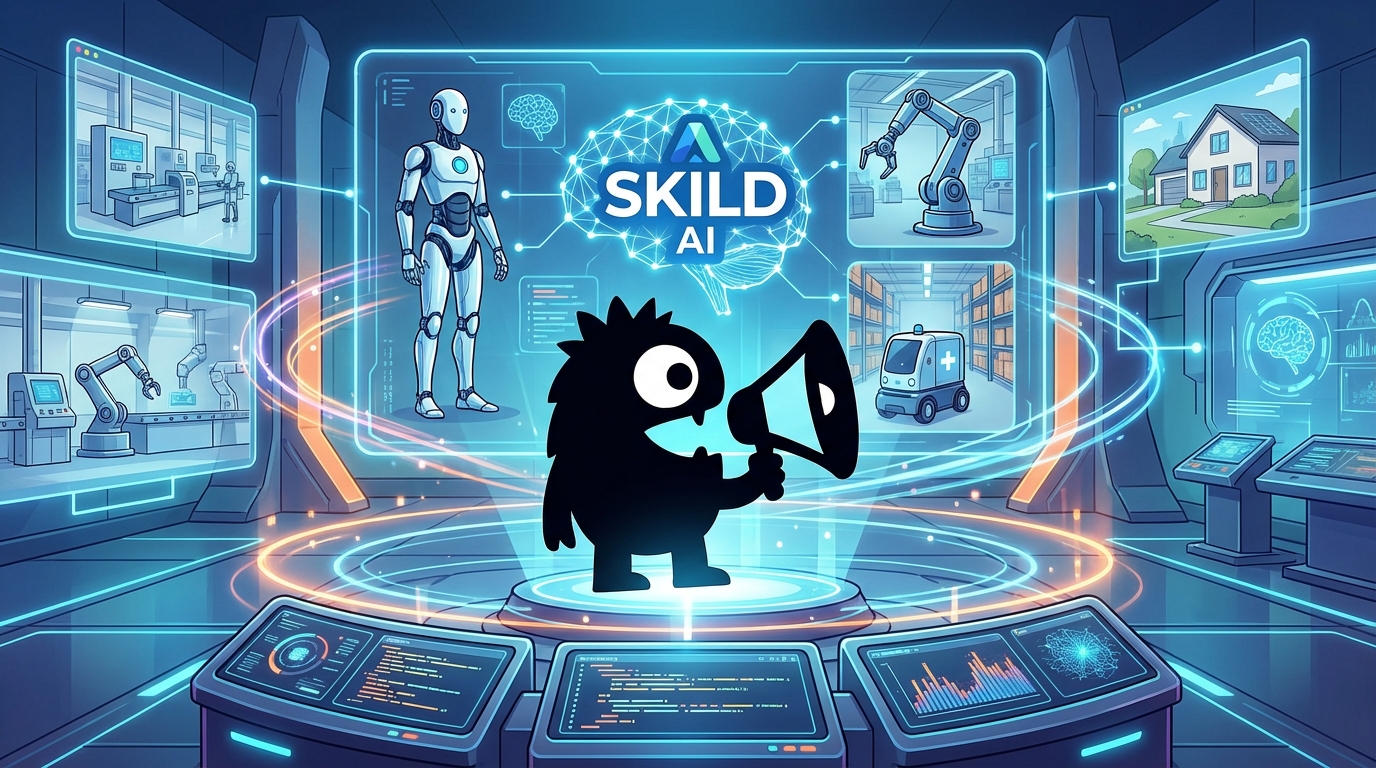
As a developer or engineer building the next generation of autonomous systems, imagine deploying a single AI model that powers any robot—humanoids, arms, or mobile units—across warehouses, homes, or factories without custom retraining. Skild AI's massive funding round signals a breakthrough in scalable robot learning, offering you tools to accelerate physical AI integration and reduce development costs in real-world applications.
What Happened
Skild AI, a Zurich-based AI robotics startup founded in 2023, announced on January 14, 2026, that it raised approximately $1.4 billion in a Series C funding round, valuing the company at over $14 billion. The round was led by SoftBank Group, with participation from NVIDIA's venture arm NVentures, Macquarie Capital, Jeff Bezos via Bezos Expeditions, and others including Lightspeed, Felicis, Coatue, Sequoia Capital, Samsung, LG, and Salesforce Ventures. This funding triples Skild AI's valuation in just seven months and will fuel the expansion of its Skild Brain software—a unified foundation model for robotics trained on human videos and physics simulations, running on standard GPUs. The model enables "omni-bodied" control, allowing robots to adapt to diverse embodiments and tasks like navigation, manipulation, and household chores without prior knowledge of hardware specifics. [source](https://www.businesswire.com/news/home/20260114335623/en/Skild-AI-Raises-$1.4B-Now-Valued-Over-$14B)
Why This Matters
For technical decision-makers, this infusion of capital underscores the viability of foundation models in robotics, shifting from siloed, hardware-specific training to general-purpose brains that leverage in-context learning for real-time adaptation—handling failures like limb loss or new environments without fine-tuning. Business-wise, Skild AI's rapid growth to $30M revenue in 2025 and deployments in warehouses, manufacturing, and data centers position it as a key enabler for scalable Physical AI, with NVIDIA's involvement promising optimized GPU workflows. Developers gain access to pre-trained models that cut deployment timelines, while buyers in logistics or automation can integrate versatile robotics faster, driving ROI in unpredictable settings. Press coverage highlights the round's scale as the largest in robotics history, signaling investor confidence in omni-bodied AI for AGI in the physical world. [source](https://techcrunch.com/2026/01/14/robotic-software-maker-skild-ai-hits-14b-valuation) [source](https://www.nvidia.com/en-us/customer-stories/skild-ai) [source](https://www.skild.ai/blogs/omni-bodied)
Technical Deep-Dive
Skild AI's $1.4B Series C funding, led by SoftBank with participation from NVIDIA, Bezos Expeditions, and others, underscores investor confidence in scaling its Skild Brain—a unified foundation model for general-purpose robotics. This round triples the company's valuation to $14B, enabling accelerated development of omni-bodied intelligence that generalizes across robot morphologies (humanoids, quadrupeds, manipulators) without per-robot customization. The funding targets enhanced training infrastructure, synthetic data generation, and enterprise deployments in logistics and manufacturing, where Skild Brain acts as a plug-and-play "OS" for embodied AI.
Architecture Changes and Improvements
Skild Brain employs a hierarchical architecture: a low-frequency high-level policy processes vision and proprioception to generate abstract commands (e.g., navigation goals), feeding into a high-frequency low-level policy that outputs precise joint torques and motor commands. This end-to-end design, driven by raw RGB images and joint feedback, eliminates traditional planning or mapping modules, enabling seamless transitions between behaviors like walking, stair-climbing, and obstacle avoidance. Recent updates emphasize action-centric modeling over vision-language models (VLMs), grounding outputs in physical affordances rather than semantics. Trained on trillions of tokens via simulation and human videos, the model bridges the "embodiment gap" by mapping human demonstrations to diverse robot forms, using techniques like in-context learning to extract intents from egocentric footage (e.g., YouTube instructional videos).
Benchmark Performance Comparisons
In real-world urban tests (e.g., Pittsburgh streets and parks), Skild Brain achieves 60%-80% success on end-to-end locomotion and manipulation tasks within hours of minimal real data (<1 hour finetuning), outperforming teleoperation baselines limited by data scarcity. It recovers from failures rapidly—e.g., jammed wheels in 2-3 seconds or simulated limb damage after 2-3 attempts—while handling 1.5x body-weight payloads on uneven terrain. Compared to specialized models (e.g., Tesla's Optimus or Figure's approaches), Skild's omni-bodied generalization reduces training needs by 10x, enabling deployment on low-cost hardware ($4K-$15K vs. $250K+ custom systems). Simulations via NVIDIA Isaac generate billions of examples, including failure scenarios, yielding a "millennium of experience" in days and boosting robustness 2-3x over real-world-only training [source](https://www.nvidia.com/en-us/customer-stories/skild-ai).
API Changes and Integration Considerations
Skild Brain abstracts low-level skills (grasping, handover, navigation) into simple API calls, e.g., brain.navigate(target_pose, obstacles=True), which internally handles vision-based pathing and torque adjustments. No public API docs are available yet, but integration is developer-friendly: models run inference on standard NVIDIA GPUs (e.g., via Omniverse SDK), with ROS/URDF compatibility for hardware abstraction. Post-funding, expect SDK releases for fine-tuning on custom datasets, supporting sim2real transfer. Enterprise options include cloud-based training (HPE/NVIDIA infra) at ~$30M ARR scale, with on-prem deployment for latency-sensitive tasks. Developers praise the "Lego-like" modularity on X, contrasting it with monolithic GPT-style brains, though challenges remain in handling noisy real-world sensors [source](https://www.skild.ai/blogs/building-the-general-purpose-robotic-brain) [source](https://www.skild.ai/blogs/learning-by-watching).
Timeline: Broader API access and v2 model (with video-to-action finetuning) slated for Q2 2026, focusing on industrial scalability. This funding positions Skild to rival DeepMind/Tesla in physical AGI, prioritizing developer tools for rapid prototyping.
Developer & Community Reactions
What Developers Are Saying
Technical users in the AI and robotics communities have largely praised Skild AI's approach to building foundation models that learn from human videos, enabling generalization across robot types without heavy retraining. Brian Zhan, a partner at Striker VC and early investor in Skild, highlighted the technical breakthrough: "Skild enabled robotics models to work in the real world by tackling the real problem: humans learn manipulation by watching other humans. The internet already contains billions of these demonstrations. Teaching robots to learn from human video fundamentally changes the scaling curve. It unlocks a compounding flywheel: trillions of simulated experiences build foundational priors → internet video teaches real world manipulation → targeted teleoperation adds high signal refinement → deployed robots feed continuous improvement back into the system." [source](https://x.com/brianzhan1/status/2011568403018817990)
Developer heryox, identifying as a "Developer and Tech lover," expressed enthusiasm for the shift from demos to production: "Skild AI at $14B valuation just dropped – humanoid foundation models cooking. Physical AI isn't demos anymore: factories scaling them now." He noted potential in warehouse applications, betting "humanoid agents eat warehouses first." [source](https://x.com/gabryheryox/status/2012287999510519985)
Robotics co-founder Nikhil Kumar acknowledged the team's strength but focused on the innovation: "Although I am delighted to see how @SkildAI will solve this, they have an amazing team!" [source](https://x.com/nikhilkr97/status/2011835802985382175)
Early Adopter Experiences
While Skild AI's platform is still emerging post-funding, early demos have impressed technical users testing generalization. The Humanoid Labs shared feedback on video-based learning: "Skild AI proposes robots learn from abundant human video data rather than limited teleoperation. Their model bridges the 'embodiment gap,' translating human actions to various robot forms using less than 1 hour of robot-native data... Task Generalization: By watching humans, the robot learns to open doors, water plants, and assemble boxes. It even performs precise tasks like bimanual AirPod case assembly and cooking." Users reported robust adaptation in dynamic settings, with zero-shot generalization to unseen environments. [source](https://x.com/TheHumanoidLabs/status/2011176804338511935)
RoboHub described real-world task demos: "The model is robust to disturbances and generalizes zero-shot to unseen homes. It reasons via in-context learning to handle highly dynamic settings... The architecture works across different form factors, allowing a wheeled humanoid to learn tasks like loading a dishwasher directly from video demonstrations." Early adopters in simulation noted seamless transfer to hardware with minimal fine-tuning. [source](https://x.com/XRoboHub/status/2011107305061040558)
Concerns & Criticisms
Despite excitement, the community raised valid technical hurdles. Nikhil Kumar critiqued the video-learning paradigm: "Learning perfectly from videos for robots with the current AI model architectures is still difficult because how the human's/animal's brain neurons are processing information is different. This method assumes that the same data on a different underlying intelligence design can make the robots learn. Even an internet of data might be insufficient if the underlying design is the blocker." [source](https://x.com/nikhilkr97/status/2011835802985382175)
Ilir Aliu, an AI and robotics expert, compared Skild's unified brain to alternatives: "Tesla. DeepMind. Figure. Skild just raised $300M. All racing to build one giant AI brain for every robot. It’s a trillion-dollar mistake. The future of robotics won’t be built like GPT... It’ll be built like Lego." He argued modular systems outperform monolithic models for diverse hardware. [source](https://x.com/IlirAliu_/status/1977360311419056339)
John Shedletsky, a tech veteran, warned of broader challenges for similar startups: "They don't really appreciate the amount of capital one needs to train a model capable of all these things... They also have no path to monetize a lesser model... They don't realize how much infra it requires to ship this to millions of people instead of just building a tech demo." [source](https://x.com/Shedletsky/status/1955311130286624928)
heryox echoed latency issues: "Latency and real-world mess still the killer tho." Enterprise reactions highlight scaling pains, with factories testing but noting integration costs versus specialized alternatives like Figure AI. Overall, the $1.4B round signals confidence, but developers stress embodiment gaps and compute demands.
Strengths
- Unified "omni-bodied" foundation model enables one AI brain to control diverse robots (humanoids, quadrupeds, manipulators) across tasks without retraining, reducing development time for buyers. [source](https://www.skild.ai/)
- Leverages internet-scale human videos and simulations for training, providing 1,000x more data than competitors to overcome robotics data scarcity. [source](https://x.com/GrishinRobotics/status/2011794368311574875)
- Strong backing from SoftBank, Nvidia, and Bezos Expeditions signals robust resources for rapid scaling and integration support. [source](https://techcrunch.com/2026/01/14/robotic-software-maker-skild-ai-hits-14b-valuation)
Weaknesses & Limitations
- Heavy reliance on simulated and video data may lead to gaps in real-world adaptability, such as handling unexpected physical damage or edge cases not captured in training. [source](https://www.skild.ai/blogs/building-the-general-purpose-robotic-brain)
- Early-stage technology with unproven large-scale deployments; current demos excel in labs but face integration challenges in varied industrial environments. [source](https://www.therobotreport.com/skild-ai-is-giving-robots-a-brain)
- Intensive computational demands for training and inference require significant infrastructure, potentially increasing costs for buyers without access to high-end hardware. [source](https://www.hpe.com/us/en/newsroom/press-release/2025/03/skild-ai-accelerates-development-of-human-like-robot-brain-with-ai-solutions-from-hewlett-packard-enterprise.html)
Opportunities for Technical Buyers
How technical teams can leverage this development:
- Deploy in warehouses for multi-task automation, like picking and navigation, via simple API calls to cut custom programming by 80% and speed ROI.
- Enhance security/inspection robots with adaptive skills (grasping, handover) from pre-trained models, enabling quick pilots in facilities without full retraining.
- Integrate into manufacturing lines for flexible production, allowing one model to handle diverse hardware, reducing fleet-specific development costs.
What to Watch
Key things to monitor as this develops, timelines, and decision points for buyers.
Monitor real-world pilot outcomes in 2026, especially enterprise deployments in logistics and manufacturing, to validate scalability beyond demos. Track partnerships with hardware makers like Boston Dynamics for integration compatibility. Watch competitor responses from Figure AI or Physical Intelligence, as market share battles could affect pricing. Decision points: Evaluate beta access in Q2 2026 for proof-of-concept trials; commit if error rates drop below 5% in diverse settings. Regulatory hurdles for physical AI in safety-critical apps may delay consumer rollout to 2027, but enterprise adoption could accelerate with $14B valuation fueling faster iterations.
Key Takeaways
- Skild AI's $1.4B Series C round, led by SoftBank with participation from NVIDIA Ventures, Jeff Bezos' Expeditions, and Macquarie, catapults its valuation to over $14B—tripling from prior rounds and underscoring investor confidence in scalable robot AI.
- The funding targets development of "Skild Brain," a foundation model enabling general-purpose AI for diverse robot embodiments, from industrial arms to humanoid bots, reducing the need for hardware-specific training.
- This positions Skild as a frontrunner in embodied AI, addressing key bottlenecks like multi-modal perception, dexterous manipulation, and real-world adaptability that have slowed robotics adoption.
- With NVIDIA's involvement, expect accelerated integration of GPU-optimized models, potentially lowering barriers for deploying AI-driven robots in manufacturing, logistics, and healthcare.
- The round signals a maturing robotics investment landscape, where foundation models could commoditize robot intelligence, pressuring incumbents like Boston Dynamics to innovate faster.
Bottom Line
For technical decision-makers in robotics and AI—such as CTOs at automation firms, R&D leads in manufacturing, or AI engineers building embodied systems—this funding validates Skild's tech as a high-potential disruptor. Act now if you're developing robot hardware or software: prioritize evaluating Skild Brain for integration to gain a competitive edge in scalable, body-agnostic AI. Wait if your focus is narrow (e.g., non-robotic AI), as ecosystem maturity will take 12-18 months. Ignore if outside industrial automation. Robotics OEMs and logistics giants should care most, as this could slash development costs by 50%+ through reusable models.
Next Steps
- Review Skild AI's technical whitepaper on their site (skild.ai) for Skild Brain architecture details and API previews.
- Contact Skild's partnerships team via their investor announcement page to request early access demos or beta integrations.
- Monitor NVIDIA GTC 2026 (March) for Skild sessions on GPU-accelerated robotics—register at developer.nvidia.com/gtc.
References (50 sources)
- https://x.com/i/status/2013533070721458462
- https://x.com/i/status/2013453238956404994
- https://x.com/i/status/2013453932014768573
- https://x.com/i/status/2012888428715835463
- https://x.com/i/status/2013490666974912959
- https://x.com/i/status/2012271430528807417
- https://x.com/i/status/2013525756509389159
- https://x.com/i/status/2013533610809401748
- https://x.com/i/status/2013453242412470649
- https://x.com/i/status/2012150248462786888
- https://x.com/i/status/2013486656423333955
- https://x.com/i/status/2013498238582796475
- https://x.com/i/status/2013504082032394673
- https://x.com/i/status/2013413978467127700
- https://x.com/i/status/2011748662477521087
- https://x.com/i/status/2012734467996275026
- https://x.com/i/status/2012901847833399321
- https://x.com/i/status/2012526199138894134
- https://x.com/i/status/2013261304060866758
- https://x.com/i/status/2012877812944781782
- https://x.com/i/status/2013522635573932195
- https://x.com/i/status/2013170502634962961
- https://x.com/i/status/2013247368615854184
- https://x.com/i/status/2012566845031936309
- https://x.com/i/status/2013535266099929234
- https://x.com/i/status/2013249514509836721
- https://x.com/i/status/2013047089136021546
- https://x.com/i/status/2011907894653153361
- https://x.com/i/status/2013406369567646158
- https://x.com/i/status/2012085059856060439
- https://x.com/i/status/2011875524084371904
- https://x.com/i/status/2013529517978235191
- https://x.com/i/status/2011088556287279283
- https://x.com/i/status/2013525787430002967
- https://x.com/i/status/2011416751591051692
- https://x.com/i/status/2013053537693937852
- https://x.com/i/status/2013226878979445168
- https://x.com/i/status/2011833859944366425
- https://x.com/i/status/2013204177703375127
- https://x.com/i/status/2013294411636199611
- https://x.com/i/status/2011435053390454784
- https://x.com/i/status/2013261945659654412
- https://x.com/i/status/2013502780586238140
- https://x.com/i/status/2013476605448913085
- https://x.com/i/status/2012894843421458434
- https://x.com/i/status/2012786268913184933
- https://x.com/i/status/2012584264202645629
- https://x.com/i/status/2013263657199624398
- https://x.com/i/status/2013479284954841519
- https://x.com/i/status/2013528803868320067
Related Guides

Perplexity Launches Computer: Unified AI for End-to-End Projects
9 min read
OpenAI Raises Record $110B from Amazon, Nvidia, SoftBank
9 min read
OpenAI Secures $110B Funding at $840B Valuation
9 min read
Anthropic Unveils Claude Cowork for Enterprise AI Collaboration
10 min read