ClickUp vs Railway vs Vercel: Which Is Best for Building SaaS Products in 2026?Updated: September 27, 2026
ClickUp vs Railway vs Vercel compared for SaaS builders: project management, backend hosting, and frontend deployment pricing, learning curve, and fit. Compare now.
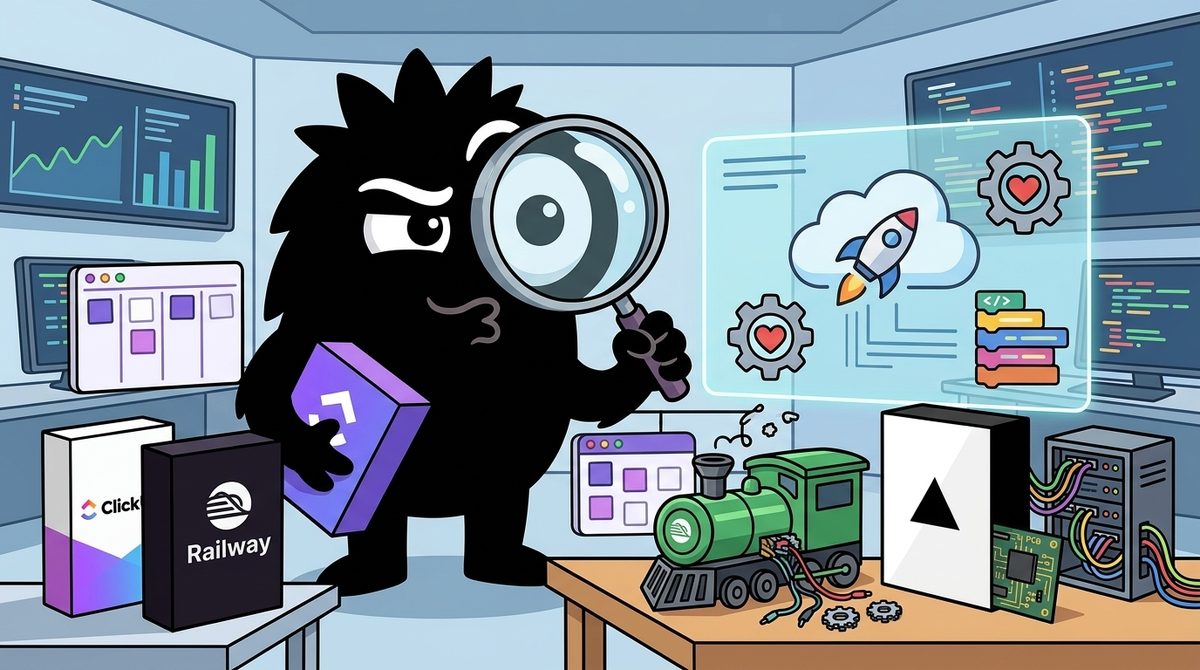
The real question is not whether ClickUp, Railway, or Vercel is the “best” SaaS platform. It is which parts of your SaaS workflow each tool should own—and whether your team needs all three.
ClickUp organizes the work around the product. Railway runs backend services, databases, workers, and other infrastructure. Vercel deploys web frontends—especially Next.js applications—and can also handle lightweight server-side logic. They are mostly complementary, although Railway and Vercel overlap enough on application hosting that teams must define a clear boundary between them.
Bottom line for 2026
>
- Choose ClickUp for roadmaps, sprints, documentation, bugs, and business operations.
- Choose Railway for persistent backends, databases, queues, workers, scheduled jobs, and containerized services.
- Choose Vercel for frontend deployment, preview environments, edge delivery, and Next.js-centric workflows.
- A common SaaS architecture uses Vercel for the frontend and Railway for the backend, with ClickUp coordinating product development.
- Solo founders rarely need the full power of all three on day one. Adopt each tool only when it removes more work than it creates.
Comparing Apples, Oranges, and Bananas: Why This Matchup Confuses People
A direct ClickUp vs Railway vs Vercel feature comparison produces a misleading result because the products operate at different layers.
ClickUp is a work-management system. It helps a team decide what to build, document requirements, assign work, track bugs, and coordinate launches. It does not host the application customers use.
Railway is an application and infrastructure platform. It is intended for running software services and supporting resources such as databases. It sits much closer to the runtime layer: the place where API servers, workers, scheduled processes, and stateful components operate.
Vercel is primarily a web deployment platform. Its strongest fit is the frontend delivery workflow, including builds, preview deployments, production releases, and globally distributed web experiences. It can execute backend logic, but its serverless-oriented execution model is not interchangeable with every conventional backend workload.
The meaningful comparison is therefore goal-first:
| SaaS need | Primary fit |
|---|---|
| Product roadmap and sprint planning | ClickUp |
| Documentation and cross-functional coordination | ClickUp |
| Web frontend and preview deployments | Vercel |
| Persistent API or application server | Railway |
| Managed database attached to backend services | Railway |
| Background workers and long-running jobs | Railway |
| Small server-side functions close to the frontend | Vercel |
| End-to-end product workflow | A combination of the three |
Railway and Vercel have the most genuine overlap. Either can host some web application logic, and both aim to make deployment easier than managing raw cloud infrastructure. The deciding factor is usually not whether code can run on one platform. It is whether the workload fits that platform’s execution, networking, storage, scaling, and billing model.
ClickUp: Running the SaaS Business Around the Code
ClickUp belongs on the operational side of the SaaS stack. It can hold feature requests, product specifications, engineering tasks, release checklists, customer onboarding work, marketing campaigns, and internal documentation.
For a small SaaS company, that consolidation can be valuable. Instead of dividing work among a task tracker, document system, spreadsheet, and separate operations board, a team can create a connected workspace. A bug can link to a release milestone; a product requirement can sit beside its implementation tasks; customer feedback can feed into roadmap prioritization.
Where ClickUp helps a SaaS team
Typical uses include:
- Product roadmaps and quarterly priorities
- Sprint or Kanban boards
- Bug and incident tracking
- Product requirements and internal documentation
- Launch checklists
- Customer implementation projects
- Sales, marketing, and support workflows
- Recurring operational tasks
That breadth is also ClickUp’s main risk. A two-person company does not automatically become better organized by designing elaborate statuses, custom fields, dashboards, dependencies, and automations. Configuration can turn into work about work.
The right test is simple: Does the system make ownership and priorities clearer? If founders spend more time maintaining ClickUp than resolving uncertainty, the workspace is overdesigned.
A solo founder may need only a backlog, an “in progress” column, and a weekly priorities list. A 10-person SaaS team spanning engineering, design, sales, and customer success can justify more structure because coordination failures become expensive. At that stage, shared documentation and visible dependencies can prevent duplicated or forgotten work.
ClickUp should therefore be evaluated against tools for planning and coordination—not against deployment platforms. It supports shipping software indirectly by reducing organizational friction; it does not ship the software itself.
Railway: Where the Backend Actually Lives
Railway is the strongest candidate of the three for a conventional SaaS backend. That means the processes that enforce business rules, connect to persistent data, run asynchronous work, and integrate with external services.
A Railway deployment might contain:
- A REST or GraphQL API
- A persistent application server
- A relational database
- A cache or queue
- Background workers
- Scheduled jobs
- Webhook processors
- Internal services
- Containerized third-party software
This matters because many production backends do more than answer short HTTP requests. They may process files, consume queues, maintain network connections, execute long jobs, or run continuously. Those patterns fit naturally into a persistent service model.
Railway’s appeal is that it abstracts much of the infrastructure setup without forcing a team to redesign everything as functions. Developers can connect code, define configuration and environment variables, attach infrastructure, and deploy without immediately operating virtual machines or assembling a full cloud platform from basic components.
Railway’s abstraction does not eliminate infrastructure decisions
A managed experience still leaves the team responsible for application architecture. Engineers must understand:
- Database migrations and backups
- Connection limits and connection pooling
- Memory and CPU requirements
- Private versus public networking
- Service health and restart behavior
- Horizontal scaling
- Logging and observability
- Secrets management
- Deployment compatibility
- Disaster recovery
Railway reduces the amount of platform engineering needed to reach production. It does not remove the need for production discipline.
Its usage-oriented economics also deserve attention. A small service with modest traffic can be inexpensive and operationally efficient. A memory-heavy worker, high-volume database, or always-on fleet changes that equation. Teams should measure resource consumption rather than assuming a managed platform will remain cheap because its initial setup was easy.
Railway fits teams that want more runtime flexibility than frontend-oriented serverless hosting provides, but less operational burden than managing raw cloud infrastructure.
Vercel: Shipping the Frontend at the Edge
Vercel is most compelling when the product experience is delivered through a modern web application, especially one built around Next.js.
Its practical value is not merely that it can host static files. Vercel connects source control, builds, deployments, preview environments, production domains, and web delivery into a workflow designed around frontend teams. A pull request can produce an isolated preview that product managers, designers, and clients can review before a release reaches production.
That shortens the feedback loop. Instead of asking non-engineers to run a branch locally, a developer can give them a working deployment. For a small team, this is a meaningful productivity advantage rather than a cosmetic feature.
Vercel is a particularly strong fit for:
- SaaS dashboards
- Marketing sites
- Documentation sites
- Customer portals
- E-commerce frontends
- Next.js applications
- Frontends that benefit from global caching and edge delivery
- Teams that rely heavily on deployment previews
Can the entire backend live on Vercel?
Sometimes—but “backend” covers several different workload types.
Short request-response operations can fit a function-based model well. Examples include form processing, authentication callbacks, lightweight API endpoints, and server-side rendering. Keeping those operations beside the frontend can simplify deployment.
The fit becomes weaker when an application needs long-running processes, persistent workers, specialized networking, sustained computation, or infrastructure that should remain continuously active. A workload that repeatedly runs into execution-model constraints is not improved by forcing it into more functions.
This leads to a common division of responsibility:
- Vercel: browser-facing application, rendering, web routes, preview deployments, and suitable functions
- Railway: primary API, database, workers, queues, cron processes, and persistent services
That boundary is not mandatory. A simple SaaS product may run entirely on Vercel while using an external database provider. A backend-centric application may run its web server and frontend together on Railway. The split becomes useful when each half has materially different runtime needs.
The Pricing Trap: Cost Creep Nobody Warns You About
Managed platforms trade engineering labor for platform fees. That is often a good deal—but only if the team models the cost unit each vendor uses.
The mistake is comparing entry-level prices rather than asking what causes the bill to grow.
ClickUp costs grow with people and workspace complexity
For ClickUp, team size is an obvious cost driver because work-management products commonly package paid access around users and plan tiers. Contractors, clients, and cross-functional stakeholders complicate the calculation: teams need to determine who requires full access, what guest access permits, and which capabilities require a higher tier.
There is also a hidden organizational cost. A highly customized workspace needs maintenance. Changing fields, permissions, templates, dashboards, and automations consumes employee time even when it does not appear on the software invoice.
Railway costs grow with running resources
Railway’s cost profile is connected to infrastructure consumption. Teams should model:
- Number of continuously running services
- Memory assigned or consumed
- CPU demand
- Database size and activity
- Storage growth
- Network traffic
- Separate staging environments
- Worker concurrency
- Logs and operational data
The expensive surprise may not be a sudden traffic spike. It may be an inefficient service that runs all month, an oversized database, or several environments duplicating the production architecture.
Vercel costs grow with delivery and execution patterns
For Vercel, teams need to examine traffic, data transfer, image and asset processing, builds, function execution, and any other metered platform capabilities relevant to their architecture. A media-heavy public site has a different cost curve from an authenticated dashboard with relatively small responses.
The familiar “viral traffic bill” concern is real in principle across usage-based hosting: success can increase costs quickly. But inefficient architecture can be just as important as popularity. Missing cache headers, unnecessarily large assets, chatty APIs, and repeated server-side work can multiply usage without adding customers.
Before committing, create three models:
- Current load: expected users, requests, data transfer, storage, and team seats.
- Growth load: approximately ten times the customer activity, including staging and background processing.
- Abuse or spike load: bot traffic, viral sharing, runaway jobs, or unexpectedly large customer datasets.
Add spending alerts, review invoices monthly, and assign an owner to unit economics. “Managed” should not mean “unobserved.”
Learning Curve and Operational Overhead for Small Teams
The best tool is not the one with the longest feature list. It is the one that removes a current bottleneck without introducing a larger one.
ClickUp’s learning curve is primarily organizational. Railway’s is infrastructural. Vercel’s is architectural: deployment may be simple, but teams still need to understand which application patterns fit its runtime.
What should a solo founder optimize for?
A solo founder should optimize for iteration speed and a low number of moving parts.
That often means:
- A minimal ClickUp workspace—or an even simpler tracker
- Vercel if the product is frontend-heavy and framework-aligned
- Railway only when the backend requires persistent services, workers, or attached infrastructure
- One production environment and perhaps one shared staging environment
- Basic logging, backups, alerts, and spending controls from the beginning
Adding all three platforms before validating the product creates additional accounts, permissions, configuration, billing surfaces, and failure points. The architecture should become more sophisticated in response to demonstrated needs.
What changes for a small funded team?
With several engineers and cross-functional colleagues, specialization starts paying off. Preview deployments help reviews; dedicated backend hosting prevents runtime compromises; structured work management makes dependencies visible.
At that point, the combined stack can reduce overhead because each platform replaces work the team would otherwise perform manually. The key is to nominate owners:
- Product or operations owns ClickUp conventions.
- Backend engineering owns Railway services and data.
- Frontend engineering owns Vercel deployments and web performance.
- Someone explicitly owns cost monitoring across all three.
Without ownership, managed tools accumulate configuration and cost while everyone assumes somebody else is watching them.
The Combined Stack: How These Three Work Together
A practical SaaS workflow can connect the tools without tightly coupling them.
- Planning starts in ClickUp. A product requirement records the customer problem, scope, acceptance criteria, design links, and rollout plan.
- Engineering branches from source control. Backend and frontend changes are developed independently where appropriate.
- Railway deploys backend services. The API, database migrations, workers, and scheduled tasks move through staging and production.
- Vercel creates frontend previews. Reviewers validate the user experience against a suitable backend environment.
- Production releases are coordinated. Teams sequence backward-compatible database changes, backend deployments, and frontend activation.
- ClickUp tracks launch and follow-up. Documentation, support preparation, analytics checks, and post-release bugs stay connected to the original work.
The most important integration point is usually not a built-in connector. It is the deployment contract between frontend and backend.
Teams need to define API URLs, authentication behavior, cross-origin policies, environment variables, version compatibility, and rollback procedures. Preview deployments also need a safe data strategy: connecting every temporary frontend to the production database is convenient but potentially dangerous.
Where the combined stack creates friction
Using separate platforms introduces several operational questions:
- Which system holds canonical environment variables?
- How are secrets rotated across frontend and backend?
- Can frontend previews reach private backend services?
- How are coordinated releases and rollbacks handled?
- Where are logs correlated across a user request?
- Which vendor’s incident is responsible for a customer-visible failure?
- How are domains, certificates, and API endpoints managed?
For a simple product, one hosting platform may be better than a theoretically elegant split. Use Vercel plus Railway when their separation reflects a real workload boundary—not because it is a fashionable architecture.
Alternatives can replace individual layers. A team might choose a simpler issue tracker instead of ClickUp, a backend-as-a-service instead of operating its own API and database stack, another container platform instead of Railway, or another web host instead of Vercel. The correct substitution depends on whether the team wants more control, lower cost, fewer services, or less operational responsibility.
Who Should Use What: Practical Recommendations for 2026
Solo founder building an MVP
Pick Vercel if the product is a web-first application that fits its deployment model. Add Railway when you have a concrete need for a persistent backend, worker, database-adjacent service, or scheduled process.
Use ClickUp lightly, if at all. A backlog, weekly priorities, and bug list are usually enough. Do not recreate an enterprise product organization before finding product-market fit.
Small funded SaaS team
A combination of all three can make sense:
- ClickUp for product and operational coordination
- Vercel for frontend delivery and previews
- Railway for backend services and data workloads
This is the strongest general-purpose recommendation when the team has separate frontend and backend concerns but no desire to employ dedicated infrastructure engineers. Establish cost budgets, environment conventions, backup procedures, and platform ownership early.
SaaS product with heavy backend workloads
Prioritize Railway over Vercel as the backend runtime when the application depends on continuous processes, intensive workers, custom services, queues, or persistent connections. Vercel can remain the frontend layer.
As scale and compliance demands increase, reassess whether Railway still provides the required control, economics, regional strategy, and operational capabilities. Managed simplicity is valuable, but it should be reevaluated when infrastructure becomes a major part of cost or product risk.
Frontend-heavy SaaS with limited server logic
Vercel may cover most of the deployment surface. Railway is unnecessary unless the application develops backend requirements that do not fit short-lived or platform-managed execution.
ClickUp remains an independent decision based on team coordination, not technical architecture.
Final decision checklist
Before choosing, answer these questions:
- Team size: Is coordination failure already slowing delivery?
- Workload: Do you need persistent services or only web requests?
- Framework: Is the frontend closely aligned with Vercel’s preferred workflow?
- Data: Where will the database live, and who owns backups and migrations?
- Background work: Are jobs short and event-driven, or long-running and continuous?
- Budget: Which units make each bill grow?
- Operations: Who handles incidents, secrets, logs, and recovery?
- Stage: Are you solving today’s bottleneck or anticipating a hypothetical one?
- Exit cost: Can services and data move if economics or requirements change?
There is no single winner in ClickUp vs Railway vs Vercel. ClickUp manages the organization, Railway runs the backend, and Vercel delivers the frontend. Choose the smallest combination that matches your current product and team, then add specialization only when the resulting reduction in engineering or coordination work clearly exceeds the added cost and complexity.
Sources
No verified web sources were provided for this article.
Related Guides
Framer vs Railway vs Figma: Which Is Best for Code Review and Debugging in 2026?
15 min read
The Best AI Model in 2026: What Polymarket's $4M Bet Reveals About Where AI Is Heading
17 min read
Aider vs Cline: Which Is Best for AI Pair Programming in 2026?
15 min read
The Best AI Model Tools in 2026: An Expert Comparison Through a $4M Polymarket Bet
25 min read