CrewAI vs Copilot Studio vs Dify: Which Is Best for Marketing Automation in 2026?
CrewAI vs Copilot Studio vs Dify compared for marketing automation: pricing, learning curve, governance, and real use cases. Find out which platform wins.
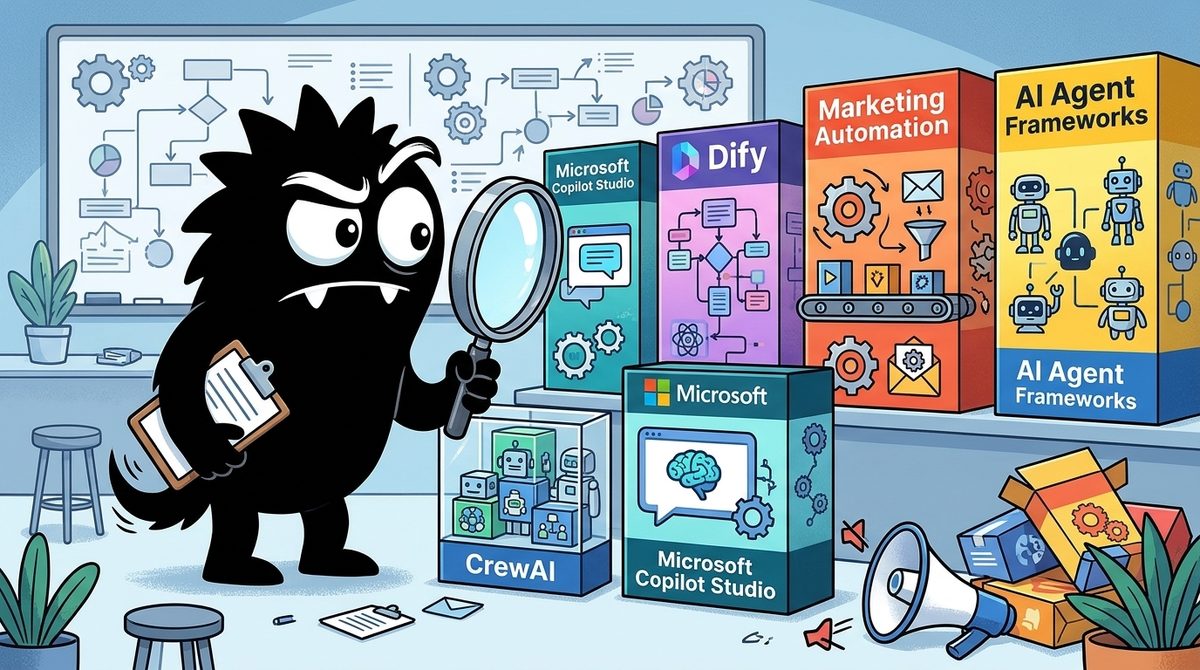
Short answer: If your marketing team has Python developers and wants custom multi-agent pipelines, pick CrewAI. If you're a lean team that needs content workflows, retrieval-augmented generation (RAG) over brand assets, and lead-scoring flows shipped fast without engineering, pick Dify. If you already run on Microsoft 365 and governance matters more than model flexibility, pick Copilot Studio.
The more important decision comes before any of those: deciding what to automate, and writing down the business rules behind it.
Bottom line (as of 2026):
- CrewAI: code-first, open-source, maximum control. Best for developer-led teams building research-and-write or competitive-intel crews.
- Dify: open-source visual builder with built-in RAG and auto-generated APIs. Best for fast, low-code content and campaign workflows.
- Copilot Studio: low-code, Microsoft-native, IT-governed persistent agents. Best for enterprises standardized on M365.
- The real bottleneck in all three: undocumented marketing logic (what counts as a "hot lead," an "on-brand" draft, a "campaign-ready" asset).
The Real Marketing Automation Problem Isn't the Model
Most people searching for this comparison want to know which platform will actually get a marketing agent into production. Practitioners on X keep reaching the same uncomfortable answer. The framework matters less than you think, and the model matters least of all.
CrewAI's creator João Moura has worked on deployments across large enterprises, and he opens with a warning rather than a feature list:
Most teams automate the wrong things.
I've seen CrewAI Flows and Agents automate systems for major companies out there including many Fortune 500 companies.
The result?
The Intelligent Automation Framework by CrewAI 🧵
A security practitioner building ticket-prioritization agents in Copilot Studio describes the other half of the problem:
Testing AI agents for SOC work. I built Copilot Studio agents to prioritize tickets, and the model was the easy part. The hard part was writing down what “high priority” really means. That logic lived in senior analysts’ heads.
#AI #SOC #Agentic #CyberSecurity
His example is a SOC, not a marketing department, but the lesson carries over directly. Replace "high priority ticket" with "marketing-qualified lead," "on-brand headline," or "campaign ready to launch." Each of those definitions usually lives in a senior marketer's head, not in a spec. Dify's own guidance for marketers makes a similar point. It treats reliable AI workflows as a design problem: break the work into explicit steps with defined inputs and outputs, rather than relying on one clever prompt[8].
Before comparing tools, then, decide which job you're automating. Lead scoring needs codified criteria. Content operations need brand rules and source material. Campaign QA needs checklists. Then judge each platform on three things:
- Control: how precisely can you shape agent behavior?
- Speed to production: how fast can a realistic team ship something that works?
- Governance: who knows the agent exists, who owns it, and what it can touch?
Why Do Enterprises End Up Running All Three? (And Why That's a Trap)
Teams that skip a deliberate choice often end up with every option at once. Lyzr AI described the pattern bluntly:
Ask a large enterprise which framework its agents run on. The honest answer is often “all of them.”
LangGraph in the data team. CrewAI in operations. Bedrock agents in a sandbox account on AWS.
A Copilot Studio bot someone in finance built on a Friday.
Each team picked what worked for them. That part is fine.
The trouble is underneath. Four frameworks, three clouds, and no shared list of which agents exist or who owns them.
Marketing is especially prone to this. A content lead tries Dify on a cloud trial. A growth engineer builds a CrewAI crew for competitor research. Someone in marketing ops spins up a Copilot Studio bot to answer campaign-brief questions. Each choice is reasonable on its own. Together they leave you with:
- no inventory of which agents touch customer data, CRM records, or brand assets;
- no single owner when an agent publishes something off-message;
- no shared logging, so you can't audit why a lead was scored a certain way.
A 2026 enterprise selection guide from China's developer community frames the agent market as a layered landscape: code frameworks, visual and low-code platforms, and vendor-native enterprise suites. It argues that teams should choose by organizational fit and governance needs, not by demo quality[3]. The three tools here map neatly onto those three layers. That is why the choice matters: each one bakes in a different answer to "who owns this agent?"
Use this comparison to pick on purpose. If you do run more than one, assign explicit ownership and a shared agent registry from the start.
CrewAI: Code-First Agent Teams for Full Control
What is CrewAI, in plain terms?
CrewAI is an open-source Python framework for building teams of AI agents. Each agent gets a role, a backstory, and tools. You assign it tasks with expected outputs and group agents into a crew that runs the tasks sequentially, hierarchically, or in custom patterns. Avi Chawla's walkthrough shows how short the path from zero to a working agent can be:
If you have NEVER built an Agent before, check this code.
It took me just 1 minute to build this Agent👇
I used CrewAI, an open-source framework to build production-ready agent systems.
The process is as follows:
• Specify the LLM to be used.
• Create an agent with a clear role, a backstory, and the tools it can access.
• Define a task for the agent with the expected output.
• Create a Crew by combining the agent and task.
• Run the Workflow.
Done!
Why CrewAI?
☑ Full control over Agent's roles and behaviors.
☑ Highly reliable architecture with robust error handling.
☑ Collaborative Intelligence to build seamless agent teamwork.
☑ Easy task management to define agentic tasks with high precision.
☑ Agent Orchestration with sequential, hierarchical, and custom workflows.
That mental model fits marketing well. A "Market Researcher" agent hands findings to a "Copywriter" agent, which hands drafts to an "Editor" agent with brand guidelines in its backstory. Matthew Berman highlighted the same research-and-writing strengths, plus an option enterprises with data-residency concerns care about:
CrewAI allows you to create incredible AI agent teams, similar to AutoGen.
It is simple and intuitive, allowing you to accomplish tasks like research, writing, stock analysis, and trip planning.
Plus, it can run entirely locally with open-source models.
Here is a step-by-step guide to use it:
Where CrewAI fits marketing automation
Comparisons from Helicone and others place CrewAI as the developer-centric choice. You get fine-grained control over agent behavior and orchestration, but you need coding skill to use it[1]. A 2026 framework roundup on Dev.to describes it the same way: approachable for multi-agent role-play patterns, but still a code framework[2]. Moura's emphasis on Flows matters for production. Flows give you deterministic, event-driven orchestration around the agents, so the unpredictable LLM steps sit inside a predictable pipeline.
Strong marketing fits:
- Competitive analysis crews that scrape, summarize, and compare positioning
- Research-to-draft content pipelines with an editorial review agent
- Custom lead-enrichment logic wired directly into your own data stack
Tradeoffs: You own everything: hosting, monitoring, UI, and integration glue. Non-technical marketers can't edit the workflow. The control is real, but so is the maintenance burden.
Dify: Visual Workflows That Kill the Glue Code
Why is Dify getting so much attention in 2026?
Dify is an open-source platform for building agentic workflows and RAG pipelines in a collaborative visual workspace[9]. Its momentum on X comes from a specific pain point: the pile of infrastructure you normally stitch together around an LLM. Hasan Toor's widely shared post makes the case:
DROP EVERYTHING.
This GitHub repo just hit 136K stars and it’s the fastest way to ship an AI app:
Dify helps you go from prototype to production without writing 1,000+ lines of glue code and using 6 other tools.
Here’s what it handles for you:
1. RAG pipelines:
Built-in hybrid search (BM25 + vector), chunking, and support for PDFs, Notion, DOCX, web scraping.
2. Agent orchestration:
Visually build ReAct-style workflows using tools, API calls, and logic blocks - no manual loops in Python.
3. Model routing:
Easily switch between GPT, Claude, or local models like Llama via Ollama/vLLM.
4. Auto-generated APIs:
Every saved workflow gets an auto-generated REST endpoint, ready to integrate.
5. LLMOps & monitoring:
Full tracing, latency, token usage, and annotation support - ready for production.
No more stitching together LangChain, FastAPI, vector DBs, and monitoring tools. Think of Dify as the missing infrastructure layer between your AI logic and a real product.
You can self-host it or use their cloud. 100% free to start.
The 136K-star figure in that post is a social proof point, not a quality guarantee. The architectural argument matters more. RAG, orchestration, model routing, APIs, and observability come in one deployable unit, and you can self-host it[9].
What Dify gives a marketing team
- Built-in RAG over your brand material. You can ingest PDFs, Notion pages, DOCX files, and scraped web content. Drafts then pull from real product docs and messaging guides instead of generic model knowledge.
- Visual workflows marketers can read. Dify's quick-start walks through building a working app in about 30 minutes[7]. A marketing ops lead can inspect the logic without reading Python.
- Reusable building blocks. Dify's workflow update added iteration, a parameter extractor, and the ability to publish a workflow as a tool[12]. In practice, a "brand voice check" workflow can become a tool that every content workflow calls. That is how tacit rules get encoded once and reused everywhere.
- Templates to start from. Community collections include workflow DSL files for SEO, deep research, translation, and automation[10]. Dify's marketer-focused blog walks through building reliable multi-step content workflows[8].
Tradeoffs: Visual builders hit a ceiling with highly custom logic. Self-hosting still means someone has to run infrastructure. Without discipline, Dify can become the easy-to-spin-up sprawl source Lyzr warned about.
Microsoft Copilot Studio: Persistent Agents Inside the Enterprise
What changed in Copilot Studio in 2026?
Copilot Studio is Microsoft's low-code agent builder. It is tightly integrated with Microsoft 365, Teams, and the Power Platform[5]. Its biggest recent shift is persistent agents, which Microsoft's Jeff Teper announced as a preview:
Today we’re taking another step toward our vision of an agent for every person and every process.
Last month, we started rolling out Autopilot. Today, Copilot Studio is taking the next step with persistent agents in Microsoft 365. This means each agent can have its own account, so people can email it, add it to a Teams chat or channel or mention it in Word, Excel or PowerPoint. Business process memory carries all the teamwork and context forward in the next cycles all while IT stays in control.
The first capabilities begin rolling out in preview today, with more planned.
For marketing, this changes how people interact with the agent. A "Campaign Brief Agent" with its own account can be emailed, added to the campaign channel in Teams, or @-mentioned inside the PowerPoint deck it's reviewing. Business process memory means it carries context across campaign cycles rather than starting cold each time. The repeated phrase in that announcement is "IT stays in control." That is the core value proposition. Note that these capabilities were in preview at announcement, so check current availability before you plan around them.
Who actually builds with it?
People inside business functions, not just developers. Kanika Tolver's list reflects how Copilot Studio tends to spread through an organization, one practical internal agent at a time:
AI agents I built using Microsoft Copilot Agent Builder and Copilot Studio:
Copilot Adoption Coach Agent
Software Packaging Intake Agent
Installation Guide Agent
HR Support Agent
ITSM Support Agent
Welcome to the @MSFTCopilot family lol.
Microsoft's own collection of adoption stories reinforces this pattern of internal, process-focused agents[13]. Marketing-specific playbooks describe uses like campaign intake, content repurposing grounded in SharePoint assets, and sales-enablement Q&A for B2B teams[14][15].
Strong marketing fits: brief intake, internal knowledge Q&A over brand and product docs, approval routing, and sales enablement, all inside tools your team already uses.
Tradeoffs: You're bound to the Microsoft ecosystem. Model and hosting flexibility is narrower than with the open-source options. Licensing follows Microsoft's commercial model rather than free self-hosting[4]. Japanese-language comparisons of Copilot Studio against other services draw the same contrast: strong M365 integration and governance, less freedom outside it[5].
Head-to-Head: How Do CrewAI, Dify, and Copilot Studio Compare on Pricing, Learning Curve, and Governance?
| Dimension | CrewAI | Dify | Copilot Studio |
|---|---|---|---|
| **Approach** | Code-first Python framework | Open-source visual/low-code platform | Low-code, Microsoft-native |
| **Learning curve** | Requires Python; steepest for marketers | Visual; accessible to technical marketers | Low-code; easiest for M365 users |
| **Hosting** | Self-run; can use local models | Self-host or cloud | Microsoft cloud |
| **Pricing model** | Open-source framework (your infra costs) | Open-source, free to start; cloud plans available | Microsoft licensing |
| **RAG** | Build or integrate yourself | Built in (hybrid search, multi-source ingestion) | Grounding via M365/SharePoint data |
| **Model flexibility** | Highest | High (GPT, Claude, local via Ollama/vLLM) | Narrower, Microsoft-mediated |
| **Governance** | Whatever you build | Platform-level tracing and logs; self-managed | Enterprise IT controls built in |
| **Best marketing use** | Custom research/content crews | Content ops, SEO, RAG-driven workflows | Internal agents in Teams/Office |
A few points the table can't show:
CrewAI vs. Dify is really a question of who maintains the workflow. Both Helicone's and xpay's 2026 comparisons frame the split the same way. CrewAI wins on programmatic control and complex agent collaboration. Dify wins on speed, visual development, and built-in infrastructure[1][6]. If marketers need to edit prompts and logic themselves, Dify's visual model removes a dependency on engineering. If the logic is complex and changes through code review, CrewAI's code-first approach is an asset.
Dify vs. Copilot Studio is a question of ecosystem. SourceForge's side-by-side contrasts Dify's open, self-hostable, model-agnostic platform with Copilot Studio's integrated Microsoft offering[4]. If your content, approvals, and conversations already live in SharePoint and Teams, Copilot Studio's integration advantage is hard to beat.
Governance answers the sprawl problem differently. Copilot Studio centralizes control by default. Agents are identities that IT can see. Dify gives you a platform where agents and logs live in one place, but you have to manage it. CrewAI gives you nothing by default. Governance is whatever your engineering team builds, which can be excellent or nonexistent. The Dev.to 2026 roundup's broader advice applies here: match framework choice to team skills and operational maturity, not feature checklists[2].
Who Should Use What: A Practical Recommendation for 2026
Choose CrewAI if:
- your marketing team includes, or is closely paired with, Python developers;
- you're building custom multi-agent pipelines such as competitive intelligence, research-to-draft content, or bespoke enrichment;
- you need local or open-source models for cost or data-control reasons;
- you're willing to own hosting, monitoring, and governance[2][6].
Choose Dify if:
- you're a lean team that needs to ship content, SEO, or RAG-backed workflows in days, not quarters;
- marketers need to read and edit workflow logic without filing engineering tickets;
- you want open-source and self-hosting without assembling a full LLM stack yourself;
- you want reusable "workflow as a tool" components for brand rules and QA checks[6][12].
Choose Copilot Studio if:
- your organization runs on Microsoft 365 and your marketers live in Teams, Outlook, and PowerPoint;
- compliance, IT visibility, and adoption matter more than model flexibility;
- your highest-value agents are internal, such as brief intake, asset Q&A, and approvals, rather than customer-facing generation pipelines[3].
If you're an enterprise already running more than one: don't rip anything out. Do assign a named owner to every agent, keep a single registry, and standardize logging. A sensible split many teams could adopt: Copilot Studio for internal, governed workflows; Dify or CrewAI for specialized content pipelines with clear ownership.
Whatever you choose, do this first: write down the logic. Define what makes a lead qualified, a draft on-brand, and a campaign launch-ready, in enough detail that a new hire could apply it. Zdk's point applies directly: the model is the easy part. The platform that wins for your team is the one that makes your documented logic easiest to encode, test, and govern. None of them can document the logic for you.
Sources
[1] Helicone — Comparing CrewAI vs. Dify: Which is the Best AI Agent Framework? https://www.helicone.ai/blog/crewai-vs-dify-ai
[2] Dev.to (agdex_ai) — LangChain vs CrewAI vs AutoGen vs Dify: The Complete AI Agent Framework Comparison [2026]. https://dev.to/agdex_ai/langchain-vs-crewai-vs-autogen-vs-dify-the-complete-ai-agent-framework-comparison-2026-4j8j
[3] Juejin — 企业级 Agent 开发,2026 年到底用什么?工具格局和选型方法一篇讲清 (Enterprise agent development in 2026: tool landscape and selection method). https://juejin.cn/post/7698533148759408681
[4] SourceForge — Dify vs. Microsoft Copilot Studio Comparison. https://sourceforge.net/software/compare/Dify-vs-Microsoft-Copilot-Studio/
[5] TDSE — 【2026年最新】Copilot Studioとは?機能や活用シーン、他サービスとの比較も解説 (What is Copilot Studio? Features, use cases, and comparisons, 2026). https://dify.tdse.jp/post_column/495/
[6] xpay — CrewAI vs Dify: Which Should You Choose? (2026 Comparison). https://www.xpay.sh/resources/agentic-frameworks/compare/crewai-vs-dify/
[7] Dify Docs — 30-Minute Quick Start. https://docs.dify.ai/en/quick-start
[8] Dify Blog — How Marketer Builds Reliable AI Workflows. https://dify.ai/blog/how-marketer-builds-reliable-ai-workflows
[9] GitHub — langgenius/dify. https://github.com/langgenius/dify
[10] GitHub — aircrushin/awesome-dify-workflow. https://github.com/aircrushin/awesome-dify-workflow
[12] Dify Blog — Workflow Major Update: Iteration, Parameter Extractor and Publish Workflow as a Tool. https://dify.ai/blog/dify-ai-blog-workflow-major-update-workflows-as-tools
[13] Microsoft Learn — Copilot Studio real-world transformation stories. https://learn.microsoft.com/en-us/microsoft-copilot-studio/guidance/adoption-case-studies
[14] Alienroad — Microsoft Copilot Studio for Marketers: What It Does and Where It Fits. https://alienroad.com/microsoft-copilot-studio-for-marketers-what-it-does-and-where-it-fits/
[15] Alienroad — Microsoft Copilot Studio for B2B Marketing Teams: A Working Playbook. https://alienroad.com/microsoft-copilot-studio-for-b2b-marketing-teams-a-working-playbook/
References (15 sources)
- Comparing CrewAI vs. Dify - Which is the Best AI Agent Framework? - helicone.ai
- LangChain vs CrewAI vs AutoGen vs Dify: The Complete AI Agent Framework Comparison [2026] - dev.to
- 企业级 Agent 开发,2026 年到底用什么?工具格局和选型方法一篇讲清 - juejin.cn
- Dify vs. Microsoft Copilot Studio Comparison - sourceforge.net
- 【2026年最新】Copilot Studioとは?機能や活用シーン、他サービスとの比較も解説 - dify.tdse.jp
- CrewAI vs Dify: Which Should You Choose? (2026 Comparison) - xpay.sh
- 30-Minute Quick Start - Dify Docs - docs.dify.ai
- How Marketer Builds Reliable AI Workflows - Dify - dify.ai
- GitHub - langgenius/dify: Build Agentic workflows, RAG pipelines, with rich AI model and tool support on one collaborative workspace. - github.com
- GitHub - aircrushin/awesome-dify-workflow: Curated Dify workflow DSL files and templates for RAG, agents, search, translation, deep research, SEO and automation. - github.com
- 【2025年版】Dify Workflow完全ガイド|ノーコードで業務自動化する始め方・事例・他ツール比較 - Saiteki AI - saiteki-ai.com
- Workflow Major Update: Iteration, Parameter Extractor and Publish Workflow as a Tool - Dify - dify.ai
- Copilot Studio real-world transformation stories - Microsoft Copilot Studio | Microsoft Learn - learn.microsoft.com
- Microsoft Copilot Studio for Marketers: What It Does and Where It Fits - alienroad.com
- Microsoft Copilot Studio for B2B Marketing Teams: A Working Playbook - alienroad.com
Related Guides
The Best AI Model Tools in 2026: What $3.4M in Polymarket Bets Reveals About the AI Arms Race
20 min read
Make vs Botpress vs OpenAI Assistants API: Which Is Best for Customer Support Automation in 2026?
15 min read
The AI Bubble Prediction Market in 2026: What Traders Pricing 9% Odds Really Means
21 min read
Deno Deploy vs Webflow: Which Is Best for AI-Powered Content Creation in 2026?
15 min read