Tabnine vs GitHub Copilot vs Replit: Which Is Best for Marketing Automation in 2026?Updated: September 27, 2026
Tabnine vs GitHub Copilot vs Replit for marketing automation: compare workflows, pricing, security, and fit for teams and solo builders. Learn
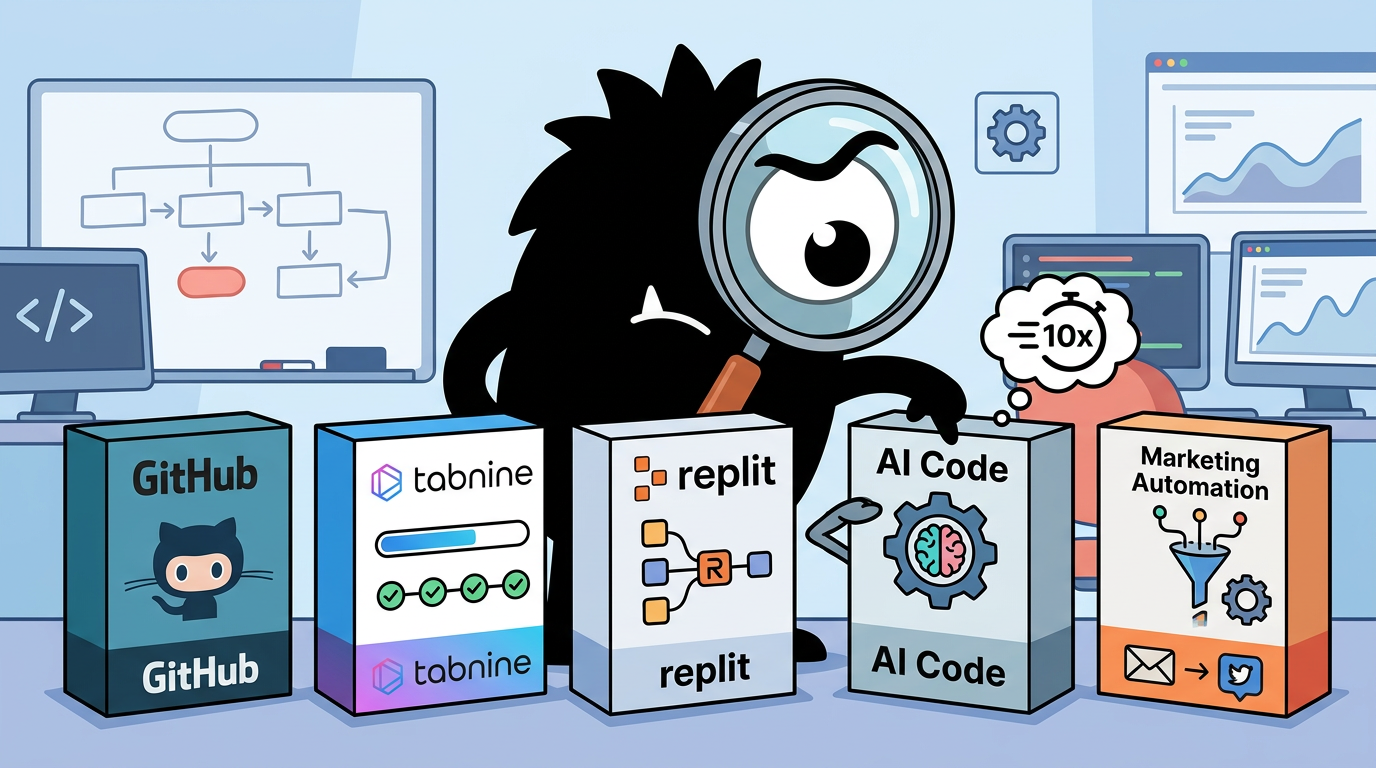
Why Marketers Are Comparing Coding Platforms, Not Just Coding Assistants
Marketing automation used to mean buying another SaaS tool: email sequencing, CRM sync, attribution dashboards, lead scoring, landing page builders. In 2026, the conversation is shifting. Teams increasingly ask a different question: should we just build the workflow ourselves?
That’s why Tabnine, GitHub Copilot, and Replit are showing up in the same discussion even though they are not the same product category. The old frame was AI autocomplete. The new frame is end-to-end execution: can a marketer, growth operator, or small product team go from idea to working automation without waiting on engineering?
Replit CEO Amjad Masad: "Code is almost fully automated."
"We have an automated software engineer that is as good as a mid-level software engineer. It would get a job at Facebook or Google."
"Even professional software engineers are not coding anymore."
"If you're a product builder, all you have to care about is who the customer is."
"What do you understand about the world that other people don't? And can you put that into an app?"
@amasad with @jackhneel
That pitch resonates because the practical use cases are real: lead routing scripts, enrichment pipelines, campaign reporting dashboards, microsites, CRM integrations, content ops tools, and internal AI agents for research or copy generation. Replit in particular has become part of the marketing-ops conversation because it lowers environment setup friction for non-engineers and semi-technical builders.[11][12]
We just saw a massive acceleration in Replit's mission.
We've always talked about how anyone can code, but the data never really reflected that... until now.
When companies started adopting Repit, we found that 50% of users are NOT “engineers.” So what are they doing with it?
We saw:
- Marketing teams build competitive analysis tools
- Finance writes complex data analysis scripts
- Designers bring prototypes to life
- Sales engineers rapidly solving customer problems
- Product Managers shipping *production* software!
I can't think of a single knowledge work department that is not represented in the data.
So how did this happen?
Since ChatGPT came out, many technical people have brushed up on their coding skills. With Replit Teams, they have found that they can ditch a hodgepodge of tools in favor of good ol' software code that AI is so good at generating.
Product and Design teams at companies like SkillsEngine are transforming from traditional no-code departments into a prolific teams that can write and ship code.
This is saving them thousands of dollars in both software and contractor hours. It's also that much more fun and gratifying to build things yourself.
Read more about SkillsEngine + Replit: https://t.co/KSoKYTEwMl
We're finally fully in the era of democratized coding, one that we've been dreaming about for years, a huge milestone towards our mission of empowering a million software creators.
Replit Teams Launch:
But these tools solve different layers of the problem:
- Tabnine helps you write code faster inside your existing development environment.
- GitHub Copilot helps you write, modify, and increasingly manage code in repository-driven workflows.
- Replit helps you generate, run, deploy, and iterate on apps in one browser-based environment.
That distinction matters. If your goal is “automate a weekly CSV cleanup,” one tool may be enough. If your goal is “ship a lead-scoring dashboard with auth, database, and deployment,” the winner changes quickly.
Goal First: How Tabnine, GitHub Copilot, and Replit Tackle Marketing Automation Differently
The smartest way to compare these products is not feature-by-feature. It’s by asking: where in the workflow do they help, and what do they assume about the user?
Tabnine: AI assistance without changing your stack
Tabnine remains relevant because it fits teams that do not want a new platform. It lives inside established IDEs, supports multiple languages and environments, and positions itself around secure, enterprise-friendly AI development.[4][5] If your marketing automation already lives in Python scripts, internal Node services, or data tooling maintained by engineers, Tabnine is a productivity layer, not a workflow replacement.
That makes it appealing for teams with existing deployment pipelines, code review practices, and infrastructure. The value proposition is straightforward: faster coding, lower disruption, tighter privacy controls.
GitHub Copilot: from autocomplete to repo-native execution
Copilot is no longer just “ghost text in VS Code.” The center of gravity has moved toward GitHub-native work: generating changes from issues, proposing implementation plans, and participating in pull-request workflows.[7]
We build GitHub on GitHub. 🛠️
We use the same tools we ship to you, including GitHub Copilot. It's evolved beyond just autocomplete. Inside our core repo, it’s now an active contributor that:
🤖 Gets assigned issues
📂 Opens pull requests
⚡️ Tackles tedious tasks
Here's how it works. ⬇️
https://t.co/qv38j02hMq
That’s a big deal for marketing automation inside engineering-led companies. If your growth systems already live in GitHub repos—customer lifecycle jobs, product-led growth experiments, API integrations, internal admin tools—Copilot fits the place where work already happens.
I got access to Copilot Workspace.
If Devin were a beer, Copilot Workspace would be more like a refined wine that people with good taste would appreciate.
My first impressions are very positive—like, "Holly Molly, this is cool!" positive. Of course, I still need more time to test it.
GitHub is using its unfair advantage very effectively: the tool is fully integrated with GitHub. You can generate code directly in a repository, solve a reported issue, and test it without leaving the interface.
But the best part is the approach:
Ask Copilot something, and it will generate a specification for you. You can read it and make changes to it if you want to.
Once you approve the specification, Copilot will generate a plan. It's a bullet list telling you what it will do on every repo file. Again, you can add things to the plan or correct any mistakes.
After you approve the plan, Copilot will start writing the code and making the changes.
The approach here is very different:
GitHub is not positioning Copilot as a hostile tool for developers. They ain't trying to get anybody's job. Instead, they are positioning the tool as an aid to developers.
Big difference. I like it.
I'll record a video to show you how this works. Subscribe to my YouTube channel if you don't want to miss it.
The key advantage is workflow continuity. Requirements, tickets, code, review, and merge all stay close together. For experienced developers, that is more valuable than flashy demos.
Replit: prompt-to-app with runtime and deployment included
Replit’s appeal is different. It’s not primarily an IDE enhancement; it’s a build environment with AI layered into it. It gives users a browser-based workspace, runtime, hosting, database options, deployment, and agentic app-building flows in one place.[3][4]
The reason @Replit is positioned to win the general purpose prompt-to-app race is because “just generating code” is not the hard part anymore as we can see. The hard part is all of the supporting infra you need to make “real things” reliable, fast, and scalable: deployments, rollbacks, built in git-backed versioning, tight db integration, support for a variety of runtimes + languages, and giving your agent access to an actual container + shell + file editing and search. And this is everything Replit has worked on for YEARS before the agent was actually developed.
While consumers don’t need to know any of this happening under the hood, it’s all necessary to make sure people can actually take their ideas out of prototype mode. Of course other companies are working towards that too, but everyone is basically playing infra catchup. Many other cos are also deliberately scoping down the kinds of apps people can make, which is fine, but aren’t always clear about the boundaries of what they can / can’t do.
I think what’s way more compelling is other cos leaning into their platform + user base strengths and offering vertical agents, which I hope Canva does
That’s why marketers keep talking about it. Replit can collapse multiple steps that normally block non-engineers:
- local environment setup
- package installation
- server/runtime configuration
- previewing and testing
- deployment
- basic versioning
This doesn’t make software easy. It makes the first mile and the last mile much less painful.
Best Tool by Use Case: Landing Pages, Integrations, Internal Tools, and AI Marketing Agents
Different marketing automation jobs demand different levels of control.
Best for fast landing pages and marketing prototypes: Replit
If you need a new marketing site, campaign microsite, gated tool, or internal dashboard by the end of the day, Replit is the most direct path. The reason is simple: it handles more of the surrounding work than a coding assistant alone.
Me today with strong CMO at $40m ARR company: "I built you a new marketing site in @Replit. I just had 20 minutes during a board meeting, what do you think."
CMO: "Woah. That's a lot better than we have today. How did you do it?"
Me: "I vibe'd it in @Replit. First I analyzed everything strong about your competitors' sites in Claude. Then I took that output and gave it to Replit and told it to remake your site using that, and the top 5 reasons customers buy from your #1 competitor."
CMO: "Wow. Do you have the number for this Replit guy? It took how long?"
Me: "There's no 'guy'. I vibe'd it myself during the boring parts of a board meeting. Your board meeting. I had about 15 minutes."
(True story)
That story sounds exaggerated until you look at how marketers are actually using AI coding tools. Replit has become especially attractive for people who want to build lightweight web apps without stitching together hosting, repos, CI, and local dev setup.[11][12]
This is also why it’s being used for autonomous marketing experiments, not just websites.
Just submitted UpReach to the @Replit Buildathon! UpReach is an autonomous AI marketing platform that helps founders launch and scale products without marketing expertise. It uses specialized agents to design strategies, create assets, and distribute content. #ReplitBuildathon
View on XFor marketers and growth generalists, Replit is best when you need:
- quick landing pages
- campaign dashboards
- lightweight internal tools
- scraper-and-enrichment apps
- AI wrappers around marketing workflows
Best for extending production code and APIs: GitHub Copilot
If your automation is part of a larger production system—say Salesforce sync logic, event ingestion, lead qualification APIs, or a reporting service inside an existing application—Copilot is the better fit.
It works best when:
- there is already a repo
- engineering review matters
- issues and pull requests are the system of record
- code quality, testing, and maintainability matter more than speed-to-demo
Copilot is particularly strong for developers who need assistance while staying in a mature software lifecycle. It accelerates implementation, but doesn’t ask the team to move platforms.[6]
Best for established teams that just want faster coding: Tabnine
Tabnine is the least dramatic option, but that’s often the point. If your marketing automation lives in scripts and services maintained across multiple IDEs and developer setups, Tabnine offers broad language and editor support with minimal process upheaval.[1][4]
That’s valuable for teams that don’t need prompt-to-app magic. They just need engineers, analysts, or ops developers to move faster.
Stop using Make or Zapier
You can use Replit to create and deploy any Python script instead.
- It's faster
- Much more flexible
- Lower cost
- You're in control
Just describe what you want the Agent to do (e.g. scrap a website).
Run and deploy in one click with Replit 🧵
The post above overstates the “stop using Zapier” case for many companies; SaaS automation tools still matter for reliability and accessibility. But it captures a real shift: once AI can help generate and deploy Python or JavaScript quickly, custom automation starts to look cheaper and more flexible than chaining no-code actions together.
Where the Real Work Happens: Deployment, Debugging, Versioning, and Reliability
This is where most comparisons get lazy. Writing code is no longer the hard part. Shipping dependable automation is.
A marketing automation tool is only useful if it actually runs: on schedule, with credentials, against real APIs, with logs, error handling, rollback paths, and some kind of version control.
Replit’s strength: the build-test-deploy loop in one place
Replit’s biggest advantage is not raw code generation quality. It’s that you can go from prompt to running app without leaving the environment. Pricing pages and comparisons only tell part of the story; the real practitioner advantage is the integrated loop of generation, testing, preview, deployment, and iteration.[3][7]
BREAKING: Built 3 MVPs this week.
Not because I'm superhuman.
Because Replit's AI Agent handles:
→ Code generation
→ Debugging
→ Deployment
→ Database setup
All from natural language prompts.
This is the 10x developer multiplier everyone's been looking for
And it all runs in your BROWSER.
The future arrived quietly.
Dive in here: https://replit.completed
haha, i used @openai operator build, deploy, and open source a tool on github using @replit agent.
took about 30 min, here's an ~8 min supercut video
thoughts:
- while working with replit agent, it actually deployed the app, tested it, and described the error back to replit agent for me
- operator asked me a few more Qs than i wanted, but it was mostly for safety (eg filling forms) so i guess okay with it
- it had trouble with a few things around UI like knowing it needs to scroll a page to see the rest of it, and it needed pointers to find the git feature in replit
- once it found the git feature it didn't need my assistance to create a repo and open source after having the agent write a readme
while a bit slower, this was even more automated than replit agent (especially testing features and working through errors) - which is impressive
would be nice to have: push notifications for when it needs my attention, and voice mode capabilities
That matters disproportionately for marketing teams because they often lack dedicated infrastructure support. A growth lead can tolerate imperfect code faster than they can tolerate spending half a day configuring hosting and dependencies.
GitHub Copilot’s strength: issue-to-PR workflows
Copilot’s operational advantage appears when your team already works through tickets, branches, and review. It’s becoming part of the implementation pipeline, not just the typing experience.
Now available for deployment:
GitHub Copilot agent
Assign any issue to GitHub Copilot and the agent will start working on an implementation, using the full issue context. When the work is ready, the issue is updated automatically with a draft PR.
That makes Copilot especially strong for repeatable marketing engineering work:
- adding a new CRM integration
- modifying attribution logic
- updating scoring rules
- building internal tooling in an established monorepo
- fixing broken automations with issue context preserved
It can be slower to start than Replit, but stronger for teams that care about auditability and maintainable change management.
Tabnine’s role: productivity inside existing delivery pipelines
Tabnine doesn’t win on deployment because deployment isn’t really its job. Its value is highest when your organization already has:
- a preferred IDE stack
- existing repos and CI/CD
- cloud or on-prem deployment standards
- human review and governance
In that context, Tabnine can improve throughput without introducing a new app platform or agent workflow.[4][6] For enterprises, that restraint is a feature, not a weakness.
Pricing, Usage Limits, and Total Cost for Marketing Teams
For teams deciding between “AI help” and “AI-built app platform,” pricing becomes practical very quickly.
AI coding assistants compared:
1. GitHub Copilot: $10/mo, best for VS Code users
2. Cursor: $20/mo, full IDE with AI built-in
3. Tabnine: free tier available, supports many languages
4. Codeium: completely free
Which one do you use? Poll below 👇
Tabnine: predictable seat-based pricing
Tabnine offers a free tier and paid plans, with enterprise options aimed at organizations that need more governance and deployment flexibility.[1] For teams that mostly want AI assistance inside the IDE, this is relatively easy to budget: per-user software spend rather than variable runtime or agent usage.
GitHub Copilot: straightforward for individuals, more nuanced for teams
GitHub Copilot offers individual, business, and enterprise plans, with plan differences tied to policy controls, model access, and organization-level management.[2][7] That makes it easy for engineering-led marketing teams to standardize if GitHub is already central to development.
In practice, Copilot is often the cleanest cost model when the question is: how do we make existing developers faster?
Replit: more leverage, but potentially more variable cost
Replit combines subscription access with platform usage considerations—particularly when you’re using hosted environments, deployments, or heavier AI-assisted workflows.[3] That means it can be astonishingly cost-effective for prototypes and lightweight apps, but less predictable if your team starts running many production workloads or repeatedly invoking agentic flows.
I hear you. I debated throwing in the analogy or not ;)
But I’m in the top 0.1% of Replit and have shipped apps there used 1,200,000+ times including an AI VP Marketing and AI VP Customer Success so I have a lot of experience at least
You know when the agent’s performance isn’t what you expected. You know. And you know what is sort of OK and where you feel like you were charged for something you shouldn’t have.
It’s fine to ask your customers and just not charge them 10% of the time when they real ask not to be charged.
And whatever that number is, it should go down over time.
It’s just one example, but 8 months about maybe 30% of what the ai agent did on Replit maybe I wouldn’t have wanted to pay for. Today it’s almost 0%. It’s so close to 0% I wouldn’t even click on a link.
That post captures the real tension. Replit can replace several tools at once, which can save money. But when agent quality is inconsistent, usage-based charging feels more personal than a flat software seat. Buyers should model both the upside and the frustration tax.
Security and Privacy: Which Platform Fits Sensitive Marketing Data and Internal Workflows?
Marketing automation is not just about copy and landing pages. It often touches proprietary audience logic, campaign performance data, CRM records, lead scores, customer lists, and internal experimentation code.
Tabnine has the clearest privacy-oriented enterprise story
Tabnine’s continued relevance comes from exactly this concern. Its security documentation and enterprise positioning emphasize protected development workflows and controlled environments.[9] For organizations worried about proprietary code or sensitive internal logic, Tabnine is often easier to approve because it fits existing governance patterns.
10. tabby
→ replaces GitHub Copilot ($10/mo)
self-hosted AI coding assistant. runs on your own GPU or CPU
VS Code, JetBrains, Vim, Emacs. CodeLlama, DeepSeek Coder
your proprietary code never touches Microsoft's servers
★ 25,000+ stars
★ https://github.com/TabbyML/tabby
The tweet mentions Tabby, not Tabnine, but it reflects the same live buyer concern: teams increasingly care whether coding assistance can stay closer to their own infrastructure.
GitHub Copilot benefits from enterprise trust inside GitHub
Copilot’s trust story is strongest for companies already standardized on GitHub. GitHub provides trust-center and compliance information aimed at enterprise buyers, and Copilot benefits from living inside an ecosystem many engineering orgs already govern tightly.[8]
That doesn’t remove the need for review. If marketers plan to build workflows touching customer data, procurement and security teams still need to examine tenant controls, prompt handling, repository permissions, and integration boundaries.
Replit requires the most careful workload-by-workload evaluation
Replit publishes security information and offers a legitimate platform for building and hosting applications.[10] But because it is more than an assistant—it is also a runtime and deployment surface—teams should assess it differently.
Questions marketers should ask before building customer-data workflows in Replit:
- Where will secrets live?
- What data will be stored or processed?
- Who can access the project workspace?
- What happens when the app needs audit logs, role-based access, or vendor review?
- Is this a prototype, an internal tool, or a production system touching regulated data?
For many internal automations, Replit is fine. For sensitive customer workflows, scrutiny should increase.
Learning Curve: Which Tool Helps Beginners, and Which Rewards Experienced Builders?
The social-media version of AI coding is “describe it in English, get a working app.” Reality is messier.
Replit lowers setup friction, not skill requirements
Replit is genuinely more accessible for non-engineers because it removes local setup pain and bundles deployment.[12] But that does not mean beginners can safely recover from broken agent steps, dependency conflicts, or logic errors.
Been using @Replit agent more
Thoughts:
Yay it works on mobile!
I like the cards UI
that’s gonna get copied for sure
Very powerful. Big skill curve.
The ability to install packages, preview & reflect on screenshots do deploy & env steps is huge.
Multi step planner & “ask user for secrets” and more info popups, are all neat flows, though I’m not convinced, and can get awkward. Like once it asks for keys I can’t say “nvm just use placeholders for now”, and asking for changes to the plan don’t seem to work?? Some improvements & smoothing to the flow can be done here as it improves past alpha
Problems:
Still insanely technical
No beginners here.
Flies too close to the sun
It’s doing a lot. Too many steps at once imo
If it messes up (which it does sometimes)
Good fucking luck
You are doomed
Especially with little coding experience
Seen a few mixed reviews and they all come back to this:
people get stuck after an error with no fix, or a way to regenerate or rollback state
I think Replit (and Devin too) also are going down this route of trying to do large large chunks of software work in big steps. Autonomy! Which is cool. But idk if it’s a good flow, cuz doing 20 steps means you need to get them all right
One wrong step and now you need to debug EVERYTHING
As opposed to something inline which has lower costs for getting it wrong. It’s not a big deal, Because you know what part messed up , and Cmd+z to undo, and can fix it easily
Smaller quick chunks seem to work better than long big chunks for this UX
But overall very cool. Still kinda jank, it’s an alpha after all. But very promising! Excited to keep playing with it!
That is the most honest critique in the current conversation. Replit reduces friction at the start, but can become punishing when something goes wrong and the user lacks debugging instincts.
Copilot is easiest for people already fluent in development workflows
Copilot tends to reward users who already understand files, repos, issues, tests, and pull requests.[7] Its suggestions make more sense when you know how to inspect and correct them. For marketers who already live in VS Code or partner closely with engineering, Copilot can feel natural quickly.
Tabnine is the least disruptive adoption path
If your team already codes, Tabnine may be the easiest rollout simply because it changes the least. It layers AI into familiar workflows instead of asking users to adopt an agent-centric environment.
When taking coding interviews, I use @Replit which has AI assist (exactly like Github Copilot)
I never turn it off for the candidate. I let them keep it on.
Most amusingly, more 50% of them turn it off or ask me how to disable it because they find the suggestions confusing or irritating. And it is not a problem with the quality of suggestion, mostly it is just a problem of the person no familiar with the Copilot workflow (where you take the suggestion and still have to make minor tweaks/fixes after it)
I think more people should start using Copilot. Adapt to new tools the world is giving you, don't stay behind in last century. Copilot is a huge productivity boost. Don't be someone who gets left behind because you are unable to leverage modern tools.
That tweet is about AI coding assistance broadly, but the takeaway is right: many people are not blocked by model quality. They are blocked by workflow adaptation. Tools that demand less behavioral change often get adopted faster.
Who Should Use Tabnine, GitHub Copilot, or Replit for Marketing Automation?
There is no universal winner here. The right choice depends on whether your problem is speed of coding, speed of shipping, or control over production workflows.
Choose Replit if you want marketers and ops generalists to ship quickly
Replit is the best fit for:
- marketers building campaign tools themselves
- founders shipping prototypes without waiting on engineering
- growth and revops teams creating internal dashboards or microsites
- teams replacing brittle no-code automations with lightweight custom apps
Its killer advantage is not that it writes better code than everyone else. It’s that it bundles the rest of the job.
If your priority is “I need a working landing page, dashboard, or automation this afternoon,” Replit is the strongest option.
Choose GitHub Copilot if marketing automation is engineering-led
Copilot is the best fit for:
- developer-owned marketing systems
- existing codebases and internal services
- teams working from issues, branches, and pull requests
- organizations that care about maintainability and review discipline
Four years ago I got hired into a team that only wrote Go. They gave me a blueprint for a service and said hey our old principal engineer wrote this what do you think.
From a systems design perspective it was a bit much so I nixed several Kafka topics, did a git init and...wrote the entire service in a week or so thanks to GitHub Copilot.
Today I can do that in less than an hour and it'll be much better than what's still out there.
That is the Copilot story in one post: massive leverage for people who already know how to shape software. When marketing automation is part of production software, Copilot usually beats Replit on governance and continuity.
Choose Tabnine if privacy, IDE flexibility, and minimal disruption matter most
Tabnine is the best fit for:
- enterprises with strict internal controls
- teams spread across multiple IDEs
- organizations that want AI assistance without changing platforms
- engineers supporting marketing automation inside existing workflows
As Copilot is becoming generally available, this might be a good time to write a comprehensive comparison between the two leading AI assistants for software development - @Tabnine_ and Copilot by Microsoft.
View on XThat comparison question is still relevant because Tabnine occupies a distinct lane. It is not trying to be the whole app-building platform. It is trying to make current coding workflows safer and faster.
The blunt recommendation
If you want the shortest answer:
- Best for non-technical or semi-technical marketing builders: Replit
- Best for software teams building marketing automation in production repos: GitHub Copilot
- Best for privacy-sensitive enterprises that want AI coding help without platform change: Tabnine
And one more nuance matters.
I think @Replit is one of the very few companies that has an edge over GitHub copilot on training extremely good coding model.
Because Replit *owns* the editor. Every cursor movement is a learning signal. The feedback is contextual and far richer than simple preference ranking.
Replit’s upside is highest when the person using it has strong product sense and enough technical judgment to steer the system. Copilot’s upside is highest when a disciplined engineering workflow already exists. Tabnine’s upside is highest when organizations value control and compatibility more than AI spectacle.
For marketing automation in 2026, the differentiator is no longer who autocompletes code best. It’s who helps you get from idea to reliable outcome with the least friction for your actual team.
Sources
[1] Plans & Pricing | Tabnine: The AI code assistant that you ...
[2] Choosing your enterprise's plan for GitHub Copilot
[3] Pricing
[4] Tabnine vs Replit vs GitHub Copilot
[6] GitHub Copilot vs TabNine vs Replit Ghostwriter
[7] GitHub Copilot · Plans & pricing
[8] GitHub Copilot Trust Center
[9] Security
[10] Security
[11] 15 Best AI Coding Tools for Marketers & Vibe Coders (2026)
[12] What is Replit, and how can marketing and marketing ops pros use it?
References (15 sources)
- Plans & Pricing | Tabnine: The AI code assistant that you ... - tabnine.com
- Choosing your enterprise's plan for GitHub Copilot - docs.github.com
- Pricing - replit.com
- Tabnine vs Replit vs GitHub Copilot - postmake.io
- Tabnine vs GitHub Copilot - tabnine.com
- GitHub Copilot vs TabNine vs Replit Ghostwriter - tooliphy.com
- GitHub Copilot · Plans & pricing - github.com
- GitHub Copilot Trust Center - copilot.github.trust.page
- Security - docs.tabnine.com
- Security - docs.replit.com
- 15 Best AI Coding Tools for Marketers & Vibe Coders (2026) - youngurbanproject.com
- What is Replit, and how can marketing and marketing ops pros use it? - martech.org
- AI in Marketing: Tools and Use Cases | Microsoft Copilot - microsoft.com
- 11 Best Email Marketing Tools for GitHub Copilot Projects - sequenzy.com
- 8 Best AI Coding Assistants [Updated April 2026] - augmentcode.com
Related Guides

Aider vs Cline: Which Is Best for AI Pair Programming in 2026?
15 min read
The Best AI Model Tools in 2026: An Expert Comparison Through a $4M Polymarket Bet
25 min read
What Is Replit? A Complete Guide for 2026
19 min read
Traders Are Betting on Anthropic: What Polymarket's 99% AI Model Odds Reveal for Developers in 2026
20 min read