The Best AI Bubble Signals in 2026: What Polymarket's 10% Odds Reveal About AI and SaaS
Polymarket AI bubble odds sit at 10% for 2026. Discover what prediction markets, capex data, and SaaS multiple collapse mean for founders and buyers. Learn more.
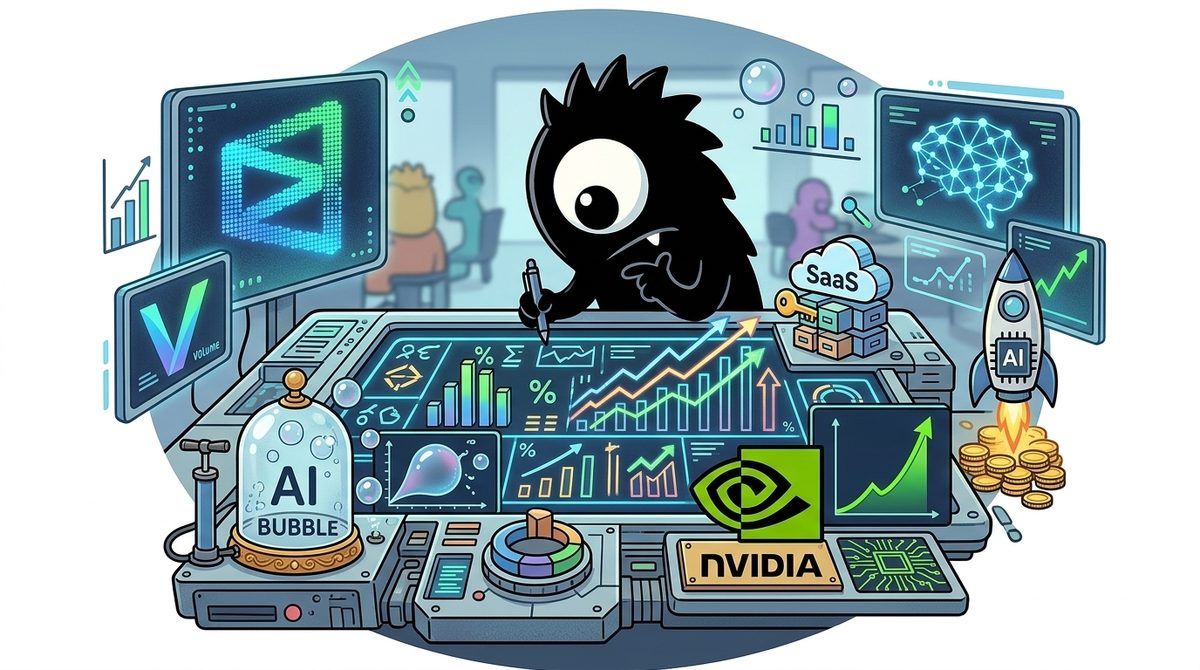
The practical question for developers, founders, and software buyers is not simply “Will the AI bubble burst?” It is: How much near-term failure is the market pricing, what would count as a burst, and which parts of AI or SaaS are already being repriced?
As of September 24, 2026, Polymarket traders imply a 10% probability that the AI bubble bursts by December 31, 2026, with $2,391,245 traded on that deadline. The market’s June 30, 2027 contract implies 20%, but has only $1,004 traded. Roughly $2,980,245 has traded across the market.[1] The useful conclusion is not that AI is “safe.” It is that traders currently treat a specific, severe and rapid industry rupture as a tail risk through 2026, while assigning more risk further out.
Bottom line
>
- The market implies 10% odds by December 31, 2026 and 20% by June 30, 2027.[1]
- The 10% is partly a product of strict resolution rules, not a clean measure of whether AI assets are overvalued.
- The more immediate signal is a sorting mechanism: cash-generating platforms and defensible SaaS vendors are separating from debt-dependent infrastructure projects and cash-burning AI companies.
- Practitioners should watch cash flow, inference economics, chip demand and financing conditions—not just the headline probability.
What Is Polymarket’s AI-Bubble Market Actually Pricing In?
Prediction-market prices represent what traders are willing to pay for a contract under specific rules. They are market-implied probabilities, not statements of fact and not necessarily well-calibrated economic forecasts.
That distinction matters here. Polymarket’s own account recently described an 11% chance of a burst by year-end:
11% chance the AI bubble bursts by end of year.
https://polymarket.com/event/ai-bubble-burst-by?via=x-afr2
The requested September 24 snapshot is 10%, illustrating that the number moves as traders update positions. Other reporting has documented substantial short-term changes in the market’s odds as well.[7] A post, screenshot or article showing 11%, 14% or 19% may therefore reflect a different observation time rather than a contradiction.
Volume needs equally careful interpretation. The $2.39 million traded on the December 2026 contract suggests meaningful attention, but trading volume is not the same thing as current open interest, unique participants or capital committed to a single directional view. The same contracts can change hands repeatedly.
The June 2027 line is more fragile as a signal. Its market-implied probability is twice as high at 20%, but only $1,004 has traded. With that little activity, one or a few orders can potentially affect the displayed price much more than they could in the December contract. Polymarket maintains a broader category of AI-related prediction markets, but liquidity and contract design vary across individual questions.[2]
The best reading, then, is:
- Traders currently price a qualifying 2026 rupture as unlikely.
- They price more risk as the time horizon expands.
- Confidence in the June 2027 estimate should be lower because its volume is extremely thin.
That is different from saying traders expect every AI company, semiconductor stock or SaaS vendor to perform well.
Nearly $3M has been traded on one question: will the AI bubble burst?
It’s live on Polymarket, and honestly, the way the market is structured is more interesting than the odds themselves.
It doesn’t resolve to “yes” just because tech stocks have a bad week or headlines turn negative. There are actual conditions that need to be met within 90 days.
That matters because the risks being discussed aren’t just about sentiment.
The BIS has already pointed to things like debt-funded data centers, electricity constraints and chip bottlenecks that could eventually force companies to slow spending.
But then you get conflicting signals.
Samsung and SK Hynix took a hit on weaker demand signals, then Micron came out with strong earnings and raised its guidance.
One data point says things are breaking. The next says the industry is still strong.
That’s why I don’t think this necessarily ends with one big pop.
We could see smaller bubbles across different parts of the AI chain. Chips, data centers, AI startups and infrastructure could all behave differently.
Some could deflate while others keep growing.
If I had to put real money on it, I’d lean NO on a full AI bubble burst within 90 days.
Not because there’s no risk, but because “AI is overvalued” and “the entire AI industry crashes within 90 days” are two very different bets.
The post captures the central interpretive problem: “AI is overvalued” and “the AI industry meets a predefined crash test within 90 days” are fundamentally different propositions.
Why Do the Resolution Criteria Matter More Than the 10% Number?
The market’s low probability partly reflects a high resolution threshold. According to discussion of the contract and its rules, a “Yes” outcome requires at least three listed conditions to occur within the defined 90-day window—not merely a correction, disappointing earnings cycle or collapse in a handful of startup valuations.[1][3]
The referenced conditions include events such as:
- Nvidia falling 50% from its all-time high;
- the SOXX semiconductor index falling 40%;
- OpenAI or Anthropic going bankrupt;
- OpenAI being acquired;
- H100 rental prices falling to $1 or less for five consecutive days; or
- a major AI hardware company such as TSMC, ASML, Broadcom, Arista Networks or Super Micro falling 50% from its high.
Is the AI bubble actually going to burst in 2026?
@Polymarket currently gives it only around a 14% chance but the interesting part isn the number It what would actually need to happen for the market to resolve YES.
This isn simply AI stocks go down
For a YES outcome at least 3 major conditions would need to happen within the defined window:
→ NVIDIA falls 50% from its ATH
→ SOXX falls 40% from its ATH
→ OpenAI or Anthropic goes bankrupt
→ OpenAI gets acquired
→ H100 rental prices collapse to $1 or below for 5 consecutive days
→ Or a major AI hardware player such as TSMC ASML Broadcom Arista or Super Micro falls 50% from its ATH.
That’s an extremely high bar.
And yet there a reason traders are watching this market closely.
Hyperscalers are pouring hundreds of billions of dollars into AI infrastructure while the industry is still trying to prove that these massive investments can generate sustainable returns.
The real question isn whether AI is useful.
It obviously is.
The question is whether the market has priced in too much future growth too quickly.
If AI revenue growth, enterprise adoption chip demand and model economics continue accelerating the current valuations could eventually look justified.
But if spending keeps rising while returns disappoint the market could experience a brutal repricing.
And that where things get interesting.
Prediction markets don’t tell us what will happen.
They show us what traders are willing to price today.
14% may look small.
But with nearly $3M in volume this is a market worth watching especially as Q3 earnings AI capex chip demand and the profitability of frontier models become clearer.
The AI boom may not end with one dramatic event.
It could start with a simple realization
the growth was real but the price of that growth was too high.
Would you bet on the AI bubble surviving 2026?
That construction creates an important gap between economic stress and contract resolution. AI startup funding could tighten, SaaS multiples could contract and data-center projects could be cancelled without the contract necessarily resolving “Yes.” Even a large semiconductor selloff might be insufficient unless other qualifying events occur inside the same window.
In other words, the market does not directly ask:
- Is AI overvalued?
- Will AI investment produce acceptable returns?
- Will SaaS business models be disrupted?
- Will an individual AI company fail?
It asks whether a cluster of extreme, observable events will satisfy a rule set on time.
That is why the 10% probability should not be used as a general-purpose “AI bubble gauge.” It is closer to the price of a defined systemic-break scenario.
Logan Jassalley’s critique comes from a safety-governance angle rather than financial-market mechanics, but it identifies the same design requirement: a useful probability needs an accountable trigger.
AI bubble odds without a named halt owner are just branding. Who can pause a frontier deploy when evals fail: the lab, a regulator, or nobody? Name the failed-run count that triggers it. Disagree?
View on XFor practitioners, the lesson is simple: read the event definition before using the percentage in a strategy memo, purchasing decision or fundraising deck. A prediction market can be internally rational while answering a much narrower question than the headline suggests.
Is the Capex-to-Revenue Gap the Strongest Bearish AI Signal?
The strongest bearish case is not that AI lacks utility. It is that infrastructure spending, financing obligations and operating costs may be running ahead of revenue that can sustainably support them.
One viral version of the argument claims approximately $450 billion in annual burn against $50 billion in revenue:
🚨 SOMETHING VERY BAD IS HAPPENING
The stock market keeps making new all-time highs.
OpenAI and Anthropic are now worth $2.1T.
That is 10% of the entire Nasdaq.
Look at the math:
– $450B burned per year
– $50B in actual revenue
The entire AI bull case depends on one assumption:
Inference gets cheaper.
That is how funds justify the math.
Spend massively today, scale later, margins explode when inference costs collapse.
But that assumption is breaking:
- Memory is getting expensive.
- Compute is not getting cheap fast enough.
- Inference is not falling the way everyone modeled.
And if inference does not get dramatically cheaper, the whole AI margin story starts to crack.
The loop is obvious:
– Big players fund each other
– Partnerships look perfect on paper
– Revenue moves around inside the same system
Everyone calls it growth.
I call it the final stage of mania.
In 2000, companies added “.com” to the name and valuations exploded:
– Small profits
– Massive valuations
– Perfect stories
Then reality hit.
Nasdaq collapsed 80%.
Now companies add “AI” to the name and reprice instantly:
– Small profits
– Massive valuations
– Perfect AI stories
This is the dot-com bubble with better AI branding.
And bubbles do not warn you before they break.
They break when everyone thinks the story is untouchable.
Turn notifications on.
The next move won’t wait for you.
A similar X post puts the gap at roughly $400 billion of annual spending versus $50 billion to $60 billion of revenue and characterizes the buildout as a debt bubble:
🚨 THE AI BUBBLE IS ABOUT TO BREAK
And I don’t think people are prepared for what comes next.
Everyone keeps treating AI like the next internet.
I don’t see it that way.
To me, this looks far closer to a debt bubble, and the timing lines up for real stress around 2026.
Let me explain.
Right now, the AI industry is burning roughly $400B per year, while generating maybe $50–60B in actual revenue.
That gap isn’t “early-stage growing pains.”
That’s a structural problem.
Some of the biggest AI players are reportedly losing tens of billions per year, and most companies using AI aren’t seeing meaningful returns at all.
Not low returns.
Zero.
That’s the part nobody likes talking about.
A few things stand out.
First, a lot of the money flowing through AI isn’t real demand. It’s circular.
Big players funding each other.
Partnerships that look good on paper.
Revenue that mostly stays inside the ecosystem.
It creates activity, not profits.
Second, when you look at timelines, there’s still no clear moment where this suddenly pays for itself.
Costs keep rising.
Margins are still unclear.
And the “we’ll scale later” argument is carrying everything.
Third, the pivot toward government and defense contracts feels less like growth and more like a safety net quietly being prepared.
That’s usually not bullish.
Here’s the part that worries me most.
The dot-com bubble was mostly equity.
When it burst, investors got wiped, but the system survived.
This time, AI is being built on massive debt.
Companies are borrowing enormous amounts assuming profits will come later.
If they don’t, the debt still has to be paid.
Private credit has already poured hundreds of billions into tech-linked loans.
Insurance companies are deeply exposed.
Banks are tied in through leverage and credit lines.
It’s all connected.
And this is happening while the consumer is already under pressure.
Foreclosures are rising.
Auto repos are climbing.
Student loan defaults are spreading.
Credit card delinquencies are increasing.
That’s before any AI unwind.
Add a tech debt problem on top of this, and it starts to look a lot less like a normal correction.
One more thing most people ignore:
The power grid can’t support the data centers everyone is planning to build.
That pushes revenue further out.
Debt payments are due now.
I’m not saying AI disappears.
I am saying the market may be wildly mispricing how painful the road there could be.
Curious to hear what others think.
Btw, I was one of the only people who called the market bottom in 2022 and the exact top in October, and I’ll do it again. Helping people navigate these cycles is what I do.
When I believe the market has truly bottomed and it’s time to invest, I’ll call it here publicly.
A lot of people are going to wish they followed me sooner.
Those figures are claims circulating in the live debate, not a standardized industry accounting measure. “Burn,” capex, operating expenditure and ecosystem revenue are not interchangeable. But the underlying question is legitimate: What return will hyperscalers, model labs and data-center financiers earn on today’s commitments?
Reuters’ coverage of the Bank for International Settlements’ concerns points to rapidly rising hyperscaler investment and uncertain returns, while also drawing attention to financing and infrastructure constraints.[8] Bloomberg has separately tracked rising borrowing associated with the AI buildout.[9] The combination matters because equity-funded experimentation and debt-funded construction have different failure modes. Debt introduces fixed payments even if utilization, pricing or deployment timelines disappoint.
The bullish model depends on several things happening together:
- inference becomes cheaper;
- model utilization rises quickly;
- enterprise demand remains durable;
- power and memory costs remain manageable;
- hardware does not become economically obsolete before it is paid off; and
- higher usage produces attractive margins rather than merely more compute expense.
If those assumptions hold, current capex could create lower-cost capacity and larger future revenue pools. If they do not, the industry could experience a slower repricing through cancelled projects, weaker vendor pricing and tighter financing—without satisfying Polymarket’s dramatic burst criteria.
Fitch’s modeled downside illustrates the gap between institutional stress testing and market odds. Reporting on its scenario describes the possibility of a 35% US equity decline and recession in an AI-bust case.[4] That is a scenario, not a prediction. But it shows why a 10% event-contract price does not eliminate serious portfolio or operating risk: low-probability outcomes can still have high consequences.
Is the AI Bubble Broad, or Is the Risk Concentrated in Semiconductors?
One camp argues that the excess is localized:
Is the market sick, or just one corner of it?
Just one corner. And this is the first thing to understand, because almost everyone gets it wrong. For months you’ve been hearing that “there’s an AI bubble” and that “this is going to blow up”.
The bubble, if you want to call it that, is in one single place: semiconductors.
Something has happened there that is worth looking at with respect, because we’ve seen it before.
There is logic behind that view. Chips and related infrastructure sit where scarcity, enormous capital commitments and aggressive growth expectations meet. Polymarket’s own resolution criteria emphasize Nvidia, SOXX, H100 rental pricing and major hardware suppliers precisely because those indicators can reveal whether demand has broken across the physical AI stack.
But semiconductor concentration does not mean semiconductor isolation. A decline in accelerator demand can affect foundries, networking suppliers, data-center developers, power contracts, cloud pricing and debt raised against expected utilization.
The broader bearish case focuses on valuations and synchronized assumptions:
💸 FT published an article. AI capex is surging at hyperscalers, a classic late stage bubble tell that could break, yet the build should make AI cheaper later.
Valuations near 30x earnings or 8x sales - these prices only make sense if every part of the AI boom continues smoothly, without the usual business or economic cycle risks.
Capex means huge spend on data centers, chips, power and land by the biggest cloud providers.
Bubble phases often end when excess capacity stretches the boom, demand slips, and the cycle turns.
The current triggers are stricter Europe AI rules, compute light models like DeepSeek and K2, and buyers with tighter cash.
Vendor financing and buying from each other can boost reported sales now, but it raises fragility later.
If end users take a cash flow hit, sales drop faster than capex can slow, earnings fall, and buybacks get cut.
The early 2000s tech bust is the guide, Microsoft fell 65%, Apple 80%, Oracle 88%, Amazon 94%, with recoveries taking 5 to 16 years.
After a bust the capacity does not vanish, new owners buy it cheap and reuse it, spreading the tech.
The critical phrase is “every part.” High valuations can remain supportable if revenue growth, financing access, utilization and margin expansion continue together. They become more fragile when one assumption depends on another: vendor financing supports purchases, purchases support reported revenue, reported revenue supports valuations, and valuations support additional financing.
CEPR’s AI Bubble Monitor follows warning signs beyond a single chip stock, reflecting the idea that bubble risk can appear through investment, valuation and macroeconomic channels.[5] Other monitoring efforts similarly combine capex, hardware pricing, startup funding and revenue signals rather than treating “AI” as one homogeneous asset.[6]
The most useful synthesis is that the bubble may be broad in financing but uneven in outcomes. Semiconductors can lead a correction while profitable cloud platforms remain resilient. Data-center projects can struggle while application-layer products grow. A full synchronized crash is only one possible path—and it is the specific path Polymarket traders currently price at 10% through December 2026.
Where Is the AI-SaaS Valuation Wedge Already Appearing?
While Polymarket focuses on an extreme rupture, SaaS investors are already repricing business models. The most dramatic version of the argument says the per-seat model is threatened as agents perform work that previously required larger teams:
I genuinely believe we're watching SaaS die in real time and most people still don't see it..
$1 trillion wiped from software stocks since January 2026 and its just getting started..
SaaS multiples collapsed from 18.5x at the covid peak to 4.8x today and in the same time the AI market went from $50B to $539B and it's heading to $3.5 trillion by 2033 if not sooner
the death cross hits around 2027.. that's when AI market trajectory fully overtakes SaaS valuations on the chart
the reason is simple.. the per-seat model dies when 10 agents replace 100 humans and no seats left to sell
every SaaS tool you're paying $50/seat a month for is about to get replaced by an agent that costs $0.003 per task..
chatgpt opened the door in 2022, claude opus 4 made agentic AI real in 2025 and now multiagent coordination systems like openclaw are making it deployable and accessible to everyone..
every step on that chart the tech gets more autonomous and the SaaS line drops further..
not saying every saas will die but the companies that were built entirely on per-seat pricing and no real data advantage are the ones exposed.
tbh I don't think most founders see it yet, not because the data isn't there, but accepting it means everything they built needs to be rethought..
The post’s claim that SaaS multiples have fallen from 18.5 times at the pandemic peak to 4.8 times today should be understood as part of the X debate rather than a universal multiple for every software cohort. Nevertheless, the underlying exposure is real: if customers employ fewer people, software priced strictly per user can lose expansion revenue even when the product remains useful.
AI also creates a valuation wedge within software. Companies that can fund AI investment from operating cash flow have more strategic room than startups that must repeatedly raise capital to cover inference and development costs.
Public markets just drew a line on AI.
Companies with positive free cash flow are trading at 2x to 3x higher multiples than AI companies burning cash. A year ago, the gap didn't exist. The market gave every AI company the same benefit of the doubt.
OpenAI delayed its IPO. Again. Anthropic hasn't filed. Cohere is private. The only major AI pure-play that went public, SoundHound, is down 40% from its peak.
Meanwhile Microsoft, Google, and Meta are up 25 to 50% this year. Not because of AI hype. Because they have the cash flow to fund AI without diluting shareholders.
VCs invested $130 billion into AI startups in the last 18 months. Public markets are now asking a different question: where's the revenue?
The AI bubble isn't popping. It's sorting. Cash flow is the filter.
That “sorting” framework is more useful than a binary bubble narrative. Carta’s private-market data and other 2026 funding reports show that capital remains available, especially around AI, but access to capital is not the same as proven economics.[12] Public investors can simultaneously reward profitable incumbents and penalize cash-burning vendors.
The same split is visible inside SaaS:
AI supercycle is blowing a valuation wedge through SaaS: a few winners (Snowflake, Datadog) trade like growth is guaranteed, most get lumped together. Here’s the thing — an “AI” label won’t make revenue. Focus on retention, margins, and real product impact.
View on XSapphire Ventures describes 2026 as an AI inflection point for software, where AI is reshaping products and economics rather than merely adding another feature category.[11] Meanwhile, analysis of the “SaaS debt trap” highlights the danger when slower growth meets obligations established under more optimistic assumptions.[10]
For founders, the important metrics are therefore changing:
- Retention: Does the AI feature make the product harder to replace?
- Gross margin: Does each additional AI interaction create enough revenue to cover inference?
- Pricing power: Can the vendor charge for outcomes, usage or workflow value rather than seats alone?
- Cash efficiency: Can growth continue if the next funding round is smaller, later or more expensive?
- Data advantage: Does the product improve through proprietary context, or can a general-purpose model reproduce it?
The “AI” label may win attention. It does not resolve weak retention, undifferentiated workflows or negative unit economics.
Why Might Traders Price Only 10%—and What Could Move the Odds?
The 10% December probability can be explained without assuming traders are universally bullish.
First, the resolution bar is unusually high. A moderate repricing is not enough. Multiple extreme conditions must occur in a short period.[1][3]
Second, traders may expect stress to unfold sequentially rather than simultaneously. Startup failures, lower H100 rental prices, weaker chip demand and public-equity declines could emerge in different quarters. That would matter economically while failing the 90-day clustering test.
Third, the market may distinguish between AI adoption and AI investment returns. The technology can keep spreading even if today’s infrastructure owners earn poor returns. The dot-com aftermath offers a useful analogy: deployed capacity can become cheaper and more widely useful after investors absorb losses.
The implied probability could rise if several contract-relevant signals begin moving together:
- a steep Nvidia or SOXX drawdown;
- collapsing accelerator rental prices;
- visible financial distress at a major model lab;
- a severe decline in a named hardware supplier; or
- weakening demand accompanied by tighter credit.
Other developments—such as delayed IPO plans, disappointing enterprise adoption or reduced capex guidance—would not necessarily trigger resolution themselves. They could still influence traders by making the qualifying events appear more likely.
The jump from 10% by December 31, 2026 to 20% by June 30, 2027 suggests that traders push more risk into the future rather than dismissing it altogether. But the June contract’s $1,004 volume makes that signal far less robust than the heavily traded December line.
What Should Developers, Founders and SaaS Buyers Do in Late 2026?
Prediction markets are most useful when they improve decisions under uncertainty. They should not replace technical evaluation, vendor diligence or financial analysis.
Developers: optimize for portability, not a crash prediction
The 10% contract is not a reason to stop building with AI. It is a reason to avoid designing systems that only work under one vendor’s temporary pricing.
Developers should:
- separate model access from application logic;
- measure cost per completed workflow, not merely cost per token;
- maintain fallbacks for model, region and provider outages;
- benchmark smaller or compute-light models for routine tasks;
- log quality, latency and inference cost together; and
- treat agent autonomy as an operational-risk decision, not just a capability upgrade.
This approach fits teams moving AI into production, especially where usage can scale unpredictably. Small experimental teams can accept more provider concentration; regulated or high-volume systems need stronger abstraction, auditability and fallback paths.
Founders: build for the valuation filter already in force
Early-stage founders should assume that AI branding will not restore 2021-style software multiples. The companies best positioned for uncertain markets are those that can demonstrate retention, workflow ownership and a credible path to positive gross margins.
Usage-based or outcome-based pricing fits products where AI materially reduces labor or processing time. Per-seat pricing can still work when users remain the source of value—collaboration, governance and systems of record are examples—but it becomes vulnerable when headcount declines directly reduce revenue.
Capital-intensive startups should model a scenario where inference prices fall more slowly than expected and the next round takes longer. Cash-generating incumbents can afford longer AI payback periods; venture-backed vendors with short runways cannot.
SaaS buyers: evaluate vendor survivability and pricing durability
Enterprise buyers should ask vendors:
- How much of the service’s gross margin depends on future inference-cost reductions?
- Are AI features subsidized today, and when could pricing change?
- Can customer data and workflows be exported?
- Which functions degrade if a model provider changes terms?
- Does the vendor have enough runway to support a multi-year contract?
Large enterprises can use multi-vendor architectures and negotiate portability clauses. Smaller companies may rationally choose an integrated vendor to reduce implementation complexity, but should avoid storing critical workflows in formats that cannot be recovered.
The market’s 10% probability is therefore neither an all-clear nor a countdown. It says traders currently regard a tightly defined, synchronized AI collapse by the end of 2026 as unlikely. The operating evidence says something more nuanced: capital remains committed, but the market is already separating durable cash flow from expensive promises.
For developers, founders and buyers, that sorting process—not the dramatic “pop”—is the AI bubble signal that matters most.
Sources
[1] Polymarket — AI bubble burst by...?
[2] Polymarket — AI Predictions & Real-Time Odds
[3] CryptoSlate — AI Bubble Burst in 2026? Prediction Market & Odds
[4] Benzinga — Fitch Says AI Bust Could Crash US Stocks 35%, Trigger Recession
[5] CEPR — The AI Bubble Monitor
[6] AI Eating the World — AI Bubble 2026: Data, Warning Signs and Burst Forecasts
[7] Odaily — Polymarket odds of “AI bubble bursting within the year” drop to 19%
[8] Reuters — BIS dares to blaspheme as AI bubble fears wane
[9] Bloomberg — AI Bubble Risks Are Rising as Borrowing Balloons
[10] Inkl — The SaaS debt trap
[11] Sapphire Ventures — 2026 Software x AI: Software’s AI Inflection Point
References (16 sources)
- Polymarket — AI bubble burst by...? - polymarket.com
- AI Predictions & Real-Time Odds | Polymarket - polymarket.com
- AI Bubble Burst in 2026? Prediction Market & Odds | CryptoSlate - cryptoslate.com
- Fitch Says AI Bust Could Crash US Stocks 35%, Trigger Recession - benzinga.com
- The AI Bubble Monitor – CEPR - cepr.net
- AI Bubble 2026: Data, Warning Signs and Burst Forecasts - aieatingtheworld.com
- Polymarket odds of "AI bubble bursting within the year" drop to 19%, down 5% in 24 hours - Odaily - odaily.news
- BIS dares to blaspheme as AI bubble fears wane - reuters.com
- AI Bubble Risks Are Rising as Borrowing Balloons - bloomberg.com
- The SaaS debt trap - inkl.com
- 2026 Software x AI: Software’s AI Inflection Point - sapphireventures.com
- State of Private Markets: Q1 2026 | Carta - carta.com
- North American Startup Funding Shattered Records In First Half Of 2026, Driven By AI - news.crunchbase.com
- Why AI Startups Are Raising Bigger Rounds, Less Traction - valueaddvc.com
- SaaS Valuation Multiples by Stage 2026: Pre-Revenue to Series C - saasvaluationmultiple.com
- Q1 2026 AI VC Trends - PitchBook - pitchbook.com
Related Guides

Is Mistral AI Worth It in 2026? An Honest, No-Hype Review
17 min read
The Best AI Model in 2026: Why Traders Put 98% Odds on Anthropic — An Expert Analysis
23 min read
HubSpot vs ConvertKit vs Buffer: Which Is Best for AI Content Creation in 2026?
13 min read
The Best AI Model Tools in 2026: An Expert Comparison Through Polymarket's Odds
12 min read