The Best AI Bubble Signals in 2026: What Polymarket's 12% Odds Reveal About AI and SaaSUpdated: September 27, 2026
Polymarket AI bubble odds sit at just 12% for 2026 despite $1T in SaaS carnage. Discover what traders actually believe about AI and SaaS. Find out what it means.
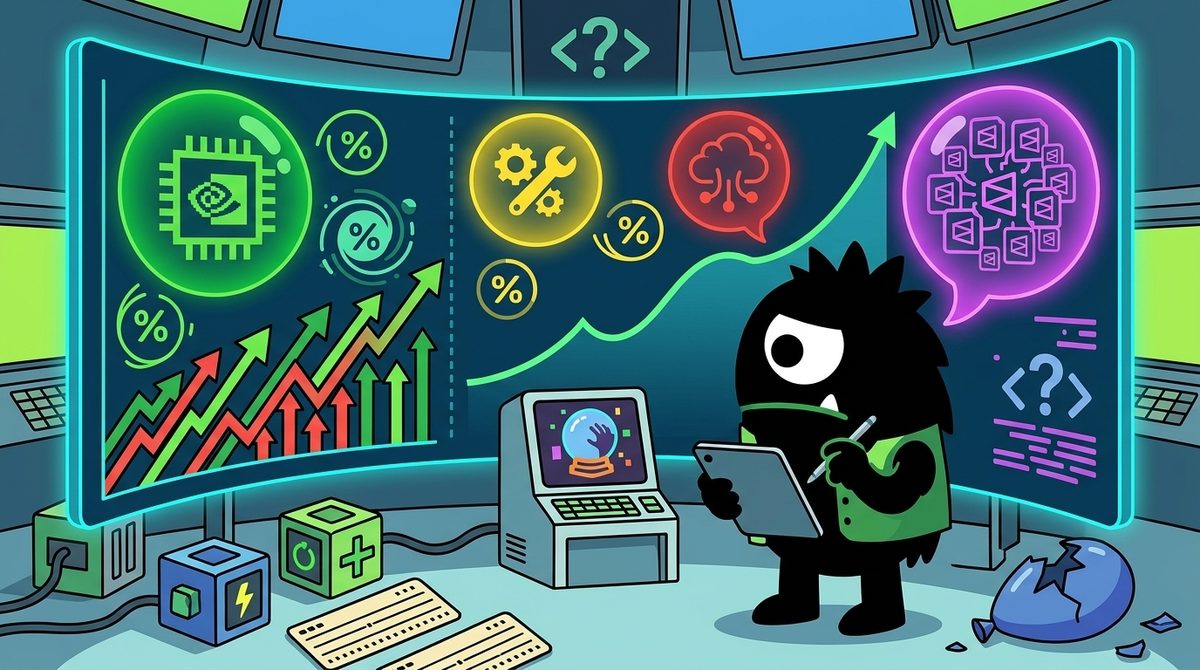
The practical question for developers, founders, and software buyers is not simply “Is AI a bubble?” It is: How likely is a clearly defined AI-market break in 2026, and should that probability change today’s product, funding, or procurement decisions?
As of August 9, 2026, Polymarket traders imply a 12% probability that the AI bubble bursts in 2026. Approximately $2,338,380 has traded on that outcome, against roughly $2,926,375 across the broader “AI bubble burst by...?” market, which resolves around December 31, 2026.[1] In other words, traders currently price about an 88% probability that the market’s formal burst criteria will not be met during 2026.
Bottom line
>
- Polymarket’s 12% implied probability signals meaningful tail risk, not a base-case expectation of collapse.
- Falling AI and SaaS stocks do not necessarily indicate falling AI usage; traders appear to distinguish valuation compression from structural failure.
- The most important risks are financing stress, public trust failures, compute overbuild, and weak application-layer economics.
- For practitioners, the rational response is to plan for continued AI adoption while stress-testing vendors and business models against that 12% downside scenario.
The Market Says 12%: How Should We Read Polymarket’s 2026 AI Bubble Odds?
Prediction markets convert a binary event into a continuously changing price. A 12% price does not mean traders know that an AI bubble will or will not burst. It means the market currently assigns roughly a 12-in-100 chance that the event will resolve “yes” under its written rules.
That distinction matters because “bubble bursting” means different things on X. It might describe a 20% software correction, a model provider’s down round, cheaper inference, or a full breakdown in AI financing. Polymarket instead resolves against specified criteria and a deadline. The conversation around the market has highlighted examples such as a 50% Nvidia drawdown or OpenAI being acquired; anyone treating the odds as an investment signal should read the current resolution language directly.[1]
Prediction markets add a different lens to the AI bubble debate. Instead of endless opinions, @Polymarket turns uncertainty into measurable probabilities showing what traders actually believe
View on XThe market is also a moving forecast, not a permanent verdict. X posts and reporting have quoted implied probabilities of 14%, 15%, 16%, 18%, and 21% at different moments. One report discussed traders assigning only a 16% chance, while other coverage tracked changing expectations around the same contract.[3][4][5]
21% chance the AI bubble bursts this year, per Polymarket:
View on XThose changes are informative. A drop from 21% to 12%, for example, would indicate that traders had become less convinced that the criteria would be met within the 2026 window. It would not establish that AI valuations were sustainable over a longer period.
The deadline is therefore as important as the event. A trader could believe AI infrastructure is badly overbuilt and still buy “no” if they expect the reckoning in 2027 rather than by December 31, 2026.
Why Do the Loudest AI Bears and Prediction-Market Traders Disagree?
The cleanest explanation is that opinions are free, while positions impose a cost.
Every market cycle has a narrative.
Right now, it's the "AI bubble."
Spend five minutes on X and you'll find people calling the top, comparing today to the dot com era and predicting a collapse.
Then you open @Polymarket
Instead of debating whether the AI bubble exists, people are putting real money on when it might burst. And based on current odds, traders don't seem to believe that moment is just around the corner.
That's what makes prediction markets so interesting.
Opinions are free.
Conviction has a price.
X rewards forceful narratives: “SaaS is dead,” “AI is 1999,” or “the crash has started.” Prediction markets force participants to choose a price, accept a resolution process, and risk capital. That does not make Polymarket infallible, but it filters out some low-conviction rhetoric.
The current 12% price says traders see a burst as plausible but decidedly outside the base case. That is consistent with a market that recognizes stretched valuations and concentrated risks while remaining unconvinced that a qualifying break will happen before year-end.
The bearish analogy remains powerful:
🚨 DOT-COM BUBBLE 1999 = AI BUBBLE 2026 🚨
And that's not a comparison I would ignore
The setup is surprisingly similar:
- AI is driving the market higher
- Valuations keep expanding
- Investors keep buying every dip
- Narrative gets stronger with every new high
That's exactly what happened before the dot-com bubble peaked
Look at the structure
The 1999 S&P 500 rallied through multiple pullbacks before the real reversal began
We're seeing a similar pattern in 2026
The difference?
This time the story isn't the internet
It's AI
And that makes the next phase extremely important
I'm not saying $SPX has to crash tomorrow
I'm saying the market is starting to resemble the late stages of a bubble - and history shows how dangerous it becomes when everyone believes the trend can only go higher
GET READY!
But prediction markets have limitations of their own:
- Resolution ambiguity: “Bubble burst” must be translated into observable criteria.
- Deadline effects: Longer-term risks may not be represented in a contract ending in 2026.
- Tail liquidity: Traders may devote less capital to low-probability outcomes.
- Participant bias: A crypto-based prediction market may not represent the views of enterprise buyers, credit markets, or AI researchers.
- Reflexivity: Public odds can influence narratives rather than merely measure them.
The right interpretation is therefore not “smart money says everything is fine.” It is narrower: traders currently price a formal 2026 break as a tail scenario, even while bearish rhetoric dominates parts of the timeline.
Are Traders Pricing an AI Bear Market Without an AI Recession?
One of the strongest explanations for the low implied probability is the gap between asset prices and operating demand.
What a conversation. Thanks @GavinSBaker @patrick_oshag. Had to re-listen to it to catch all of the interesting narratives:
Narrative 1: AI bear without AI recession
The central narrative violation: AI equities have fallen sharply while almost every observable metric appears to be improving.
July can be seen as “2022 in a month,” with many AI names falling 40–60%. Yet there is no clear visible deterioration in demand. Token consumption is accelerating, GPU rental prices keep rising, and memory remains scarce (after last week’s stories we may know what contributed to the sell-off).Public markets appear to believe that Nvidia and memory companies are significantly “overearning” and that today’s margins or demand will eventually collapse. On the other side, markets cannot properly see the private economy surrounding OpenAI, Anthropic, Grok and the open-model inference clouds.
Related prediction markets & Data:
1. Polymarket: AI bubble bursts in 2026
2. Ornn Compute Index
Narrative 2: Open models move margin down the stack
Markets appear to have interpreted the success of open models (Kimi and GLM) as bearish for the entire AI ecosystem. But it is mainly bearish for the margins of frontier-model providers.
A cheaper open-model token may require similar underlying compute, memory and electricity to produce as an expensive frontier token. In this case, the customer may pay less because less margin is captured by the model provider, not because less infrastructure is consumed. Lower prices can also increase usage (Jevons Paradox again). Companies can route routine tasks toward customized open models and reserve frontier models for planning, verification and the most difficult requests. Result: a decrease in AI spending per task while increasing the total number of tokens they consume.
Therefore, the effect of open models could be weakened frontier-labs power, stronger inference clouds, and increased GPU demand and AI applications with proprietary data. The application stops being a simple wrapper once it owns the data, fine-tuned model, router and feedback loop.
Related prediction markets:
Polymarket: Which company has best AI model end 2026
Narrative 3: Credit or Cash Flow Funding?
A “unresolved” bear case is related to financing. In the ecosystem, real yields have risen, credit spreads have widened and CDS prices have increased.These signs may “merely” be related to hedging activities Debt-financing the infrastructure buildout, naturally is more risky. As Dario pointed out earlier this year, even a temporary mismatch between estimated supply and demand can result in insolvency. The counterargument is that much of today’s compute is locked into contracts signed well below current spot prices. As those contracts expire, the installed GPU base could reprice upward, materially increasing hyperscaler operating cash flow.
Related prediction markets:
Kalshi: NVIDIA H200 · Hourly price on Aug 28:
Narrative 4: Nvidia’s Central Bank
The AI bottleneck is moving beyond raw processing power toward memory, supply-chain access and financing.
HBM determines how quickly data can reach a processor. More memory bandwidth allows expensive accelerators to remain productive and generate more tokens. This makes memory allocation strategically important, not merely another procurement input.
Hyperscalers and chip companies are consequently entering long-term supply agreements. Breaking one during a temporary period of oversupply may save money, but it risks losing priority when the market becomes constrained again. In a race between Nvidia, Google, Amazon, AMD and the frontier labs, losing future memory allocation could mean losing market share.
Nvidia’s advantage increasingly extends beyond selling GPUs. It can help connect projects with capital, power, land and customers, while taking equity stakes or revenue participation. It is beginning to resemble the banker and toll collector of the AI infrastructure economy, not simply its largest hardware provider.
Narrative 5: AI-Analysis makes sheep of all of us
AI is increasingly the system investors use to interpret every new piece of information. Thereby, it may cause reflexivity in markets. Earnings releases, announcements, regulatory developments (AND podcast transcripts) are instantaneously fed into the latest frontier AI model. Investors’ interpretations and therefore their trades and recommendations may become increasingly correlated. This can cause accelerated price discovery, but it can also reduce “cognitive diversity”. If the model interprets a development incorrectly, a large part of the market may make the same mistake simultaneously - a possible edge for participants “thinking for themselves”.
Narrative 6: Regulation
The ultimate “AI bottleneck” may not be chips, memory, energy, or capital. It may be compliance political permission.
Many voters think this when they hear AI and datacentres: higher power bills, excessive water consumption and job loss. The negative narrative is easier to communicate than the complex economic counterargument (we are wrong about spinach’s health benefits by orders of magnitude). That creates a serious risk of moratoria, permitting restrictions and limits on grid connections. The industry may therefore win the technical and economic race but lose the political one.
Related prediction markets:
Polymarket: Will any state enact a data center moratorium by December 31?
Herrsosa’s summary captures the paradox: some AI-related equities reportedly fell 40–60% during July, while token consumption, GPU rental prices, and memory scarcity continued to indicate demand. Those observations are claims from the live market conversation, not proof that demand will remain strong. But they illustrate why an equity drawdown alone may not satisfy the market’s idea of a burst.
A stock can fall because investors expect:
- lower future margins;
- higher financing costs;
- more competition from open models;
- reduced valuation multiples;
- profits shifting from model providers to infrastructure or applications.
None necessarily implies an “AI recession,” meaning a broad contraction in actual use, workloads, or compute consumption. Recent bubble analysis has similarly focused on the tension between rapid adoption and the capital intensity needed to support it.[7][8]
Open models make this distinction sharper. If a cheaper model performs the same task, revenue per token may decline while total token volume rises. Customers benefit, model-provider margins weaken, and infrastructure utilization can remain high. Public markets could punish frontier labs or software vendors even as developers deploy more AI.
For founders, that favors usage-linked businesses with proprietary data, workflow integration, routing, or measurable customer returns. It is less reassuring for companies whose valuation depends mainly on access to a model that competitors can also call.
Does the SaaS Selloff Mean the AI Bubble Is Already Bursting?
Not necessarily. The “SaaSpocalypse” may be a violent repricing inside the technology sector rather than evidence that Polymarket’s broader burst criteria have been met.
The most bearish framing circulating on X says approximately $1 trillion has been wiped from software stocks since January 2026, with SaaS multiples falling from a COVID-era peak near 18.5 times to about 4.8 times:
I genuinely believe we're watching SaaS die in real time and most people still don't see it..
$1 trillion wiped from software stocks since January 2026 and its just getting started..
SaaS multiples collapsed from 18.5x at the covid peak to 4.8x today and in the same time the AI market went from $50B to $539B and it's heading to $3.5 trillion by 2033 if not sooner
the death cross hits around 2027.. that's when AI market trajectory fully overtakes SaaS valuations on the chart
the reason is simple.. the per-seat model dies when 10 agents replace 100 humans and no seats left to sell
every SaaS tool you're paying $50/seat a month for is about to get replaced by an agent that costs $0.003 per task..
chatgpt opened the door in 2022, claude opus 4 made agentic AI real in 2025 and now multiagent coordination systems like openclaw are making it deployable and accessible to everyone..
every step on that chart the tech gets more autonomous and the SaaS line drops further..
not saying every saas will die but the companies that were built entirely on per-seat pricing and no real data advantage are the ones exposed.
tbh I don't think most founders see it yet, not because the data isn't there, but accepting it means everything they built needs to be rethought..
That thesis is especially relevant to seat-based SaaS. If agents allow fewer employees to complete the same work, software revenue tied directly to employee counts could weaken. Application vendors without unique data, distribution, compliance expertise, or switching costs are most exposed.
But the opposing case is that investors have extrapolated this threat too quickly:
The SaaS oversell right now will go down in history alongside other recent market overreactions like DeepSeek wiping out $2 trillion of market cap or Meta losing 2/3 of its value at one point over VR investment fears.
View on XRecent SaaS research supports looking beneath the sector-level headline. The 2026 SaaS market includes businesses with materially different growth, retention, profitability, and AI exposure; M&A and valuation reporting also points toward consolidation rather than a uniform end to software.[11][12] Research published in July 2026 described some recovery as investors’ interpretation of AI’s SaaS impact shifted.[14]
There is also an unresolved logical problem in the selloff:
The SaaS carnage is confusing for this simple premise:
If AI is going to commoditize all of SaaS, then why isn’t the market rotating heavily into Semis and Hyperscalers?
If Anthropic were to destroy $CRM and $NOW, I’d imagine we need tons of compute. More than we can fathom if agents take over hundreds of billions of marketcap for SaaS companies.
Yet, the market is selling off SaaS AND AI names which doesn’t seem to make sense if all the demand for the SaaS carnage will lead to AI growth.
Also, how is AI a bubble if we are talking about massive enterprise software companies being decimated by AI?
The entire logic behind the selloff feels more like forced, structural rotation without a pure reason for why the rotation is happening.
From Goldman: “The forward P/E multiple for software has declined from 35x in late 2025 to 20x currently, representing the lowest absolute level since 2014 and the smallest premium to the average S&P 500 stock since 2010.”
If AI agents are expected to absorb workloads previously handled by large software suites, one might expect strong rotation into semiconductors, clouds, and hyperscalers. When both SaaS and AI infrastructure names sell off, other explanations become plausible: deleveraging, multiple compression, crowded trades, or doubts about who will capture the economics.
Segment selection is therefore critical.
I think this was more or less exactly what has played out. Since Jan, most SaaS software stocks continued to sell off, in many cases by more than 50% until Apr or May.
Some SaaS sw held up and ripped though. They are web-based distributed services. Although the more accurate description should've been operators of critical infrastructure layers or "internet traffic toll companies".
AI was genuinely bad for software. The unexpected surge of AI spending forced cuts to sw opex. AI presented/s a genuine threat to the traditional seat-based high margin pricing model while adopting AI creates a new line of cost that hampers margins.
I think the surge and proliferation of cheap and near-frontier open AI models will be structurally bullish for SaaS companies as intermediators of AI to other enterprises, which increasingly will find it unacceptable to build wholly on closed frontier models bc of cost and IP protection. That's a hypothesis. I don't think it's playing out just yet, or maybe just starting if it has. What's happening now is most just an unwind of the semis/sw LS trade.
The distinction for buyers and investors is between:
- Commoditizable application SaaS: thin interfaces, weak data advantages, and pricing tied to seats.
- Workflow systems of record: deeply embedded products with proprietary data and high switching costs.
- Infrastructure toll collectors: identity, networking, observability, security, payments, and other critical services.
- AI intermediators: vendors that route models, protect enterprise data, manage evaluation, or integrate AI into regulated workflows.
Polymarket’s 12% odds can coexist with severe pain in category one. A sector can undergo repricing and consolidation without producing the systemic event required for a “yes” resolution.
Is 2026 Really Another 1999—or Is Survival the Better Question?
The dot-com analogy is useful only if it changes how practitioners allocate resources.
"AI bubble" talk in 2026 = "internet bubble" talk in 1998.
They weren't wrong a crash was coming. They were wrong about what survived it.
Amazon survived. Pets .com didn't.
The question was never "is this a bubble." It's "am I building the thing that survives."
Internet adoption continued after the dot-com crash, but value shifted toward businesses with durable demand, sound unit economics, and defensible infrastructure. The same conditional framing applies to AI: even if betting markets eventually price a higher probability of a burst, that would not imply AI usage disappears.
The analogy is also imperfect. Many current AI leaders have substantial revenue, cash flow, infrastructure, and existing customer distribution. At the same time, critics argue that high market valuations leave little room for execution errors:
The next market crash is coming and it's built on the AI house of cards. Here's how it happens:
1. The market is currently wildly overvalued. PE ratios sit near all-time highs, about 4% off the dot-com peak. That's not an immediate timing signal, but it means there's no cushion when something breaks.
2. Much of that is concentrated in AI-heavy firms, and the industry is circular. In Alphabet's July report, it booked roughly $99bn in "other income" from net gains on equity securities, mainly their investments in SpaceX and Anthropic increasing in value. That's $6.26 of its $9.11 EPS coming from paper marks rather than operations.
3. The same circularity runs through Amazon, Microsoft, Nvidia and OpenAI, each of them funding the others' income.
4. The losses underneath some of these investments are enormous. OpenAI is projecting around $14bn of losses this year at an $852bn valuation. Anthropic is at $965bn with a better burn profile but still massive losses. Whether either floats before things turn doesn't change the maths, only who's holding the bag.
5. The first domino is subsidised pricing for AI stopping. The liquidity to fund this huge spend isn't infinite. Investor pressure to cut losses means AI costs for end users need to rise. We're starting to see signs of this. Subscriptions are cancelled as firms and users of AI feel the impact. Pressure is put on the model-makers valuations.
6. SpaceX is the live test case. Absurd listing valuation is down over 50% from its June peak of $225, a record $772.8bn of market cap erased between June and July. The first lockup expires today: 911.5 million shares unlock, more than the 640 million currently trading. Short sellers are already positioned for it.
7. We've already seen the first crack. GOOGL fell 7% on that July report despite posting the largest quarterly profit in corporate history. The market looked straight through the headline number to the paper gains underneath it.
8. The marks reverse: that $99bn gain swings into a loss and has to be written down. Big tech share prices that were buoyed on the way up get the same mechanism in reverse.
9. Capex by model-makers gets cut to protect margins. Nvidia's growth expectations reset sharply as a result, and its multiple goes with them. The knock-ons hit everything the buildout was funding: construction, grid infrastructure, power generation, contractors.
10. Nvidia pulls back its own investments into AI firms. Their valuations fall further.
11. The application layer breaks first. Thousands of companies were built on artificially cheap inference. As their AI bill increases: the fast ones migrate to open weights or self-host in time. Many don't and collapse. Either way the model makers' valuations take the hit.
12. Mass layoffs: the collapsing or contracting firms make massive redundancies hitting consumer spending, impacting firms across nearly every sector
13. Investors de-risk broadly. Money comes out of everything speculative. The rest of the market gets dragged down with it.
Every cycle ends with exuberance. Data centres in space, Trillions committed to hardware with a five year useful life, The SpaceX IPO, all canaries in the coal mine.
Don't get me wrong, I'm not anti-AI, but that doesn't mean I don't think we've built something incredible unstable on top of it.
This post will likely trigger a lot of people and I'll probably get called a doomsayer etc but eventually everyone will realise the emperor is wearing no clothes - the people expecting things to continue as they are will be those left holding the bag.
The specific figures in that post—including claims about price-to-earnings ratios, Alphabet’s equity gains, private-company valuations, and projected losses—represent a bearish X thesis and should be checked against company filings before being used in financial decisions. Its broader mechanism is nevertheless important: interconnected investments can amplify both gains and write-downs.
The 12% market price implies that traders do not currently make this chain reaction their central 2026 scenario. Yet founders should still ask the 1999-style survival questions:
- Does the product save customers enough money to survive budget cuts?
- Are gross margins viable without subsidized inference?
- Can the company switch models or self-host?
- Is its proprietary advantage data, workflow, trust, or merely early access?
- How much runway remains if fundraising takes twice as long?
Those questions are valuable at 12% odds because durable companies are built for adverse scenarios before those scenarios become the market consensus.
What Could Push the Implied Probability Above 12%?
Three catalyst groups could materially change traders’ expectations: trust failure, financing stress, and compute overbuild.
A public failure could turn technical risk into a trust crisis
Here's the @polymarket connection that nobody's making.
The 15% odds on the AI bubble bursting aren't primarily about Nvidia's stock price or H100 rental costs.
the real trigger is TRUST.
the scenarios in the resolution criteria – NVDA down 50%, OpenAI acquired.
this are all downstream of the same thing: the moment markets decide AI's promises don't match its real-world performance.
a single high-profile AI moderation failure at reddit's scale – millions of wrongly banned users, a visible bias pattern, a viral moment where the model's judgment looks absurd
this is exactly the kind of event that erodes that trust publicly and fast.
Reddit didn't just launch a product. They launched a live, highly public experiment in whether single-model AI judgment holds up under pressure.
The result of that experiment will move markets.
That's why the 15% number is interesting right now.
Not because AI is about to collapse, it isn't.
but because reddit just created one of the clearest possible stress tests for what happens when you skip the part where judgment has multiple perspectives.
A visible AI failure matters financially when it changes behavior: enterprises suspend deployments, regulators intervene, insurers raise requirements, or users reject automated decisions. A moderation error by itself may not burst a bubble. A large-scale incident that demonstrates unreliable judgment and triggers commercial or regulatory consequences could be more relevant.
Sky News’ examination of bubble pressure points similarly emphasizes that the risk is not reducible to one stock price; multiple financial and operational dependencies can interact.[8]
A funding break could expose uneconomic demand
Premium: How The AI Bubble bursts in 2026 - The largest funder of AI data centers is pulling out, OpenAI and Anthropic need more money than ever during a massive VC liquidity crisis - and NVIDIA's debt-powered customer base is quietly shrinking.
https://www.wheresyoured.at/premium-how-the-ai-bubble-bursts-in-2026/
The financing thesis is straightforward: frontier models and data centers require large, continuing capital commitments. If private funding, debt, or customer prepayments become unavailable, projects that looked viable under abundant capital may have to be canceled or restructured.
Warning indicators include:
- widening credit spreads or rising default protection costs;
- failed or downsized capital raises;
- reduced hyperscaler capital-expenditure guidance;
- customers renegotiating compute contracts;
- model providers increasing prices to slow cash burn;
- major write-downs of AI equity stakes.
These would be more consequential than an ordinary technology-stock correction because they affect the system’s ability to fund future capacity.
Overbuilding could crush supplier economics while increasing adoption
AI BUBBLE WILL BURST IN MID-2026
While AI adoption is expected to continue growing, a significant bubble is forming in data center investment.
US companies are planning to spend $7T on new data center and GPU investments.
At some point, supply will start to outstrip demand exponentially, driving the cost of inference to near zero.
Revenues will plummet dramatically, and the already growing losses will escalate, causing the bubble to burst.
Ironically, AI adoption will contine to skyrocket as consumers access SOTA models for free.
Bindu Reddy’s $7 trillion figure is an X claim about planned data-center and GPU investment, not a verified total established by the listed reporting. But the mechanism deserves attention: if capacity grows much faster than paid demand, inference prices and infrastructure returns could fall sharply.
Paradoxically, that could be excellent for developers. Cheap inference would unlock more applications. It could simultaneously be damaging for highly leveraged data-center projects, model providers, or suppliers valued on persistent scarcity.
These scenarios may also combine. Falling inference prices weaken revenue; weaker revenue restricts funding; funding cuts reduce chip orders; lower valuations force equity write-downs; and those write-downs further reduce risk appetite. That feedback loop is the type of evidence likely to move the market more than another viral “bubble” thread.
Are Nationalization and Obsolete Code Outside the 2026 Market’s Window?
Some of the most consequential scenarios may sit beyond the contract’s deadline.
Late 2026 to early 2027 AI bubble scenario:
Frontier model economics break down. OpenAI and Anthropic struggle to raise private capital, IPO attempts fail, and the first AI bubble collapses.
But AI is already deeply embedded in defense, cyber, and intelligence systems. Governments cannot afford to stop development. Nationalization follows, and the US-China AI race shifts to massive state funding.
Models can be copied quickly. Compute, HBM memory, power, and data centers cannot. This creates a second, more intense bubble focused on infrastructure.
From an investment perspective, the real winners are likely NVIDIA, SK Hynix, Samsung, Micron, and power/data center related names rather than the model companies themselves.
The “burst then nationalize” thesis separates private economics from strategic importance. Frontier-model businesses could face financial stress while governments continue funding compute because AI has become important to defense, intelligence, and cybersecurity. Under that scenario, a commercial bubble could deflate without ending the technology race.
It also suggests different durability across the stack. Models may become easier to reproduce, while HBM memory, power, land, grid connections, chip fabrication, and data centers remain physically constrained. That would shift value rather than eliminate it.
At the other extreme, confident predictions that AI will make conventional code obsolete sit uneasily beside modest market pricing of systemic risk:
Elon say that AI will soon make source code itself obsolete by writing efficient binaries straight from the idea
On the other hand on @polymarket the wider market is still only pricing an 18% chance the whole AI bubble bursts this year
the gap between that kind of confidence and the actual risk feels massive right now. hard not to sit with how fast the ground keeps shifting under everything!
Neither claim should be treated as a forecast. The useful point is that technological confidence and financial durability are separate variables. AI could improve rapidly while business models fail, or public equities could recover while many application startups disappear.
Because Polymarket resolves around December 31, the current 12% price necessarily truncates late-2026 and 2027 pathways. Timing risk is part of the contract, not noise around it.
What Should Developers, Founders, and SaaS Buyers Do With a 12% Signal?
The best use of Polymarket is as a live risk dashboard, not an oracle.
@Super_Powers_AI Hey Super, build a interactive AI Bubble Burst Probability & Scenario Simulator grounded in prediction market odds from Polymarket's 14% aggregate forecast.
https://app.getsupers.com/sites/ai-bubble-probability-model-25/?card=da568279d8f2b736e64b
The primary viewport features a direct visual node graph and interactive probability flow driven by D3.js, where users directly drag, scrub, and toggle underlying market catalyst nodes—such as AI Cloud Revenue Misses, GPU Power Grid Bottlenecks, Copyright & Antitrust Injunctions, and Hardware Export Caps. Adjusting any node instantly propagates conditional probability cascades across secondary market catalysts, calculating real-time implied compound risk indexes, hazard rate decays across 6-month, 12-month, and 24-month horizon timelines, and sensitivity stress curves without full page reloads.
Designed with a high-contrast dark prediction-market interface using neon emerald greens, crisp probability blues, and coral hazard warnings, the tool includes preset stress scenarios, direct node-link relationship toggles, real-time metrics, and one-click JSON/CSV parameter set exports with full state rehydration. The tool canonical slug is ai-bubble-probability-model-25 with canonical and og:url set to the site address. Include absolute og:image and twitter:image pointing to the site card image path, set twitter:card to summary_large_image, and provide full OpenGraph and Twitter metadata. Every interaction operates smoothly on desktop and mobile viewports with zero horizontal overflow.
Founders: plan for continuity, stress-test for disruption
A 12% probability favors continuing to build rather than freezing in anticipation of collapse. It does not justify assuming that funding and subsidized inference will remain abundant.
Founders should model at least three cases:
- Base case: AI demand keeps expanding, but competition compresses prices.
- SaaS repricing case: customers cut seats and demand outcome-based contracts.
- Burst case: funding tightens, inference pricing changes, and vendors or customers fail.
Early-stage teams should prioritize runway and model portability. Growth-stage companies should examine customer concentration, inference gross margins, and debt exposure. Infrastructure-heavy businesses need harsher utilization and refinancing assumptions than capital-light application companies.
SaaS buyers: buy durability, not AI branding
Multi-year commitments are most suitable when a vendor controls a critical workflow, supports model portability, protects customer data, and can demonstrate acceptable economics without perpetual external subsidies.
Shorter contracts or exit clauses fit products that are easy to replicate, depend on one frontier provider, or price primarily by seat while promising heavy automation. Buyers should request service-continuity plans, data-export rights, model-dependency disclosures, and clarity on how inference-price changes flow through to invoices.
Developers: follow workloads more closely than stock prices
If token consumption and compute demand continue rising, engineering demand can remain resilient despite equity volatility. Developers should favor transferable capabilities: evaluation, observability, data engineering, security, model routing, retrieval, cost control, and human-review systems.
Finally, watch the change in odds rather than obsessing over one print. Re-read the resolution criteria when the price moves, compare the move with credit conditions and operating metrics, and ask whether traders are responding to evidence or headlines.
>15%... AI bubble bursts by Dec 31, 2026
$2.9M vol from @polymarket
That 15% number isn't really about @nvidia stock or OpenAI going bankrupt.
► It's about TRUST.
The moment people stop believing AI judgment is reliable – at scale, in public, on things that matter to real people, the whole story starts to crack.
@reddit just handed AI moderation to a single model, for billions of users, across thousands of communities, making judgment calls that affect real speech every day.
They didn't know it, but they just launched the largest real-world test of single-model AI judgment ever run.
and @genLayer already knows how this ends.
:: a thread⤵
@RuzgarFlns @Aezakmi_x
As of August 9, 2026, the market implies 12%, not zero—and certainly not certainty. The actionable conclusion is to position for continued adoption while ensuring that a trust crisis, financing break, or compute glut would be survivable. Prediction markets measure priced conviction. They do not remove uncertainty.
Sources
[1] AI bubble burst by...? Predictions & Odds 2026 — Polymarket
[2] AI Technology Predictions & Real-Time Odds — Polymarket
[3] AI bubble burst in 2026 Odds & Prediction Market Analysis — CryptoSlate
[4] Traders set odds of AI bubble burst in 2026 — Finbold
[5] Polymarket Traders: 16% Chance of AI Bubble Bursting by 2026 — Phemex News
[7] AI Bubble 2026: Is the Tech Rally About to Burst? — Aequifin
[8] Is the AI bubble about to burst? If so the consequences could be dire — Sky News
[11] SEG 2026 Annual SaaS Report
[12] The SaaS M&A Report 2026 — SaaSrise
[14] SaaS valuations recover somewhat as AI perspective shifts — First Analysis
References (15 sources)
- AI bubble burst by...? Predictions & Odds 2026 | Polymarket - polymarket.com
- AI Technology Predictions & Real-Time Odds - Polymarket - polymarket.com
- AI bubble burst in 2026 Odds & Prediction Market Analysis | CryptoSlate - cryptoslate.com
- Traders set odds of AI bubble burst in 2026 | Finbold - finbold.com
- Polymarket Traders: 16% Chance of AI Bubble Bursting by 2026 | Phemex News - phemex.com
- AI Predictions & Real-Time Odds - Polymarket - polymarket.com
- AI Bubble 2026: Is the Tech Rally About to Burst? - aequifin.com
- Is the AI bubble about to burst? If so the consequences could be dire - news.sky.com
- How to Know the Exact Day the AI Bubble Will Crash the Stock Market - marketwise.com
- AI bubble - en.wikipedia.org
- SEG 2026 Annual SaaS Report - softwareequity.com
- The SaaS M&A Report 2026 - saasrise.com
- SaaS Consolidation Wave: 2026 M&A Trends and Data - saasmag.com
- SaaS valuations recover somewhat as AI perspective shifts - firstanalysis.com
- Four early 2026 SaaS trends - saas-capital.com
Related Guides

Aider vs Cline: Which Is Best for AI Pair Programming in 2026?
15 min read
The Best AI Model Tools in 2026: An Expert Comparison Through a $4M Polymarket Bet
25 min read
What Is Replit? A Complete Guide for 2026
19 min read
Traders Are Betting on Anthropic: What Polymarket's 99% AI Model Odds Reveal for Developers in 2026
20 min read