The Market Says 15%: What Polymarket's 'AI Bubble Burst by 2026' Odds Reveal for Developers in 2026Updated: September 27, 2026
Polymarket prices a 15% chance the AI bubble bursts by December 2026. Discover what these odds mean for developers, founders, and SaaS buyers. Learn more.
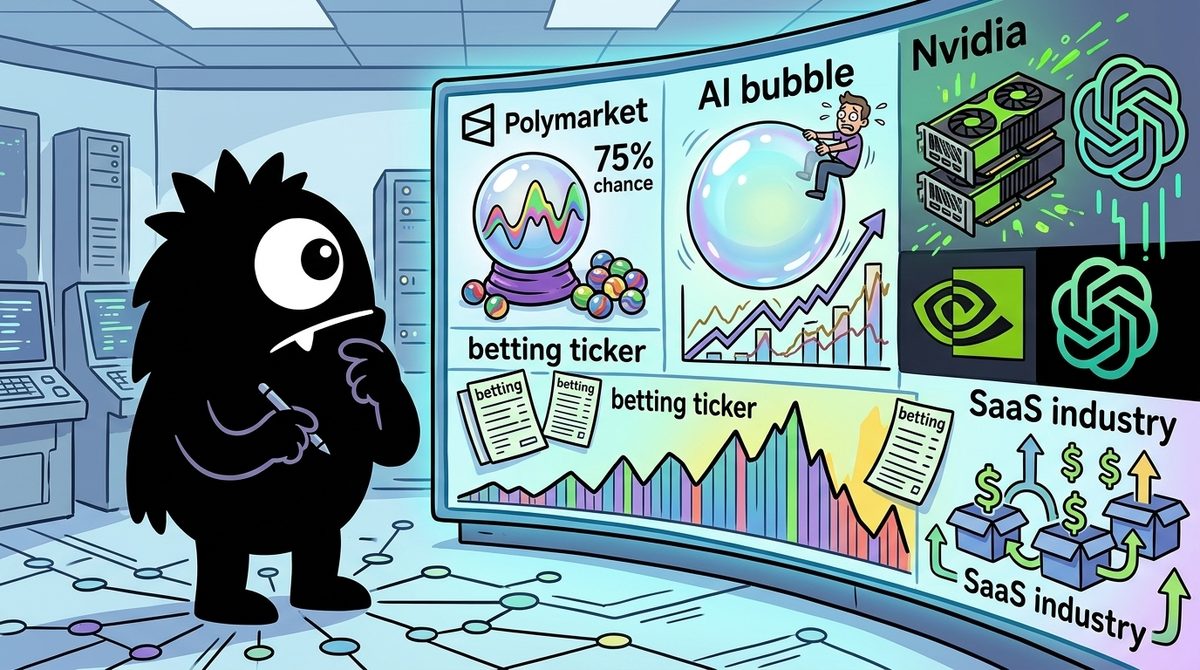
The practical question behind Polymarket’s “AI bubble burst by...?” market is not whether artificial intelligence is overhyped. It is whether traders see a meaningful chance of a specific, acute, market-wide break before the end of 2026—and whether developers, founders, and software buyers should change plans because of it.
As of August 11, 2026, traders price the “AI bubble burst in 2026” outcome at an implied probability of 15%. Approximately $2,339,377 has been traded on that outcome, within roughly $2,927,372 of total market volume. The market is scheduled to resolve around December 31, 2026.[1]
Bottom line: The market implies roughly an 85% probability that its defined burst conditions will not be met in 2026. That is not proof that AI valuations are sustainable, or that AI revenue will justify infrastructure spending. It suggests traders currently regard a sudden, synchronized collapse as a tail risk while pricing slower, sector-specific damage—especially in SaaS—as much more plausible.
The most useful interpretation is therefore not “the AI boom is safe.” It is that the market expects dispersion rather than detonation: some vendors, funds and software categories may suffer severe repricing without producing the concentrated event required for a “Yes” resolution.
The number everyone is quoting: What does 15% actually mean?
The live number has become confusing because X posts have circulated snapshots ranging from 12% to 21%.
Currently about 15% on Polymarket for the AI bubble bursting by Dec 31, 2026.
View on X12% chance the AI bubble bursts.
https://polymarket.com/event/ai-bubble-burst-by?via=x-afr2
21% chance the AI bubble bursts this year, per Polymarket:
View on XThose figures do not necessarily contradict one another. Prediction-market prices move as participants buy and sell, and posts can remain visible long after their quoted odds have changed. Polymarket’s broader AI and technology pages also present live markets rather than fixed forecasts.[2][3] Anyone using the percentage operationally should therefore record both the price and timestamp, not copy an isolated screenshot.
The relevant snapshot for this analysis is 15% on August 11, 2026, with about $2.34 million traded on the 2026 outcome.[1] That price can be read as the market collectively implying about a 15-in-100 chance of the contract resolving “Yes,” subject to its rules.
Three qualifications matter:
- Probability is not certainty. A 15% event can happen; an 85% event can fail to happen.
- Volume is not a poll sample. Nearly $3 million of turnover does not mean $3 million of independent conviction. The same capital can trade repeatedly, and large participants can influence price.
- “No burst” is narrower than “AI is healthy.” The market implies approximately 85% odds that its specified resolution threshold will not be crossed. It does not imply an 85% chance that every AI company, SaaS vendor or infrastructure investment succeeds.
That last distinction is the central one. The odds are compatible with substantial valuation compression, layoffs, failed products and vendor consolidation—as long as those developments do not satisfy the market’s formal definition.
Polymarket gives a 14% chance that the AI bubble bursts.
View on XHow does Polymarket define an AI “burst”—and why does the wording matter?
“AI bubble” is usually a subjective label. The Polymarket contract attempts to turn it into a resolvable event by looking for defined, observable stress signals rather than asking whether the industry merely feels overvalued.[1]
The discussion around the market describes signals such as a 50% decline in Nvidia shares, sharp funding reductions or widespread layoffs occurring within a tight 90-day period:
🚨 AI BUBBLE ODDS HOLD AT 14% ON POLYMARKET.
Polymarket traders are pricing a 14% chance that the AI sector hits a clear downturn by year‑end. The market tracks whether three major stress signals—like a 50% drop in Nvidia’s stock, sharp funding cuts, or widespread layoffs—occur within a tight 90‑day window.
The contract’s precise wording matters more than anyone’s general macroeconomic thesis. Traders are not simply answering, “Is there too much enthusiasm for AI?” They are pricing whether the specified evidence will occur within the required timeframe and satisfy the resolution process.
That makes 15% less surprising than it first appears. A slow deflation could be devastating for individual companies while never producing a qualifying burst. Consider several possible paths that might still resolve “No”:
- AI infrastructure spending slows gradually rather than collapsing.
- Public AI stocks fall, but not far enough or quickly enough.
- Funding dries up for application-layer startups while frontier labs remain well financed.
- SaaS vendors cut staff and lose pricing power, but layoffs are not sufficiently widespread or synchronized.
- One highly leveraged investor fails without causing sector-wide contagion.
A strict contract generally prices a bar-clearing event, not public unease. That helps explain why X can sound overwhelmingly anxious while the market remains near 15%.
The #AI bubble has room to inflate.
Polymarket gives a 14% year-end
chance of a bubble burst.
Fear leads before proof arrives.
Fourteen percent leaves doubt.
The forecast can change fast.
For practitioners, the implication is straightforward: use the contract to monitor the likelihood of acute market stress, not to answer the broader question of whether AI economics are attractive.
Is Polymarket a real signal or just a measure of crowd sentiment?
The strongest criticism in the X conversation is that prediction markets can convert a fashionable narrative into a precise-looking number without adding equivalent analytical rigor.
Polymarket odds are just crowd sentiment, not a real gauge of AI's durability. The hiring data says more: small businesses still can't find workers, so AI adoption will stay focused on labor gaps, not speculative overbuild.
If the bubble does pop, it'll be because earnings fail to justify capex, not because of a prediction market.
That critique is partly right. A market price can reflect positioning, attention, liquidity and participant composition as much as underlying fundamentals. Polymarket traders do not necessarily have privileged access to enterprise renewals, GPU utilization, private-company burn rates or hiring pipelines. A price can also move because one large trader reacts to the same headline everyone else has seen.
The opposite argument is that prediction markets force participants to attach a price to their beliefs. Because those prices update continuously, they can react faster than quarterly reports or analyst research. Polymarket now groups numerous markets around models, regulation, technical milestones and company performance, making the platform a potentially useful real-time map of AI expectations.[2][12]
With 552 active AI prediction markets, Polymarket has become a real-time barometer for the blistering pace of AI evolution. 📊https://polymarket.com/event/which-company-has-the-best-ai-model-end-of-april
As of April 3rd, these markets cover everything from model rankings and safety regulations to the probability of technical breakthroughs. Monthly active users have skyrocketed from 4,000 to 600,000, with total trading volume reaching $63.5 billion last year. 📈
In the "Who has the best AI model?" market, Anthropic currently holds a commanding 93% implied probability. Prediction markets are essentially pricing mechanisms for collective intelligence; when professionals bet real capital on AI's trajectory, the platform becomes the ultimate indicator for tech trends. 💡
This aligns with Luffa’s future vision: our intelligence system plans to integrate these prediction market signals into our daily tracking, capturing the most cutting-edge industry shifts as they happen.
#Luffa #Polymarket #AIAgents #Web3 #AITrends #Intelligence
But “real-time” does not mean “correct.” The best way to use the 15% number is as a sentiment thermometer with financial stakes, not an oracle.
For a developer, that thermometer can indicate whether public anxiety is turning into expectations of an industry-wide hiring shock. For a founder, it can show whether financing sentiment is deteriorating before a new round. For a technical buyer, it can flag when vendors built around aggressive growth assumptions may face pressure.
well i see the % bubble of polymarket bursts more than AI bubble bursts
AI here to take over world, imagine what happen with AGI in the next 2y
A disciplined market watcher should combine the odds with at least four external measures:
- AI-related earnings and forward guidance
- Capital expenditure versus realized AI revenue
- Private funding terms and down-round frequency
- Hiring, layoffs, renewals and net retention
If the contract rises while those fundamentals remain stable, the move may be narrative-driven. If the odds rise alongside weakening guidance, funding cuts and layoffs, the signal deserves more weight.
What did the Situational Awareness scare reveal about contagion risk?
The reported forced sale involving the Situational Awareness hedge fund offered a useful stress test for how the market reacts to a concentrated shock.
Situational Awareness went from AI market darling to forced seller of its entire $16B equity book in 48 hours.
This is the story of how Polymarket traders sniffed out the bust before mainstream media, and what they think happens next in the AI trade.
https://poly.market/GmpGBeQ
According to the account circulating among Polymarket-focused observers, a margin call forced the fund to liquidate billions of dollars of equities. Traders raised the perceived probability of an AI burst and reduced Nvidia-related bets before the full story had entered mainstream coverage. The burst odds subsequently eased as participants treated the episode as a fund-specific problem rather than proof of sector-wide contagion.
Situational Awareness Hedge Fund Sale
The AI hedge fund had a margin call, which forced it to sell off billions of dollars worth of assets
Polymarket noticed the market stress even before the news appeared: traders began to increase the likelihood of an AI bubble and reduce bets on NVIDIA
But the panic quickly subsided - the market decided that this was a problem for a separate fund, and not the beginning of a large-scale collapse of the AI sector
One forced seller, and Polymarket started signaling problems in the AI market ahead of the news
What did the traders see and why was it more important than the sale itself?
The important signal was not that the market had “predicted” a crash. It was that traders rapidly tested two competing explanations:
- Systemic interpretation: The seller had uncovered, or would trigger, broader weakness across the AI trade.
- Idiosyncratic interpretation: Leverage at one fund created forced selling without changing the industry’s underlying earnings or financing outlook.
The subsequent repricing toward containment suggests traders did not see enough evidence of a feedback loop. A genuine contagion process would more likely involve forced selling pushing down collateral values, triggering further margin calls, tightening financing and spreading losses to otherwise healthy holders.
Recent reporting has similarly distinguished between bubbles or excesses in specific parts of AI and a broader investment cycle that could continue growing.[11] That distinction aligns with the Polymarket response: one vehicle can break without the entire AI thesis breaking.
This episode also reveals why 15% should not be dismissed as trivial. Sentiment was sensitive enough to reprice on concentrated stress, but resilient enough to reverse when contagion failed to appear. The market currently seems alert, not panicked.
Is the real burst risk about Nvidia—or a collapse in trust?
The contract naturally directs attention toward measurable indicators such as stock prices, funding and layoffs. Practitioners, however, are raising a deeper possibility: the AI trade ultimately depends on confidence that model outputs can be trusted in valuable workflows.
>15%... AI bubble bursts by Dec 31, 2026
$2.9M vol from @polymarket
That 15% number isn't really about @nvidia stock or OpenAI going bankrupt.
► It's about TRUST.
The moment people stop believing AI judgment is reliable – at scale, in public, on things that matter to real people, the whole story starts to crack.
That thesis reframes the risk. Hardware demand and model capability matter, but enterprise value depends on whether organizations allow AI systems to influence consequential decisions. If reliability failures remain manageable, companies can continue moving from experimentation into production. If a highly visible failure causes customers, regulators or insurers to reconsider autonomous deployment, expected revenue could be revised rapidly.
Trust can deteriorate through several channels:
- Repeated hallucinations in regulated or high-stakes workflows
- Security failures involving agents with access to production systems
- Unclear accountability for automated decisions
- Benchmark gains that do not translate into dependable business outcomes
- Vendors overstating autonomy while customers absorb supervision costs
An OpenAI public offering has also entered the conversation as a possible sentiment catalyst:
@grok can openAI ipo be the reason for the AI bubble to burst?
View on XAn IPO would not inherently cause a burst. The market might price it as validation, excess or neither, depending on valuation, disclosures, demand and subsequent performance. The more important point is that a major listing could expose private AI economics to public-market scrutiny. Revenue quality, compute commitments, customer concentration and margins could then affect expectations across the sector.
Trust-driven deterioration is difficult for a strict prediction contract to capture. Confidence can erode slowly, workflow by workflow, without immediately producing a 50% stock decline or synchronized layoffs. Polymarket could therefore remain at low odds even as enterprise adoption becomes more cautious.
Why does the “SaaSpocalypse” coexist with only 15% burst odds?
The apparent contradiction of 2026 is that AI’s broad collapse is priced as unlikely while large parts of SaaS have already experienced severe valuation pressure.
Early-2026 SaaS analysis described weakening expectations as investors reconsidered how agentic AI might alter software economics.[6] Forrester framed the disruption as a “SaaS-pocalypse,” reflecting concern that AI could change packaging, interfaces and the value of traditional seat-based products.[10]
Yet the operational picture is not uniformly disastrous:
The SaaS index tells two stories and the market is only pricing one of them.
Story one: SaaS companies are executing. Most are meeting or beating plans. Revenue is growing. Free cash flow is positive. The median public SaaS company is generating $179M in operating cash flow. By every operational metric, these businesses are fine.
Story two: the market just gave them a 45-point spread against the NASDAQ. EMCLOUD down 31%, NASDAQ up 17%. A 45-point spread means the market is pricing in a categorical extinction event for an entire software delivery model.
Here’s what’s actually happening. The median SaaS revenue multiple has collapsed from 18-19x at the 2021 peak to 5.1x as of December 2025. Median revenue growth decelerated from 17% in 2023 to 12.2% by Q4 2025. Only 17% of public SaaS companies now exceed the Rule of 40. The math is compressing from both sides simultaneously: growth is slowing AND multiples are falling.
The AI agent threat is real but the market is pricing it as if every SaaS company sells the same thing. Publicis Sapient is already cutting traditional SaaS licenses by roughly 50% and replacing them with generative AI tools. But they’re cutting probabilistic tools, the ones where AI can replicate the output. They’re keeping their systems of record, the CRMs and ERPs where deterministic accuracy matters.
That distinction is everything. A SaaS company that stores your data and enforces your business logic has a fundamentally different risk profile than one that generates reports or drafts content. The market is treating them as the same trade. They’re not.
The companies sitting at 5x revenue with embedded workflow data across thousands of enterprise customers are getting priced like the ones selling AI-replaceable features on top. And that mispricing, where the entire category trades as a single risk, is where the opportunity is.
The figures in that post capture the disconnect. It describes a median public SaaS revenue multiple falling from 18–19 times at the 2021 peak to 5.1 times in December 2025, even while many companies remained cash-generative. The argument is not that all SaaS is healthy; it is that markets may be applying an overly broad AI-displacement discount.
This produces two separate 2026 stories:
- Systemic AI story: Traders currently put only 15% odds on the contract’s acute burst scenario.
- Software-selection story: Public markets may still punish vendors whose features can be replicated, whose pricing depends on seats, or whose products lack proprietary workflow context.
HOW THE MARKET PRICES GROWTH TECH ENTERING 2026
This chart shows how the market is valuing growth SaaS based on 3-year revenue CAGR (2025-2028) against EV to gross profit.
The market is already separating the companies that already have AI boats and which still need to build them ahead of the AI tsunami.
$NET, $PLTR, $SHOP, $FIG, $RBRK, $SNOW, $CRWD, $DDOG, $ZS, $KVYO, $MNDY, $TEAM, $IOT, $MDB, $NOW, $HUBS $PANW, $VEEV, $S, $ESTC, $PATH, $ADBE, $WDAY, $CRM, $OKTA, $GTLB, $OS, $FROG
By mid-2026, analysis suggested some recovery in SaaS valuations as investors developed a more differentiated view of AI exposure.[7] That does not mean the threat disappeared. It means the market increasingly distinguishes between:
- systems of record and optional productivity layers;
- vendors owning proprietary workflow data and generic wrappers;
- products with measurable AI monetization and those using AI mainly in marketing;
- durable recurring revenue and usage that could migrate directly to a model provider.
This is the article’s key synthesis: Polymarket’s low burst probability and SaaS’s valuation pain are not inconsistent. Traders can expect the AI buildout to continue while also expecting it to redistribute software value aggressively. The likely market expectation is not that every boat rises, but that capital moves toward infrastructure owners and software businesses with defensible data, distribution or workflow control.
Does an 85% “No” price mean AI is paying for itself?
The optimistic interpretation is that the market expects AI revenue to catch up with capital expenditure.
14% odds? That means Polymarket has priced in an 86% chance AI revenue will outpace capex before December. The bubble isn’t bursting; it’s just paying for itself
View on XIt is a compelling narrative—but it overstates what the contract says. An approximately 85% “No” probability is not equivalent to an 85% probability that AI revenue will outpace capex by December. It means traders currently price roughly an 85% chance that the specified burst criteria will not be satisfied.
The market can resolve “No” even if returns disappoint. Hyperscalers may continue investing despite uncertain near-term revenue. Companies may accept lower margins to preserve strategic position. Long-term infrastructure commitments may keep spending elevated after application demand weakens.
The more defensible optimistic thesis is buildout rather than immediate payback. AI adoption can continue if it addresses genuine labor constraints, automates expensive tasks or creates products customers will fund—even when aggregate returns remain uneven.
A multi-method academic analysis published in 2026 examined AI through several bubble frameworks rather than reducing the question to a single valuation ratio.[9] That approach is useful because bubble-like behavior can coexist with genuine technological progress. Excess financing, unrealistic startup pricing and speculative trading do not prove that the underlying infrastructure lacks long-term value.
The decisive variable is the path from spending to earnings:
- Are inference and infrastructure costs falling quickly enough?
- Are customers renewing AI products after pilots?
- Is usage producing incremental revenue or merely defending existing contracts?
- Can vendors maintain margins after model and compute costs?
- Does automation reduce labor costs without introducing unacceptable supervision and liability?
The 15% price suggests traders do not currently expect failures across these variables to culminate in a qualifying 2026 break. It does not settle whether today’s investments will earn attractive long-term returns.
What should developers, founders and SaaS buyers do with the 15% number?
The correct response depends on the decision being made.
Developers: Use the odds for timing signals, not career selection
Developers choosing a specialization should not treat a 15% contract as a reason to enter or leave AI. Career decisions operate over years; this market resolves in months under narrow criteria.
Instead, monitor whether changing odds coincide with:
- falling AI job postings;
- startup hiring freezes;
- cancelled model or data-center projects;
- declining open-source investment;
- vendors shifting from expansion to cost control.
The odds become actionable when market movement confirms real labor-market data. Engineers should prioritize transferable capabilities—data engineering, security, evaluation, distributed systems and production observability—rather than skills dependent on one vendor or speculative application category.
Founders: Build for a selective market, not a universal collapse
Founders should plan around the more probable risk revealed by the broader discussion: capital and valuations separating AI haves from have-nots.
The right strategy for an early-stage team with limited runway is to prove one narrow economic outcome rather than fund a broad infrastructure bet. Growth-stage companies should demonstrate defensible annual recurring revenue, retention and a credible path from model usage to gross margin. Vendors selling replaceable AI features need proprietary data, workflow integration, distribution or compliance advantages.
Interactive tools can help teams understand how events and order sizes affect implied probabilities, but simulations remain models of market behavior—not substitutes for company fundamentals.
@Super_Powers_AI Hey Super, build a high-performance interactive simulation and implied probability analyzer for Polymarket's '13% AI Bubble Burst' prediction market.
View on XSaaS buyers: Evaluate survivability, reliability and switching risk
Enterprise buyers should not delay valuable AI deployments solely because the market assigns a 15% burst probability. They should, however, avoid contracts that assume every current vendor will remain well financed.
For each supplier, ask:
- Does the product own a system of record or sit on top of one?
- Is its AI output auditable and dependable for the intended workflow?
- Can data and configurations be exported?
- What happens if the vendor changes model provider or pricing?
- Does the claimed ROI include review, security and compliance costs?
- Is the vendor’s business supported by recurring usage or investor subsidies?
Teams evaluating model providers can also use prediction markets to map expectations around future leadership, while recognizing that benchmark events can move prices faster than enterprise adoption.
@Super_Powers_AI Hey Super, build an interactive AI model leadership prediction market simulator based on Polymarket's 2026 year-end model standings market.
https://app.getsupers.com/sites/ai-model-race-odds-51/?card=8376373b3109ac5fc2b6
The tool allows users to trade shares in competing AI labs (Meta at 2%, OpenAI 41%, Anthropic 28%, Google 22%, xAI 7%), execute buys and sells using an AMM bonding curve, and simulate market probability updates driven by upcoming frontier model milestone events (e.g., benchmark releases, compute cluster deployments, open-source model releases).
Visitors can directly manipulate order sizes or trigger benchmark events to see live probability curves update, orderbooks shift in real time using D3.js visual curves, calculate expected portfolio payouts based on market-implied probabilities, and export trade summary reports.
The best reading of 15% on August 11, 2026 is neither reassurance nor an alarm. It is a market expectation that an acute, formally defined AI burst remains possible but unlikely before December 31. Beneath that headline, investors are already pricing a harsher and more practical outcome: a prolonged sorting process in which trust, earnings quality and workflow defensibility determine which AI and SaaS companies retain value.
Sources
[1] Polymarket — AI bubble burst by...? Predictions & Odds 2026
[2] Polymarket — AI Predictions & Real-Time Odds
[3] Polymarket — Technology Prediction Markets & Live Odds 2026
[4] CryptoSlate — AI bubble burst in 2026 Odds & Prediction Market Analysis
[5] Perplexity Finance — AI bubble burst by...?
[6] SaaS Capital — Four early 2026 SaaS trends
[7] First Analysis — SaaS valuations recover somewhat as AI perspective shifts
[8] Software Equity Group — SEG 2026 Annual SaaS Report
[10] Forrester — SaaS As We Know It Is Dead: How To Survive The SaaS-pocalypse!
References (15 sources)
- AI bubble burst by...? Predictions & Odds 2026 - polymarket.com
- AI Predictions & Real-Time Odds - polymarket.com
- Technology Prediction Markets & Live Odds 2026 - polymarket.com
- AI bubble burst in 2026 Odds & Prediction Market Analysis - cryptoslate.com
- AI bubble burst by...? - perplexity.ai
- Four early 2026 SaaS trends - saas-capital.com
- SaaS valuations recover somewhat as AI perspective shifts - firstanalysis.com
- SEG 2026 Annual SaaS Report - softwareequity.com
- Boom, Bubble, or Buildout? A Multi-Method Evaluation of Whether AI Is in a Financial Bubble as of May 2026 - arxiv.org
- SaaS As We Know It Is Dead: How To Survive The SaaS-pocalypse! - forrester.com
- One AI bubble has already burst. The next one—a 'rare' kind—is still growing, economist warns - fortune.com
- AI Prediction Markets & Live Odds 2026 | Polymarket - polymarket.com
- Best AI Prediction Market Sites of 2026: Trade on AI Models | SailGP - sailgp.com
- 26 Predictions for 2026 (Part II) | Digital Native - digitalnative.tech
- AI data center in space by...? Predictions & Odds 2026 | Polymarket - polymarket.com
Related Guides

Aider vs Cline: Which Is Best for AI Pair Programming in 2026?
15 min read
The Best AI Model Tools in 2026: An Expert Comparison Through a $4M Polymarket Bet
25 min read
What Is Replit? A Complete Guide for 2026
19 min read
Traders Are Betting on Anthropic: What Polymarket's 99% AI Model Odds Reveal for Developers in 2026
20 min read