The Best AI Market Signals in 2026: An Expert Read on the 'AI Bubble Burst' OddsUpdated: September 27, 2026
AI bubble odds sit at 15% on Polymarket in 2026. See what nearly $3M in trader positioning reveals for developers, founders, and SaaS buyers. Discover the signals.
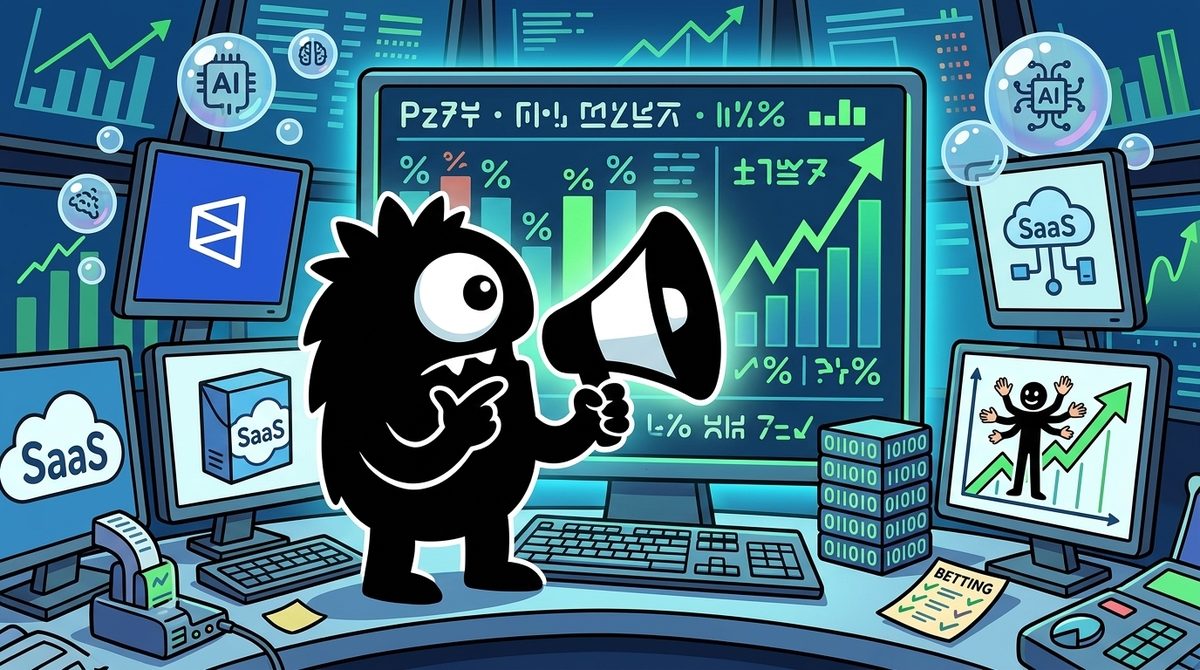
The practical question behind 2026’s AI-bubble debate is not simply “Is AI overvalued?” It is: Should developers, founders, and software buyers keep investing as if today’s momentum will continue, or prepare for a sharp reset before year-end?
The prediction market’s answer is cautiously bullish. As of August 12, 2026, Polymarket traders imply a 15% probability that the AI bubble bursts in 2026, with approximately $2,339,699 traded on that outcome. The broader “AI bubble burst by...?” market has attracted roughly $2,927,694 and is scheduled to resolve around December 31, 2026.[1]
Bottom line: The market currently prices an approximately 85% chance that no qualifying AI-bubble burst occurs in 2026. That supports continued investment in AI products, skills, and adoption—but a 15% tail risk is large enough that founders should protect runway, developers should avoid vendor-specific lock-in, and SaaS buyers should negotiate for portability and measurable returns.
The 15% Signal: What Is the Market Actually Pricing?
A 15% implied probability does not mean traders believe AI businesses are reasonably valued, that every AI startup will survive, or that infrastructure spending will produce attractive returns. It means something narrower: at current contract prices, the market assigns a 15% chance that the event will meet Polymarket’s criteria for an “AI bubble burst” by the end of 2026.[1]
The complement is equally important. Traders currently price roughly an 85% probability that a qualifying burst does not happen within that window. That is the base case embedded in the market—not a guarantee.
Prediction-market percentages are prices converted into probabilities. In simplified terms, a contract trading near $0.15 represents a market-implied probability near 15%, before accounting for trading frictions, market structure, and any ambiguity in settlement. Participants willing to risk money collectively establish that price.
That makes the signal different from an opinion poll or a viral X post:
- An opinion poll records what respondents say.
- A social-media trend measures attention and engagement.
- A prediction market measures the price at which traders will take opposite financial positions.
- A prediction-market price still is not objective truth. It reflects the participants, available information, liquidity, incentives, and contract wording.
The roughly $2.9 million in reported market volume shows meaningful interest, but volume should not be confused with the amount of independent capital expressing a single view. Trading volume can include repeated buying and selling, and it does not reveal how many unique traders have carefully modeled AI revenue, capital expenditure, or SaaS valuations.
The best reading, therefore, is precise but limited: traders are not dismissing the possibility of a 2026 break, but they currently see “no burst this year” as substantially more likely.
Why Are Traders Positioned for No AI-Bubble Burst—Yet?
The 15% price can coexist with widespread anxiety about AI valuations because “the sector looks overheated” and “a defined bubble burst will occur by December 31” are different claims.
A short deadline favors the status quo
Time is one reason. From August 12 to the end of December 2026, the market has only a few months in which the specified event can occur. Even a trader who expects eventual consolidation, lower valuations, or disappointing returns might reasonably bet against a burst during that particular period.
This is a form of timing risk. Being directionally right about an industry can still produce the wrong prediction-market position if the expected correction happens after the contract expires.
The market may therefore be saying less about whether current AI economics are sustainable over five years than about whether a visible break will happen before the end of 2026.
The word “burst” implies a higher bar than ordinary weakness
Resolution criteria matter in every prediction market. “Burst” is not synonymous with:
- A handful of startup failures
- A down funding quarter
- Layoffs at an AI company
- A correction in selected public stocks
- Lower SaaS valuation multiples
- Slower growth in infrastructure spending
- Consolidation among model or application vendors
Any of those developments could damage companies without satisfying the market’s ultimate settlement standard. Traders pricing the contract must estimate both the underlying economic event and whether observable developments will qualify under the rules.[1]
That ambiguity can suppress the “yes” price. A trader may believe the industry is overextended yet remain unwilling to buy a contract whose resolution requires a more definitive or broadly recognized rupture.
Real adoption can support an overheated market
The debate often gets framed as “bubble” versus “real technology,” but both can be true. A technology can have genuine users, useful products, and rapidly growing adoption while investment runs ahead of monetization.
That distinction helps explain the current odds. Traders can acknowledge stretched expectations while concluding that ongoing product launches, enterprise experimentation, contract renewals, and infrastructure commitments make a 2026 collapse less likely than continued expansion.
The market’s 85% no-burst base case should consequently be read as an expectation of near-term continuity—not as validation of every AI company’s business model.
Are SaaS Valuations and AI Capex Disconnected From Revenue?
For practitioners, the most useful question is not whether AI deserves the emotionally loaded label “bubble.” It is whether cash flowing into infrastructure and company valuations is converting into durable, high-margin revenue.
The prediction market cannot answer that directly. Its 15% probability compresses many competing views into one price. Operators need to monitor the underlying variables.
Infrastructure spending and application revenue operate on different clocks
AI infrastructure can be purchased before customers have demonstrated a willingness to pay enough for the resulting products. That creates a timing gap:
- Compute capacity is financed or reserved.
- Models are trained and deployed.
- AI features are incorporated into software.
- Customers test those features.
- Vendors attempt to turn usage into recurring revenue.
- Revenue must eventually cover inference, development, sales, and support costs.
A gap between step one and step six is not automatically evidence of a burst. It becomes dangerous when usage fails to create sufficient revenue, retention, or productivity gains before funding becomes more expensive.
The important SaaS indicators are operational
Founders, investors, and buyers should look beyond announcements and track:
- Gross margin after inference costs: Revenue growth is less valuable if every additional customer creates substantial model-serving expense.
- Net revenue retention: Existing customers should maintain or increase spending rather than abandon AI add-ons after experimentation.
- Paid conversion: High usage does not prove buyers will pay a sustainable premium.
- Customer concentration: Revenue dependent on a few experimental enterprise contracts is more fragile.
- Contract duration and renewal quality: Multi-year commitments provide stronger evidence than pilots or promotional usage.
- Inference-cost trends: Falling unit costs can rescue weak initial economics; rising usage costs without pricing power can undermine them.
- Time to measurable ROI: Customers need outcomes such as lower support costs, faster development, greater throughput, or new revenue.
The market’s 15% price does not quantify the probability that individual vendors will fail. Company-level risk can be much higher than sector-level “bubble burst” risk. That is why the odds are a macro sentiment signal, not a substitute for SaaS diligence.
What Do the 2026 Odds Mean for AI and SaaS Founders?
Founders should plan around the market’s 85% no-burst base case while financing the company so it can survive the 15% tail scenario.
That requires asymmetry: retain enough exposure to growth if enthusiasm continues, but avoid a capital structure that becomes fatal if funding or customer budgets tighten.
Who should continue spending aggressively?
Aggressive investment is most defensible for a company that has:
- Repeatable paid demand rather than mostly pilots
- Strong retention or expansion among existing customers
- Gross margins that remain viable after model costs
- A clear path from product usage to customer ROI
- Sufficient runway to withstand a slower fundraising environment
For these founders, the current odds support continued hiring and product development—but not indiscriminate spending.
Who should prioritize runway?
A more defensive posture fits companies that have:
- Less than a comfortable fundraising window
- Revenue concentrated in experimental AI budgets
- Heavy dependence on one model or infrastructure provider
- Negative unit economics masked by subsidized usage
- Valuations requiring exceptional growth to justify the next round
These businesses should consider slower hiring, staged infrastructure commitments, and earlier fundraising conversations. A 15% market-implied probability is too high to ignore when the downside could be existential.
Most importantly, founders should not confuse valuation momentum with defensibility. A durable AI company needs proprietary workflow integration, distribution, customer data advantages, switching costs, or demonstrably better economics. Merely reselling model access leaves the business exposed to falling API prices, platform replication, and vendor consolidation.
Prediction-market odds are useful here as an emotional counterweight. When X sentiment turns euphoric, the 15% “yes” price reminds founders that a meaningful group is paying to bet on a near-term break. When bubble warnings dominate the feed, the 85% complement shows that traders still favor continuity through year-end.
What Do the Odds Mean for Developers and Engineers?
For developers, an 85% implied chance of no 2026 burst supports continued investment in AI skills. It does not support tying a career to one model, framework, or vendor.
The strongest hedge is to learn skills that remain valuable whether the market expands or contracts:
- Data engineering and evaluation
- Distributed systems
- Security, privacy, and access control
- Model observability
- Cost and latency optimization
- Retrieval and search architecture
- Product experimentation
- Domain-specific workflow design
- API abstraction and migration planning
These are “AI-adjacent” capabilities, but they are not dependent on one company maintaining its current valuation.
Choose abstractions according to the cost of failure
A small team building a prototype can reasonably prioritize speed and use a tightly integrated vendor stack. Its primary risk is failing to reach users, not long-term lock-in.
A production team handling critical workflows should demand more:
- Provider-neutral interfaces where practical
- Exportable prompts, evaluations, and customer data
- Fallback models or degraded operating modes
- Monitoring of token, latency, and per-task costs
- Clear policies for model retirement and API changes
Developers should also evaluate vendor health rather than relying only on benchmark performance. Warning signs include abrupt pricing changes, disappearing service tiers, unstable product direction, and support quality that deteriorates as usage grows.
The career decision is therefore not “AI or no AI.” The better decision is portable AI competence versus narrow platform dependence.
What Do the Odds Mean for SaaS Buyers?
SaaS buyers face a different asymmetry. They receive only part of the upside if a vendor’s valuation soars, but they bear migration and operational costs if that vendor fails, is acquired, or sharply reprices its product.
A 15% sector-level tail risk is enough to justify contractual insurance.
Protective terms for material AI purchases
For systems that affect revenue, customer service, engineering, security, or regulated data, buyers should seek:
- Data-export rights in usable formats
- Termination clauses tied to material product or pricing changes
- Service-level commitments for availability and support
- Notice periods for model, API, and feature retirement
- Price protections or caps on usage-based increases
- Transition assistance following acquisition or shutdown
- Clear data-use terms, including whether customer data trains models
- Documented fallback procedures if an AI capability becomes unavailable
Large enterprises and regulated organizations should negotiate these terms before deep integration. Smaller teams with low switching costs may rationally accept less protection in exchange for flexibility or lower prices.
Do not prepay for theoretical AI value
Buyers should separate three categories:
- AI features already producing measurable savings or revenue
- Features showing promising adoption but incomplete ROI
- Road-map promises bundled into a higher renewal price
Longer commitments fit the first category when the vendor is financially credible and the contract protects portability. Short trials, usage caps, or phased rollouts fit the second. Buyers should resist paying a large premium for the third.
The market’s 85% no-burst probability is not a reason to freeze procurement. It is a reason to proceed while preserving an exit.
Are Prediction Markets Better Than AI Punditry?
Prediction markets offer one advantage over hot takes: participants must accept a financial consequence for being wrong. Prices can also update continuously as new information arrives, creating a real-time sentiment instrument.
But money-weighted does not mean infallible.
The “AI bubble burst by...?” market has roughly $2,927,694 in reported trading volume, enough to make it more informative than a casual online poll but not enough to eliminate structural weaknesses.[1] Those include:
- Resolution ambiguity: Traders may be pricing how adjudicators interpret “burst,” not just the economy.
- Participant selection: The trader population may not represent AI operators, enterprise buyers, or public-market specialists.
- Liquidity differences: A displayed price can move more easily when order-book depth is limited.
- Deadline effects: The probability may fall simply because less time remains, even if long-term concerns persist.
- Volume inflation through turnover: The same capital can trade repeatedly.
- Event compression: One binary number cannot describe valuation declines, startup failures, capex pullbacks, or uneven sector performance.
The most useful signal is often movement, not the absolute percentage. A sustained rise from 15% would indicate that traders are assigning more weight to a qualifying 2026 break. A falling price would indicate increasing confidence that the deadline will pass without one.
Practitioners should track the odds alongside operational evidence. If the market rises while vendor discounts deepen, renewals weaken, infrastructure commitments are cut, and fundraising terms deteriorate, the combined signal would be more meaningful than any one input. If odds move on rhetoric alone while customer economics remain stable, the move may be less actionable.
The Takeaway: Who Should Do What Before December 31, 2026?
The market currently implies that a 2026 AI-bubble burst is possible but not the base case. The correct response is neither panic nor unhedged enthusiasm.
- AI and SaaS founders: Build for the 85% continuity scenario, finance for the 15% tail. Continue investing if paid demand, retention, margins, and customer ROI are visible. Extend runway if growth depends on pilots, cheap capital, or subsidized inference.
- Developers: Keep learning AI systems, but favor portable foundations over expertise tied to one provider. Prototype quickly when switching costs are low; add abstraction, fallback paths, and cost monitoring before production dependence becomes material.
- SaaS buyers: Purchase AI capabilities that demonstrate measurable value. Use shorter commitments for unproven products and demand data portability, pricing protections, retirement notice, and exit rights for critical systems.
- Technical and financial decision-makers: Treat Polymarket as a sentiment gauge, not a valuation model. Watch how the 15% implied probability changes as the market approaches its December 31, 2026 resolution.[1]
The non-obvious message in the odds is that near-term resilience and long-term overextension are not mutually exclusive. Traders can price no burst in 2026 while still expecting failed startups, compressed SaaS multiples, or weaker returns from some AI investments.
That makes the prediction market useful—but only when read narrowly. Its present signal is not “the AI boom is safe.” It is: a decisive 2026 rupture is currently a minority expectation, while the downside remains large enough to insure against.
Sources
References (1 sources)
- Polymarket — AI bubble burst by...? - polymarket.com
Related Guides

Aider vs Cline: Which Is Best for AI Pair Programming in 2026?
15 min read
The Best AI Model Tools in 2026: An Expert Comparison Through a $4M Polymarket Bet
25 min read
What Is Replit? A Complete Guide for 2026
19 min read
Traders Are Betting on Anthropic: What Polymarket's 99% AI Model Odds Reveal for Developers in 2026
20 min read