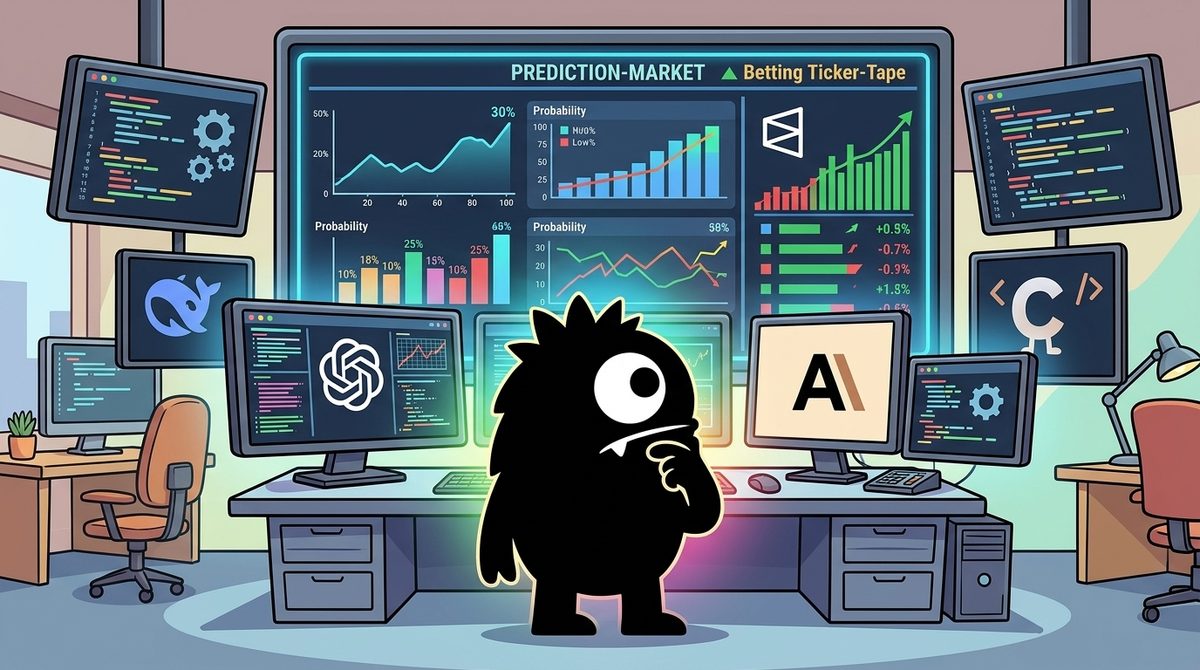
AI Bubble Burst by 2026? What Polymarket's 14% Odds Mean for Developers in 2026Updated: September 27, 2026
Polymarket traders price a 14% chance the AI bubble bursts in 2026. Discover what these live prediction-market odds mean for founders and SaaS buyers. Learn more.

The question for developers, founders, and SaaS buyers is not simply whether AI valuations look inflated. It is whether a sharp correction is probable enough in 2026 to change hiring, fundraising, architecture, or procurement decisions now.
As of August 13, 2026, Polymarket traders price the probability of an AI bubble bursting in 2026 at 14%—roughly a one-in-seven chance. The complementary reading is that the market assigns approximately 86% probability to no qualifying burst before year-end. That makes continued expansion the base case, but leaves enough downside risk to justify flexible contracts, portable infrastructure, disciplined burn, and measurable return-on-investment requirements.[1]
Bottom line
>
- Polymarket implies a 14% chance of an AI bubble burst in 2026, with about $2,340,806 traded on that outcome.
- The broader “AI bubble burst by...?” market has attracted roughly $2,928,801 in volume and resolves around December 31, 2026.[1]
- Traders currently price continuity—not collapse—as the dominant scenario.
- Practitioners should therefore keep adopting useful AI, while hedging against vendor failure, funding contraction, and valuation resets.
The Number That Matters: A 14% Implied Probability
Polymarket’s “AI bubble burst by...?” market has drawn approximately $2,928,801 in total trading volume as of August 13, 2026. Within it, the contract asking whether the AI bubble will burst in 2026 carries a 14% implied probability, with around $2,340,806 traded and resolution expected around December 31, 2026.[1]
An implied probability is the market price translated into odds. A contract trading near $0.14 is generally interpreted as traders collectively assigning the event about a 14% chance of occurring under the market’s rules. If the qualifying event happens and the contract resolves “Yes,” a winning share pays $1; if not, it pays nothing.
That does not mean an AI correction will be exactly 14% likely in any objective or scientific sense. Nor does it mean traders believe AI businesses have a 14% chance of failing. It means participants currently price a roughly one-in-seven chance that the contract’s specified definition of an AI bubble burst will be satisfied by its deadline.
The distinction matters. A downturn in public AI stocks, a failed funding round, layoffs at an AI company, or falling model prices might feel like a burst without necessarily meeting the resolution conditions. Conversely, a qualifying market event could trigger resolution even while AI usage continues to grow.
Still, nearly $3 million in volume makes the market more informative than an informal social-media poll. Participants can lose money for being wrong, creating an incentive to evaluate new information rather than merely express optimism or pessimism. Volume also indicates meaningful disagreement: trades occur because participants hold different views of the probability or believe the current price is miscalibrated.
The best interpretation is therefore narrow but useful: traders see a 2026 burst as possible, consequential, and worth wagering on—but decidedly outside the base case.
Can a Betting Market Really Predict the AI Cycle?
Prediction markets aggregate money-weighted beliefs. Instead of asking respondents whether AI is a bubble, they require traders to take positions at specific prices. A skeptic who thinks the real probability is 30% may buy “Yes” at 14 cents; an optimist who believes it is 5% may take the other side.
That mechanism can make a market more responsive than a conventional survey. New information—weak earnings, changing capital expenditure, a major funding round, enterprise adoption data, or regulatory action—can be incorporated into the price quickly.
But prediction markets are not crystal balls. Four limitations are especially important here.
The definition of “burst” controls the result
“AI bubble” is a cultural and financial label, not a standardized economic indicator. A market must convert that fuzzy idea into enforceable resolution criteria. Traders are pricing whether those criteria will be met, not every possible interpretation of an industry correction.
Anyone using the 14% figure should read the market rules and resolution language directly.[1] Seemingly technical details—covered companies, thresholds, dates, data sources, and treatment of temporary declines—can materially affect the price.
Volume is not the same as predictive depth
The roughly $2.9 million headline volume represents cumulative trading activity, not necessarily the amount of capital available at every price. The same contract can change hands repeatedly. A market may have substantial historical volume while still having limited liquidity for a large new position.
That means a well-funded trader—or several traders reacting to the same narrative—can sometimes move the displayed odds. The price is meaningful, but it should not be mistaken for a statistically representative survey of developers, enterprise buyers, venture investors, and economists.
The deadline suppresses broad, long-term concerns
The contract resolves around December 31, 2026.[1] Traders may believe AI valuations will eventually correct while assigning low probability to the correction happening within the remaining months of 2026.
A 14% price can therefore coexist with substantial long-term skepticism. It does not imply that traders consider current investment levels sustainable indefinitely; it implies that most do not expect a qualifying rupture within this contract’s window.
Markets can reflect narrative as well as fundamentals
Prediction markets react to sentiment, attention, and positioning. If “AI bubble” discourse intensifies on X, traders may update even before hard business metrics change. Conversely, excitement around a model release or financing announcement can reinforce optimism without proving durable enterprise value.
For practitioners, the right approach is to treat 14% as a live risk price, not a verdict. It belongs beside customer retention, cloud spending, model economics, vendor financial health, and public-market signals—not above them.
Why Traders Are Pricing Calm Over Catastrophe
The inverse of the 14% “Yes” price is an approximately 86% implied probability that no qualifying burst occurs in 2026. That is not necessarily a vote for every AI company or valuation. It is a bet that the broader cycle retains enough momentum to avoid crossing the contract’s threshold before year-end.
Several forces could explain that positioning.
First, enterprise AI adoption can continue even when individual products disappoint. Once AI features become embedded in support, development, search, analytics, sales, and document workflows, the relevant buyer question changes from “Should we use AI?” to “Which implementation creates enough value to keep?” That transition favors continued spending while increasing pressure on weak vendors.
Second, infrastructure commitments create inertia. Data centers, chips, cloud capacity, power agreements, and model-development programs operate on longer timelines than social-media sentiment. Even if expected returns decline, previously approved projects do not all disappear immediately.
Third, useful workflows can be sticky. A product that materially reduces handling time, improves developer throughput, or automates a costly process may survive a valuation correction because its value rests on operational economics rather than novelty.
The 14% downside price nevertheless captures legitimate pressure points:
- Capital intensity: Training and serving models can require substantial, recurring expenditure.
- Margin uncertainty: Rapidly falling model prices help buyers but can weaken vendors whose differentiation depends on marking up inference.
- Valuation risk: Revenue can grow while a company’s valuation still falls if earlier expectations were too aggressive.
- Financing dependencies: Companies that require repeated capital infusions are more exposed if investor appetite changes.
- Commoditization: Features built primarily on widely available model access may struggle to maintain pricing power.
There is also a simple calendar effect. Dramatic system-wide bursts are uncommon during any specific short period. Traders do not only need to be directionally right about excess; they must be right about timing and the resolution definition. That helps explain why skepticism about AI economics can coexist with an 86% implied “no burst in 2026” base case.
What Would an AI “Burst” Actually Mean for the Technology Stack?
A burst would not affect every layer equally. Practitioners should separate financial repricing from fundamental collapse in usage.
A valuation correction means investors become less willing to pay high multiples for expected future growth. AI products could keep gaining users while startups raise money at lower valuations, public companies fall, and hiring slows. A fundamental collapse would be more severe: customers would reduce deployments because the products failed to deliver sufficient value.
The former is easier to imagine than the latter—and far more relevant to planning.
Infrastructure and API pricing
A correction could produce opposing effects. Reduced demand growth might make some compute capacity cheaper, benefiting developers and buyers. But financially stressed providers could also withdraw subsidies, tighten free tiers, increase minimum commitments, or discontinue low-margin services.
Teams should consequently avoid assuming that a downturn automatically makes inference cheaper. The outcome would depend on capacity, competition, contract structure, and provider solvency.
For production systems, the practical hedge is architectural portability: isolate model calls, maintain evaluation suites, track cost by workflow, and preserve the ability to change models or providers. Full multi-cloud complexity is unnecessary for many small teams, but tightly coupling core business logic to one proprietary interface creates avoidable risk.
Startup funding and hiring
A valuation reset would probably be most painful for companies that need Series B or later capital before reaching credible unit economics. Investors could demand stronger revenue quality, shorter paths to profitability, and clearer technical defensibility.
Hiring would likely become more selective rather than uniformly stop. Roles tied to deployment, data quality, security, evaluation, infrastructure efficiency, and customer outcomes would remain easier to justify than speculative head-count growth based on expected future financing.
The SaaS application layer
Thin products whose main function is packaging a general-purpose model face the clearest consolidation risk. If a model provider or incumbent SaaS suite can reproduce the feature, the standalone vendor needs another moat: proprietary workflow data, distribution, integration depth, regulated-domain expertise, switching costs, or superior reliability.
By contrast, software attached to a system of record or a mission-critical workflow can retain value even if “AI” loses marketing power. A burst in valuations would not erase demand for automation; it would make customers less willing to pay for undifferentiated automation.
What Does the 14% Signal Mean If You Are Buying or Building SaaS?
An 86% implied probability of no qualifying 2026 burst supports continued adoption—but not indiscriminate purchasing. The appropriate strategy is deploy, measure, and preserve optionality.
SaaS buyers should evaluate vendor durability
For material deployments, ask vendors:
- Which model and infrastructure providers are critical dependencies?
- Can the product switch models without breaking customer workflows?
- How are inference-cost changes passed through?
- What happens to customer data and exports if the service closes?
- Are essential AI features included in the contract or separately metered?
- Does the vendor have credible revenue, runway, or backing?
- Can the product demonstrate renewal-worthy value beyond a pilot?
Large enterprises should add security, data-residency, auditability, continuity, and escrow requirements where appropriate. Smaller teams usually cannot conduct extensive financial diligence, so they should prioritize exportability, short commitments, usage caps, and replacement plans.
Contract length should follow switching cost and proven value
A multi-year agreement can make sense when a product is deeply integrated, delivers measured savings, and offers meaningful pricing concessions. It is a poor fit for an experimental assistant with unclear adoption or rapidly changing model dependencies.
Buyers should seek:
- annual or shorter initial terms for unproven tools;
- renewal caps or price-protection provisions;
- termination rights after material product changes;
- data-export and deletion commitments;
- service-level remedies;
- transparency about usage-based charges.
The market’s 14% downside signal is not a reason to freeze procurement. It is a reason to avoid contracts that only work if today’s vendor, pricing model, and feature advantage remain unchanged.
Builders should fund outcomes, not novelty
Internal teams should prioritize workflows with a defined baseline: cost per resolved ticket, time to complete a task, error rate, conversion rate, or developer cycle time. If success cannot be measured, it becomes difficult to distinguish durable value from hype.
A useful decision rule is straightforward: buy when integration speed and vendor maturity matter more than customization; build when proprietary data, workflow differentiation, control, or scale economics justify ownership.
What Should Founders Do With a 14% Downside Signal?
For founders, 14% is too low to justify retreating from a strong market—but too high to run a company that survives only under perfect financing conditions.
Plan runway around delayed capital
Founders should model at least three scenarios:
- Momentum continues: Demand and financing remain available through 2026.
- Selective slowdown: Customers keep buying but procurement lengthens and investors demand stronger metrics.
- Sharp reset: New funding becomes expensive or unavailable while customers consolidate vendors.
The appropriate runway depends on stage. Pre-seed companies need enough time to find a repeatable problem; growth-stage companies need evidence that expansion is not masking poor margins or churn. Any company expecting to raise soon should know what happens if the round takes twice as long or comes at a lower valuation.
Build defensibility above the model layer
Model access alone is unlikely to remain a durable moat. Stronger defenses include:
- proprietary or permissioned data;
- workflow integration;
- evaluation and observability infrastructure;
- domain-specific trust and compliance;
- distribution advantages;
- user feedback loops;
- low-cost, reliable operations.
The key test is whether the product becomes more valuable as foundation models improve—or becomes easier for customers and incumbents to replicate.
Raise from strength, not from market timing alone
An optimistic financing environment may favor raising before sentiment changes. But capital is not free protection: excessive dilution, unrealistic milestones, and expanded burn can make a later correction more dangerous.
Founders with measurable traction and a capital-intensive plan may reasonably secure runway while the market’s base case remains constructive. Efficient businesses with improving revenue may retain more leverage by avoiding a premature round. The decision should turn on milestones and cash needs, not an attempt to trade a prediction-market deadline.
Which Leading Indicators Could Move the Odds Before December 31, 2026?
Practitioners should watch the variables that can either validate continued investment or expose a gap between spending and returns.
Big Tech capital expenditure and AI revenue
Rising infrastructure commitments can reinforce the continuity case, particularly when paired with credible revenue growth. But capex without improving monetization could strengthen the bear argument. The crucial measure is not expenditure alone; it is whether demand and returns appear capable of supporting it.
Frontier-model financing and valuation
Large rounds at stable or rising valuations would indicate continued investor confidence. Down rounds, delayed financing, emergency capital, or worsening deal terms could increase perceived burst risk—especially if several firms face pressure simultaneously.
Enterprise renewals, expansion, and churn
Pilot announcements are weaker evidence than paid renewals. Buyers should watch whether enterprises expand AI deployments after initial trials, reduce seat counts, or consolidate tools into existing platforms. Durable value appears in retention and budget ownership, not demo activity.
API prices and gross-margin signals
Falling inference costs can broaden adoption, but they also compress vendors whose economics rely on reselling model access. The healthiest signal would be declining unit costs alongside stable customer value and improving margins. A pricing race without differentiation would increase consolidation risk.
Hiring and funding breadth
A few exceptional companies can raise money during a broader slowdown. More informative signals include how widely capital is available, whether later-stage rounds close, and whether hiring remains concentrated in production roles rather than promotional expansion.
No single indicator proves a bubble has burst. A meaningful shift in Polymarket’s 14% price would more likely follow a cluster of reinforcing evidence than one disappointing headline.
The Bottom Line: Plan for 86%, Hedge for 14%
As of August 13, 2026, betting markets imply that no qualifying AI bubble burst in 2026 is the substantially more likely outcome. The 14% “Yes” probability nevertheless represents a material tail risk, not background noise.[1]
The practical response depends on role:
- Developers: Continue building AI expertise, but keep skills and architectures portable. Learn evaluation, data engineering, observability, security, and cost optimization rather than specializing only in one provider’s interface.
- SaaS buyers: Adopt products with demonstrated ROI. Use shorter contracts for experimental tools, negotiate data portability and price protections, and evaluate vendor dependencies.
- Early-stage founders: Pursue the opportunity if customer pain is real, but preserve runway and prove value before scaling fixed costs.
- Growth-stage founders: Stress-test margins, financing needs, and renewal quality. Raise when capital advances a defensible milestone—not merely because sentiment is favorable.
- Technical leaders: Separate model enthusiasm from production readiness. Require reliability, measurable outcomes, and a fallback path.
Polymarket’s price does not settle the debate over whether AI is overvalued. It tells us something narrower and more actionable: traders currently believe a qualifying 2026 burst is possible but unlikely. The rational operating posture is therefore neither panic nor complacency. Build for the 86% base case, while making sure the company, contract, or architecture can survive the 14%.
Sources
References (1 sources)
- Polymarket — AI bubble burst by...? - polymarket.com
Related Guides
The Best AI Model in 2026: What Polymarket's $4M Bet Reveals About Where AI Is Heading
17 min read
Aider vs Cline: Which Is Best for AI Pair Programming in 2026?
15 min read
The Best AI Model Tools in 2026: An Expert Comparison Through a $4M Polymarket Bet
25 min read
What Is Replit? A Complete Guide for 2026
19 min read