The Best AI Market Signals in 2026: What Polymarket's 14% Bubble-Burst Odds Reveal About AI and SaaSUpdated: September 27, 2026
Polymarket puts AI bubble burst odds at just 14% with $2.9M traded. Discover what the market implies for developers, founders, and SaaS buyers in 2026. Learn more.
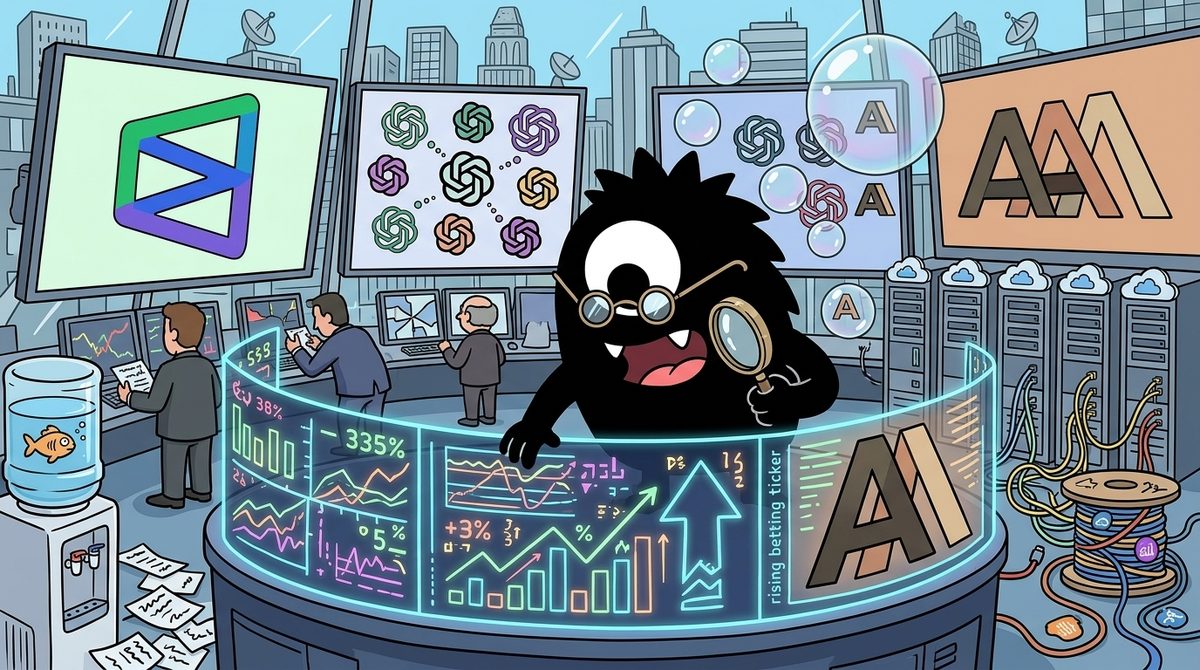
The practical question behind Polymarket’s “AI bubble burst by...?” market is not simply whether AI is overvalued. It is whether developers, founders, and software buyers should prepare for a broad industry break before the end of 2026—or for a less dramatic but still painful repricing.
As of August 14, 2026, traders price a 14% implied probability that the contract’s conditions for an AI bubble burst will be met by roughly December 31, 2026. About $2,341,127 has traded on the 2026 contract, out of approximately $2,929,122 across the wider event.[11] That leaves an implied 86% probability that the specified event does not occur by the deadline.
The bottom line:
- Polymarket implies that a qualifying near-term rupture is unlikely, not that AI valuations or business models are healthy.
- The contract’s high resolution threshold makes 14% less reassuring than it first appears. SaaS multiples, startup funding, or AI margins can deteriorate without triggering a “Yes.”
- The most exposed businesses may be thin-margin AI applications and vulnerable SaaS vendors—not necessarily foundation-model labs or chip suppliers.
- Practitioners should use the odds as a live stress indicator, then make decisions from unit economics, vendor durability, workload portability, and cash runway.
What Does Polymarket’s 14% AI Bubble-Burst Probability Really Mean?
A prediction-market price is the amount traders are collectively willing to pay for a contract under a particular set of rules. A 14-cent “Yes” price is commonly read as roughly a 14% implied probability, but it is not an objective forecast generated from all available evidence. It is a traded price shaped by participants, liquidity, positioning, time remaining, and the resolution language.
That last point is critical. Polymarket’s market does not resolve based on whether commentators decide AI “felt like a bubble” in retrospect. It tracks specific, observable stress signals, including conditions involving a roughly 50% Nvidia decline, sharp funding contraction, or widespread layoffs within a tight 90-day window.[11] Secondary market trackers have reported different probabilities as the contract moved, including 12.4% at another snapshot.[4]
🚨 AI BUBBLE ODDS HOLD AT 14% ON POLYMARKET.
Polymarket traders are pricing a 14% chance that the AI sector hits a clear downturn by year‑end. The market tracks whether three major stress signals—like a 50% drop in Nvidia’s stock, sharp funding cuts, or widespread layoffs—occur within a tight 90‑day window.
The contract has drawn millions in trading volume, showing how closely investors are watching for signs that the AI boom could cool. The odds have stayed low, suggesting most traders think the industry will keep expanding through the end of the year.
The posts citing 14%, 16%, 18%, 20.3%, 23%, or 26% are therefore not necessarily contradictory. Prediction markets update continuously. A forced asset sale, financing announcement, earnings report, or shift in Nvidia’s price can cause traders to reposition. The date of the observation matters as much as the percentage.
The #AI bubble has room to inflate. Polymarket gives a 14% year-end chance of a bubble burst. Fear leads before proof arrives. Fourteen percent leaves doubt. The forecast can change fast.
View on XThe correct interpretation on August 14 is narrow: traders currently put the odds of the defined conditions occurring by the deadline at 14%. They do not put a 14% probability on every conceivable version of an AI downturn. A rolling software selloff, declining startup valuations, weak gross margins, or a multiyear capex hangover could all unfold without satisfying the contract.
That distinction explains why the market can look calm while industry financials look considerably less comfortable.
Why Do Calm Bubble Odds Coexist With Alarming AI Financials?
The strongest bearish argument in the live debate is that capital requirements and expected revenues appear badly mismatched. One widely shared post points to a reported $207 billion OpenAI funding gap through 2030 and extremely high private-market valuations as evidence that the sector is raising money faster than it is proving durable earnings.
AI BUBBLE: THE MARKET SAYS IT WON'T POP. THE FINANCIALS DISAGREE @Polymarket prices an "AI bubble burst by end of 2026" at just 18%, down 15 points The crowd is MORE confident the party continues, while the funding gap grows • OpenAI is staring at a reported $207 billion funding gap through 2030 • Its own CFO has publicly questioned readiness for public-company scrutiny • Anthropic just raised at a $965B valuation, overtaking OpenAI's $852B These are not the numbers of a settled industry. They are the numbers of a sector raising faster than it earns. "Bubble burst" markets are almost always underpriced, because nobody wants to hold the bearish side while the line still goes up. The rational read isn't calling a crash. It's noticing that 18% looks low for an industry funding itself on expectations it hasn't met yet. ALWAYS DYOR
View on XRecent reporting has similarly framed the AI boom as an unusual kind of bubble risk because the investment is concentrated in real, expensive infrastructure rather than purely speculative websites or intangible assets.[7] Other 2026 analyses highlight the possibility that aggressive data-center and chip investment could outrun monetizable demand.[9][10]
The bearish mechanism is straightforward:
- Hyperscalers, model labs, and infrastructure providers build capacity based on expected demand.
- Competition and hardware efficiency reduce the marginal price of inference.
- Customers consume more AI but pay less per unit of intelligence.
- Revenue growth fails to cover depreciation, financing, energy, and model-development costs.
- Investors reduce funding, causing layoffs, delayed projects, and lower valuations.
AI BUBBLE WILL BURST IN MID-2026 While AI adoption is expected to continue growing, a significant bubble is forming in data center investment. US companies are planning to spend $7T on new data center and GPU investments. At some point, supply will start to outstrip demand exponentially, driving the cost of inference to near zero. Revenues will plummet dramatically, and the already growing losses will escalate, causing the bubble to burst. Ironically, AI adoption will contine to skyrocket as consumers access SOTA models for free.
View on XThis thesis contains an important paradox: rapid AI adoption does not guarantee attractive AI economics. Inference could become ubiquitous while returns on infrastructure decline. A technology can transform software and still disappoint the investors financing its buildout.
Why, then, does the market imply only 14%?
The main reason may be time. From August 14 to December 31 is a short period in which to satisfy a demanding, multi-signal contract. Even traders who expect overcapacity or weaker returns in 2027 could rationally buy “No” for 2026. The 86% side may therefore represent confidence in the deadline more than confidence in the decade.
It is also easier for financing stress to remain contained when large technology companies can fund capex from existing cash generation. Fidelity’s framework for assessing an AI bubble explicitly separates high valuations from other warning signs, including earnings growth and whether capital spending remains affordable.[8] Those variables could weaken gradually without producing the concentrated 90-day shock the market requires.
What Bull Case Is the Market Pricing for the Rest of 2026?
The bullish interpretation is that AI demand and monetization will remain strong enough through December to prevent simultaneous breakdowns in equity prices, financing, and employment.
14% odds? That means Polymarket has priced in an 86% chance AI revenue will outpace capex before December. The bubble isn’t bursting; it’s just paying for itself
View on XThat post overstates what the contract proves. An 86% “No” price does not literally mean an 86% probability that revenue will outpace capex. Revenue could trail spending while the resolution conditions still fail to occur. But it captures the broader bullish intuition: traders do not currently expect the financial mismatch to become an acute, contract-triggering crisis before year-end.
Valuation comparisons also complicate the bubble narrative. Some investors argue that most major AI beneficiaries trade below the extreme multiples associated with earlier speculative peaks.
After reviewing forward P/S and EBITDA multiples across the MAG7, Palantir, CoreWeave, and the rest of the AI leaders, here’s the truth:
There is no AI bubble.
With one exception — Palantir — whose elevated multiple is earned because of the ontology architecture I’ve been talking about… the rest of the field is trading well below 2021 levels. Multiples have drifted up since the 2022 lows, yes — but nowhere near the dot-com moonshots where everything went vertical overnight.
That does not mean the companies are cheap, nor does it eliminate concentration risk. It does suggest that “AI bubble” is too broad a category. A profitable hyperscaler, a chip designer, a debt-financed data-center project, a foundation-model lab, and an API wrapper have different margins, capital needs, and valuation logic. They are unlikely to fail—or remain resilient—for the same reasons.
Underlying software demand also remains substantial. Gartner’s forecast, reported by SaaStr, projects 2026 business-software spending of $1.4 trillion, up 14.7%.[12] If that expectation holds, AI could redirect software budgets rather than destroy them. Spending may move from seats to consumption, agents, data platforms, security, and implementation services.
For practitioners, the relevant bullish case is therefore not “every AI company wins.” It is that enterprise demand remains large enough for infrastructure investment and software substitution to proceed without producing a synchronized break by December.
Is SaaS Being Repriced Rather Than the AI Bubble Popping?
The headline contract may obscure the more immediate story: public software investors are reducing what they will pay for predictable future cash flows because those cash flows no longer look as predictable.
One viral post characterizes the decline as the death of SaaS, citing a fall in multiples from roughly 18.5 times at the pandemic peak to 4.8 times and arguing that agent adoption will undermine per-seat pricing.
I genuinely believe we're watching SaaS die in real time and most people still don't see it..
$1 trillion wiped from software stocks since January 2026 and its just getting started..
SaaS multiples collapsed from 18.5x at the covid peak to 4.8x today and in the same time the AI market went from $50B to $539B and it's heading to $3.5 trillion by 2033 if not sooner
the death cross hits around 2027.. that's when AI market trajectory fully overtakes SaaS valuations on the chart
the reason is simple.. the per-seat model dies when 10 agents replace 100 humans and no seats left to sell
Those figures come from the post rather than the Polymarket contract, but the mechanism is relevant. Traditional SaaS pricing assumes that customer headcount, seats, renewal rates, and expansion revenue remain reasonably forecastable. If a customer can replace parts of a workflow with agents—or rapidly build a competing internal tool—seat growth becomes less reliable.
The more precise interpretation may be multiple compression caused by lost visibility, not the disappearance of software.
AI is compressing valuations.
This isn’t fear.
It’s uncertainty.
When you can’t forecast cash flows 3 years out, you don’t get premium multiples.
AI isn’t creating a bubble.
It’s destroying visibility.
Software isn’t just “cheap.”
It’s being repriced for a world where:
• Competition is instant
• Intelligence is abundant
• Moats erode faster than models update
A lower multiple is the market’s way of charging for uncertainty. When investors cannot estimate revenue retention, margins, or competitive position three years out, they demand a lower price today. Forrester’s “SaaS-pocalypse” analysis similarly argues that established SaaS assumptions are changing and vendors will have to adapt their operating and value-delivery models.[13]
This creates a puzzling market dynamic. If AI is expected to consume SaaS value, capital should theoretically rotate toward the semiconductor companies and hyperscalers supplying the replacement. Instead, investors may sell both groups.
The SaaS carnage is confusing for this simple premise:
If AI is going to commoditize all of SaaS, then why isn’t the market rotating heavily into Semis and Hyperscalers?
If Anthropic were to destroy $CRM and $NOW, I’d imagine we need tons of compute. More than we can fathom if agents take over hundreds of billions of marketcap for SaaS companies.
Yet, the market is selling off SaaS AND AI names which doesn’t seem to make sense if all the demand for the SaaS carnage will lead to AI growth.
Also, how is AI a bubble if we are talking about massive enterprise software companies being decimated by AI?
The entire logic behind the selloff feels more like forced, structural rotation without a pure reason for why the rotation is happening.
From Goldman: “The forward P/E multiple for software has declined from 35x in late 2025 to 20x currently, representing the lowest absolute level since 2014 and the smallest premium to the average S&P 500 stock since 2010.”
Several explanations can coexist:
- Investors may expect SaaS revenue destruction to happen faster than AI profits emerge.
- Falling software valuations may reflect forced de-risking rather than a clean sector rotation.
- Lower inference prices may benefit customers while limiting supplier margins.
- Enterprises may adopt agents slowly because of security, integration, governance, and reliability constraints.
- Both SaaS and AI infrastructure could have been priced for more certainty than current evidence supports.
For SaaS founders, the decision criterion is not whether “SaaS dies.” It is whether the product owns a durable workflow, proprietary data, distribution, compliance position, or system of record that remains valuable when model intelligence becomes cheap.
For buyers, repricing can create leverage—but also vendor risk. A heavily discounted multiyear contract is unattractive if the provider must cut support, sell itself, or discontinue the product.
Are Thin-Margin AI Wrappers the More Likely Bubble Risk?
The most useful segmentation in the X debate separates foundational infrastructure from the application layer. Some AI applications are valued like scalable SaaS companies even though each customer action incurs variable model and compute costs.
Replit and Lovable will pop the AI bubble, not OpenAI or Anthropic.
They both raised $400 million each in the last few months.
They are evaluated using SaaS economy multipliers: build once, sell to millions. Infinite scale.
But the reality is more brutal. Their business is closer to manufacturing than SaaS.
They depend on suppliers - tokens. AI wrappers have the worst margins in tech.
Lovable themselves reported only 35-36%, while large-scale SaaS is expected at 80-85%.
The post cites gross margins of 35%–36% for Lovable, compared with an expected 80%–85% for large-scale SaaS, and says Lovable and Replit each recently raised $400 million. These figures should be treated as the author’s claims rather than as Polymarket data. But the underlying unit-economics question is valid: does incremental usage create high-margin recurring revenue, or merely increase the token bill?
An AI wrapper is not automatically a weak business. The label often hides meaningful product work in orchestration, evaluation, data access, user experience, and workflow integration. Risk rises when a company has all of the following:
- Heavy dependence on one or two model suppliers
- Limited ability to pass token costs to customers
- Low switching costs
- Features that model providers could absorb
- Valuation based on mature-SaaS margins that have not materialized
- Growth purchased through subsidized usage
Large funding rounds can extend the time available to improve margins, but they can also delay recognition of weak economics. More capital does not itself create pricing power.
The timing is the trade: $18B goes all-in on AI agents the same day "AI bubble burst in 2026" ticks up 3 points to 26% on Polymarket. need a market on whether the AI fund outperforms the human analysts it replaced
View on XThis is where the app layer could connect to Polymarket’s resolution mechanics. A series of isolated startup shutdowns would probably not be enough. A synchronized funding retreat followed by widespread layoffs might matter, depending on whether it meets the contract’s exact thresholds and timing.[11]
Founders should identify which economic model actually describes their company:
- SaaS-like: high gross margins, low incremental delivery cost, strong retention.
- Usage platform: variable costs, but defensible scale and metered pricing.
- Services-like: significant human implementation and support.
- Manufacturing-like: each unit of output carries a substantial supplier cost.
The wrong label can produce the wrong valuation, pricing strategy, and runway plan.
Should Developers and Investors Trust Prediction-Market Odds?
Prediction markets have a real advantage: participants must attach money to a defined outcome. Prices can update faster than analyst notes, surveys, or quarterly forecasts. That makes them useful for detecting changes in perceived risk.
One X account describes traders raising bubble odds and reducing Nvidia bets before news of a hedge fund’s forced selling became public, then reversing as the event appeared contained.
Situational Awareness Hedge Fund Sale
The AI hedge fund had a margin call, which forced it to sell off billions of dollars worth of assets
Polymarket noticed the market stress even before the news appeared: traders began to increase the likelihood of an AI bubble and reduce bets on NVIDIA
But the panic quickly subsided - the market decided that this was a problem for a separate fund, and not the beginning of a large-scale collapse of the AI sector
One forced seller, and Polymarket started signaling problems in the AI market ahead of the news
What did the traders see and why was it more important than the sale itself?
If accurately characterized, the episode illustrates both the strength and weakness of the signal. Polymarket could react quickly to stress—but that stress came from a forced seller rather than a confirmed industry-wide deterioration. A market can detect smoke without knowing whether it comes from a building fire or a burnt piece of toast.
The skeptical view is blunt:
Polymarket odds are just crowd sentiment, not a real gauge of AI's durability. The hiring data says more: small businesses still can't find workers, so AI adoption will stay focused on labor gaps, not speculative overbuild.
If the bubble does pop, it'll be because earnings fail to justify capex, not because of a prediction market.
Several limitations matter:
- The contract measures a narrow event. Its price should not be generalized into a probability that all AI investment is sound.
- Volume is not the same as depth. Roughly $2.34 million traded can include repeated turnover; it does not mean that amount is available at the current price.
- Marginal traders set the price. A concentrated participant or forced position can temporarily move the implied probability.
- Ambiguous concepts require explicit rules. “Bubble burst” sounds subjective, but resolution depends on the written criteria.
- Markets can share the same blind spots. Financial incentives do not guarantee diverse information or calibrated judgment.
There is also a broader business-model critique: prediction markets themselves can attract venture expectations that exceed their durable economics.
I'd bet dollars to donuts that Kalshi and Polymarket eventually end up being donuts in a lot of VC portfolios.
I'm not against prediction markets. I actually think they're fascinating. But let's not pretend they were invented yesterday. Prediction markets have been around for decades. People have experimented with them for elections, weather derivatives, corporate forecasting, and all sorts of other applications.
The problem is taking an interesting forecasting tool, pouring hundreds of millions of venture dollars into it, and then applying the Silicon Valley "growth at all costs" playbook.
AI agents could make these markets faster by monitoring news and trading continuously. Faster arbitrage may improve price consistency, but autonomous participation does not necessarily improve the quality of the underlying assumptions. Many agents trained on similar data could amplify consensus errors just as quickly as they eliminate stale prices.
The best use of the 14% is therefore as a sensor, not an oracle. Watch its direction, trading depth, and response to new information—but verify the causal story with earnings, financing, hiring, capex, and customer-spending data.
What Should Developers, Founders, and SaaS Buyers Do With the 14% Signal?
A 14% implied probability is low enough that practitioners should not treat an abrupt 2026 rupture as the base case. It is high enough—and the contract narrow enough—that ignoring financial fragility would also be a mistake.
Developers: design for provider and cost volatility
The prediction-market price should not determine architecture. Workload characteristics should.
Developers operating material AI workloads should:
- Abstract model access where switching costs justify the engineering effort.
- Measure cost per completed workflow, not merely cost per token.
- Build evaluations before changing models or routing policies.
- Set usage caps and degradation paths for noncritical features.
- Track whether model improvements reduce total cost or simply encourage more consumption.
This is most important for small teams with limited runway and products whose gross margin depends directly on API pricing. Large enterprises may accept more provider concentration when security, support, or model quality outweighs portability.
Founders: finance against a visibility crunch, not just a crash
Founders should not plan around “86% means safe.” The market only implies an 86% chance that the defined burst does not occur by the deadline.
Raise or preserve runway when the company has high inference costs, uncertain retention, or dependence on continued funding. Prioritize growth more aggressively only when cohorts, gross margins, and pricing power demonstrate that scale improves economics.
A useful board-level test is: If the next financing happened at a lower multiple and model costs fell more slowly than expected, would the company still have a credible path to break-even?
SaaS buyers: negotiate hard, but assess survival risk
The repricing environment may improve buyer leverage. Buyers can ask for lower minimums, consumption pricing, portability clauses, renewal caps, and export rights.
But procurement teams should also examine:
- Gross-margin durability
- Cash runway and ownership
- Dependence on external model APIs
- Product-roadmap credibility
- Data portability
- Support and security staffing
- Contract protections following acquisition or shutdown
Mission-critical buyers should favor durable vendors even if the sticker price is higher. Experimental teams can accept more startup risk when contracts are short, data is portable, and replacement costs are low.
Polymarket: tech layoffs up 2026 at 82%, AI bubble burst at 20.3% with $2.9M wagered. But zero markets on UAW strikes or auto worker displacement. The risk GM is creating has no prediction market hedge.
View on XPolymarket’s 14% is ultimately a statement about market expectations under specific rules on August 14, 2026. It implies that traders see a qualifying burst before year-end as a minority outcome. It does not imply that SaaS multiples will recover, AI wrappers will achieve mature-software margins, or infrastructure spending will generate acceptable returns.
The deeper signal is that markets currently expect the AI expansion to continue while repricing its weakest business models. For practitioners, that calls for neither panic nor complacency. It calls for architecture that can switch suppliers, financing plans that survive lower multiples, and vendor decisions based on economic durability rather than the AI label.
Sources
[1] AI bubble burst in 2026 Odds & Prediction Market Analysis — CryptoSlate
[4] AI bubble burst in 2026? — Prediction Bubbles
[7] The AI Bubble Is No Ordinary Bubble — The Atlantic
[8] 5 signs of an AI bubble to watch for — Fidelity
[9] When will the AI Bubble Burst? — Aitken Advisors
[10] AI Investment Bubble 2026: Is the Tech Rally About to Burst? — Intellectia
[11] AI bubble burst by...? Predictions & Odds 2026 — Polymarket
[12] Gartner: Business Software Spend Will Grow 14.7% in 2026 to $1.4 Trillion — SaaStr
[13] SaaS As We Know It Is Dead: How To Survive The SaaS-pocalypse! — Forrester
References (15 sources)
- AI bubble burst in 2026 Odds & Prediction Market Analysis - cryptoslate.com
- Traders set odds of AI bubble burst in 2026 - finbold.com
- AI Bubble Burst by 2026: Market Says Probably Not - lines.com
- AI bubble burst in 2026? — 12.4% on Polymarket - predictionbubbles.net
- AI bubble burst in 2026? — Prediction Market — Silicon Report - siliconreport.com
- ‘Yet another way in which 2026 is looking like 1999’: Top analyst fears bubble popping with investors and Wall Street out over their skis - fortune.com
- The AI Bubble Is No Ordinary Bubble - theatlantic.com
- 5 signs of an AI bubble to watch for - fidelity.com
- When will the AI Bubble Burst? - aitkenadvisors.com
- AI Investment Bubble 2026: Is the Tech Rally About to Burst? - intellectia.ai
- AI bubble burst by...? Predictions & Odds 2026 - polymarket.com
- Gartner: Business Software Spend Will Grow a Stunning 14.7% in 2026 to $1.4 Trillion, Up from 11.5% in 2025. Are You Grabbing It? - saastr.com
- SaaS As We Know It Is Dead: How To Survive The SaaS-pocalypse! - forrester.com
- The big list of 2026 SaaS statistics that you should know - bettercloud.com
- 175+ Unmissable SaaS Statistics for 2026 - zylo.com
Related Guides
The Best AI Agents in 2026: What Polymarket's 98% Anthropic Bet Reveals About Where SaaS Is Heading
24 min read
Framer vs Railway vs Figma: Which Is Best for Code Review and Debugging in 2026?
15 min read
The Best AI Model in 2026: What Polymarket's $4M Bet Reveals About Where AI Is Heading
17 min read
Aider vs Cline: Which Is Best for AI Pair Programming in 2026?
15 min read