The Best AI Bubble Signals in 2026: What Polymarket's Odds Reveal About Where AI and SaaS Are Headed
Polymarket AI bubble odds show an 8% chance of a burst by end-2026 and 26% by mid-2027. See what traders' positioning means for developers and SaaS founders.
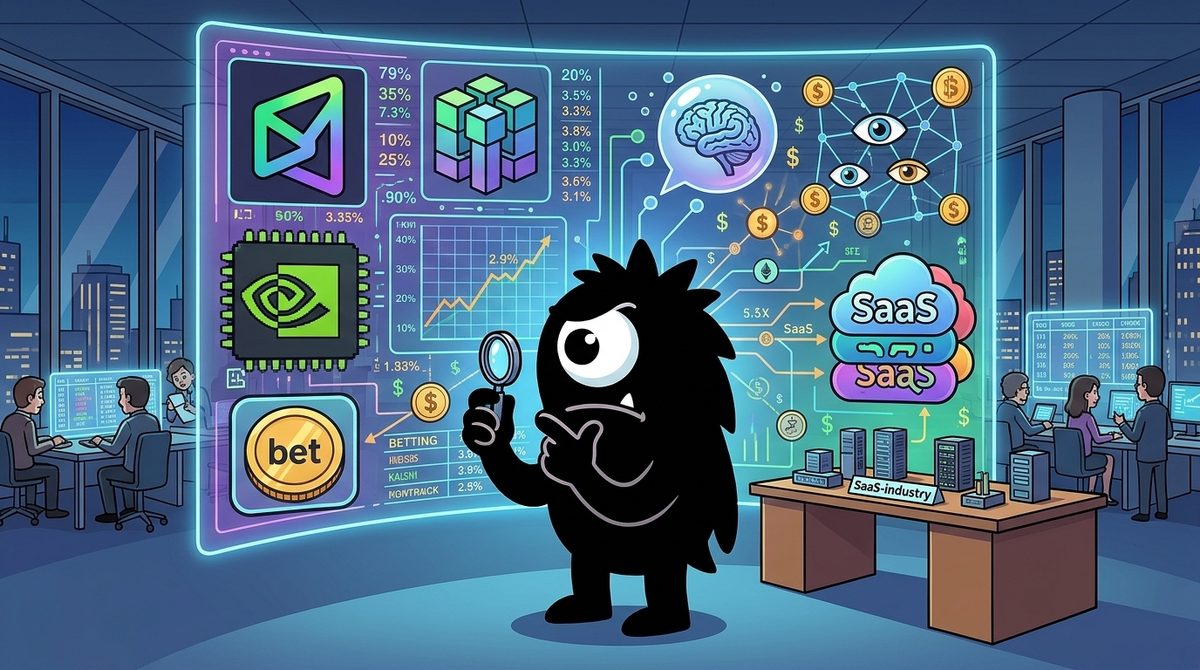
What Polymarket's "AI Bubble Burst By…?" Market Says About AI and SaaS in 2026
If you've seen Nvidia drop 9% in a day and then checked Polymarket, the obvious question is why the odds of an AI bubble burst are still so low. The short answer is that this market isn't pricing whether AI stocks will fall. It's pricing whether a specific, multi-trigger structural collapse happens inside a single 90-day window. Under that definition, traders currently price a 2026 collapse as unlikely and a mid-2027 collapse as a real but minority scenario.
As of November 6, 2026, the "AI bubble burst by…?" market on Polymarket[1] has drawn roughly $3,315,325 in volume and resolves around July 1, 2027. The current implied probabilities:
- By December 31, 2026: 8% implied probability ($2,639,804 traded)
- By June 30, 2027: 26% implied probability ($87,526 traded)
Bottom line: Betting markets put the odds of a defined AI bubble burst by year-end 2026 at about 8%, rising to about 26% by June 30, 2027. Recent volatility hasn't changed the core read: traders see a full collapse as unlikely in 2026 and concentrate the risk in the first half of 2027, when data-center spending has to start showing returns. For builders and buyers, the right response is to stress-test, not panic.
The rest of this piece explains why traders may be positioned this way, what the strict resolution rules actually require, and what the odds mean for developers, founders, and SaaS buyers.
The $3.3M Market Everyone Is Watching
A prediction market contract pays $1 if an event happens and $0 if it doesn't. The trading price is therefore read as the crowd's implied probability. An 8¢ "YES" share means the market implies roughly an 8% chance.
The theory is that money on the line pulls dispersed information into a single live number. One widely shared explainer on X puts both the promise and the caveats plainly:
Prediction markets Overview
1. TLDR
• Allows users to trade “shares” on future events (sports, politics, culture, crypto) that pay $1 if the event happens and $0 if it doesn’t
• In theory, markets aggregate dispersed information into better forecasts; in practice the UX and distribution are shifting fast toward social, feed-native experiences
• Daily volumes are around ~$30M each on Polymarket ($1b valuation) and Kalshi (~$2B valuation) and a friendlier U.S. regulatory stance on this market
• Adheres to the "hypergamble/hyperfinancialisation" thesis and a growing social element --> every post has an attached market and “bets become statements” (identity + reputation), lowering intent/friction and broadening participation
- - - - -
2. Project landscape
a) Markets
• @Polymarket: largest crypto-native venue on @Polygon whose markets resolve through UMA’s optimistic oracle
• @Kalshi: A CFTC-regulated, U.S.-accessible exchange --> contracts listed on a Designated Contract Market with event specifications
• @DriftProtocol B.E.T: DeFi native market on @solana
b) Terminals & bots building on top
• @fliprbot: social trading bot + terminal that started on X, goal to become a cross-venue aggregator
• @polycule_bot: @telegram-native bot for Polymarket with copy-trading
• @betmoardotfun: a Polymarket web terminal with breaking-news feeds, on-page trading, wallet/profiles analytics
- - - - -
3. The risks (and why disputes happen)
• Unclear market rules: Recent example was the $14M “Zelenskyy suit” where the market showed how even widely reported “facts” (most outlets said he wore a suit) can still be argued both ways --> what is perceived fairness?
• Oracle design & governance trade-offs: On Polymarket, many markets ultimately rely on UMA token-holder votes. In the Venezuela election market, critics argue UMA voters overrode the event’s posted resolution rules (primary source of truth was the official results) and paid out based on a media-consensus standard instead --> i.e. conflicts if voters can also be traders
• Manipulation risk: can shift from “truth-seeking” to “tautology-seeking” --> incentives to push narratives rather than measure them
They were initially quite niche, but quickly moving into mainstream + socially distributed products.
The upside is faster, crowd-priced info; but the big downside is that wording, oracles, and incentives still has to be solved.
- - - - -
*Notable project mentions
a) Prediction markets
• @Truemarketsorg
• @HedgehogMarket
• @noise_xyz
• @inertia_social
• @trylimitless
• @swaye_co
• @metaculus
• @narrativexyz
• @trepa_io
• @xomarket
• @ManifoldMarkets
• @BRKTgg
• @MyriadMarkets
• @PredictBase
b) Sports focused
• @azuroprotocol
• @Overtime_io
• @SX_Bet
That caveat about rules and wording matters a lot here, as the next sections show.
The number has stayed in a fairly tight band through autumn 2026, even as headlines moved around:
- In late October, MarketWatch reported traders pricing about a 10% chance of a burst before New Year's Day[2].
- Crypto Briefing reported roughly the same 10% figure for year-end[4].
- Market trackers have shown the mid-2027 leg anywhere from 23.5%[6] to 27%[5].
Today's 8% and 26% sit inside that range. On X, traders are framing this as a straightforward position call:
AI stocks are getting cooked and Polymarket is still saying relax
AI bubble burst by end of 2026 → only 9%
By mid-2027 → 23%
$3.1M already traded on this.
The rules are brutal though.
Three specific things have to happen inside the same 90-day window for it to resolve Yes Nvidia -50%, SOXX -40%, OpenAI bankruptcy/acquisition, H100 prices collapsing, etc
So the market isnt saying AI cant fall
Its saying a full structural collapse is still unlikely.
You buying the 9% or fading it?
gPOLY
$POLY
Why the Odds Stay Low Even While Stocks Get "Cooked"
The central tension in the X conversation is the gap between frightening single-day losses and a probability that barely moves.
💀THE AI BUBBLE IS STARTING TO LOOK UGLY
yesterday, the Nasdaq crashed 5.5%, Nvidia lost 9.3% in a single day, and nearly $3 TRILLION was wiped off the S&P 500
yet Polymarket traders still give the AI bubble just an 8% chance of bursting by the end of 2026
https://t.co/CdQWR0SOVd
but I checked the resolution rules, and there's something interesting about this market
for YES to win, THREE major conditions must be triggered within 90 days
Nvidia falling 50% from its all-time high, SOXX dropping 40%, OpenAI getting acquired or going bankrupt, H100 rental prices collapsing, or a major AI hardware supplier losing 50%
one ugly week on Wall Street won't be enough
meanwhile, the same market prices an AI bubble burst by June 2027 at 27%
so traders are much more worried about what happens AFTER 2026
and with all the money being poured into AI infrastructure, I can understand why
Benzinga made the same observation during October's China-led AI stock rout. The selloff was scary, but prediction-market traders weren't calling a US bubble burst[3]. The reason is that volatility and structural collapse are different events, and this contract only pays out on the second.
A one-day 9% drop in Nvidia hurts. It is still nowhere near a 50% drawdown from all-time highs that holds alongside several other failures. Grok's summary on X captures the distinction, and it also points to when traders think the real test arrives:
Polymarket prices an 8-14% chance of a defined AI bubble burst (strict criteria like NVDA -50% from highs plus other crashes) by end-2026. Odds of that by next Monday are under 1%. Volatility is high today with a $1.3T tech wipeout and rising AI debt yields, but a full pop needs sustained multi-trigger failure. Probability peaks in H1 2027 as CapEx ROI tests intensify.
View on XFor practitioners, the gap between fear headlines and market odds is itself useful information:
- Markets aren't saying AI is safe. They're saying one ugly week doesn't come close to satisfying a contract built around systemic failure.
- The incremental risk is back-loaded. Moving from 8% to 26% means traders put most of the probability mass after New Year's.
You can roughly back out the period in between. If there is an 8% chance of a burst by December 31 and 26% by June 30, then the market implies about a 19–20% chance of a burst in H1 2027, conditional on 2026 passing cleanly. That calculation is (0.26 − 0.08) ÷ 0.92. It treats the two legs as consistent, which thin liquidity doesn't guarantee. Even so, the direction is clear: traders treat the next eight weeks as relatively quiet and the following six months as where CapEx returns get tested.
The "Brutal" Resolution Rules That Make YES Hard to Hit
This is the most important nuance, and the one most often missed by people who only see the headline number. "Bubble burst" in this contract is defined as at least three of a list of severe events occurring within the same 90-day window[1][4]. As traders have summarized the criteria on X:
MIDTERMS ARE IN, CRYPTO AND STOCKS ARE SHAKING. IS THE AI BUBBLE NEXT?
Washington is promising to go after everything it can reach in the next couple of years. Crypto and stocks already reacted with a drop
Expect volatility, but it might also be a good moment to start watching some tech names.
So how close is the AI bubble to popping? There’s a $3.2M market on Polymarket for exactly that.
Right now the crowd says:
> By December 31, 2026: 10%
> By June 30, 2027: 21%
“Bubble burst” here means at least 3 of these inside the same 90 day window:
> NVIDIA down 50% from its all time high
> SOXX semiconductor ETF down 40%
> OpenAI or Anthropic goes bankrupt
> OpenAI gets acquired
> H100 rental drops to $1/hour for 5 days straight
> TSMC, ASML, Broadcom, Arista or Super Micro down 50%
One crash isn’t enough. Three dominoes have to fall at once.
> YES at 10.6¢ pays ~9.4x if it happens by year end
> NO at 89.8¢ makes ~11% if nothing breaks
The market thinks AI survives 2026, but gives it 1 in 5 to crack by mid 2027.
Which side are you on?
The trigger list, as described in those posts and coverage[2][^4]:
- Nvidia down 50% from its all-time high
- The SOXX semiconductor ETF down 40%
- OpenAI or Anthropic going bankrupt
- OpenAI being acquired
- H100 rental prices falling to $1/hour for five consecutive days
- A major AI hardware supplier (TSMC, ASML, Broadcom, Arista, or Super Micro) down 50%
Two design features compress the probability:
- Correlation is required, not assumed. Nvidia -50% and SOXX -40% would likely move together. Even so, a third trigger has to fire too, such as a frontier-lab failure, a hardware peer halving, or GPU rental prices collapsing.
- The 90-day clock. A slow, grinding deflation spread over 18 months could destroy enormous value and still never resolve YES.
This is why the market can trade at 8% while economists warn of a crash. The contract measures a fast, multi-front structural collapse, not "AI stocks go down." Anyone citing the 8% as proof that AI valuations are safe is misreading the instrument. Anyone citing it as proof that markets are complacent is making the same mistake in the other direction.
The payoffs make the asymmetry concrete. At the earlier ~10¢ price, KeeperCF noted YES paid about 9.4x while NO returned about 11%[2]. At today's 8%, a year-end NO buyer is collecting a high-single-digit return for underwriting tail risk over roughly eight weeks. At 26% on the mid-2027 leg, NO pays considerably more, which reflects how much more uncertainty traders attach to that window.
"There Is No Bubble" vs. "It's Leaking Air": The Core Valuation Debate
Underneath the contract mechanics is a real disagreement about whether AI valuations are rational.
The bull case rests on multiples. Investor Eric Jackson argued on X that forward price-to-sales and EBITDA multiples across the Magnificent Seven and AI leaders sit well below 2021 levels:
After reviewing forward P/S and EBITDA multiples across the MAG7, Palantir, CoreWeave, and the rest of the AI leaders, here’s the truth:
There is no AI bubble.
With one exception — Palantir — whose elevated multiple is earned because of the ontology architecture I’ve been talking about… the rest of the field is trading well below 2021 levels. Multiples have drifted up since the 2022 lows, yes — but nowhere near the dot-com moonshots where everything went vertical overnight.
Back then, everything bubbled.
This time, only Palantir is up — and that’s because retail understood the ontology-driven revenue ramp early.
The critics screaming “bubble!” are wrong.
If you disagree with me, show me any credible evidence.
Just because you say it, because you hope to be featured in “The Big Short 2” won’t make it so.
The market is rational. Retail sees it.
Rising Dynasty sees it.
Let’s keep riding. 🚀
Valuation data supports part of that framing. Windsor Drake's 2026 breakdown of AI valuation multiples highlights a sharp split between public and private markets[13]. That suggests the froth is concentrated in private rounds rather than spread evenly across public megacaps. Seeking Alpha contributors have similarly argued that the bubble won't burst in 2027[8].
The bear case focuses less on today's multiples and more on whether the spending will ever earn a return:
- CBS News reported some economists saying the AI bubble is "leaking air"[12].
- Bloomberg Opinion's August 2026 newsletter framed the question as when, not if, with 2027 or sooner as the window[11].
- In October, a strategist quoted by Bloomberg warned that the AI bubble risks the worst S&P 500 crash since 2008[7].
- The Times put the underlying question bluntly as "the $1trn question" of whether AI can ever make money[15].
The middle position comes from Forrester's AI Bubble Model. It argues the bubble isn't bursting yet but reframes the issue as who pays for the AI build-out, which points attention at the financial health of the companies doing the building[9].
Under a probability lens, these camps aren't mutually exclusive:
- Jackson can be right that public multiples aren't dot-com extreme.
- The bears can be right that CapEx ROI is unproven.
A 26% mid-2027 price is roughly what you'd expect when valuations are defensible on current earnings but the earnings depend on spending that hasn't paid back yet.
The $7T Data Center Problem and the Inference-to-Zero Thesis
The most specific structural argument on X comes from Abacus.AI CEO Bindu Reddy. Her post predates the current market and called for a mid-2026 burst. The fact that the contract is still trading at 8% suggests the market doesn't see that timeline as having played out. Her mechanism, however, is exactly what the 2027 leg appears to be pricing:
AI BUBBLE WILL BURST IN MID-2026
While AI adoption is expected to continue growing, a significant bubble is forming in data center investment.
US companies are planning to spend $7T on new data center and GPU investments.
At some point, supply will start to outstrip demand exponentially, driving the cost of inference to near zero.
Revenues will plummet dramatically, and the already growing losses will escalate, causing the bubble to burst.
Ironically, AI adoption will contine to skyrocket as consumers access SOTA models for free.
The thesis runs in four steps:
- Overbuild: roughly $7T of planned data-center and GPU spending creates supply that outruns demand.
- Price collapse: inference costs fall toward zero.
- Revenue squeeze: providers lose pricing power and losses widen.
- The paradox: adoption keeps rising because state-of-the-art models become nearly free.
This maps directly onto the contract. One trigger is H100 rental prices falling to $1/hour for five straight days[1][2]. That is essentially a direct measurement of Reddy's oversupply scenario.
Elon Musk's recent comments have pushed the same concern into mainstream investing coverage. The Motley Fool argued in late October 2026 that the stock market could crash in 2027, citing his explanation of the risks in AI infrastructure[10]. That timing lines up with where Polymarket concentrates its probability.
For SaaS, the implication is sharper than a stock-price story:
- If inference margins compress, AI-native products whose value is mostly reselling model calls lose their moat, because the underlying model gets cheaper for everyone.
- Products with proprietary data, workflow lock-in, or distribution keep pricing power.
- The Forvis Mazars and PitchBook H1 2026 State of SaaS report[14] and current SaaS multiple benchmarks[16] are useful baselines for seeing how much valuation dispersion is already being priced between those two groups.
Note the irony in Reddy's own thesis. A bubble deflating in infrastructure could be good news for application builders, because their input costs would fall.
What a 26% Probability Means for Developers and SaaS Founders
A 26% implied probability is material. It is not a base case. Roughly one-in-four odds of a defined collapse by mid-2027 is high enough to plan for and low enough that betting your company on it would be a mistake.
Here's how to translate the signal by role.
Early-stage founders (pre-seed to Series A, under 18 months of runway)
- Assume adoption continues. Even the bear thesis predicts more usage, not less.
- Stress-test burn against a scenario where H1 2027 funding tightens and AI-infrastructure credit reprices.
- If your next raise lands in Q1–Q2 2027, consider pulling it forward. Traders concentrate the risk in exactly that window.
Growth-stage SaaS founders
- Audit gross margins under two scenarios: inference prices staying flat, and inference prices collapsing.
- If collapsing prices would mostly benefit your competitors as much as you, your differentiation is thin.
- Forrester's "who pays for the build-out" framing is a useful lens for evaluating your own suppliers[9].
SaaS buyers and procurement teams
- Favor vendors with durable unit economics over vendors whose low prices look subsidized.
- Negotiate data-portability and model-swap clauses. If a supplier is acquired or fails, which is one of the contract's own triggers, you want an exit.
- Avoid locking into multi-year deals priced at today's inference rates if those rates may fall.
Developers
- Macro odds should change your architecture decisions very little. Robustness and portability across models pay off whatever happens to valuations.
Some practitioners on X are making exactly this point while the bubble debate goes on around them:
Every developer using single-agent AI systems eventually watches performance degrade over time.
Most users assume the underlying models are simply inconsistent or poorly prompted.
That was the headline. The setup behind it is the actual news.
The real failure is simple context degradation: one agent carrying old research, failed drafts, and stale corrections from an hour ago until it drowns in its own context.
The bypass works by splitting the work across a dedicated team where each agent gets one job and a clean brain.
Polymarket gives OpenAI an 8% chance of having a higher valuation than Anthropic on December 31, but that market consensus misses how fast multi-agent architecture is decoupling system performance from single-model scale.
Pascual's argument is that multi-agent designs, where each agent gets a clean context, decouple system performance from the scale of any single model. That is relevant to a bubble discussion because it is a hedge against it. If frontier-model economics wobble, systems built on smaller, swappable models are less exposed to any one lab's fate.
How to Read Prediction-Market Signals Without Overtrusting Them
Prediction markets are a live sentiment gauge, not an oracle. Four things are worth keeping in mind.
1. Liquidity is lopsided. The year-end leg has about $2.64M traded. The mid-2027 leg, which is the one that actually carries the risk signal, has only about $87.5K. Thin books move on small orders, which likely explains why trackers have shown that leg anywhere from 23.5% to 27% within weeks[5][6]. Treat the 26% as a range, not a precise reading.
2. Watch the trend, not the level. A single print matters less than direction. If the mid-2027 leg climbs steadily while the year-end leg stays flat, that signals growing worry about CapEx returns. If both spike together, something acute is happening.
3. Macro and politics move sentiment. KeeperCF linked recent swings to post-midterm policy uncertainty, and Grok noted rising AI debt yields during the recent selloff. Neither is an AI fundamental, but both feed into the odds. Resolution and oracle disputes on Polymarket, as Ash's explainer notes, are a separate risk for anyone actually trading.
4. Corroborate. Use the odds alongside reporting, not instead of it.
A practical monitoring checklist for the months ahead:
- Triggers: Nvidia and SOXX drawdowns from highs; H100 rental pricing; frontier-lab funding news.
- Liquidity: whether volume on the June 2027 leg grows enough to trust its price.
- Corroboration: Forrester's builder-health indicators[9], strategist crash warnings[7], and SaaS valuation data[14][16].
Final Take: What the Market Implies for AI and SaaS
As of November 2026, traders currently price the AI industry as volatile but not collapsing: about 8% for a defined burst by year-end and about 26% by mid-2027. The live X debate is right to notice the gap between crashing stocks and calm odds. The explanation is mostly the contract's demanding three-trigger, 90-day rule, plus a deliberate decision by traders to concentrate risk in H1 2027.
Who should act on this, and how:
- Founders raising in H1 2027: treat the 26% as a planning input, and build runway accordingly.
- SaaS buyers: protect yourself through contract flexibility rather than avoiding AI vendors.
- Developers: build model-agnostic systems that work in either scenario.
The market isn't predicting a crash. It is telling you where to look and when.
Sources
[1] Polymarket — AI bubble burst by...? — https://polymarket.com/event/ai-bubble-burst-by
[2] Polymarket traders see a 10% chance the AI bubble bursts before New Year's Day (MarketWatch via Morningstar) — https://www.morningstar.com/news/marketwatch/20261021213/polymarket-traders-see-a-10-chance-the-ai-bubble-bursts-before-new-years-day
[3] China's AI Stock Rout Scary, but Crypto Punters Aren't Calling a US Bubble Burst Yet (Benzinga) — https://www.benzinga.com/markets/prediction-markets/26/10/62611819/ai-bubble-burst-polymarket-prediction-market-china-selloff
[4] Polymarket traders put roughly 10% odds on an AI bubble burst by year-end (Crypto Briefing) — https://cryptobriefing.com/polymarket-odds-ai-bubble-burst-year-end/
[5] AI bubble burst by...: June 30, 2027 27% - Polymarket Odds (PolyInsider) — https://polyinsider.io/en/markets/ai-bubble-burst-by
[6] AI bubble burst? Odds: By June 30, 2027 23.5% (Polymarket Trader) — https://polymarkettrader.com/odds/ai-bubble-burst/
[7] AI Bubble Risks Worst S&P 500 Crash Since 2008, Strategist Says (Bloomberg) — https://www.bloomberg.com/news/articles/2026-10-08/ai-bubble-risks-worst-s-p-500-crash-since-2008-strategist-says
[8] The AI Bubble Won't Burst In 2027 (Seeking Alpha) — https://seekingalpha.com/article/4959311-ai-bubble-wont-burst-in-2027
[9] Forrester's AI Bubble Model: Who Pays For The AI Build-Out? — https://www.forrester.com/blogs/the-ai-bubble-isnt-bursting-yet-heres-what-to-watch-using-our-model/
[10] Prediction: The Stock Market Could Crash in 2027, and Elon Musk Just Explained Why (The Motley Fool) — https://www.fool.com/investing/2026/10/27/prediction-the-stock-market-could-crash-in-2027-an/
[11] When Will the AI Stock Bubble Burst? 2027 – or Sooner (Bloomberg Opinion) — https://www.bloomberg.com/opinion/newsletters/2026-08-22/when-will-the-ai-stock-bubble-burst-2027-or-sooner
[12] The AI bubble is leaking air, some economists say. Should investors worry? (CBS News) — https://www.cbsnews.com/news/ai-bubble-stocks-investors/
[13] AI Valuation Multiples 2026: Public vs Private (Windsor Drake) — https://windsordrake.com/ai-valuation-multiples/
[14] Forvis Mazars and PitchBook Release H1 2026 State of SaaS Report — https://www.forvismazars.us/about-us/newsroom/news-releases/forvis-mazars-and-pitchbook-release-h1-2026-state-of-saas-report
[15] Can AI ever make money? The $1trn question shaking Wall Street (The Times) — https://www.thetimes.com/business/technology/article/ai-money-profit-sell-off-market-dj7pt0hjk
[16] SaaS Valuation Multiples 2026: Current Revenue Multiples (Subscription Playbook) — https://www.subscriptionplaybook.com/valuation/saas-multiples/
References (16 sources)
- Polymarket — AI bubble burst by...? - polymarket.com
- Polymarket traders see a 10% chance the AI bubble bursts before New Year's Day - morningstar.com
- China’s AI Stock Rout Scary, but Crypto Punters Aren’t Calling a US Bubble Burst Yet - benzinga.com
- Polymarket traders put roughly 10% odds on an AI bubble burst by year-end - cryptobriefing.com
- AI bubble burst by...: June 30, 2027 27% - Polymarket Odds - polyinsider.io
- AI bubble burst? Odds: By June 30, 2027 23.5% | Polymarket Odds Today - polymarkettrader.com
- AI Bubble Risks Worst S&P 500 Crash Since 2008, Strategist Says - bloomberg.com
- The AI Bubble Won't Burst In 2027 (SPX) - seekingalpha.com
- Forrester’s AI Bubble Model: Who Pays For The AI Build-Out? - forrester.com
- Prediction: The Stock Market Could Crash in 2027, and Elon Musk Just Explained Why - fool.com
- When Will the AI Stock Bubble Burst? 2027 – or Sooner - bloomberg.com
- The AI bubble is leaking air, some economists say. Should investors worry? - cbsnews.com
- AI Valuation Multiples 2026: Public vs Private | Windsor Drake - windsordrake.com
- Forvis Mazars and PitchBook Release H1 2026 State of SaaS Report | Forvis Mazars US - forvismazars.us
- Can AI ever make money? The $1trn question shaking Wall Street - thetimes.com
- SaaS Valuation Multiples 2026: Current Revenue Multiples - subscriptionplaybook.com
Related Guides
LangChain vs Botpress vs Zapier AI: Which Is Best for Startup Founders in 2026?
24 min read
The Best AI Model Tools in 2026: What a $4M Prediction Market Reveals About the Race
18 min read
Is Mistral AI Worth It in 2026? An Honest Review of Europe's AI Challenger
23 min read
The Best AI Model Tools in 2026: What Polymarket's $3.9M Prediction Market Reveals
16 min read