Is Mistral AI Worth It in 2026? An Honest Review of Europe's AI Challenger
Mistral AI in 2026: an honest review of Large 4, Medium 3.5, Codestral, and Le Chat covering benchmarks, pricing, licensing, and the China debate. Find out.
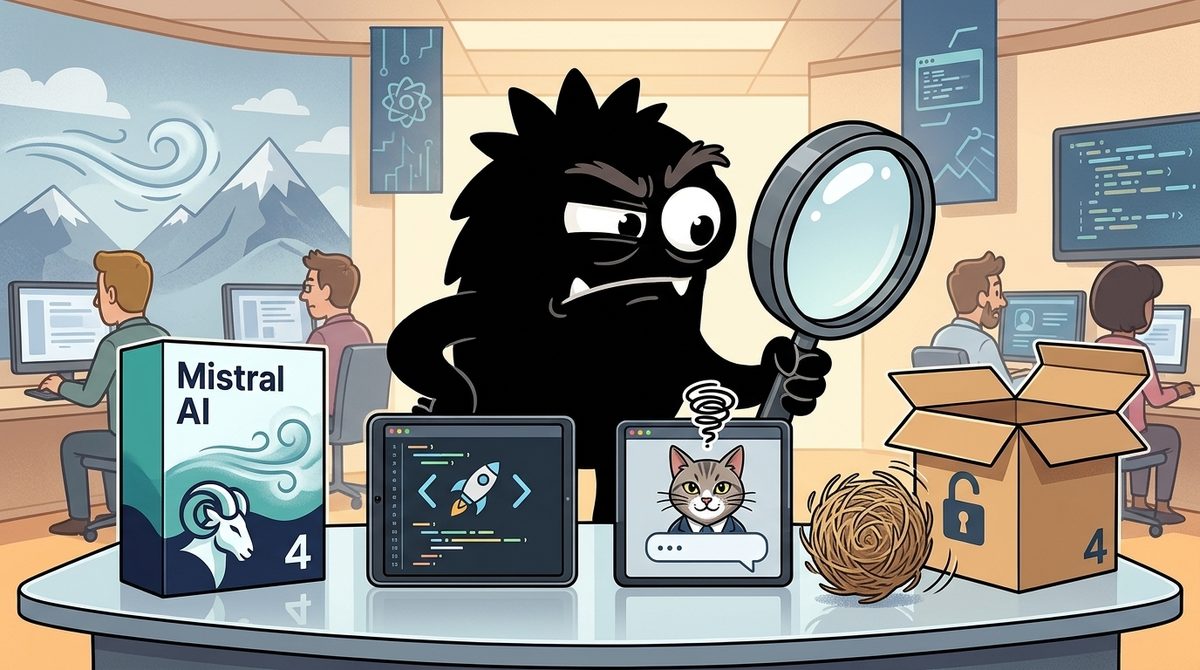
Mistral AI is worth it in 2026 for some teams and a poor fit for others. The answer depends on whether you consume models through an API, self-host them, or resell them, and on how much you care about where your AI comes from. As of November 2026, Mistral Large 4 (nicknamed "Le Chonk") is the strongest open-weight model built outside the U.S. and China.[11] It is also cheap per token and unusually token-efficient for agentic coding, meaning AI agents that write and run code across many steps. But its best benchmark numbers come with caveats, its license is not open source, and the debate over whether Mistral is still an original research lab is not settled.
The bottom line (November 2026):
- Worth it if you need a strong European-built model, run cost-sensitive agentic coding, can self-host a ~1T-parameter mixture-of-experts model, or build defensive security tooling.
- Think twice if you resell model access via API (read the license), need verified performance in your own agent setup, or want a truly permissive open-source license.
- Key numbers: ~1T total / ~52B active parameters, 1M context, $0.70 / $2.10 per million input/output tokens, roughly half the output tokens of GLM 5.3 at equal coding-index scores.
Why Does Mistral Still Matter in 2026?
Mistral launched with a clear promise: Europe would have its own frontier lab, and investors put more than $3 billion behind it. Its early models earned the attention. Mistral 7B and Mixtral were original designs that outperformed models far larger than themselves. In February 2024, Mistral launched the first Mistral Large and its Le Chat interface. It is now a full product company with consumer, enterprise, and open-weight offerings.[13]
The 2026 context is what sharpened the "worth it?" question. Cohere acquired Aleph Alpha, which left Mistral as the only European lab still competing at the frontier.
Mistral Medium 3.5 is interesting less for the benchmarks and more for the positioning. Look at who they're comparing against: Kimi, Qwen, GLM, Claude (Sonnet). Not GPT, not Gemini. And i dont mean that in a negative way!
With Aleph Alpha being acquired by Cohere last week, Mistral is now the only non-US, non-Chinese lab still in the frontier conversation. At 128B dense with open weights, they're making a different bet than the Chinese MoE models in that chart (which activate only 17-40B params despite being 400B-1T total).
Mistral is trading inference efficiency for consistency. The Collie score (95.8, best in class by a wide margin) tells you where they're aiming: not raw reasoning, but the most reliable model to actually follow instructions in production. That's a European enterprise pitch, not a benchmark race.
Very solid release from Mistral!
That rarity has strategic value. Independent testing ranks Large 4 the best model outside the U.S. and China. The same reporting notes that Chinese open-weight models still beat Europe's best effort.[11] So "worth it" means different things to different readers:
- API consumers care about price-performance per task.
- Self-hosters care about the license, hardware needs, and serving stack.
- Sovereignty-driven buyers, such as EU public sector, regulated finance, and defense-adjacent teams, care about a model trained in Europe on European compute.
The rest of this review takes each lens in turn.
What Is Mistral Large 4 "Le Chonk," Architecturally?
Large 4 launched API-only in October 2026. Mistral then published the full weights on Hugging Face. TechCrunch dated the weights release October 29, 2026, and framed it around cybersecurity.[12]
🔓 Mistral Large 4 weights are now on Hugging Face
The model launched earlier this month API-only. Now the full ~1T-parameter checkpoint is downloadable.
🧠 Natively multimodal MoE: ~1T total, ~52B active per token. 128 routed experts (4 active) + 1 shared expert. 1M context. Text + image in, text out
🎚️ One set of weights for chat, reasoning, coding and agents. Reasoning effort per request: low / medium / high. Native function calling and strict JSON schema
💻 48% on the Artificial Analysis Coding Agent Index, roughly tied with GLM-5.3 at 47% fewer tokens per task. Intelligence Index v5: 26, top among western open-weight models
⚡ Built-in DSpark speculative decoding: up to 1.9x throughput, identical outputs. NVFP4 checkpoint for Blackwell. Runs on vLLM, SGLang, Transformers and llama.cpp
📜 Modified MIT license, commercial use allowed. Model-as-a-Service requires a separate license from Mistral
#MistralAI #OpenWeights #LLM #AI #EUROPE
For beginners, a mixture-of-experts (MoE) model splits its parameters into many specialist sub-networks and activates only a few for each token. Large 4 has roughly 1 trillion parameters of stored knowledge but computes with only ~52B per token. That is why it can be priced and served like a much smaller model.[9] Its main traits:
- One weight set for everything. Chat, reasoning, coding, and agent work all run on the same model. You choose reasoning effort (low, medium, or high) per request, so you don't route between separate "thinking" and "fast" models.
- Production features built in. Native function calling and strict JSON-schema output reduce the glue code that agent frameworks usually need.
The engineering details matter for anyone serving the model:
Mistral's Large 4 at a glance 👇 1T-param MoE (52B active), multimodal, 1M context:
– 72 layers MLA + DeepSeek-style sparse attention: indexer picks 2,048 keys/query
– Surgery mid-pretraining: SWA+CLA hybrid hurt SWE-bench at equal perplexity → back to full attn, YOCO kept
– Learned RoPE freqs + SSMax; NoPE every 4th layer; 70 KiB KV/token
– 128+1 experts, top-4, softmax router; built-in 3-layer DSpark drafter
– Leads FrontierCode 2.0 (19.7%) + Terminal-Bench 4 (41%) against open peers
– NVFP4 build: 606 GB, serves on 4× GB300
Blog: https://t.co/dKeWsSwzPJ
Weights:
Here is what those details mean in practice:
- MLA plus a sparse attention indexer. Multi-head latent attention, combined with an indexer that selects 2,048 keys per query, keeps the KV cache small (about 70 KiB per token). The KV cache is the memory a model uses to hold context, so a small one makes a 1M-token context affordable rather than theoretical.
- NoPE every 4th layer. Some layers drop positional encoding entirely, a technique associated with better length generalization.
- Built-in DSpark drafter. A small 3-layer draft model enables speculative decoding with identical outputs. The Hugging Face writeup reports up to 1.9× throughput,[9] which is free speed for self-hosters.
- Deployment. An NVFP4 checkpoint (606 GB) runs on 4× GB300. It is supported in vLLM, SGLang, Transformers, and llama.cpp.
"Open weights" does not mean "runs on your laptop." You need Blackwell-class infrastructure, or a provider that has it.
Do Mistral Large 4's Benchmarks Hold Up? Vendor Harness vs Neutral Harness
The launch-week posts focused on the headline numbers:
Mistral Large 4 is bad news for every closed-weight premium model shipping this quarter.
1T parameters. Multimodal. Mixture-of-experts. Open weights on Hugging Face. Mistral calls it "Le Chonk" and the nickname is doing a lot of work.
the numbers that matter:
> Terminal-Bench 4.0: 41%
> FrontierCode: 19.7%
> B3 Agent Security defense rate: 97.1%
> 47% fewer tokens than comparable open models on the Artificial Analysis Coding Agent Index
> API price: $0.70 per million input, $2.10 per million output
the comparison that lands when you line them up:
the Terminal-Bench score sits within arm's reach of Claude Opus 5.5 and Kimi K3.1 Pro. the pricing is a fifth of what Opus charges per output token. the weights are public, so you can run it on your own cluster the day it clears legal review at your shop.
if you ship a coding agent or an inference workload today, two things get real this week:
> your inference line looks different against a competitor on Large 4 by Monday
> every customer with a procurement team will send you a comparison deck by Friday
the second-order effect:
the weight of frontier evaluation shifts from closed-weight API scoreboards to agent benchmarks you can self-host. Mistral priced Large 4 to be the price floor for serious coding inference. Opus and Sonnet pricing is going to look expensive by Q1.
full writeup is in the article below. this is the week open-weight passed the price-performance threshold for serious coding agents.
Those numbers are real, but they need context. A harness is the agent scaffolding that wraps a model during evaluation: the tool definitions, retry logic, and context management. On agentic benchmarks like Terminal-Bench, the harness can swing scores dramatically. One developer checked:
I read the Mistral Large 4 licence line by line. It is not open source.
If you sell API access to models, read condition 2 before you build on it.
And the 41.4% Terminal-Bench score comes from Mistral's own agent. In a neutral harness it scores 24.75%.
https://aitoolspolice.com/frontier-models/mistral-large-4/
A drop from 41.4% to 24.75% is not a rounding error. It means much of the headline result reflects Mistral's own agent design, not the raw model alone. That doesn't make the vendor number dishonest. Many labs report scores using their own harness, and Mistral's agent is a legitimate product. But it changes what you should expect if you plug Large 4 into Claude Code-style tooling, Cline, or your own framework.
Independent aggregate rankings give a more measured picture. Artificial Analysis tracks Mistral's models across intelligence, speed, and price.[8] One widely shared breakdown puts Large 4 at 26 on the Intelligence Index v5, the top score among Western open-weight models. Tom's Hardware reaches the same split verdict: Large 4 is best outside the U.S. and China, but Chinese open weights still lead overall.[11]
How to read these benchmarks without being misled:
- Treat vendor-harness agentic scores as an upper bound.
- Weight neutral-harness and third-party index results more heavily.
- Run your own task suite in your harness before you commit.
Is Mistral Large 4 Cost-Effective for Agentic Coding?
This is where Mistral's case is strongest. Coding agents can call a model hundreds of times in one session. When that happens, the cost of a completed task matters more than any single-prompt score.
1 trillion parameters, roughly 52B active by the model's own naming, and it just topped Cognition's FrontierCode among every open model that exists. Mistral didn't update Le Chonk to chase a leaderboard, they updated it because agentic coding burns tokens by the million and raw capability stopped being the thing that mattered months ago.
Look at the actual numbers. On Artificial Analysis's Coding Agent Index, Mistral Large 4 ties GLM 5.3 using roughly 47 percent fewer tokens to get there. Terminal-Bench jumped 13 points while cutting output tokens by about 30 percent. That's the real story: every frontier lab is now optimizing for cost per completed task, not just task completion itself, because an agent that calls a model five hundred times in a session makes token efficiency the actual unit economics.
The cybersecurity angle is the sharper signal though. CrowdStrike, Cloudflare, Rubrik and Zscaler are each named as partners putting the model through live attack scenarios, and Mistral says it hit a 96.6 percent refusal rate on malicious requests, the highest it has measured in an open model. Open weights used to mean "less safe by default." That framing gets harder to defend when the open model is the one cyber vendors are choosing to stress test first.
None of this happens in a vacuum. Mistral is reportedly in talks for 3 billion euros at a 20 billion euro valuation, barely a year after its 1.7 billion euro round at 11.7 billion. Compare that to Anthropic's 65 billion dollar raise at a 965 billion valuation a month ago, or OpenAI's 122 billion at 852 billion. Mistral is a rounding error next to either of them in capital raised, yet it's the model cyber vendors and agent builders are benchmarking against this week.
My read: Europe finally has a frontier-adjacent model it can point to as proof the sovereignty argument isn't just regulatory cope.
The efficiency claim holds up better than the raw-score claim, because it comes from a third-party index. On the Artificial Analysis Coding Agent Index, Large 4 roughly ties GLM 5.3 while using about 47% fewer tokens.[7] Mistral's own researchers frame it the same way:
Mistral researcher @Sagar_Vaze reveals how Mistral Large 4 matches GLM 5.3 on a coding benchmark while using 50% fewer output tokens:
"It's our first flagship OSS release in a while. It's a trillion parameter model trained on 1E25 FLOPs."
"This FLOP budget and parameter scale is a key milestone in any AI lab's development. We had to build out our own data centers. This model was trained from scratch on our own compute, which we built just outside of Paris."
"It's by far the best agentic coding model we've released, both in our internal testing and with third party evals. On the AA coding index, it's exactly tied with GLM 5.3 but needs 50% less output tokens."
"On these critical domains for our customers, cyber defense, finance, law, we're not only best OSS, but in many cases, the best model, period."
@MistralAI
Part of the efficiency comes from method, not just architecture. Mistral's earlier technical work on its Lean (theorem-proving) models showed the same approach. Instead of building complex scaffolds, the team used a simple coding agent and scaled test-time compute, which is the amount of reasoning spent per problem.
very nice release by mistral (with a tech report!!), they replace the complicated scaffold of previous lean models by a simple coding agent and just scale test time compute budget with compaction every 200k
it's also quite interesting that you don't really see the impact of compaction in this curve (or maybe this is why they see diminishing returns?)
~6B lean mid training token, SFT with 50% lean traces and then RL with CISPO
The practical math. Mistral lists Large 4 at $0.70 per million input tokens and $2.10 per million output tokens.[1] Output tokens usually dominate agentic spend because the model writes code, reasoning, and tool calls. Halving output tokens at that price compounds into large savings per task. VentureBeat reports a 63% lower cost per task.[14]
If your agent only needs to be "good enough" and runs at volume, Large 4's economics are hard to ignore. If your bottleneck is solving the hardest 10% of tasks, cheaper tokens won't fix a capability gap.
Is Mistral an Original Lab or an Inference Wrapper on Chinese Architectures?
This is the most pointed critique in the conversation, and it deserves a direct answer.
Mistral is becoming an inference provider for open source Chinese models.
3 years ago Mistral raised over $3 billion on a simple promise: Europe would have its own frontier lab. And to be fair, they delivered for a while. Mistral 7B and Mixtral were genuinely great models, original architectures that punched above their weight and made the whole industry pay attention.
Then the trajectory bent.
Large 3, their December 2025 flagship, was already built on Chinese blueprint. The config is DeepSeek V3's: same 7168 hidden dim, same 61 layers, same 3 dense layers before the MoE, multi head latent attention identical down to the LoRA ranks. The one structural change is MoE granularity, which buys inference throughput rather than capability.
The weights are Mistral's own, trained with their own tokenizer (131k vocab vs DeepSeek's 129k), so this is not DeepSeek's model with a French label on it. But the architecture of Europe's sovereign flagship was designed in Hangzhou.
Now they've dropped the pretense entirely. GLM 5.2 from Zai sits on their platform as a "featured" model, served unmodified. Chinese brand and all. No training, no adaptation. Just inference.
You can see it in who they hire, too. The careers page that once read like a research lab's now reads like a services firm's: forward deployed engineers, applied AI, solutions architects, people who own the client "from pre-sale to post-implementation." That's a headcount profile for installing software at enterprises, not pushing the frontier.
The lab that made Europe believe it could compete at the frontier is turning into an installer of other people's models. And the models are Chinese.
The specific claims are verifiable. Large 3's configuration closely mirrors DeepSeek V3's, and Large 4 uses DeepSeek-style sparse attention, which Mistral's own materials describe.[9] Mistral also serves third-party models on its platform. The hiring shift toward forward-deployed engineers and solutions architects matches a company growing its enterprise services arm.
The counterpoint is also substantive:
- Trained from scratch. Large 4 was trained from scratch with 1E25 FLOPs on compute Mistral built outside Paris.
- Original engineering choices. The team performed surgery mid-pretraining, testing an SWA+CLA hybrid, finding it hurt SWE-bench, and reverting to full attention while keeping YOCO. It also used learned RoPE frequencies, an integrated drafter, and CISPO-based reinforcement learning on its Lean models.
Those are research decisions, not wrapper behavior.
The fair synthesis is that the frontier now runs on shared building blocks. Labs adopt MLA and sparse attention the way they once adopted transformers. Using a published architecture does not cancel sovereignty, but it does narrow it. Mistral offers European training, data, compute, and control. It no longer clearly offers European architectural leadership. For a procurement team, the first is usually what matters. For investors who funded a frontier research lab, the second was the pitch.
Is Mistral Large 4 Open Source? Read the License Before You Build
No. Large 4 ships under a modified MIT license. Commercial use is allowed, but offering the model as a service (Model-as-a-Service) requires a separate license from Mistral.[9] That is the "condition 2" warning in the post above. If your business sells API access, hosts models for customers, or runs an inference platform, the download is not enough. You need a deal with Mistral.
Mistral's licensing has also varied across its lineup and over time. Some checkpoints have shipped under the more restrictive Mistral Research License, as this summary of Large 2 notes:
Mistral Large 2 is a 123B-class model for demanding local chat, coding, writing, multilingual work, and technical research. It is designed for teams that need more reasoning and context capacity than a compact assistant can provide, while retaining control over the model files and serving stack.
🧭 Overview
This mistralai checkpoint is a high-capacity dense model: the full parameter count shapes storage, memory, and serving costs. It is a good fit for a private workstation or multi-GPU server where answer quality, long-form synthesis, and multilingual instruction following matter more than low hardware requirements.
🛠️ What it does
• Follows detailed instructions, rewrites long documents, summarizes technical material, and extracts structured fields.
• Explains code, reviews patches, proposes implementation plans, and helps compare architecture trade-offs.
• Handles research workflows such as question decomposition, retrieval-augmented generation, evidence notes, and report drafting.
• Supports multilingual assistants and translation-aware workflows when the model card and chosen runtime support the target languages.
✅ Practical uses
1) Build a private assistant over engineering manuals, tickets, policies, and internal knowledge bases.
2) Prototype a coding copilot that can review a repository, explain failures, and turn requirements into implementation steps.
3) Create long-form research and documentation pipelines with retrieval, citation notes, and human review checkpoints.
4) Benchmark quality against smaller local models using the same prompts, context windows, and evaluation set.
⚙️ Getting started
A 4-bit GGUF or AWQ build generally needs about 60–95 GB of storage; FP16 can require roughly 220–330 GB. Plan around 96–192 GB of RAM or VRAM, plus extra headroom for context and runtime buffers. On a capable multi-GPU system, a 4-bit deployment may land around 1–8 tokens/s. Treat these as planning estimates: backend, quantization, prompt length, context, thermals, and batch size can change the result substantially.
Read the model card and chat template first. Choose GGUF, GPTQ, AWQ, or safetensors according to your runtime, then load it with llama.cpp, Transformers, vLLM, Ollama, or LM Studio where supported. Start with a short multilingual benchmark. Record first-token latency, steady-state tokens/s, peak memory, instruction adherence, and factual consistency before changing one variable at a time.
⚠️ License & security
The repository lists the Mistral Research License. Review the current license, tokenizer terms, and dependency licenses before redistribution or commercial deployment. Pin model and runtime versions, verify downloads, isolate inference services, limit tool permissions, and keep confidential prompts away from untrusted plugins or external connectors.
🔗 Repository: https://t.co/Qj62JST9ae
#MistralLarge #LocalAI #OpenModels
This contrasts with several leading Chinese open-weight models, whose licenses are generally more permissive for hosting. That is one reason they dominate third-party inference catalogs.
Due-diligence checklist before building a product on Mistral weights:
- Identify the exact license for the specific checkpoint and version you'll deploy.
- Determine whether your product counts as "Model-as-a-Service." Direct API resale clearly does. Embedded features inside your own app may not, so get legal review.
- Check the tokenizer and dependency licenses separately.
- Pin versions, because license terms can differ between releases.
- If you resell inference, budget time to negotiate a commercial license with Mistral.
Is Mistral Large 4 Good for Cybersecurity, and What About the Refusal Rates?
Mistral has deliberately made cybersecurity a differentiator. TechCrunch's coverage of the weights release centered on it.[12] Mistral reports a 97.1% defense rate on the B3 Agent Security benchmark and names CrowdStrike, Cloudflare, Rubrik, and Zscaler as partners testing it in live attack scenarios.[7]
The leading cyber scores, however, come with a trade-off:
Mistral Large 4 beats Opus 5.5 and GPT-6 Astra on cybersecurity benchmarks, largely because it refuses far fewer security tasks.
Meanwhile Opus and Astra had ~40% of tasks blocked by their own safety filters.
This is the difference between capability and willingness. If a rival model refuses 40% of security tasks, its benchmark score measures its safety filters as much as its skill. Large 4 attempts more tasks, so it scores higher. That doesn't mean it understands exploits better. It means it engages with them more.
Mistral also reports a 96.6% refusal rate on clearly malicious requests. So the company is drawing the line between legitimate security work and abuse at a different point than OpenAI and Anthropic, rather than removing the line altogether.
What this means by team type:
- Red teams and penetration testers: Fewer refusals mean less friction for the dual-use work you are authorized to do. This is a real productivity gain.
- SOC and defensive teams: Self-hostable weights let you analyze sensitive logs and malware samples without sending them to a U.S. API. That benefit is often decisive for regulated organizations.
- Risk and compliance owners: A more permissive model in employees' hands needs your own guardrails, such as tool-permission limits, logging, and isolated inference. Don't rely on the model's refusals as your control layer.
Beyond the Flagship: Medium 3.5, Codestral, Small 4, and Le Chat
Most teams won't need a trillion-parameter model for every call. Mistral's broader lineup is where many will actually spend money.
Codestral is Mistral's dedicated coding model. When it launched, its breadth and speed stood out:
Codestral @MistralAILabs first impression:
1. 80 languages is crazy. Finally someone included Swift. Which a lot of OS models skip
2. Really fucking fast. wtf.
It’s a 22b model and it’s significantly faster than mistral 7b. Are they using groq to serve it?? Comparison:
At 22B parameters with coverage of 80 programming languages, including Swift, which many open models skip, it suits IDE autocomplete and high-volume, low-latency code tasks.
Medium 3.5 takes a different architectural approach. It is a 128B dense model with open weights, rather than a sparse MoE, and Mistral benchmarks it against Kimi, Qwen, GLM, and Claude Sonnet. A dense model gives up some inference efficiency in exchange for consistency, and its best-in-class Collie instruction-following score supports that strategy. Pricing aggregators list Medium 3.5 well below Large-tier rates.[2][4]
Small 4 and the Ministral tiers cover cost-sensitive and edge use cases, such as classification, extraction, routing, and on-device assistants, where latency and cost per call matter more than reasoning depth.[3]
Le Chat is the consumer and team-facing entry point. It has been part of Mistral's offering since the original Mistral Large launch:
Today, we are releasing Mistral Large, our latest model. Mistral Large is vastly superior to Mistral Medium, handles 32k tokens of context, and is natively fluent in English, French, Spanish, German, and Italian.
We have also updated Mistral Small on our API to a model that is significantly better (and faster) than Mixtral 8x7B.
Lastly, we are introducing Le Chat (https://t.co/CCMpILcmFy), a chat interface (currently in beta) on top of our models.
The Verdict: Who Should Use Mistral in 2026, and Who Shouldn't?
Mistral's identity has been debated since early in the company's history. When the first Mistral Large launched, early testers noticed its answers closely resembled GPT-4's. They also praised it for being faster and more concise:
Ⓜ️ Mistral-Large just got released
I tried 5 complex prompts to compare Mistral-Large with GPT-4. Here's what I gathered:
- Answers are *very* similar, which indicates that Mistral-Large has been trained on a synthetic dataset generated by GPT-4.
- It is more concise and inference speed is faster (that's helpful!)
- It doesn't have access to tools like Code Interpreter, so it fails some math questions.
- A lot less "lazy" in terms of code: it doesn't try to explain what it's going to do and immediately outputs code.
It looks pretty on par in general. You can try it for free using the new Le Chat:
That pattern still holds in 2026. Mistral is efficient, practical, and enterprise-focused, and questions about how original its work is continue to follow it. Here is how to decide.
Use Mistral if you are:
- An EU-sovereignty-conscious organization. You get a frontier-adjacent model trained in Europe, self-hostable, from the only remaining European frontier lab.
- Running cost-sensitive agentic coding. Roughly half the output tokens at competitive scores, combined with $0.70/$2.10 pricing, makes it a strong default for volume work.
- A self-hoster with Blackwell-class infrastructure. NVFP4 weights, DSpark speculative decoding, and broad runtime support make serving it realistic.
- Building defensive security tooling. Low refusal friction plus private deployment is a rare combination.
Think twice if you are:
- An API reseller or inference host. The Model-as-a-Service restriction requires a separate license.
- Dependent on harness-agnostic performance. Expect closer to neutral-harness numbers (~25% on Terminal-Bench) unless you adopt Mistral's agent.
- Seeking truly permissive open source. Several Chinese open-weight models are more flexible.
- Optimizing for absolute peak capability. Top U.S. closed models and leading Chinese open weights still lead overall.[11]
Model-by-use-case cheat sheet:
| Use case | Mistral model |
|---|---|
| Complex agents, long-context reasoning, cyber | Large 4 |
| Reliable instruction-following in enterprise workflows | Medium 3.5 |
| IDE autocomplete, fast code generation | Codestral |
| Classification, extraction, edge/on-device | Small 4 / Ministral |
| Non-technical teams, quick evaluation | Le Chat |
What to watch next. Mistral is reportedly in talks to raise €3B at a €20B valuation. That is still a small fraction of what U.S. rivals are raising. The open question is whether that capital funds original research or deeper enterprise services built on shared blueprints. Large 4 suggests Mistral can still do serious engineering at trillion-parameter scale. Whether it can lead on architecture again, rather than follow, will decide whether "Europe's AI challenger" remains a challenger or becomes a regional supplier.
For most practitioners today, Mistral is worth evaluating, especially when cost per task, data residency, or self-hosting drives the decision. Judge it on neutral-harness results in your own setup, and have legal review the license before you build on it.
Sources
[1] API pricing | Mistral Docs — https://mistral.ai/pricing/api/
[2] Mistral API Pricing (November 2026): Large 3 & Medium 3.5 Rates | BenchLM.ai — https://benchlm.ai/mistral/api-pricing
[3] Mistral AI Models & API Pricing (Nov 2026) | LiteLLM — https://models.litellm.ai/providers/mistral
[4] Mistral AI API Pricing 2026 — Current Per-Token Costs | AI Pricing Guru — https://www.aipricing.guru/mistral-pricing/
[7] Introducing Mistral Large 4 — https://mistral.ai/news/mistral-large-4/
[8] Mistral - Intelligence, Performance & Price Analysis — https://artificialanalysis.ai/providers/mistral
[9] Welcome Le Chonk: Mistral Large 4 on Hugging Face — https://huggingface.co/blog/mistral-large4
[11] Independent tests rank Mistral's new trillion-parameter Large 4 the best AI model outside the U.S. and China — https://www.tomshardware.com/tech-industry/artificial-intelligence/independent-tests-rank-mistrals-new-trillion-parameter-large-4-the-best-ai-model-outside-the-u-s-and-china-but-chinese-open-weights-still-overcome-europes-best-efforts
[12] Mistral releases weights for its trillion-parameter AI model, targeting cybersecurity — https://techcrunch.com/2026/10/29/mistral-releases-weights-for-its-trillion-parameter-ai-model-targeting-cybersecurity/
[13] What is Mistral AI? Everything to know about the OpenAI competitor — https://techcrunch.com/2026/07/04/what-is-mistral-ai-everything-to-know-about-the-openai-competitor/
[14] Mistral Large 4 'Le Chonk' arrives as the top open model outside China with improved coding performance and 63% lower cost-per-task — https://venturebeat.com/technology/mistral-large-4-le-chonk-arrives-as-the-top-open-model-outside-china-with-improved-coding-performance-and-63-lower-cost-per-task
References (15 sources)
- API pricing | Mistral Docs - mistral.ai
- Mistral API Pricing (November 2026): Large 3 & Medium 3.5 Rates | BenchLM.ai - benchlm.ai
- Mistral AI Models & API Pricing (Nov 2026) | LiteLLM - models.litellm.ai
- Mistral AI API Pricing 2026 — Current Per-Token Costs | AI Pricing Guru - aipricing.guru
- Mistral AI Models: Benchmarks & Pricing (November 2026) | BenchLM.ai - benchlm.ai
- Mistral AI AI Models: Pricing, Context & API Comparison · AI Model Intelligence - modelcompare.dev
- Introducing Mistral Large 4 - mistral.ai
- Mistral - Intelligence, Performance & Price Analysis - artificialanalysis.ai
- Welcome Le Chonk: Mistral Large 4 on Hugging Face - huggingface.co
- Mistral releases open weights for Mistral Large 4 - siliconreport.com
- Independent tests rank Mistral’s new trillion-parameter Large 4 the best AI model outside the U.S. and China - tomshardware.com
- Mistral releases weights for its trillion-parameter AI model, targeting cybersecurity - techcrunch.com
- What is Mistral AI? Everything to know about the OpenAI competitor - techcrunch.com
- Mistral Large 4 'Le Chonk' arrives as the top open model outside China with improved coding performance and 63% lower cost-per-task - venturebeat.com
- Mistral AI has officially released its Large 4 (Le Chonk) model. - theverge.com
Related Guides
The Best AI Model Tools in 2026: What Polymarket's $3.9M Prediction Market Reveals
16 min read
Dify vs Flowise vs AgentOps: Which Is Best for Rapid AI Prototyping in 2026?
19 min read
The Best AI Model Tools in 2026: What a $3.8M Prediction Market Reveals About the Race
20 min read
OpenAI's GPT-6 Series: What It Means for Developers in 2026
17 min read