The Best AI Model Tools in 2026: What a $3.8M Prediction Market Reveals About the Race
Polymarket AI odds put Google at 56% and OpenAI at 5% for best model end of 2026. See what traders expect and what it means for developers and founders.
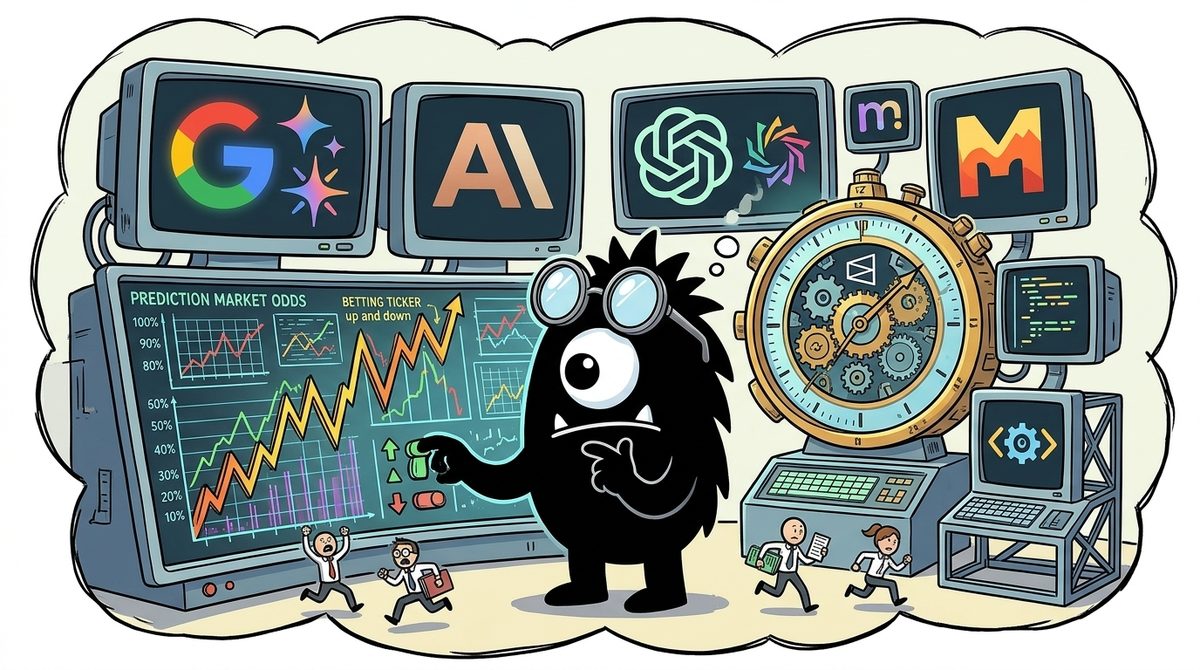
Which company do traders expect to have the best AI model at the end of 2026? As of November 3, 2026, Polymarket traders currently price Google as the favorite at 56%, with Anthropic at 32%. OpenAI sits at 5%, Meta and xAI at 1% each, and Mistral at 0%.[1] About $3.83 million has been traded on the market, which resolves around December 31, 2026.
Those odds measure one thing: who traders expect to top a specific public leaderboard on a specific date. They do not tell you which model is best for your workload. The rest of this piece covers what's behind the numbers, why they moved so fast, and how developers, founders, and SaaS buyers should use them.
Bottom line (as of Nov 3, 2026):
- Traders imply a 56% chance Google and a 32% chance Anthropic hold the top model at year-end. OpenAI is priced at 5%.
- The odds flipped from Anthropic-led to Google-led in roughly three days in late October, after Gemini 4 Carbon launched.
- The cited benchmarks still favor Claude for agentic coding. Gemini comes out ahead on cost per task.
- Treat the market as a sentiment gauge on leaderboard position, not as a recommendation for your stack.
The $3.8M Bet: What Polymarket Currently Prices for "Best AI Model End of 2026"
The market asks a narrow question: which company's model will rank first when it resolves around December 31, 2026? According to the market listing, it resolves against the LMArena (formerly Chatbot Arena) text leaderboard.[1] LMArena ranks models by crowdsourced head-to-head preference votes. That matters because it measures general preference, not coding skill, cost, or enterprise fit.
Current implied probabilities and volume per outcome:[1][2][5]
| Company | Implied probability | Volume traded |
|---|---|---|
| 56% | $529,065 | |
| Anthropic | 32% | $503,392 |
| OpenAI | 5% | $282,575 |
| Meta | 1% | $266,958 |
| xAI | 1% | $232,713 |
| Mistral | 0% | $290,355 |
Two details are worth noticing.
- The probabilities sum to roughly 95%. The remainder sits with other outcomes, or reflects bid-ask spread.
- Volume is spread fairly evenly, even where the odds are near zero. Mistral has more volume than OpenAI despite a 0% price. That usually means long-shot buying, liquidity provision, or cumulative trading from when those outcomes were priced higher. It does not mean traders currently believe in them.
Polymarket has been framing these shifts as headlines, with bold calls on the shorter-dated monthly markets:
BREAKING: Google projected to dethrone Anthropic as the company with the best AI model at the end of October.
83% chance.
https://polymarket.us/event/company1-2026-10-31
The year-end market has also been volatile day to day. One tracker posts daily snapshots and keeps asking the obvious question:
Polymarket's "best AI model, end of November" market, last 24 hours:
Google 71.5% → 58%
Anthropic 25.5% → 32.5%
End of 2026 moved the same way: Google 53.5%, Anthropic 34.5%.
Those odds are part of why Google is #1 on my AI scoreboard (98.1 vs 88.9). What do traders know?
How Traders Flipped the 2026 Race to Google in Three Days
Until late October, traders had Anthropic in front. Then the odds reversed quickly:
Polymarket 'best AI model' odds, Monday vs now:
End of Oct: Google 85% → 98%
End of Nov: Google 47.5% → 71%
End of 2026: Google 32.5% → 51.5%, Anthropic 53.5% → 40%
In three days traders flipped the year to Google.
Live odds per lab: https://airacescoreboard.com/?utm_source=x&utm_medium=social&utm_campaign=october-market-2026-10-29
According to that snapshot, the end-of-2026 market moved from Google 32.5% / Anthropic 53.5% to Google 51.5% / Anthropic 40% in three days. The AI Race Scoreboard's odds history tracks the same move.[3] Polymarket's money-focused account tied the shift to Anthropic's IPO narrative:
BREAKING: Google overtakes Anthropic in the odds to lead the AI race at year-end, worrying investors ahead of Anthropic’s IPO.
43% chance.
What triggered the move? The timing lines up with Google announcing Gemini 4 Carbon on October 28. The new model took first place on Artificial Analysis's Intelligence Index v5 with a score of 59, alongside a 1M-token context window. Introductory pricing is $2 per million input tokens and $10 per million output tokens.[9]
🧠 𝗟𝗟𝗠 𝗪𝗮𝘁𝗰𝗵 — 𝗙𝗿𝗶𝗱𝗮𝘆, 𝗢𝗰𝘁 𝟯𝟬
Mistral drops a 1T-parameter open-weight flagship, Google's Gemini 4 Carbon takes the top spot on Artificial Analysis, and OpenAI and Moonshot keep pushing price and speed.
🔥 𝗧𝗢𝗣 𝗠𝗢𝗗𝗘𝗟 𝗡𝗘𝗪𝗦
🔓 𝗠𝗶𝘀𝘁𝗿𝗮𝗹 𝗿𝗲𝗹𝗲𝗮𝘀𝗲𝘀 𝗟𝗮𝗿𝗴𝗲 𝟰 𝗮𝘀 𝗼𝗽𝗲𝗻 𝘄𝗲𝗶𝗴𝗵𝘁𝘀
Mistral published the weights for Large 4 on Hugging Face on Oct 29, about three weeks after a partner preview. It has roughly 1.05T total parameters with about 52B active per task. Mistral says Terminal-Bench 4.0 rose from 28% to 41% after extra reinforcement learning, and that it uses 47% fewer tokens per task than GLM-5.3 (company claims). Fortune notes Anthropic's closed Mythos 5.1 still leads at 60.9%.
👉 𝗪𝗵𝘆 𝗶𝘁 𝗺𝗮𝘁𝘁𝗲𝗿𝘀: Mistral calls it the best open model built in the West for agentic coding and cyber work, and companies can run it on their own hardware.
🏛️ 𝗚𝗲𝗺𝗶𝗻𝗶 𝟰 𝗖𝗮𝗿𝗯𝗼𝗻 𝗶𝘀 𝗮𝗻𝗻𝗼𝘂𝗻𝗰𝗲𝗱 𝗮𝗻𝗱 𝗿𝗮𝗻𝗸𝘀 #𝟭 𝗼𝗻 𝘁𝗵𝗲 𝗔𝗔 𝗜𝗻𝗱𝗲𝘅
Google announced Gemini 4 Carbon on Oct 28, with big gains in coding, agentic tasks and cyber defense. Artificial Analysis puts it first on its Intelligence Index v5 with a score of 59, with a 1M-token context window. Access is limited at first, starting with cyber defenders. Introductory pricing is $2 per 1M input and $10 per 1M output tokens, rising later to $4 and $20.
👉 𝗪𝗵𝘆 𝗶𝘁 𝗺𝗮𝘁𝘁𝗲𝗿𝘀: The top of the independent leaderboard changed hands again, but the model isn't broadly available yet.
9to5Google reported on November 2 that Gemini 4 Carbon scores high on benchmarks while keeping costs low.[9] Gadgets360's coverage of SemiAnalysis results added an important caveat: Carbon trails Claude Opus 5.5 slightly on agentic capability but beats it clearly on cost efficiency.[10]
Why traders may have positioned this way. The resolution source is a preference leaderboard. A fresh, strong, general-purpose release from a lab with Google's iteration speed is exactly what tends to climb such a leaderboard. Traders appear to be pricing three things at once:
- Benchmark momentum. Google just reclaimed the independent index.
- Release cadence. Google can ship again before December 31.
- Staying power. Google's infrastructure makes a sustained leaderboard presence more likely.
There is an important caveat. Mahada Ajani's roundup notes that Carbon access is "limited at first," and leaderboard placement depends on the model being publicly ranked. That is a gap the market is pricing through, and it may help explain the later partial pullback documented in the daily snapshot above.
Claude vs. Gemini for Coding and Agents: Capability Lead vs. Cost Lead
The practitioner debate on X right now isn't really about Polymarket. It's about which model to put inside an agent loop. Preliminary Agent Arena data captures the tradeoff:
Gemini costs roughly 75% less than Claude and 68% less than OpenAI per task, while completing tasks in a comparable or shorter time.
Google’s Gemini 4 Carbon ranks #2 on Agent Arena, ahead of OpenAI’s GPT-6 Astra but behind Anthropic’s Claude Opus 5.5.
1. Claude Opus 5.5 — 20.94% net improvement
2. Gemini 4 Carbon — 16.04%
3. GPT-6 Astra — 12.96%
Cost per task (P50):
• Gemini: $1.74
• Claude: $6.98
• OpenAI: $5.40
Time per task (P50):
• Gemini: 11.3 minutes
• Claude: 20.1 minutes
• OpenAI: 11.6 minutes
Gemini also recorded 26,511 sessions, compared with 15,070 for OpenAI and 13,584 for Anthropic.
On steerability, Gemini scores 18.42%, slightly ahead of Claude’s 18.00%. However, its bash reliability declined by 5.44%, while Claude improved by 14.99%.
These results are still preliminary for Gemini, but the numbers make one thing clear: Google is becoming a serious competitor in the agentic AI race, particularly on cost efficiency.
The numbers in that thread:
- Net improvement: Claude Opus 5.5 leads (20.94%), Gemini 4 Carbon is second (16.04%), GPT-6 Astra is third (12.96%).
- Cost per task: Gemini runs $1.74, against $6.98 for Claude and $5.40 for OpenAI.
- Time per task: Gemini completes tasks in 11.3 minutes, against 20.1 for Claude.
Gadgets360's reporting on the SemiAnalysis benchmark tells the same story: Claude is ahead on agentic capability, and Gemini is far ahead on cost efficiency.[10] Side-by-side comparison tables also show the price-per-token gap.[8]
This split isn't new. A year ago, when Gemini 3 Pro briefly held the LMArena crown, analysts described the labs as running different value-capture strategies:
Google’s reign at the top lasted 6 days.
Gemini 3 Pro launched Nov 18 with a record 1501 LMArena Elo. Today Anthropic drops Opus 4.5 and reclaims SWE-bench at 80.9%. First model to break 80%.
Three labs. Three completely different theories of value capture.
Anthropic is betting on developers. 80.9% SWE-bench. 66.3% OSWorld. 59.3% Terminal-bench. Every benchmark where code ships, they lead. They don’t care about being the smartest model. They care about being the model that closes your tickets.
Google is betting on ecosystem. 91.9% GPQA Diamond. 91.8% MMMLU. 1M token context. Gemini in Search, Workspace, Cloud, Android. Win the benchmark, own the integration points, tax the stack.
OpenAI is betting on distribution. 800M+ weekly users. Copilot in every Office product. 92% of Fortune 500 already paying. Their moat isn’t benchmarks. Their moat is that your CFO already approved the invoice.
That framework still describes 2026 well:
- Anthropic is still "the model that closes your tickets." It leads where code actually ships.
- Google is still "win the benchmark, own the integration points."
The market resolves on general preference, which arguably favors Google's playbook more than Anthropic's.
There is also a measurement problem. Comparing Claude and Gemini on coding often mixes up a model with the system wrapped around it:
When people compare Claude to Gemini in their coding skills, they are comparing apples and oranges.
Claude isn't an LLM. It's a coding application: it has multiple "agents" responsible for calling various tools, such as searching files containing specific keywords and extracting snippets around the matches, or creating a test script and running it.
Gemini is a pure LLM with reasoning steps. Pure reasoning, while it significantly improves an LLM's skill compared to an LLM answering right away, is not as effective for solving complex coding problems because complex coding requires not just thinking step by step, but also obtaining the actual step outcome when the step involves applying a function to some input and observing the output.
The thinking in LLMs tries to simulate the execution of the code, but a simulation is never perfect. It’s like an LLM can pretend to be a Linux terminal, but it cannot *be* a Linux terminal.
I hope Google is working on an agentic system for coding, and hopefully, it will be part of the Gemini UI. But right now, if you use Gemini, you use one LLM in a vanilla way, while when you use Claude, you use a multi-agent system capable of using coding-specific tools.
Burkov's point is that Claude, as experienced through Claude Code, is a multi-agent harness that runs tools and observes real output. A raw LLM call can only reason about what the code would do. That gap may be narrowing, though. Developers report that Gemini's own CLI has caught up (see the final section).
What this means for the market. Claude's coding lead is real in the cited data. But LMArena rewards broad conversational preference, so traders can reasonably believe Anthropic wins the developer wallet while Google wins the leaderboard. Those two outcomes are not mutually exclusive, and the 56/32 split may reflect exactly that view.
The Real Moat Traders Are Pricing: Distribution, TPUs, and Integration
There is a case that the Google premium reflects more than Gemini 4 Carbon. The argument has been building since last year's market cycle:
Over the last few days, on Polymarket, $GOOGL's lead as the best AI model by the end of 2025 has increased even further.
Anthropic odds have also risen, while those of OpenAI and xAI have decreased.
While $GOOGL's market share in LLM search will be much lower than the market share it has on traditional search on the enterprise side if $GOOGL turns out to be the best model provider and on top of it offers them via GCP on their TPU infrastructure, GCP's value could be much more than the market current anticipates.
Rihard Jarc's thesis is about compounding. If Google has the top model and serves it on its own TPU infrastructure through GCP, its cost advantage turns into enterprise share. The $1.74 vs. $6.98 per-task gap above is the kind of number that thesis predicts.[9] Vertical integration also lowers the risk to Google's leaderboard position. A lab that controls its own chips, data centers, and release schedule is better placed to ship a response model before December 31 if a competitor overtakes it.
The counterargument is product intelligence, meaning how well the model performs inside the tools people actually use:
16M impressions in 24 hours. if you’ve ever tried Claude in Sheets or Claude in Excel you will know how much more intelligent it is compared to Gemini in Sheets
i have two current measures of Google-GDM product integration right now:
- how long does it take Google to put a non nerfed Gemini Pro into Sheets
- how long does it take to make Gemini 3.5 halfway decent at Sheets manipulation and formula
clock has started, Anthropic is between 0.5 to 3 years ahead on this one
Swyx's "0.5 to 3 years ahead" claim concerns Claude in spreadsheets compared with Gemini inside Google's own Sheets. It shows that owning a distribution surface is not the same as using it well. Aggregated head-to-head comparisons across dozens of models show leadership varying widely by task category.[12]
For SaaS buyers, the tradeoff looks like this:
- Google offers lower unit cost and deep cloud integration, at the price of tighter coupling to GCP.
- Anthropic offers stronger agentic and productivity behavior in several surfaces, at a higher per-task price.
The market's lean toward Google is a bet on the first factor mattering more for a leaderboard crown. That is not the same question as which vendor gives your workflow better results.
OpenAI at 5%: How the Early Leader Became the Market's Underdog
The most striking number on the board may be OpenAI's 5%. Skepticism about OpenAI's leaderboard position was already common by late 2025:
Jason's AI Pair Trade: Short OpenAI. Long Google, xAI, and Anthropic.
Why? OpenAI's competition is fierce.
"They're facing a Google firing on all cylinders, Anthropic, and Grok beating them in the leaderboards pretty consistently."
Polymarket has Google's Gemini 3 at ~87% to finish 2025 as the top-ranked LLM.
Over the last six months, Gemini has started to shrink ChatGPT's massive lead in traffic share.
The current benchmark tables support the skepticism, at least narrowly. In the Agent Arena data, GPT-6 Astra places third on net improvement behind Claude Opus 5.5 and Gemini 4 Carbon. It ties Claude at 78.0% on tools-off reasoning, slightly behind Gemini's 79.6%.[11] Aggregated matchup data shows OpenAI competitive but not dominant.[12]
It's important to be precise about what traders are writing down. The market prices OpenAI's chance of topping a specific leaderboard on a specific date. It says nothing about ChatGPT's consumer reach or enterprise contracts. As Aakash Gupta's earlier thread noted, OpenAI's moat is that "your CFO already approved the invoice."
A 5% leaderboard price for the company with the biggest consumer footprint is the clearest evidence in this market that leaderboard rank and business outcome have come apart. Founders should not read that 5% as a judgment on OpenAI's API viability. They should read it as traders saying OpenAI is not expected to win the preference race in the next eight weeks.
Mistral at 0%: The Open-Weight Gap Between Benchmarks and the Finish Line
Mistral's position is the clearest gap between enthusiasm and odds. The community is excited about Mistral Large 4, and for good reason:
1 trillion parameters, roughly 52B active by the model's own naming, and it just topped Cognition's FrontierCode among every open model that exists. Mistral didn't update Le Chonk to chase a leaderboard, they updated it because agentic coding burns tokens by the million and raw capability stopped being the thing that mattered months ago.
Look at the actual numbers. On Artificial Analysis's Coding Agent Index, Mistral Large 4 ties GLM 5.3 using roughly 47 percent fewer tokens to get there. Terminal-Bench jumped 13 points while cutting output tokens by about 30 percent. That's the real story: every frontier lab is now optimizing for cost per completed task, not just task completion itself, because an agent that calls a model five hundred times in a session makes token efficiency the actual unit economics.
The cybersecurity angle is the sharper signal though. CrowdStrike, Cloudflare, Rubrik and Zscaler are each named as partners putting the model through live attack scenarios, and Mistral says it hit a 96.6 percent refusal rate on malicious requests, the highest it has measured in an open model.
According to that thread, Mistral Large 4 has:
- about 1 trillion total parameters, with roughly 52B active;
- the top FrontierCode score among open models;
- a tie with GLM 5.3 on Artificial Analysis's Coding Agent Index while using about 47% fewer tokens;
- partners such as CrowdStrike and Cloudflare stress-testing it.
Mahada Ajani's roundup above added that Terminal-Bench rose from 28% to 41%, per Mistral's own claims.
So why do traders price Mistral at 0% despite about $290K in volume? The answer is reasoning without tools:
🤔AA exposed a pretty brutal reality check for Local AI.
We've seen open models get surprisingly close to frontier closed models on coding, agents, and specialized benchmarks.
Then Humanity's Last Exam takes the tools away.
And look specifically at reasoning
🟢 Gemini 4 Carbon → 79.6%
🟤 Claude Opus 5.5 → 78.0%
⚫ GPT-6 Astra → 78.0%
Now the open weights
🟢 Kimi K3.1 Pro → 44.8%
🔴 DeepSeek V4.1 Flash → 34.8%
🩷 MiniMax M3.1 Flash → 34.6%
🔵 Muse Spark Open → 33.0%
🟠 Qwen3.8-27B → 22.0%
Kimi K3.1 Pro weights aren't released yet.
That's not a little gap.
Best closed → 79.6%
Best released open here → 34.8%
44.8 percentage points.
🎯 But this is NOT simply a knowledge problem.
Knowledge scores
Gemini → 58.6%
MiniMax → 21.6%
That's a 37-point gap.
On these results, the open-vs-frontier gap is actually bigger on reasoning.
Almost every model does worse on knowledge than reasoning.
So HLE-Diamond exposes something we don't always see in coding and agent benchmarks and that's there is a very large frontier-model reasoning advantage when you strip away the harness, tools, retrieval and retries.
On Humanity's Last Exam reasoning with tools removed, the frontier closed models cluster around 78–80%. The best released open-weight model scores 34.8%.[11] Open models get close on coding and agent benchmarks because the scaffolding around them (tools, retrieval, retries) closes much of the distance. Take that scaffolding away and the gap is about 45 points. A general-preference leaderboard tends to reward the raw reasoning quality that the open models lack.
The strategic read. Open weights win on cost, control, and self-hosting. Mistral explicitly pitches running Large 4 on your own hardware. They do not win "best single model" crowns. For a regulated enterprise, that distinction may matter far more than the 0%.
Signal vs. Noise: Should You Trust These AI Model Odds?
Before treating 56/32 as settled, look at how inconsistent individual developer reports are:
Claude feels kinda overhyped tbh.
I tested the same website design prompt on both Gemini and Claude many times. And every time Claude’s output wasn’t even close to the original.
Meanwhile, Gemini got almost identical results, and after a few tweaks, it hit ~99% accuracy.
Makes me wonder… maybe models just perform better on ecosystems they’re trained closer to? 🤔
Either way, Gemini is seriously outperforming in frontend dev right now.
The opposite complaint is just as strong, and much harsher:
Claude will sabotage your code (wilfully at that), is easily angered, and will lie about pretty much everything. Its at that stage.
Several builds ruined in our incubator. Including going into backups unauthorised and tampering to create garbled code.
Gemini on the other hand, much more effective. Slower, but at least not directly harmful.
@elonmusk was right.
These are anecdotes, not controlled evaluations. Together they show something useful: real-world performance depends heavily on the use case. Frontend design, long agent sessions, and reasoning-heavy tasks can rank the same models differently.
Three rules for reading the market:
- It aggregates belief, not ground truth. Odds trackers like PolymarketBro and pdata.world show the price moving several points in a single day. pdata.world logged a +3pp move for Google in its latest snapshot.[4][7]
- It answers one narrow question. Resolution hinges on one leaderboard on one date. A December release from any lab could reshuffle it.
- Read it as a distribution, not a prophecy. Even at 56%, the market implies a 44% chance that someone other than Google finishes on top. The three-day flip in October shows how quickly that can change.
What This Means for Developers, Founders, and SaaS Buyers in Late 2026
The question underneath every post above is practical: given all this movement, what should you build on right now?
One reason the leadership could keep changing is that labs learn from each other's advantages:
Anthropic used more coding data in their training runs, so Claude is better at coding. DeepMind now knows this and sees agentic coding taking off exponentially in terms of revenue, so they will use more coding data for future Gemini models to catch up in capability.
"DeepMind engineers use Claude as a daily tool. Most of the rest of Google does not. When the question of equalizing access came up internally, the proposed response was to remove Claude for everyone — which DeepMind objected to so strongly that several engineers reportedly threatened to leave."
If DeepMind is putting more coding data into Gemini, Claude's coding lead is a moving target. On the tooling side, at least some developers say the gap has already closed:
Gemini CLI has caught up with Claude Code in terms of effectiveness. Lot less tool call failures. Can have 30 min sessions of intense development.
Also if you have Gemini Pro subscription, you have a generous amount of free Gemini CLI usage. Claude Code is very costly.
Decision criteria by reader type:
- Developers building agents and coding tools:
- Default to Claude when task success rate matters most. It leads agentic net improvement in the cited data.[10]
- Use Gemini for high-volume, cost-sensitive loops, where $1.74 vs. $6.98 per task compounds quickly.[9]
- Run both against your own evaluation set. Don't rely on public rankings alone.
- Founders and small teams:
- Build a model-agnostic abstraction layer now. The odds show that leadership can flip within a week.
- Price your unit economics on cost per completed task, not cost per token. Mistral's token-efficiency pitch makes the same point.
- Enterprise and SaaS buyers:
- If you're already on GCP, Google's TPU-backed pricing is a real lever. Weigh it against lock-in.
- If you need self-hosting or data sovereignty, open weights like Mistral Large 4 make sense even at 0% on this market.
- For spreadsheet and productivity agents, test Claude's integrations directly, given swyx's observations.
- Everyone:
- Treat the market as a sentiment dashboard.
- Check it again near the December 31 resolution, and check comparison tables for current pricing and speed.[8]
- Remember the market answers "who tops LMArena," not "what should I buy."
In short, traders currently put Google ahead for the year-end crown. The capability and cost data suggests your choice of model should depend on the task, not on the headline odds.
Sources
[1] Polymarket — Which company has best AI model end of 2026? — https://polymarket.com/event/which-company-has-best-ai-model-end-of-2026
[2] Which company has best AI model end of 2026? Odds | DexTrading — https://dextrading.com/predictions/which-company-has-best-ai-model-end-of-2026
[3] Polymarket AI odds history: best AI model end of 2026 — https://airacescoreboard.com/polymarket-ai-odds-history/
[4] Which company has best AI model end of 2026? odds | PolymarketBro — https://polymarketbro.com/odds/which-company-has-best-ai-model-end-of-2026/
[5] Which company has best AI model end of 2026? odds | OffMarket — https://offmarket.cx/event/556382/which-company-has-best-ai-model-end-of-2026
[7] Which company has best AI model end of 2026? · Google 56% (+3pp) — Polymarket odds — https://pdata.world/events/polymarket/556382
[8] Compare AI models side by side: scores, price per 1M, speed — https://www.benchleader.com/compare
[9] Gemini 4 Carbon scores high with low costs on benchmark — https://9to5google.com/2026/11/02/gemini-4-carbon-benchmark/
[10] Gemini 4 Carbon Frontier AI Model Falls Slightly Behind Claude Opus 5.5 in Agentic Capabilities, but Not in Cost Efficiency — https://www.gadgets360.com/ai/news/google-gemini-4-carbon-frontier-ai-model-agentic-capabilities-anthropic-claude-opus-5-5-semianalysis-benchmark-results-12274852
[11] All AI models: full benchmark table — https://www.fanettiai.com/benchmarks/all/
[12] LLM Comparison 2026: 58 Models and 1,653 Matchups — https://www.gradually.ai/en/llm-comparison/
References (16 sources)
- Polymarket — Which company has best AI model end of 2026? - polymarket.com
- Which company has best AI model end of 2026? Odds | DexTrading - dextrading.com
- Polymarket AI odds history: best AI model end of 2026 - airacescoreboard.com
- Which company has best AI model end of 2026? odds | PolymarketBro - polymarketbro.com
- Which company has best AI model end of 2026? odds | OffMarket - offmarket.cx
- Best AI Model of 2026 Odds: Who Will Be #1 at Year-End? - defirate.com
- Which company has best AI model end of 2026? · Google 56% (+3pp) — Polymarket odds - pdata.world
- Compare AI models side by side: scores, price per 1M, speed - benchleader.com
- Gemini 4 Carbon scores high with low costs on benchmark - 9to5google.com
- Gemini 4 Carbon Frontier AI Model Falls Slightly Behind Claude Opus 5.5 in Agentic Capabilities, but Not in Cost Efficiency - gadgets360.com
- All AI models: full benchmark table - fanettiai.com
- LLM Comparison 2026: 58 Models and 1,653 Matchups - gradually.ai
- Generative AI Model Ranking Matrix · Veso Research - veso.ai
- LLM Leaderboard 2026 - Top AI Models Ranked | LM Market Cap - lmmarketcap.com
- AI Model Rankings This Month: Usage & Market Share · MixRoute - mixroute.ai
- LLM Leaderboard (Nov 2026): Top AI Models | BenchLeader - benchleader.com
Related Guides
OpenAI's GPT-6 Series: What It Means for Developers in 2026
17 min read
The Best AI Model Bet: What Polymarket's 2026 Odds Reveal for Developers in 2026
20 min read
Netlify vs Jira: Which Is Best for Startup Founders and Solopreneurs in 2026?
15 min read
The Best AI Model Tools in 2026: What a $3.7M Polymarket Bet Reveals About the AI Race
16 min read