The Best AI Model Bet: What Polymarket's 2026 Odds Reveal for Developers in 2026
Polymarket's $3.8M 'best AI model end of 2026' market puts Google at 56% and Anthropic at 38%. Discover what the odds mean for developers and SaaS buyers.
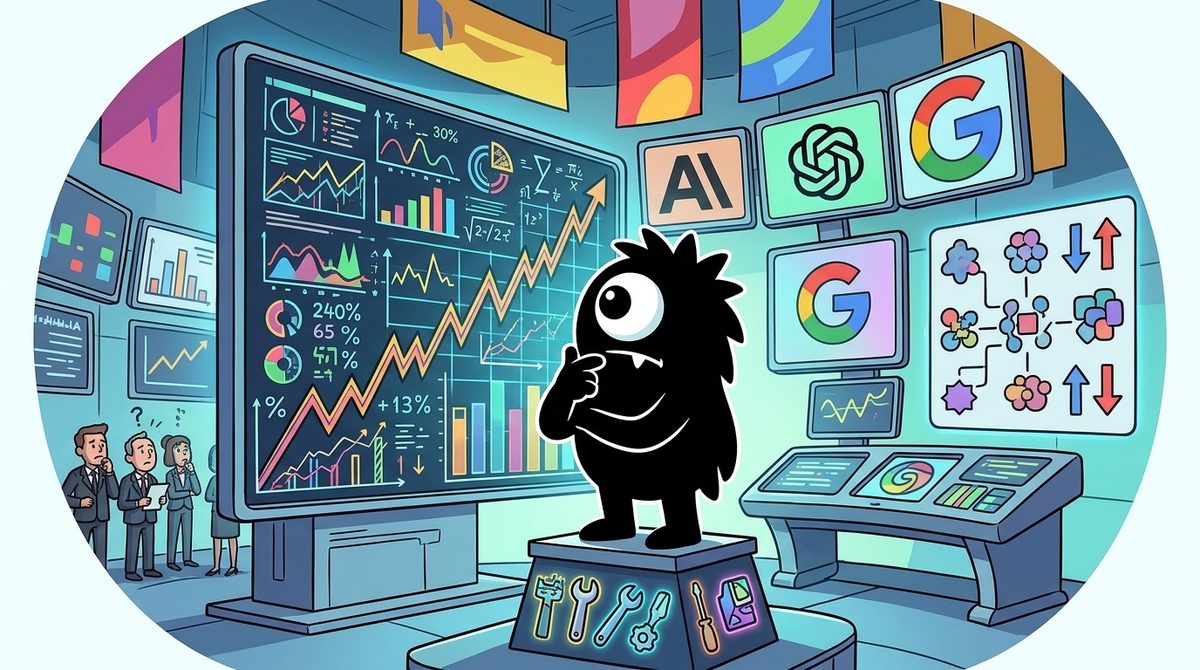
As of November 2, 2026, the question behind Polymarket's "Which company has best AI model end of 2026?" market is easy to state. With about $3.8 million staked, who do traders expect to hold the top spot on December 31, and should that change which model you build on? The short answer: the market implies a two-horse race, with Google modestly favored over Anthropic. It does not tell you which model is best for your workload, and the odds have moved sharply on sentiment within days.
The 56/38 split is less a verdict on raw intelligence than a bet on how one public leaderboard will look on one specific day. Developers, founders, and SaaS buyers should read the market as a live gauge of industry narrative. It is not a procurement signal.
Bottom line (as of Nov 2, 2026):
- Polymarket traders currently price Google at 56%, Anthropic at 38%, OpenAI at 5%, Meta and xAI at 1% each, and Mistral at 0%, with roughly $3.8M traded on a market resolving around December 31, 2026[1].
- The odds have swung hard in recent weeks. Google went from about 32.5% to above 50% in three days[5].
- Practitioners still split on the question. Gemini leads on cost and some leaderboards, while Claude leads several agentic-coding benchmarks.
- Actionable takeaway: test on your own tasks, design for model portability, and weight cost per task as heavily as leaderboard rank.
The $3.8M Market: What Are Polymarket Traders Actually Pricing for 2026?
The headline numbers come straight from the market page[1], and aggregators such as DexTrading[4] and OffMarket[6] mirror them:
| Company | Implied probability | Volume traded |
|---|---|---|
| 56% | $524,231 | |
| Anthropic | 38% | $497,037 |
| OpenAI | 5% | $279,725 |
| Meta | 1% | $259,831 |
| xAI | 1% | $232,246 |
| Mistral | 0% | $289,295 |
The most important detail is the resolution mechanism, not the percentages. As ChainDuck summarized it, the market is "ranked by LMArena on Dec 31." In practice that means the question is "which company tops a crowd-voted public leaderboard on one date," not "which lab builds the most capable model."
$3.4M of real bets say the #1 AI model of 2026 is a coin flip
- Google 50%
- Anthropic 42%
- OpenAI 5.6%.
Polymarket traders, ranked by LMArena on Dec 31
Send this to the friend who swears by Claude. Or Gemini
ChainDuck's "coin flip" framing captures the right mental model. A 56% favorite still loses 44% of the time. Implied probabilities express what traders collectively expect. They are not forecasts of certainty.
The volume column also says something the percentages don't. Google and Anthropic each drew about $500K, which shows where the real disagreement sits. Mistral, priced at 0%, has seen $289,295 change hands, more than OpenAI's $279,725. Heavy volume on a near-zero outcome usually reflects traders buying cheap "No" shares or making lottery-ticket longshot bets, not conviction that the outcome will happen. The six options listed account for roughly $2.08M of the $3.8M total. Volume measures attention and churn as much as belief.
The Three-Day Flip: Why Polymarket's AI Odds Move Faster Than Research
The current favorite only recently became the favorite. The odds-history tracker at AI Race Scoreboard documents the swing[5], and Claudiu Micu laid out the before-and-after on X:
Polymarket 'best AI model' odds, Monday vs now:
End of Oct: Google 85% → 98%
End of Nov: Google 47.5% → 71%
End of 2026: Google 32.5% → 51.5%, Anthropic 53.5% → 40%
In three days traders flipped the year to Google.
Live odds per lab: https://airacescoreboard.com/?utm_source=x&utm_medium=social&utm_campaign=october-market-2026-10-29
Anthropic went from 53.5% to 40% and Google from 32.5% to 51.5% in three days. No lab published a paper that changed the fundamentals in that window. Michal Strnadel put the cause bluntly:
Polymarket's "best AI model at the end of 2026" market had Google at 35% on Wednesday and 50% on Thursday.
Google's research didn't change in a day. What people saw on their timeline did.
I'd still lean Anthropic, mostly because December is a long way off in AI time.
The shorter-dated markets are even more reflexive. Polymarket's "end of November" market showed Google at 69.5% on one tracker[2] and 66% on another as of November 2[3]. Micu recorded a 24-hour slide from 71.5% to 58% in the same contract:
Polymarket's "best AI model, end of November" market, last 24 hours:
Google 71.5% → 58%
Anthropic 25.5% → 32.5%
End of 2026 moved the same way: Google 53.5%, Anthropic 34.5%.
Those odds are part of why Google is #1 on my AI scoreboard (98.1 vs 88.9). What do traders know?
Micu's closing question, "What do traders know?", is the right one to ask. The honest answer is probably "not much that you don't." These prices aggregate public signals: launch announcements, leaked benchmarks, viral demos, and the general mood of the timeline. That makes them useful as a real-time sentiment index, because they show quickly which lab the industry believes has momentum. It makes them weak as a capability verdict.
As Strnadel notes, "December is a long way off in AI time." Two months is enough for a major release to reshuffle any leaderboard.
Benchmarks vs. Real Work: Why Traders Favor Google but Builders Reach for Claude
The central tension in the X conversation is that betting momentum points to Google while many practitioners say they still use Claude for serious work. Prannay Rai made the contrarian case directly:
Polymarket gives Google 56% for the best AI model at the end of 2026. Anthropic is at 34%, OpenAI near 6%.
I'd take Anthropic at 34%. Google wins benchmarks, but for real work like coding and agents, people still pick Claude.
Who are you betting on? I really want to see @bot someday there too
The vendor and third-party data back both sides of this split. Anthropic positions Claude Opus 5.5 as its flagship for agentic and coding work[8]. Vipin's breakdown of the Agent Arena rankings, which appears in the cost section below, has Opus 5.5 at #1 on net improvement, ahead of Gemini 4 Carbon and GPT-6 Astra. On the other side, BenchLeader's head-to-head describes Opus 5.5 and Gemini 4 Carbon as "neck and neck on quality"[12]. BenchLM's October 2026 comparison also shows the verdict depends heavily on which category you weight[10].
The deeper problem is that the gaps people argue about are often tiny, and the winner depends on the test chosen. NightRacc pulled the numbers to show how thin the margins are:
"CLAUDE IS THE BEST AI" AND "GPT IS THE BEST AI" ARE SEPARATED BY 0.8 POINTS.
I pulled the actual leaderboard instead of the marketing slides.
SWE-bench Verified, same harness for all three:
Claude Opus 5 — 97.00%
DeepSeek V4 Pro — 96.40%
GPT-5.6 Sol — 96.20%
That's the whole gap people argue about all day.
Then it gets worse. Change the benchmark, change the winner:
→ SWE-bench Pro (harder, contamination-resistant): GPT has led snapshots where Claude didn't
→ LiveCodeBench: Gemini 3.1 Pro sits ~200 Elo ahead of both
Same models. Different test. Different champion.
To be fair: these are single snapshots, and every tracker reports different numbers for the same model depending on the scaffolding.
The "best model" is mostly whichever benchmark someone picked before writing the post.
Which one do you actually use day to day, and why?
NightRacc found a 0.8-point spread on SWE-bench Verified (a widely used coding benchmark). On the harder, contamination-resistant SWE-bench Pro, a different leader has appeared in some snapshots. On LiveCodeBench, Gemini sits about 200 Elo ahead. As NightRacc concludes, "the 'best model' is mostly whichever benchmark someone picked before writing the post."
Szymon Paluch's analysis of Gemini 4, GPT-6 Astra, and Claude makes the same methodological point: headline rankings shift depending on which suite and conditions you read[11].
This explains how the market can favor Google while builders prefer Claude. If the market resolves on a crowd-preference leaderboard, Google can win the bet even if Claude remains the production default for coding agents. Traders are pricing the scoreboard. Builders are pricing their workflows. Both groups can be right at the same time.
The Hidden Axis: Do Cost and Speed Matter More Than the Top Leaderboard Spot?
For founders and SaaS buyers, the most consequential data in this debate may not be about rank. Vipin's breakdown of Agent Arena shows why:
Gemini costs roughly 75% less than Claude and 68% less than OpenAI per task, while completing tasks in a comparable or shorter time.
Google’s Gemini 4 Carbon ranks #2 on Agent Arena, ahead of OpenAI’s GPT-6 Astra but behind Anthropic’s Claude Opus 5.5.
1. Claude Opus 5.5 — 20.94% net improvement
2. Gemini 4 Carbon — 16.04%
3. GPT-6 Astra — 12.96%
Cost per task (P50):
• Gemini: $1.74
• Claude: $6.98
• OpenAI: $5.40
Time per task (P50):
• Gemini: 11.3 minutes
• Claude: 20.1 minutes
• OpenAI: 11.6 minutes
Gemini also recorded 26,511 sessions, compared with 15,070 for OpenAI and 13,584 for Anthropic.
On steerability, Gemini scores 18.42%, slightly ahead of Claude’s 18.00%. However, its bash reliability declined by 5.44%, while Claude improved by 14.99%.
These results are still preliminary for Gemini, but the numbers make one thing clear: Google is becoming a serious competitor in the agentic AI race, particularly on cost efficiency.
At P50 (the median task), Gemini costs $1.74 per task, compared with $6.98 for Claude and $5.40 for OpenAI. It also finishes in 11.3 minutes versus Claude's 20.1. Claude still wins on net improvement (20.94% vs. 16.04%) and improved on bash reliability while Gemini's declined. Vipin flags these Gemini results as "still preliminary." The cost gap, though, is about 75%.
The pattern holds on a harder, economically oriented benchmark:
Gemini 4 Carbon just got 91% of Opus 5.5's score on SemiAnalysis's new GDPx benchmark.
$16.29 per task vs $51.41.
Same work, a third of the price. Carbon is the most underrated model on that leaderboard and it isn't even generally available yet.
Ivana reports that on SemiAnalysis's GDPx, Gemini 4 Carbon reached 91% of Opus 5.5's score at $16.29 per task versus $51.41. Google's own launch post for Gemini 4 Carbon emphasizes this efficiency positioning[9], and the BenchLM and BenchLeader comparisons land in the same place on price[10][12].
The cost difference matters more for agents than for chat. A single chat response barely registers on an invoice. An agentic pipeline running tens of thousands of multi-step tasks a month turns a 3–4x price difference into a line item that can decide gross margins.
If a model delivers roughly 90% of the quality at roughly 30% of the price, many SaaS products will choose it. Not every task needs the top model, and the savings fund more retries, more evals, or lower prices for customers.
This economic story is a plausible reason traders have been pricing Google's trajectory upward. A lab that is close on quality and far ahead on price tends to win usage. Usage feeds crowd-voted leaderboards and the narrative around them. Gemini's session count in Vipin's data, 26,511 versus 13,584 for Anthropic, hints at that flywheel.
Can You Even Trust the Scoreboard? The Harness and Contamination Problem
Every number above comes with a caveat that practitioners raise constantly: how a model was tested shapes the result. A harness is the scaffolding, tools, and agent loop a model runs inside, and its choice can move scores dramatically. Vipin raised it about FrontierCode 2.0:
FrontierCode 2.0 ranks Claude Opus 5.5 #1 at 45.5% and OpenAI's GPT-6 Astra #2 at 42.8%.
Meanwhile, Gemini 4 Argon sits at #11 with 26.3%, tested on Devin CLI instead of Google's own Antigravity.
How is this a fair comparison when Claude and OpenAI models are evaluated on their respective coding harnesses?
Gemini 4 Argon landed at #11 with 26.3% when tested on Devin CLI rather than Google's own Antigravity harness. Meanwhile Claude and OpenAI models were evaluated on their native tooling. Whether that comparison is unfair, or whether it fairly reflects how models perform outside their home environment, is a real debate. Either way, a single ranking hides a lot.
Auditing these benchmarks is also hard and expensive. Sankalp (dejavucoder) wrote a darkly comic account of what independent verification costs:
i’m so fucking stressed out, i’m about to have a nervous breakdown. a high data circle friend asked me to audit this benchmark. i said i can’t🗣️. i’m too poor. i will have to go make my trace police go through every fucking trace. every fucking trace. 4-5 opus 5.5 agents going through it for days at end few hundred USD per task. asking them to sanity check questions double-checking everything trying to read the strict ass verifier code. i can’t. it’s not open source. the fucking benchmark is not even open source. i can’t even look at the data. looking at the data is my sole source of income. and now they’re pushing fucking gemini up. gemini number two on the leaderboard... it’s not even out yet. then i have to write a blog and beg people to read it. probably make some vendor enemies in the way. my tiny apartment smells like burnt tokens. oh man the credits i have to inject in that big chungus opus, just to wake it up, just to get it moving for the day. i have pumped all my money into looking at data. my fans will comment stuff about how the work i’m doing is important... bringing the attention of the eval community bringing umm bringing verifier issues slop task issues to the forefront. piece of shit fucking job. i hate benchmark auditing.
View on XBehind the frustration are concrete points: "a few hundred USD per task," days of agent time, and a benchmark that is "not even open source," so outsiders "can't even look at the data." When the most-cited new evals are closed, the community cannot easily check verifier bugs, poorly constructed tasks, or contamination (training data leaking test answers).
For this market, methodology is decisive. A resolution based on LMArena rewards whatever human voters prefer in head-to-head comparisons across categories. Even LMArena's own sub-leaderboards produce different winners. In an earlier Search Arena update, for example, Google's grounded Gemini models held the top spots while Claude's best search variant sat at #7:
🌐🚨Search Arena Leaderboard Update!
Four frontier models have landed on the Search leaderboard, and the Top 15 have been disrupted:
▪️#1 gemini-3-flash-grounding by @GoogleDeepmind (+6pts over gemini-3-pro-grounding)
▪️#5 gpt-5.2-search-non-reasoning by @OpenAI (only non-reasoning in Top 5)
▪️#7 claude-opus-4-5-search by @AnthropicAI (best Claude variant in search)
▪️#13 claude-sonnet-4-5-search by @AnthropicAI (+3pts over claude-opus-4-1-search)
In Search Arena, frontier models are evaluated on real-time search queries and citation source quality. Come test them with your hardest queries.
Category leaderboards like Search, WebDev, and Text can each crown different labs. Anyone betting on December 31 is partly betting on which leaderboard view resolves the market and how voters behave in the weeks before.
Distribution vs. Intelligence: Does Google's Ecosystem Explain the Odds?
The strongest structural argument for Google is distribution. Gemini can be embedded across Workspace, Search, Android, and Cloud, and Google's launch materials emphasize availability across its surfaces[9]. No rival has comparable default placement in front of billions of users. That reach feeds the usage and preference signals that crowd leaderboards measure.
The counterargument is that distribution is not the same as product intelligence. swyx made the point using a product Google owns:
16M impressions in 24 hours. if you’ve ever tried Claude in Sheets or Claude in Excel you will know how much more intelligent it is compared to Gemini in Sheets
i have two current measures of Google-GDM product integration right now:
- how long does it take Google to put a non nerfed Gemini Pro into Sheets
- how long does it take to make Gemini 3.5 halfway decent at Sheets manipulation and formula
clock has started, Anthropic is between 0.5 to 3 years ahead on this one
Even inside Google Sheets, swyx argues that Claude's spreadsheet integration is noticeably smarter than Gemini's. He estimates Anthropic is "between 0.5 to 3 years ahead" on this front. Anthropic has kept pitching Opus 5.5 on exactly this kind of real-work productivity[8].
A more pointed signal comes from inside Google. Tae Kim shared reporting on Claude's use within DeepMind:
Anthropic used more coding data in their training runs, so Claude is better at coding. DeepMind now knows this and sees agentic coding taking off exponentially in terms of revenue, so they will use more coding data for future Gemini models to catch up in capability.
"DeepMind engineers use Claude as a daily tool. Most of the rest of Google does not. When the question of equalizing access came up internally, the proposed response was to remove Claude for everyone — which DeepMind objected to so strongly that several engineers reportedly threatened to leave."
Kim summarizes the reporting this way: DeepMind engineers use Claude daily, and they objected so strongly to a proposal to remove it that some reportedly threatened to leave. His interpretation is that Anthropic's coding edge comes from training-data choices, and that DeepMind will try to close the gap by using more coding data.
If that reading is right, the market's Google tilt is partly a bet that DeepMind closes the gap in time for December 31. The bet is not that the gap has already closed.
For SaaS buyers, these two forces pull in opposite directions:
- Distribution convenience: Gemini is already in your Workspace contract, with no extra vendor review.
- Raw capability on specific tasks: Claude may perform better on the agentic or analytical work you actually care about.
OpenAI, xAI, Meta, and Open-Source: Are the Market's Long Shots Mispriced?
The market implies just 5% for OpenAI, even though GPT-6 Astra places near the top of several of the leaderboards discussed above. It ranks #3 on Agent Arena and #2 on FrontierCode 2.0. Two explanations are possible:
- Genuine mispricing. OpenAI ships a model that tops LMArena before the market resolves.
- A resolution artifact. Traders believe OpenAI's models are strong but unlikely to finish #1 on the specific leaderboard on the specific date.
Ethan Mollick's state-of-the-frontier read helps explain why the rest of the field sits near zero:
So we now have a pretty good picture of the state of the frontier AI model makers.
US closed source models continue to lead. Google, OpenAI, and Anthropic stand well ahead of the pack, and may have signs of recursive self-improvement. xAI has fallen from frontier status for now (though promises to return shortly). Meta re-entered the space today with a not-quite-frontier closed source model, but an approach that suggests that they might be back in the race. All the other US players seem far behind.
On the Chinese model front, Alibaba (Qwen), Moonshot (Kimi), MiniMax, Xiaomi (MiMo), Deepseek, and Z (GLM) all still appear to be very much in the race, though the best Chinese models are still 7-9+ months behind released US closed source models. For some of these players, especially Xiaomi and Alibaba, their commitment to open weights appear to be slipping.
Outside of China, Mistral seems to have fallen from frontier status.
Mollick described Google, OpenAI, and Anthropic as "well ahead of the pack." He said xAI had "fallen from frontier status for now," Meta had re-entered with a "not-quite-frontier" model, and Mistral "seems to have fallen from frontier status." Those assessments line up closely with xAI at 1%, Meta at 1%, and Mistral at 0%[1].
The bigger blind spot is structural. This is a company market, so open-weight and non-US models cannot win it as framed, even when they win specific leaderboards. BridgeMind's post shows how quickly that can happen:
Kimi K2.6 just dropped.
And it crushed Claude Opus 4.6 on SWE-Bench Pro.
Kimi K2.6: 58.6
GPT-5.4 xhigh: 57.7
Gemini 3.1 Pro: 54.2
Claude Opus 4.6: 53.4
An open source Chinese model is now #1 on agentic coding.
Frontier labs have a problem.
Kimi K2.6 briefly topped SWE-Bench Pro, and DeepSeek V4 Pro appears within a fraction of a point of the leaders in NightRacc's SWE-bench Verified snapshot above. For practitioners, open-weight models offer self-hosting, fine-tuning, and cost control that closed APIs cannot match. None of that shows up in a market where the options are Google, Anthropic, OpenAI, Meta, xAI, and Mistral.
History also argues for humility about any lab's position. A 2025 post from Florian Brand called Anthropic "the furthest away from the frontier since Claude 3.0" and named Gemini "the best coding model around":
Ironically enough, Anthropic is the furthest away from the frontier since Claude 3.0
Everyone has a longer context, everyone beats them at pricing in the Haiku range and Gemini is the best coding model around (probably until o3/o4-mini drop)
Within a year, the conversation had flipped to "people still pick Claude for coding." Frontier positions change fast, which is the best reason not to treat any probability here, high or low, as settled.
What Should Developers, Founders, and SaaS Buyers Do With These Odds?
The recurring frustration on X is that the "best model" debate is noisy, depends on which benchmark you pick, and changes week to week. Here is how to act on it without betting your business on a sentiment market.
For developers: test on your own workloads
Sub-point leaderboard gaps rarely survive real tasks, and performance can depend heavily on the domain. The Bugged Dev's frontend comparison is anecdotal but typical:
Claude feels kinda overhyped tbh.
I tested the same website design prompt on both Gemini and Claude many times. And every time Claude’s output wasn’t even close to the original.
Meanwhile, Gemini got almost identical results, and after a few tweaks, it hit ~99% accuracy.
Makes me wonder… maybe models just perform better on ecosystems they’re trained closer to? 🤔
Either way, Gemini is seriously outperforming in frontend dev right now.
Remix:
The poster consistently got closer design replication from Gemini than from Claude, the opposite of the "Claude for coding" consensus. Build a small eval set from your own tickets, prompts, and failure cases, and rerun it whenever a major model ships.
For founders: architect for model portability
A three-day sentiment flip, a price cut, or a surprise release should not strand your product. Abstract model calls behind a routing layer and keep prompts and tool schemas provider-agnostic. Consider tiered routing: premium models for hard reasoning steps, cheaper models for high-volume steps. The cost data above, with Gemini around $1.74 per task against Claude's $6.98, shows how much margin routing can recover.
For SaaS buyers: weight cost per task and integration fit
Ask vendors which models they use, whether they can switch, and how cost per task is passed through to you. If you already run Workspace, Gemini's built-in distribution is a real advantage. If your use case is analytical or agentic, compare Claude's in-app intelligence directly before defaulting to what is already bundled.
Who should lean which way right now
- Choose Claude-first if your core value is agentic coding or complex multi-step work, and quality per task matters more than cost.
- Choose Gemini-first if you run high-volume agentic workloads where a 3–4x cost difference decides margins, or you are already deep in Google's ecosystem.
- Keep OpenAI and open-weight models in your eval set. They sit near the top of several leaderboards, and open weights add hosting control.
- Design a multi-model setup if you are a founder whose product depends on model quality. That describes most AI-native startups in 2026.
Treat the odds for what they are: a real-time dashboard of where industry belief is moving, as of November 2, 2026. The market implies Google 56%, Anthropic 38%[1], and the main signal in that split is that the race is still open. Your model choice should rest on your own evals.
Sources
[1] Polymarket — Which company has best AI model end of 2026? — https://polymarket.com/event/which-company-has-best-ai-model-end-of-2026
[2] Which company has the best AI model end of November? Odds: Google 69.5% | Polymarket Odds Today — https://polymarkettrader.com/odds/which-company-has-the-best-ai-model-end-of-november/
[3] Which company has the best AI model end of November odds: Google 66% (2 Nov) | PredictRips — https://predictrips.com/odds/q/which-company-has-the-best-ai-model-end-of-november
[4] Which company has best AI model end of 2026? Odds | DexTrading — https://dextrading.com/predictions/which-company-has-best-ai-model-end-of-2026
[5] Polymarket AI odds history: best AI model end of 2026 — https://airacescoreboard.com/polymarket-ai-odds-history/
[6] Which company has best AI model end of 2026? odds | OffMarket — https://offmarket.cx/event/556382/which-company-has-best-ai-model-end-of-2026
[8] Introducing Claude Opus 5.5 — https://www.anthropic.com/claude-opus-5-5
[9] Introducing Gemini 4 Carbon — https://blog.google/innovation-and-ai/models-and-research/gemini-models/introducing-gemini-4-carbon/
[10] Claude vs Gemini (October 2026): Benchmarks, Price & Verdict — https://benchlm.ai/compare/claude-vs-gemini
[11] Gemini 4 vs GPT-6 Astra vs Claude: reading the benchmarks — https://szymonpaluch.com/blog/posts/gemini-4-vs-gpt-6-vs-claude
[12] Claude Opus 5.5 vs Gemini 4 Carbon: neck and neck on quality — https://www.benchleader.com/compare/claude-opus-5-5-vs-gemini-4-carbon
References (16 sources)
- Introducing Claude Opus 5.5 - anthropic.com
- Polymarket — Which company has best AI model end of 2026? - polymarket.com
- Which company has the best AI model end of November? Odds: Google 69.5% | Polymarket Odds Today - polymarkettrader.com
- Which company has the best AI model end of November odds: Google 66% (2 Nov) | PredictRips - predictrips.com
- Which company has best AI model end of 2026? Odds | DexTrading - dextrading.com
- Polymarket AI odds history: best AI model end of 2026 - airacescoreboard.com
- Which company has best AI model end of 2026? odds | OffMarket - offmarket.cx
- Which company has the best AI model end of November Odds: Prediction Market Favorites (October 2026) - WIN DAILY® - windailysports.com
- Introducing Gemini 4 Carbon - blog.google
- Claude vs Gemini (October 2026): Benchmarks, Price & Verdict - benchlm.ai
- Gemini 4 vs GPT-6 Astra vs Claude: reading the benchmarks - szymonpaluch.com
- Claude Opus 5.5 vs Gemini 4 Carbon: neck and neck on quality - benchleader.com
- Claude vs ChatGPT vs Gemini: Carbon, Opus 5.5, Terra [2026] - tech-insider.org
- LLM Leaderboard (Nov 2026): Top AI Models | BenchLeader - benchleader.com
- AI Model Rankings & Benchmarks | The Latent Score - thelatent.co
- LLM leaderboard November 2026: Claude Fable 5 xHigh Effort ranks first across 4 benchmarks | Rank.ai - rank.ai
Related Guides
Netlify vs Jira: Which Is Best for Startup Founders and Solopreneurs in 2026?
15 min read
The Best AI Model Tools in 2026: What a $3.7M Polymarket Bet Reveals About the AI Race
16 min read
Is Deno Worth It in 2026? An Honest Review After the Node Wars
16 min read
The Best AI Model Tools in 2026: What a $3.6M Polymarket Bet Reveals About Where the Industry Is Heading
18 min read