The Best AI Model Tools in 2026: What a $3.6M Polymarket Bet Reveals About Where the Industry Is Heading
Polymarket's best AI model 2026 odds put Google at 52% and Anthropic at 38%. Discover what traders' $3.6M bet signals for developers and SaaS buyers. Learn more.
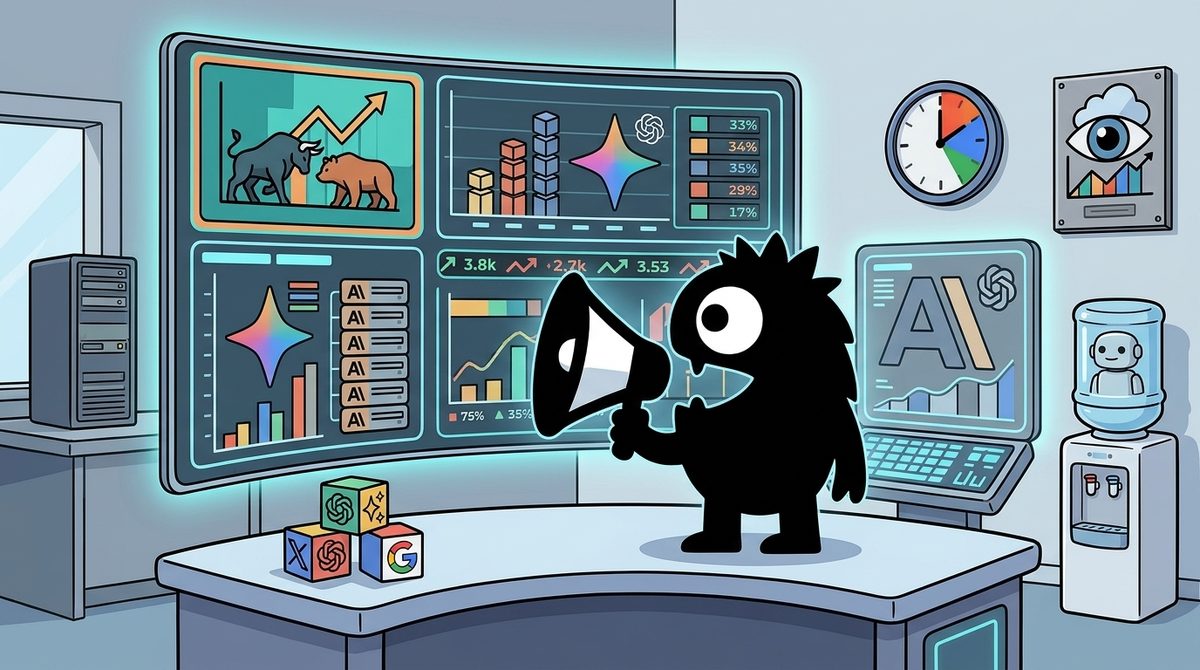
The question this market answers is narrower than it sounds. Polymarket's contract "Which company has best AI model end of 2026?"[1] does not settle which lab builds the most useful model for your stack. It settles which company traders expect to sit on top of a specific public leaderboard on a specific date. Keep that distinction in mind and the odds become a useful tool for anyone choosing an AI vendor in late 2026.
The direct answer: as of October 31, 2026, traders currently price a two-horse race. The market implies a 52% chance for Google and 38% for Anthropic. OpenAI is far behind at 6%, and Meta, Mistral, and Alibaba are priced at roughly zero. About $3.64 million has been staked on these outcomes. The lead has changed hands repeatedly in recent weeks, so the strongest signal here is that nobody has locked in leadership.
Bottom line (as of Oct 31, 2026):
- Google 52% / Anthropic 38%: the market implies a genuine toss-up that leans Google, not a settled winner.
- OpenAI 6%: traders currently price OpenAI as a long shot, despite recent GPT-6-series launches.
- Meta 1%, Mistral 0%, Alibaba 0%: written off for the #1 spot, which is not the same as being written off for production use.
- For buyers: treat these odds as a weekly confidence gauge. Build for model portability rather than betting your roadmap on one lab.
The $3.6M Bet on the Table: What the Market Is Actually Pricing
An implied probability is simply the price of a "yes" share. A Google share trading at 52¢ means traders collectively price about a 52% chance that Google resolves as the winner. It is not a forecast of fact. It is the point where buyers and sellers currently agree, and it moves every time new information or new money arrives.
Here is the snapshot on Polymarket[1] as of October 31, 2026:
| Company | Implied probability | Volume traded |
|---|---|---|
| 52% | $497,256 | |
| Anthropic | 38% | $487,161 |
| OpenAI | 6% | $273,161 |
| Meta | 1% | $256,478 |
| Mistral | 0% | $283,295 |
| Alibaba | 0% | $228,254 |
The listed outcomes add up to about 97%. The rest sits with smaller contracts such as xAI.
The resolution mechanism shapes trader behavior more than anything else. The market settles around December 31, 2026, against a public leaderboard: the LMArena/Chatbot Arena rankings, which are built from crowd-voted head-to-head comparisons[1]. Traders are therefore not betting on "best model" in any philosophical sense. They are betting on which model will rank first in human preference votes on one date.
That explains why the quoted odds vary so much on X. Aggregators and traders quote different numbers depending on when they took their snapshot. One tracker recently showed Google at 55%[2], and another lists live prices that shift intraday[5]. Two widely shared posts from the past couple of weeks capture how far apart the numbers can be:
Three frontier launches since September: GPT-6 Astra, Claude Opus 5.5, Gemini 4 Argon.
Polymarket, best AI model at the end of 2026:
Anthropic 53.5%
Google 37.5% $GOOG
OpenAI 5.9%
Which price is most wrong?
Polymarket gives Google 56% for the best AI model at the end of 2026. Anthropic is at 34%, OpenAI near 6%.
I'd take Anthropic at 34%. Google wins benchmarks, but for real work like coding and agents, people still pick Claude.
Who are you betting on? I really want to see @bot someday there too
Anthropic at 53.5% in one post and Anthropic at 34% in another are both real readings, taken days apart. Volume also tells its own story. Mistral drew $283K in volume despite a 0% price, more than OpenAI. Money that flows into an outcome priced at zero is usually traders selling "no" certainty, hedging, or taking contrarian lottery tickets. It does not mean the crowd believes in a Mistral upset.
A Volatile Two-Horse Race: Is Google or Anthropic the Real 2026 Favorite?
For most of 2026 this was not a close race. According to the week-by-week odds history, Anthropic held a commanding lead through much of the year before falling back as Google surged[3]. Prasenjit Sarkar summarized the arc and explained what drives it:
Polymarket had Anthropic as the best AI lab in the world for most of 2026, sitting at 70 to 80 percent odds on "best model by year end." That number is 42 percent today. Google sits at 43. Kalshi has it even tighter: Gemini 41.9, Claude 41.3, OpenAI's ChatGPT trailing both at 8.4.
The mechanism is boring and that's what makes it reliable. Traders aren't rereading benchmark papers every morning, they're watching release calendars. On Oct 19, Quo Tracker priced 42 percent odds against Anthropic shipping Fable 5.2 or later by Oct 24. Anthropic shipped nothing. Fable stayed at 5.1, the bet resolved against Anthropic, and the next checkpoint, Oct 31, already sits at 35 percent yes. Markets don't wait for a launch event to update, they update the moment a deadline passes quietly.
Google's case is thinner than the odds suggest. Gemini 4 Argon has no public release date. Google is still routing it through select cybersecurity partners and the federal pre-release access program, and its own benchmarks say Argon beats OpenAI's Astra and Anthropic's Opus on most coding and cyber tests but loses two of four coding benchmarks outright. I'd weigh the deadline data over Google's own benchmark claims any day, one is adversarial, the other is marketing. What's real is distribution: Google Cloud says almost 90 percent of the Fortune 100 now run Gemini Enterprise, and Gemini Agent just shipped the kind of single prompt, cross app task execution Anthropic hasn't matched yet.
Haiku 5.5 landing October 7 bought Anthropic goodwill, not a lead. An IPO priced near $2 trillion in three weeks needs more than goodwill. It needs Fable 5.2 to actually land, and soon.
His point about the mechanism matters most. Traders reprice the moment a deadline passes quietly. They do not wait for a launch event. When Anthropic's expected release did not land by an October checkpoint, the odds moved against Anthropic right away.
The speed of the most recent flip shows how thin the leader's margin is in traders' minds:
Polymarket 'best AI model' odds, Monday vs now:
End of Oct: Google 85% → 98%
End of Nov: Google 47.5% → 71%
End of 2026: Google 32.5% → 51.5%, Anthropic 53.5% → 40%
In three days traders flipped the year to Google.
Live odds per lab: https://airacescoreboard.com/?utm_source=x&utm_medium=social&utm_campaign=october-market-2026-10-29
In three days, traders moved the year-end market from Anthropic 53.5% / Google 32.5% to Google 51.5% / Anthropic 40%. A swing of roughly 20 points in under a week is unusual for a market with millions in volume. Defirate's odds coverage likewise describes repeated lead changes rather than a stable frontrunner[4].
What this means for SaaS buyers: if the crowd can't hold a view for a week, you shouldn't sign a multi-year exclusive on the assumption that one lab has "won." The volatility does not mean either lab's models are bad. It means the gap between them is small enough that a single release or a single missed deadline flips the expected leader.
Benchmarks Say One Thing, the Market Says Another
This is the part of the conversation that confuses newcomers most. If you open a benchmark leaderboard in October 2026, Anthropic often looks like the leader:
- BenchLeader ranks Claude Opus 5.5 first with a score of 69.2[8].
- LLMBenchmark, which tracks 379 models, also puts Claude Opus 5.5 on top at 86.9[10].
- UnifyBench has OpenAI's GPT-6 Astra leading its aggregate[11].
- LMArena, the leaderboard the market resolves against, has Gemini 4 at the top with an Elo around 1528[9]. HyzenPro's October roundup shows a similarly crowded top tier[12].
So the market is not ignoring benchmarks. It is following the one benchmark that counts for settlement, and that leaderboard is unusually tight at the top:
The top 3 models on @arena are 16 points apart:
Gemini 4 Argon 1524
Muse Wonder 1509
Claude Opus 5.5 1508
Polymarket's odds for best model at the end of 2026: Anthropic 46.5%, Google 43%, Meta 1.3%.
Voters see a three-way race. The market sees two. Who's wrong about Meta?
"Voters see a three-way race. The market sees two." The 16-point Elo spread among the top three models falls within the range where one fresh release can reorder the board. A model that leads on coding evals can still trail in Arena preference votes, because Arena voters reward conversational quality, formatting, and general helpfulness as much as raw reasoning.
The insight that ties this together is Sarkar's "boring mechanism" from the earlier post: traders watch release calendars and resolution rules, not benchmark papers. The question that moves the price is "who ships last, and strongest, before December 31?" It is not "whose model is best today?" Google's odds rose partly because Gemini 4 already holds the Arena top spot. Anthropic, meanwhile, needs a release to land in time to reclaim it.
The practitioner takeaway: don't treat a model's leaderboard position, or its implied odds, as a measure of fitness for your workload. A model at #3 on Arena could be #1 for your agentic coding pipeline. The market prices a ranking contest, not your use case.
The Anthropic Premium: Why Coding and Agents Keep Claude in the Race
If benchmarks are mixed and the Arena leans Google, why do traders still give Anthropic 38%? The practitioner case rests on pricing power and stickiness. One widely circulated analysis on X argues that Anthropic sustains a premium other labs can't:
ANT circa FEB 2026 is the only company (OAI to a much lesser extent) ever to been able to charge premia that is an order of magnitude higher than its very similar competitors.
Anecdotally everybody who use a very large amount of tokens for coding swears by Claude; Ive heard things like Claude has great taste, whereas OAI is merely smart... OFC this isn't quantifiable but it is reflected in the insane user stickiness of ANT.
This O/A premium is the entire foundation that the current AI capex trade is built upon.
Hyperscaler numbers look excellent because O/A can afford and justify limitless compute spend on training, and hyperscalers can (so far) keep buying hardware from upstream since they can just pass it on downstream.
Once for whatever reason O/A pricing power erodes (most likely coming from China OS), the pricing collapse will first hit inference computing spend, then very quickly spread to training spend aswell; since frontier labs can no longer justify burning such large amount of capital for the next gen of models when the returns are no longer obvious.
In this collapse scenario, Hyperscalers have no pricing power whatsoever, since compute is a homogenous product that is more or less a commodity; and there are at least 300 vendors selling highly homogenous compute right now.
neocloud segment of GOOG and META's current edge is the long contracts they have secured with upstream vendors and ability to navigate IRL hurdles like regulation and electricity.
When demand no longer massively outpaces supply the neocloud segment of GOOG and META is essentially tossed into the mudpit with the hundreds of other neoclouds and transitioning bitcoin miners.
The only case where GOOG can seize the pricing power, is not by overtaking O/A in model capacity; that would merely reduce ANT's edge and not increase overall Dollar Token Spend and trigger the collapse scenario outlined above.
GOOG needs to start a new growth curve much like coding earlier this year and be able to charge 10x+ premia for their tokens going forward while retaining very sticky users.
Frankly that is not something i would like to bet on.
In the most perverse way possible, GOOG/META's current revenue run is reliant on their own model actually being behind ANT and ANT being able to charge stupid prices.
The claim goes beyond "Claude is good at coding." It says heavy-token coding users rarely switch, and that this stickiness lets Anthropic charge far more than near-equivalent competitors. The author also argues that this premium underpins much of the current AI capex trade. That thesis is contested, but it explains why some traders refuse to price Anthropic below a third: revenue and usage dominance can coexist with benchmark slippage.
The strangest data point comes from inside Google itself. Tae Kim relayed a report that DeepMind engineers rely on Claude day to day:
Anthropic used more coding data in their training runs, so Claude is better at coding. DeepMind now knows this and sees agentic coding taking off exponentially in terms of revenue, so they will use more coding data for future Gemini models to catch up in capability.
"DeepMind engineers use Claude as a daily tool. Most of the rest of Google does not. When the question of equalizing access came up internally, the proposed response was to remove Claude for everyone — which DeepMind objected to so strongly that several engineers reportedly threatened to leave."
If the people building Gemini reportedly fought to keep Claude access, that is a meaningful quality signal for agentic coding, even though it says nothing about Arena rank.
Traders' reaction to bad news is also telling. When Reuters reportedly said Anthropic paused training on its next flagship for over a month over security concerns, the odds went up rather than down:
Reuters reportedly says Anthropic paused training its next flagship for over a month after security concerns.
Polymarket still has Anthropic at 55.5% for best AI model at end of 2026, up 3 today.
Google is 34.0%
OpenAI 5.9%
Meta 1.8%
xAI 1.1%.
Anthropic was about 20 points higher a month ago. Market ends Dec 31.
There are two readings. Bulls see a lab whose position is strong enough to absorb a pause. Bears note that the post itself shows Anthropic was about 20 points higher a month earlier, so the bounce came off an already-falling trend. The later slide to 38% suggests the bears' deadline-focused logic eventually won out.
Why Traders Are Long Google: Benchmarks, TPUs, and the GCP Flywheel
Google's case starts with the resolution board, where Gemini 4 tops LMArena[9]. Last year's version of this market previewed the dynamic. In late 2025, the All-In Podcast framed Google as "firing on all cylinders":
Jason's AI Pair Trade: Short OpenAI. Long Google, xAI, and Anthropic.
Why? OpenAI's competition is fierce.
"They're facing a Google firing on all cylinders, Anthropic, and Grok beating them in the leaderboards pretty consistently."
Polymarket has Google's Gemini 3 at ~87% to finish 2025 as the top-ranked LLM.
Over the last six months, Gemini has started to shrink ChatGPT's massive lead in traffic share.
At the time, Polymarket priced Gemini 3 at roughly 87% to finish 2025 as the top-ranked LLM, and Gemini had started to shrink ChatGPT's traffic lead. Separate contracts for the end of October 2026 show the same pattern of Google confidence at short horizons[6].
The structural argument is about infrastructure, not only models. Rihard Jarc made it during the 2025 cycle:
Over the last few days, on Polymarket, $GOOGL's lead as the best AI model by the end of 2025 has increased even further.
Anthropic odds have also risen, while those of OpenAI and xAI have decreased.
While $GOOGL's market share in LLM search will be much lower than the market share it has on traditional search on the enterprise side if $GOOGL turns out to be the best model provider and on top of it offers them via GCP on their TPU infrastructure, GCP's value could be much more than the market current anticipates.
If Google owns both the top-ranked model and the TPU silicon and GCP distribution it runs on, it captures margin at every layer. Sarkar's earlier post adds the distribution angle: Google Cloud says nearly 90% of the Fortune 100 run Gemini Enterprise. He also cautions that Google's newest model is still in limited partner access and that its self-reported benchmarks are "marketing" next to adversarial deadline data.
Enterprise implication: buying Gemini increasingly means buying into Google's whole stack, including cloud, chips, and workspace integration. That bundle helps if you're already a GCP shop and creates lock-in if you're not. The market currently prices Google as the structural favorite. Fifty-two percent is still close to a coin flip, not a guarantee.
OpenAI at 6%: Has the Crowd Moved On?
The most striking number on the board is OpenAI's. GPT-6 Astra leads at least one aggregate benchmark[11], OpenAI keeps shipping, and ChatGPT remains a household name. Yet traders currently price only about a 6% chance that OpenAI tops the leaderboard at year-end. Prediction Tape and Defirate both show OpenAI stuck in single digits[5][4].
On Polymarket’s “Which company has the best AI model at end of 2026?” — it’s basically a 2-horse leaderboard: Anthropic ~56% and Google ~35%, while OpenAI sits ~6% despite the fresh GPT-6.1 Terra rollout. Reads like the crowd’s already moved on from “next version” to “arena dominance.”
View on X"Moved on from 'next version' to 'arena dominance'" is the clearest summary of the logic. Under LMArena resolution, a new GPT release only matters if it beats Gemini and Claude in head-to-head votes before December 31. The market implies traders don't expect that. The All-In "pair trade" quoted above (short OpenAI, long Google, xAI, and Anthropic) frames the same view as an investment position.
The key lesson: mindshare and traffic are not market-implied model leadership. OpenAI can lead consumer usage and still be priced as a long shot in a ranking contest.
For founders on OpenAI's API: a persistent 6% does not mean your model is about to get worse. It means traders don't expect OpenAI to hold the single top slot. If your product depends on "we use the best model," that marketing claim is fragile. If it depends on OpenAI's tooling, ecosystem, and reliability, the odds say little about you.
The Zeros: Meta, Mistral, and the Chinese Labs the Market Has Written Off
Meta at 1%, Mistral at 0%, and Alibaba at 0% look like dismissals. Independent analysis supports the general ordering, though less brutally than the prices suggest:
Based on the data I see, I think:
- Anthropic🇺🇸/Google🇺🇸/OpenAI🇺🇸 all ~tied
- Meta🇺🇸 / xAI🇺🇸 each ~7mo behind
- Moonshot🇨🇳/- Deepseek🇨🇳 / zAI 🇨🇳 / Alibaba🇨🇳each ~9mo behind
- Mistral🇫🇷 ~1.5 years behind
- No other companies competitive
Peter Wildeford estimated earlier this year that Meta and xAI were about 7 months behind the frontier, Chinese labs including Alibaba about 9 months, and Mistral about 1.5 years. In a market that resolves in two months, a gap of 7 to 9 months is effectively a zero. These labs aren't incapable. They just can't plausibly close the gap before December 31.
The volume is the puzzle. Mistral ($283K) and Alibaba ($228K) together drew more trading than OpenAI. The likely explanations are traders earning small yields by selling near-certain "no" positions, hedging, and occasional contrarian bets. Earlier in the year, Claudiu Micu asked "who's wrong about Meta?" when it sat at 1.3%. The market's answer has been consistent: not this cycle.
What near-zero does not mean: it says nothing about whether Qwen or Mistral models fit your production needs. Open-weight models from these labs are often cheaper, self-hostable, and good enough for classification, extraction, or on-prem compliance workloads. The market prices a single gold medal, not fitness for a specific job.
What This Means for Developers, Founders, and SaaS Buyers in Late 2026
The X conversation keeps circling one implicit question: given this volatility, who should I build on, and how much should I trust the crowd? The evidence supports these rules:
- Treat odds as a confidence signal, not a forecast. A market that swung 20 points in three days[3] tells you leadership is contested. Use it to gauge risk, not to choose a vendor.
- For coding and agentic workloads, evaluate Anthropic seriously. The premium and stickiness practitioners describe, including the reported DeepMind usage, suggest real advantages that Arena rank doesn't capture. This fits teams whose costs are dominated by developer tooling or long-running agents.
- For cost, scale, and infrastructure bets, Google is why traders are long. If you're already on GCP, or need enterprise distribution and TPU-backed pricing, Gemini's stack integration is the structural case. Weigh the lock-in deliberately.
- Don't build on OpenAI because it's "the best," and don't flee it because of 6%. Choose it for ecosystem and tooling fit. The odds only describe the ranking race.
- Use the "zeros" where they fit. Open-weight models from Mistral and Alibaba suit cost-sensitive, self-hosted, or regulated workloads, regardless of their 0% headline.
- Design for portability. With Google at 52% and Anthropic at 38%, the most defensible architecture puts an abstraction layer over model providers, keeps eval suites that run against multiple labs, and avoids prompts tuned to only one model.
- Watch calendars, not papers. Release dates and the December 31 resolution date move this market more than any benchmark paper[1]. If you plan a vendor review, scheduling it after the year-end release window is a reasonable hedge.
Bettors have put $3.6 million on a single leaderboard slot. For practitioners, the signal worth acting on is that the crowd itself can't agree for more than a few days, and that is a reason to keep your options open.
Sources
[1] Polymarket — Which company has best AI model end of 2026? — https://polymarket.com/event/which-company-has-best-ai-model-end-of-2026
[2] Which company has best AI model end of 2026? Odds: Google 55% | Polymarket Odds Today — https://polymarkettrader.com/odds/which-company-has-best-ai-model-end-of-2026/
[3] Polymarket AI odds history: best AI model end of 2026, week by week — https://airacescoreboard.com/polymarket-ai-odds-history/
[4] Best AI Model of 2026 Odds: Who Will Be #1 at Year-End? — https://defirate.com/odds/best-ai-model-2026/
[5] Best AI Model Odds 2026: Which Company Wins? Live Prices — https://predictiontape.com/markets/tech/best-ai-model/
[6] Which company has the best AI model end of October Odds & Prediction Market Analysis — https://cryptoslate.com/predictions/market/which-company-has-the-best-ai-model-end-of-october/
[8] LLM Leaderboard (Oct 2026): Top AI Models | BenchLeader — https://www.benchleader.com/
[9] LLM & AI Benchmark Rankings: LMArena Leaderboard, Oct 2026 — https://www.aiblogly.com/benchmarks
[10] LLM Benchmark: LLM Leaderboard & AI Benchmarks, 379 Models — https://llmbenchmark.ai/
[11] LLM Leaderboard: AI Model Benchmark Rankings | UnifyBench — https://unifybench.ai/
[12] AI Leaderboard October 2026: Best AI Models Ranked | HyzenPro — https://hyzenpro.com/ai-leaderboard/
References (16 sources)
- Polymarket — Which company has best AI model end of 2026? - polymarket.com
- Which company has best AI model end of 2026? Odds: Google 55% | Polymarket Odds Today - polymarkettrader.com
- Polymarket AI odds history: best AI model end of 2026, week by week - airacescoreboard.com
- Best AI Model of 2026 Odds: Who Will Be #1 at Year-End? - defirate.com
- Best AI Model Odds 2026: Which Company Wins? Live Prices - predictiontape.com
- Which company has the best AI model end of October Odds & Prediction Market Analysis - cryptoslate.com
- Which company has the best AI model end of November Odds: Prediction Market Favorites (October 2026) - windailysports.com
- LLM Leaderboard (Oct 2026): Top AI Models | BenchLeader - benchleader.com
- LLM & AI Benchmark Rankings: LMArena Leaderboard, Oct 2026 - aiblogly.com
- LLM Benchmark: LLM Leaderboard & AI Benchmarks, 379 Models - llmbenchmark.ai
- LLM Leaderboard: AI Model Benchmark Rankings | UnifyBench - unifybench.ai
- AI Leaderboard October 2026: Best AI Models Ranked | HyzenPro - hyzenpro.com
- LLM Leaderboard & AI Model Benchmarks — October 2026 - benchlm.ai
- LLM Market Share by Lab and Model - tidelines.ai
- AI Model Rankings This Year: Usage & Market Share · MixRoute - mixroute.ai
- Enterprises Embrace Open Weights but Infrastructure Sellers Profit Most - futurumgroup.com
Related Guides

Vertex AI Agents vs Flowise vs Copilot Studio: Which Is Best for Enterprise Teams in 2026?
17 min read
The Best AI Bubble Signals in 2026: What Polymarket's Odds Reveal About AI and SaaS
20 min read
Plasmic vs Webflow vs Cloudflare Workers: Which Is Best for Full-Stack Web Apps in 2026?
17 min read
The Best Signal on the AI IPO Wave in 2026: What Polymarket's Anthropic Odds Reveal
16 min read