The Best AI Bubble Signals in 2026: What Polymarket's Odds Reveal About AI and SaaS
Polymarket AI bubble odds show traders pricing a 9% burst by year-end 2026 and 22% by mid-2027. Discover what the market expects for AI and SaaS. Learn more.
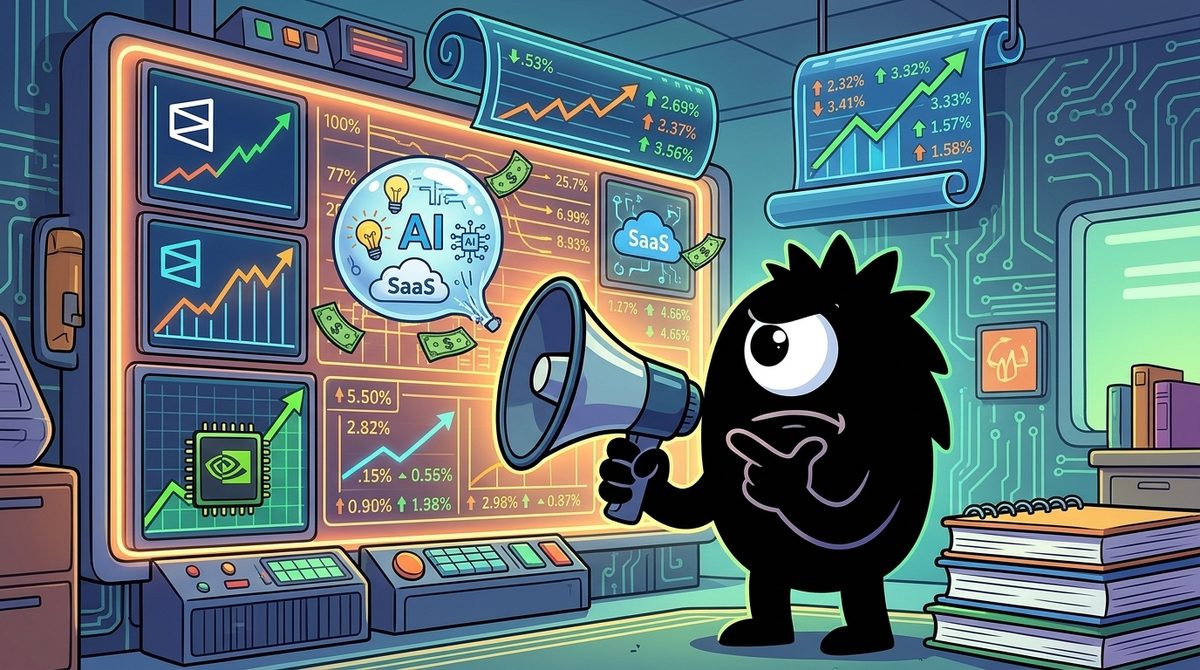
As of October 30, 2026, Polymarket traders price roughly a 9% chance that the AI bubble bursts by December 31, 2026, and about 22% by June 30, 2027. So does a prediction market think the AI boom is about to collapse? Not by year-end. The odds do show worry building for the first half of 2027. They also leave out the risk practitioners talk about most on X: a slow repricing of SaaS (software-as-a-service) companies that would never meet this market's definition of a "burst."
This analysis breaks down the live odds on Polymarket's "AI bubble burst by...?" market[1]. It explains what those odds measure and what they leave out, and what developers, founders, and SaaS buyers should do with them.
Bottom line (as of Oct 30, 2026):
- Traders currently price a 9% implied probability of an AI bubble burst by Dec 31, 2026 ($2,519,311 traded) and 22% by June 30, 2027 ($43,776 traded)[1].
- Those numbers measure the odds of a sharp, rule-defined crash. They don't measure whether AI is overvalued.
- The more likely risk for software businesses is a grinding compression of SaaS valuations, which this market doesn't measure.
- Watch where the June 2027 line moves, but keep in mind it trades on very little money.
What Polymarket Is Actually Pricing Right Now
About $3,151,082 has been wagered on the market, which resolves around January 1, 2027[1]. Two outcomes matter most:
| Deadline | Implied probability | Volume traded |
|---|---|---|
| December 31, 2026 | 9% | $2,519,311 |
| June 30, 2027 | 22% | $43,776 |
Trackers of the market have reported similar figures through October[3][5]. On X, several accounts that follow the market have described the mood as worry rather than panic:
Worry, yes, but not panic: Polymarket puts an AI bubble burst at 9.7% by the end of the year and 22.5% by the end of June 2027, the later date up four points in a week.
View on XThe year-end contract has also drifted up slightly on the same order book:
AI bubble burst in 2026 priced at 9.6% on Polymarket, up 0.5 points, on $2.5M traded
Up from 9.0% on Oct 25 on the same book, a fresh finance board repricing.
#AI #Finance #Polymarket
The two numbers also tell you something about timing. If traders put 9% on a burst by year-end and 22% on a burst by mid-2027, they are implicitly pricing about a 14% chance of a burst in the first half of 2027, assuming none happens in 2026. You get that by dividing the 13-point gap by the 91% "survival" probability. That implied risk for the six-month window is higher than the risk for the two months left in 2026. In other words, the market puts the danger in 2027, not this quarter.
The volume gap matters too. The 2026 line has about $2.5 million behind it. The June 2027 line has about $44,000[1]. A four-point weekly move on a book that small could reflect a few motivated traders as much as a consensus shift. In every case, these figures are what traders currently imply. None of them describes what will happen.
Why 9% Doesn't Mean "No Bubble": The Resolution Criteria Trap
People who see a 9% headline often read it as "the market thinks AI is fine." That misreads what the contract pays out on. One odds-reliability account summed it up:
Polymarket's 'AI bubble burst in 2026' sits around 9%, but its bar is high: it needs three of a list like Nvidia down 50% from its high or the chip ETF down 40%, all within 90 days. Our scoring flags that market as thin, with about $1K traded today. Calling a bubble and pricing an actual crash are two very different things.
View on XThe market won't resolve "yes" just because valuations look stretched or commentators declare a bubble. It needs several severe market moves to happen together within a short window. The examples cited include Nvidia falling 50% from its high or a semiconductor ETF falling 40% within 90 days. Coverage of the market has noted the same thing: the low headline number reflects how hard it is to hit those triggers before New Year's Day[2][4].
That changes how you should read the 9%. It doesn't say "91% of traders think AI is fairly valued." It says traders put about 9% odds on a crash severe and fast enough to meet specific mechanical conditions within roughly two months. A sector could be badly overvalued and still deflate slowly enough that this market never resolves yes. Bloomberg-reported strategist warnings that an AI bubble risks the worst S&P 500 crash since 2008[15] fit comfortably alongside 9% odds, because a crash on that scale can still take longer than 90 days to unfold.
How to use it: treat this market as a gauge of near-term tail risk, meaning the chance of a sudden, severe drop. It doesn't settle whether AI is overvalued. If you need an answer to that question, you'll have to look elsewhere.
The "Great SaaS Meltdown" Debate the Odds Don't Capture
The loudest AI-and-software argument on X in 2026 isn't about Nvidia crashing. It's about traditional software being slowly hollowed out by AI. Chamath Palihapitiya's framing has become the reference point:
We've talked a lot about this on the Pod, but the Great SaaS Meltdown has started and there's no going back.
What exactly is happening?
In short, hi growth, low/no profitability SaaS is no longer a winning strategy because the big question mark is the durability of that growth in the short term and, because of AI, the lack of profits in the long term. Every SaaS company has sold the dream (to investors and employees) that they will growth quickly now, and harvest lots of cash later. With AI, this assumption may be completely out the window.
Now the threshold question is whether their growth will be overtaken by a much cheaper AI-developed solution?
If you are a venture supported SaaS startup and are a legacy Heuristics+APIs+CRUD product, it is likely that a new AI oriented workflow is coming for you.
Investors in private markets can see this now and think that money to fund short term growth will not be rewarded. Investors in public markets no longer believe long term profitability is possible. They would rather pivot into something they think is more resilient.
This is a change in the risk calculus that has existed for the past 15 years and why the chart below is the chart below.
Good luck to all the players!
The argument is about structure. For 15 years, SaaS companies were valued on a deal with investors: grow fast now, collect profits later. Chamath argues that AI calls both halves into question. Growth may not last if a cheaper AI-built tool replaces the product. Future profits are uncertain if AI compresses pricing power. Other accounts put numbers on the sentiment, though those figures are the poster's own and not independently checked here:
I genuinely believe we're watching SaaS die in real time and most people still don't see it..
$1 trillion wiped from software stocks since January 2026 and its just getting started..
SaaS multiples collapsed from 18.5x at the covid peak to 4.8x today and in the same time the AI market went from $50B to $539B and it's heading to $3.5 trillion by 2033 if not sooner
the death cross hits around 2027.. that's when AI market trajectory fully overtakes SaaS valuations on the chart
the reason is simple.. the per-seat model dies when 10 agents replace 100 humans and no seats left to sell
every SaaS tool you're paying $50/seat a month for is about to get replaced by an agent that costs $0.003 per task..
chatgpt opened the door in 2022, claude opus 4 made agentic AI real in 2025 and now multiagent coordination systems like openclaw are making it deployable and accessible to everyone..
every step on that chart the tech gets more autonomous and the SaaS line drops further..
not saying every saas will die but the companies that were built entirely on per-seat pricing and no real data advantage are the ones exposed.
tbh I don't think most founders see it yet, not because the data isn't there, but accepting it means everything they built needs to be rethought..
The most important line in that post concerns the per-seat pricing model. Most SaaS revenue is billed per user. If 10 AI agents replace 100 human users, there are fewer seats to sell, regardless of what happens to Nvidia's stock price.
Here is the point that connects the two debates: a SaaS meltdown and a Polymarket-defined AI burst are separate events that could even move in opposite directions. If money rotates out of application software and into compute, chip stocks could hold up while the median SaaS stock falls sharply. In that case the burst market would stay low while software investors absorb large losses. One fund-manager account makes exactly that case:
Six months later and my view on this hasn’t changed at all. Fast forward another 18 months from now and I think the median public SaaS co will be down -60% or more from current levels with a handful that have tripled because they managed to ride the AI wave and a larger number that are in an absolute death spiral.
Whats fascinating is the non-maxis who seemingly hold two contradicting thoughts in their heads simultaneously…. They say hey AI is going to be focused on solving cancer and isn’t incentivized to burn tokens on replicating existing software rails…they also say hey we have way too much compute being built relative to future demand.
Will be interesting to see how they reconcile these two views when they get their hands on upcoming models which clearly will demonstrate the capability that bears have been warning about while also having a directive to be as cost-effective as possible on increasingly longer-duration objectives.
Like I’ve said before “the easy money in shorting SaaS is behind us”. The first selloff was on EV concern. The next selloff will be on budget crowd out. Tread carefully. Avoid the space if you can.
If you’re a software analyst whose PM is forcing you to pair trades in the space find ways to long the compute factor and start sending out your resume 🫡
"Long the compute factor" while shorting software is a bet on AI winning, not AI collapsing. Meanwhile, the economics of generative AI itself are under strain. Reporting on high compute costs, thin margins, and investor fatigue describes the AI economy cooling even as infrastructure spending rises[7]. The MarketWatch-reported strategist who calls a pop "a matter of when, not if" points readers toward preparing for repricing rather than timing a single crash[10].
For SaaS founders and buyers, the realistic downside is not a dramatic single-day crash. It is gradual repricing and disruption, which a burst contract was never built to measure.
China's Rout: A Warning Shot or a Decoupled Event?
If you want to see an AI equity crash in practice, China has provided one in 2026. Posters on X have been comparing China's AI stock decline with the low US odds:
China's AI bubble has already burst: STAR50 down 40%, $480B wiped out on high valuations, demand doubts and export curbs. For the US it serves as a warning on concentration risks and intensifies pressure from cheaper Chinese models that could erode margins, though direct contagion stays limited by decoupling.
A US burst would cut deeper—IMF flags global equity drops, investment cuts and tighter credit from leverage plus circular financing. Analysts project 20-40% tech declines, wealth effects and selective job losses, yet underlying tech progress endures. Polymarket odds remain low near-term.
Benzinga's coverage gets at the tension: China's AI stock decline is alarming, yet crypto and prediction-market traders still aren't calling a US burst[3]. The reason is decoupling. Export controls, separate capital markets, and state support limit how directly a Shanghai selloff spreads to Nasdaq. One of the more careful threads separated the financial signals from the technology signals:
China's AI crash: three models, one verdict.
We put the same question to three AI models: is China's AI crash a "bubble bursting"?
The inputs: STAR 50 down ~40% since June 2026. ~$2.4tn wiped from Chinese equities since May (Bloomberg data, as reported by the Guardian). AI stocks over 40% of Chinese/HK market value (Goldman estimate). Polymarket prices ~8% that a Chinese lab holds the top model by year-end. Epoch AI measures the open-weight gap to the US frontier at ~7 months, and narrowing.
All three seats separated the signals the same way. The crash is a financial repricing of expected profits, backed by a state fund (60bn yuan) rather than the market. It is not evidence about capability. The gap data runs the other way: models converging while equities fell.
The 8% is not a contradiction of the 7 months. "Top model" is winner-take-all and year-end is weeks away; 7 months behind means #2-3, not #1. Both numbers are honest at once.
One dissent worth keeping: if the US bans Chinese components in data centres, the clean split dies. Compute access couples everything.
That thread makes two useful distinctions. First, China's crash looks like a repricing of expected profits, partly cushioned by a state fund, rather than evidence that its AI capabilities failed. Second, the gap between Chinese open-weight models and the US frontier is reported to be narrowing even as Chinese stocks fell.
That points to the channel traders are watching. The concern isn't that China's crash spreads to the US. The concern is that cheaper Chinese open-weight models squeeze US pricing power. If capable models keep getting cheaper, the expensive infrastructure US hyperscalers are building has to earn returns in a market with lower prices. That pressure works slowly through margins, not suddenly through a 90-day crash. It fits a low 2026 number and a rising 2027 line.
The thread's dissent is worth noting. If US policy restricts Chinese components in data centers, the clean separation weakens, because "compute access couples everything." For now, the market treats concentration risk as real but contained.
Circular Financing, Idle GPUs, and Data-Center Debt
The best explanation for why the June 2027 odds are rising is in the infrastructure financing. The Telegraph's October 24, 2026 report on risky debt piling up described a possible "death spiral." In that scenario, heavily indebted data-center operators and "neoclouds" (GPU-rental providers such as CoreWeave) face higher borrowing costs. Falling share prices make refinancing harder, and the stress compounds[9]. CEPR's AI Bubble Monitor tracks related systemic concerns, including circular financing, where chipmakers, hyperscalers, and AI labs invest in one another and buy from one another, inflating demand signals that all depend on each other[11].
There is also a timing mismatch between spending and revenue that has caught attention on X:
While AI as technology is not a bubble, AI companies like @OpenAI , @Meta @amazon or @Google @AnthropicAI , now shows hundreds of billions worth of @nvidia hardware and server racks piled up.
They didn't even had approval to build their datacentres, which means all their investment (Hundreds of Billions) just sitting and not generating revenue and they don't seem to get any closer.
I wonder if Openai and Anthropic IPO is really just a chance to get their hands on some investor money and extend their lifespan, to become profitable.
Do you think the AI bubble will burst for many of these companies?
Funfact , polymarket forecast Anthropic has 10% chance to go bankrupt before end of 2027
The figures in that post are the poster's own claims. The underlying logic is still why the risk is concentrated in a 2027 window. Hardware that has been bought but can't be deployed, whether because of permitting, power, or construction delays, costs money now and earns revenue later, or possibly never. The longer that gap lasts, the more debt-financed players need capital markets to stay open. That is the kind of pressure that builds over six months, not two.
The planned IPOs of the major labs add to the skepticism. One trader's view:
anthropic is probably the best business in AI right now and i still wouldn’t touch it on day one. the whole thing is set up for suppliers and insiders to sell into the index buying.
View on XThe worry is that index inclusion and IPO demand give early holders and suppliers a way to sell. If that happens in a weakening market, a high-profile IPO that disappoints could be the kind of event that clusters with chip-stock drops. It's speculation, but it's the type of path that would push a crash market from 9% toward 22%.
The Bull Case the 91% Are Betting On
The majority view deserves a fair hearing. When traders price a 91% chance of no burst by year-end, they are betting that revenue visibility is strong enough to carry the industry through a period of heavy spending. The clearest version of that argument on X:
You need to be buying as much of the hyperscalers as you can right now (Save this).
The chart shows combined quarterly free cash flow across Meta, Microsoft, Alphabet, Amazon, and Oracle falling to its lowest level since the 2022 downturn before surging to a record of more than $120 billion by late 2029.
That near term pressure is the cost of building the massive AI infrastructure that will eventually generate enormous amounts of revenue.
Combined hyperscaler Capex is on track to hit roughly $750-765 billion in 2026 and climb toward $1.1 trillion in 2027, and Goldman expects that spending to actually exceed operating cash flow by about $150 billion before these companies turn free cash flow positive again around 2028.
The market will reward the companies that start converting this spending into actual AI revenue and that shift is already underway.
Microsoft's AI run rate revenue hit $37 billion in the first quarter, up 123% year over year, AWS's AI business crossed a $15 billion run rate and Google Cloud posted a stunning 800% jump in enterprise AI revenue, with cloud growth accelerating to 63%.
Combined committed backlog across Amazon, Microsoft, Google, Oracle, and CoreWeave reached $2.1 trillion by the end of the first quarter, up 184% year over year, meaning the demand pipeline behind future revenue is already locked in, it just hasn't been recognized as revenue yet.
Google's own backlog is a good example of what's coming because it jumped $222 billion in a single quarter to $462 billion, driven partly by new TPU chip sales agreements that the company said will begin converting to actual recognized revenue mostly in 2027.
That's exactly the pattern investors should expect across the group, capex and backlog build up first, then revenue recognition catches up a few quarters later, and free cash flow follows behind that.
This is why these stocks should get rerated once the revenue ramp becomes undeniable.
Right now the market is pricing hyperscalers largely off Capex fear and depressed free cash flow, but as AI revenue scales from tens of billions toward the hundreds of billions implied by that $2.1 trillion backlog, the market typically re-prices these companies on forward earnings power rather than punishing them for near term cash burn.
I think the market is setting up one of the better hyperscaler opportunities we've seen in years, make sure to follow @MelvinInvests for more AI infrastructure insights, and if you want to see exactly what I'm buying as an analyst at Milk Road Pro, check out this link (today is the last day to grab Pro at our current prices)
The thesis is that spending and contracted backlog build first, recognized revenue catches up a few quarters later, and free cash flow follows after that. The capex, backlog, and AI run-rate figures in that post are the poster's citations and not independently checked here. If the pattern holds, the stretch of weak free cash flow in 2026–2027 is a cost of building, not a sign of failure.
Seeking Alpha's analysis argues the bubble won't burst in 2027 and treats any serious unwinding as more likely a 2028 story tied to eventual capex cuts[8]. Even the "when, not if" strategist[10] isn't predicting a crash within Polymarket's window.
Both views can hold at once. You can believe AI valuations will eventually correct and still think a 90-day, multi-trigger crash before June 2027 is unlikely. The 9%/22% pricing reflects exactly that position: concern about the long run, little expectation of a near-term crash.
What Founders, Developers, and SaaS Buyers Should Do With These Odds
Political attention is also rising, which is often a sign that systemic worry is spreading beyond markets:
House progressives are already debating who pays if the AI boom breaks, with a nonbinding resolution opposing taxpayer bailouts.
Polymarket:
2026 — 8%
By June 30, 2027 — 23%
Same bubble, different clock. What does the market think happens in those six months?
When lawmakers start debating who pays for a possible AI bust, the idea of systemic risk has reached policy discussion, whatever the odds say. Here's how to translate the probabilities into decisions.
For founders (seed through growth stage)
- Stress-test against two separate scenarios. The first is a slow SaaS repricing, where your revenue multiple compresses and later rounds get harder to raise. The second is a sharp funding freeze, the low-probability tail the market prices. Most startups are exposed to the first, and most plans only consider the second.
- Don't assume AI compute will stay cheap. If your gross margin depends on today's model API pricing, run the numbers with higher prices and with lower ones. One founder's essay arguing the bubble is about to burst, written by someone who started an AI company, makes this same case from the inside[12].
- Per-seat pricing is the most exposed business model. If agents reduce the number of users your customers need, start testing pricing based on usage or outcomes now.
For developers and engineering leads
- Treat dependence on a single model provider as a design constraint. Abstract your model calls, keep evaluation suites that work across providers, and track how often your vendors change prices. Narrowing open-weight gaps make it easier to move between providers.
- Assume provider instability is possible. Even with low crash odds, the debt and financing pressures described above affect compute providers directly. Avoid tying critical systems to one neocloud without a fallback.
For SaaS buyers and procurement teams
- Question the "AI premium" in vendor pricing. Prefer vendors with durable profitability, proprietary data, or workflows your team relies on. A vendor that adds an AI label to a basic database-and-API product, the kind Chamath warns about, is a renewal risk.
- Negotiate for flexibility. Shorter terms, data portability clauses, and protections against seat-count changes all hedge against vendor repricing or failure.
How to read prediction markets as a risk gauge
- Watch how the June 2027 line moves, not just the headline 9%. The share of risk shifting into 2027 is the more informative signal[1][6].
- Weight moves by volume. A move on $2.5 million carries more information than one on $44,000.
- Read the resolution rules before reacting. A burst market can stay low while your corner of software reprices sharply.
The overall picture as of late October 2026 is concern about 2027 rather than alarm about 2026. Traders aren't pricing an imminent crash, but they are steadily raising the odds for the first half of next year. For practitioners, the more useful takeaway is that a slow repricing of software doesn't need a crash to hurt, so plan for that while monitoring the tail risk.
Sources
[1] Polymarket — AI bubble burst by...? — https://polymarket.com/event/ai-bubble-burst-by
[2] Crypto Briefing — Polymarket traders put roughly 10% odds on an AI bubble burst by year-end — https://cryptobriefing.com/polymarket-odds-ai-bubble-burst-year-end/
[3] Benzinga — China's AI Stock Rout Scary, but Crypto Punters Aren't Calling a US Bubble Burst Yet — https://www.benzinga.com/markets/prediction-markets/26/10/62611819/ai-bubble-burst-polymarket-prediction-market-china-selloff
[4] Morningstar/MarketWatch — Polymarket traders see a 10% chance the AI bubble bursts before New Year's Day — https://www.morningstar.com/news/marketwatch/20261021213/polymarket-traders-see-a-10-chance-the-ai-bubble-bursts-before-new-years-day
[5] WinDailySports — AI bubble burst by... Odds: Prediction Market Favorites (October 2026) — https://windailysports.com/prediction-markets/tech/ai-bubble-burst-by/
[6] PolyInsider — AI bubble burst by...: June 30, 2027 23% - Polymarket Odds — https://polyinsider.io/en/markets/ai-bubble-burst-by
[7] Mashable — The AI bubble is deflating: High compute costs, thin margins, and investor fatigue — https://me.mashable.com/tech/77766/the-ai-bubble-is-deflating-high-compute-costs-thin-margins-and-investor-fatigue
[8] Seeking Alpha — The AI Bubble Won't Burst In 2027 (SPX) — https://seekingalpha.com/article/4959311-ai-bubble-wont-burst-in-2027
[9] The Telegraph — The tech 'death spiral' that could destroy the AI boom — https://www.telegraph.co.uk/business/2026/10/24/warning-signs-flash-for-ai-boom-as-risky-debt-piles-up/
[10] Morningstar/MarketWatch — This strategist says it's a matter of when, not if, the AI bubble pops — https://www.morningstar.com/news/marketwatch/2026102675/this-strategist-says-its-a-matter-of-when-not-if-the-ai-bubble-pops-heres-how-to-prepare-for-that
[11] CEPR — The AI Bubble Monitor — https://cepr.net/publications/ai-bubble-monitor/
[12] Alice.tech — I started an AI company, but I think the AI bubble is about to burst — https://alice.tech/blog/the-ai-bubble-is-about-to-burst/
[15] Bloomberg — AI Bubble Risks Worst S&P 500 Crash Since 2008, Strategist Says — https://www.bloomberg.com/news/articles/2026-10-08/ai-bubble-risks-worst-s-p-500-crash-since-2008-strategist-says
References (16 sources)
- Polymarket — AI bubble burst by...? - polymarket.com
- Polymarket traders put roughly 10% odds on an AI bubble burst by year-end - cryptobriefing.com
- China’s AI Stock Rout Scary, but Crypto Punters Aren’t Calling a US Bubble Burst Yet - benzinga.com
- Polymarket traders see a 10% chance the AI bubble bursts before New Year's Day - morningstar.com
- AI bubble burst by... Odds: Prediction Market Favorites (October 2026) - windailysports.com
- AI bubble burst by...: June 30, 2027 23% - Polymarket Odds | PolyInsider - polyinsider.io
- The AI bubble is deflating: High compute costs, thin margins, and investor fatigue - me.mashable.com
- The AI Bubble Won't Burst In 2027 (SPX) - seekingalpha.com
- The tech ‘death spiral’ that could destroy the AI boom - telegraph.co.uk
- This strategist says it's a matter of when, not if, the AI bubble pops. Here's how to prepare for that. - morningstar.com
- The AI Bubble Monitor – CEPR - cepr.net
- I started an AI company, but I think the AI bubble is about to burst - alice.tech
- A leading Silicon Valley cheerleader just showed all the reasons to be worried about the AI bubble - morningstar.com
- Three AI bubbles are testing Wall Street’s faith in the boom - calcalistech.com
- AI Bubble Risks Worst S&P 500 Crash Since 2008, Strategist Says - bloomberg.com
- Is this the beginning of the end of the AI stock market boom? - theguardian.com
Related Guides
Plasmic vs Webflow vs Cloudflare Workers: Which Is Best for Full-Stack Web Apps in 2026?
17 min read
The Best Signal on the AI IPO Wave in 2026: What Polymarket's Anthropic Odds Reveal
16 min read
Moz vs. Canva vs. Clearscope: Which Is Best for Developer Productivity in 2026?
14 min read
The Best AI Bubble Signals in 2026: What Polymarket's Odds Reveal About Where AI and SaaS Are Headed
19 min read