The Best AI Bubble Signals in 2026: What Polymarket's Odds Reveal About Where AI and SaaS Are Headed
Polymarket AI bubble odds sit at 8% by year-end 2026 and 22% by mid-2027. See what traders' positioning signals for developers, founders, and SaaS buyers now.
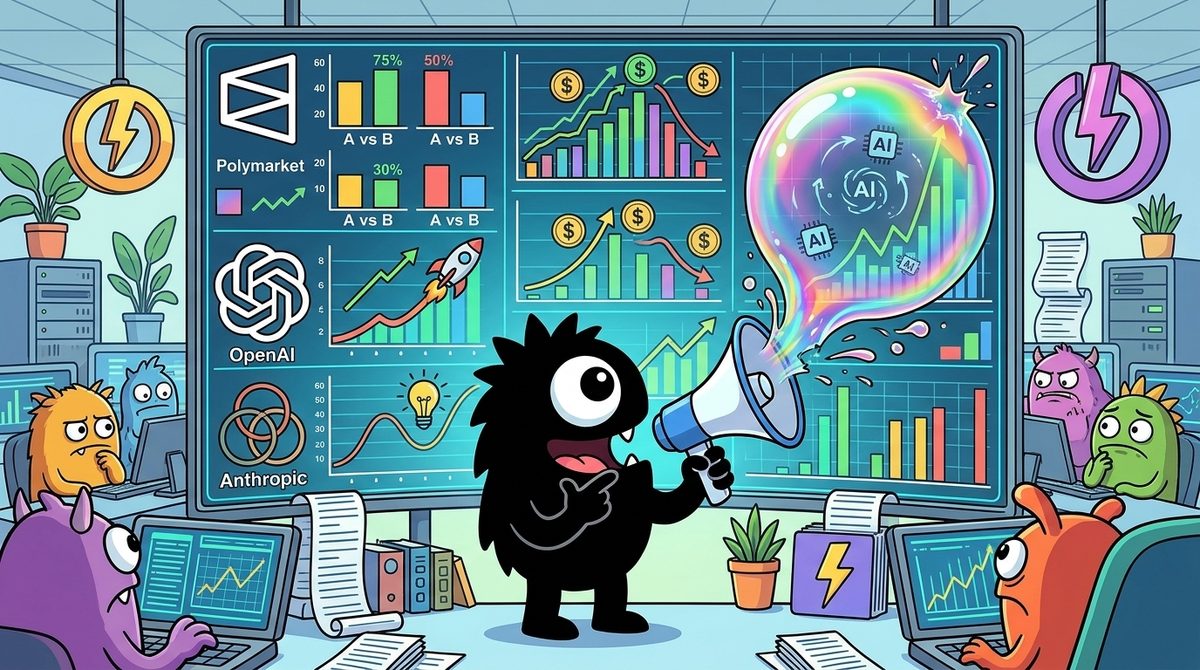
If you've seen "AI bubble" odds on your X feed this week, you probably want to know whether traders think AI is about to crash, and what that should change for your roadmap, funding plan, or vendor contracts. As of October 28, 2026, the answer from Polymarket is mostly no, but with a growing caveat. Betting markets put the odds of an "AI bubble burst" by December 31, 2026 at 8%, and by June 30, 2027 at 22%[1].
Those numbers don't say AI is safe. The contract defines a "burst" as a severe, multi-asset collapse, not a bad quarter. A low number therefore means traders see a systemic crash as unlikely in the near term. It does not mean they think valuations are fair. The useful signal is the gap between the two dates and the direction the longer-dated line is moving.
Bottom line (as of Oct 28, 2026):
- Polymarket traders currently price an 8% chance of an AI bubble burst by Dec 31, 2026 and 22% by June 30, 2027[1].
- "Burst" requires three of six hard crash triggers inside a single 90-day window, such as Nvidia down 50% from its high. That is a catastrophe test, not a vibe check[2].
- The posture is worry, not panic. Optimism is being trimmed and tail risk is rising, but traders are not pricing an imminent collapse.
- For practitioners, this reads as a hedge-worthy tail risk, not an exit signal. The bigger near-term story is the split between AI winners and laggards in software valuations.
What Polymarket's 'AI Bubble Burst' Market Is Actually Pricing
Here are the anchor figures. As of October 28, 2026, roughly $3,144,341 has traded on Polymarket's "AI bubble burst by...?" market. Its headline year-end contract resolves around January 1, 2027[1]. Two outcomes matter:
- December 31, 2026: 8% implied probability, on about $2,515,693 traded
- June 30, 2027: 22% implied probability, on about $40,653 traded
You'll see slightly different numbers floating around X, because these markets move hourly and aggregators sample at different times. MarketWatch's reporting, syndicated via Morningstar, put the year-end odds near 10% in late October[4]. Odds trackers have shown the June 2027 line at around 22.5%[5]. The Basement View captured the snapshot many people were reacting to:
Worry, yes, but not panic: Polymarket puts an AI bubble burst at 9.7% by the end of the year and 22.5% by the end of June 2027, the later date up four points in a week.
View on XThe "up four points in a week" detail matters more than the level itself. The near-dated contract has drifted down toward single digits while the longer-dated one has risen. In other words, traders are pushing their concern out in time rather than raising it across the board.
Ramin's framing is the right one to hold through the rest of this piece:
Polymarket is putting a price on one of the biggest questions in tech: Is the AI boom becoming a bubble?
Current market data reported by MarketWatch puts the odds of a major AI downturn before January 1, 2027, at 10%, rising to 20% before July 2027. The year-end market has nearly $2.5M in trading volume.
Important distinction: these are market-implied probabilities, not proof that a crash is coming.
My take: prediction markets become especially interesting when they quantify risks that traditional markets debate but struggle to express clearly.
The real signal isn't just the percentage. It's how that probability changes as valuations, bond yields and AI spending evolve.
Would you trust this market's odds over the consensus on Wall Street?
@Polymarket
These are prices people are willing to pay for a contract. They are not forecasts of what will happen. An 8% price means the market collectively implies something like a 1-in-12 chance under the contract's rules. A 22% price for mid-2027 implies roughly 1-in-5. Neither tells you what the outcome will be.
Why the Resolution Rules Make This a High Bar (Not a Vibe Check)
The most common misreading on X runs like this: "Everyone says it's a bubble, so why is the burst probability only 8%?" The answer is in the rulebook.
Crypto Briefing's coverage lays out how the contract works[2]. A "burst" requires three of six specific events to occur within one 90-day window. probcast puts the distinction bluntly:
Polymarket's 'AI bubble burst in 2026' sits around 9%, but its bar is high: it needs three of a list like Nvidia down 50% from its high or the chip ETF down 40%, all within 90 days. Our scoring flags that market as thin, with about $1K traded today. Calling a bubble and pricing an actual crash are two very different things.
View on XYeon Vail lists the full trigger set and adds the math that makes the bar concrete:
POLYMARKET TRADERS SEE A 10% CHANCE THE AI BUBBLE BURSTS BEFORE NEW YEAR. THEY READ THE RULES FIRST.
At 0:01 the line starts at 42.5%, last November. By 0:06 it has slid to 6%. At 0:07 it turns and climbs to 11%, then settles near 9%.
Not random. On Polymarket, "bursts" needs 3 of 6 events inside one 90-day window. Nvidia 50% below its high. SOXX 40% below. OpenAI or Anthropic bankrupt. OpenAI sold. H100 rent at $1 for 5 days. TSMC, ASML, Broadcom, Arista or Supermicro halved.
Nvidia closed at $214.13 on October 16. Half of its $243.37 high is $121.69, another 43% down, and that is only one of the three.
Traders put $2.48M on the year-end contract. The mid-2027 one sits at 20%.
Citadel's Ken Griffin said in October 2026 that AI is "almost certainly" in a bubble.
The traders mostly agree. They just do not think it pops by December.
Is 10% too low for that rulebook, or too high?
The six triggers, as described in that thread and in reporting on the market[^2]:
- Nvidia falls 50% below its high
- The SOXX semiconductor ETF falls 40% below its high
- OpenAI or Anthropic goes bankrupt
- OpenAI is sold
- H100 rental prices hit $1 for five days
- TSMC, ASML, Broadcom, Arista, or Supermicro halves
Yeon Vail's arithmetic shows the scale involved. With Nvidia at $214.13 on October 16 against a $243.37 high, the stock would need to fall another ~43% just to satisfy one trigger. Two more triggers would then have to hit inside the same 90-day window.
Seen that way, 8% is not a sign of complacency. It is a price on a correlated, multi-front collapse of the AI hardware stack and its flagship labs. The same thread notes that Citadel's Ken Griffin called AI "almost certainly" a bubble in October 2026. That is entirely consistent with low burst odds. As Yeon Vail puts it, traders "mostly agree. They just do not think it pops by December."
The practical takeaway: this market measures catastrophe risk, not valuation discomfort. If your worry is "my AI-adjacent stock is overpriced" or "my Series B multiple will be lower," this contract is the wrong instrument. If your worry is "could my GPU provider, model vendor, or chip supply chain experience a systemic shock," this is exactly the right dial.
Worry, Not Panic: How Traders Are Positioned
So what posture do the odds describe? Bubble Tracker's read is probably the most precise one on X:
As of Oct 24, Polymarket priced a 9.4% chance the AI bubble "bursts" in 2026, up from about 7% at our last reading.
Our index reads 62.2, HIGH. Traders are pricing less perfection, not a crash. We could be wrong about which signal matters most.
"Pricing less perfection, not a crash." That phrase explains a combination that looks contradictory at first: a high bubble-index reading alongside low burst odds. Froth and fragility are different things. Markets can stay frothy for years, and stretched valuations can compress without a systemic event.
Benzinga's coverage of October's China AI stock rout supports this. The selloff was frightening, but prediction-market traders didn't treat it as the start of a US bubble burst[3]. A plausible reading is that the rout fed into the longer-dated line, which is consistent with the June 2027 contract climbing, while leaving year-end odds largely intact. Traders seem to be repricing financing risk and contagion over a longer horizon, not betting on a December collapse.
The Basement View's second post highlights that the rules sit behind this posture:
Polymarket gives the AI bubble 9.7% to burst by the end of the year, and 22.5% by June 2027, up four points in a week. The contract needs three hard signs, such as Nvidia down 50% from its high.
View on XOne caveat for experts concerns volume asymmetry. The year-end contract has roughly $2.5M traded. The June 2027 contract has roughly $40K[1]. A thin market can swing several points on a handful of trades, so the "up four points in a week" move deserves attention but not overconfidence. Give the year-end line more weight for its level and the June line more weight for its direction.
Nuveen's macro commentary frames the wider environment as one where AI investment remains a dominant growth driver while financing conditions and concentration risk deserve scrutiny[9]. That reading fits the market's posture: tail risk worth hedging, not a reason to exit.
The Capex Supercycle Fueling the Bubble Debate
Why is the bubble question so contested? Because the spending numbers are larger than anything in modern tech, and the forecasts disagree by trillions. The Analyst Lab's breakdown is one of the most data-dense posts in the conversation:
Latest SemiAnalysis pieces are genuinely outside the chart on capex and AI buildout vs any Wall Street forecast. Their $11.1T cumulative AI capex (2024–29) sits well above Goldman's $7.6T (2026–31) and pretty much everyone else has no figures that extend thus far.
If you go and look up on consensus from a bottom up approach, top hyperscaler capex (chart: META, GOOGL, MSFT, AMZN, ORCL) is $693bn FY26, $900bn FY27, $980bn FY28. Latest post-Q1 prints already put '26 near $800bn and '27 above $1T (MS, Evercore, BofA), and MS has these five alone at $1.1T in '27 (3.2% of US GDP) or around 23% above WS estimates. The thing is that on top of capex from those names you need to add every major AI capacity builder. That includes SpaceX + neoclouds. SemiAnalysis for instance has 2028 capex peaking at $2T (full stack, includes silicon + IT + power...). Basically, WS consensus is well behind on AI capex.
The funny part though are memory players. Most of the forecasts mirror 2026/27 800bn and 1.1-1.2T capex and then forecast a 60-70% drop (due to prices). Thing is, everyone else is expecting 2028 to be record capex year and the buildout to continue (at least in some form) until 2029-30. If forecasts are right and 2028 capex is around 1.5-2T (well above 2027) memory players will, well, do the numbers yourself.
At the end of the day, if you think the hyperscaler CEOs are AI-pilled (Elon, Zuck, the Google founders...) and keep spending into '28, memory is priced at pennies on the dollar as their profit is basically: capex x capex share (a.k.a. value capture) and capex share is and will continue to be high in 2028 due to their position on the whole AI value chain.
Of course, the numbers are astronomical, and even crediting the AI-driven jump in operating cash flow, it's hard to self-fund capex north of $1T (hence the capital markets). SemiAnalysis sees $7T of AI debt by 2029, with $NVDA the key enabler, backstopping neocloud GPU-rental revenue (and directly leasing datacenters).
I do not believe we'll do 11T of AI capex until 2029, but if 2028 is not a cratter year (i.e. something forces this AI pilled CEOs to stop) memory is, by and large, the single best bet you can hope to make. I am so surprised on how everyone is looking at second derivative bets (even copper) projecting massive DC buildout beyond 2028 (see graph below) yet not realize that if, and only IF, a fraction of that forecast were to be true, memory guys will be out of the chart.
The key figures from that thread:
- SemiAnalysis projects $11.1T in cumulative AI capex for 2024–29, compared with Goldman's $7.6T for 2026–31.
- Bottom-up consensus for the top five hyperscalers (Meta, Alphabet, Microsoft, Amazon, Oracle) was $693bn for FY26 and $900bn for FY27. Post-Q1 revisions put 2026 near $800bn and 2027 above $1T.
- Morgan Stanley reportedly has those five at $1.1T in 2027, or about 3.2% of US GDP.
- SemiAnalysis sees ~$7T of AI debt by 2029.
That last figure connects directly to the Polymarket triggers. Spending north of $1T a year can't be self-funded even with AI-boosted cash flows, so it runs through capital markets. Seeking Alpha's analysis of the "next stage" of the boom makes the same point: the story is shifting from whether AI demand exists to how the buildout gets financed, and what happens to valuations if financing tightens[12].
This is how traders can hold two views at once. They can believe AI demand is real and durable, and also price meaningful tail risk. A debt-financed buildout behaves differently from an equity-financed one. Leverage means a demand wobble can turn into a credit event, and credit events are what knock 40–50% off semiconductor names inside 90 days. Several of the Polymarket triggers are, in effect, bets on the financing chain breaking.
The Revenue Case: Can OpenAI and Anthropic Grow Into the Valuations?
The bull counterweight centers on two companies. P Equity Research relayed the most aggressive revenue claim currently in circulation:
Dylan Patel @dylan522p of SemiAnalysis believes Anthropic and OpenAI can get to $600-700 billion in revenue by end of 2027:
"I'm of the belief that we can get to $600 billion or $700 billion across OpenAI and Anthropic alone by December of next year."
"I’m of the opinion that you can get to $1.5 trillion, maybe even by the end of 2027, with just those two companies."
Via @firesidealpha, @Kantrowitz
According to that post, Dylan Patel argues OpenAI and Anthropic together could reach $600–700B in revenue by December 2027, and possibly $1.5T by the end of 2027. Treat these as one analyst's stated beliefs, not consensus. Still, the logic matters. If even a fraction of that trajectory materializes, today's capex stops looking like a bubble and starts looking like rational capacity planning.
This is why foundation-model economics, not SaaS multiples, dominate the burst question. Look at the contract again: two of the six triggers involve OpenAI or Anthropic directly (bankruptcy, or OpenAI being sold)[2]. Revenue growth at those labs is the main thing standing between the current buildout and the scenario where compute buyers default and GPU rental prices collapse.
Windsor Drake's 2026 valuation report describes a related split. Foundation-model companies continue to command premium valuations, while enterprise AI application companies are normalizing toward more conventional multiples[11]. The market is paying up for the layer whose revenue would justify the capex, and pricing everyone else more skeptically.
Is SaaS 'Dying'? The Multiple Compression Story Underneath the Odds
Now to the loudest claim in the feed. JUMPERZ argues the per-seat model is collapsing under agentic AI:
I genuinely believe we're watching SaaS die in real time and most people still don't see it..
$1 trillion wiped from software stocks since January 2026 and its just getting started..
SaaS multiples collapsed from 18.5x at the covid peak to 4.8x today and in the same time the AI market went from $50B to $539B and it's heading to $3.5 trillion by 2033 if not sooner
the death cross hits around 2027.. that's when AI market trajectory fully overtakes SaaS valuations on the chart
the reason is simple.. the per-seat model dies when 10 agents replace 100 humans and no seats left to sell
every SaaS tool you're paying $50/seat a month for is about to get replaced by an agent that costs $0.003 per task..
chatgpt opened the door in 2022, claude opus 4 made agentic AI real in 2025 and now multiagent coordination systems like openclaw are making it deployable and accessible to everyone..
every step on that chart the tech gets more autonomous and the SaaS line drops further..
not saying every saas will die but the companies that were built entirely on per-seat pricing and no real data advantage are the ones exposed.
tbh I don't think most founders see it yet, not because the data isn't there, but accepting it means everything they built needs to be rethought..
The thread gets some things right. Software multiples have compressed hard from the COVID peak, and per-seat pricing with no data advantage is genuinely exposed when agents replace headcount. But the "death" framing runs ahead of the current data.
The more recent picture shows stabilization, not freefall. Software Equity Group's quarterly SaaS report shows the 3Q26 median EV/TTM revenue multiple around 4.1x[8]. That is far below the peak, but it describes a market finding a floor. Forward-looking estimates put 2027 SaaS multiples in the 4.0–5.0x ARR range[10]. That points to partial recovery, not extinction.
What the data does support is bifurcation. Shay Boloor's chart, posted entering 2026, shows the market already separating companies by AI positioning:
HOW THE MARKET PRICES GROWTH TECH ENTERING 2026
This chart shows how the market is valuing growth SaaS based on 3-year revenue CAGR (2025-2028) against EV to gross profit.
The market is already separating the companies that already have AI boats and which still need to build them ahead of the AI tsunami.
$NET, $PLTR, $SHOP, $FIG, $RBRK, $SNOW, $CRWD, $DDOG, $ZS, $KVYO, $MNDY, $TEAM, $IOT, $MDB, $NOW, $HUBS $PANW, $VEEV, $S, $ESTC, $PATH, $ADBE, $WDAY, $CRM, $OKTA, $GTLB, $OS, $FROG
Plotting growth SaaS by three-year revenue CAGR against EV/gross profit shows a market rewarding companies that have "AI boats" and discounting those still building them. Forbes' "Schrödinger's SaaS" piece frames the same tension: SaaS is evolving alongside AI rather than simply being replaced, with outcomes depending on whether vendors can rebuild around AI-native value[13].
How this connects to the Polymarket odds is easy to miss. The SaaS repricing is mostly happening outside the burst contract. None of the six triggers mention software stocks. A trillion dollars of software market cap can disappear while the burst probability stays at 8%, because the contract tracks the AI infrastructure and lab layer. For SaaS founders and buyers, the relevant risk is already showing up in multiples, not waiting on a prediction market to resolve.
Should You Trust a Prediction Market on This at All?
Partly. Here is how to calibrate.
Reasons to discount the number:
- Thin liquidity. probcast's scoring flagged roughly $1K traded on a given day, and the June 2027 line has only about $40K total[1]. Small trades can move thin markets.
- Extreme resolution criteria. Because the bar is a three-trigger, 90-day collapse, the number says very little about milder scenarios such as a 25% correction or a funding winter.
- Aggregator drift. Different trackers report different snapshots. Odds roundups from late October show the figure shifting with each sample[7].
Reasons to pay attention anyway:
- Prediction markets put a number on tail risk that sell-side analysts rarely state outright. No bank research note will say "1-in-5 chance of systemic AI collapse by mid-2027." This market does, with money behind the claim.
- The term structure is informative. Low near-term odds combined with rising longer-dated odds is a coherent signal: the risk is in time and financing, not in next month's earnings.
How to use it: treat the odds as a dashboard dial, not a crystal ball. Watch direction and volume together. A rising June 2027 line on thin volume is a flag. The same move on heavy volume would be a much stronger signal. Before acting, cross-check against capex revisions, lab revenue disclosures, and valuation data.
What Developers, Founders, and SaaS Buyers Should Do Now
None of this tells you what will happen. It does tell you which risks the market thinks are worth pricing. Here is how that translates by role.
Developers and engineering leads
- Avoid single-provider dependency. Two of the six triggers involve the leading labs' survival or sale. Even at low odds, abstracting your model layer so you can swap providers is cheap insurance.
- Plan for volatile compute pricing in both directions. The H100-at-$1 trigger is a reminder that a glut is a possibility too. Avoid long, rigid compute commitments unless the discount clearly compensates for the lock-in.
Founders
- Lead with demonstrated AI revenue, not AI narrative. The valuation data points to a bifurcated market: AI-native winners hold premiums while enterprise AI apps normalize toward roughly 3–6x[11], and median SaaS sits near 4.1x[8]. Build your fundraising model on those numbers, not 2021 comparables.
- Stress-test your runway against a financing squeeze. The risk traders are pricing into mid-2027 is largely a financing risk[12]. If your plan depends on cheap capital, assume it might get more expensive.
- If you're per-seat, start migrating now. JUMPERZ's worst case may be overstated, but the exposure he describes, per-seat pricing with no data advantage, is the cohort the market is already discounting.
SaaS buyers and procurement
- Scrutinize vendors' AI roadmaps and financing. The "haves vs. have-nots" split[8] is now priced in. A vendor on the wrong side may cut product investment or get acquired.
- Negotiate for flexibility. Shorter terms, data portability, and exit clauses matter more when vendor durability is uncertain.
Everyone
- Monitor, don't panic. Revisit the 8%/22% odds as hyperscaler capex prints, lab revenue updates, and quarterly SaaS multiples arrive. If the June 2027 line keeps climbing and volume deepens, take that seriously. Until then, the market is describing what The Basement View called it: worry, yes, but not panic.
Sources
[1] Polymarket — AI bubble burst by...? — https://polymarket.com/event/ai-bubble-burst-by
[2] Polymarket traders put roughly 10% odds on an AI bubble burst by year-end — https://cryptobriefing.com/polymarket-odds-ai-bubble-burst-year-end/
[3] China's AI Stock Rout Scary, but Crypto Punters Aren't Calling a US Bubble Burst Yet — https://www.benzinga.com/markets/prediction-markets/26/10/62611819/ai-bubble-burst-polymarket-prediction-market-china-selloff
[4] Polymarket traders see a 10% chance the AI bubble bursts before New Year's Day — https://www.morningstar.com/news/marketwatch/20261021213/polymarket-traders-see-a-10-chance-the-ai-bubble-bursts-before-new-years-day
[5] AI bubble burst? Odds: By June 30, 2027 22.5% | Polymarket Odds Today — https://polymarkettrader.com/odds/ai-bubble-burst/
[6] AI bubble burst by...: June 30, 2027 23% - Polymarket Odds | PolyInsider — https://polyinsider.io/en/markets/ai-bubble-burst-by
[7] AI bubble burst by... Odds: Prediction Market Favorites (October 2026) — https://windailysports.com/prediction-markets/tech/ai-bubble-burst-by/
[8] SaaS M&A and Public Market Report | Software Equity Group — https://softwareequity.com/research/quarterly-saas-report
[9] Global macro musings | Nuveen — https://www.nuveen.com/global/insights/investment-outlook/global-macro-musings
[10] SaaS Valuation Forecast 2027 — https://blog.mean.ceo/saas-valuation-forecast/
[11] AI Software Valuation Report 2026 | Windsor Drake — https://windsordrake.com/ai-software-valuation-report-2026/
[12] The Next Stage Of The AI Boom: Financing, Valuations & Risk — https://seekingalpha.com/article/4954532-the-next-stage-of-the-ai-boom-financing-valuations-and-risk
[13] Schrödinger's SaaS: How SaaS Will Evolve Alongside AI — https://www.forbes.com/councils/forbestechcouncil/2026/10/21/schrdingers-saas-how-saas-will-evolve-alongside-ai/
References (13 sources)
- Polymarket — AI bubble burst by...? - polymarket.com
- Polymarket traders put roughly 10% odds on an AI bubble burst by year-end - cryptobriefing.com
- China’s AI Stock Rout Scary, but Crypto Punters Aren’t Calling a US Bubble Burst Yet - benzinga.com
- Polymarket traders see a 10% chance the AI bubble bursts before New Year's Day - morningstar.com
- AI bubble burst? Odds: By June 30, 2027 22.5% | Polymarket Odds Today - polymarkettrader.com
- AI bubble burst by...: June 30, 2027 23% - Polymarket Odds | PolyInsider - polyinsider.io
- AI bubble burst by... Odds: Prediction Market Favorites (October 2026) - windailysports.com
- SaaS M&A and Public Market Report | Software Equity Group - softwareequity.com
- Global macro musings | Nuveen - nuveen.com
- SaaS Valuation Forecast 2027 - blog.mean.ceo
- AI Software Valuation Report 2026 | Windsor Drake - windsordrake.com
- The Next Stage Of The AI Boom: Financing, Valuations & Risk - seekingalpha.com
- Schrödinger's SaaS: How SaaS Will Evolve Alongside AI - forbes.com
Related Guides
Monday.com vs Notion: Which Is Better for Code Review and Debugging in 2026?
13 min read
The Best Signals in the AI Bubble Debate for 2026: What Polymarket's Odds Reveal
18 min read
Perplexity AI vs Hugging Face: Which Is Best for Marketing Automation in 2026?
15 min read
The Best AI Model Prediction Market in 2026: An Expert Analysis of What Polymarket's Odds Reveal
20 min read