Perplexity AI vs Hugging Face: Which Is Best for Marketing Automation in 2026?
Perplexity AI vs Hugging Face for marketing automation: compare agents, open models, pricing, and workflows to find out which platform fits your team. Compare now.
Perplexity vs Hugging Face Isn't the Fight You Think It Is
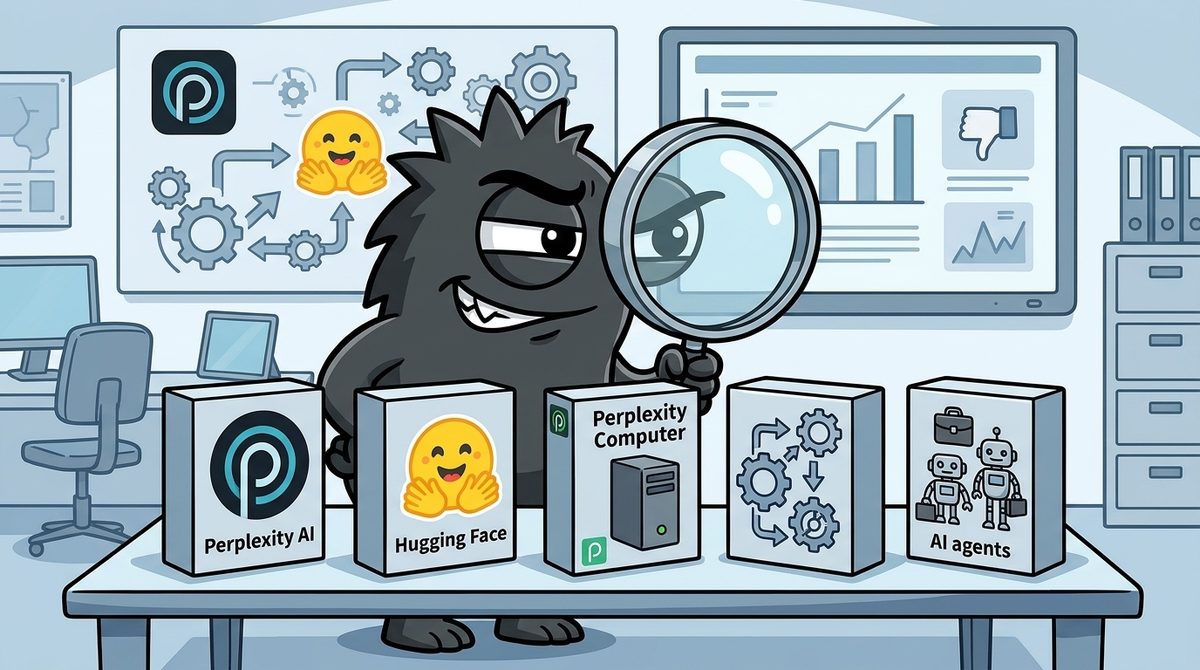
If you're asking whether Perplexity AI or Hugging Face is better for marketing automation in 2026, the answer depends on what you're buying. Perplexity sells a finished workflow. Hugging Face sells the parts you'd use to build one. They overlap less than the "versus" framing suggests, and the overlap that does exist is growing because Perplexity now publishes some of its own models on Hugging Face.
Perplexity is a vertically integrated research and agent product. Its marketing pitch centers on real-time research, competitive intelligence, and content support for marketing teams, delivered as a managed service[1]. Hugging Face is an infrastructure layer: a hub of models, datasets, and hosted apps (called "Spaces") that you assemble into your own pipelines. Even non-technical guides to using Hugging Face for marketing describe it as a toolbox, not a finished tool[7].
The two get conflated for another reason too. On Hugging Face, "perplexity" is also a standard language-model metric. This post from a model publisher is about quantization quality, not the company:
1017, part 2: EXL3.
DeepSeek-V4.1-Flash-1017 at 2.9 bpw for exllamav3: 196 GiB of weights. The first EXL3 of 1017 on Hugging Face.
Perplexity vs the base model: +1.8% on code, +0.4% on prose.
🤗 https://huggingface.co/LibertAIDAI/DeepSeek-V4.1-Flash-1017-EXL3-2.9bpw
If you've been scanning the Hub and wondering why "Perplexity" shows up everywhere, that's part of the reason. The rest is real. Perplexity has been moving toward open source since at least early 2024, when it was already trying to shed the "OpenAI wrapper" label[13]. In 2026 it ships open-weight embedding and decision models directly on Hugging Face.
Bottom line (2026):
- Choose Perplexity if you're a lean marketing team that needs real-time research, competitor monitoring, and agentic campaign tasks working this week, with no ML engineers.
- Choose Hugging Face if you need custom or fine-tuned models, data control, self-hosting, or specialized components such as classifiers, retrievers, and decision models, and you have engineering support.
- Many teams should use both. Use Perplexity's managed research up front, and run open models (including Perplexity's own Hugging Face releases) inside a custom pipeline for routing, scoring, and retrieval.
What Does Marketing Automation Actually Require From an AI Tool?
Before comparing features, list the jobs. Most marketing automation in 2026 comes down to five recurring tasks:
- Prospect and market research. Who is this company, what did they just announce, what are competitors running?
- Lead enrichment. Attaching structured facts to CRM records.
- Content generation. Emails, ad variants, landing copy.
- Campaign optimization. Budget allocation, creative fatigue, attribution.
- Decisioning. Is this lead qualified? Does this reply need a human? Is this ad off-brand?
The first three are where chat-style products are strong. The last two are where most teams overspend and underperform, because they use a conversational model for a classification problem.
This widely shared outreach stack shows how practitioners chain tools in practice:
This AI system researches prospects like a psychopath and writes to them like a best friend.
This combo is absolutely insane for outreach that actually books calls.
No SDRs. No manual research. No sales reps spending 3 hours per prospect.
Just AI tools working together like a professional sales team.
Here's how it works:
→ AI scrapes LinkedIn profiles + recent posts automatically
→ Perplexity researches their company across the entire internet
→ Claude analyzes pain points and writes hyper-personalized 3-email sequences
→ System references specific achievements like you personally studied them
→ Emails send in proper time zones with perfect deliverability rotation
→ Sequences stop automatically when prospects reply
Perplexity's role in that pipeline is narrow and specific: the research step. Claude writes, other tools handle scraping and sending. That is how most real stacks look. No single platform owns the whole flow. Zapier's own guide to automating Perplexity reflects this, framing it as a research engine you trigger from other apps and route into docs, Slack, or spreadsheets[3].
So evaluate each platform on four criteria:
- Speed to value. How fast does a marketer get a working workflow?
- Control. Can you fine-tune, self-host, and audit outputs?
- Cost. Per-call pricing plus the engineering time to maintain the system.
- Maintainability. Who fixes it when an API changes or a model drifts?
How Does Perplexity Computer Handle Agentic Marketing Workflows?
Perplexity's product answer to automation is Computer, an agent that runs multi-step tasks on your behalf instead of just answering a query[6][2]. For marketers, its value is that research, action, and scheduling happen in one managed environment.
According to a 2026 breakdown of Perplexity Computer for business automation, the system is organized around connectors (links to the apps you already use), skills (reusable task definitions), and tasks that can run on a schedule[5]. The connectors that matter for marketing include CRMs such as HubSpot and Salesforce, plus ad platforms such as Google Ads and Meta. Combined with scheduled automations and email triage, this lets a marketer build recurring jobs: a weekly competitor-ad digest, a daily scan of brand mentions, or pre-call research briefs that land in the CRM automatically.
The more aggressive move is in advertising. As AdTechRadar reported on March 9, 2026, Perplexity is positioning Computer for ad workflows that go beyond reporting. That includes working through ad-platform APIs to optimize budgets and detect creative fatigue[4]. That shifts Perplexity from the research layer into the execution layer, which competes directly with the custom pipelines teams have been building on open models.
What this means in practice:
- What you gain: real-time web research grounded in current sources, competitor and sentiment monitoring as built-in features[1], and agentic actions without writing infrastructure.
- What you give up: you can't fine-tune Computer on your historical campaign data, you have limited visibility into how decisions are made, and you depend on whichever connectors Perplexity supports.
- Governance: autonomous budget changes need guardrails. Before you let any agent move ad spend, define spend caps, approval steps, and rollback procedures.
For the outreach stack in the previous section, Computer could plausibly absorb the research step and parts of the orchestration. It wouldn't necessarily replace the specialized writing or deliverability tools.
How Do You Build a Marketing AI Stack on Hugging Face?
Hugging Face takes the opposite approach. It doesn't hand you a marketing product. It gives you hundreds of thousands of models and hosted apps, and increasingly the ability for agents to call them.
Hugging Face is becoming the platform for agents to use and build AI. Now they can call 1M HF spaces to do everything the latest specialized models can do!
View on XThat claim from Hugging Face's CEO describes the strategic bet. Instead of one agent that does everything, an agent orchestrates many specialized models: a sentiment classifier here, an image generator there, a translation model, a custom scorer. For marketing, the practical result is that you can pick the best model for each narrow job instead of accepting one vendor's generalist.
The Hub also hosts domain-specific marketing models. One example is a 70B-parameter LoRA fine-tune positioned as a multichannel campaign optimizer, focused on tasks such as ROAS and attribution reasoning[9]. Treat community uploads like this as starting points to evaluate, not production-ready products. Check the model card, the training data description, and the license, and validate against your own campaign history before relying on it.
Hugging Face doesn't require a full engineering team. There are no-code and low-code options:
- Zapier can connect Hugging Face models to triggers in other apps, for example classifying incoming form submissions or summarizing feedback[8].
- Integrately offers Hugging Face connections to Salesforce Marketing Cloud for tasks like translating and syncing data[11].
- Agent platforms such as Enrich Labs advertise AI agents built on top of Hugging Face integrations[10].
- Code-first teams can build agent tools themselves. One walkthrough shows how to give a Hugging Face transformers/smolagents agent an email tool so it can send and manage messages[12].
There's an important caveat. No-code integrations get you single-model calls. The real advantages of Hugging Face (fine-tuning on your data, self-hosting for privacy, chaining specialized models) require someone who understands inference endpoints, GPU memory, and evaluation.
Why Do Embeddings and Decision Models Matter More Than Another Chatbot?
This part of the 2026 conversation matters most for practitioners, and it's where the line between Perplexity and Hugging Face disappears. Perplexity isn't only shipping a chat product. It's publishing specialized open-weight components on Hugging Face.
Late-interaction embeddings: search your PDFs without OCR
Marketing teams sit on large amounts of unsearchable content: old decks, case-study PDFs, brand guidelines, competitor one-pagers. Here's how Laurence Moroney describes Perplexity's new retrieval models:
Still running OCR over your PDFs before you can search them? Perplexity's new open embedding models are built to skip that step.
Perplexity released pplx-embed-v2-late on Hugging Face under the MIT license, in 0.6B and 9B sizes built on Qwen3.5. They're ColBERT-style late-interaction retrievers: every token gets its own 128-dimensional vector, and a query is scored by matching each of its tokens to the closest one in the document (MaxSim). They handle text, images, and rendered pages such as PDFs and slides. Both sizes share one embedding space, so the small model can query an index built with the 9B. On the image track of the public ViDoRe v3 benchmark, Perplexity reports nDCG@10 of 62.3% for the 0.6B and 65.2% for the 9B. Both were distilled from an internal 18B teacher.
Storing a vector for every token makes these indexes big, so test on your own data first. Index a few hundred of your pages with the 9B, compare results when you query with the 0.6B and the 9B, and note how much disk the index takes. 🔍 #RAG
In plain terms, a standard embedding model compresses a whole document into one vector. A late-interaction model (the ColBERT approach) keeps one vector per token and matches query terms against document terms individually. That usually improves precision on detail-heavy documents. Because these models read rendered pages directly, you can index slides and PDFs as images and skip the error-prone OCR step.
For a marketing team, that could mean a RAG system that answers "which case studies mention retail clients with churn problems?" across years of PDFs. Moroney's caveat about index size is the operational detail to take seriously: storing a vector for every token can make indexes much larger, so pilot on a few hundred pages first.
Decision models: yes/no with a probability, not prose
The second release fits marketing automation even more directly:
Not every AI job needs a chatbot. Sometimes you just need a yes or no with a probability. Perplexity built exactly that.
pplx-decider-v1-27b has open weights on Hugging Face under Apache 2.0, fine-tuned from Qwen3.8-27B. It doesn't write sentences. It returns calibrated probabilities: yes/no scores, choices or rubric ratings, up to 128 questions in one call. It takes text, JSON or images.
On the Decisions API it costs $0.04 per million input tokens. Output is free.
This is the boring stuff that runs real pipelines. Ticket triage, fraud flags, lead routing. A lot of teams still do that with chat models and then parse the prose.
Caveats. The win over Jev, 85.71% vs 84.51% on an 11-test panel, is self-reported. And self-hosting needs about 49 to 52 GiB of VRAM.
Rodrigo Porto's line, "Not every AI job needs a chatbot", sums up the argument. Lead routing, reply classification ("interested / not now / unsubscribe / out of office"), brand-safety checks, and qualification scoring are all decision problems. Many teams still prompt a chat model, get a paragraph back, and parse it with fragile regex. A model that returns calibrated probabilities lets you set thresholds instead: auto-route above 0.85, send to a human between 0.5 and 0.85, discard below.
As Porto reports, batching up to 128 questions per call matters for enrichment. You can ask "Is this B2B? Over 200 employees? Using a competitor? Hiring for marketing?" in one pass. At a reported $0.04 per million input tokens with free output, scoring an entire CRM becomes a minor expense.
This changes the "Perplexity vs Hugging Face" decision. You can use a Perplexity model through Perplexity's API or pull its open weights from Hugging Face and run it in your own stack. The vendor choice and the deployment choice are now separate decisions.
What Are the Real Costs of Each Platform: Pricing, Learning Curve, and Maintenance?
Per-token prices only tell part of the story. Total cost of ownership looks like this:
| **Perplexity** | **Hugging Face** | |
|---|---|---|
| **Pricing model** | Subscription seats plus API/Computer usage | Pay for hosted inference/endpoints, or self-host open weights on your own GPUs |
| **Setup cost** | Near zero; marketer-configurable | Low for no-code Zapier/Integrately flows[^8]; high for custom pipelines |
| **Customization** | Limited to prompts, skills, and connectors | Full: fine-tuning, model swapping, chaining |
| **Data control** | Vendor-managed | Can be fully in-house when self-hosted |
| **Learning curve** | Marketer-friendly | Engineering or ML support needed for anything beyond simple calls |
| **Maintenance** | Vendor handles it | You own model versions, infra, and evals |
Self-hosting has a real price. Porto notes the 27B decider needs roughly 49–52 GiB of VRAM, which means a high-end data-center GPU, not a laptop. For most marketing teams, the hosted Decisions API at $0.04/M input tokens will cost far less than renting that hardware unless volumes are very large or data residency rules require in-house processing.
Licensing also matters for ownership. The embedding models are reported as MIT-licensed and the decider as Apache 2.0. Both are permissive licenses that allow commercial use and modification. That gives you an exit option you don't get with a closed product: if pricing or terms change, you can keep running the weights.
Perplexity's hidden cost is lock-in to its connectors and agent behavior. Hugging Face's hidden cost is engineering hours. Decide which one your team can absorb.
Can You Trust the Benchmarks Perplexity and Others Publish?
Vendor benchmark claims are flooding X in 2026, and marketers putting automation budget behind them should read them skeptically.
Perplexity wins on Hugging Face Decision Index (benchmark for decision models). Our model is open-weights and accessible to all!
View on XAravind Srinivas presents the result as a clean win, and the open weights are a real strength. The fine print Porto pointed out still applies: the margin he cites (85.71% vs 84.51% on an 11-test panel) is self-reported and narrow. A 1.2-point gap on a small panel may not hold on your lead data.
The skepticism isn't directed only at Perplexity. Here's a reaction to a different vendor's launch:
Smart to open source the tests on Hugging Face. That detail is what separates this from the usual AI marketing. One thing buyers will catch: these are internal benchmarks from 2026, so Silvia grading itself against Claude, ChatGPT, Gemini, Perplexity and Grok.
View on XThat post praises publishing the tests on Hugging Face and also flags the core problem: a vendor grading itself against Claude, ChatGPT, Gemini, Perplexity, and Grok. Publishing tests openly makes the results reproducible, but it doesn't make them unbiased. Vendors still choose which tests to run.
A practical evaluation process before you commit:
- Pull 200–500 real examples from your own pipeline, such as past leads with known outcomes, actual email replies, and ad creatives that did or didn't fatigue.
- Label them with the decision you wish had been made.
- Run each candidate (the Perplexity API, an open model from Hugging Face, your current chat-model setup) against the same set.
- Measure what matters for your business: precision at your routing threshold, cost per 1,000 decisions, and latency.
Open weights are what make step 3 possible for every model. That's arguably the strongest reason to choose models published on Hugging Face, whoever built them.
Verdict: Should You Use Perplexity or Hugging Face for Marketing Automation?
The 2026 conversation doesn't support a single winner. Perplexity publishes models on Hugging Face, agents call Hugging Face Spaces, and practitioners chain Perplexity research into multi-tool outreach stacks. Choose based on your team and the job.
Choose Perplexity if:
- You're a lean team (roughly 1–10 marketers) with little or no engineering support.
- Your main need is real-time research, competitor monitoring, and content support[1].
- You want agentic tasks through CRM and ad connectors running quickly, and you accept vendor-defined behavior in exchange[5].
Choose Hugging Face if:
- You have ML or engineering support, or a technical marketing-ops lead.
- You need fine-tuned models on proprietary data, strict data control, or self-hosting.
- Your bottlenecks are specialized tasks such as classification, retrieval, or scoring, where a purpose-built model beats a generalist. Agent and integration layers like those from Enrich Labs can lower the barrier[10].
Choose the hybrid if:
- You're growing out of no-code tools. Use Perplexity for live web research, then route its output into a pipeline that uses open models from Hugging Face (including Perplexity's own decider and embedders) for qualification, routing, and internal document search.
Quick decision checklist:
| Job | Best fit |
|---|---|
| Prospect and company research | Perplexity |
| Competitor ad and sentiment monitoring | Perplexity |
| Scheduled CRM and ad-platform tasks | Perplexity Computer |
| Lead scoring and reply routing | Decision model (Perplexity API or open weights via Hugging Face) |
| Searching internal PDFs and decks | Late-interaction embeddings via Hugging Face |
| Campaign attribution modeling on your data | Fine-tuned model on Hugging Face (validate first) |
| Privacy-sensitive processing | Self-hosted on Hugging Face weights |
In 2026, choosing between Perplexity and Hugging Face mostly comes down to whether you want to buy a finished workflow or build one. More and more teams do some of each.
Sources
[1] Perplexity for Marketing — https://www.perplexity.ai/enterprise/use-cases/marketing
[2] Perplexity Computer | AI Agent — https://www.perplexity.ai/gen/computer-lp
[3] 6 ways to automate Perplexity | Zapier — https://www.zapier.com/blog/automate-perplexity/
[4] Perplexity Eyes Ad Workflows With New AI Agent — https://adtechradar.com/2026/03/09/perplexity-computer-ai-agent-advertising/
[5] How to Use Perplexity Computer for Business Automation: Connectors, Skills, and Tasks — https://www.mindstudio.ai/blog/how-to-use-perplexity-computer-business-automation
[6] What is Computer? — https://www.perplexity.ai/help-center/en/articles/13837784-what-is-computer
[7] Bringing AI to Marketing: A Non-Technical Guide to using Hugging Face for Marketing — https://www.datawhistl.com/blog/bringing-ai-to-marketing-a-non-technical-guide-to-using-hugging-face-for-marketing/
[8] 4 ways to automate Hugging Face — https://zapier.com/blog/automate-hugging-face/
[9] Adaption AutoScientist — Multichannel Campaign Optimizer (70B LoRA) — https://huggingface.co/narendarcodes/adaption-multichannel-campaign-optimizer-70b
[10] AI Agent for Hugging Face | Enrich Labs — https://www.enrichlabs.ai/integrations/hugging-face
[11] Hugging Face + Salesforce Marketing Cloud Integration: Translate and Sync Data — https://integrately.com/integrations/hugging-face/salesforce-marketing-cloud
[12] how to build an email tool for a hugging face transformers agent — https://lobstermail.ai/blog/how-to-build-an-email-tool-for-a-hugging-face-transformers-agent
[13] More than an OpenAI Wrapper: Perplexity Pivots to Open Source — https://ricmac.org/2024/01/12/more-than-an-openai-wrapper-perplexity-pivots-to-open-source/
References (15 sources)
- Perplexity for Marketing - perplexity.ai
- Perplexity Computer | AI Agent - perplexity.ai
- 6 ways to automate Perplexity | Zapier - zapier.com
- Perplexity Eyes Ad Workflows With New AI Agent - adtechradar.com
- How to Use Perplexity Computer for Business Automation: Connectors, Skills, and Tasks - mindstudio.ai
- What is Computer? - perplexity.ai
- Bringing AI to Marketing: A Non-Technical Guide to using Hugging Face for Marketing - datawhistl.com
- 4 ways to automate Hugging Face - zapier.com
- Adaption AutoScientist — Multichannel Campaign Optimizer (70B LoRA) - huggingface.co
- AI Agent for Hugging Face | Enrich Labs - enrichlabs.ai
- Hugging Face + Salesforce Marketing Cloud Integration: Translate and Sync Data - integrately.com
- how to build an email tool for a hugging face transformers agent - lobstermail.ai
- More than an OpenAI Wrapper: Perplexity Pivots to Open Source - ricmac.org
- Anthropic vs Hugging Face vs Perplexity AI: Which Is Best for SEO and Content Strategy in 2026? - adtools.org
- Perplexity vs Hugging Face (2026): Which Is Better? - toolhalla.ai
Related Guides
The Best AI Model Prediction Market in 2026: An Expert Analysis of What Polymarket's Odds Reveal
20 min read
CrewAI vs Copilot Studio vs Dify: Which Is Best for Marketing Automation in 2026?
14 min read
The Best AI Model Tools in 2026: What $3.4M in Polymarket Bets Reveals About the AI Arms Race
20 min read
Make vs Botpress vs OpenAI Assistants API: Which Is Best for Customer Support Automation in 2026?
15 min read