The Best Signals in the AI Bubble Debate for 2026: What Polymarket's Odds Reveal
Polymarket AI bubble odds show 9% by end-2026 and 22% by mid-2027. Discover what these market-implied probabilities mean for developers, founders, and SaaS buyers.
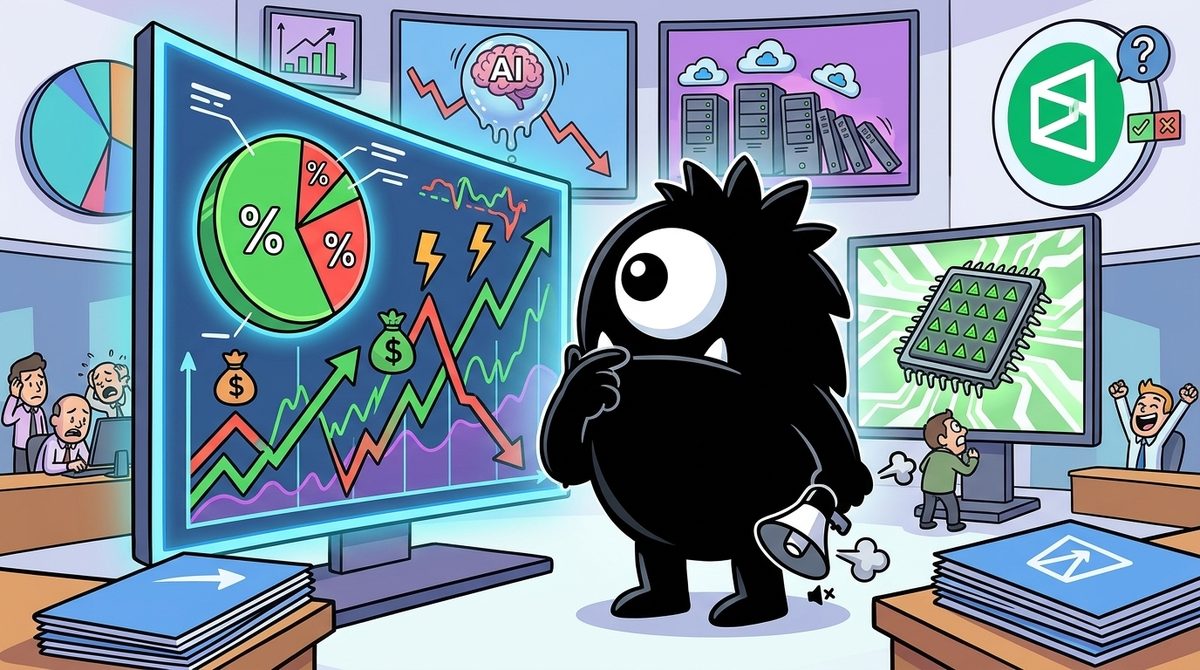
As of October 27, 2026, Polymarket traders price a 9% chance that the AI bubble "bursts" by December 31, 2026, and a 22% chance by June 30, 2027[1]. Both numbers are low, and neither should be read as a forecast of what will happen. What they do show is how traders are thinking about timing.
The short reading is that the crowd sees AI as stretched but does not expect a qualifying collapse before New Year's. Traders are pushing the risk into 2027 rather than ruling it out. For people who build and buy software, the more useful signal sits outside the headline odds: software is already being repriced, whether or not a formal "burst" ever resolves YES.
Bottom line (as of Oct 27, 2026)
- 9% implied probability of an AI bubble burst by Dec 31, 2026 ($2,502,101 traded on that leg)[1]
- 22% implied probability by June 30, 2027 ($39,710 traded on that leg)[1]
- The bar for "YES" is a set of severe, simultaneous conditions, not just a falling AI stock.
- Independent models and some strategists price downturn risk well above the crowd.
- The repricing practitioners actually feel today is happening in SaaS valuations, and it doesn't depend on the market resolving YES.
The $3M Bet Everyone in Tech Is Arguing About
Polymarket's "AI bubble burst by...?" event has drawn roughly $3,129,806 in total volume and resolves around January 1, 2027[1]. Most of that money sits on the year-end leg: $2,502,101 traded on the December 31, 2026 contract, against $39,710 on the June 30, 2027 contract. Third-party trackers put the mid-2027 leg at 22.5% to 23%[5][6]. That fits the 22% Polymarket shows, given how few dollars are trading on that leg.
The market has become a common reference point because it attaches a single number to a question that is usually argued with adjectives. MarketWatch's coverage of the market reported roughly 10% odds of a burst before New Year's Day[4]. Benzinga noted that even a sharp rout in Chinese AI stocks did not push crypto bettors toward calling a U.S. burst[2].
Polymarket is putting a price on one of the biggest questions in tech: Is the AI boom becoming a bubble?
Current market data reported by MarketWatch puts the odds of a major AI downturn before January 1, 2027, at 10%, rising to 20% before July 2027. The year-end market has nearly $2.5M in trading volume.
Important distinction: these are market-implied probabilities, not proof that a crash is coming.
My take: prediction markets become especially interesting when they quantify risks that traditional markets debate but struggle to express clearly.
The real signal isn't just the percentage. It's how that probability changes as valuations, bond yields and AI spending evolve.
Would you trust this market's odds over the consensus on Wall Street?
@Polymarket
Ramin's caveat is the right starting point: market-implied probabilities are not proof. A 9% price means traders, at the margin, are willing to pay about 9 cents for a contract that pays $1 if the bubble bursts under the market's rules. That reflects positioning, liquidity, and belief together. It does not predict the outcome. As Ramin also argues, the more useful signal is how the probability moves as AI spending, yields, and earnings change.
The number has already moved. Bubble Tracker cited 7% on October 17, and posts across late October put it anywhere from 9% to 14%. The market is not static, and the direction of drift is worth tracking.
What a 'YES' Actually Requires, and Why the Bar Is So High
The low headline number makes more sense once you read what would have to happen. Several X users who have parsed the rules say the market does not resolve on "AI stocks go down."
Is the AI bubble actually going to burst in 2026?
@Polymarket currently gives it only around a 14% chance but the interesting part isn the number It what would actually need to happen for the market to resolve YES.
This isn simply AI stocks go down
For a YES outcome at least 3 major conditions would need to happen within the defined window:
→ NVIDIA falls 50% from its ATH
→ SOXX falls 40% from its ATH
→ OpenAI or Anthropic goes bankrupt
→ OpenAI gets acquired
→ H100 rental prices collapse to $1 or below for 5 consecutive days
→ Or a major AI hardware player such as TSMC ASML Broadcom Arista or Super Micro falls 50% from its ATH.
That’s an extremely high bar.
And yet there a reason traders are watching this market closely.
Hyperscalers are pouring hundreds of billions of dollars into AI infrastructure while the industry is still trying to prove that these massive investments can generate sustainable returns.
The real question isn whether AI is useful.
It obviously is.
The question is whether the market has priced in too much future growth too quickly.
If AI revenue growth, enterprise adoption chip demand and model economics continue accelerating the current valuations could eventually look justified.
But if spending keeps rising while returns disappoint the market could experience a brutal repricing.
And that where things get interesting.
Prediction markets don’t tell us what will happen.
They show us what traders are willing to price today.
14% may look small.
But with nearly $3M in volume this is a market worth watching especially as Q3 earnings AI capex chip demand and the profitability of frontier models become clearer.
The AI boom may not end with one dramatic event.
It could start with a simple realization
the growth was real but the price of that growth was too high.
Would you bet on the AI bubble surviving 2026?
According to 0xerfani's breakdown, a YES needs at least three of a list of severe events within the defined window:
- Nvidia down 50% from its all-time high
- The SOXX semiconductor ETF down 40% from its high
- OpenAI or Anthropic going bankrupt, or OpenAI being acquired
- H100 rental prices collapsing to $1 or below for five consecutive days
- A major AI hardware name (TSMC, ASML, Broadcom, Arista, Super Micro) falling 50%
probcast adds a time constraint: the qualifying events must land within roughly 90 days of each other.
Polymarket's 'AI bubble burst in 2026' sits around 9%, but its bar is high: it needs three of a list like Nvidia down 50% from its high or the chip ETF down 40%, all within 90 days. Our scoring flags that market as thin, with about $1K traded today. Calling a bubble and pricing an actual crash are two very different things.
View on XThese conditions describe a disorderly, systemic unwind: a crash in the chip complex together with distress at a frontier lab. A painful 25% correction in AI names, a down quarter for hyperscaler capex, or a wave of SaaS layoffs would not qualify. CryptoSlate's market analysis frames the 2026 contract the same way, as a high-threshold event rather than a general sentiment gauge[7].
As probcast puts it, calling a bubble and pricing an actual crash are two very different things. Someone who reads "9%" as "the crowd thinks AI is fine" has drawn the wrong conclusion. A closer reading is that traders assign low odds to a specific, compound catastrophe arriving in the next nine weeks. A market can be overvalued and still fall short of these rules.
For practitioners, the gap between what the contract measures and what you care about matters a lot. Your vendor's pricing power, your startup's next round, and your cloud bill can all change sharply in scenarios that resolve NO.
Stretched Is Not the Same as Bursting: Why Traders Push Risk to 2027
The most useful feature of this market is the term structure, meaning how the odds change across expiry dates. The probability goes from 9% by year-end to 22% by mid-2027[1]. Over six more months, the implied risk more than doubles. Traders are deferring the risk, not dismissing it.
The skepticism is mostly about timing. Polymarket has an AI bubble burst in 2026 near 10% and a US recession by year-end under 10%, but the bubble question pushed to mid-2027 is closer to 1 in 4, and Kalshi's 2027 recession contract sits around 21%. Our scoring rates the 2026 AI-bubble book as thin, under $2K traded today. Markets aren't dismissing the call, they just don't see it landing this year.
View on Xprobcast sets the bubble odds beside the macro picture. A U.S. recession by year-end is priced under 10% on Polymarket, while Kalshi's 2027 recession contract sits around 21%. Both the bubble and recession questions look roughly 1-in-10 near term and roughly 1-in-4 or 1-in-5 a year out. That is consistent with a view where any AI unwind comes with, or because of, a broader macro slowdown rather than on its own.
Valuation gauges are telling a "stretched but not peaked" story at the same time:
As of Oct 17, Polymarket priced a 7% chance the AI bubble "bursts" in 2026.
Our index reads 63.4, HIGH. A market can say "not this year" and a gauge can say "stretched" at the same time. Both can be right.
- Bubble Tracker's index reads 63.4, which it labels "HIGH."
- InvestorPlace's 13-signal checklist concludes the AI peak "isn't here yet," which places the market in late-cycle territory without a confirmed top[8].
- CEPR runs a dedicated AI Bubble Monitor to track these stress indicators over time[11].
Bubble Tracker's point is the key one: a market can say "not this year" and a gauge can say "stretched" at the same time. Both can be right. Froth indices measure how high prices sit relative to fundamentals. The Polymarket contract measures whether a specific crash arrives by a specific date. Bubbles can stay stretched for a long time before anything breaks.
What this means for founders: if you are raising or planning runway, the market's term structure suggests the window to raise on today's terms is open now and may get riskier through 2027. A reasonable planning assumption is that capital stays available through year-end and that you build enough cushion for a tougher 2027.
Why Smart Models Disagree With the Crowd
The crowd is not the only forecaster. Some independent models see considerably more risk than Polymarket does.
The market on the thing everyone argues about.
AI bubble burst in 2026?
Polymarket: 11.1% YES
Precision: 27.4% YES
Gap: +16.3 points
We read a downturn at better than twice the venue.
Informational research, not a trade.
https://precisionalgorithms.com
PrecisionAlgorithms puts a downturn at 27.4% against Polymarket's 11.1% at the time, a gap of more than 16 points, or "better than twice the venue." Crypto Briefing reported the Polymarket figure in the same range, about 10% by year-end[3]. The two numbers may not measure exactly the same event. A "downturn" model is likely looser than Polymarket's three-condition rule. Still, the gap points to something real: experts and the crowd are reading the same risk differently.
There are three reasons not to treat the 9% as settled.
- Liquidity is thin. probcast flags the near-term book as thin, with daily volume of $1K to under $2K on some days. Cumulative volume of $2.5M sounds large, but if only a few thousand dollars change hands on a given day, a handful of traders can move the price. The June 2027 leg is thinner still, at $39,710 total.
- Long-dated contracts tie up capital. Money locked in a contract that resolves months from now earns no return in the meantime, so traders tend to underprice tail risks on longer horizons. That plausibly biases the 22% downward.
- Conviction-based strategists use different horizons. A MarketWatch-syndicated interview presents TS Lombard's Dario Perkins arguing it is a matter of when, not if the AI bubble pops[9]. That is a multiyear thesis, and it can be completely right while the 2026 contract still resolves NO.
Calcalist's reporting describes "three AI bubbles" testing Wall Street's faith in the boom[10]. Risk is spread across chips, model labs, and the financing that connects them, rather than resting on one stock or one date.
How to weigh them:
- Use crowd odds for timing on short horizons where the resolution rules are clear.
- Use conviction models and strategists for direction over multiple years.
- Treat thin liquidity as a reason to widen the range, not to discard the number. When both sources point to more risk in 2027 than in 2026, take that seriously.
The Real Story Under the Odds: SaaS Is Being Repriced
This is where the discussion on X gets most relevant to day-to-day work. A large share of practitioners argue the important story is not an AI bubble at all. In their view it is compression of software valuations, which is already happening.
I genuinely believe we're watching SaaS die in real time and most people still don't see it..
$1 trillion wiped from software stocks since January 2026 and its just getting started..
SaaS multiples collapsed from 18.5x at the covid peak to 4.8x today and in the same time the AI market went from $50B to $539B and it's heading to $3.5 trillion by 2033 if not sooner
the death cross hits around 2027.. that's when AI market trajectory fully overtakes SaaS valuations on the chart
the reason is simple.. the per-seat model dies when 10 agents replace 100 humans and no seats left to sell
every SaaS tool you're paying $50/seat a month for is about to get replaced by an agent that costs $0.003 per task..
chatgpt opened the door in 2022, claude opus 4 made agentic AI real in 2025 and now multiagent coordination systems like openclaw are making it deployable and accessible to everyone..
every step on that chart the tech gets more autonomous and the SaaS line drops further..
not saying every saas will die but the companies that were built entirely on per-seat pricing and no real data advantage are the ones exposed.
tbh I don't think most founders see it yet, not because the data isn't there, but accepting it means everything they built needs to be rethought..
JUMPERZ's numbers are his own and should be read as one voice's framing: $1 trillion wiped from software stocks since January 2026, and SaaS multiples falling from 18.5x at the COVID peak to 4.8x. The mechanism he describes is the part to focus on. Per-seat pricing breaks down when agents do work that humans used to do, because there are fewer seats left to sell. He is careful to say he is not predicting that every SaaS company dies. The exposed ones, in his view, are businesses built entirely on per-seat pricing without a real data advantage.
Jordi Visser takes the argument a step further:
AI is compressing valuations.
This isn’t fear.
It’s uncertainty.
When you can’t forecast cash flows 3 years out, you don’t get premium multiples.
AI isn’t creating a bubble.
It’s destroying visibility.
Software isn’t just “cheap.”
It’s being repriced for a world where:
• Competition is instant
• Intelligence is abundant
• Moats erode faster than models update
This is not a cyclical rotation.
It’s a structural regime shift from:
Concentration → Dispersion
Asset-light → Asset-heavy
Duration certainty → Scarcity repricing
And most investors are still fighting the last decade.
"AI isn't creating a bubble. It's destroying visibility." Investors pay premium multiples when they can forecast cash flows several years out. If competition can appear quickly, intelligence is abundant, and moats erode faster than models improve, that visibility goes away and multiples come down. Visser calls this a structural regime shift: from concentration to dispersion, and from asset-light to asset-heavy.
This view changes what the Polymarket question means for practitioners. If Visser is right, the main danger for software is not a single crash date. It is a repricing that is already underway and would not trigger any of the contract's conditions. Nvidia could hold up while the median SaaS stock keeps falling. Calcalist's "three bubbles" framing makes room for this kind of split across segments[10]. Morgan Stanley's forecast that AI spending growth slows sharply by 2028 and shifts toward software[16] points the same way: the money could move rather than disappear, and it could pass over incumbents in the process.
What dispersion means for procurement and build-vs-buy:
- Pricing for per-seat tools is likely to soften or move to usage-based models. That gives buyers leverage.
- Some vendors will thrive while others shrink or get acquired. Vendor viability belongs in your risk review, not only features.
- Building in-house with agents gets more attractive for narrow workflows. Buying still makes sense where the vendor owns proprietary data or carries compliance burden you don't want.
The Counterargument: Maybe There's No Bubble at All
A balanced reading has to give real weight to the camp arguing there is no systemic bubble.
After reviewing forward P/S and EBITDA multiples across the MAG7, Palantir, CoreWeave, and the rest of the AI leaders, here’s the truth:
There is no AI bubble.
With one exception — Palantir — whose elevated multiple is earned because of the ontology architecture I’ve been talking about… the rest of the field is trading well below 2021 levels. Multiples have drifted up since the 2022 lows, yes — but nowhere near the dot-com moonshots where everything went vertical overnight.
Back then, everything bubbled.
This time, only Palantir is up — and that’s because retail understood the ontology-driven revenue ramp early.
The critics screaming “bubble!” are wrong.
If you disagree with me, show me any credible evidence.
Just because you say it, because you hope to be featured in “The Big Short 2” won’t make it so.
The market is rational. Retail sees it.
Rising Dynasty sees it.
Let’s keep riding. 🚀
Eric Jackson's review of forward price-to-sales and EBITDA multiples across the Magnificent 7, CoreWeave, Palantir, and other AI leaders concludes that most are trading below 2021 levels and are "nowhere near the dot-com moonshots." His one exception is Palantir, which he considers justified. IoT Analytics reaches a similar conclusion from a different angle. Its capex-payback analysis concludes there is no broad equity valuation bubble, even while acknowledging losses in particular segments[12]. InvestorPlace's checklist, while flagging late-cycle signals, also says the peak isn't here yet[8].
Read this way, the low Polymarket odds are not complacency. They are consistent with the no-bubble view: if valuations are anchored to real earnings, a compound crash of 50% in Nvidia plus a lab bankruptcy should be unlikely.
Where the no-bubble case is strongest: the megacap platforms with diversified, cash-generating businesses. Their multiples are elevated but far from dot-com extremes.
Where it is weakest: the parts of the stack funded by debt and rental income. These include neoclouds, GPU-backed lending, and infrastructure build-outs whose returns depend on sustained demand for compute. Benign forward multiples on the leaders say little about that layer. Notably, one of the YES conditions is H100 rental prices collapsing to $1. That condition tests exactly this weak point rather than the megacaps.
What Developers, Founders, and SaaS Buyers Should Do Now
The market's message is that risk is low this year and higher next year. The repricing of software is a separate issue and is already underway. Here is how to act on that by role.
Developers and engineering leads
- Treat the 22%-by-mid-2027 figure as a planning signal. A roughly 1-in-5 chance of severe disruption within 20 months is high enough to justify contingency plans.
- Spread model and vendor dependencies. Abstract your LLM calls behind a routing layer so a provider's pricing change, outage, or financial trouble doesn't stall your roadmap.
- Watch compute pricing. GPU rental prices are both a cost line for you and one of the market's YES conditions. A sharp drop helps your budget and also signals stress in the infrastructure layer.
Founders
- Assume multiple compression is structural, not cyclical. If Visser's visibility argument is right, valuations based on revenue growth alone will stay under pressure.
- Prioritize margin, defensibility, and proprietary data over growth at any cost. JUMPERZ's warning applies here: per-seat pricing without a data advantage is the most exposed model.
- Use the term structure for timing. If you need capital, the market implies 2026 is the calmer window. Build runway that assumes 2027 could be harder.
SaaS buyers and procurement teams
- Negotiate shorter terms and portability. In a market where vendors diverge, avoid multiyear lock-ins with vendors whose moat looks thin.
- Ask for usage-based or outcome-based pricing. As agents replace seats, paying per seat may mean overpaying.
- Add vendor financial health to due diligence. Consolidation tends to rise when multiples fall.
Everyone
Treat the Polymarket odds[1], froth gauges like CEPR's AI Bubble Monitor[11], and checklists like InvestorPlace's[8] as a dashboard to watch, not a prediction. Watch the direction of change: whether the year-end odds move from 9% toward the teens, and whether the gap between crowd odds and independent models closes or widens. The market reflects how traders currently price the risk. Read it alongside the rules, the liquidity, and the changes in SaaS pricing that are already visible.
Sources
[1] Polymarket — AI bubble burst by...? — https://polymarket.com/event/ai-bubble-burst-by
[2] Benzinga — China's AI Stock Rout Scary, but Crypto Punters Aren't Calling a US Bubble Burst Yet — https://www.benzinga.com/markets/prediction-markets/26/10/62611819/ai-bubble-burst-polymarket-prediction-market-china-selloff
[3] Crypto Briefing — Polymarket traders put roughly 10% odds on an AI bubble burst by year-end — https://cryptobriefing.com/polymarket-odds-ai-bubble-burst-year-end/
[4] Morningstar/MarketWatch — Polymarket traders see a 10% chance the AI bubble bursts before New Year's Day — https://www.morningstar.com/news/marketwatch/20261021213/polymarket-traders-see-a-10-chance-the-ai-bubble-bursts-before-new-years-day
[5] PolymarketTrader — AI bubble burst? Odds: By June 30, 2027 22.5% — https://polymarkettrader.com/odds/ai-bubble-burst/
[6] PolyInsider — AI bubble burst by...: June 30, 2027 23% — https://polyinsider.io/en/markets/ai-bubble-burst-by
[7] CryptoSlate — AI bubble burst in 2026 Odds & Prediction Market Analysis — https://cryptoslate.com/predictions/market/ai-bubble-burst-in-2026/
[8] InvestorPlace — Our 13-Signal AI Bubble Checklist Says the Peak Isn't Here Yet — https://investorplace.com/hypergrowthinvesting/2026/10/our-13-signal-ai-bubble-checklist-says-the-peak-isnt-here-yet/
[9] Morningstar/MarketWatch — This strategist says it's a matter of when, not if, the AI bubble pops — https://www.morningstar.com/news/marketwatch/2026102675/this-strategist-says-its-a-matter-of-when-not-if-the-ai-bubble-pops-heres-how-to-prepare-for-that
[10] Calcalist — Three AI bubbles are testing Wall Street's faith in the boom — https://www.calcalistech.com/ctechnews/article/b170000emhfg
[11] CEPR — The AI Bubble Monitor — https://cepr.net/publications/ai-bubble-monitor/
[12] IoT Analytics — Are we in an AI bubble? – What our analysis says (and why the answer is no) — https://iot-analytics.com/why-there-is-no-ai-bubble-analysis/
[16] Economic Times — AI spending growth seen slowing sharply by 2028, marking shift towards software: Morgan Stanley — https://m.economictimes.com/tech/artificial-intelligence/ai-spending-growth-seen-slowing-sharply-by-2028-marking-shift-towards-software-morgan-stanley/articleshow/134536981.cms
References (16 sources)
- Polymarket — AI bubble burst by...? - polymarket.com
- China’s AI Stock Rout Scary, but Crypto Punters Aren’t Calling a US Bubble Burst Yet - benzinga.com
- Polymarket traders put roughly 10% odds on an AI bubble burst by year-end - cryptobriefing.com
- Polymarket traders see a 10% chance the AI bubble bursts before New Year's Day - morningstar.com
- AI bubble burst? Odds: By June 30, 2027 22.5% | Polymarket Odds Today - polymarkettrader.com
- AI bubble burst by...: June 30, 2027 23% - Polymarket Odds | PolyInsider - polyinsider.io
- AI bubble burst in 2026 Odds & Prediction Market Analysis | CryptoSlate - cryptoslate.com
- Our 13-Signal AI Bubble Checklist Says the Peak Isn’t Here Yet - investorplace.com
- This strategist says it's a matter of when, not if, the AI bubble pops. Here's how to prepare for that. - morningstar.com
- Three AI bubbles are testing Wall Street’s faith in the boom - calcalistech.com
- The AI Bubble Monitor - cepr.net
- Are we in an AI bubble? – What our analysis says (and why the answer is no) - iot-analytics.com
- Your AI Economics Pulse for October 2026 - cloudzero.com
- AI Capex And Earnings: What Happens When Growth Slows - seekingalpha.com
- AI set to boost cloud spending — again: S&P Global - ciodive.com
- AI investment cycle: AI spending growth seen slowing sharply by 2028, marking shift towards software: Morgan Stanley - m.economictimes.com
Related Guides

Perplexity AI vs Hugging Face: Which Is Best for Marketing Automation in 2026?
15 min read
The Best AI Model Prediction Market in 2026: An Expert Analysis of What Polymarket's Odds Reveal
20 min read
CrewAI vs Copilot Studio vs Dify: Which Is Best for Marketing Automation in 2026?
14 min read
The Best AI Model Tools in 2026: What $3.4M in Polymarket Bets Reveals About the AI Arms Race
20 min read