The Best AI Market Signals in 2026: What Polymarket's OpenAI IPO Odds RevealUpdated: September 27, 2026
OpenAI IPO odds on Polymarket sit near 20% for 2026. See what traders' probabilities reveal about the AI and SaaS industry's direction. Discover the signals.
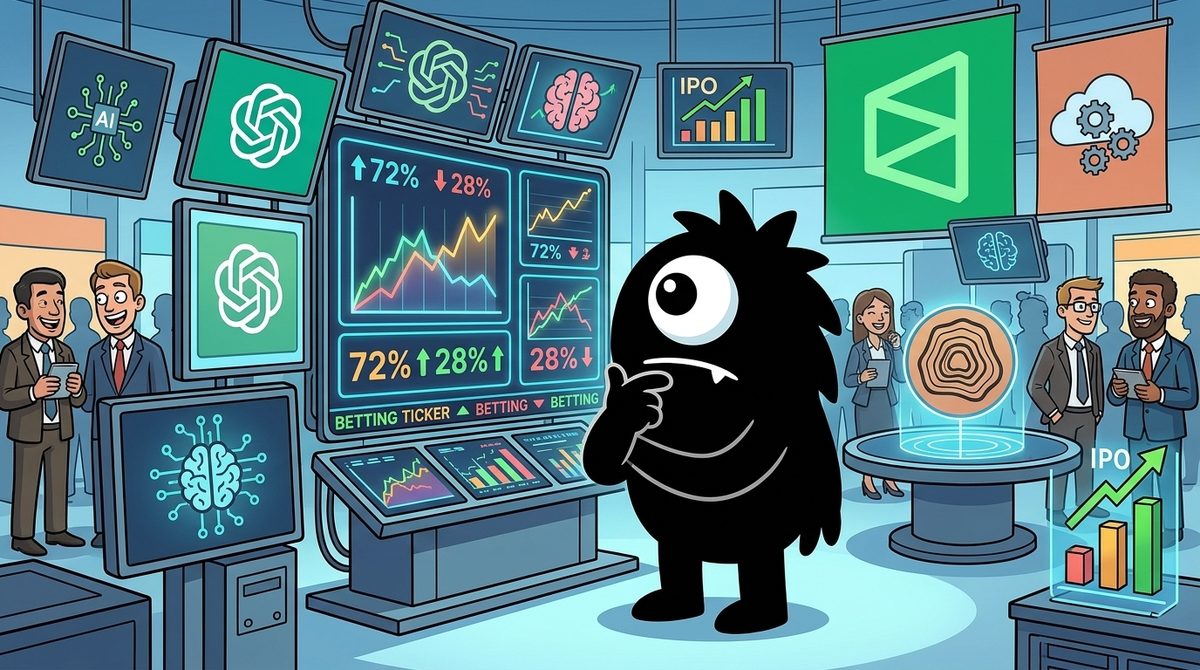
The practical question for developers, founders, and SaaS buyers is not simply “Will OpenAI go public in 2026?” It is: Should you make technology, financing, or procurement decisions as though a near-term OpenAI IPO is likely?
As of August 17, 2026, the prediction market’s answer is no. Traders in Polymarket’s “OpenAI IPO by...?” market currently imply a 20% probability of an IPO by December 31, 2026, compared with 2% by September 30 and 0% by August 31. Roughly $2,820,812 has been traded across the market, including $877,082 on the December contract, $113,479 on September, and $193,156 on August.[7]
Bottom line: The market currently implies an approximately 80% probability that OpenAI will not complete an IPO by the end of 2026 under the contract’s resolution rules. That does not mean a delay is certain. It means traders now view a 2027-or-later listing as substantially more likely than a 2026 debut—and practitioners should plan around continued private-company behavior while monitoring the odds for evidence of a genuine shift.
Why is the 20% OpenAI IPO probability the signal worth watching?
A prediction-market percentage is a live, money-weighted forecast. In a simplified binary market, a “Yes” contract trading near $0.20 suggests that participants collectively price the event at roughly a 20% probability, because a winning contract pays $1.
That is not the same as a verified forecast from OpenAI, a regulatory filing date, or a guarantee. Market prices can be distorted by liquidity, trader positioning, ambiguous news, or the precise resolution criteria. But they force participants to attach a number to their beliefs rather than merely post “IPO soon” or “delayed” on social media.
Axios automating local news with OpenAI is a product deal, not an IPO signal.
Market still has OpenAI going public in 2026 at ~21%. Confidential S-1 filed, but traders think they stay private longer.
https://polymarket.com/event/openai-ipo-by
The date matters too. The August, September, and December contracts represent different deadlines; their percentages should not be added together. The 0% August 31 price says traders see virtually no path to a completed listing within two weeks of the August 17 snapshot. The 2% September 30 price leaves only a narrow tail probability for September. The 20% December 31 contract captures the remaining possibility of a fourth-quarter transaction.[7]
This also explains why X users have circulated apparently incompatible numbers:
70% chance OpenAI IPOs by December 31, per Polymarket:
View on XThe 70% figure was a snapshot from a different point in the news cycle, not an alternative reading of the current 20%. Polymarket Analytics and the underlying market provide the more useful frame: prices move continuously, while posts and articles preserve individual moments.[12] A number without its timestamp is stale surprisingly quickly.
Why did OpenAI’s IPO odds swing from the 70s to about 20%?
The movement from reported odds above 70% to today’s 20% is not evidence that one side necessarily had secret information. It shows how aggressively traders repriced the timing when the public narrative changed.
Earlier in 2026, reporting and social posts emphasized a potential fourth-quarter listing:
🔥 LATEST: Prediction market Polymarket now places the odds of an OpenAI IPO by the end of 2026 at 72%.
View on XWSJ reports OpenAI is targeting a Q4 IPO but Polymarket traders put the odds at just 41%.
View on XAn IPO pipeline, a confidential filing, fast revenue growth, and bank involvement can all increase the perceived probability of a listing. But none guarantees that management and underwriters will accept the valuation, disclosure obligations, investor demand, or market conditions available on a particular date.
Reports that OpenAI might wait for a less “choppy” market produced the opposite reaction:
BREAKING: OpenAI’s odds to IPO this year are tanking on reports the company may hold off for a less “choppy” market.
Now a 29% chance.
Reporting in June indicated that OpenAI was leaning toward holding up its IPO until the following year.[1] Other coverage connected the possible delay to concerns following SpaceX’s rocky public-market entrance.[6] Yahoo Finance similarly reported that the company could postpone its plans after the SpaceX scare.[9]
The resulting volatility is itself informative. A stable 20% based on abundant definitive information would imply confidence. A drop from the 70s through 41% and 29% to approximately 20% implies high sensitivity to timing signals. Traders appear to believe the company can technically pursue a listing, but may lack a compelling reason to complete one in 2026.
For practitioners, the key distinction is between IPO readiness and IPO urgency. OpenAI may possess the first while lacking the second.
Why doesn’t a confidential S-1 mean an OpenAI IPO is imminent?
OpenAI confidentially filed paperwork for a U.S. IPO in June 2026, after Anthropic entered the pipeline, according to Reuters, Bloomberg, TechCrunch, and The Wall Street Journal.[2][3][4][5] That is meaningful: filing requires preparation, legal work, audited financial information, and engagement with regulators.
But a confidential S-1 is an option, not a binding launch date.
Companies use confidential filings to begin SEC review without immediately publishing sensitive financial and operating disclosures. They can revise the paperwork, wait for better conditions, alter the offering, or postpone the process. Public investors usually do not receive the full filing until later in the sequence.
That difference is getting lost in the X conversation:
OpenAI is reportedly targeting an IPO as early as September 2026, with an S-1 filing expected soon.
View on XThe post captures the optimistic case—an early target and paperwork in progress—but the current market price shows that traders no longer treat those steps as sufficient evidence of a 2026 completion.
The more useful interpretation is that OpenAI has built the infrastructure needed to move when conditions fit. The market currently implies that management is more likely to preserve that flexibility than exercise it before December 31. The reported possibility of a 2027 delay reinforces that reading.[1][6]
For founders, this is a familiar financing lesson: administrative readiness does not create transaction necessity. A company with access to private capital, employee liquidity programs, and strong strategic demand can prepare for an IPO while retaining the ability to wait.
Why do traders think Anthropic could go public before OpenAI?
The OpenAI market cannot be understood in isolation. It is also pricing a race between the two leading private frontier-model companies.
A widely shared Polymarket snapshot put the probability of Anthropic listing before OpenAI at approximately 78%:
78% chance Anthropic IPOs before OpenAI, per Polymarket:
View on XThat price has moved dramatically as well. An earlier snapshot put the same proposition at only 25%:
25% Anthropic IPOs before OpenAI, per Polymarket:
View on XThe reversal reflects changing expectations rather than an established outcome. Bloomberg reported that OpenAI had joined an AI IPO pipeline estimated at $3.6 trillion as rivals raced toward the market.[3] Within that pipeline, traders are attempting to determine which company offers the cleaner first test of public demand for a pure-play frontier AI laboratory.
Current X discussion portrays Anthropic as moving more aggressively toward an early-October debut:
Anthropic just moved to the front of the IPO line and Polymarket jumped 75% overnight.
Early October. Goldman Sachs. Morgan Stanley. JPMorgan. The biggest underwriters on earth lined up for what could be the most anticipated tech IPO since the dot-com era.
WSJ reported pre-IPO investor meetings are already happening. That means the roadshow is weeks away. The S-1 was filed confidentially in June. Everything points to October.
OpenAI pushed their IPO to 2027. Anthropic is going first.
Here is why this matters. Anthropic crossed $30 billion in run-rate revenue. Profitable. Growing faster than any AI company on earth. A Claude model sitting at number one on every major benchmark. They own the market share narrative.
When they hit the public markets, they will be the first pure-play AI company to trade on a US exchange. Not cloud infrastructure. Not an AI tool. An actual AI model company with real revenue and real margins.
The valuation will be historic. $100 billion? $200 billion? The market gets to finally price what Anthropic is actually worth after three years of private fundraising at accelerating valuations.
Polymarket traders are already betting October. Goldman is already building the roadshow materials. Anthropic is already in meetings with the biggest institutions on earth.
This is not speculation. This is market infrastructure being built in real time.
Track every Anthropic and AI company IPO market on Polymarket.
Those details should still be treated as claims and expectations—not a completed timetable. Another market snapshot put Anthropic’s probability of listing by October 31 at 57%, far below certainty:
Polymarket now puts the chance of an Anthropic IPO by Oct. 31 at 57%.
View on XIf Anthropic were to list first, it could establish the initial public benchmark for frontier-model economics: revenue multiples, gross-margin expectations, compute disclosures, customer concentration, model-development costs, and stock-based compensation. OpenAI could then observe how public investors price those risks instead of volunteering to be the first test case.
That scenario would favor patience for OpenAI if Anthropic’s reception were weak or volatile. A strong reception, however, could raise OpenAI’s 2026 odds by demonstrating investor appetite. Anthropic’s timeline is therefore a leading indicator for the OpenAI contract, not merely a separate company story.
How are traders pricing OpenAI’s revenue-growth-versus-cash-burn paradox?
The bullish IPO case begins with extraordinary reported growth. Posts circulating in August cite an annualized revenue run rate of about $40 billion and monthly growth above 20%, driven by subscriptions, coding agents, and enterprise adoption.
OpenAI’s ~$40B annualized run rate is being read as IPO fuel: subscriptions, coding agents, and enterprise seats re-accelerated after a softer spring, with July monthly growth cited above 20% in the reporting trail.
Price cuts against Anthropic and open-weight pressure sit in the same chapter — buy share and lock workflows before a public listing, even if unit economics tighten.
Run rate is still not profit. Compute and go-to-market costs scale with tokens; cash-flow timing has historically lagged the top-line narrative for frontier labs.
IPO in 2026 remains a path, not a filed date.
Public markets will price growth next to margins, concentration risk, and model leadership versus peers.
For the industrial stack, more paid agent steps still mean more inference on GPUs and HBM — the same bottleneck whether the issuer is private or listed.
But run rate is not annual revenue already earned, and revenue is not profit. A run rate typically annualizes recent performance. It can be useful for a fast-growing company, but it can overstate durability if growth slows, pricing changes, or temporary demand spikes fade.
The bearish case is that frontier AI remains intensely capital-hungry:
OpenAI’s IPO story is going to be interesting.
Q1 2026:
$5.7B revenue
$3.7B cash burn
$9.3B operating loss
$665B in compute commitments through 2030
AI demand is obviously real. But the business model is still: burn insane amounts of money to buy enough compute to stay frontier. The comparison with Anthropic will be tough.
Those figures are part of the live debate and would require full public filings to evaluate properly. Still, they identify the variables public investors would scrutinize:
- Inference costs: More agent actions and generated tokens can increase revenue while also increasing compute expense.
- Training costs: Remaining near the frontier requires recurring investment in chips, data centers, networking, energy, and research.
- Price competition: Discounts can accelerate adoption but weaken gross margins.
- Customer concentration: Large contracts can produce fast growth while making results dependent on fewer buyers.
- Compute commitments: Long-term capacity agreements can secure supply but create fixed obligations if demand or pricing changes.
- Model durability: A leading model can lose relative advantage within a short product cycle.
Valuation prediction markets already attempt to price parts of this uncertainty, including possible IPO closing market capitalizations.[8] Yet public-market scrutiny would be substantially more detailed than a single valuation number.
OpenAI: $40B revenue run rate. 20% monthly growth. $852B valuation. $1T IPO floor. Also, OpenAI: COO leaving. CRO leaving. Product chief left in July. Same week. Both things true. The paradox worth understanding.
View on XThat is the core paradox behind the 20% probability. Strong growth can make OpenAI capable of going public while high burn and uncertain margins make management reluctant to expose the company to quarterly valuation resets. The market appears to be pricing the option value of remaining private as greater than the immediate benefits of listing.
For AI founders, the warning is clear: do not use frontier-lab run rates as proof that application-layer economics will automatically work. Track gross margin after model costs, customer acquisition payback, inference intensity per workflow, and exposure to API price changes.
Are executive departures and the $7 billion tender offer delay signals?
Prediction markets also absorb organizational news that is difficult to translate into conventional financial models.
Posts in the current conversation cite 12 executive departures or role changes during 2026, including leadership in operations, revenue, product, safety, and ethics:
【注目】OpenAI、2026年に幹部12人が退社・退任
・元COOのBrad Lightcap氏やCROのDenise Dresser氏が離脱
・製品、安全、倫理部門の責任者も相次ぎ退社
・一部は健康上の理由で退任や非常勤顧問へ移行
OpenAIが2026年内にIPOしない確率は80%
OpenAI in Crisis Mode: Executive Exodus Sparks IPO Red Flags OpenAI is facing a major executive exodus ahead of its planned initial public offering, highlighted by the recent departures of Chief Revenue Officer Denise Dresser and COO Brad Lightcap. In response, President Greg Brockman has stepped into an active "founder mode" to stabilize operations and reassure stakeholders amidst growing concerns over the company's internal stability and massive $852 billion valuation.
View on XDepartures do not prove that an IPO has been postponed. Executives leave rapidly growing companies for many reasons, and leadership changes can sometimes strengthen an organization. But turnover around finance, operations, product, or revenue can increase execution risk during an offering, when underwriters and prospective shareholders expect a stable team and consistent internal controls.
The tender offer may be a more concrete clue. X posts describe a completed transaction allowing employees to sell approximately $7 billion of shares:
OpenAI completes $7 billion tender offer (this is where employees can cash out part of their shares), while Anthropic is signaling public market debut (IPO) in about 2 months from now, most likely early October. Buckle up.
View on XA tender can reduce one of the strongest reasons for a mature private company to list: employee and early-investor demand for liquidity. If staff can sell some holdings privately, management may gain additional time to improve financial reporting, wait for better markets, or watch a competitor’s debut.
A flat valuation after a buyback usually means one thing. It relieves pressure on employees so a company does not have to rush a listing. OpenAI already filed confidentially for an IPO with the SEC in June. This tender signals the debut could slip into 2027.
View on XA flat valuation following a buyback is open to interpretation, but the strategic logic is straightforward. Private liquidity lowers IPO urgency. Combined with market turbulence and leadership turnover, it helps explain why the contract currently implies roughly an 80% probability of no completed 2026 IPO.
Are prediction markets becoming a useful private-tech dashboard?
Polymarket’s expansion into IPO and private-company valuation events turns traditionally opaque corporate milestones into continuously tradable expectations. The platform introduced markets involving OpenAI, Anthropic, SpaceX, Stripe, Kraken, and other private companies as reported platform volume approached $39 billion in 2026.[11]
🚨 JUST IN: Polymarket launches prediction markets for IPOs and private company valuations, featuring firms like OpenAI, SpaceX, Stripe, Anthropic, and Kraken as platform volume nears $39B in 2026.
View on XFor technical decision-makers, this creates a faster dashboard than waiting for formal statements. A sharp repricing can reveal that traders consider a tender offer, executive exit, public filing, competitor roadshow, or market selloff relevant—even when no single development is decisive.
But prediction markets have important limitations:
- Volume is not the same as depth. The $2.82 million figure represents cumulative trading, including repeated turnover. It does not mean $2.82 million can be bought or sold near the displayed price without moving it.
- Deadline markets can be thin. A distant December contract may contain more useful information than a near-expiry monthly contract, but both can overreact to modest order flow.
- Resolution rules control the outcome. Traders must price what qualifies as an IPO under the contract, not an informal definition such as “files paperwork.”
- Headlines can create reflexive moves. Traders may buy because odds are rising, while social accounts report the rise as evidence that an IPO is becoming more likely.
- Markets forecast events, not business quality. A company can complete an IPO that performs poorly, or delay an IPO despite strong fundamentals.
Use the odds as a compact consensus indicator—not as due diligence and not as an instruction to redesign a technology stack.
What should developers, founders, and SaaS buyers do with the 20% odds?
The current market signal supports different actions for different audiences.
SaaS buyers choosing an AI platform
Plan for OpenAI to remain founder-controlled through 2026, while preserving provider flexibility. A private OpenAI may face less short-term shareholder pressure around margins, but customers still face pricing, model, capacity, and roadmap risk.
The right approach for larger teams is a provider-abstraction layer, evaluation suite, and contractual exit plan. Smaller teams should avoid expensive multi-provider architecture unless switching risk is material; instead, maintain portable prompts, data exports, and benchmark tests.
Founders building on OpenAI APIs
Treat price competition as an opportunity and a dependency risk. Lower model prices can improve application margins, but a future shift toward profitability could reverse favorable economics. Model unit cost, caching, fallback routing, and per-customer inference consumption explicitly.
Founders raising capital should also separate AI-lab growth claims from their own economics. Investors will care whether the product has proprietary distribution, workflow ownership, or data advantages beyond API access.
Investors and market watchers
Recheck the 20% rather than memorializing it. The price could change rapidly after public S-1 disclosure, an Anthropic timetable update, another tender, underwriter activity, or broader market volatility.
Headlines about a trillion-dollar offering remain expectations, not outcomes:
This hiring spree lines up with a much bigger event.
OpenAI is reportedly eyeing a trillion-dollar IPO as soon as late 2026.
Goldman Sachs is one of the banks underwriting that offering.
The same firm Altman once turned down now profits from his company twice.
The best monitoring framework combines four signals: OpenAI’s December probability, Anthropic’s relative timing odds, publication of offering documents, and public-market reception for other large AI listings. Together they say more than any single viral percentage.
At the August 17 snapshot, the strongest conclusion is limited but useful: traders price OpenAI as IPO-ready, but not IPO-compelled. For the AI and SaaS industry, that points toward another period in which private capital, compute economics, model competition, and employee liquidity—not public shareholders—remain the dominant forces shaping the frontier.
Sources
[1] OpenAI Leans Toward Holding Up I.P.O. Until Next Year — The New York Times
[2] OpenAI files for US IPO after Anthropic as AI giants head to public markets — Reuters
[3] OpenAI Joins a Massive AI IPO Pipeline Now Worth $3.6 Trillion — Bloomberg
[4] OpenAI files confidentially for IPO, following Anthropic — TechCrunch
[5] OpenAI Files IPO Paperwork With SEC — The Wall Street Journal
[6] OpenAI May Delay Its IPO To 2027, Report Says — Forbes
[7] OpenAI IPO by...? Predictions & Odds 2026 — Polymarket
[8] OpenAI IPO closing market cap above ___? — Perplexity
[9] OpenAI Could Reportedly Delay IPO After SpaceX Scare — Yahoo Finance
References (15 sources)
- OpenAI Leans Toward Holding Up I.P.O. Until Next Year - nytimes.com
- OpenAI files for US IPO after Anthropic as AI giants head to public markets - reuters.com
- OpenAI Joins a Massive AI IPO Pipeline Now Worth $3.6 Trillion - bloomberg.com
- OpenAI files confidentially for IPO, following Anthropic - techcrunch.com
- OpenAI Files IPO Paperwork With SEC - wsj.com
- OpenAI May Delay Its IPO To 2027, Report Says - forbes.com
- OpenAI IPO by...? Predictions & Odds 2026 | Polymarket - polymarket.com
- OpenAI IPO closing market cap above ___ ? - Perplexity - perplexity.ai
- OpenAI Could Reportedly Delay IPO After SpaceX Scare - finance.yahoo.com
- Polymarket Traders Price OpenAI IPO Odds Near 72% | Intellectia.AI - intellectia.ai
- Polymarket expands into private-company bets as Anthropic and OpenAI valuations become tradable - mlq.ai
- OpenAI IPO by...? | Polymarket Analytics - polymarketanalytics.com
- OpenAI raises $122 billion to accelerate the next phase of AI - openai.com
- Our structure | OpenAI - openai.com
- OpenAI - en.wikipedia.org
Related Guides
The Best AI Model of 2026: What Polymarket's $1.9M Market Signals for Developers
20 min read
Make vs Vertex AI Agents vs OpenAI Assistants API: Which Is Best for Code Review and Debugging in 2026?
18 min read
The Best AI Model in 2026: An Expert Analysis of What a $4.2M Prediction Market Reveals
24 min read