The Best AI Model Race in 2026: What a $1M Polymarket Bet Reveals About Where AI Is HeadingUpdated: October 18, 2026
Polymarket odds put Anthropic at 56% for the best AI model of 2026. Discover what traders' probabilities reveal about the AI and SaaS race. Find out who leads.
The practical question for developers, founders, and SaaS buyers is not simply which lab is winning today? It is: which company is most likely to hold the top model position when 2026 ends—and how much should that expectation influence decisions made now?
As of September 4, 2026, Polymarket traders give Anthropic the clearest lead. The market implies a 56% probability for Anthropic, compared with 26% for OpenAI, 4% for xAI, 1% for Moonshot, and effectively 0% for DeepSeek and ByteDance. Roughly $1,008,161 in total trading volume has passed through the market, which is expected to resolve around January 1, 2027 using a public model leaderboard specified in its rules.[1]
The bottom line:
- Anthropic is the market’s default expectation, especially for coding and autonomous-agent workloads.
- OpenAI remains the only strongly priced challenger, with traders assigning it roughly one chance in four.
- xAI and Chinese labs generate far more attention than their win probabilities suggest.
- For buyers, these odds argue for model-agnostic architecture, not a year-long commitment to whichever model tops this week’s benchmark.
What is the $1 million prediction market really telling us?
A 56% contract price does not mean Anthropic will certainly finish 2026 with the best model. It means traders currently price that outcome at approximately a 56% implied probability, before accounting for market frictions, liquidity and the precise resolution rules.
The distinction matters because this market is not asking which company has the largest user base, the best API economics or the safest enterprise platform. It resolves according to its specified public leaderboard methodology.[1] A company could therefore win the contract with one highly ranked model while remaining a weaker choice for a particular production workload.
The September 4 snapshot is:
| Company | Implied probability | Traded on outcome |
|---|---|---|
| Anthropic | **56%** | **$115,130** |
| OpenAI | **26%** | **$90,409** |
| xAI | **4%** | **$80,866** |
| Moonshot | **1%** | **$76,173** |
| DeepSeek | **0%** | **$73,982** |
| ByteDance | **0%** | **$69,292** |
These are selected outcomes rather than the market’s entire field, which is why the percentages shown do not add to 100%. The dollar figures are trading volume—turnover from buying and selling—not necessarily capital still committed to each position.
The odds also move much faster than an industry ranking. Recent X posts quoted Anthropic near 69%, OpenAI between 11% and 16.5%, and xAI around 7% on earlier snapshots:
Polymarket, best AI model end of 2026: Anthropic 69.5¢. OpenAI 16.5¢ (+5¢/24h). Google 7¢. $917k vol.
View on XNeither of them is the favourite. On the end of 2026 best model market Anthropic is 69 percent, OpenAI 11 and xAI 7, on an $841K board. The fight is over second place.
View on XBy September 4, Anthropic had fallen to 56% while OpenAI had risen to 26%; a market tracker described Anthropic’s move as a 14-percentage-point decline.[2] That volatility is itself informative: traders see Anthropic as the favorite, but not as an untouchable one.
Prediction markets are useful here because they force benchmark claims, product announcements and lab reputations into a falsifiable price. They are not infallible. Thin liquidity, rule interpretation and short-term news can distort them. But unlike X enthusiasm, a market price makes participants pay for being wrong.
Why do traders price Anthropic at 56%—even when critics dislike it?
The most revealing argument for Anthropic’s lead is not coming only from enthusiastic Claude users. It is coming from people who object to the company’s policies or strategy but still regard its models as the standard competitors must beat.
I hate Anthropic more than anyone, but like it or not, their models are the industry standard.
Everyone used to chase Opus, and today they're chasing Fable.
Anthropic simply has the best data on earth.
Look at OpenAI: they flopped with the GPT-5 launch, fumbled around until 5.5 where things stabilized a bit, and then stumbled again with Sol, a reckless model that lacks human touch and real comprehension.
If you're a retail user paying $200 or less, OpenAI's models might be fine for you, but billion-dollar enterprises are all paying Anthropic.
There is no comparison.
That sentiment helps explain why traders currently give Anthropic a probability larger than OpenAI, xAI, Moonshot, DeepSeek and ByteDance combined in the quoted snapshot.
The bull case has three components.
First, Claude has become a reference point for coding, scientific reasoning and agentic work. Independent ranking sites continue to compare frontier models across coding, reasoning, latency and price, reinforcing the idea that there is no single universal benchmark—but also that Anthropic consistently belongs in the leading group.[8][9]
Second, observers believe Anthropic has aligned its commercial strategy with its strongest technical capabilities: expensive API access and enterprise workloads rather than maximally subsidized consumer usage. One X analysis argues that this gives Anthropic stronger unit economics while reserving its best inference configurations for higher-margin customers:
Deep dive into Anthropic vs OpenAI strategy:
Like many others, I personally criticize Anthropic's stance a lot.
But it is impossible to deny that their model performance and strategy are beating OpenAI.
According to recent reports, Anthropic's revenue and profitability are significantly higher.
Consumer AI subscriptions still give you over 30x more usage compared to API pricing.
If you back-calculate this with SpaceXAI compute rental costs, it is obvious they are running these subscriptions at a massive loss through subsidies.
Every lab is starved of compute right now, and they are taking very different paths:
Google stopped pushing Pro models and dominated the B2C market by serving small, cheap models on their massive existing infrastructure.
Anthropic built the most capable models and focused on selling expensive APIs to enterprises, which actually turned them profitable.
Multiple tests on X show that the exact same model on Anthropic's subscription is heavily nerfed.
It is easy to guess what is happening: full models go to high-margin APIs, while heavily quantized, nerfed models are served to subsidized, unprofitable subscriptions to squeeze more users per compute unit.
OpenAI is in the most awkward spot.
They do not have the strongest model right now.
Sol falls way behind un-nerfed Fable and Opus via API.
Because of this, they are forced to focus on the B2C consumer market.
But as mentioned, subscriptions are heavily subsidized and bleed cash.
No matter how many users they have, the unit economics just do not work.
That is why OpenAI has been aggressively slashing subscription limits. Codex limits used to be generous, but now they are even tighter than Claude.
The difference with Google is clear. Google can plug AI into existing, highly profitable infrastructure without burning cash. For OpenAI, more users just means burning more money.
This is exactly why Anthropic is confidently moving forward with their IPO next month, while OpenAI has to delay theirs.
Those revenue and profitability claims should be treated as the poster’s interpretation, not as audited evidence provided by this market. But the underlying strategic point is relevant. If frontier inference remains scarce, a lab serving high-value API workloads may have more freedom to spend compute on quality, long contexts and multi-step agents.
Third, the Fable and Mythos narrative has created an expectation of a pipeline, not merely one winning release. Traders appear to be pricing the possibility that Anthropic can respond to challengers before year-end. That expectation is more valuable than a temporary benchmark lead because the contract resolves at a future cutoff, not today.
Anthropic’s 56% is therefore best read as a vote for organizational repeatability: data, post-training, evaluation, enterprise feedback and a credible next-model cadence. It is not proof that any individual Claude model is best for every application.
Are autonomous agents replacing benchmarks as the frontier metric?
The most consequential shift in the 2026 model race is from single-response accuracy toward long-horizon autonomy: whether a model can execute, inspect, recover and continue working over many hours without human intervention.
A viral example came from discussion of Anthropic’s Fable 5.1 documentation. The post claims that an internal run continued for 38 hours, corrected an earlier machine-learning result and launched six parallel experiments:
CLAUDE FABLE 5.1 CAN NOW RUN UNSUPERVISED FOR 38 HOURS STRAIGHT. ITS SCORE ON A HARD SCIENCE BENCHMARK MORE THAN DOUBLED OVERNIGHT, FROM 24.7% TO 52.6%. ANTHROPIC WON'T SAY WHAT ACTUALLY CHANGED INSIDE THE MODEL.
so anthropic buried the real story in a system card nobody reads. one internal fable 5.1 run went 38 hours straight, zero human in the loop. it caught an error in an earlier ml result, fixed it, kicked off six parallel experiments overnight, and came back with results plus next steps. that's not a demo, that's a lab assistant that doesn't sleep.
That is a more meaningful capability target for many SaaS teams than moving from, say, 88% to 91% on a static test. A coding copilot that answers one question correctly is useful. An agent that can investigate a repository, modify several services, run tests, recognize a regression and recover without supervision could change staffing, pricing and product design.
But long-horizon claims are also harder to evaluate. Performance can depend on scaffolding, tool permissions, retry budgets, token spending and the quality of the environment—not just the underlying model. A 38-hour run is impressive only if the work is reproducible, economically viable and robust to unfamiliar tasks.
Even the benchmarks themselves are contested. Discussion of Anthropic’s system card highlighted a corrected scientific-reasoning benchmark intended to remove ambiguities and errors from the original questions:
Apologies - I missed this discussion in the Fable 5.1 system docs!
Section 8.9, “CritPT-Corrected” in Anthropic’s Claude Fable 5.1 & Claude Mythos 5.1 System Card (Sept 1, 2026). Pages 168–171.
The revised benchmark cleans pervasive ambiguities and errors found in the original problems to evaluate advanced postgraduate scientific reasoning more accurately.
That correction cuts both ways. Better evaluations can reveal real progress, but changing a benchmark also makes before-and-after headlines difficult to interpret. SaaS buyers should ask:
- How often does the agent finish the full workflow?
- How much human review does it require?
- Can it recover from tool and environment failures?
- What is the cost per successful task, not per token?
- Does quality persist over hours rather than one prompt?
If long-horizon reliability becomes the market’s implicit definition of “best,” Anthropic’s agent reputation helps explain its 56% probability. If leaderboard resolution instead rewards shorter, user-rated interactions, the contract may undervalue models optimized for broad conversational appeal.
Can OpenAI’s 26% become a genuine comeback?
Traders currently put OpenAI’s end-of-2026 win probability at 26%, with $90,409 traded on the outcome. That makes OpenAI the only challenger the market treats as more than a long shot.
The comeback case centers on GPT-5.6 and its Sol, Terra and Luna lineup. OpenAI presents GPT-5.6 as frontier intelligence that scales across workload intensity,[7] while supporters describe Sol as the high-end option for coding, cybersecurity and biology, with parallel-agent execution in its highest-compute mode:
OPENAI RELEASED GPT-5.6 AND BEAT ANTHROPIC'S BEST MODELS
OpenAI unveiled a new generation of its models and immediately set a new bar in coding, cybersecurity and biology. The lineup has three models, essentially an answer to Anthropic's Haiku, Sonnet and Opus:
> Sol, the flagship for heavy coding, cybersecurity and biology
> Terra for everyday work with a balance of price and quality
> Luna for fast and cheap high-volume tasks
The flagship has an ultra mode that runs several agents in parallel and splits one complex task between them
On the numbers, Sol leads:
> 91.9% on Terminal-Bench against 88% for Claude Mythos 5
> the only model to cross 50% on Agent's Last Exam
> up to 750 tokens per second at launch in July
The product logic is clear. A tiered lineup lets OpenAI compete on several fronts: flagship performance, routine knowledge work and cheap high-volume inference. For SaaS companies, that can simplify routing because one vendor potentially covers multiple price and latency bands.
Yet the X reception is divided. Critics characterize the earlier GPT-5 rollout as a stumble and question whether Sol matches Anthropic in real-world comprehension. Supporters argue that OpenAI’s faster release posture could allow a forthcoming model such as Astra to retake the lead:
OpenAI and Anthropic are taking very different strategies.
OpenAI seems willing to ship frontier models with cyber capabilities to the public asap, Anthropic is more cautious.
That means Astra could very well be the best model in the world when it launches.
For the first time in a long time, GPT will be ahead of Claude.
This disagreement explains why the market can simultaneously price OpenAI as the obvious second-place candidate and still give it less than half Anthropic’s probability. OpenAI does not need to prove that GPT-5.6 wins every current test. It needs traders to believe it can ship the highest-ranked qualifying model near the resolution date.
OpenAI fits teams that need broad platform coverage, consumer familiarity, multimodal products or access to multiple performance tiers. Anthropic remains the market-implied safer choice for buyers prioritizing coding and agentic depth. But a 26% price is substantial: founders should not design systems as though an Anthropic year-end win were predetermined.
Why is xAI priced at only 4% despite Grok’s surprise wins?
The market prices xAI at just 4%, even though its outcome has generated $80,866 in volume—close to OpenAI’s $90,409. That is one of the clearest gaps between attention and confidence.
Grok has produced eye-catching results on specialized evaluations. One RareBench report said Grok 4.6 edged Claude Opus 5 on rare-disease diagnosis at roughly one-third of the cost:
From Mecha Hitler to SOTA rare-disease diagnosis in children? @SpaceXAI's @grok 4.6 has taken the 👑 on RareBench, edging out @AnthropicAI Claude Opus 5 for about 1/3 the cost. This was not on my 2026 bingo card!
@deepseek_ai's new v4-pro-0813 model underperformed my expectations, v4-flash, and seemingly the entire internet's. We accessed using DeepSeek's 1P API on the day of release and I almost wonder if they didn't switch over their model endpoint correctly. We will re-benchmark and report back.
@Zai_org has attracted a following with GLM5.2, but they, too, underperformed. This doesn't surprise me because when I compared GLM and @Kimi_Moonshot K3 for coding use-cases, I found Kimi substantially stronger, but the internet seems to love this model.
Another informal multi-agent arena reportedly ended with eight Grok agents surviving and no Claude agents remaining:
40 AI AGENTS ENTERED
ONLY 8 MADE IT OUT
I put 20 Grok 4.6 agents against 20 Claude Opus 5 agents inside a 60-second PvP arena. Both teams began in vertical ranks, then split into four linked five-agent squads coordinated through a shared command bus.
Every fighter could call targets, launch assault dashes, dodge incoming attacks, parry and counter. Claude formed a defensive wall and survived the opening waves. Grok kept rotating squads and striking from multiple lanes until the entire formation collapsed.
Final score:
Grok: 8 alive
Claude: 0
Neither result establishes that Grok is the best general model. RareBench measures a narrow, important domain. A custom agent arena may reveal coordination behavior, but its outcome can be heavily shaped by prompts, tools, timing and game mechanics. These tests nevertheless matter because they show where xAI could become commercially relevant before winning the overall crown: cost-sensitive inference, specialized reasoning and multi-agent orchestration.
The larger debate is whether frontier progress can be purchased primarily through compute. Some observers interpret Grok’s improvement as evidence that enough GPUs, user interactions and coding data can compress a seemingly durable lead:
xAI-Cursor arc have shaken my confidence in Anthropic's lead. Sure Cursor has a lot of data, but… I thought Anthropic's edge is deeper at this point.
Grok 4.5 is good enough to accelerate
Muse Spark 1.1 seems close
Seems like if you have GPUs you can still catch up
Skeptics counter that xAI is chasing a moving target. Matching an older Claude model may not matter if Anthropic’s internal development workflows use newer models to accelerate the next generation:
Elon Musk says it will take till May for Grok to be close to Opus 4.6 & June to “match or exceed standards”
(see red dots) - that’s where Grok & 4.6 Opus line up today on AAIA.
But xAI isn’t competing with Opus 4.6 they’re competing with Mythos. And if you do even rough indexing math, Mythos likely lands 60–61+.
At that point I’ll say it again: I don’t know if it’s even possible to catch up under the current paradigm. If Anthropic employees are each running 4 instances of Claude Mythos, they’re effectively out-building you by 30–50x.
This is the recursive advantage traders may be pricing: the leading lab’s models help its researchers code, evaluate and run experiments faster, potentially widening the gap even when competitors add hardware.
At 4%, the market does not imply that Grok is irrelevant. It implies that traders distinguish winning tasks from finishing first on the specified year-end leaderboard. Grok may fit teams that can validate it on a bounded workload and capture its cost advantage. It is a riskier sole-provider choice for companies whose product depends on consistently having the strongest general model.
Why do Moonshot, DeepSeek and ByteDance have only about 1% combined?
The China catch-up debate is far louder on X than in the market price. In the September 4 snapshot, traders assign Moonshot 1%, with $76,173 traded. DeepSeek and ByteDance are both displayed around 0%, despite respective volumes of $73,982 and $69,292.
Together, those three outcomes have produced $219,447 in turnover while retaining only about 1% combined displayed probability. That does not mean traders expect Chinese labs to stop improving. It means the market currently sees a low probability that one of these named companies will hold the qualifying top position at the exact resolution point.
The bullish case is not trivial. Kimi K3 supporters cite results where Moonshot’s model beats US competitors across selected tests. But one detailed X challenge turns that enthusiasm into a falsifiable proposition: if the gap is really only around 1.4 months, Chinese models should also lead on hard scientific, cyber, mathematical and long-horizon evaluations—not only favorable coding benchmarks.
MoonshotAI will overtake OpenAI and Anthropic before the end of the year
or will they? at least that's what the hype kiddies on X want you to believe
So let me make it falsifiable. They are saying:
- China / MoonshotAI is catching up
- they are catching up generally (not just coding, but almost all domains and including restricted models like Mythos 5)
- the gap is currently ~1.4 months based on Artificial Analysis Index and benchmarks provided by MoonshotAI, where Kimi-K3 beats Opus 4.8 in 30 of 35 benchmarks, and GPT-5.6-Sol in 19 of 35 benchmarks
(they ignore the existence of all Mythos variants)
- China is not catching up due to distillation, so they should overtake US labs
Their implicit prediction then is:
- a chinese model / MoonshotAI will overtake Anthropic (and OpenAI) on the Artificial Analysis Index by:
- Median: 2026-12-24 (80% CI: 2026-09-17, 2027-09-14)
Since they claim that chinese models are as general as american models, we should see unsolved mathematics, physics, and more being solved by chinese models at higher rates than american models.
Speaking to its generality Kimi-K3 should surpass Opus 4.8 and GPT-5.6-Sol on the majority of these benchmarks:
- METR Time Horizons, FrontierCode, MirrorCode, UK AISI cyber ranges, ExploitBench/ExploitGym, CritPT, FrontierMath T4, ARC-AGI-2 / ARC-AGI-3, WeirdML, ALE-Bench, GSO, MRCR2/GraphWalks
- vibes
Some other things that are more speculative and downstream of China overtaking US models:
- more involvement by the USG
- stricter export controls on semis
- potentially a Manhatten-style project, as we will be behind in 2027 and are racing against China
- also in the cards: US banning chinese models or US labs distilling from chinese models
I have already stated my position clearly.
Chinese models are generally ~6-8 months behind, with some domains like coding behind slightly less.
Kimi-K3 did not significantly shift my estimate on the gap and it currently does not change my outlook on the future, but we will have a MUCH clearer picture once we have all the benchmarks I mentioned earlier.
The main reasons for my position:
- Kimi-K3 doesn't even beat Mythos Preview, a ~5 month old model
- We will likely not see much larger open models than Kimi-K3 for several months, likely not until early-mid 2027
- Meanwhile Anthropic is sitting on a 10T model since ~February, OpenAI likely just finished the training of GPT-6, which should also be around that size, and more 10T param US models are coming from SpaceX AI, Google and Meta.
- We are currently not seeing the true frontier of models. Anthropic and OpenAI are currently sandbagging as the legal situation for releasing new frontier models is unclear.
- Historically, chinese models have been more benchmaxxed than US models, meaning their benchmark numbers do not translate to real world performance as well as their american counterparts
- GPT-5.6-Sol is still 2-3x more token-efficient on the Artificial Analysis Index than Kimi-K3 (while likely being smaller, ~2T)
- US labs have more compute
I'm very happy that Kimi bros released this model.
It's a great model and probably the first really useful chinese model.
Independent coverage identifies Kimi K3 as a leading Chinese model as of September 2026, while also emphasizing comparisons across price, context and benchmark categories rather than a single definitive score.[14] That supports a more nuanced conclusion: Moonshot can be highly useful without being the market favorite to win this specific contract.
ByteDance adds a scale argument. Reports circulating on X say it is training a model that could approach the size attributed to Anthropic’s Mythos system:
ByteDance is training an AI model that could approach the size of Anthropic’s Mythos system
Its training a model with as many as 10tn parameters, three times larger than Moonshot’s Kimi K3.
Parameter count alone, however, does not determine production quality. Training data, architecture, post-training, tool use, inference-time compute and evaluation discipline all affect the result. Traders appear unwilling to convert a large planned training run directly into a high probability of first place.
There is also a contentious capability-transfer issue. Anthropic reportedly disclosed coordinated attempts by several Chinese AI companies to generate millions of Claude exchanges, which one X commentator characterized as “capability arbitrage”:
Anthropic’s disclosure that DeepSeek AI, Moonshot AI, and MiniMax generated over 16 million exchanges through 24,000 coordinated accounts to extract Claude’s capabilities represents a structural inflection point in frontier AI competition. The scale, coordination, and targeting indicate capability arbitrage emerging as a deliberate strategy.
View on XEven if model extraction accelerates catch-up, it does not guarantee leadership. A lab learning from a frontier system is chasing a target whose owner may already be training the next version.
The disconnect appears in shorter-duration markets too. One post contrasted enthusiastic benchmark claims with a roughly 1.45% prediction-market price in a separate September contest:
69.5% vs 1.45%. Market: Alibaba "best AI in China", DeepSeek a rounding error.
Open-sourced 305B params, beat Opus 4.8 — Polymarket: 1.45%. Sept 30 board decides.
68 points for "better"? 📊
#DeepSeek #Alibaba #Polymarket
For developers, the implication is not “avoid Chinese models.” Moonshot or DeepSeek may be compelling when cost, open deployment, regional availability or coding performance matters more than winning a general leaderboard. The implication is to validate their performance on your own workload rather than treating catch-up headlines as evidence of across-the-board parity.
Why do trading volume and implied probability diverge so sharply?
Volume measures disagreement and activity; probability measures the current price.
A low-probability outcome can generate heavy volume because optimists buy it, skeptics sell it, and traders repeatedly adjust positions as news arrives. That is why Moonshot, DeepSeek and ByteDance can collectively account for more than $219,000 in turnover while the market displays only about 1% combined probability for the three.
The reverse is also important. Anthropic’s $115,130 outcome volume is not dramatically larger than the volumes attached to OpenAI or xAI, yet its implied probability is far higher. Traders are actively debating the challengers without pricing them as equally likely winners.
This is the signal inside the hype-versus-money gap:
- X rewards surprising benchmark results.
- Trading markets price whether those results will persist until a specific date.
- Production buyers need a third standard: whether the model improves their own economics and reliability.
A model can dominate online discussion because it wins one test, is released openly or sharply undercuts incumbents. None of those factors necessarily makes it the likely year-end leaderboard winner. Conversely, the leaderboard winner may be too expensive, slow or restrictive for a particular SaaS product.
Which model strategy should developers, founders and SaaS buyers choose?
The odds are most useful as a risk signal, not a procurement ranking.
Developers building coding or autonomous-agent systems
Start with Anthropic when long-horizon coding quality is the priority, because both practitioner sentiment and the 56% market probability point in that direction. But benchmark at least one OpenAI model and one lower-cost challenger against complete tasks.
Measure successful pull requests, test-pass rates, rollback frequency and human review time—not just prompt-level accuracy.
Startups choosing a primary model provider
Use OpenAI when broad platform coverage and multiple model tiers matter. Its 26% probability makes it the only challenger traders price as having a substantial year-end path.
However, place provider calls behind an internal abstraction layer. Store prompts, tool schemas and evaluation cases separately from vendor-specific code. The 14-point movement in Anthropic’s odds demonstrates how quickly expectations can change.[2]
Cost-sensitive SaaS products with narrow workflows
Evaluate Grok, Moonshot and DeepSeek when the task is bounded and testable. A 4%, 1% or rounded 0% probability of winning the overall market does not imply poor unit economics on diagnosis, coding, extraction or routing.
These models fit teams capable of running their own evaluations and accepting uneven performance across domains. They are less suitable as an untested, single-provider foundation for high-stakes general agents.
Enterprises buying AI software rather than APIs
Require vendors to disclose:
- Which model and model version power each workflow
- Whether routing changes by task, price or availability
- Success rates over complete jobs
- Human escalation and audit controls
- Data-retention and provider-switching terms
- Cost per accepted output
The market implies Anthropic is the favorite, not that every SaaS vendor should standardize exclusively on Claude.
The deeper industry signal is that frontier-model leadership is becoming less durable while application architecture becomes more important. Anthropic’s 56% reflects the strongest current expectation. OpenAI’s 26% preserves a credible comeback scenario. xAI and Chinese labs remain low-probability candidates for the contract but potentially high-value suppliers for specific workloads.
The rational response is neither to ignore the market nor follow it blindly. Treat the odds as a live estimate of frontier momentum—and build your product so that a change in the favorite does not require rebuilding the company.
Sources
[1] Which company has best AI model end of 2026? Trading Odds & Predictions — Polymarket
[2] Which company has best AI model end of 2026? Anthropic 56% (-14pp) — pdata.world
[7] GPT-5.6: Frontier intelligence that scales with your ambition — OpenAI
[8] Frontier AI Models: Live Top 10 Rankings, Evidence and Pricing, September 2026 — BenchLM.ai
[9] LLM Leaderboard & AI Model Benchmarks, September 2026 — BenchLM.ai
[14] Best Chinese AI Models, September 2026: Kimi K3 Leads — BenchLM.ai
References (15 sources)
- Which company has best AI model end of 2026? Trading Odds & Predictions | Polymarket - polymarket.com
- Which company has best AI model end of 2026? · Anthropic 56% (-14pp) — Polymarket odds - pdata.world
- Tech Predictions & Odds | Polymarket - polymarket.com
- Which Company Has the Best AI Model in September 2026? Winner Odds | Lines.com - lines.com
- Which company has the best AI model end of September Odds & Prediction Market Analysis | CryptoSlate - cryptoslate.com
- Which company has the best AI model end of September? — Polymarket odds | Polymtrade - polym.trade
- GPT-5.6: Frontier intelligence that scales with your ambition | OpenAI - openai.com
- Frontier AI Models: Live Top 10 Rankings, Evidence and Pricing (September 2026) | BenchLM.ai - benchlm.ai
- LLM Leaderboard & AI Model Benchmarks — September 2026 - benchlm.ai
- AI Model Performance Timeline | Foxxe Labs - foxxelabs.ie
- Best AI Models in 2026: The Complete Ranking | The AI Rankings - theairankings.com
- GPT-5.6 vs Claude: which AI model wins in 2026? | eesel AI - eesel.ai
- AI Model Leaderboard 2026 - Ranked by Usage | whatstrending.ai - whatstrending.ai
- Best Chinese AI Models (September 2026): Kimi K3 Leads | BenchLM.ai - benchlm.ai
- Model Performance Leaderboard | LMSpeed - lmspeed.net
Related Guides
The Market Says 8%: What Polymarket's OpenAI AGI Odds Reveal About Where AI and SaaS Are Headed in 2026
15 min read
Together AI vs Azure OpenAI vs Replicate: Which Is Best for Marketing Automation in 2026?
21 min read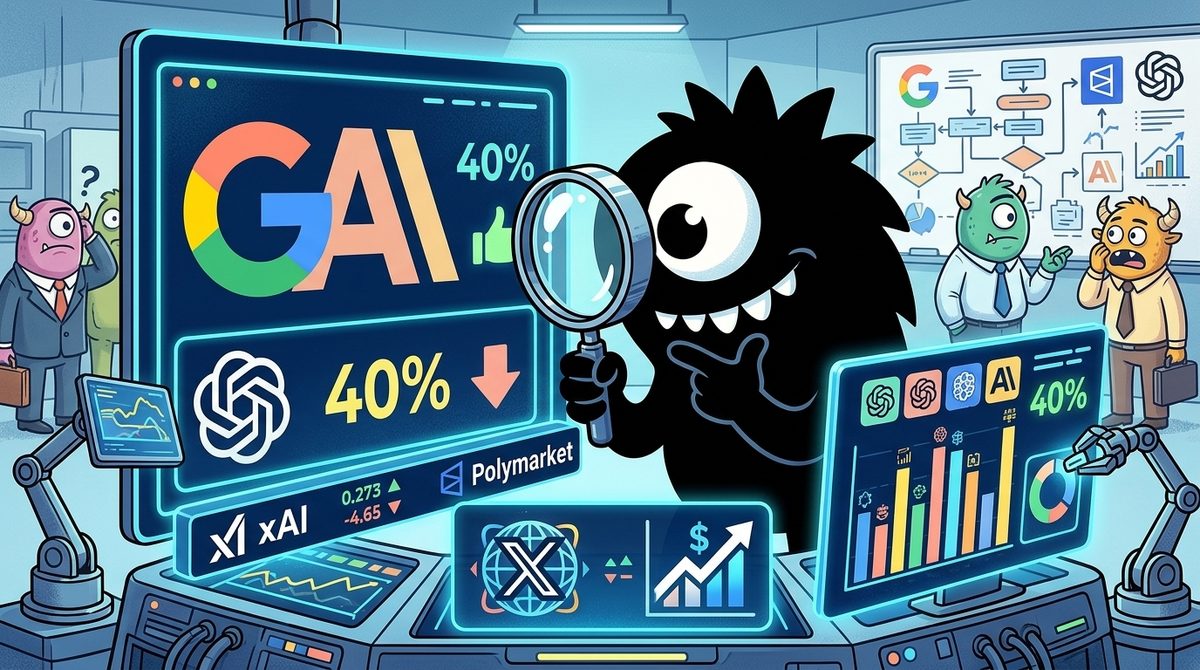
The Best AI Model of 2026: What Prediction Markets Reveal About the Frontier Race
19 min read
Anthropic vs Hugging Face vs Perplexity AI: Which Is Best for SEO and Content Strategy in 2026?
17 min read