The Best AI Bubble Signals to Watch in 2026: What Polymarket's 10% Odds Reveal About the IndustryUpdated: October 11, 2026
AI bubble odds on Polymarket sit at 10% for 2026. Discover what traders' probabilities reveal about AI valuations, SaaS margins, and compute moats. Find out.
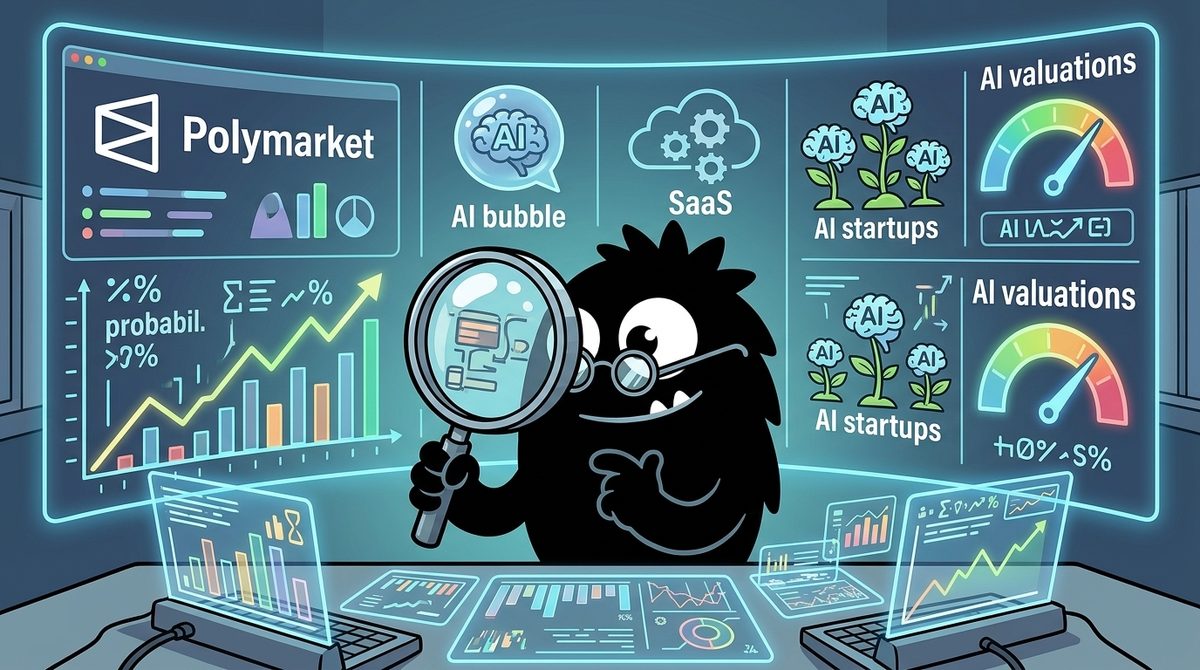
The practical question for developers, founders, and SaaS buyers is not simply, “Is AI a bubble?” It is: How much near-term collapse risk should I price into hiring, fundraising, architecture, and procurement decisions?
As of September 2, 2026, Polymarket traders imply a 10% probability that the AI bubble bursts in 2026. Approximately $2,352,007 has traded on that outcome, within an “AI bubble burst by...?” event holding roughly $2,940,003 in total volume and resolving around January 1, 2027.[6] That is a clear market expectation: traders currently price a qualifying 2026 burst as an unlikely tail event—not as the base case.
Bottom line
>
- Polymarket’s 10% implied probability says traders expect the AI investment cycle to survive 2026 more often than not.
- It does not imply AI valuations, SaaS margins, or individual startups are safe.
- The market appears more concerned with a correction, margin compression, and startup consolidation than with a sector-wide collapse.
- The best signals to watch now are compute demand, memory supply, AI gross margins, platform dependence, debt-backed capital expenditure, and correlations with recession risk.
What Do Polymarket’s 10% AI-Bubble Odds Actually Say?
A prediction-market price is best read as a crowd-generated probability conditional on the market’s rules. It is not proof, an analyst consensus, or a guarantee. At 10%, traders are effectively saying that contracts paying out if the defined event occurs are worth about ten cents on the dollar.
The exact wording matters. Polymarket’s contract resolves according to its published criteria for major negative events in the AI sector, rather than every valuation markdown, failed startup, or stock-market correction qualifying as a “burst.”[6] Consequently, a trader can believe that AI companies are overvalued, that public technology stocks could fall, and that weak startups will disappear—while still betting “No” on a formally defined 2026 bubble burst.
The market has also moved. Other 2026 snapshots and market trackers have shown probabilities near 11%, while earlier reporting recorded a decline to 19% after a five-point move in 24 hours.[4][3] X posts citing 12% to 14% reflect earlier observations of the same moving market, not necessarily contradictory data.
Elevated but uncertain. BIS and Fitch flag major risks from $1T+ hyperscaler AI capex outpacing returns, echoing past tech manias, with debt and circular financing adding fragility. Prediction markets put ~14% odds on a full 2026 burst; corrections more likely sooner.
Fallout: tech-heavy market drop, investment pullback cutting growth, credit strains, job losses in data centers/chips—potentially tipping to recession, worsened by energy shocks and inflation. AI tech endures; excess capacity remains useful long-term.
This distinction is central: a correction is not automatically a burst. Traders can price substantial pain in AI infrastructure, venture funding, or software valuations without expecting the contract’s resolution threshold to be met by December 31.
Ghocha’s framing captures why the low probability has become a rebuttal to louder collapse narratives:
Polymarket currently gives only ~12% odds that the AI bubble will burst by the end of 2026.
So the current picture looks more like this:
demand → present
capital → present
orders → present
physical memory → in short supply
Therefore, the thesis that AI capex is already rolling over because demand is disappearing has not been confirmed so far.
The risk to the AI boom has not gone away — it has simply shifted from “who will buy all this compute?” to “can the industry physically produce enough of it?”
Against this backdrop, Polymarket’s 12% probability looks more like a bet on a future breakdown in AI investment than a reflection of current demand dynamics.
The useful interpretation is therefore not “the bears are wrong.” It is that, as of September 2, the money in this specific market has not accepted the strongest version of the bear case.
Why Should Developers, Founders, and SaaS Buyers Watch This Number?
Polymarket’s 10% number matters because each group has a different exposure to the same investment cycle.
- Founders need to decide whether to raise aggressively while capital remains available or conserve cash for a funding slowdown.
- Developers must choose whether to specialize in model infrastructure, AI applications, data engineering, or more durable software layers.
- SaaS buyers need to assess whether AI-native vendors can maintain service levels and pricing if inference costs stay high or investors become less willing to subsidize growth.
- Technical decision-makers must decide how much of their stack can safely depend on one model provider, cloud, or API contract.
The low implied probability is helpful, but it should not become an “all clear” signal. Recent reporting has highlighted a disconnect between high AI valuations and the revenue growth needed to justify them.[10] Funding conditions also remain central because frontier models, data centers, and AI-native products can require continuing access to outside capital.
That tension is visible in Ed Zitron’s forceful bear thesis:
Premium: How The AI Bubble bursts in 2026 - The largest funder of AI data centers is pulling out, OpenAI and Anthropic need more money than ever during a massive VC liquidity crisis - and NVIDIA's debt-powered customer base is quietly shrinking.
https://www.wheresyoured.at/premium-how-the-ai-bubble-bursts-in-2026/
Practitioners do not have to choose between Zitron’s scenario and Polymarket’s price as if one must be entirely correct. The better approach is to treat the post as a stress scenario and the market price as an indication of how heavily traders currently weight it.
For a seed-stage founder with 12 months of runway, even a low-probability funding freeze deserves preparation. For a profitable SaaS vendor with low infrastructure costs, the same tail risk may require little more than vendor diversification and disciplined budgeting.
Has the Main 2026 Risk Shifted From Weak Demand to Compute Supply?
The most important synthesis from the market and the X conversation is that the near-term risk may be changing form. The original bubble thesis emphasized demand collapse: hyperscalers would build too many data centers, customers would fail to pay for AI products, and capital expenditure would roll over.
The alternative thesis says demand, orders, and investment remain present, while the binding constraints are increasingly physical: chips, memory, power, networking, data-center capacity, and deployment lead times.
That helps explain why traders may price only a 10% chance of a qualifying burst in 2026. Persistent orders make an abrupt collapse less likely in the market’s view, even if they do not prove that investment returns will ultimately justify the spending.
Market commentary in 2026 has continued to frame AI as both a potential bubble and a long-term investment opportunity, rather than treating those possibilities as mutually exclusive.[11] Record-setting startup funding in the first quarter of 2026 was likewise heavily shaped by AI mega-rounds, indicating that capital had not disappeared from the category.[13]
But a supply-constrained boom carries its own vulnerabilities:
- Scarcity can inflate prices. Expensive accelerators and memory raise the cost of serving each customer.
- Lead times can encourage over-ordering. Buyers may reserve more capacity than they ultimately need.
- Infrastructure can arrive after demand changes. Data centers and power agreements operate on slower timelines than software adoption.
- Debt can obscure end-user economics. Orders remain strong while financing is available, even if application revenue is not yet sufficient.
The key signal is therefore not capex alone. Practitioners should compare capital expenditure with realized AI revenue, utilization, and cash returns. Traders may currently expect the build-out to continue through 2026, but that expectation could move quickly if orders are canceled, utilization falls, or financing costs rise.
Why Are AI Companies Still Priced Like SaaS When Their Costs Look Different?
The strongest argument for fragility does not require a sector-wide burst. It starts with unit economics.
Traditional SaaS became attractive partly because one software product could serve additional customers at relatively low incremental cost. AI-first products often pay meaningful recurring costs for inference, hosting, data processing, model access, and human review. That can make them look less like classic software and more like a technology-enabled managed service.
John Iosifov states the valuation mismatch directly:
Investors are pricing AI companies at SaaS multiples. But AI-first startups have economics closer to managed services.
Traditional SaaS COGS: 15-20% of revenue.
AI-first SaaS COGS: 40-50% of revenue — almost all of it inference, hosting, and data.
This gap will close. The question is whether it closes at Series B through a hard CFO conversation, or at IPO through a very public margin compression problem.
Most teams don't notice the trajectory until the revenue curve starts bending. By then, the architectural decisions that created the COGS problem are already locked in — the inference calls are embedded in production, the models are oversized for the tasks, the caching was never prioritized.
The SaaS multiple assumes gross margins of 70-85%. AI-first companies hitting 50-60% gross margins are valued on the wrong comp set.
The figures in the post—15% to 20% cost of goods sold for traditional SaaS versus 40% to 50% for AI-first SaaS—describe why revenue multiples alone can be misleading. An AI company with 50% to 60% gross margins cannot automatically support the same valuation as a software company expected to sustain 70% to 85%.
Recent valuation analysis has put AI startup multiples broadly in the 10x to 50x range, compared with roughly 3x to 7x for SaaS.[7] Other 2026 analysis has placed foundation-model companies near 37.5 times revenue, versus approximately 3.4 times for median public SaaS.[12] These comparisons vary by company and methodology, but their direction is clear: AI expectations remain much richer than ordinary software valuations.
That gap can close in several ways, none of which requires Polymarket to resolve “Yes”:
- Model costs fall faster than usage grows.
- Companies route simple tasks to smaller, cheaper models.
- Caching and batching reduce repeated inference.
- Prices rise, testing customers’ willingness to pay.
- Valuation multiples decline.
- Vendors add human services but are valued more like consultancies.
- Weaker companies shut down or sell.
Hardware and embodied AI add depreciation risk to the equation:
The embodied AI bubble isn't software. It's hardware with a 18-month depreciation schedule selling for a SaaS multiple. Capital expenditure meets the disposition effect: holding losers too long because they look like "foundations" rather than toasters that need updates
View on XThe market can therefore be broadly right that no formal burst occurs in 2026 while many investors are wrong about specific companies. Sector durability and company-level returns are different bets.
For founders, the decision criterion is gross-margin trajectory, not an “AI” label. If each new customer materially increases model or labor expense, plan financing as a lower-margin business until the architecture proves otherwise. For buyers, unusually cheap AI subscriptions may indicate efficiency—but they may also indicate investor-subsidized pricing that will not last.
Which AI Startups Have Defensible Moats—and Which Are Thin Wrappers?
Low bubble-burst odds do not imply low competitive mortality. Indeed, continued capital availability can intensify competition by funding many teams to build similar products.
Jamie Quint’s warning is that impressive horizontal demos are now reproducible by numerous startups:
Thoughts on investing in AI lately:
- If you can build a wildly impressive demo in 1-3 months so can 10+ other teams (and they are)
- The more broad (horizontal) your use case is, the more competition you'll face
- Late 2000's and early 2010's SaaS companies that did not have network effects and still turned into $5bn+ outcomes (e.g. Stripe, Palantir, Twilio, Okta) had relatively little competition near the time they were founded. Certainly there were not 10 other startups doing the same thing at the same time. Maybe 1-2.
- AI valuations are hilariously inflated, it's like we completely forgot about what we just learned from 2021.
- Outcome valuations will be compressed by the hyper-competitiveness of the space without more defensibility.
A thin wrapper is an application whose core capability comes largely from another company’s model API, with limited proprietary data, workflow integration, distribution, or infrastructure. Such products can still create customer value. Their problem is bargaining power: the model provider can change prices, restrict access, reproduce features, or prioritize a competing application.
The more aggressive version of this thesis argues that vertical integration and compute ownership are becoming the decisive moats:
The AI music has stopped, and everyone is scrambling for a seat. 🎵⚠️
Most people are still investing in the 2023 landscape. The real game in 2025/2026 is Vertical Integration and Compute Moats.
If you are a startup building a "thin wrapper" on someone else's API, you don't own a company; you own a distribution agreement that can be canceled with 30 days' notice. We saw Anthropic kill Windsurf's $3B OpenAI deal by cutting their API access. This is the new playbook.
The market is partitioning into two clear zones:
🟢 THE WINNERS (The Integrated Frontier): Companies that own the entire stack—from silicon (NVIDIA, Cerebras) and massive compute clusters (SpaceX/xAI's Colossus) up to the application interface (Grok, Cursor). They cannot be sherlocked or cut off. They have negative marginal costs.
🔴 THE LOSERS (The Model-Dependent & Legacy Layers): Pure API labs (OpenAI, Anthropic) are burning billions with no hardware moat. Their app partners (Perplexity, Lovable, Base44) are structurally vulnerable to margin squeeze and kill switches. The "Legacy Stack" (Azure, AWS) is bogged down by regulatory headwinds, security hacks, and third-party model dependency.
The era of renting a brain is over. You either own the compute, or you are a feature waiting to be absorbed.
Place your bets accordingly. 👇
#AI #VentureCapital #xAI #Grok #OpenAI #NVIDIA
Not every claim in that post should be treated as established fact—particularly sweeping classifications of winners and losers. But the platform-dependency concern is real enough to shape architecture and diligence.
Owning chips is not a practical requirement for most startups. A more realistic defensibility ladder is:
- Thin interface: Prompting and presentation on one provider’s API.
- Workflow integration: Deep connections to customer systems and operational processes.
- Proprietary context: Unique, permissioned data that improves task outcomes.
- Multi-model orchestration: Ability to switch providers or self-host selected models.
- Distribution moat: Trusted access to a difficult-to-reach customer segment.
- Infrastructure advantage: Specialized serving, fine-tuning, hardware, or contracted compute.
A small team validating demand should generally begin higher in the stack rather than buying infrastructure prematurely. But once usage becomes material, it should add provider portability, cost controls, and proprietary workflow value.
Compute ownership fits frontier labs and well-capitalized infrastructure companies. Model independence, not literal hardware ownership, is the more appropriate goal for most vertical SaaS startups.
What Does It Mean When Independent Models Disagree With Polymarket?
A market price becomes more informative when it is compared with dissenting estimates. PrecisionAlgorithms, for example, posted a 23.5% estimate when Polymarket stood at 14%—a 9.5-point gap:
Polymarket: 14% YES
Precision: 23.5% YES
Gap: +9.5 points
OpenAI between $750 billion and $1 trillion on IPO day. The venue prices it at 14 percent. We read close to 24.
Values can move. Informational research, not a trade.
https://precisionalgorithms.com
That divergence does not establish that either estimate is superior. It identifies questions practitioners should ask:
- Does the independent model use the contract’s exact resolution criteria?
- Is it estimating a stock-market correction, a funding downturn, or Polymarket’s narrower event?
- How current are its inputs?
- Is the prediction market liquid enough to absorb informed trading?
- Are traders constrained by access, fees, or position limits?
- Does the market contain hedging activity rather than pure forecasts?
Even roughly $2.94 million in event volume should not be confused with the depth of a major public equity market. Headline volume is cumulative trading, not necessarily capital available at the current price.
The other complication is correlation. An AI downturn may not remain isolated if it affects technology stocks, credit, construction, energy demand, and business investment.
If that correlation is real then the AI trade is now a bitcoin risk. Polymarket has an AI bubble burst by Dec 31 at 13% ($3M) and a US recession by end of 2026 at 8%. On the year, the S&P is 59% to beat bitcoin and gold, with bitcoin third at 16%. Same bucket, same tail.
View on XCEPR’s AI Bubble Monitor provides a broader framework for watching valuation and investment conditions rather than relying on a single binary contract.[8] Other market analyses have similarly emphasized the tension between the opportunity created by AI and the possibility that capital spending runs ahead of returns.[11]
The practical lesson is to use Polymarket as one live sensor. If its probability rises while recession odds, credit stress, funding weakness, and AI infrastructure cancellations also rise, the combined signal is more consequential than a one-day move in the contract.
What Should Practitioners Do With a 10% Probability?
The right response to a 10% tail risk is not panic or complacency. It is proportionate preparation.
Founders: optimize for survivability before the next raise
Audit:
- Gross margin by customer and workload
- Inference cost per successful task
- Dependence on a single API or cloud
- Contractual exposure to provider price changes
- Runway under a slower fundraising scenario
- Whether proprietary data or workflow integration improves retention
This matters most for Series A and B companies whose valuations assume SaaS-like margins before those margins have been demonstrated. Damodaran’s 2026 analysis argues that AI has reached the stage where business questions—revenues, costs, reinvestment, and risk—must replace hype alone.[9]
SaaS buyers: test whether an AI vendor can survive its own pricing
Buyers considering mission-critical deployments should request:
- Service-level and data-portability terms
- Clear model-provider dependencies
- Price-change protections
- Export and transition procedures
- Evidence of gross-margin improvement
- A continuity plan if a third-party model becomes unavailable
Short pilots fit experimental workflows. Multi-year contracts fit vendors with credible economics, strong integration, and acceptable exit provisions—not merely the most impressive demo.
Developers: distinguish a correction from disappearing demand
Developers should watch hiring, compute availability, memory pricing, model-serving costs, and production adoption. A valuation correction could reduce speculative projects while increasing demand for engineers who can make AI systems cheaper, observable, secure, and reliable.
Skills tied to measurable production outcomes—evaluation, data pipelines, inference optimization, security, orchestration, and domain integration—are likely to be more resilient than expertise tied to one model’s interface.
Everyone: monitor the probability, but monitor its drivers more closely
The best 2026 AI-bubble signals are:
- Hyperscaler capex guidance and canceled orders
- Memory, accelerator, power, and data-center constraints
- AI revenue relative to infrastructure spending
- Startup gross margins and burn multiples
- Down-rounds, shutdowns, and funding concentration
- API price changes and access restrictions
- Credit conditions and recession probabilities
- Polymarket’s direction, liquidity, and resolution date
As of September 2, 2026, traders currently price the formal burst scenario at 10%.[6] That is a meaningful vote against an imminent collapse, but not a vote for every valuation, vendor, or architecture.
The most defensible conclusion is narrower: the market expects the AI build-out to continue through 2026, while company-level shakeouts, SaaS multiple compression, and infrastructure bottlenecks remain compatible with that expectation. Practitioners should build for the 90% path—but make sure the 10% path is survivable.
Sources
[3] Polymarket odds of “AI bubble bursting within the year” drop to 19%, down 5% in 24 hours — Odaily
[4] AI bubble burst in 2026? — 11% Odds | OddsShift
[6] AI bubble burst by...? Predictions & Odds 2026 | Polymarket
[7] AI Startup Valuation Multiples 2026: 10–50x vs SaaS 3–7x — Value Add VC
[8] The AI Bubble Monitor — CEPR
[9] AI’s Bar Mitzvah Moment: From Hype & Hope to Business Questions! — Musings on Markets
[11] Market Update 6/30/26: Artificial Intelligence: A Bubble or an Opportunity? — Cresset Capital
[12] Software vs. AI Q1 2026: SaaSpocalypse Examined — Long Angle
[13] Global startup funding hits record in Q1 2026 — AI mega-rounds reshape venture landscape — Nexi
References (15 sources)
- AI bubble burst in 2026 Odds & Prediction Market Analysis | CryptoSlate - cryptoslate.com
- AI Bubble Burst Odds Rise Amid Dire Warning by Ex-Fidelity Fund Manager, IBM - coingape.com
- Polymarket odds of "AI bubble bursting within the year" drop to 19%, down 5% in 24 hours - Odaily - odaily.news
- AI bubble burst in 2026? — 11% Odds | OddsShift - oddsshift.com
- AI bubble burst in 2026? - predictmarketcap.com
- AI bubble burst by...? Predictions & Odds 2026 | Polymarket - polymarket.com
- AI Startup Valuation Multiples 2026: 10–50x vs SaaS 3–7x - valueaddvc.com
- The AI Bubble Monitor – CEPR - cepr.net
- Musings on Markets: AI's Bar Mitzvah Moment: From Hype & Hope to Business Questions! - aswathdamodaran.blogspot.com
- There’s a disconnect between AI valuations and revenue-growth forecasts, observes this investor - marketwatch.com
- Market Update 6/30/26: Artificial Intelligence: A Bubble or an Opportunity? - cressetcapital.com
- Software vs. AI Q1 2026: SaaSpocalypse Examined | Long Angle - longangle.com
- Global startup funding hits record in Q1 2026 — AI mega-rounds reshape venture landscape - nexi.fund
- Year 2026 retool, reset or melt? - economictimes.indiatimes.com
- Generative AI funding: A sober retrospective and the trends shaping 2026 - spglobal.com
Related Guides

The Best AI Bubble Signals in 2026: What Polymarket's 7% Odds Reveal About AI and SaaS
25 min read
What Is Cursor AI? A Complete Guide for 2026
24 min read
The Best AI Model Prediction Market in 2026: What $2.6M in Traders' Odds Reveals About the AI Race
22 min read
AI Safety and Alignment: A Complete Guide for Builders in 2026
19 min read