The Best AI Bubble Signals in 2026: What Polymarket's 7% Odds Reveal About AI and SaaS
Polymarket AI bubble odds price a 7% chance of a 2026 burst and 16% by mid-2027. See what traders signal for AI and SaaS founders, buyers, and devs. Learn more.
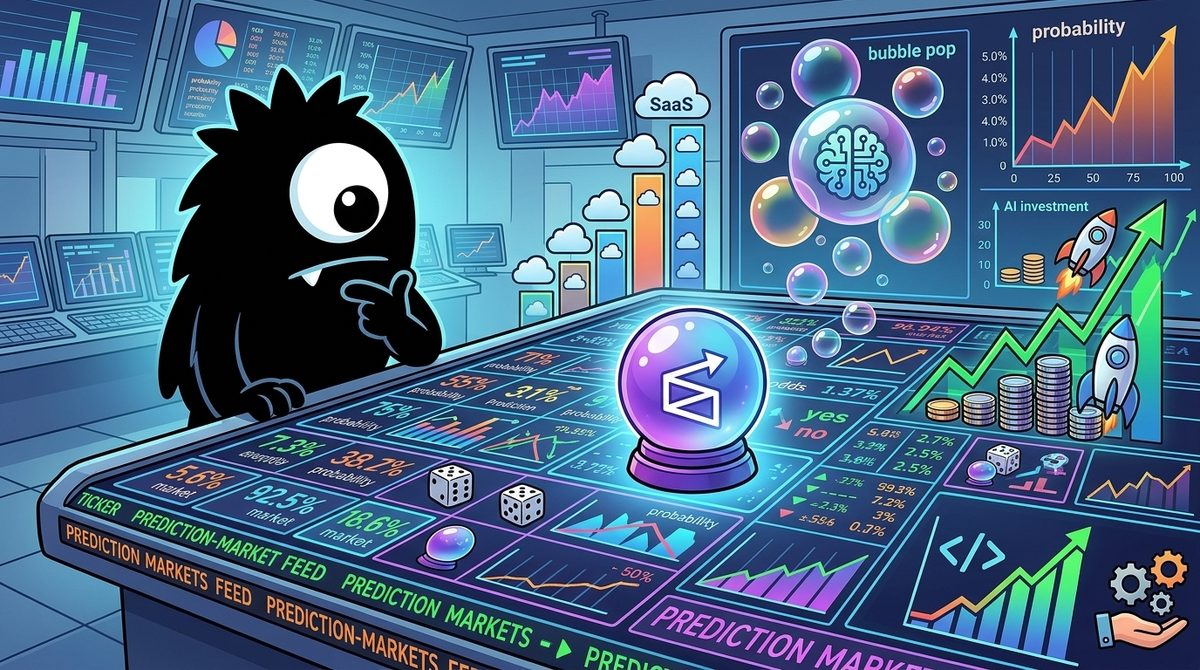
The practical question behind the best AI bubble signals in 2026 is not simply “Will AI crash?” It is: Should developers, founders, and software buyers continue making long-term AI commitments, or prepare for a sharp repricing?
As of October 17, 2026, Polymarket traders imply only a 7% probability that the AI bubble bursts by December 31, 2026, with $2,441,547 traded on that outcome. The corresponding June 30, 2027 contract stands at 16%, although it has attracted only $24,327 in volume. Roughly $3,053,869 has been traded across the broader “AI bubble burst by...?” market, whose displayed resolution timing is around January 1, 2027.[6]
Bottom line:
- The market implies that a recognized bubble-burst event is unlikely before the end of 2026.
- Traders price more than twice as much risk by mid-2027, suggesting concern is being deferred rather than dismissed.
- The most important fault line is not whether AI works. It is whether AI revenue, software pricing and cash flow can justify the infrastructure spending and valuations built around it.
- For practitioners, the sensible response is neither retreat nor complacency: preserve flexibility around vendors, models, pricing and 2027 financing needs.
What Is the AI Bubble Market Actually Pricing in October 2026?
A prediction-market price is best understood as a tradable crowd forecast under a specific set of resolution rules. A contract trading near seven cents is conventionally read as approximately a 7% implied probability—not a guarantee that the underlying event has exactly a 7% real-world chance of happening.
That distinction matters here. “AI bubble bursts” is not synonymous with:
- Software stocks entering a correction.
- An AI startup shutting down.
- A hyperscaler cutting one category of spending.
- Open-source models undercutting an API provider.
- SaaS valuation multiples declining.
The Polymarket contract resolves according to its stated criteria, so readers should inspect those rules before treating the price as a general-purpose measure of AI risk.[6] A painful sector repricing could occur without satisfying the market’s threshold, while a sufficiently sharp and broadly recognized event could resolve the contract even if AI adoption continued afterward.
As of October 17, traders currently price:
| Deadline | Implied probability | Traded volume |
|---|---|---|
| December 31, 2026 | **7%** | **$2,441,547** |
| June 30, 2027 | **16%** | **$24,327** |
AI bubble burst in 2026 priced at 7% on Polymarket
Up 0.5 points on $2.4M traded, a fresh finance contract leading a quiet quarter-hour.
The volume difference is crucial. The December contract has far more trading activity, making its price a more meaningful expression of market consensus. The June 2027 price offers an interesting signal, but its much thinner volume means a smaller amount of capital can potentially move it.
Volume is also cumulative trading activity—not necessarily the amount currently at risk or a count of independent forecasters. Prediction markets can aggregate dispersed information, but their prices are still affected by liquidity, position concentration, contract wording and traders’ opportunity costs.[1][2]
Record long exposure, and Polymarket has an AI bubble burst this year at 6.2%. Consensus rarely looks this comfortable.
View on XThe useful reading is therefore not “there is only a 7% risk in AI.” It is narrower: traders currently regard a contract-qualifying burst before year-end as a low-probability outcome.
Why Does a Comfortable 7% Consensus Still Look Fragile?
A 7% price indicates that traders mostly interpret the recent selloff as volatility within an ongoing AI expansion—not definitive evidence that the top is in. Yet that apparent calm sits beside another market condition highlighted repeatedly on X: heavy long exposure.
That combination is potentially fragile. A market can have strong long-term fundamentals and still be vulnerable when positioning becomes one-sided. If most participants already own the same beneficiaries, prices can fall quickly when expectations change because fewer incremental buyers remain.
The signal to watch is therefore not the 7% number in isolation. It is the relationship among:
- Prediction-market odds
- Equity positioning and valuations
- Hyperscaler capital-expenditure guidance
- Revenue revisions
- Credit and financing conditions
The spread between the two dated contracts is especially informative. Betting markets put the odds at 7% by December 31, 2026, but 16% by June 30, 2027. Given the June contract’s limited volume, that difference should not be treated as a precise probability curve. Even so, the direction suggests traders are pushing the risk window outward.
That makes intuitive sense. Data centers already under construction and chip orders already committed provide near-term momentum. The harder questions arrive when executives must approve the next spending cycle and demonstrate returns from the current one.
In other words, the market implies that 2026 commitments have inertia, while 2027 expectations remain contestable. The odds could change rapidly if capital-expenditure growth, model revenue or financing conditions disappoint.
Does “This Will Pass” Mean AI Investments Will Pay Off?
Executive reassurance during a selloff can reflect genuine visibility into demand. It can also describe the technology’s long-term importance without answering whether today’s investments will earn acceptable returns.
Huang's "this will pass" is the standard CEO line during every tech correction. Polymarket still prices only a 7% chance the AI bubble actually bursts by year-end meaning most traders currently treat the selloff as noise, not the top.
View on XThe market’s 7% year-end price partly supports the first interpretation: traders currently assign little probability to an imminent, recognizable collapse. Bullish analysts have likewise argued that major AI-linked companies’ valuations and earnings profiles do not necessarily resemble the most speculative parts of the dot-com period.[13]
But “AI demand is real” and “every layer of the AI capital stack is correctly priced” are completely different claims.
Jensen may be right that this selloff will pass.
But as I argued in my earlier AI bubble post, AI can succeed while the massive investments around it fail to deliver the expected returns.
The dot-com bubble burst, but the internet kept growing. I think AI could follow a similar path. The technology survives, but not every valuation or company will.
The dot-com comparison is valuable precisely because it separates technological adoption from investment outcomes. Internet usage kept expanding after the bubble burst, but many businesses and valuations did not survive the repricing. Recent reporting similarly distinguishes the probability that AI remains strategically important from the probability that today’s large field of AI companies all builds sustainable economics.[8]
For decision-makers, that creates four separate questions:
- Will AI capabilities continue improving?
- Will enterprises keep deploying them?
- Which providers can capture the resulting revenue?
- Will that revenue justify the infrastructure, financing and valuations already attached to the boom?
The market’s low near-term odds primarily answer the perceived probability of an imminent burst. They do not settle the final three questions.
Is SaaS Really Dying in Real Time—or Merely Being Repriced?
The loudest bearish case on X is no longer that generative AI will fail. It is that AI will succeed so aggressively that established software economics break.
I genuinely believe we're watching SaaS die in real time and most people still don't see it..
$1 trillion wiped from software stocks since January 2026 and its just getting started..
SaaS multiples collapsed from 18.5x at the covid peak to 4.8x today and in the same time the AI market went from $50B to $539B and it's heading to $3.5 trillion by 2033 if not sooner
the death cross hits around 2027.. that's when AI market trajectory fully overtakes SaaS valuations on the chart
the reason is simple.. the per-seat model dies when 10 agents replace 100 humans and no seats left to sell
every SaaS tool you're paying $50/seat a month for is about to get replaced by an agent that costs $0.003 per task..
chatgpt opened the door in 2022, claude opus 4 made agentic AI real in 2025 and now multiagent coordination systems like openclaw are making it deployable and accessible to everyone..
every step on that chart the tech gets more autonomous and the SaaS line drops further..
not saying every saas will die but the companies that were built entirely on per-seat pricing and no real data advantage are the ones exposed.
tbh I don't think most founders see it yet, not because the data isn't there, but accepting it means everything they built needs to be rethought..
This thesis targets per-seat pricing: the familiar model in which companies pay for each employee using an application. If agents let a smaller workforce complete the same amount of work—or if one agent operates across several systems—the number of billable human seats could decline.
The threat is greatest for software that has:
- Little proprietary or workflow-specific data.
- Weak integration into systems of record.
- High prices relative to the complexity of the task.
- Low switching costs.
- Features that models can reproduce through natural-language interfaces and tool calls.
- Revenue tied closely to employee headcount.
Recent commentary has similarly argued that large AI capital expenditure can remain justified while traditional software and IT-services business models face disruption.[10] Fortune’s reporting on the “SaaS debt trap” also frames the problem as one of business-model and financing pressure, not simply whether software remains useful.[11]
The more severe public-market view expects a large divergence between a small group of AI winners and a much wider group of impaired SaaS vendors:
Six months later and my view on this hasn’t changed at all. Fast forward another 18 months from now and I think the median public SaaS co will be down -60% or more from current levels with a handful that have tripled because they managed to ride the AI wave and a larger number that are in an absolute death spiral.
Whats fascinating is the non-maxis who seemingly hold two contradicting thoughts in their heads simultaneously…. They say hey AI is going to be focused on solving cancer and isn’t incentivized to burn tokens on replicating existing software rails…they also say hey we have way too much compute being built relative to future demand.
Will be interesting to see how they reconcile these two views when they get their hands on upcoming models which clearly will demonstrate the capability that bears have been warning about while also having a directive to be as cost-effective as possible on increasingly longer-duration objectives.
Like I’ve said before “the easy money in shorting SaaS is behind us”. The first selloff was on EV concern. The next selloff will be on budget crowd out. Tread carefully. Avoid the space if you can.
If you’re a software analyst whose PM is forcing you to pair trades in the space find ways to long the compute factor and start sending out your resume 🫡
Yet “SaaS is dying” compresses several different outcomes into one slogan. AI could reduce seats but increase usage-based revenue. It could replace the user interface while leaving the underlying system of record intact. It could also make software cheaper to build, enabling incumbents to expand margins—or inviting competitors to attack them.
Most importantly, a SaaS selloff is not automatically an AI bubble burst under Polymarket’s rules.[6] Software multiples can contract because investors expect weaker growth, lower pricing power or AI-driven budget crowd-out without producing the broader event required for resolution.
For founders, the decision criterion is not whether a product carries the SaaS label. It is whether the business controls a durable workflow, proprietary data, compliance responsibility or a transaction layer that an agent must still use.
Are Beaten-Down SaaS Stocks the Buying Opportunity of the Decade?
The contrarian view argues that markets are indiscriminately selling both vulnerable software wrappers and deeply embedded, cash-generative applications.
Wall Street is, in 2026, in the middle of one of the most predictable mass panics it has ever experienced about a technology category, which is the SaaS panic, and like every previous panic of this type, it will be remembered, ten years from now, as the single best buying opportunity of the decade for anyone who had the discipline to ignore the consensus and do the actual arithmetic on the businesses being thrown overboard.
The thesis driving the panic is simple and wrong. The thesis is that AI is going to replace SaaS, that every workflow tool, every vertical application, every embedded enterprise platform will be eaten by a language model, that the entire $400 billion in collective SaaS revenue is going to migrate, in 24 to 36 months, to a small number of foundation model companies, that anyone holding a traditional SaaS business is holding the equivalent of a newspaper stock in 2007. This thesis has the shape of every major panic of the last 50 years. It is intuitive, it is dramatic, it is endlessly repeatable on podcasts, and it is being priced into the stocks of profitable, growing, cash-generative software businesses at multiples that, by any historical standard, do not make sense.
There are, right now, roughly 80 publicly traded SaaS companies in the United States that are growing revenue between 6% and 18% per year, generating free cash flow margins above 20%, sitting on net cash, with renewal rates above 92%, trading at single digit multiples of free cash flow. These are not failing businesses. These are the boring, embedded, mission-critical applications that run dental practices, municipal water systems, agricultural cooperatives, regional law firms, trucking dispatchers, and small-town governments, and the customers of these businesses are not switching to ChatGPT, are not switching to anything, are renewing on time, are paying their invoices, and are increasing their seat counts every year, and the cash flow statements show this clearly to anyone willing to read them.
The market is not pricing the cash flow. The market is pricing the narrative. The narrative says these businesses are obsolete. The cash flow says they are compounding. This is the gap. The gap is the trade. The gap has been the trade in software in 2002, 2008, 2015, and 2022, and the people who bought the gap each of those times made multiples of their capital while the people who believed the panic missed one of the largest equity opportunities of their lifetime.
You do not need to identify a winner. You do not need to bet on a single name. You need to buy a basket of 20 to 30 of these companies, in equal weights, and hold them for five years, and let the math do what the math has always done. The thesis will correct on its own schedule. The cash flow will compound while you wait. The multiples will, eventually, re-rate, because the alternative is that the entire mathematical history of equity markets stops applying, and that is not a bet anyone has ever won.
Almost nobody is buying. That is the entire reason the trade is sitting there. The people who used to own these stocks have decided, as a class, that the category is dead, and they are selling at any price to anyone who will take the position. You can take the position. You will be ridiculed for it at dinner parties for the next 18 months. You will be vindicated by the cash flow over the next five years. This is, as it has always been, the whole job.
This case rests on an important observation: generating an interface is easier than replacing an operational system. A model may draft legal text, summarize patient records or schedule a delivery. That does not automatically give it the data rights, auditability, integrations and liability framework required to become the underlying legal, medical or logistics platform.
The 7% Polymarket price is directionally compatible with the idea that the current decline is not an imminent systemic break. But it does not validate every beaten-down SaaS company. The contract measures an AI bubble event, not the probability that any specific software equity recovers.
A more useful distinction is between two types of SaaS business.
Businesses that may fit the contrarian case
- Positive free cash flow with limited refinancing needs.
- High renewal rates supported by operational necessity.
- Proprietary data accumulated through customer workflows.
- Deep integrations and high migration costs.
- Pricing based on usage, outcomes or transactions rather than seats alone.
- A credible path to using AI to lower service and development costs.
Businesses at risk of becoming falling knives
- Debt-heavy companies dependent on multiple expansion.
- Thin application layers over third-party models.
- Products whose primary function can be reproduced by an agent.
- High customer-acquisition costs and weak retention.
- Seat-based revenue exposed to workforce reduction.
- AI features that increase inference costs without supporting higher prices.
The low burst odds favor neither group automatically. They merely suggest that traders do not currently expect a broad, contract-qualifying rupture before year-end.
Why Is 2027 the More Important CAPEX and Compute-Wall Window?
The strongest explanation for the move from 7% by year-end to 16% by June 2027 is the timing of the next infrastructure and financing decisions.
🚨 TRUMP LOSING THE MIDTERMS COULD BE THE TRIGGER THAT POPS THE AI BUBBLE.
The reason comes down to two things:
Politics and CAPEX.
The AI boom now requires an enormous amount of spending to keep growing.
Major hyperscalers are on track to spend nearly $800 billion on CAPEX this year, per J.P. Morgan, roughly 10x their 2019 spending.
UBS estimates overall AI spending could reach around $900 billion in 2026 and $1.2 trillion in 2027.
That money flows through almost the entire AI trade. Microsoft, Amazon, Alphabet, Meta and Oracle build the data centers.
Nvidia, Broadcom and AMD sell the chips. Then you have memory, networking, cooling, electricity and construction. This is why AI stocks don't need CAPEX to collapse.
CAPEX growth only needs to disappoint Wall Street. And maintaining this level of spending is becoming harder.
AI CAPEX consumed around 33% of hyperscaler operating cash flow in 2023. J.P. Morgan estimates that has reached roughly 93% in 2026.
Hyperscalers issued around $121 billion of bonds in 2025, and J.P. Morgan expects around $250 billion in 2026. The full data center buildout could require trillions of dollars through 2030.
So AI is becoming more dependent on debt and external financing at exactly the wrong time:
U.S. borrowing costs are rising again.
The Fed just raised rates to 3.75%-4.00%, while the 30-year Treasury yield has reached its highest level since 2002.
Trump wants the opposite.
He has publicly demanded rates of 1% or lower.
Cheaper money would make it easier to finance data centers, power projects and the next round of AI expansion.
But the Fed is independent, and some officials are discussing further hikes because inflation remains high.
And this creates another risk around the midterms. Trump has been one of the strongest political voices pushing the Fed toward lower rates.
Losing Congress would not remove Trump's pressure on the Fed because he would still be president.
But it could weaken his broader ability to push a pro-liquidity, pro investment agenda through Washington while the Fed is moving in the opposite direction.
And right now, the Fed is clearly not following Trump's preferred path.
Most policymakers still expect another rate hike this year, while Fed Governor Michael Barr says further hikes will likely be needed to control inflation.
That could leave Trump entering 2027 with a divided government, less room to advance new AI-supportive legislation, and a Fed still keeping borrowing costs high or potentially raising them further.
For an AI industry increasingly dependent on outside financing, that's another major risk.
Now add the midterms.
Trump has made rapid AI infrastructure expansion a major part of his administration's policy.
Executive Order 14318 directs federal agencies to speed up permitting for large data centers and related power infrastructure, use federal land and provide pathways for financial support to qualifying projects.
But Republicans could lose control of Congress in November.
Trump would still be president. His executive orders would remain in place.
But a Democratic House would control committees and could increase oversight of the AI buildout through hearings, investigations and subpoenas.
It could also create more fights over federal funding and push harder on some of the biggest political problems surrounding data centers:
1. Electricity bills.
2. Grid upgrades.
3. Water usage.
4. Environmental reviews.
And who pays for the infrastructure these projects require.
That matters because Trump's administration is trying to make the buildout faster, while a change in congressional control could increase scrutiny and political friction around parts of that expansion.
And this could happen while Trump is pushing for much lower rates but the actual cost of borrowing remains extremely high. That's where the two risks meet.
More political friction + expensive financing.
For an industry preparing to spend trillions of dollars, that combination could be dangerous.
A project already under construction doesn't suddenly disappear after the election. Existing chip orders don't automatically get cancelled either. The real question for markets becomes:
What happens to the next round of CAPEX?
If political pressure, higher power costs and expensive financing make hyperscalers even slightly less aggressive with 2027 and 2028 spending, Wall Street starts cutting future demand expectations.
Nvidia doesn't need today's GPU sales to collapse. Investors only need to expect slower growth in tomorrow's orders.
The same applies to Broadcom, AMD, Micron and the rest of the AI infrastructure chain.
And this is where it becomes a broader market problem.
Microsoft, Nvidia, Amazon, Alphabet, Meta, Broadcom and other AI-linked companies are among the biggest weights in the Nasdaq-100.
So when the AI trade gets repriced, it isn't a small corner of the market falling.
Some of the companies with the greatest influence over the entire index are falling together.
That means a major AI selloff can drag the Nasdaq lower even if large parts of the market aren't directly involved.
And investors are already becoming less willing to reward spending for the sake of spending.
J.P. Morgan says higher CAPEX plans have recently been rewarded only when accompanied by stronger revenue expectations. Investors increasingly want proof that all this investment is actually generating demand and returns.
That's what makes November important.
AI enters the midterms with nearly $800 billion of hyperscaler CAPEX, spending consuming roughly 93% of operating cash flow, rapidly growing financing needs and borrowing costs already near multi-decade highs.
Trump is pushing for faster AI infrastructure development and dramatically lower interest rates.
A Republican loss wouldn't reverse all of that overnight.
But it could add congressional pressure to an AI CAPEX cycle that is already becoming much more expensive to finance.
And if that causes Wall Street to question the next trillion dollars of AI spending, the companies that drove this market higher would be the first place investors look.
The figures being debated are enormous. The X analysis above cites hyperscaler capital expenditure approaching $800 billion in 2026, while UBS estimates referenced in the discussion put broader AI spending near $900 billion in 2026 and $1.2 trillion in 2027. These estimates are forecasts, not guaranteed expenditure, but they illustrate the scale of expectations supporting the AI supply chain.
Recent reporting describes a potential mismatch between approximately $7 trillion in infrastructure spending and roughly $3.6 trillion in expected revenue. The same analysis cites a Gartner forecast that as many as 80% of independent GPU-as-a-service providers could disappear by 2030.[9] Other reporting has highlighted the risk that data-center expansion, power requirements and financing commitments could become a more immediate threat if expected demand or returns weaken.[12]
This does not mean the market predicts a 2027 collapse. At 16%, traders still imply that a qualifying burst by June 30, 2027 is substantially less likely than not. But the higher price captures a recognizable mechanism:
- Hyperscalers make enormous infrastructure commitments.
- Investors tolerate them while revenue expectations rise alongside spending.
- Financing and power constraints increase project costs.
- Customers demand lower model and software prices.
- Executives reassess the next round of data-center and chip orders.
- Even slower growth in CAPEX causes suppliers’ future revenue assumptions to be revised.
AI-linked equities would not require data-center construction to stop completely for a repricing. If valuations assume exceptional growth, capital expenditure merely needs to fall short of those expectations. Bloomberg has reported warnings that an AI reversal could create broad index risk because major AI beneficiaries carry significant weight in the US equity market.[7]
The best forward signal may therefore be revenue guidance per dollar of capital expenditure, not raw spending alone.
How Do Open-Source Models Weaken Closed-Lab Pricing Moats?
At the developer level, the bubble debate becomes a unit-economics question: how much can model providers charge when capable alternatives keep getting cheaper?
Direction of AI mid through late-2026:
1. Big labs are gonna push expensive bigger closed-source models directly to big tech. The moat will shift away from consumer markets coz OSS models are getting too good to compete at current price point. Plus big labs got more money to make directly going B2B.
2. Open source labs are making comparable coding models now. They lack marketing exposure, but it will be impossible to keep serving (example) Opus at the ridiculous token price Anthropic is. Qwen, Kimi, Minimax, GLM, etc... anybody got a clear shot here to deliver a Sonnet or a GPT5.2 at 1/10th pricing, completely agentic-pilled with coding and tool calls.
3. Local models are gonna go crazy because people will figure out speculative decoding + kv cache quantization to make models run fast on-device. If Qwen 3.6 27B is any indication, local coding models will be a thing soon enough.
4. Devs will realize that there is a lot of money to be made by making AI first local apps that use private local edge LMs (~0.5-4B models).
You can literally see indications of all 4 things above if you followed last 2 weeks of AI news. Mythos, Kimi K2.6, Qwen3.6-27B, DFlash, TurboQuant, Gemma-4... live examples of all the above at play.
I feel this is the next phase of evolution for LLMs.
The X thesis anticipates a split market:
- The largest closed labs pursue high-value enterprise deployments.
- Open-source and open-weight models compress prices for coding and agentic workloads.
- Smaller local models handle private or latency-sensitive tasks on-device.
- Applications route tasks among models rather than depending on one premium provider.
This matters because falling inference prices have two opposing effects. They can expand adoption and make previously uneconomic products viable. But they can also weaken the revenue assumptions used to justify large infrastructure investments.
For closed labs, enterprise distribution, security, reliability, indemnification and integration may become more durable moats than raw benchmark leadership. For startups, simply wrapping one frontier API becomes riskier if another model can provide comparable performance at a fraction of the price.
SaaS buyers should welcome competition but avoid assuming that low token prices make total deployment cheap. Integration, evaluation, observability, human review, security and failed-agent actions can cost more than inference itself.
The practical procurement test is switchability. Buyers should ask whether prompts, evaluations, tool definitions, retrieval systems and workflow logic can move between providers. Founders should know how gross margins change if model prices fall, stay flat—or if a critical provider raises enterprise rates.
What Should Developers, Founders and SaaS Buyers Do With the 7% and 16% Odds?
The correct response to low near-term odds is not to ignore risk. It is to avoid paying heavily for protection against the wrong risk.
For developers: design for model substitution
The 7% year-end price suggests traders do not expect an immediate break, so halting useful AI work would be difficult to justify from this signal alone. But the 16% mid-2027 price supports preparing for vendor and pricing changes.
Use abstraction where it produces real portability:
- Maintain provider-independent evaluations.
- Separate application logic from model-specific prompts.
- Track quality, latency and cost by task.
- Keep a fallback model for critical workflows.
- Test whether smaller or local models can handle narrow workloads.
This is most important for teams with high inference spend, regulated data or hard uptime requirements. Small experimental projects do not need an elaborate multi-model platform before product-market fit.
For founders: stress-test the 2027 financing case
Founders should model what happens if capital becomes more expensive, enterprise sales cycles lengthen or API prices compress faster than usage grows. The relevant downside is not necessarily an industry collapse. It may be a funding market that demands clear gross margins and shorter payback periods.
Companies raising before mid-2027 should be able to explain:
- Their economics at several model-price assumptions.
- Which assets remain proprietary if base models commoditize.
- Whether revenue is seat-, usage-, transaction- or outcome-based.
- How long existing cash lasts without another favorable round.
- Which infrastructure commitments can be reduced.
For SaaS buyers: negotiate flexibility instead of predicting the winner
Enterprises do not need to decide whether the entire AI sector is a bubble. They need contracts that survive multiple market outcomes.
Seek shorter commitments for rapidly changing AI features, usage caps, export rights, transparent overage pricing and clear treatment of customer data. Longer contracts remain reasonable for deeply embedded systems when discounts compensate for lock-in and the vendor’s finances are sound.
Finally, watch the market itself—but watch changes, not just levels. A move from 7% to 10% on thin trading is less informative than a sustained repricing accompanied by higher volume, weaker CAPEX guidance, widening credit stress and falling revenue expectations. Conversely, declining odds alongside stronger monetization would indicate that traders see infrastructure spending becoming easier to justify.
Polymarket’s present message is restrained, not euphoric: an AI bubble burst by December 31, 2026 is priced as unlikely, while the perceived risk increases into mid-2027. For practitioners, that is a mandate to keep building where the economics work—and to preserve enough flexibility that one model provider, pricing structure or financing cycle cannot determine the company’s fate.
Sources
[1] AI bubble burst by... Odds & Prediction Market Prices (October 2026)
[2] AI bubble burst by...? Prediction Market Prices — Yahoo Finance
[6] AI bubble burst by...? — Polymarket
[7] AI Bubble Risks Worst S&P 500 Crash Since 2008, Strategist Says — Bloomberg
[8] Why many AI companies are set to fail — Computer Weekly
[11] The SaaS debt trap — Fortune
[12] AI slowdown calls justified but collapse of bubble may be more immediate threat — The Guardian
[13] Nvidia’s Valuations Show AI Rally Isn’t a Bubble, DBS Says — Bloomberg
References (15 sources)
- AI bubble burst by... Odds & Prediction Market Prices (October 2026) - windailysports.com
- AI bubble burst by...? Prediction Market Prices - finance.yahoo.com
- The 'AI Bubble Burst' Prediction Market in 2026: An Expert Analysis of What Traders Are Really Pricing - adtools.org
- The AI Bubble Bet: What Polymarket's 14% Odds Reveal About Where AI and SaaS Are Really Headed - adtools.org
- The Best AI Bubble Signals in 2026: What Polymarket's 10% Odds Reveal About AI and SaaS - adtools.org
- AI bubble burst by...? - polymarket.com
- AI Bubble Risks Worst S&P 500 Crash Since 2008, Strategist Says - bloomberg.com
- Why many AI companies are set to fail - computerweekly.com
- The AI math isn't mathing as infrastructure spending forecast to outstrip expected revenue - theregister.com
- Massive AI capex not a bubble, but software & IT business models at risk: Arvind Sanger - m.economictimes.com
- The SaaS debt trap - fortune.com
- AI slowdown calls justified but collapse of bubble may be more immediate threat - theguardian.com
- Nvidia’s Valuations Show AI Rally Isn’t a Bubble, DBS Says - bloomberg.com
- AI boom or doom? Your questions answered - capitalgroup.com
- Opinion | Is There an A.I. Bubble? A Debate. - nytimes.com
Related Guides
What Is Cursor AI? A Complete Guide for 2026
24 min read
The Best AI Model Prediction Market in 2026: What $2.6M in Traders' Odds Reveals About the AI Race
22 min read
AI Safety and Alignment: A Complete Guide for Builders in 2026
19 min read
The Best AI Model Tools in 2026: What Polymarket's $2.6M Bet Reveals About Google, Anthropic, and OpenAI
21 min read