The 'AI Bubble Burst' Prediction Market in 2026: An Expert Analysis of What Traders Are Really Pricing
AI bubble burst odds on Polymarket sit at just 6% for 2026 and 18% by mid-2027. See what these prediction-market probabilities reveal for SaaS and AI. Learn more.
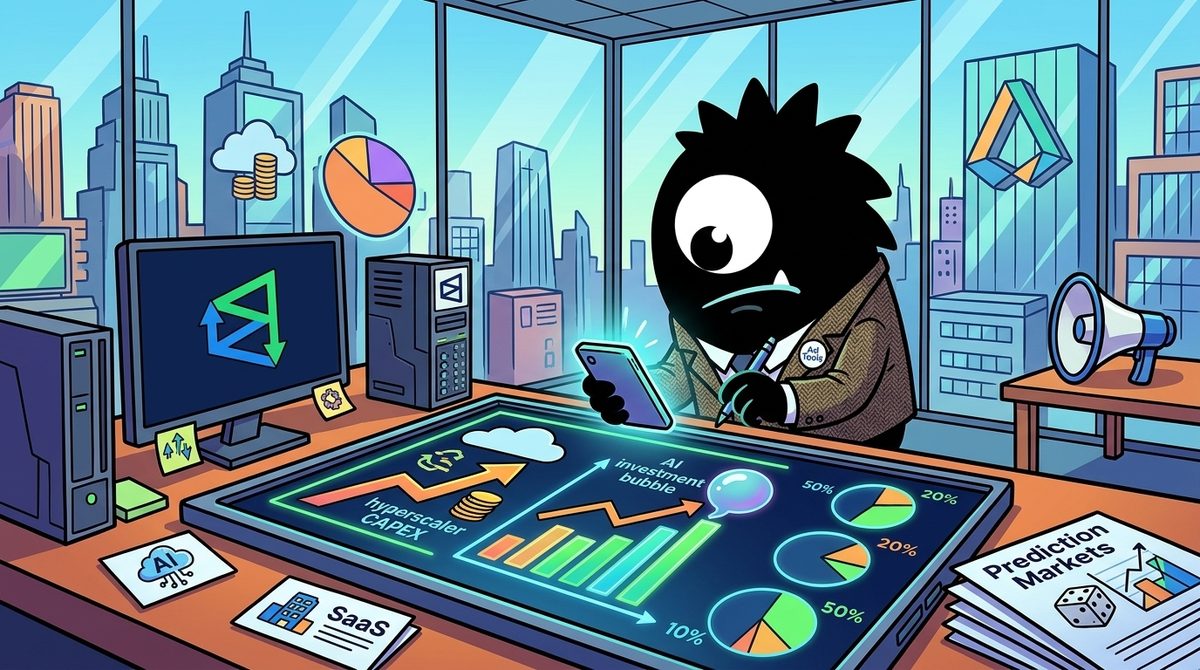
The practical question for developers, founders, and software buyers is not simply whether AI is “a bubble.” It is whether today’s investment cycle is likely to break abruptly—or instead produce a slower, highly uneven repricing across infrastructure, AI-native software, and legacy SaaS.
As of October 8, 2026, Polymarket traders imply only a 6% probability that the AI bubble bursts by December 31, 2026, with $2,434,131 traded on that outcome. The market puts the probability at 18% by June 30, 2027, although that later contract has attracted just $18,539. Roughly $3,040,666 has been put into the broader market, which resolves around January 1, 2027.[1]
The useful conclusion is not that AI valuations are safe. It is that traders currently consider a near-term, contract-defined rupture unlikely, while assigning higher odds to trouble as the industry enters its 2027 return-on-investment test. For practitioners, the more probable risk may be bifurcation: AI-native winners keep attracting capital while legacy, seat-priced SaaS vendors suffer a prolonged valuation and demand reset.
Bottom line
>
- The market implies a 6% near-term burst probability, not a 94% probability that every AI company will thrive.
- The 18% June 2027 price points to greater concern once infrastructure spending must produce measurable returns.
- Collapsing SaaS multiples can coexist with a continuing AI boom because a gradual software repricing may not satisfy a binary “bubble burst” contract.
- Plan for vendor and business-model divergence, not only an industry-wide crash.
What Do the Polymarket Odds Actually Say in October 2026?
The headline number driving the current conversation is straightforward:
6% chance the AI bubble bursts by end of year.
https://polymarket.com/event/ai-bubble-burst-by?dub_id=ROMQ9DGtGJLga6x4
A 6% contract price means traders collectively price the defined outcome at approximately six chances in 100. It is a market expectation, not an objective measurement of the AI sector’s underlying health—and certainly not a factual statement about what will happen.
The distinction matters because Polymarket resolves contracts according to their written rules. A market can correctly anticipate that valuations, margins, or funding conditions will deteriorate without pricing a high probability of a qualifying “burst.” The contract asks a binary question; the economy can produce a spectrum of outcomes.[1]
The later date changes the picture:
18% chance the AI bubble bursts by june 30, 2027
https://poly.market/ymjq7Rp
As of October 8, traders price an 18% probability by June 30, 2027. One market tracker reported the figure at 17.5%, illustrating that displayed prices can move and may be rounded.[3] Other trackers and analyses have shown figures around 11% to 14% at different snapshots.[4][5] These differences can reflect timing, price updates, rounding, and whether a page is tracking the same date-specific contract.
Liquidity is equally important. The December 2026 outcome has $2.43 million traded, versus only $18,539 for June 2027. That makes the 6% price a stronger measure of committed market opinion than the thinner 18% contract—even though neither should be treated as truth.
Why Do Traders Price Only a 6% Chance of a 2026 Burst?
The apparent puzzle is the gap between highly visible bubble warnings and the money-weighted probability. Recent reporting has documented investor concern about record technology valuations, while Ray Dalio has publicly warned that the AI trade may be approaching a bursting point.[14][15][16] Yet traders still assign only a small chance to a qualifying event before year-end.
Dalio has correctly called about 11 of the last 3 bubbles, yet the market assigns only a 6% chance of an AI bubble bursting this year. The optimal profit zone lies between a “classic bubble” and that 6% probability.
View on XThere are four plausible reasons.
The contract prices a specific event, not general overvaluation
“AI is expensive,” “some data centers will earn poor returns,” and “the AI bubble will burst by December 31” are different propositions. A gradual decline in software multiples, a correction concentrated in unprofitable startups, or a reduction in 2027 capital-expenditure guidance might not produce the clean binary event required for a YES resolution.
The remaining time window is short
As of October 8, fewer than three months remain before December 31. Even a fragile system may need a catalyst—earnings disappointments, financing stress, policy changes, or cancelled infrastructure orders—to reprice disorderly. A 6% price can therefore mean not yet, rather than never.
Adoption and valuation can move in opposite directions
AI usage can continue rising even if infrastructure assets or public equities fall. IoT Analytics, for example, argues that current conditions do not amount to a generalized AI bubble, emphasizing underlying adoption and investment fundamentals.[9] The CEPR’s bubble monitor takes a broader signal-based approach, underscoring that “bubble” depends on which valuations, spending flows, and financial vulnerabilities are being measured.[6]
Traders have to stake capital
Pundits can repeatedly issue warnings without defining the threshold or date. Prediction-market participants must choose a contract, price, and time horizon. That discipline does not guarantee accuracy, but it turns a broad opinion into a falsifiable probability.
Is the Bigger Risk a Bubble—or the Slow Repricing of SaaS?
The most emotionally charged argument on X is not that all AI demand suddenly disappears. It is that AI continues expanding while legacy SaaS economics deteriorate.
I genuinely believe we're watching SaaS die in real time and most people still don't see it..
$1 trillion wiped from software stocks since January 2026 and its just getting started..
SaaS multiples collapsed from 18.5x at the covid peak to 4.8x today and in the same time the AI market went from $50B to $539B and it's heading to $3.5 trillion by 2033 if not sooner
the death cross hits around 2027.. that's when AI market trajectory fully overtakes SaaS valuations on the chart
the reason is simple.. the per-seat model dies when 10 agents replace 100 humans and no seats left to sell
every SaaS tool you're paying $50/seat a month for is about to get replaced by an agent that costs $0.003 per task..
chatgpt opened the door in 2022, claude opus 4 made agentic AI real in 2025 and now multiagent coordination systems like openclaw are making it deployable and accessible to everyone..
every step on that chart the tech gets more autonomous and the SaaS line drops further..
not saying every saas will die but the companies that were built entirely on per-seat pricing and no real data advantage are the ones exposed.
tbh I don't think most founders see it yet, not because the data isn't there, but accepting it means everything they built needs to be rethought..
The post’s figures and forecasts should be treated as a market thesis, not as settled outcomes. But its core mechanism is credible enough to examine: if agents allow fewer employees to complete the same work, software priced strictly per human seat can lose expansion revenue even as customers consume more automation.
SaaS industry reporting already describes a market contending with changing growth expectations, efficiency pressure, and the need to incorporate AI into both products and operating models.[11] Separate analysis argues that AI may become software’s largest opportunity, with AI-native companies growing much faster than traditional SaaS businesses.[12]
Those trends can coexist. They imply redistribution rather than universal software destruction.
Six months later and my view on this hasn’t changed at all. Fast forward another 18 months from now and I think the median public SaaS co will be down -60% or more from current levels with a handful that have tripled because they managed to ride the AI wave and a larger number that are in an absolute death spiral.
Whats fascinating is the non-maxis who seemingly hold two contradicting thoughts in their heads simultaneously…. They say hey AI is going to be focused on solving cancer and isn’t incentivized to burn tokens on replicating existing software rails…they also say hey we have way too much compute being built relative to future demand.
Will be interesting to see how they reconcile these two views when they get their hands on upcoming models which clearly will demonstrate the capability that bears have been warning about while also having a directive to be as cost-effective as possible on increasingly longer-duration objectives.
Like I’ve said before “the easy money in shorting SaaS is behind us”. The first selloff was on EV concern. The next selloff will be on budget crowd out. Tread carefully. Avoid the space if you can.
If you’re a software analyst whose PM is forcing you to pair trades in the space find ways to long the compute factor and start sending out your resume 🫡
That is precisely why the prediction-market odds can look bullish while SaaS investors remain anxious. A median software company could suffer lower multiples, slower seat growth, or budget displacement without causing a contract-defined AI bubble burst. Meanwhile, a smaller group of infrastructure providers and AI-native applications could continue to grow.
For founders, the relevant test is not whether the company uses an LLM. It is whether AI changes the product’s economic value:
- Does it complete work rather than merely assist a user?
- Does proprietary workflow data improve results?
- Can pricing shift from seats toward usage, completed tasks, or outcomes?
- Does gross margin remain defensible after inference and orchestration costs?
- Would customers still buy the product if foundation-model capabilities improve?
A thin AI interface over a conventional seat model remains exposed. A product embedded in a high-value workflow, with differentiated data and measurable automation, has a stronger basis for retention.
Where Does the AI Bubble Risk Actually Live? Follow CAPEX
The load-bearing pillar of the AI trade is capital expenditure: data centers, accelerators, networking, memory, cooling, power generation, and construction. The bearish argument is not necessarily that people stop using AI. It is that infrastructure supply and investment costs outrun monetizable demand.
AI BUBBLE WILL BURST IN MID-2026
While AI adoption is expected to continue growing, a significant bubble is forming in data center investment.
US companies are planning to spend $7T on new data center and GPU investments.
At some point, supply will start to outstrip demand exponentially, driving the cost of inference to near zero.
Revenues will plummet dramatically, and the already growing losses will escalate, causing the bubble to burst.
Ironically, AI adoption will contine to skyrocket as consumers access SOTA models for free.
This is a crucial distinction. Falling inference prices would benefit developers and buyers, but they could hurt infrastructure owners if utilization, pricing, and revenue fail to cover depreciation and financing costs. Adoption could accelerate while returns on the assets enabling that adoption disappoint.
Industry reporting describes 2027 as a crucial test of whether extraordinary AI investment can generate sufficient revenue and productivity gains.[8] The market’s 6% versus 18% term structure is consistent with that timing: traders price little chance of an immediate break, but greater risk once the next spending cycle confronts harder ROI questions.
The spending numbers discussed on X are enormous:
🚨 TRUMP LOSING THE MIDTERMS COULD BE THE TRIGGER THAT POPS THE AI BUBBLE.
The reason comes down to two things:
Politics and CAPEX.
The AI boom now requires an enormous amount of spending to keep growing.
Major hyperscalers are on track to spend nearly $800 billion on CAPEX this year, per J.P. Morgan, roughly 10x their 2019 spending.
UBS estimates overall AI spending could reach around $900 billion in 2026 and $1.2 trillion in 2027.
That money flows through almost the entire AI trade. Microsoft, Amazon, Alphabet, Meta and Oracle build the data centers.
Nvidia, Broadcom and AMD sell the chips. Then you have memory, networking, cooling, electricity and construction. This is why AI stocks don't need CAPEX to collapse.
CAPEX growth only needs to disappoint Wall Street. And maintaining this level of spending is becoming harder.
AI CAPEX consumed around 33% of hyperscaler operating cash flow in 2023. J.P. Morgan estimates that has reached roughly 93% in 2026.
Hyperscalers issued around $121 billion of bonds in 2025, and J.P. Morgan expects around $250 billion in 2026. The full data center buildout could require trillions of dollars through 2030.
So AI is becoming more dependent on debt and external financing at exactly the wrong time:
U.S. borrowing costs are rising again.
The Fed just raised rates to 3.75%-4.00%, while the 30-year Treasury yield has reached its highest level since 2002.
Trump wants the opposite.
He has publicly demanded rates of 1% or lower.
Cheaper money would make it easier to finance data centers, power projects and the next round of AI expansion.
But the Fed is independent, and some officials are discussing further hikes because inflation remains high.
And this creates another risk around the midterms. Trump has been one of the strongest political voices pushing the Fed toward lower rates.
Losing Congress would not remove Trump's pressure on the Fed because he would still be president.
But it could weaken his broader ability to push a pro-liquidity, pro investment agenda through Washington while the Fed is moving in the opposite direction.
And right now, the Fed is clearly not following Trump's preferred path.
Most policymakers still expect another rate hike this year, while Fed Governor Michael Barr says further hikes will likely be needed to control inflation.
That could leave Trump entering 2027 with a divided government, less room to advance new AI-supportive legislation, and a Fed still keeping borrowing costs high or potentially raising them further.
For an AI industry increasingly dependent on outside financing, that's another major risk.
Now add the midterms.
Trump has made rapid AI infrastructure expansion a major part of his administration's policy.
Executive Order 14318 directs federal agencies to speed up permitting for large data centers and related power infrastructure, use federal land and provide pathways for financial support to qualifying projects.
But Republicans could lose control of Congress in November.
Trump would still be president. His executive orders would remain in place.
But a Democratic House would control committees and could increase oversight of the AI buildout through hearings, investigations and subpoenas.
It could also create more fights over federal funding and push harder on some of the biggest political problems surrounding data centers:
1. Electricity bills.
2. Grid upgrades.
3. Water usage.
4. Environmental reviews.
And who pays for the infrastructure these projects require.
That matters because Trump's administration is trying to make the buildout faster, while a change in congressional control could increase scrutiny and political friction around parts of that expansion.
And this could happen while Trump is pushing for much lower rates but the actual cost of borrowing remains extremely high. That's where the two risks meet.
More political friction + expensive financing.
For an industry preparing to spend trillions of dollars, that combination could be dangerous.
A project already under construction doesn't suddenly disappear after the election. Existing chip orders don't automatically get cancelled either. The real question for markets becomes:
What happens to the next round of CAPEX?
If political pressure, higher power costs and expensive financing make hyperscalers even slightly less aggressive with 2027 and 2028 spending, Wall Street starts cutting future demand expectations.
Nvidia doesn't need today's GPU sales to collapse. Investors only need to expect slower growth in tomorrow's orders.
The same applies to Broadcom, AMD, Micron and the rest of the AI infrastructure chain.
And this is where it becomes a broader market problem.
Microsoft, Nvidia, Amazon, Alphabet, Meta, Broadcom and other AI-linked companies are among the biggest weights in the Nasdaq-100.
So when the AI trade gets repriced, it isn't a small corner of the market falling.
Some of the companies with the greatest influence over the entire index are falling together.
That means a major AI selloff can drag the Nasdaq lower even if large parts of the market aren't directly involved.
And investors are already becoming less willing to reward spending for the sake of spending.
J.P. Morgan says higher CAPEX plans have recently been rewarded only when accompanied by stronger revenue expectations. Investors increasingly want proof that all this investment is actually generating demand and returns.
That's what makes November important.
AI enters the midterms with nearly $800 billion of hyperscaler CAPEX, spending consuming roughly 93% of operating cash flow, rapidly growing financing needs and borrowing costs already near multi-decade highs.
Trump is pushing for faster AI infrastructure development and dramatically lower interest rates.
A Republican loss wouldn't reverse all of that overnight.
But it could add congressional pressure to an AI CAPEX cycle that is already becoming much more expensive to finance.
And if that causes Wall Street to question the next trillion dollars of AI spending, the companies that drove this market higher would be the first place investors look.
The post cites hyperscaler CAPEX approaching $800 billion in 2026, alongside UBS estimates of approximately $900 billion in AI spending in 2026 and $1.2 trillion in 2027. These figures are best interpreted as estimates within a bullish investment cycle, not guaranteed expenditures or returns.
The fragility comes from expectations at the margin. AI CAPEX does not have to collapse for valuations to fall. If investors expect 40% spending growth and hyperscalers guide to 25%, chip, networking, power, and data-center forecasts can all be marked down. Because many AI-linked companies carry large index weights, a synchronized repricing could affect the wider market.
The opposite is also possible: continuing demand, lower unit costs, and successful software monetization could validate more of the infrastructure buildout. The prediction market’s low near-term odds suggest traders currently give that continuation scenario much more weight through December.
Which Triggers Could Move the AI-Bubble Odds?
The market price should change as new information alters either the probability of stress or the likelihood that stress satisfies the resolution rules. Practitioners should watch measurable signals rather than social-media sentiment alone.
1. Hyperscaler guidance and order growth
The most important signal is not current accelerator deliveries but guidance for the next round of projects. Watch:
- CAPEX growth forecasts for 2027 and 2028
- changes in GPU and networking order commitments
- data-center delays or cancellations
- depreciation and useful-life assumptions
- AI revenue disclosed against infrastructure spending
Morgan Stanley expects AI investment growth to slow sharply by 2028 as the cycle shifts from infrastructure toward software.[10] Slower growth would not automatically mean a burst. A controlled transition toward application revenue could be healthy; abrupt cuts caused by weak returns would be more concerning.
2. Inference economics
Lower inference costs help application builders, but the distribution of those savings matters. If price declines stimulate enough demand, total revenue can still grow. If models become commoditized faster than usage expands, providers may face margin compression.
Developers should track the cost per completed workflow, not merely cost per token. Agents often require multiple model calls, retries, tool execution, monitoring, and human review. Cheap tokens do not automatically create cheap, reliable automation.
3. Financing and political conditions
Higher borrowing costs raise the hurdle rate for long-lived infrastructure. Policy can also affect permitting, power access, subsidies, environmental review, and the pace of grid expansion. The 2026 midterms therefore matter as one potential influence on financing and project execution—not as an automatic bubble trigger.
A political shift would not instantly cancel projects under construction. Its effect would be more likely to appear in future approvals, oversight, funding negotiations, and corporate willingness to authorize the next CAPEX tranche.
4. The June 2027 contract
The later market deserves attention because it spans more of the industry’s proving period. But its $18,539 volume means modest trading can move the displayed 18% probability. Treat a sharp move as a prompt for investigation, not confirmation of an impending event.
Is This Really One Bubble—or Two Diverging Economies?
A single “AI bubble” label obscures the sector’s internal split. Public markets are already attempting to distinguish companies that can monetize AI from those that must defend an older product and pricing structure.
HOW THE MARKET PRICES GROWTH TECH ENTERING 2026
This chart shows how the market is valuing growth SaaS based on 3-year revenue CAGR (2025-2028) against EV to gross profit.
The market is already separating the companies that already have AI boats and which still need to build them ahead of the AI tsunami.
$NET, $PLTR, $SHOP, $FIG, $RBRK, $SNOW, $CRWD, $DDOG, $ZS, $KVYO, $MNDY, $TEAM, $IOT, $MDB, $NOW, $HUBS $PANW, $VEEV, $S, $ESTC, $PATH, $ADBE, $WDAY, $CRM, $OKTA, $GTLB, $OS, $FROG
The “AI boats” metaphor captures a useful valuation framework. Investors are comparing expected growth with enterprise value and gross profit, then asking whether AI is an accelerant, a substitute, or an added cost.
That creates at least four groups:
- Infrastructure suppliers benefit while hyperscaler spending and order visibility remain strong.
- AI-native applications can gain if they automate valuable workflows with defensible distribution or data.
- Adaptable incumbent SaaS vendors may protect their position by embedding agents, changing pricing, and using existing customer access.
- Undifferentiated seat-based tools face the highest risk of budget crowd-out and feature commoditization.
Not only is the AI bubble going to burst, but all at once, SaaS is going to begin returning multiples at transaction again. Except vibe SaaS whose valuation will take a haircut after due diligence. The foaming at the mouth will stop, and some people will look very stupid.
View on X“Vibe SaaS” describes products whose valuations depend more on AI positioning than on retention, gross margin, security, or durable differentiation. Due diligence is likely to focus increasingly on inference costs, model dependency, customer concentration, evaluation quality, and whether claimed automation survives production constraints.
At the other end, AI can expand beyond software replacement into scientific and industrial workflows:
Danaher plans an AI-robotics lab for 2027 that designs and tests molecules with little human help, aiming for 8x faster discovery.
Polymarket flagged it alongside a market giving only a 6% chance of an AI bubble bursting this year.
That wider adoption thesis helps explain why traders may resist an all-or-nothing bubble narrative. The market can reprice speculative application companies while continuing to fund AI-enabled drug discovery, cybersecurity, coding, logistics, and other high-value uses.
How Should You Use Prediction Markets Without Treating Them as Gospel?
Prediction markets aggregate participants’ beliefs and incentives into a price. Their advantage is specificity: a defined event, deadline, and monetary stake. Their weakness is that prices can be distorted by ambiguous criteria, low liquidity, trader concentration, and the limited capital available to correct mispricing.
The volume difference here is instructive:
- December 31, 2026: 6%, with $2,434,131 traded
- June 30, 2027: 18%, with $18,539 traded
The first is a more mature signal. The second is closer to an early indication of concern.
New products are also trying to layer AI forecasting on top of market prices:
Official Announcement
We’ve launched an end-to-end AI Oracle system.
Five specialized AI Agents, coordinated by the NE Prediction Model, analyze Polymarket’s real-time data with advanced LLM reasoning to generate forward-looking signals beyond market consensus.
AI × Prediction Markets is now live.
Such systems may help summarize news or generate scenarios, but claims of producing signals “beyond market consensus” require evidence across many resolved forecasts. LLM-generated reasoning can sound coherent while double-counting correlated information, misunderstanding resolution rules, or expressing unjustified precision.
Use prediction markets as one input in a monitoring stack:
- Market odds for the crowd’s current probability.
- Contract volume and spreads for signal quality.
- CAPEX and financing data for infrastructure stress.
- Vendor revenue and margins for monetization.
- Independent analytical frameworks, such as the CEPR bubble monitor and sector-level adoption research.[6][9]
What Should Developers, Founders, and SaaS Buyers Do Now?
The market implies low near-term crash risk, but it does not justify passive positioning.
Founders: build for bifurcation
AI-native differentiation fits founders who can automate a valuable workflow, access proprietary context, and price against customer outcomes. Teams without those advantages should avoid adding expensive AI features merely to support an AI narrative.
Stress-test:
- model substitution risk
- inference cost at scale
- gross margin under heavy usage
- dependency on one provider
- human-review requirements
- measurable customer ROI
SaaS buyers: negotiate for flexibility
Larger buyers and regulated teams should prioritize security, auditability, data rights, service levels, and model-change controls. Smaller teams should avoid long commitments where agent capabilities and pricing are changing rapidly.
Push for usage or outcome pricing when seats no longer represent value. Request evidence that automation works on your workflows, not only curated demonstrations. Also assess vendor viability: falling inference costs help buyers, but unsustainable pricing can leave customers dependent on a provider that cannot support the product.
Developers: move toward the application and evaluation layers
Developers do not need to bet their careers on either a crash or permanent exponential spending. Durable skills include system integration, evaluations, observability, data engineering, security, orchestration, and cost control. These remain valuable whether model providers consolidate or proliferate.
The Polymarket signal is therefore narrower—and more useful—than the headline. Traders currently price only a 6% chance of a qualifying burst by December 31, 2026, but 18% by June 30, 2027. That is a vote against an imminent, discrete pop, not against valuation compression or SaaS disruption.
The better operating assumption is that AI’s next phase will separate businesses with real economics from those funded by narrative. Prepare for that separation rather than waiting for one dramatic event to settle the debate.
Sources
[1] Polymarket — AI bubble burst by...?
[3] Polymarket Trader — AI bubble burst? Odds: By June 30, 2027 17.5%
[4] Predict Market Cap — AI Bubble Burst Date 2026
[5] AdTools — The Best AI Bubble Signals in 2026
[6] CEPR — The AI Bubble Monitor
[8] Investopedia — The AI Spending Boom Faces a Crucial Test in 2027
[9] IoT Analytics — Are We in an AI Bubble?
[10] The Economic Times — AI Spending Growth Seen Slowing Sharply by 2028
[11] SG Analytics — US SaaS Industry Trends 2026
[12] Great North Ventures — AI Could Be Software’s Biggest Opportunity Yet
[14] Semafor — Investors Warn of AI Bubble as Tech Stocks Reach Record Highs
[15] Quartz — Ray Dalio Warns AI Bubble Is Nearing a Bursting Point
[16] Forbes — Billionaire Ray Dalio Warns AI Bubble Could Soon Burst
References (16 sources)
- Polymarket — AI bubble burst by...? - polymarket.com
- AI bubble burst by... Odds & Prediction Market Prices (October 2026) - WIN DAILY® - windailysports.com
- AI bubble burst? Odds: By June 30, 2027 17.5% | Polymarket Odds Today - polymarkettrader.com
- AI Bubble Burst Date 2026 - predictmarketcap.com
- The Best AI Bubble Signals in 2026: What Polymarket's 12% Odds Reveal for Founders and SaaS Buyers - adtools.org
- The AI Bubble Monitor – CEPR - cepr.net
- AI bubble burst in 2026? — 6% | OddsShift - oddsshift.com
- The AI Spending Boom Faces a Crucial Test in 2027 - investopedia.com
- Are we in an AI bubble? – What our analysis says (and why the answer is no) - iot-analytics.com
- AI investment cycle: AI spending growth seen slowing sharply by 2028, marking shift towards software: Morgan Stanley - m.economictimes.com
- US SaaS Industry Trends 2026 - sganalytics.com
- AI Could Be Software’s Biggest Opportunity Yet - greatnorthventures.com
- AI Companies Are In a Race Against Time - econjared.substack.com
- Investors warn of AI bubble as tech stocks reach record highs - semafor.com
- Ray Dalio warns AI bubble is nearing a bursting point - qz.com
- Billionaire Ray Dalio Warns AI Bubble Could Soon Burst - forbes.com
Related Guides

OpenAI vs Azure OpenAI vs Replicate: Which Is Best for Building SaaS in 2026?
15 min read
The Odds on AI Supremacy: What a $2.3M Polymarket Bet Reveals About the Frontier Model Race in 2026
20 min read
What Is Framer? A Complete Guide for Developers in 2026
20 min read
The Best AI Market Signals in 2026: What Polymarket's Bubble-Burst Odds Reveal
18 min read