The Best AI Market Signals in 2026: What Polymarket's Bubble-Burst Odds Reveal
Polymarket AI bubble odds price a 6% burst by end of 2026 and 20% by mid-2027. Discover what traders' positioning means for AI and SaaS. Find out now.
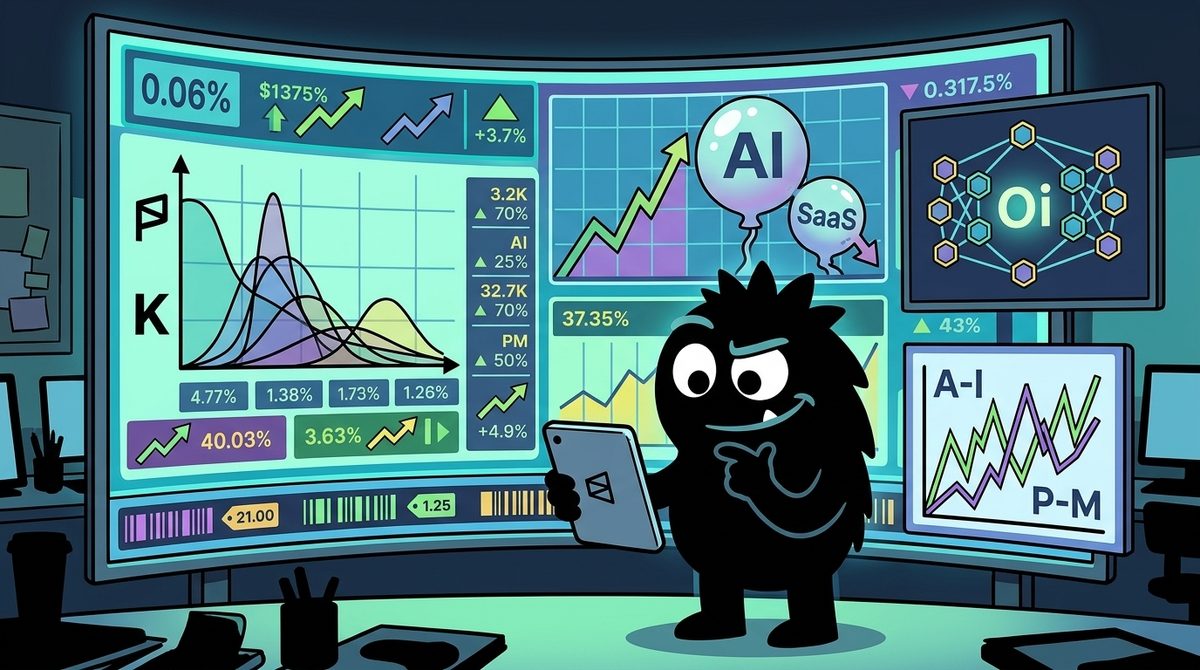
The question for developers, founders, and SaaS buyers is not simply “Is AI a bubble?” It is: how much near-term failure risk is the market actually pricing, and should that change technology or spending decisions now?
As of October 6, 2026, Polymarket traders imply only a 6% probability that the AI bubble will burst by December 31, 2026, on $2,433,307 traded. The market implies a higher 20% probability by June 30, 2027, but that contract has attracted only $11,307, making its price a much weaker signal. The broader market reports roughly $3,032,610 in volume, with the 2026 contract resolving around January 1, 2027.[1]
The bottom line: traders are not pricing an imminent, clearly measurable AI crash as the base case. But the odds do not prove that AI valuations are sustainable. They may instead reflect strict resolution rules, a short deadline and the possibility that excesses unwind gradually—through lower SaaS multiples, weaker retention and disappointing AI monetization—rather than through one dramatic “burst.”
Market-watch summary
>
- Near term: The market implies a 6% burst probability by December 31, 2026.
- By mid-2027: Traders currently price roughly 20%, but with very limited liquidity.[2]
- What it means: A sudden, rule-qualifying collapse is not the consensus expectation.
- What it does not mean: That AI infrastructure spending, circular financing or weak product conversion are harmless.
The market vs. the mood: What is Polymarket actually pricing in October 2026?
The contrast with X is striking. Online discussion increasingly treats an AI reckoning as imminent, while the prediction market assigns it a low near-term probability.
the polymarkets put an ai bubble burst in 2026 at 7%, and 20% by mid-2027
https://poly.market/7e4zEfN
The post above referred to a 7% 2026 price at its observation point. Prediction-market prices move continuously; the October 6 snapshot specified here is 6%. That movement is less important than the overall range: traders have consistently treated a qualifying 2026 burst as a tail risk, not the central scenario.[3]
It is also essential to distinguish probability from confidence. A 6% market price roughly means participants are willing to trade as if the defined event has a six-in-100 chance of occurring by the deadline. It does not mean that 94% of traders believe AI companies are sensibly valued, or that infrastructure investment will earn an adequate return.
The market is pricing a particular event under particular rules. It is not pricing every version of the claim that “AI is overhyped.”
That distinction explains some of the disconnect with commentary like this:
Interest and usage of advanced AI features is a bubble.
Like Crypto, it gets a disproportionate amount of news, broadcast and social media interest compared to its impact on the general public.
Dave Taylor’s argument concerns the gap between media attention and general-public impact. That gap could be real without satisfying Polymarket’s resolution criteria. Usage could disappoint, AI features could fail to command higher prices, and software valuations could compress further—yet the contract might still resolve “no” if the required downturn indicators do not occur by the specified date.
For practitioners, that makes the 6% price useful but narrow. It says more about the odds of a visible, near-term rupture than about whether every AI investment is economically justified.
How should you read a 6% probability without fooling yourself?
Three caveats determine whether these odds are actionable.
1. “By this date” is doing substantial work
The market implies only a 6% probability for the December 31, 2026 deadline. A low short-dated price can mean traders expect the cycle to continue long enough to miss the cutoff—not that they reject the bubble thesis entirely.
The increase to approximately 20% by June 30, 2027 supports that interpretation. Third-party trackers have shown the later contract around 19.5% to 20%.[2][7] The market appears to assign more risk as the time window expands, although the later price deserves less weight because of its thin trading volume.
2. “Bubble burst” has a contract definition
Prediction markets resolve according to written rules rather than the general mood. Reporting on this market indicates that resolution requires multiple downturn conditions, setting a higher bar than a falling stock, a failed funding round or a weak earnings report.[4]
That creates definition risk. A slow repricing across private AI companies and public software stocks could feel like a bubble deflating while never producing the specific combination required for a “yes” resolution.
3. Not all displayed probabilities are equally informative
The 2026 contract’s $2.43 million in traded volume is meaningfully more informative than the $11,307 attached to June 2027. Low-volume contracts are easier for a small number of participants to move, and wider spreads can make the displayed probability less representative of a broad consensus.
Prediction markets Overview
1. TLDR
• Allows users to trade “shares” on future events... Daily volumes are around ~$30M each on Polymarket ($1b valuation) and Kalshi (~$2B valuation)...
2. Project landscape
• @Polymarket: largest crypto-native venue...
3. The risks (and why disputes happen)
• Unclear market rules... Oracle design & governance trade-offs... Manipulation risk...
Ash’s overview captures the right framework: prediction markets aggregate financially backed opinions, but unclear rules, oracle design, governance and manipulation risk can affect what the price means. The later 20% contract should therefore be treated as a directional warning, not a precise forecast.
Is circular financing making the AI buildout a house of cards?
The strongest bubble argument is not that AI has no value. It is that the financial commitments needed to build AI infrastructure may be expanding much faster than durable end-user revenue.
The Interconnected Web of OpenAI's AI Infrastructure - A House of Cards or the Future of Tech? Is it a bubble?
OpenAI's aggressive expansion under CEO Sam Altman is shaping up as one of the largest speculative bubbles in history—one built not just on cash flows, but on sheer faith that it won't collapse. ... [full detailed analysis of dependencies, Nvidia $100B investment, Oracle $40B GPUs, CoreWeave $6.5B deal, AMD equity swap, $500B valuation, power shortages, circular financing echoing dot-com]
Paweł Łaskarzewski’s thread frames the concern as an interconnected web involving OpenAI, Nvidia, Oracle, CoreWeave and AMD. The core fear is circular financing: chip suppliers, cloud providers, model developers and infrastructure companies invest in, contract with or support one another, allowing demand to appear stronger while shifting risk around the same ecosystem.
That does not automatically make the arrangements unsound. Supplier financing and long-term purchase commitments can accelerate the construction of genuinely productive infrastructure. The danger emerges if projected customer demand fails to materialize and multiple parties rely on the same optimistic utilization assumptions.
The scale of planned capital expenditure makes this more than a theoretical concern.
Latest SemiAnalysis pieces are genuinely outside the chart on capex and AI buildout vs any Wall Street forecast. Their $11.1T cumulative AI capex (2024–29) sits well above Goldman's $7.6T (2026–31) and pretty much everyone else has no figures that extend thus far.
If you go and look up on consensus from a bottom up approach, top hyperscaler capex (chart: META, GOOGL, MSFT, AMZN, ORCL) is $693bn FY26, $900bn FY27, $980bn FY28. Latest post-Q1 prints already put '26 near $800bn and '27 above $1T (MS, Evercore, BofA), and MS has these five alone at $1.1T in '27 (3.2% of US GDP) or around 23% above WS estimates. The thing is that on top of capex from those names you need to add every major AI capacity builder. That includes SpaceX + neoclouds. SemiAnalysis for instance has 2028 capex peaking at $2T (full stack, includes silicon + IT + power...). Basically, WS consensus is well behind on AI capex.
The funny part though are memory players. Most of the forecasts mirror 2026/27 800bn and 1.1-1.2T capex and then forecast a 60-70% drop (due to prices). Thing is, everyone else is expecting 2028 to be record capex year and the buildout to continue (at least in some form) until 2029-30. If forecasts are right and 2028 capex is around 1.5-2T (well above 2027) memory players will, well, do the numbers yourself.
At the end of the day, if you think the hyperscaler CEOs are AI-pilled (Elon, Zuck, the Google founders...) and keep spending into '28, memory is priced at pennies on the dollar as their profit is basically: capex x capex share (a.k.a. value capture) and capex share is and will continue to be high in 2028 due to their position on the whole AI value chain.
Of course, the numbers are astronomical, and even crediting the AI-driven jump in operating cash flow, it's hard to self-fund capex north of $1T (hence the capital markets). SemiAnalysis sees $7T of AI debt by 2029, with $NVDA the key enabler, backstopping neocloud GPU-rental revenue (and directly leasing datacenters).
I do not believe we'll do 11T of AI capex until 2029, but if 2028 is not a cratter year (i.e. something forces this AI pilled CEOs to stop) memory is, by and large, the single best bet you can hope to make. I am so surprised on how everyone is looking at second derivative bets (even copper) projecting massive DC buildout beyond 2028 (see graph below) yet not realize that if, and only IF, a fraction of that forecast were to be true, memory guys will be out of the chart.
The Analyst Lab post contrasts an $11.1 trillion cumulative AI-capex estimate for 2024–2029 with Goldman’s cited $7.6 trillion estimate for 2026–2031. It also argues that post-earnings forecasts put major hyperscaler spending near $800 billion in fiscal 2026 and above $1 trillion in fiscal 2027.
These are projections, not settled outcomes. Their divergence is itself the signal: analysts do not yet agree on how large the buildout could become, how it would be financed or how much revenue it must generate.
Recent reporting has similarly focused on the distance between hyperscaler spending and near-term AI profits.[15] CEPR’s AI Bubble Monitor tracks this broader imbalance between investment, financing conditions, valuations and revenue realization.[12]
Why, then, does Polymarket imply only 6% near-term burst risk? Because a capex-revenue gap can persist. Large platforms may keep funding infrastructure from cash flow and capital markets; investors may tolerate weak current returns if growth remains credible; and governments may view compute capacity as strategically important. None of those possibilities guarantees a good return. They simply make the timing of a collapse difficult to forecast.
Is SaaS dying in real time—or being repriced for slower growth?
The most emotionally charged version of the argument is that autonomous agents will destroy traditional per-seat software pricing.
I genuinely believe we're watching SaaS die in real time and most people still don't see it..
$1 trillion wiped from software stocks since January 2026 and its just getting started..
SaaS multiples collapsed from 18.5x at the covid peak to 4.8x today and in the same time the AI market went from $50B to $539B and it's heading to $3.5 trillion by 2033 if not sooner
the death cross hits around 2027.. that's when AI market trajectory fully overtakes SaaS valuations on the chart
the reason is simple.. the per-seat model dies when 10 agents replace 100 humans and no seats left to sell
every SaaS tool you're paying $50/seat a month for is about to get replaced by an agent that costs $0.003 per task..
chatgpt opened the door in 2022, claude opus 4 made agentic AI real in 2025 and now multiagent coordination systems like openclaw are making it deployable and accessible to everyone..
every step on that chart the tech gets more autonomous and the SaaS line drops further..
not saying every saas will die but the companies that were built entirely on per-seat pricing and no real data advantage are the ones exposed.
tbh I don't think most founders see it yet, not because the data isn't there, but accepting it means everything they built needs to be rethought..
There is a legitimate mechanism underneath the rhetoric. If one employee using agents can perform work previously done by a larger team, software vendors that charge per user could face fewer seats, tougher renewals and pressure to adopt usage-, outcome- or workload-based pricing.
But the current data supports valuation divergence and business-model pressure, not the conclusion that SaaS as a category is disappearing.
SaaS buyout multiples reportedly fell from 20.4 times to 11.7 times EV/EBITDA in the first half of 2026, while private-equity investment declined to $58.8 billion.[9] Separate valuation analysis put the median public-AI company around 15.0 times enterprise value to revenue, compared with approximately 11.1 times for application software.[8]
Those measures are not directly interchangeable—one uses EBITDA and the other revenue—but both show investors becoming more selective. Markets are paying more for companies perceived to own AI infrastructure, proprietary data or unusually strong growth, while discounting slower software businesses with exposed seat-based economics.
HOW THE MARKET PRICES GROWTH TECH ENTERING 2026
This chart shows how the market is valuing growth SaaS based on 3-year revenue CAGR (2025-2028) against EV to gross profit.
The market is already separating the companies that already have AI boats and which still need to build them ahead of the AI tsunami.
$NET, $PLTR, $SHOP, $FIG, $RBRK, $SNOW, $CRWD, $DDOG, $ZS, $KVYO, $MNDY, $TEAM, $IOT, $MDB, $NOW, $HUBS $PANW, $VEEV, $S, $ESTC, $PATH, $ADBE, $WDAY, $CRM, $OKTA, $GTLB, $OS, $FROG
Bain reports that slower growth and declining net revenue retention are reshaping software due diligence.[10] Yet Euclid’s public-company analysis put net revenue retention near 109%, indicating that existing customers, in aggregate, were still spending more year over year even amid the “SaaSpocalypse” narrative.[11]
That leads to a more precise interpretation:
- Commodity workflow SaaS with little proprietary data and rigid per-seat pricing faces the highest risk.
- Systems of record with deep integrations, compliance obligations and high switching costs have stronger defenses.
- AI-native software can justify premium valuations only if usage becomes repeatable, gross margins remain attractive and customers pay for outcomes.
- Infrastructure providers may benefit from the buildout but carry exposure to utilization, financing and customer concentration.
Multiple compression can continue without triggering Polymarket’s definition of a burst. In fact, a prolonged rotation from generic SaaS into a smaller set of AI “haves” may be more consistent with the market’s low odds than either “everything is fine” or “all software is dying.”
Is the quietest AI risk really the paying-conversion problem?
Infrastructure financing attracts attention because the numbers are enormous. The more immediate operating risk for many founders, however, is much simpler: users may try AI without paying enough for it.
4.5% paying is the real AI bubble popping
View on XThe “4.5% paying” post does not provide enough context to treat that figure as an industry-wide benchmark. But it captures the demand-side question every AI company must answer: how much of apparent adoption converts into durable, high-margin revenue?
Interest is cheap. Free usage can be subsidized. Demonstrations can go viral without producing retention. A viable product needs customers who repeatedly receive enough value to cover inference, support, sales and infrastructure costs.
This is also why a monetization disappointment might not look like a single bubble burst. It could emerge as:
- Falling free-to-paid conversion;
- Rising inference cost per retained customer;
- Weak expansion revenue;
- Lower net revenue retention;
- Discounts on AI add-ons;
- Customers consolidating overlapping copilots;
- Longer payback periods for model and infrastructure spending.
Bain’s emphasis on slower software growth and retention makes these indicators particularly important in 2026.[10] CEPR’s monitoring framework similarly points toward the relationship between spending and realized economic return, rather than relying on headline valuations alone.[12]
For founders, conversion and retention are more actionable than Polymarket’s headline probability. For buyers, the relevant question is whether an AI feature reduces labor, increases throughput or improves quality enough to justify its total cost. “Has AI” is no longer an adequate procurement criterion.
Can Polymarket and Kalshi be trusted as market signals?
Skepticism about prediction markets is part of the same conversation.
I think Anthropic, OpenAI, Kalshi and Polymarket are way overvalued
don't see a path to profitability for them
Yet worth $20-30B for prediction markets? Aka online gambling
Or
closed source corporations that want trillions in IPO value?
Na not today or tomorrow or 2027
The criticism combines two separate questions: whether prediction-market companies deserve their valuations, and whether their prices contain useful information. A platform could be overvalued while still producing informative odds. Conversely, a popular, highly valued platform could host an illiquid or poorly specified contract.
Prediction markets have three advantages:
- Participants risk money, making casual claims costly.
- Prices update quickly as news and positioning change.
- A single probability is legible, unlike a stream of contradictory commentary.
They also have material weaknesses:
- Traders may interpret the resolution rules differently.
- Thin markets can be moved by relatively small positions.
- Oracle or dispute processes can introduce governance risk.
- Participants may share the same narrative rather than independent information.
- Prices can reflect hedging, entertainment or publicity—not only sincere forecasts.
Political events can further complicate the thesis. Benzinga reported an analyst’s argument that the U.S. midterms could become an external trigger affecting expectations around an AI bubble.[5] That is a scenario, not a forecast, but it illustrates why odds can move for reasons beyond product adoption: policy, liquidity, interest rates and government responses can all affect financing conditions.
👽⚡ KAV is the Alien of Solana - and KAV loves studying the signals forming before the crowd sees them.
TODAY’S SIGNAL IS A WILD ONE: WHAT IF THE AI BUBBLE BURSTING BECOMES FUEL FOR THE NEXT MASSIVE CRYPTO RALLY? ... Arthur Hayes... AI is currently in a bubble... pressure could arrive within 12-18 months... OpenAI, Anthropic and xAI... data-center financing and debt stress... governments would have strong incentives to prevent a disorderly collapse... liquidity and monetary expansion... cheap and abundant computing power.
The crypto-oriented post adds another speculative layer: even if AI stress emerged, traders might expect policy intervention or liquidity expansion rather than an uncontrolled collapse. That hypothesis should not be mistaken for evidence that intervention would occur. It does show why a binary “bubble/no bubble” contract compresses many macroeconomic paths into one number.
The best approach is to treat prediction markets as one probabilistic input, weighted by contract quality and liquidity. The 6% contract deserves more attention than the 20% contract because substantially more money has traded, but neither should override company-level fundamentals.
What should developers, founders and SaaS buyers do with these odds?
The market implies that an abrupt, qualifying AI bust by the end of 2026 is unlikely. That supports continued investment—but not indiscriminate investment.
Developers: Keep building, but avoid a single-layer career bet
The 6% price does not support abandoning AI engineering because of an expected near-term crash. Developers working on production use cases can continue investing in model integration, evaluation, retrieval, security and agent orchestration.
However, the capex and monetization risks argue for skills that remain valuable if model vendors consolidate or budgets tighten:
- Distributed systems and data engineering;
- Model evaluation and observability;
- Security, privacy and governance;
- Cost optimization and workload routing;
- Domain-specific product engineering.
This approach fits developers who want AI exposure without depending on one model provider or speculative application category.
Founders: Measure revenue quality, not narrative strength
Early-stage founders should track paid conversion, gross margin after inference, retention, expansion and customer concentration. Growth funded by free usage is less defensive than growth supported by repeated paid workflows.
Per-seat SaaS founders should consider usage or outcome pricing when agents materially reduce human seats. But they should not change pricing merely because X predicts the death of SaaS. The right trigger is evidence from customer behavior: declining seat growth, increased automation and willingness to pay for completed work.
SaaS buyers: Use repricing as leverage
Buyers should treat lower software multiples and slower growth as negotiating leverage. Ask vendors to substantiate AI premiums with measurable outcomes and insist on protections around data use, model changes, security and unpredictable consumption charges.
Large enterprises with integration and compliance needs may still favor established systems of record. Smaller teams with flexible processes may benefit more from AI-native tools—provided usage-based costs remain below the labor or software expense being replaced.
Investors and decision-makers: Use a three-signal dashboard
Do not make a capital-allocation decision from the 6% headline alone. Track:
- Market expectations: Polymarket prices, volume and rule changes;
- Financial reality: capex, debt, utilization, margins and revenue growth;
- Product reality: paid conversion, retention, workload frequency and measurable customer ROI.
The clearest synthesis is not that the market has disproved the AI-bubble thesis. It is that traders currently expect any reckoning to be later, slower or harder to define than the loudest online commentary suggests.
That makes the best 2026 strategy neither “bet everything on AI” nor “prepare for its imminent collapse.” It is to keep investing where adoption is measurable, demand proof of monetization, and treat the widening gap between infrastructure commitments and paying usage as the indicator most likely to change the odds.
Sources
[1] Polymarket — AI bubble burst by...?
[2] AI bubble burst? Odds: By June 30, 2027 19.5% — Polymarket Odds Today
[3] AI bubble burst Odds: No Clear Favorite Yet — Live Odds
[4] AI bubble burst in 2026 Odds & Prediction Market Analysis — CryptoSlate
[5] Trump Losing Midterms Could Be the “Trigger” that Pops AI Bubble, Says Market Analyst — Benzinga
[7] AI bubble burst by...: June 30, 2027 20% — PolyInsider
[8] AI Valuation Multiples 2026: Public vs. Private
[9] SaaS buyout multiples collapse from 20.4x to 11.7x — AltAssets
[10] Software Investing in the Age of AI and Slower Growth — Bain & Company
[11] SaaSpocalypse, Now What? — Euclid
[12] The AI Bubble Monitor — CEPR
[15] AI profits still look far off, new analysis says — Axios
References (16 sources)
- Polymarket — AI bubble burst by...? - polymarket.com
- AI bubble burst? Odds: By June 30, 2027 19.5% | Polymarket Odds Today - polymarkettrader.com
- AI bubble burst Odds: No Clear Favorite Yet | Live Odds - predictioncircle.com
- AI bubble burst in 2026 Odds & Prediction Market Analysis | CryptoSlate - cryptoslate.com
- Trump Losing Midterms Could Be the 'Trigger' that Pops AI Bubble, Says Market Analyst — Here's What Crypt - benzinga.com
- The Best AI Market Signals in 2026: What Polymarket's 9% Bubble-Burst Odds Really Tell Us | AdTools.org - adtools.org
- AI bubble burst by...: June 30, 2027 20% - Polymarket Odds | PolyInsider - polyinsider.io
- AI Valuation Multiples 2026: Public vs Private - windsordrake.com
- SaaS buyout multiples collapse from 20.4x to 11.7x as PE investment falls to $58.8bn - altassets.net
- Software Investing in the Age of AI and Slower Growth | Bain & Company - bain.com
- SaaSpocalypse Now What? - insights.euclid.vc
- The AI Bubble Monitor – CEPR - cepr.net
- Forvis Mazars and PitchBook Release H1 2026 State of SaaS Report - globenewswire.com
- How to Know When the AI Boom Is About to Go Bust - wsj.com
- AI profits still look far off, new analysis says - axios.com
- 2026 Software x AI: Software’s AI Inflection Point - sapphireventures.com
Related Guides
JetBrains AI Assistant vs Zed vs Cline: Which Is Best for Developers in 2026?
21 min read
The Best AI Model in 2026: What Polymarket's $2.1M Market Reveals About the Frontier
22 min read
DALL-E 3 vs Ideogram vs Later: Which Is Best for AI Content Creation in 2026?
14 min read
The Best AI Model in 2026: An Expert Analysis of the $2M Polymarket Odds
22 min read