The Odds on AI Supremacy: What a $2.3M Polymarket Bet Reveals About the Frontier Model Race in 2026
Polymarket's $2.3M market on the best AI model of 2026 prices Anthropic at 48% and Google at 40%. Discover what these odds reveal for developers and founders.
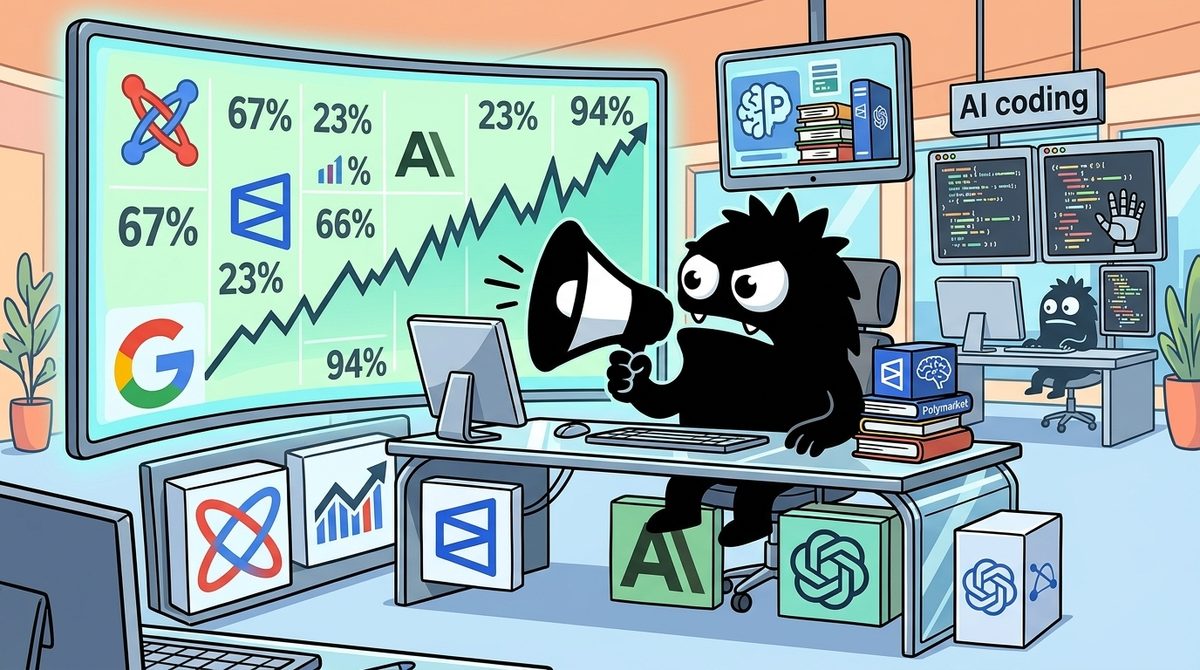
The practical question behind the Polymarket contract is not simply which AI lab will win 2026? It is whether developers, founders, and software buyers should commit to today’s leader—or prepare for the lead to change again before December 31.
As of October 7, 2026, the market’s answer is cautious: traders currently price Anthropic at 48% and Google at 40%, leaving neither company with an outright majority. OpenAI is priced at 6%, xAI at 1%, and Mistral and DeepSeek near 0%. With roughly $2,307,483 in trading volume, this is a meaningful snapshot of collective expectations, but not proof of what will happen.[1]
Bottom line: The market implies a two-company race for the year-end leaderboard, with Anthropic narrowly favored for coding and agentic strength and Google close behind after Gemini 4 Argon. For practitioners, the more important signal is that no provider commands even 50%: model portability, task-based routing, and cost controls are safer bets than choosing one permanent winner.
The $2.3M Bet: What Are Traders Actually Pricing?
The October 7 market snapshot is:
| Company | Implied probability | Reported traded volume |
|---|---|---|
| Anthropic | 48% | $317,282 |
| 40% | $250,066 | |
| OpenAI | 6% | $192,348 |
| xAI | 1% | $156,808 |
| Mistral | ~0% | $187,238 |
| DeepSeek | ~0% | $138,380 |
These figures should be read as market prices, not objective probabilities or predictions stated as facts. A 48-cent contract broadly indicates that traders collectively price an outcome at about a 48% implied probability. Prices can reflect information, speculation, liquidity, portfolio hedging, and market mechanics.
The individual outcome prices also need not add neatly to 100% at every moment. This is a set of tradable contracts with bids, asks, spreads, and rounding—not a professionally calibrated scientific forecast.
anthropic 52%, google 41%, openai 3% for best model by end of year
https://poly.market/jwYulOQ
More importantly, “best AI model” is not an open-ended judgment about revenue, developer adoption, inference economics, or enterprise market share. The contract’s resolution rules tie the result to the designated leaderboard around December 31, 2026.[1] That makes the bet partly about model quality and partly about which lab times a qualifying release to perform well under the resolution source.
That distinction explains why long-shot companies can attract substantial trading volume despite near-zero current prices. Volume is cumulative activity, not the amount currently betting “yes.” A contract can trade heavily as participants enter, exit, arbitrage, or reverse positions.
Polymarket traders repriced Anthropic's AI crown after Google dropped Gemini 4 Argon
The end of October market on Anthropic holding the top model sits at 36c rn.
It moved 53 points in 24h on $168,528 of volume. Resolves 2026-10-31.
The end of 2026 contract shows Anthropic at 52% vs Google 41%, OpenAI at 5%.
I see this as a calendar gap: 36c for October vs 52% for year end, with one launch in between.
Read the expiry before the headline.
The market therefore conveys two messages. First, traders currently see Anthropic and Google as the most plausible year-end leaderboard winners. Second, the 48%-to-40% split signals genuine uncertainty rather than settled consensus. Historical snapshots reinforce how quickly that consensus can move: one September report had Anthropic priced at 74%, far above its October 7 level.[6]
Why Does October Lean Google While the End of 2026 Leans Anthropic?
The sharpest insight in the current X discussion is the calendar gap: contracts using the same general competitive frame can produce very different prices because they expire on different dates.
After the announcement of Gemini 4 Argon, Google’s end-of-October odds reportedly jumped from roughly 7.8 cents to 72 cents. One X analysis described a 53-point move in 24 hours on $168,528 in volume.
google 72%, anthropic 28% for best model end of october
https://poly.market/q8xWGMc
The year-end contract moved much less decisively. At one point during that repricing, the end-of-2026 market still had Anthropic at approximately 52% and Google at 41%.
THE MONTH LEANS GOOGLE, THE YEAR LEANS ANTHROPIC
>Gemini 4 Argon leads the Text Arena: 1533 vs 1512 for Claude Opus 5.5 (style control off, Argon's score still preliminary)
>best AI model end of October: Google 72¢, Anthropic 28¢. a week ago Google was 7.8¢ on Polymarket
>best AI model end of 2026: Anthropic 53¢, Google 40¢
what Google says is new: 1M output tokens, up from 64K, and it finds and patches security bugs on its own. it isn't publicly released yet. Google is rolling it out to cyber defenders first
same leaderboard, two dates
so traders trust Argon to hold #1 for a month. for three months, they'd rather have Anthropic
who's #1 on Dec 31?
That is not necessarily a contradiction. The October market asks whether Argon’s initial leaderboard position can survive for weeks. The December contract asks whether it can survive subsequent Anthropic, Google, OpenAI, or other releases over a much longer window.
A newly announced model can transform a short-expiry market because there may be little time for rivals to respond. Its effect on a longer contract is diluted by the probability of:
- an Anthropic release before December 31;
- another Google model replacing Argon;
- independent evaluations changing the perceived ranking;
- a qualifying OpenAI release outperforming both;
- leaderboard methodology or voting patterns producing a different order.
Buying 100 shares of anthropic and google on @Polymarket
Which company has the best AI model at the end of October? on this market: https://polymarket.com/event/which-company-has-the-best-ai-model-end-of-october?r=magsimich
Anthropic is coming to the top position since January 2026, so it's been 9 months since he got the top position.
But a few days ago something crazy happened: Google dropped Gemini 4 Argon, which was the top on the 13/19 benchmark, but the wild part is its on there own benchmark
Also we can see more models to launch in this month because there is still 29 days left
My position is like this:
- Google NO ~ 100 share $39 cost
-> Anthropic YES ~ 100 share $41
Will aquire more in the future lets see !!!
The model-release calendar is consequently part of the wager. Traders are not only comparing systems already visible on October 7. They are estimating which labs have unreleased models, how quickly those models can reach a public leaderboard, and whether they will arrive before the resolution cutoff.
This is why “read the expiry before the headline” is the right rule.
For SaaS teams, the same principle applies to procurement. A model that is best for a prototype this month may not be the safest foundation for a two-year contract. Short-term capability leadership and long-term platform suitability are separate decisions.
Why Do Traders Still Favor Anthropic at Year-End?
The market’s 48% Anthropic price appears to reflect a durable thesis: Claude’s position is not based on one general chatbot score but on strength in coding, hard reasoning, and agentic workflows.
Agents are systems that perform multi-step work—reading files, calling tools, modifying code, checking results, and recovering from errors—rather than merely generating a single response. That distinction matters commercially because agentic coding can consume large quantities of inference while addressing expensive engineering work.
Independent ranking sites track intelligence, coding, speed, price, and other dimensions separately, underscoring that “best” depends on the evaluation chosen.[7] Recent leaderboard roundups have nevertheless placed Anthropic’s frontier models near the top overall and particularly strongly in coding-oriented work.[10]
The X conversation attributes part of that advantage to training emphasis:
Anthropic used more coding data in their training runs, so Claude is better at coding. DeepMind now knows this and sees agentic coding taking off exponentially in terms of revenue, so they will use more coding data for future Gemini models to catch up in capability.
"DeepMind engineers use Claude as a daily tool. Most of the rest of Google does not. When the question of equalizing access came up internally, the proposed response was to remove Claude for everyone — which DeepMind objected to so strongly that several engineers reportedly threatened to leave."
The reported claim that some DeepMind engineers use Claude should not be mistaken for a controlled benchmark. It is anecdotal and comes through an X post. But it is strategically notable because expert adoption inside a rival organization—if accurately reported—would suggest that coding utility can matter even when a company has access to its own frontier models.
Developer sentiment after OpenAI’s recent releases has similarly favored Claude in some discussions:
So at DevDay, OpenAI released GPT-6.1 Sol and GPT-6 Astra Ultrafast, which is supposed to be the most cost-efficient and responsive model on the market.
But Anthropic's Claude 5.5 models are the ones getting the praise.
Opus 5.5 >> GPT-6.1 Sol + GPT-6 Astra
Sonnet 5.5 >> GPT-6 Astra Ultrafast
So much for the comeback.
If GPT-6.1 Astra isn't a good answer, Anthropic has won 2026 even without releasing Fable 5.5
Again, that post is a practitioner verdict, not independent proof that Anthropic will win the contract. Its importance is as evidence of market narrative: traders may believe Anthropic has retained a meaningful quality advantage even as OpenAI competes on speed, price, and product breadth.
Anthropic may also have a workflow-integration advantage in high-value knowledge work. Claude’s spreadsheet capabilities have become part of the debate because a model’s usefulness depends on whether it can manipulate actual work products, not merely answer benchmark questions.
16M impressions in 24 hours. if you’ve ever tried Claude in Sheets or Claude in Excel you will know how much more intelligent it is compared to Gemini in Sheets
i have two current measures of Google-GDM product integration right now:
- how long does it take Google to put a non nerfed Gemini Pro into Sheets
- how long does it take to make Gemini 3.5 halfway decent at Sheets manipulation and formula
clock has started, Anthropic is between 0.5 to 3 years ahead on this one
For developers building coding agents, research systems, or complex back-office automation, this is the strongest case for Claude. For a buyer whose primary need is voice, image generation, consumer reach, or cheap high-volume inference, it is less decisive.
The market’s sub-50% price captures that boundary. Traders currently favor Anthropic, but they do not imply that Anthropic is the best choice for every task—or even more likely than the entire field combined to finish first.
Can Gemini 4 Argon Turn Google’s October Surge Into a Year-End Win?
Google’s 40% price makes it the only challenger the market currently treats as close to Anthropic. The immediate catalyst is Gemini 4 Argon, which Google positioned for long coding tasks, enterprise work, and cyber defense.
According to the X discussion, Argon reached a preliminary Text Arena score of 1533, compared with 1512 for Claude Opus 5.5, with style control off. It was also described as leading 13 of 19 reported benchmarks and expanding maximum output to one million tokens.
Google released a frontier model better than all of OpenAI models (including flagship)
but we can't use yet
here's my review.
1 → Gemini 4 Argon
- what Google said it’s for
long coding, enterprise work (legal, finance), cyber defense.
2 → better than the last public Gemini?
on paper, yes. first new Gemini frontier since 3.1 Pro.
3 → rank in its field
Artificial Analysis ~53, level with GPT-6 Astra and 5 points behind Claude Opus 5.5.
4 → worth switching from Sol or Sonnet 5.5?
only Fairwind cyber defenders can use it for now
5 → models still above it
Claude Opus 5.5. it's side by side with Claude Fable 5.1.
6 → price vs last Gemini Pro
price per 1M tokens is $2/$10 (input/output)
The bull case extends beyond one score. Google has distribution through its productivity and cloud platforms, substantial infrastructure, and the ability to place Gemini in existing user workflows. Long context and very large outputs could be valuable for codebase analysis, legal review, research synthesis, and security investigations—provided the model remains accurate and economical at those lengths.
But Argon’s launch also exposes a benchmark-credibility problem. At the time discussed in these posts, access was limited rather than broadly public. More importantly, some reported agentic results apparently compared Google’s internally computed numbers with competitors’ public leaderboard scores.
Impressive results
Evaluation methodology here:
https://storage.googleapis.com/deepmind-media/gemini/gemini_4_argon_model_evaluation.pdf
The main issue is that for several agentic benchmarks, they compare their own computed scores against public leaderboard scores for Claude and GPT models.
So, I'm not sure they are comparable. The report above doesn't give enough details to assess this.
I would wait for each leaderboard to publish Gemini 4's scores before drawing any definitive conclusions on the model's agentic superiority.
That is not necessarily evidence that Google’s results are wrong. It means the measurements may not be directly comparable. Differences in prompts, scaffolding, tool permissions, retry policies, sampling, and test versions can materially change agent benchmarks.
The rational practitioner position is therefore to wait for:
- Independent leaderboard placement under common conditions.
- Public or sufficiently broad access that allows reproducibility.
- Production evidence on latency, failure rates, rate limits, and cost.
- Task-specific evaluation using the buyer’s own code and documents.
Did this happen for the first time in months?
Anthropic has almost officially stopped being the AI leader
For months, ARENA AI and Polymarket traders kept choosing Claude as the best AI
But now something changed
Google caught up with Claude without even releasing Gemini 4.0 Pro yet
And for the first time in a while, users aren’t even sure which AI will be the best this month
We didn’t see this level of competition even when GPT Astra launched
The AI race is finally close again
The prediction market may be applying the same discount. Traders sharply repriced Google for October because Argon altered the immediate leaderboard picture, but they still assign Anthropic slightly better year-end odds. Google’s 40% is substantial confidence; it is not full acceptance of every launch benchmark.
Is Anthropic’s Model Lead Economically Durable?
Capability is only half of the competition. The contrarian case against Anthropic is that Claude’s quality could carry an unfavorable cost structure for customers and for Anthropic itself.
One widely discussed post argues that serious Claude usage could lead to overages of $400 to $1,000 per user per day and claims Anthropic’s lack of owned data centers may leave it with a structurally weaker cost base.
Prediction: Claude has massively taken the lead right now because they offer a better product, but that comes at a massive cost.
Buyers have not realized that included in a Claude subscription is not enough tokens to get real work done and that overages will cost $400 to $1,000 per day per user. Anthropic will need to buy significantly more compute, but because they don't own their own data centers, the cost to serve will continue to go up.
Spend will shift gradually and then quickly back to OpenAI, who can offer comparable models but at a much lower cost basis because they own their own data centers. Cost of inference will become the only competitive advantage making this market a race to the bottom.
Apple or Google will buy or merge(!!!) with Anthropic.
Those figures and the post’s acquisition prediction are opinions, not established outcomes. The broader concern is still valid: high-quality agentic models can generate enormous token consumption because they repeatedly inspect context, call tools, revise plans, and validate outputs. A subscription that looks affordable for chat may behave very differently when connected to an autonomous coding workflow.
Cost also changes quickly. A detailed practitioner account contrasted the coding-model economics of July and September 2026, arguing that Anthropic’s experience improved while OpenAI’s relative value deteriorated:
The coding model market changed a ridiculous amount in two months.
July 2026:
Anthropic had the best coding models, but the gap was small enough that choosing OpenAI still made plenty of sense.
Claude was slower, more expensive, full of peak “Claudeisms,” and you could burn through a $200 plan in a day.
OpenAI gave up a little capability, but the models were faster, cheaper, nicer to use, and the $200 plan basically felt unlimited. Tibo was handing out resets every few days anyway.
September 2026:
Anthropic still has the best coding model.
Now the gap is much harder to ignore.
Opus 5.5 is fast, surprisingly cheap, reliable, and the writing is actually pleasant. Somehow the same $200 plan now feels almost unlimited.
Meanwhile, choosing OpenAI specifically for coding has become a much tougher sell.
You give up a meaningful amount of capability and reliability. Without fast mode, the models feel painfully slow, which makes the economics worse. A $200 plan can disappear in hours, and UltraFast can chew through the $500 plan even faster.
I fully expect OpenAI to fight its way back.
But the situation looks very different from July.
That account cuts against the assumption that Anthropic must remain the expensive option. It illustrates why static price comparisons are unreliable: providers can alter limits, model efficiency, caching, routing, and subscription policies within weeks.
Bank of America’s Frontier AI Tracker, as summarized in the current conversation, adds another layer: Anthropic reportedly commands much more spending, while DeepSeek leads usage share, and token prices are falling.
CLAUDE TOPS AI RANKINGS AS COSTS FALL
Bank of America launched its Frontier AI Tracker, monitoring model intelligence, usage, token prices and hardware costs.
Anthropic’s Claude Opus 5 ranks #1 for intelligence, followed by Claude Fable 5 and OpenAI’s GPT-5.6 Sol.
DeepSeek leads usage share at 30%, while Anthropic dominates AI spending at 65%.
Meanwhile, AI token prices fell 9% month-over-month, helped by major OpenAI price cuts, while GPU rental costs remained broadly stable.
The reported split—roughly 65% of spending for Anthropic versus 30% usage share for DeepSeek—captures a central industry tension. The highest-revenue model provider need not serve the most requests. Premium coding and agent workloads can generate disproportionate spend, while inexpensive models absorb high-volume, lower-margin work.
Benchmarks that include both capability and price make this tradeoff visible.[9] Falling token prices intensify it: buyers gain more leverage, but providers must keep funding training and inference as unit revenue declines.
For SaaS buyers, the relevant metric is therefore not price per million tokens alone. Calculate cost per completed task, including retries, human review, latency, cache discounts, tool calls, and failure recovery. A pricier model can be cheaper if it finishes reliably; a cheaper model can win when workloads are tolerant of errors and operate at scale.
Is There Really One “Best” AI Model in 2026?
The contract must resolve to one company, but production AI is increasingly a task-by-task market.
the frontier is basically a tie now
claude opus 5.5 leads independent general intelligence tests
gemini 3.8 flash wins long context and speed
gpt-6 luna and deepsek win on price
swe-bench coding is at 88 percent for everyone serious
the era of one model ruling everything is over
pick by task
speed and context, gemini
hard reasoning and agents, claude
budget scale, deepseek and the open crew
anyone telling you one model wins at everything is selling something
That “pick by task” framing is more useful than a universal ranking:
- Claude is commonly favored for difficult coding, reasoning, and long-running agents.
- Gemini is competitive where context length, speed, Google integration, or multimodal workflows matter.
- OpenAI retains advantages in ecosystem breadth, voice, images, and lower-cost options.
- DeepSeek and open models can be compelling for budget-sensitive scale, deployment control, and workloads that do not require the absolute frontier.
- Mistral and xAI can be credible on particular axes without being favored to finish first on the contract’s designated leaderboard.
Anthropic (Claude) focuses on safety and often leads coding/agentic benchmarks with Opus 5.5 at $4/$20 per M tokens. OpenAI (GPT-6 Astra/Sol/Luna) leads multimodal features, ChatGPT ecosystem, and lower-cost tiers. Both public-benefit corps racing on capability and price cuts. Claude for code/long agents; GPT for voice/images/broad use. Neck and neck.
View on XThis helps explain the otherwise striking prices for the rest of the field. OpenAI’s 6%, xAI’s 1%, and Mistral’s and DeepSeek’s approximately 0% do not imply that their products have no value. They mean traders currently assign them little probability of satisfying this contract’s specific year-end resolution condition.
Mistral, for example, may be strong at coding without holding the top position:
Coding is strong but not on top. In a blind test where pro coders rated answers without knowing which AI wrote them, it came 2nd of 5, behind only Anthropic's Claude Opus 5. On one coding test it still trails China's Kimi K3, 62% to 68%. These are Mistral's own numbers
View on XMeanwhile, coding results across frontier labs have compressed. Historical benchmark jumps can be dramatic over short periods:
Anthropic did what they do best and dropped the best coding model once again.
SWE Benchmarks Record
18 Nov : Gemini 3.0 Pro : 76.2
19 Nov : GPT 5.1 Codex Max : 77.9
24 Nov : Claude Opus 4.5 : 80.9
AI space is crazy.
As top systems cluster, small differences in evaluation design become decisive. A one-point leaderboard lead may resolve a market while having almost no practical significance for a company processing invoices or generating product descriptions.
That produces the article’s most important synthesis: prediction markets concentrate attention on the marginal model that can take first place, while SaaS economics reward the portfolio that delivers acceptable quality at the lowest total cost. Those are different competitions.
What Do the Odds Mean for Developers, Founders, and SaaS Buyers?
Developers should design for model substitution
A stack hard-wired to one provider assumes more certainty than the market does. The favorite is priced at only 48%, while its main rival sits at 40%.
Developers should use:
- a provider-neutral internal interface;
- versioned prompts and evaluation sets;
- separate routing for coding, extraction, vision, and chat;
- logs that support side-by-side replay;
- fallback models for outages and rate limits;
- explicit budgets for tokens, latency, and retries.
Avoid abstracting away every provider-specific feature. Instead, isolate those features behind adapters so the application can retain portability without collapsing every model to the lowest common denominator.
Founders should route by task, not by brand
Early-stage companies with limited engineering capacity may reasonably choose one default provider to ship quickly. Anthropic fits products centered on demanding coding or agents; Google fits context-heavy and Google-adjacent workflows; OpenAI may fit broad multimodal applications and teams that value its ecosystem.
Once AI spend or dependency becomes material, add at least one alternative. The July-to-September shift described by practitioners shows that quality and economics can reverse in two months. A second provider is not merely an outage backup—it creates negotiating leverage and protects product margins.
SaaS buyers should evaluate the bill, not the benchmark headline
Enterprise buyers should request workload-level evidence:
- What is the cost per resolved support case or merged code change?
- How often does the model need human correction?
- Are long contexts billed repeatedly or cached?
- What happens after subscription allowances are exhausted?
- Can data, prompts, and evaluations move to another provider?
- Does the vendor expose model versions and deprecation schedules?
Independent leaderboards are useful for narrowing a shortlist, and several current trackers compare models across capability, coding, speed, and pricing.[8][11] They are not substitutes for an evaluation based on the buyer’s own distribution of tasks.
Use prediction markets as a signal, not a roadmap
Polymarket aggregates informed views, speculative positioning, and release-calendar expectations. It can reveal changes in sentiment faster than quarterly analyst reports. It cannot tell a company which model will produce the best unit economics for its application.
Use the market to monitor:
- Direction: Are traders repricing a lab after a release?
- Magnitude: Is the move marginal or regime-changing?
- Expiry: Does confidence apply for weeks or months?
- Resolution: Which benchmark or authority decides the contract?
- Liquidity: Is the displayed probability supported by meaningful trading?
As of October 7, 2026, the market implies that Anthropic has the strongest chance of holding the designated year-end crown, but Google is close enough that another release or independent Argon evaluation could move the odds sharply. The low prices for OpenAI, xAI, Mistral, and DeepSeek reflect this particular leaderboard race—not their broader commercial relevance.
The strategic conclusion is clearer than the winner: the AI market is converging toward multiple frontier-grade suppliers differentiated by task performance, distribution, and cost. Developers should preserve portability, founders should route workloads intelligently, and SaaS buyers should negotiate around total task economics. Betting on one permanent champion is a much stronger claim than even the betting market is willing to make.
Sources
[1] Which company has best AI model end of 2026? Trading Odds & Predictions — Polymarket
[7] Generative AI Model Ranking Matrix — Veso Research
[8] LLM Leaderboard 2026: Top AI Models Ranked — BenchLeader
[9] AI Model Benchmarks — Intelligence, Coding, Speed & Price — Tech Times
[10] Frontier AI Models: Live Top 10 Rankings, Evidence and Pricing — BenchLM.ai
[11] Best AI Models in 2026: The Complete Ranking — The AI Rankings
References (15 sources)
- Which company has best AI model end of 2026? Trading Odds & Predictions | Polymarket - polymarket.com
- Which company has best AI model end of 2026 Odds & Prediction Market Prices (October 2026) - WIN DAILY® - windailysports.com
- Best AI Model of 2026 Odds: Who Will Be #1 at Year-End? - DeFi Rate - defirate.com
- Which company has best AI model end of 2026? · Anthropic 49% (+2pp) — Polymarket odds - pdata.world
- Best AI Model Odds - The Top Markets and Outcomes - Casino.org - casino.org
- Polymarket Assigns 74 Percent Probability to Anthropic for Best AI Model at 2026 Close - SCCG Management - sccgmanagement.com
- Generative AI Model Ranking Matrix · Veso Research - veso.ai
- LLM Leaderboard 2026: top AI models ranked | BenchLeader - benchleader.com
- AI Model Benchmarks — Intelligence, Coding, Speed & Price | Tech Times - techtimes.com
- Frontier AI Models: Live Top 10 Rankings, Evidence and Pricing (October 2026) | BenchLM.ai - benchlm.ai
- Best AI Models in 2026: The Complete Ranking | The AI Rankings - theairankings.com
- LLM Leaderboard & AI Model Benchmarks — October 2026 - benchlm.ai
- LLM Leaderboard 2026 - Top AI Models Ranked | LM Market Cap - lmmarketcap.com
- Who Is Winning the AI Race? Monthly LLM Leader Timeline (October 2026) | BenchLM.ai - benchlm.ai
- AI Index - Leaderboard & Trends - ai-index.netskope.com
Related Guides
What Is Framer? A Complete Guide for Developers in 2026
20 min read
The Best AI Market Signals in 2026: What Polymarket's Bubble-Burst Odds Reveal
18 min read
JetBrains AI Assistant vs Zed vs Cline: Which Is Best for Developers in 2026?
21 min read
The Best AI Model in 2026: What Polymarket's $2.1M Market Reveals About the Frontier
22 min read