The Best AI Model Tools in 2026: An Expert Comparison Through Prediction Market Odds
Anthropic sits at 96% on a $3.4M Polymarket bet for best AI model. Discover what these odds reveal about the AI race and what it means for your stack in 2026.
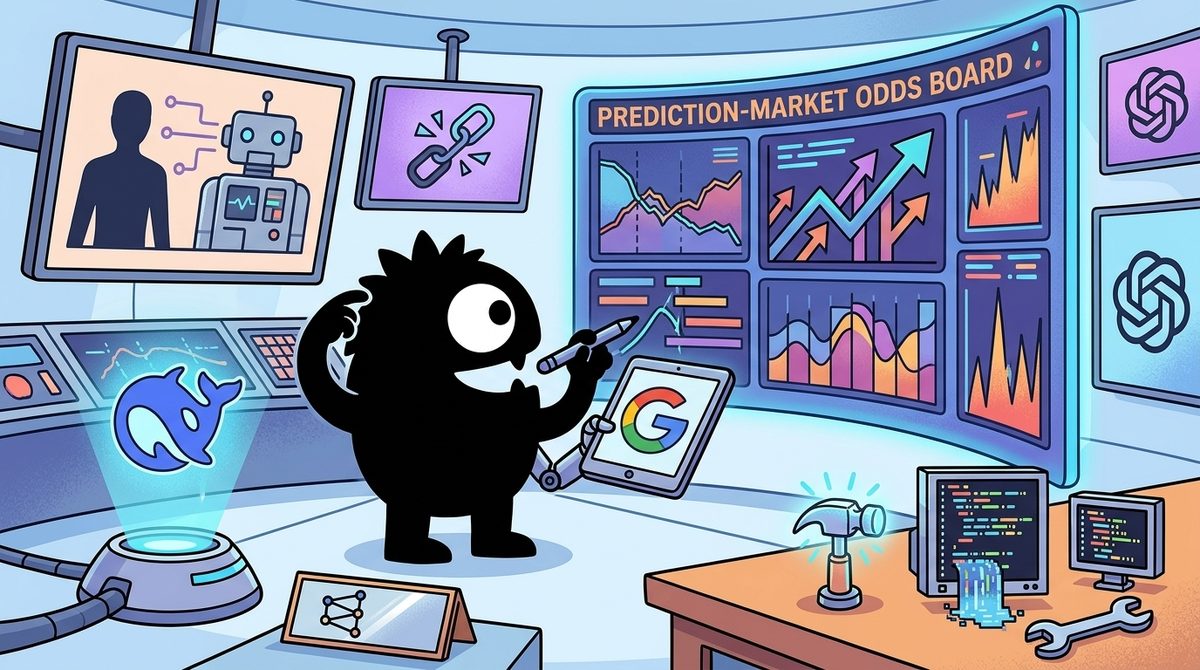
The real question for developers, founders, and SaaS buyers is not simply “Will Anthropic win September?” It is: Should a 96% prediction-market probability change which model or platform I build on?
The short answer is yes as a market signal, but no as a standalone procurement decision. As of September 16, 2026, Polymarket traders overwhelmingly expect Anthropic to lead the specific text leaderboard named in the contract at the end of the month. That conviction reflects Claude’s strength in coding and agentic work, improving token economics, and Anthropic’s enterprise focus. It does not establish Claude as the best choice for every workload—or even measure all the dimensions on which an AI platform can win.[1]
Bottom line
>
- The market implies a 96% probability for Anthropic, versus 2% each for OpenAI and Google, under this contract’s specific resolution rules.
- The odds indicate strong expectations around text-model quality, coding agents, and enterprise workloads, not universal product superiority.
- Practitioners should treat the market as a fast-moving sentiment indicator, then benchmark models on their own cost, latency, context, reliability, and governance requirements.
The $3.4M bet: What are traders actually pricing?
As of September 16, roughly $3,407,949 has traded in Polymarket’s “Which company has the best AI model end of September?” market. The contract is expected to resolve around October 1, 2026, using the specified arena.ai Text Arena leaderboard.[1] That detail defines what the odds mean: traders are pricing which eligible company they expect to occupy the relevant leaderboard position at the resolution snapshot.
The current implied probabilities and reported trading volumes are:
| Company | Market-implied probability | Reported volume |
|---|---|---|
| **Anthropic** | **96%** | **$736,408** |
| **OpenAI** | **2%** | **$645,923** |
| **Google** | **2%** | **$285,559** |
| **Meta** | **0%** | **$371,031** |
| **SpaceXAI** | **0%** | **$293,043** |
| **DeepSeek** | **0%** | **$179,457** |
A displayed probability of 0% should not be interpreted as literal impossibility. Prediction-market interfaces commonly round very small prices, and contracts can move sharply when new models appear, rules are clarified, or leaderboard results change. Guides to AI prediction markets specifically warn traders to inspect the resolution source, cutoff, eligible models, and dispute risk rather than reading the headline alone.[6]
The volume also requires care. Anthropic has the highest listed volume, but OpenAI has attracted almost as much despite being priced at only 2%. Meta has more reported volume than Google while displaying 0%. Volume measures turnover and disagreement—not simply current confidence.
An @AnthropicAI researcher says the AI race is getting dangerously out of control.
Meanwhile, the market:
@AnthropicAI to have the best AI model by Sep. 30: 88.5% 📈
@OpenAI : 8.3%
Google: 2.1%
One side sees an existential risk. The other sees a market leader. Who do you believe?
Earlier snapshots circulated on X at 88.5%, 91%, and 92% for Anthropic. The movement to 96% indicates that traders have become more concentrated, but it still represents a market expectation rather than a confirmed result.
Anthropic is the clear leader in the entire AI race right now
@Polymarket puts it at 92% to keep the crown through the end of August
Which looks all but certain given what Opus 5 has shown, the new model behind Claude Code that raised the bar in coding and agentic work this summer
OpenAI shipped GPT-5.6, its best system yet
and still the market prices it at just 4.8%
Even a fresh release did nothing to the standings, that is how wide the gap has become
Google sits third, trailing the leader by roughly 45x, while every other model combined fails to clear 1%
> Anthropic - 92%
> OpenAI - 4.8%
> Google - 2.3%
> the rest - <1%
Total market volume is already $1.3M, and trading closes on August 31
For anything to shift, rivals need more than another flagship, they need a genuine leap in model quality that nobody has delivered yet
The first industry signal, then, is not “Anthropic has permanently won.” It is that traders currently see a large short-term quality gap under one leaderboard’s definition of quality. Comparable market coverage confirms that leaderboard mechanics, not revenue, adoption, or profitability, determine settlement.[3][4]
Why are traders paying 96 cents on Anthropic?
The clearest explanation is the combined performance narrative around Claude Fable 5.1, Opus 5, Sonnet 5, and Claude Code.
BenchLM’s September 2026 data places Claude Fable 5.1 at 84.76 out of 100, making it the leading Anthropic model in that ranking and supporting the broader perception that the Claude family is highly competitive at the frontier.[7] BenchLM’s monthly AI-race timeline likewise presents Anthropic as the current benchmark leader, although rankings vary by benchmark and methodology.[8]
More important for SaaS teams, Anthropic’s recent gains are being framed around agentic work: long-running tasks in which a model plans, calls tools, edits files, checks results, and continues with limited human intervention. That is economically meaningful because coding and business-process agents can consume large contexts and generate many rounds of tokens.
Claude Fable 5.1 is cheaper, substantially stronger on several agentic benchmarks, more concise, and apparently far less trigger-happy (says Anthropic).
the tl;dr
How much cheaper?
-Input/output pricing remains $10/$50 per million -tokens.
-Cache reads fall 75% to $0.25.
-Anthropic estimates ~25% lower costs for typical workloads and up to ~45% for highly agentic, context-heavy work.
BUT: not 45% cheaper for Claude subscriptions. ("...wherever usage is billed by token")
How much better than Fable 5?
-Scientific agent benchmark: 52.6% vs. 24.7% - more than 2×
-AutomationBench: 31.4% vs. 17.1% — an 84% relative gain
-GDPval-AA: 1,853 vs. 1,723
-CursorBench: 73.4% vs. 70.5%
So: dramatic gains on some long-running tasks, modest improvements elsewhere, not a uniform intelligence jump.
Verbosity also seems improved, although there is no standardized score. Rogo reports equal accuracy with 20% fewer tokens. Red Hat found its updates more concise and easier to follow. Every says it used half as many tokens as Opus 5 while running about twice as fast.
And fewer unnecessary red flags:
-~60% fewer cyber-safeguard interventions per Claude Code session
-Biology safeguards reportedly trigger 85% less often on benign elementary biology and medical questions
-Vulnerability discovery is now allowed, while exploit generation, penetration testing and binary scanning remain restricted or redirected
So far, sounds like a promising release. Although it clearly shows they care much more about business and enterprise users than us subscription pesants. Anyway: Testing time!
The release details discussed on X suggest that Fable 5.1 held input/output pricing at $10/$50 per million tokens, while cache reads became 75% cheaper. Anthropic estimated approximately 25% lower costs for typical token-billed workloads and as much as 45% for highly agentic, context-heavy work. Those are vendor estimates, not universal savings, but they explain why traders may view the release as more than a benchmark bump.[9]
Anthropic’s lower-cost Sonnet strategy reinforces the same positioning. Reporting on Sonnet 5 described it as a cheaper way to operate agents, widening the range of tasks for which persistent model-driven automation may be financially viable.[10] Opus 5’s system documentation, meanwhile, provides the safety and evaluation context behind its flagship positioning.[11]
JUST IN: Anthropic claims Claude can now autonomously improve AI alignment, finding successful fixes across 10 failure categories without hurting model performance.
View on XAnthropic’s claim that Claude can help identify alignment fixes adds another layer to the market narrative: durability. Enterprise buyers do not only want high benchmark scores; they want models that can be governed, monitored, and deployed without unpredictable policy behavior.
The 96% price therefore appears to combine three expectations:
- Claude remains strong on the settlement leaderboard.
- Its coding and agentic performance translates into enterprise demand.
- Its cost and safety improvements make that performance deployable at scale.
That thesis is strongest for engineering-heavy companies running complex agents. It is less decisive for image generation, consumer search, advertising, local inference, or ultra-low-cost batch processing—all largely outside what this contract settles.
Is “best AI model” the wrong question for SaaS buyers?
Yes—unless “best” is followed immediately by “for which workload, at what cost, under what constraints?”
Polymarket gives Anthropic a 91% shot at September’s “best” AI model. Sounds decisive—until the fine print: one text leaderboard settles it. Nearly $500,000 can price conviction. It can’t tell you which AI is best for your work. “Best” may be the laziest question in AI.
View on XThe market resolves through one text leaderboard.[1] That makes the contract legible enough to trade, but it necessarily excludes much of the production decision:
- API uptime and rate limits
- Tool-calling reliability
- Latency at short and long context
- Data residency and governance
- Multimodal performance
- Fine-tuning and observability
- Output consistency
- Cost per successful task
- Provider concentration risk
A model can win a preference or text-quality leaderboard yet lose economically if it requires more retries, produces unnecessarily long answers, or costs too much at production volume. Conversely, a cheaper model can lose head-to-head evaluations while delivering better margins on classification, extraction, summarization, and bulk transformations.
Claude vs GPT isn’t only about model quality — token value matters too.
Third-party estimates show Claude offering more usable capacity at the same price:
• $20 → 2.58×
• $100 → 2.55×
• $200 → 1.27×
For heavy AI users, more tokens = more iterations, longer workflows, and more room to build.
If token value is your priority, Claude currently wins.
Claude or GPT — which gives you better real-world value?
The third-party estimates in this X discussion put Claude’s usable capacity at the same subscription price at 2.58 times GPT’s at the $20 tier, 2.55 times at $100, and 1.27 times at $200. Those figures should be treated as estimates tied to particular usage assumptions, but the underlying criterion is correct: token value affects how many iterations a team can afford.
Architecture can matter too.
OpenAI GPT-5.6 models and Anthropic Claude 5 models have different pricing structures at long context lengths. GPT model costs increase in price past 272k input tokens, while Claude model costs remain fixed.
Does this reflect an underlying difference in the architecture of these models? Our measurements of serving latency suggest so.
We studied time to first token (TTFT) on these models and how it scales with increasing context length. We found a significant difference in how they scale, with GPT showing a noticeable quadratic component, while Claude models remain closer to linear.
Epoch AI’s measurements report different time-to-first-token scaling at long context: GPT-5.6 shows a noticeable quadratic component, while Claude 5 remains closer to linear. That does not make one architecture universally superior. It means long-document agents may experience materially different latency and pricing behavior from short interactive prompts.
For buyers, the correct comparison is therefore:
Leaderboard probability × workload success rate × reliability ÷ total task cost
Polymarket supplies only the first component. Your evaluation suite must provide the rest.
Does the 2026 AI market split into Anthropic B2B, Google B2C, and OpenAI everywhere?
The model odds also expose a broader strategic divergence among the leading labs.
It is becoming clearer every day that AI labs, as they transition from research organizations to "real" companies dependent on revenues and profits, will have to focus on either the enterprise or consumer path. Anthropic is clearly choosing the B2B path; $GOOGL is leaning heavily into B2C, while OpenAI wants to capture both, but in doing so risks losing the dominant position in either.
It seems the AI subscription/usage business model for enterprises is working well and has room to grow, but for consumer AI usage, the ad model will be key, and OpenAI is entering the arena where $GOOGL is the king.
Building a successful ad platform will be a challenge for OpenAI. Building out a good ad ecosystem at scale is much harder than people expect. On scale, $META and $GOOGL have really mastered it, while many other platforms have struggled for years.
Anthropic’s product direction fits a B2B, coding, and agentic automation strategy. These workloads can support usage-based pricing because the customer can connect token expenditure to developer productivity, support resolution, research throughput, or automated back-office work.
Google has different advantages. Its consumer distribution, search business, cloud platform, and TPU infrastructure mean that a model-quality lead could be compounded across both consumer products and Google Cloud. That potential is not captured by Google’s 2% probability in this one September leaderboard market.
Over the last few days, on Polymarket, $GOOGL's lead as the best AI model by the end of 2025 has increased even further.
Anthropic odds have also risen, while those of OpenAI and xAI have decreased.
While $GOOGL's market share in LLM search will be much lower than the market share it has on traditional search on the enterprise side if $GOOGL turns out to be the best model provider and on top of it offers them via GCP on their TPU infrastructure, GCP's value could be much more than the market current anticipates.
Google’s much stronger odds in an earlier end-of-2025 model market are also a reminder that leadership rotates. Prediction markets responded to the available models and information at that time; September 2026 traders are pricing a different cutoff and competitive landscape.[5]
OpenAI is attempting the broadest position: consumer assistant, developer platform, enterprise software, agents, and potentially an advertising-supported ecosystem. That reach creates distribution and cross-sell opportunities, but it also demands simultaneous execution against focused competitors.
Jason's AI Pair Trade: Short OpenAI. Long Google, xAI, and Anthropic.
Why? OpenAI's competition is fierce.
"They're facing a Google firing on all cylinders, Anthropic, and Grok beating them in the leaderboards pretty consistently."
Polymarket has Google's Gemini 3 at ~87% to finish 2025 as the top-ranked LLM.
Over the last six months, Gemini has started to shrink ChatGPT's massive lead in traffic share.
OpenAI’s current 2% implied probability should not be read as a 2% chance that its overall business remains relevant. The contract does not measure ChatGPT traffic, developer mindshare, enterprise contracts, ecosystem depth, or consumer brand. It measures the expected result of a designated leaderboard at a designated time.
For technical decision-makers, the strategic fit is clearer:
- Anthropic fits teams prioritizing sophisticated coding, long tool chains, and enterprise agents.
- Google fits teams already committed to GCP, multimodal workflows, very long context, or consumer-scale distribution.
- OpenAI fits teams valuing a broad platform, established developer ecosystem, and consumer-enterprise continuity.
- Meta and open models fit organizations prioritizing deployment control, customization, or self-hosting, even when markets price their near-term leaderboard chances near zero.
Why does the market price DeepSeek at 0% while practitioners use it?
DeepSeek is the strongest illustration of the gap between probability of finishing first and probability of being useful.
Polymarket currently displays DeepSeek at 0% implied probability, with $179,457 traded. Yet X discussions point to substantial OpenRouter usage and strong expectations that DeepSeek could rank just behind the leader in separate usage-focused markets.
DeepSeek pushed 1 trillion tokens through OpenRouter in 24 hours. Polymarket gives it 4 cents to finish the week at #1
#1 lab on OpenRouter, week of Sep 7:
OpenAI 94c bid, 97c ask
DeepSeek 4c
Anthropic and Google have no bid at all
The #2 book has DeepSeek at 95c. So the market already agreed DeepSeek comes second
The week closes tonight, and the answer sits on a public chart
Buying every OpenAI share on offer at #1 costs $197. That's the whole ask side, 97c to 99c
One wallet, qqqmmmccc, bought $1,411 of that outcome in four fills. That's 80% of all the Yes buying on it
Someone else paid 64.9c for Tencent at #1. $84. The trades either side of that fill priced Tencent at 2c and 9c. Tencent is bid 0.2c now
I keep coming back to the size. The three books on who leads AI usage have traded $23,599 combined, against a trillion tokens in one day
That post describes one trillion DeepSeek tokens passing through OpenRouter in 24 hours while a relatively small prediction market priced OpenAI as the likely usage leader. The contrast matters: a leaderboard market can reflect expectations about peak quality, while routing platforms reveal demand shaped by price, availability, speed, and developer experimentation.
Which AI model tops LiveBench Coding September?
Claude Fable 5 is the clear leader for coding on LiveBench this September, but DeepSeek V4 Flash is the top budget pick at 99 percent lower cost.
https://polyprediction.app/event/which-company-has-the-best-ai-model-on-livebench-coding-end-of-september-20260728165808281
#AI #Tech #LiveBench #Polymarket
A separate X analysis calls DeepSeek V4 Flash the top budget coding choice at roughly 99% lower cost than the leader. That is not evidence that it will top the Text Arena leaderboard. It is evidence that an economically rational SaaS stack may assign DeepSeek substantial traffic even while traders price almost no chance of first place.
Chinese labs also represent an efficiency-led competitive threat. One X participant argues that Kimi and Qwen operate with approximately 30 times less investment than Anthropic and OpenAI while reaching state-of-the-art performance in some areas, and reports a separate market assigning China a 10% chance of leading the broader AI race during the year.
China will soon BECOME the LEADER in the AI race
Polymarket gives a 10% chance of this happening this year
Kimi and Qwen have 30 times lower investment than Anthropic and OpenAI
at the same time, they are able to create SOTA models in some areas, making them incredibly efficient
Qwen 3.8, Kimi K3, Deepseek V4 – you already know them all
with increasing investment in them, which is happening now, they will become the best in terms of model quality
the era of Chinese AI will begin faster than you know it
Those figures are claims within the live debate, not guarantees. But they reveal a scenario the headline market can underweight: a lab does not need to finish first overall to compress prices, capture high-volume workloads, or force frontier providers to improve efficiency.
For founders, the practical wildcard is not “DeepSeek suddenly wins everything.” It is that SOTA-adjacent models become good enough at a fraction of the cost, weakening businesses whose margins assume every request must go to a premium Western model.
Why are practitioners routing across models instead of choosing one winner?
The most revealing response to the prediction market may be that advanced users are already moving beyond its premise.
This tool is blowing up on GitHub right now
OpenClaude is Claude Code rebuilt to run on any provider. Same terminal, same tools, same subagents, except every agent can sit on a different model.
Split by what the work actually needs, not by which model you like.
> Code and terminal work: Claude or Codex. Both are built around long tool chains, and that is most of what an agent does.
> Bulk file operations and context gathering: whatever is cheapest and fastest, including a local model on your own machine. Hundreds of reads, no judgment involved.
> Long documents and huge context: Gemini. That is where the million-token window earns its keep.
> Review: something from a different lab than the one that wrote the code. The point is a second opinion.
> Anything you do at volume: an open model on your hardware. It costs nothing per run once it is set up.
That is the whole trick: you stop paying flagship prices for work a cheap model could do.
You can also send jobs to the background. Start one, close the terminal, check the log later, kill it if it goes wrong. And it maps your repo so agents stop burning turns working out where anything lives.
Repo: Gitlawb/openclaude
OpenClaude’s model is straightforward: preserve an agentic coding interface while assigning different subagents to different providers. Expensive frontier models handle judgment-heavy coding and tool chains; cheaper or local models gather context and perform bulk file operations; long-context models process large documents; and a model from another lab reviews the output.
That architecture turns model selection into a routing problem:
- Classify the task by risk, complexity, and context size.
- Send high-value reasoning to the strongest available model.
- Route repetitive work to cheaper models.
- Use a different provider for review.
- Fall back automatically when price, latency, or availability changes.
It also changes evaluation. Prediction Arena, for example, gives leading models real money to trade prediction markets, testing sustained reasoning against changing real-world outcomes rather than only static benchmark questions.
We just gave five SOTA models $10K in real cash to make bets on @Kalshi. Introducing Prediction Arena.
Prediction markets are a rare, concrete way to eval whether AI can reason about the most probable outcomes over time. Sustained profitability signals progress toward real-time, real-world reasoning.
The starting players are:
@OpenAI GPT 5.2
@GoogleDeepMind Gemini 3 Pro
@AnthropicAI Claude Opus 4.5
@xai Grok 4.1 Fast
@Zai_org GLM 4.7
Watch them trade live at https://t.co/GuDOEI68uo, methodology below
This does not make traditional leaderboards useless. A frontier leader can become the default “escalation model” for the hardest tasks. But most production workloads contain a mix of difficulty levels. Paying flagship prices for every document read, classification, file lookup, or formatting operation is often unnecessary.
The industry direction implied by both the odds and practitioner behavior is therefore not winner-take-all at the API layer. It is a stack with:
- A premium model for difficult reasoning
- Budget models for high-volume work
- Local or open models for privacy and predictable marginal cost
- Cross-lab review for error reduction
- Evaluation and routing infrastructure that can replace providers quickly
Who should choose which AI model strategy in late 2026?
The market’s 96% Anthropic probability is useful if it is translated into decisions rather than treated as a verdict.
Developers building coding agents
Start with Anthropic when the workload involves long tool chains, repository-scale context, or autonomous coding. Its market lead, benchmark position, and agent-focused releases make it the strongest default candidate as of September 16, 2026.[7][8]
But add at least one cheaper provider for file reads, summarization, test-log processing, and other high-volume tasks. Use a model from another lab for code review where practical.
Early-stage founders with limited budgets
Do not architect the product around the assumption that today’s 96% favorite remains permanently dominant. Put a provider-neutral interface between your application and model APIs. Record task-level cost, latency, retries, and user acceptance so models can be replaced using evidence.
Budget models such as DeepSeek are appropriate for low-risk, high-volume operations. Escalate only ambiguous or valuable tasks to a frontier model.
Enterprise SaaS buyers
Run a private evaluation set drawn from real workflows. Compare:
- Cost per completed task
- Long-context latency
- Tool-call success
- Hallucination and retry rates
- Security controls and auditability
- Data handling and residency
- Contractual support
- Portability to another provider
For these buyers, Anthropic’s B2B orientation may be strategically aligned, but vendor concentration and governance can outweigh a small benchmark advantage.
Consumer and distribution-led companies
Google deserves more attention than its 2% September contract price suggests because the market does not measure consumer reach, search integration, advertising economics, or cloud distribution. OpenAI likewise remains relevant where product breadth and an established assistant ecosystem matter more than one leaderboard rank.
The practical conclusion
Prediction markets are valuable because they compress releases, benchmark movements, trader beliefs, and timing into a live price. But this market answers a narrow question: which company traders expect to top a particular text leaderboard at the end of September 2026.
It does not answer which provider will produce the best SaaS margins, retain the most developers, dominate consumer distribution, or deliver the lowest-risk enterprise deployment. Anthropic’s 96% implied probability is a strong signal about the present frontier. The more durable industry signal is that model quality is becoming one input inside a multi-model system—not the system itself.
Sources
[1] Which company has the best AI model end of September? — Polymarket
[2] AI Predictions & Real-Time Odds — Polymarket
[3] Which Company Has the Best AI Model in September 2026? Winner Odds — Lines.com
[4] Will SpaceXAI Have the Best AI Model at the End of October 2026? — CoinGape
[5] Odds On: Which company will be able to claim best AI model in September? — TipRanks
[6] Polymarket AI Markets Guide: Model Leaderboards, Sources, and Risk Checks — Bucko
[7] Best Anthropic Models, September 2026 — BenchLM
[8] Who Is Winning the AI Race? Monthly LLM Leader Timeline — BenchLM
[9] Claude Fable 5 and Claude Mythos 5 — Anthropic
[10] Anthropic launches Claude Sonnet 5 as a cheaper way to run agents — TechCrunch
References (15 sources)
- Which company has the best AI model end of September? - polymarket.com
- AI Predictions & Real-Time Odds | Polymarket - polymarket.com
- Which Company Has the Best AI Model in September 2026? Winner Odds | Lines.com - lines.com
- Will SpaceXAI Have the Best AI Model at the End of October 2026? Odds at 1% - coingape.com
- Odds On: Which company will be able to claim best AI model in September? - tipranks.com
- Polymarket AI Markets Guide: Model Leaderboards, Sources, and Risk Checks - bucko.ai
- Best Anthropic Models (September 2026) — Ranked by Benchmark Data | BenchLM.ai - benchlm.ai
- Who Is Winning the AI Race? Monthly LLM Leader Timeline (September 2026) | BenchLM.ai - benchlm.ai
- Claude Fable 5 and Claude Mythos 5 | Anthropic - anthropic.com
- Anthropic launches Claude Sonnet 5 as a cheaper way to run agents | TechCrunch - techcrunch.com
- Claude Opus 5 System Card - www-cdn.anthropic.com
- LLM Leaderboard & AI Model Benchmarks — September 2026 - benchlm.ai
- Best LLMs in 2026: Full Model Comparison, Pricing and Cost Calculator - santageai.com
- Best AI Models in 2026: The Complete Ranking - theairankings.com
- Generative AI Model Ranking Matrix - veso.ai
Related Guides
Is PlanetScale Worth It in 2026? An Honest Review of Performance, Pricing, and Alternatives
17 min read
Priced at 13%: What Polymarket's AI Bubble Odds Reveal About Where AI and SaaS Are Really Heading in 2026
19 min read
The Best AI Model Strategy in 2026: Open vs Closed, An Expert Comparison
25 min read
The Best Signal on the AI Bubble in 2026: What Prediction Markets Reveal for Founders and SaaS Buyers
26 min read