Adobe Express vs ConvertKit: Which Is Best for Customer Support Automation in 2026?
Adobe Express vs ConvertKit compared for customer support automation: AI agents, email workflows, pricing, and learning curve. Find out which fits your team.
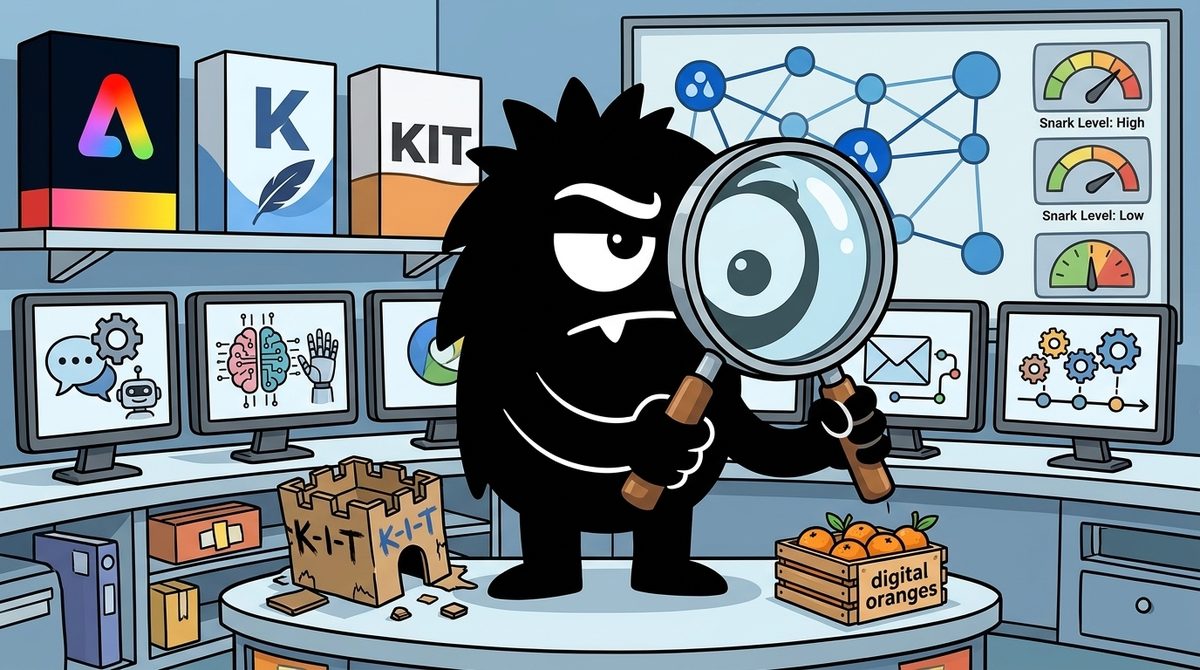
The real question is not whether Adobe Express or ConvertKit has “more AI.” It is which product can automate the customer interaction you need: answering questions, routing issues, delivering self-service content, or following up after a purchase.
Bottom line for 2026:
- Choose ConvertKit—now branded Kit—for creator-scale onboarding, lifecycle emails, purchase-triggered follow-up, and proactive support communication.
- Choose Adobe’s broader AI stack for conversational self-service and AI-assisted ticket triage—but Adobe Express alone is not a support platform.
- Choose a dedicated helpdesk when you need ticket ownership, queues, service-level agreements, escalation, or a reliable record of support conversations.
For most solo creators and small teams, Kit is the more practical automation product. For enterprises trying to deflect support volume through conversational agents, Adobe has the stronger direction—but that capability extends well beyond an Adobe Express subscription.
Two Very Different Tools, One Confusing Question
Adobe Express and ConvertKit occupy different software categories.
Adobe Express is primarily a creative production platform. Its AI Assistant supports conversational creation and editing: users can describe what they want to make or change instead of manually manipulating every design element.[1] Adobe positioned the assistant at Adobe MAX in October 2025 as a way to create and edit content conversationally while preserving user control.[2]
ConvertKit, renamed Kit, is primarily an email marketing and creator lifecycle platform. Its automation system connects events such as form submissions, purchases, tags, and subscriber attributes to email sequences and other actions.[7]
That distinction matters because neither product is a conventional helpdesk. A helpdesk normally provides:
- A shared customer inbox
- Ticket assignment and ownership
- Priority and category queues
- Escalation paths
- Response-time tracking
- Conversation history
- Service-level agreement, or SLA, reporting
Kit can automate communication around a customer issue, but it does not become a ticketing system merely because it has workflows and customer records. Adobe Express can produce support content, but it does not become a support agent merely because users can interact with its design tools conversationally.
The confusion is understandable. Nathan Barry’s roadmap for the ConvertKit ecosystem described analytics, publishing, a Trello-style CRM, templates, advertising infrastructure, subscriber imports, and deeper APIs:
We've got big things coming in the @ConvertKit ecosystem:
1. A revolutionary new analytics platform so you can see exactly where your results and revenue are coming from.
2. An entirely new content publishing workflow and site/newsletter builder.
3. A custom Trello-style CRM so you can track, interact with, and close your high value leads.
4. A paid template marketplace so you can buy email designs from the world's best designers.
5. A new ad management platform with a huge collection of sponsor brands built in.
6. The ability to import paid subscribers from other platforms.
7. New APIs for deep integrations with other apps (what Mighty Networks used to build their native integration)
...and much more.
We ship one new feature a week, every week.
All to help creators earn a living.
That is an ambitious creator-business ecosystem. But an expanding CRM and automation layer should not be mistaken for full customer support operations. Tracking a customer and sending an automated message are different from understanding, resolving, and escalating that customer’s problem.
What Does Customer Support Automation Actually Require in 2026?
To compare Adobe Express and Kit fairly, start with the job rather than the product category. Customer support automation generally has four layers.
1. Triage
Triage identifies the issue, determines its urgency, and routes it to the right destination. A useful triage system might distinguish a billing problem from a password reset, identify an angry high-value customer, or escalate a safety-sensitive complaint.
This usually requires access to the customer’s message and context—not simply a marketing tag.
2. Conversational self-service
Self-service answers routine questions without human intervention. Older systems relied on keyword-driven chatbots and static decision trees. Newer agentic systems can interpret natural-language requests, retrieve relevant information, ask clarifying questions, and potentially perform approved actions.
Adobe argues that agentic AI can reduce support load by moving beyond static FAQ experiences toward more adaptive self-service.[3] The important production question is not whether an agent can generate plausible text. It is whether the agent is grounded in approved information, respects permissions, exposes uncertainty, and hands off safely when it cannot resolve the issue.
3. Automated responses and support content
Not every interaction needs a live agent. Customers may need a troubleshooting graphic, short tutorial, personalized instructions, product update, or status notification.
This is where content production becomes support infrastructure. Adobe Express’s conversational editing and at-scale content capabilities can help teams produce and adapt such assets.[4] But creating the answer is not the same as selecting the correct answer for a particular ticket.
4. Lifecycle follow-up
Support does not end when the immediate problem is closed. Teams may need to send onboarding guidance, check whether a fix worked, provide renewal instructions, or educate customers after a purchase.
This is Kit’s natural territory. It can use customer events and attributes to place people into structured sequences.[7] That makes it effective for proactive and post-interaction communication, even though it lacks native ticket operations.
How Does Adobe Express Approach Support Automation?
Adobe Express contributes to support automation mainly through content creation, while Adobe’s wider enterprise AI portfolio addresses conversational service and triage.
Keeping those layers separate prevents a misleading conclusion about what Express itself can do.
Adobe Express AI Assistant creates support content conversationally
The Adobe Express AI Assistant lets a user request creative changes in natural language. That can accelerate production of:
- Help-center illustrations
- Onboarding checklists
- Troubleshooting cards
- Product education graphics
- Localized or audience-specific content variants
- Social posts explaining incidents or product changes
Adobe’s documentation describes the assistant as a conversational interface for creating and editing within Express.[1] Adobe also emphasizes generating and editing content while maintaining creative control and brand consistency.[2]
For a support organization, the outcome is faster content operations. A small team could turn a recurring question into a visual guide without routing every change through a specialist design queue. A larger team could adapt approved assets for different channels and audiences.
However, the Express AI Assistant is assisting the content creator. It is not, by itself, reading incoming customer tickets and resolving them.
Adobe’s Product Support Agent is closer to genuine support automation
Adobe’s broader AI work reaches further into operational support. Reporting on Adobe’s Product Support Agent describes a system designed to accelerate ticket triage for marketing operations by examining support requests and associated context.[6]
That is materially different from generating a branded FAQ image. Ticket triage operates inside a support workflow: understanding an issue, collecting context, classifying it, and helping direct the next action.
Adobe’s agentic self-service direction similarly focuses on conversational experiences that can handle more of a customer journey than a rigid chatbot.[3] This makes Adobe the stronger option in this comparison for organizations whose definition of automation is “let customers ask questions conversationally and resolve more issues without a human.”
The catch is substantial: these enterprise agent capabilities should not be treated as standard Adobe Express features. They belong to Adobe’s larger customer-experience and AI environment, with the implementation, data, governance, and integration requirements that implies.
Adobe fits content-heavy, enterprise-governed support
Adobe’s approach is strongest when:
- Support depends on large volumes of visual or branded material.
- The organization already uses Adobe products and customer-experience infrastructure.
- Conversational self-service is a strategic initiative rather than a simple email workflow.
- The team can manage knowledge grounding, identity, permissions, monitoring, and human handoff.
- Support and marketing operations share content systems and customer data.
It is a weaker fit when a two-person creator business simply needs to send the right onboarding email after someone buys a course.
How Does ConvertKit Automate Customer Follow-Up?
Kit approaches automation as a sequence of subscriber and customer events. Its visual automation builder connects entry points, conditions, actions, and email sequences.[7]
A typical support-adjacent workflow might look like this:
- A customer purchases a product.
- Kit applies a customer tag.
- The customer enters an onboarding sequence.
- A condition checks which product or plan they purchased.
- Kit sends the corresponding setup instructions.
- Several days later, it sends a “Do you need help?” message.
- Clicking a troubleshooting link applies another tag or triggers a different sequence.
This does not answer an open-ended support question. It can, however, prevent predictable questions from becoming tickets.
Visual automations are useful for known customer journeys
Kit’s strength is deterministic automation: when a known event occurs, run a defined workflow. Its templates give creators a starting point for common funnels and automation structures rather than requiring every flow to be built from scratch.[12]
That model works well for:
- Product onboarding
- Event or course reminders
- Membership instructions
- Failed-engagement follow-up
- Educational email series
- Purchase-specific guidance
- Renewal or expiration notices
- Post-support check-ins initiated by a tag or integration
Published Kit case studies attribute meaningful business outcomes to these automations; one describes a creator growing her business by 25% using Kit workflows.[10] That is evidence of lifecycle automation’s commercial value, not proof that Kit replaces a helpdesk.
CRM expansion brings Kit closer to customer operations—but not ticketing
A Trello-style CRM can give creators more visibility into high-value leads and customers. In a small business, that record may also help identify who needs personal follow-up.
Yet CRM stages such as “new lead,” “qualified,” or “customer” do not automatically model support concepts such as:
- Open versus resolved issues
- Ticket priority
- Assigned agent
- Escalation status
- First-response time
- Reopened conversations
- Customer satisfaction after resolution
Kit’s expanding ecosystem therefore creates support-adjacent customer context, not a full support operating system.
Integrations can extend Kit, but architecture matters
Kit has a built-in n8n node, allowing technical teams to connect subscriber operations to wider workflows.[9] n8n also documents workflows connecting Adobe and ConvertKit services.[14]
That makes hybrid implementations possible. For example, a helpdesk event could trigger an n8n workflow that updates a Kit tag and starts a post-resolution email sequence.
But an integration does not remove the need for a system of record. The helpdesk should still own the ticket, its status, and agent activity. Kit should own lifecycle messaging. Adobe Express should own relevant creative assets. Automation works best when each system has an explicit responsibility.
Which Is Better for Triage, Self-Service, Responses, and Follow-Up?
The answer changes by support function.
| Support requirement | Adobe Express and Adobe AI | ConvertKit/Kit |
|---|---|---|
| **Ticket triage** | Adobe’s broader Product Support Agent direction is relevant; Express itself is not a ticket queue | No native ticketing or AI triage |
| **Conversational self-service** | Stronger through Adobe’s wider agentic AI portfolio | Not designed for open-ended support conversations |
| **Support content creation** | Clear strength, especially for branded visual assets | Email templates and sequences are useful, but creative production is not the core advantage |
| **Automated email response** | Possible through broader Adobe systems, but not Express’s primary role | Strong for event-triggered and segmented email sequences |
| **Lifecycle follow-up** | Possible in Adobe’s wider marketing stack, generally with greater enterprise complexity | Clear strength for creators and small businesses |
| **Case ownership and SLA tracking** | Neither Express nor the cited agent capabilities should be assumed to replace a helpdesk | Not supported as a native helpdesk function |
| **Ease for a solo creator** | Express is accessible for content, but enterprise support agents are a different proposition | Better fit for predictable customer journeys and follow-up |
Adobe wins when “support automation” means understanding conversations
If the customer should be able to describe a problem naturally and receive a context-aware answer, Kit is the wrong category of product. Kit’s rules can respond to events, but they do not inherently interpret the meaning of an unstructured complaint.
Adobe’s agentic self-service work and Product Support Agent are more aligned with that requirement.[3][6] Even then, buyers must evaluate accuracy, retrieval architecture, access controls, observability, escalation, and cost—not merely the quality of a demonstration.
Kit wins when “support automation” means preventing repetitive questions
Many creators do not initially need AI ticket resolution. They need customers to receive the correct information at the correct moment.
Kit can send setup guidance immediately after purchase, branch onboarding by customer attributes, and follow up when someone does not complete a desired step.[7] Pre-built visual automation templates lower the effort required to structure those flows.[12]
That can reduce support demand indirectly. The system is not resolving tickets; it is preventing avoidable ones.
Neither wins when support requires operational accountability
Once multiple people answer customers, a marketing automation workaround becomes risky. Without native assignment and state management, two people may reply to the same issue—or nobody may reply because each assumes the other owns it.
A dedicated helpdesk becomes necessary when the business needs:
- Multiple support agents
- Measured response targets
- Escalations
- Omnichannel conversation history
- Auditability
- Reliable open, pending, and resolved states
- Customer satisfaction measurement
Kit can then handle lifecycle follow-up, while Adobe can support content production or more ambitious agentic experiences.
How Do Pricing, Learning Curve, and Team Fit Compare?
A direct sticker-price comparison is misleading because the products being compared do not deliver equivalent capabilities.
Adobe Express is accessible; Adobe’s support-agent stack is an enterprise decision
Adobe Express has consumer, team, and organizational use cases, with a continuing stream of AI and creative feature updates.[5] But the cost of Express should not be presented as the cost of Adobe-powered conversational customer support.
An enterprise deployment may also require customer data connections, knowledge sources, identity controls, integration work, monitoring, and governance. Comparisons of Adobe’s marketing environment and ConvertKit consistently place them in very different complexity and buyer categories.[13]
Best fit: design-heavy teams, established brands, and enterprises already invested in Adobe infrastructure.
Poor fit: a creator expecting an Express plan to provide a ready-made AI helpdesk.
Kit has the gentler path for creator lifecycle automation
Kit is structured around concepts creators already use: forms, subscribers, tags, purchases, sequences, and broadcasts. Guides to its sequences and automation builder show a relatively approachable visual model, although branching workflows can still become difficult to reason about as they grow.[8][11]
Third-party reviews generally frame Kit’s pricing and feature set around creator email marketing rather than enterprise customer service.[15] Teams should assess the size and growth of their subscriber base, because lifecycle-platform economics can change as the audience expands.
Best fit: solo creators, newsletter businesses, course sellers, coaches, and small digital-product teams.
Poor fit: a support department that needs queues, agent permissions, or SLA reporting.
Ecosystem expansion can create lock-in
Both vendors are broadening their scope. This is convenient until business-critical logic becomes spread across proprietary templates, CRM fields, AI configurations, and automation branches.
Reduce lock-in by keeping:
- Customer identifiers consistent across systems
- Critical knowledge in exportable, governed repositories
- Workflow documentation outside the automation canvas
- Clear ownership for each data field and process
- Integrations observable and recoverable after failures
Do not select an ecosystem merely because it can perform every task loosely. Select it because it performs your critical task reliably.
Who Should Choose Adobe Express, Kit, or a Dedicated Helpdesk?
Choose Adobe Express plus Adobe’s wider AI stack if:
- You need large amounts of branded support and educational content.
- You are pursuing conversational self-service at enterprise scale.
- You have the technical and operational capacity to govern AI agents.
- Your customer-support strategy is already connected to Adobe’s broader experience ecosystem.
- Ticket deflection and intelligent triage justify an enterprise implementation.
Adobe is the stronger direction for AI-mediated customer interaction, but the relevant product footprint is broader than Express.[3][6]
Choose ConvertKit/Kit if:
- You are a creator or small team with predictable customer journeys.
- Most support demand can be reduced through better onboarding.
- Purchases, subscriptions, tags, and engagement events should trigger follow-up.
- Email is your primary customer communication channel.
- You want visual automation without building an enterprise service architecture.
Kit is the better practical choice for proactive support communication and lifecycle follow-up. Its automation tools can reduce repetitive questions, but they should not be represented internally as ticket resolution.[7][10]
Combine them if content production and lifecycle delivery are both bottlenecks
A sensible division of responsibility is:
- Adobe Express: create and update visual support assets.
- Kit: deliver onboarding, education, and follow-up sequences.
- n8n or another integration layer: pass controlled events between systems.[14]
- Dedicated helpdesk: own customer conversations, ticket state, assignment, and reporting.
This architecture avoids forcing either product to impersonate a category it was not built to serve.
Pick a dedicated helpdesk first if support is already operationally complex
If customers are opening real cases that must be assigned, tracked, escalated, and audited, neither Adobe Express nor Kit should be the foundation.
The decisive 2026 verdict is therefore conditional but clear: Kit is better for most creator-scale “support automation” because those teams usually mean onboarding and automated follow-up. Adobe’s broader AI platform is better for actual conversational self-service and triage, while Adobe Express contributes content rather than case management. For mature support operations, use neither as the helpdesk.
Sources
[1] Adobe Express AI Assistant | Adobe Express
[3] Agentic AI self-service can reduce customer support load
[4] Adobe Express launches AI conversational editing
[5] What’s new in Adobe Express | Adobe Express
[6] AI-Powered Ticket Triage: Inside Adobe’s Product Support Agent
[7] Email Automation Tools | Automated Campaigns & Workflows for Creators | Kit
[8] ConvertKit (Kit) Automation Sequences: 2026 Guide + Examples
[9] ConvertKit | Nodes | n8n Docs
[10] How this creator grew her business by 25% using Kit automations
[11] Getting Started with Kit, Part 6: Sequences and Automations
[12] Visual automation templates: Get a headstart on your funnels
[13] Adobe Marketing Cloud vs. ConvertKit: Pros, Cons, Pricing & Ratings (2026)
[14] Adobe and ConvertKit: Automate Workflows with n8n
[15] ConvertKit Review 2025 — Features, Pricing & Alternatives
References (15 sources)
- Adobe Express AI Assistant | Adobe Express - helpx.adobe.com
- Adobe Introduces New AI Assistant in Adobe Express that Unlocks Creativity for All with Conversational Creation and Editing - news.adobe.com
- Agentic AI self-service can reduce customer support load - business.adobe.com
- Adobe Express launches AI conversational editing - adobe.com
- What's new in Adobe Express | Adobe Express - helpx.adobe.com
- AI‑Powered Ticket Triage: Inside Adobe’s Product Support Agent - vktr.com
- Email Automation Tools | Automated Campaigns & Workflows for Creators | Kit - convertkit.com
- ConvertKit (Kit) Automation Sequences: 2026 Guide + Examples - excelohunt.com
- ConvertKit | Nodes | n8n Docs - docs.n8n.io
- How this creator grew her business by 25% using Kit automations - convertkit.com
- Getting Started with Kit, Part 6: Sequences and Automations - clickandrepeat.com
- Visual automation templates: Get a headstart on your funnels - convertkit.com
- Adobe Marketing Cloud vs. ConvertKit: Pros, Cons, Pricing & Ratings (2026) - marketingautomationinsider.com
- Adobe and ConvertKit: Automate Workflows with n8n - n8n.io
- ConvertKit Review 2025 - Features, Pricing & Alternatives | Workflow Automation - workflowautomation.net
Related Guides

Traders Are Betting 96% on Anthropic: What Polymarket's $3.2M AI Model Market Signals for 2026
20 min read
Supabase vs Webflow vs Linear: Which Is Best for Building SaaS in 2026?
22 min read
The Best AI Model in 2026: What Polymarket's 96% Anthropic Bet Reveals About the AI Race
21 min read
Replit vs Cline: Which Is Best for Building SaaS Products in 2026?
17 min read