AutoGPT vs Vertex AI Agents vs LangChain: Which Is Best for Customer Support Automation in 2026?Updated: September 27, 2026
AutoGPT vs Vertex AI Agents vs LangChain for customer support automation, with pricing, architecture, and fit by team size. Compare
Why Customer Support Automation Has Become an Urgent Build Priority
Customer support automation is no longer a “nice to have” experiment for AI-forward teams. It’s increasingly a leverage function: a way to let small teams support larger customer bases without building a big support org. That’s the practical context behind any comparison of AutoGPT, Vertex AI Agents, and LangChain.
The pressure is obvious in the current conversation. Founders and operators aren’t bragging about chatbot demos anymore; they’re talking about resolution rates, staffing decisions, and whether AI can absorb the bulk of repetitive support work.
You’d be surprised at how many young guys are running 8 figure stores with extremely lean teams.
The reality is you don’t need a big team to scale. You need a small circle of good talent, detailed SOPs, and automations/workflows for certain processes.
One of the many systems we’ve spent a lot of time optimizing is customer support. Here’s how we use AI to handle over 90% of our CS tickets with zero human input:
Step 1: Export 200+ support tickets from Gorgias or your current helpdesk
Step 2: Feed them into ChatGPT and tag by intent:
→ Shipping, tracking, returns, product questions, setup
Step 3: Build custom response templates based on tone, content, and complexity
Step 4: Connect Gorgias to N8N/Zapier and trigger replies based on tag
Step 5: Add a human fallback for edge cases or escalations
It seems simple but this system reduced our CS load across the portfolio by a significant percentage, and we have no plans to hire any other reps anytime soon.
Want the prompt bank + system flow we use to install AI support in under 2 hours?
Like this post & comment ‘Support’. I’ll DM you our AI workflow & SOP.
And at the higher end, teams are reporting results that would have sounded implausible a year ago:
We've reached an all-time high of 87.6% autonomous resolution rate on @vercel support cases.
Best part: people truly love it. Even when the AI can't help, the overall UX is better (we auto-fill the ticket form).
Last week I had my "CEO supports day". It's now clear to me that:
1️⃣ Every single legitimate support case will be automated by AI. As in: the customer needs guidance.
2️⃣ The remainder of tickets will be triaged and prioritized by our AI PM for coding agents to work on
As far as 1️⃣ goes, as we continue to fine tune our agent, evals, models, and data sources, we are confident we can achieve near 100% resolution. Because we built and deployed our support agent on @vercel, we have full control over its destiny (screenshot below).
That shift matters because the target has changed. Teams aren’t just trying to deflect basic FAQ traffic. They want systems that can:
- identify intent,
- pull account or order context,
- execute actions like refund requests or status checks,
- escalate cleanly to humans,
- and preserve a trustworthy user experience when automation fails.
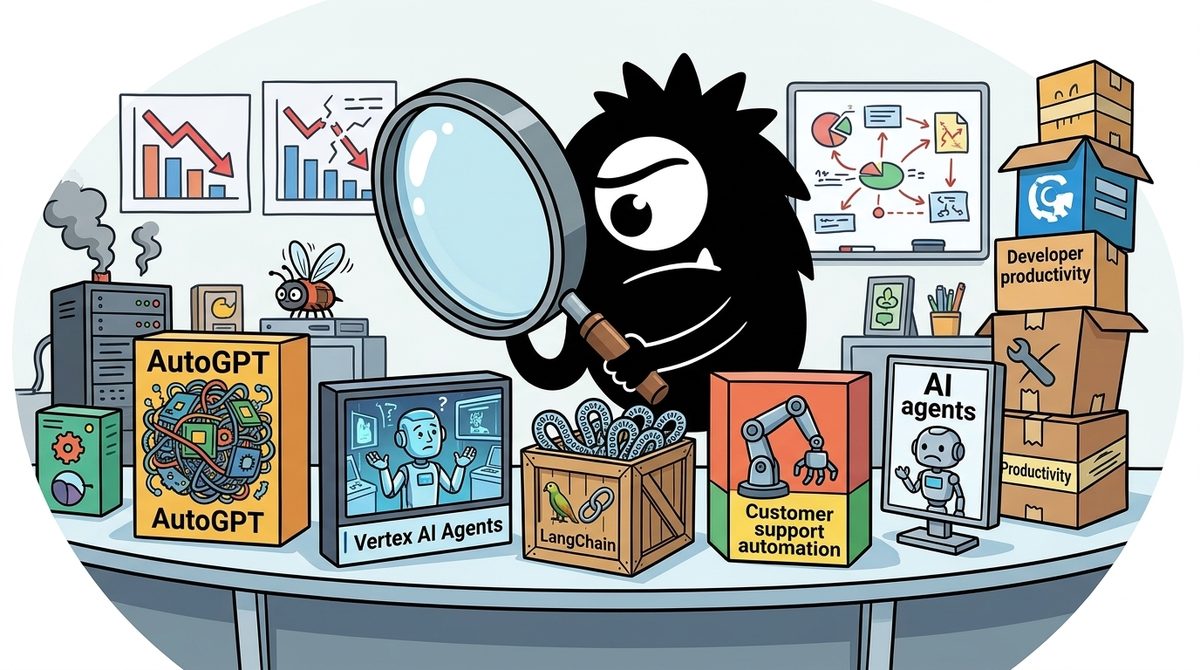
That last point is easy to miss. The strongest support automation stories are not just about autonomy; they’re about good failure handling. Google positions Vertex AI Agent Builder as infrastructure for generative AI experiences and enterprise agents, while AutoGPT frames itself around agents that can “finish the work.”[7][1] LangChain’s support examples increasingly emphasize production architecture, not toy assistants.[9]
So the real decision is not, “Which agent tool is most advanced?” It’s: Which stack fits the maturity of your support operation, your governance needs, and your tolerance for building missing pieces yourself?
AutoGPT vs Vertex AI Agents vs LangChain: Three Very Different Approaches
A lot of the confusion in this category comes from comparing things that sit at different layers of the stack.
To build saleable AI agents (autonomous systems that solve real problems and generate revenue):
1. Pick a specific pain point (e.g., automated sales outreach, contract review, or customer support).
2. Use frameworks like LangChain, CrewAI, or AutoGen + a strong LLM.
3. Give it tools (APIs, browsers, databases) + memory/loops for autonomy.
4. Test in real scenarios, add guardrails, then package as SaaS.
5. Sell via marketplaces (Product Hunt, Gumroad), B2B outreach, or your own site.
Start MVP in a weekend. Focus on ROI for buyers. What's the niche you're targeting?
That post gets one thing exactly right: useful agents need a specific problem, tools, memory, and guardrails. But the tools in this comparison provide those pieces in very different ways.
AutoGPT: agent runtime and platform for autonomous task execution
AutoGPT started in the open-source world as a framework for autonomous agents that can break goals into steps, use tools, and loop toward outcomes.[1] Today it spans both open-source components and a commercial platform message: “Stop building workflows. Start hiring agents.”[2] That positioning makes it attractive to teams that want agent-style task execution around support operations, especially if they prefer self-hosting or deeper control.
AI agents are changing how businesses handle automation, workflows, customer support, coding, and internal operations.
I compared OpenClaw vs Dify vs AutoGPT to see which platform is best for:
Read the full comparison here:
https://www.sadedar.com/openclaw-vs-dify-vs-autogpt/
#AI #AIAgents #OpenClaw #Dify
The catch: AutoGPT is not purpose-built for customer support. You can absolutely use it there, but you will often need to adapt it into a support-safe system.
Vertex AI Agents: managed enterprise platform
Google’s Vertex AI Agent Builder has evolved into the Gemini Enterprise Agent Platform, with tooling for building, deploying, and governing agents in enterprise environments.[8][10][12] It is less a lightweight framework and more a managed platform for organizations that care about deployment controls, enterprise integrations, and scaling under governance.
LangChain: developer framework and orchestration ecosystem
LangChain is best understood as a developer ecosystem for building LLM applications, not a single packaged support product. For support specifically, LangGraph has become central because it gives teams stateful orchestration and graph-based control over agent behavior, handoffs, and workflows.[13][14]
That difference is critical:
- AutoGPT is strongest as an autonomy-first agent approach.
- Vertex AI Agents is strongest as a managed enterprise platform.
- LangChain is strongest as a flexible developer toolkit for custom support systems.
If you treat them as interchangeable, you’ll make the wrong choice.
Which Tool Handles Stateful Workflows, Routing, and Escalation Best?
This is where customer support automation gets real. A useful support agent does not just answer questions. It moves through steps, remembers what already happened, routes to specialists, calls tools, and hands off to a human without making the customer start over.
I replaced a 15-minute booking nightmare with a stateful LangGraph agent. 🤖 The result? A customer support flow that actually remembers context, handles steps, and cuts friction to near-zero. Here's the blueprint 🧵 #AIAgents #Automation
View on XThat statefulness is exactly why LangChain, especially LangGraph, has so much momentum in support use cases.
🤖 Smart Agent Routing
Build intelligent chatbot systems that seamlessly route conversations between specialized agents while maintaining state, just like a real call center. Using LangGraph, implement state preservation, custom routing, and agent transitions with ease.
Learn how to build it 👉
LangGraph is well matched to support because it lets you define explicit nodes, transitions, and persistent state across a conversation. That means you can build flows like:
- classify the issue,
- retrieve account and policy context,
- invoke the right tool,
- route to a specialist agent if needed,
- escalate to a human with full transcript and decision history.
That architecture lines up closely with LangChain’s own guidance on customer support handoffs and multi-agent support patterns.[14][13]
If I built a #customer support #AI_Agent today:
#FastAPI
API + auth
#LangGraph
agent orchestration
PostgreSQL:
customers, orders, payments, conversations
Tools:
get_order_status()
get_payment_status()
create_refund_request()
escalate_to_human()
That post is practically a blueprint for the modern support stack: API layer, orchestration layer, transactional database, and explicit operational tools like get_order_status() and escalate_to_human().
Where Vertex AI Agents fits
Vertex AI Agents also supports structured support experiences, but with a more managed, enterprise orientation. Google’s customer experience tooling emphasizes conversational agents, enterprise deployment, and channel-ready support experiences.[8][10] If your priority is consistent deployment across web, self-service, and enterprise workflows, Vertex’s opinionated platform can be a strength.
The tradeoff is flexibility. You usually get less low-level orchestration freedom than with LangGraph, but more baked-in infrastructure.
Where AutoGPT fits
AutoGPT can automate support-related workflows, especially back-office or semi-autonomous tasks, but it is less naturally aligned with tightly controlled support state machines. You can wire it into support flows, but if you need deterministic escalation rules, strict transition logic, or compliance-sensitive routing, you’ll likely end up building extra orchestration around it.[1][9]
Verdict on workflows:
- Best for custom stateful routing: LangChain/LangGraph
- Best for managed enterprise support journeys: Vertex AI Agents
- Best for autonomy-heavy workflow experimentation: AutoGPT
Reliability First: RAG, Knowledge Grounding, and Hallucination Control
In customer support, the most dangerous bot is not the one that says “I don’t know.” It’s the one that sounds confident and is wrong.
That is why production support systems are increasingly grounded in retrieval-augmented generation, or RAG. Instead of relying purely on the model’s memory, RAG pulls from trusted sources like knowledge bases, policies, product docs, and customer records, then uses that material to generate answers.
🤖🏦 Demo Bank Support
A production-ready RAG chatbot powered by LangChain that delivers reliable AI customer support with built-in testing and monitoring. Features FastAPI backend, React frontend, and comprehensive RAG pipeline for accurate responses.
Learn more:
That framing is more important than most autonomy talk. Reliable support depends on grounding. LangChain’s public support demos consistently center on RAG pipelines, testing, and monitoring rather than just “agent magic.”[10]
🏦 Demo Bank Support Bot
A RAG-powered chatbot demonstrating reliable banking customer support. Built with LangChain's framework, it showcases how to prevent AI hallucination through comprehensive testing and evaluation.
Explore the complete solution on GitHub 🚀
That post gets at the heart of the issue: hallucination prevention is not an optional add-on in support. It is the product.
LangChain’s strength here
LangChain has unusually visible momentum around production-ready RAG support systems. Its examples and ecosystem increasingly pair retrieval with evaluation, tracing, and testable workflows.[10][13] For teams building custom support agents, this is a major advantage because the framework doesn’t treat retrieval as secondary.
Vertex AI Agents’ approach
Vertex AI Agents emphasizes enterprise data grounding and managed agent deployment.[8][10][12] For organizations already invested in Google Cloud, that can simplify the path from internal docs and structured data to support-grade agent behavior. The value isn’t just retrieval; it’s that retrieval sits inside a governed platform.
AutoGPT’s reality
AutoGPT is less defined by support-specific grounding patterns. In practice, it often makes the most sense for workflow assistance, drafting, task execution, or support-adjacent automation unless you deliberately engineer strong retrieval and guardrails around it.[1][5] That does not make it a weak tool. It means reliability is more your responsibility.
If your support bot can’t be trusted, your “autonomous resolution rate” is mostly a vanity metric.
Monitoring, Evaluation, and Production Operations: Where Projects Usually Succeed or Fail
Most support automation projects do not fail because the model is too weak. They fail because the team cannot see what the system is doing, cannot measure quality, and cannot improve it safely.
For his new article, @snr14 shares a step-by-step guide to building, running, and monitoring a stateful customer support agent using Python, LangGraph, and Langfuse. https://towardsdatascience.com/i-replaced-a-15-minute-booking-process-with-a-langgraph-ai-agent/
View on XThat post reflects a big change in the market: practitioners now talk about running and monitoring support agents as a first-class engineering task. Tracing, state inspection, and replayable workflows matter because support is an operational system, not just a UI feature.
LangChain’s operational advantage
LangChain’s broader ecosystem has made observability and evaluation part of the conversation. Support teams use tracing, test cases, and LLM-as-judge style evaluation to tune behavior over time. The platform examples around LangGraph and LangSmith have been especially influential.[13]
Lyft built a self-serve AI agent platform for customer support using Langchain & LangGraph.
And the most important part?
Non-technical teams can now build and improve AI agents without depending on ML engineers for every change.
Key architecture highlights:
• Router-based multi-agent system
• Specialized agents for different support tasks
• Stateful workflows with LangGraph
• Safety checks and agent handoffs
• Tracing, monitoring, and debugging with LangSmith
• Automated LLM-as-a-judge evaluations
• Human + AI collaboration loops
The result:
AI agent development time dropped from ~6 months to just a few weeks.
Their agents now help handle account access, damage claims, charge reviews, earnings disputes, rider and driver support at massive scale
This is a glimpse of the future where
companies will not build one giant AI assistant. They will build ecosystems of specialized autonomous agents orchestrated together.
This is the strongest real-world argument for LangChain in support: not just flexibility, but the ability for cross-functional teams to iterate on specialized agents with monitoring and evaluation loops.
Vertex AI’s operational advantage
Google’s managed platform brings a different kind of operational maturity: deployment infrastructure, lifecycle tooling, and enterprise governance controls.[8][12] For larger organizations, that matters as much as prompt quality. If legal, security, and platform engineering all need a seat at the table, managed controls can accelerate rollout more than a highly hackable framework.
AutoGPT’s operational question mark
AutoGPT can be powerful, but teams should be honest about how much production infrastructure they will need to assemble around it. Monitoring agent decisions, capturing traces, evaluating outputs, and managing regressions are not optional in support.[2] If you choose AutoGPT, assume you are taking on more of that systems work yourself unless your use case is narrow.
I took our exisitng support and AI'd it on a self hosted model, ai sorts all the tickets, auto closes rubbish, auto answers easy offers A/B test answers on others for support staff / tracks wins / losses and KB gaps - migh extend to live phone.
View on XThat self-hosted operator mindset is real, and for some teams it is exactly right. But it only works if you are willing to own the entire quality loop: ticket classification, auto-closing rules, A/B testing, win/loss tracking, and knowledge-base gap analysis. That is not “plug and play.” It is product engineering for support.
Learning Curve, Pricing Model, and Build-vs-Buy Tradeoffs
The deepest divide in this market is not technical ideology. It is operational preference: Do you want to build your support agent system, or adopt a platform that constrains you in exchange for speed and governance?
This maps closely onto the open-source-versus-commercial divide. AutoGPT and LangChain both have open-source, self-hostable roots, which gives teams more control over hosting, data, and agent behavior—but also shifts more of the cost of building, operating, and governing the system onto the team.[1] Vertex AI Agents is a managed commercial platform, which lowers infrastructure burden and bakes in governance and deployment tooling in exchange for platform dependence and Google Cloud pricing patterns.[8][10][12] In short: self-hostable frameworks trade higher engineering ownership for control and flexibility, while commercial platforms trade control for speed, governance, and lower operational overhead.
i am all for doing customer support myself. across 8+ of my products every email is routed to me.
about a month ago i launched my own support ticket system that is ai-driven before something gets to me. i did that because as a customer if i have a problem, i don't mind popping open a chat and having an ai-bot help me or direct me to where i need to go.
with my support ticket system, every chat can be turned into a ticket that goes directly to me.
i can see the conversations that users are having and 90% of them get solved without me lifting a finger. i can still gather feedback and reach out to the user if i need to get clarification on something.
for me, that's what's working at the moment.
That post captures why many smaller operators are excited about AI support: they want leverage without losing direct visibility into customer pain. But the path you choose determines how much engineering you absorb.
LangChain: maximum flexibility, maximum architecture responsibility
LangChain gives developers the most control over orchestration, tools, memory, prompts, and handoffs.[14] For product teams with strong backend skills, that is a huge advantage. For teams without them, it can turn into architecture debt quickly.
Expect to own:
- workflow design,
- retrieval quality,
- observability,
- evaluation harnesses,
- deployment patterns,
- and often UX details around escalation.
Vertex AI Agents: lower infrastructure burden, higher platform dependence
Vertex AI Agents reduces the amount of custom infrastructure you need to build and operate, especially around enterprise deployment and governance.[8][10] That often shortens the time to a production pilot in larger organizations.
The obvious tradeoff is lock-in. You are buying into Google Cloud’s platform model and pricing patterns. For enterprises, that may be acceptable or even desirable. For startups, it can feel heavy unless you already live in that ecosystem.
AutoGPT: appealing autonomy, variable implementation complexity
AutoGPT is attractive to teams that want self-hosting options, open-ended autonomy, or support-adjacent task automation.[1][2] But implementation complexity varies a lot by use case. A support copilot that drafts responses is much easier than a fully autonomous customer-facing support agent with action-taking permissions.
Also very interested in knowing what people are building with LangChain these days? Last year I was mainly seeing customer support agents, but saw this cool talk from Pinterest recently too https://t.co/tyJVHMhE37. Compiling a list!!!
View on XThat curiosity around LangChain points to a broader truth: practitioners increasingly choose stacks based on how much they want to customize. If you want a framework, choose a framework. If you want a managed platform, choose a platform. Don’t pretend those are the same buying decision.
Side-by-Side: Which Tool Fits Your Actual Support Use Case?
The cleanest way to decide is by use case, not by brand.
🏦🤖 Demo Bank: AI Customer Support
An open-source banking support chatbot using RAG and LangChain to deliver reliable customer service. Built for production with FastAPI/React, comprehensive testing, and advanced tracing capabilities.
Learn more: https://t.co/yk927cnBmg
⚙️ What it does:
A step-by-step guide to building, running, and monitoring a stateful customer support agent using Python, LangGraph, and Langfuse. The post I Replaced a 15-Minute Booking Process with a LangGraph AI Agent appeared first on Towards Data Science.
Best fit by scenario
| Use case | AutoGPT | Vertex AI Agents | LangChain |
|---|---|---|---|
| **FAQ / RAG chatbot** | Possible, but not its natural center of gravity | Strong if you want managed enterprise deployment | **Best for custom, production-grade RAG builds** |
| **Transactional assistant** (order status, refunds, account actions) | Good for agent-style task execution, but needs guardrails | Strong with enterprise integrations and managed ops | **Excellent if you want explicit tool control and stateful flows** |
| **Ticket triage and routing** | Useful for workflow automation | Strong in enterprise workflows | **Best if routing logic is complex or multi-agent** |
| **Omnichannel enterprise support** | Usually requires significant assembly | **Best managed choice** | Viable, but you’ll build more yourself |
| **Internal support copilot for agents** | Strong candidate | Strong candidate | Strong candidate, especially with custom workflow logic |
In plain English:
- Choose LangChain when support is a product capability you want to engineer deeply.
- Choose Vertex AI Agents when support is an enterprise platform capability you want to operationalize safely.
- Choose AutoGPT when you want autonomy-first experimentation or workflow-heavy support operations with more control over hosting and agent behavior.
Who Should Use AutoGPT, Vertex AI Agents, or LangChain?
Here’s the decisive version.
Choose AutoGPT if…
You want to experiment with autonomous agents around support operations, especially if self-hosting and workflow flexibility matter more than polished managed infrastructure. AutoGPT is a reasonable choice for startups or technical operators building internal support automations, response drafting, triage flows, or task-executing agents around the support desk.[1][2]
Choose Vertex AI Agents if…
You are an enterprise team that needs governance, managed deployment, scaling, and customer experience tooling in one platform. If your stakeholders include security, compliance, platform engineering, and support leadership, Vertex is often the most practical answer.[8][10][12]
Choose LangChain if…
You are a product or platform team building a deeply customized support system with state, routing, tool use, handoffs, and rigorous evaluation. In 2026, LangChain—really LangChain plus LangGraph and observability tooling—is the strongest choice for teams treating support automation as a serious software system rather than a chatbot feature.[13][14]
My opinion: for most advanced customer support automation builds, LangChain is the best technical fit because support is fundamentally a workflow and reliability problem. For large enterprises, Vertex AI Agents is the best organizational fit because governance and deployment are part of the product. AutoGPT is best used selectively, where autonomous task execution is the goal and your team is comfortable owning more of the surrounding platform work.
The winning stack is not the one with the most agent hype. It’s the one that helps you automate aggressively without making support feel less trustworthy.
Sources
[1] AutoGPT — AI agents that finish the work
[2] AutoGPT — Stop building workflows. Start hiring agents.
[7] Build generative AI experiences with Vertex AI Agent Builder | Google Cloud Blog
[8] Gemini Enterprise Agent Platform (formerly Vertex AI) | Google Cloud
[9] Customer Experience Agent Studio | Google Cloud
[10] Vertex AI Agent Builder documentation | Google Cloud Documentation
[12] Agent Platform overview | Gemini Enterprise Agent Platform | Google Cloud Documentation
[13] How Minimal built a multi-agent customer support system with LangGraph & LangSmith
References (15 sources)
- AutoGPT — AI agents that finish the work - github.com
- AutoGPT — Stop building workflows. Start hiring agents. - agpt.co
- What is AutoGPT? - ibm.com
- AutoGPT: Overview, advantages, installation guide, and use cases - leewayhertz.com
- What is AutoGPT? Complete Guide to Building AI Agents - codecademy.com
- AutoGPT: Architecture, Performance, & Applications - labellerr.com
- Build generative AI experiences with Vertex AI Agent Builder | Google Cloud Blog - cloud.google.com
- Gemini Enterprise Agent Platform (formerly Vertex AI) | Google Cloud - cloud.google.com
- Customer Experience Agent Studio | Google Cloud - cloud.google.com
- Vertex AI Agent Builder documentation | Google Cloud Documentation - docs.cloud.google.com
- Building AI Agents with Vertex AI Agent Builder | Google Codelabs - codelabs.developers.google.com
- Agent Platform overview | Gemini Enterprise Agent Platform | Google Cloud Documentation - docs.cloud.google.com
- How Minimal built a multi-agent customer support system with LangGraph & LangSmith - langchain.com
- Build customer support with handoffs - docs.langchain.com
- Implementing a sales & support agent with LangChain - medium.com
Related Guides
Aider vs Cline: Which Is Best for AI Pair Programming in 2026?
15 min read
The Best AI Model Tools in 2026: An Expert Comparison Through a $4M Polymarket Bet
25 min read
What Is Replit? A Complete Guide for 2026
19 min read
Traders Are Betting on Anthropic: What Polymarket's 99% AI Model Odds Reveal for Developers in 2026
20 min read