Traders Are Betting 96% on Anthropic: What Polymarket's $3.2M AI Model Market Signals for 2026
Polymarket's $3.2M AI model market prices Anthropic at 96% while X debates cost, enterprise, and Google's comeback. See what the odds mean for SaaS buyers.
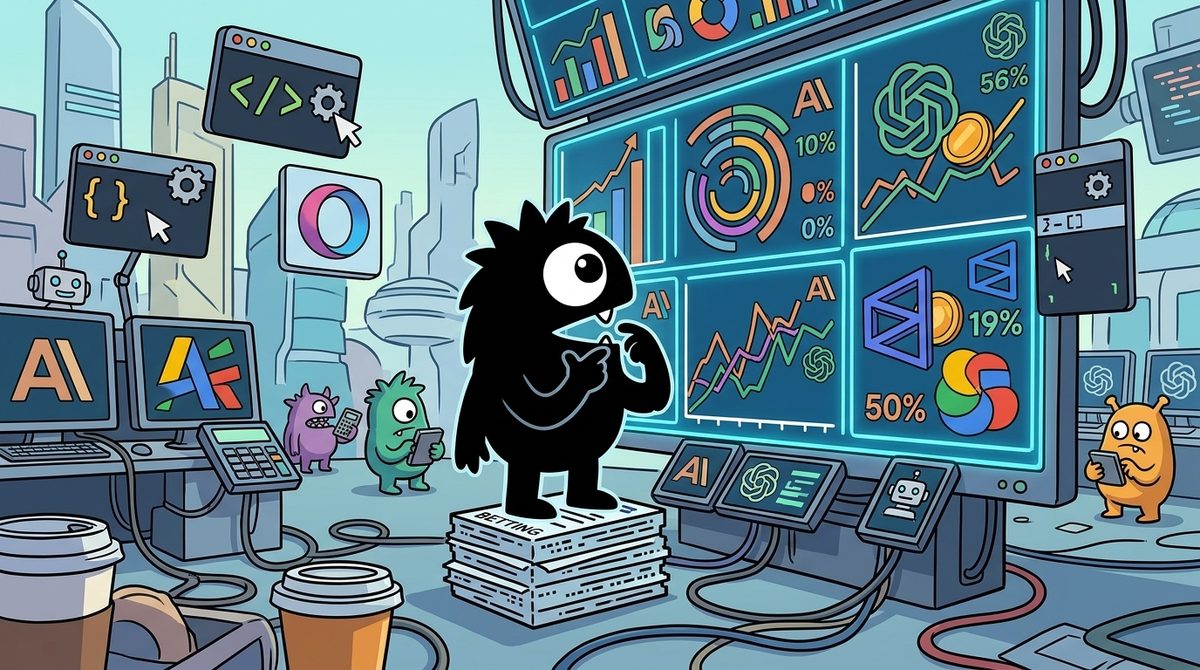
The practical question for developers, founders, and SaaS buyers is not whether Anthropic has already “won” AI. It is whether Polymarket’s overwhelming Anthropic position should influence model selection, vendor strategy, or infrastructure spending before September ends.
Bottom line: As of September 13, 2026, traders price a 96% probability that Anthropic will hold the qualifying top model position at the end of September, versus 3% for Google and 1% for OpenAI. That is a strong near-term leaderboard signal—not a prediction of long-term platform dominance, superior economics, or the best model for every workload. The actionable lesson is to take Anthropic’s capability lead seriously while preserving provider flexibility, because cost, distribution, and infrastructure ownership point to a much more competitive industry than the headline odds suggest.
The 96% bet: What is Polymarket actually pricing?
The Polymarket market asks which company will have the best AI model at the end of September 2026. It is expected to resolve around October 1 using the specified September 30 snapshot of the arena.ai Text Arena leaderboard.[6] As of September 13, approximately $3,206,510 has traded in the market.
Traders currently price the named outcomes as follows:
| Company | Implied probability | Volume traded |
|---|---|---|
| **Anthropic** | **96%** | **$700,417** |
| **Google** | **3%** | **$276,953** |
| **OpenAI** | **1%** | **$613,597** |
| **Meta** | **~0%** | **$331,998** |
| **SpaceXAI** | **~0%** | **$280,852** |
| **Alibaba** | **~0%** | **$177,286** |
These prices are visible across the market and prediction-market trackers covering the contract.[1][2][3] A 96% price means traders collectively value an Anthropic “Yes” share at roughly $0.96—not that Anthropic is guaranteed to win.
That distinction matters. The market is pricing one model’s position on one leaderboard at one cutoff, not safety, API reliability, enterprise adoption, developer experience, revenue, or five-year strategic durability. Rounded 0% prices likewise mean the market sees very little chance under these specific conditions, not that Meta, xAI, or Alibaba are irrelevant.
The volume also reveals disagreement that the headline prices hide. OpenAI has attracted about $613,597 in trading, nearly Anthropic’s volume, despite its current 1% implied probability. Volume measures turnover, not net bullish conviction, but it suggests active repositioning rather than indifference.
A separate year-end market discussed on X shows how expectations change with the time horizon:
Anthropic is priced at 64c to have the best AI model at the end of 2026, OpenAI at 15.5c. Our OpenAI vs Anthropic index has read 12.3% weaker over the last 30 days, so the gap was there before anyone was accused of routing users to Claude.
View on XThe September contract is therefore best read as a short-duration leaderboard trade. Longer-duration markets leave more room for surprise releases, benchmark movement, and shifting product strategies.
Why do traders currently favor Anthropic so heavily?
The simplest explanation is that the market believes Anthropic enters the final weeks of September with the model to beat. Claude Fable 5.1, released at the beginning of the month according to release tracking and leaderboard coverage, is being treated as the current frontier leader in the conversation surrounding the contract.[7][8][11] Anthropic had also introduced Claude Opus 5 in July, reinforcing the impression of sustained model momentum rather than a one-off result.[12]
That recent release cadence matters because the contract has little time remaining. A rival does not merely need a promising research announcement. It may need to release a qualifying model, make it available for evaluation, accumulate enough arena comparisons, and overtake Anthropic before the snapshot. Traders currently imply that sequence is unlikely—but not impossible.
The bullish case extends beyond the benchmark. Anthropic’s supporters increasingly frame it as a vertical AI infrastructure company rather than another consumer chatbot vendor:
This is Anthropic telling you they stopped competing with OpenAI on chatbots at the end of 2024. Jared Kaplan, their Chief Science Officer, admitted it publicly. They’re building vertical AI infrastructure across five high-margin regulated industries where GPT-4 wrappers can’t compete.
The numbers tell the story. Revenue went from $1B in January 2025 to $5B+ by August. $183B valuation. Claude Code alone generates $1B in run-rate revenue with 10x growth in three months. They did $9B+ in 2025, projecting $26B in 2026.
Here’s the constraint nobody’s pricing in: Claude for Life Sciences launched in October with direct integrations into Benchling, 10x Genomics, and PubMed. Their Head of Biology said the goal is “a meaningful percentage of all life science work in the world running on Claude.” They’re not fighting for consumer attention. They’re embedding into the workflow layer where switching costs compound monthly.
The DOE Genesis Mission partnership gives them access to all 17 national laboratories for energy and biosecurity applications. The cybersecurity team doubled Claude’s success rate on Cybench in six months. The audio team is building speech language models while competitors are still optimizing text.
OpenAI is burning $74B through 2028 to own the ChatGPT interface. Anthropic is building the picks and shovels for regulated industries that require domain expertise, compliance frameworks, and enterprise integrations.
MCP, Agent Skills, Claude Cowork. All open standards. Microsoft already adopted Skills in VS Code and GitHub. Cursor, Goose, Amp running on Anthropic infrastructure. GitHub Copilot’s default model is Claude Sonnet.
They’re becoming the middleware layer that every AI application needs to touch regulated data.
That ABCDE is a roadmap for vertical integration into five industries worth trillions.
The revenue, valuation, partnership, and adoption figures in that post represent the author’s argument, not independently established facts from the prediction market. But the strategic thesis helps explain trader confidence: Anthropic is associated with high-value coding and agentic work, regulated-industry integrations, and infrastructure standards such as Model Context Protocol.
For founders, this is important because a model lead becomes more durable when it is embedded in workflows. A slightly better chatbot can be replaced. A model connected to internal repositories, permissions, laboratory systems, or compliance processes is harder to dislodge.
Yet the market may also be compressing several different judgments into one price:
- Fable 5.1 currently leads the relevant evaluation.
- Anthropic can defend that lead through September 30.
- Rivals are unlikely to release and qualify something stronger in time.
- The leaderboard and resolution process will behave as expected.
A failure in any one assumption could reprice the contract sharply.
Is Claude’s cost structure the risk that 96% odds understate?
The strongest Anthropic bear case on X is not primarily about intelligence. It is about the cost of converting intelligence into sustained production work.
Prediction: Claude has massively taken the lead right now because they offer a better product, but that comes at a massive cost.
Buyers have not realized that included in a Claude subscription is not enough tokens to get real work done and that overages will cost $400 to $1,000 per day per user. Anthropic will need to buy significantly more compute, but because they don't own their own data centers, the cost to serve will continue to go up.
Spend will shift gradually and then quickly back to OpenAI, who can offer comparable models but at a much lower cost basis because they own their own data centers. Cost of inference will become the only competitive advantage making this market a race to the bottom.
Apple or Google will buy or merge(!!!) with Anthropic.
Claims of $400 to $1,000 per day per user are anecdotal projections circulating in the X conversation, not a general price guaranteed for every customer. Actual expenditure depends on model tier, token volume, context reuse, caching, agent loops, tool calls, and negotiated enterprise terms. Still, the concern is credible in direction: agentic systems can consume far more tokens than chat interfaces because they repeatedly inspect context, call tools, revise plans, and retry failed steps.
Anthropic’s current model catalog and pricing structure make model and tier selection material to total cost.[10] Teams should therefore model a completed workflow—not a single prompt. The relevant metric is often cost per resolved support case, merged pull request, completed research task, or accepted design, rather than cost per million tokens alone.
Long-context behavior complicates simplistic price comparisons:
OpenAI GPT-5.6 models and Anthropic Claude 5 models have different pricing structures at long context lengths. GPT model costs increase in price past 272k input tokens, while Claude model costs remain fixed.
Does this reflect an underlying difference in the architecture of these models? Our measurements of serving latency suggest so.
We studied time to first token (TTFT) on these models and how it scales with increasing context length. We found a significant difference in how they scale, with GPT showing a noticeable quadratic component, while Claude models remain closer to linear.
Epoch AI’s post suggests that Claude 5 and GPT-5.6 may scale differently as context grows. Claude’s fixed long-context pricing and closer-to-linear time-to-first-token behavior could benefit document-heavy workloads, even if another provider appears cheaper on a standard prompt. Conversely, a workload dominated by short interactions may favor a less expensive model or smaller tier.
This is the critical disconnect in the market: “best model” is not synonymous with “best unit economics.” A leaderboard rewards user preference or measured capability under defined conditions. A CFO evaluates utilization, overages, latency, failure rates, governance, and switching costs.
Anthropic is therefore most compelling for teams where additional capability has high economic value—complex coding agents, difficult document analysis, design, or regulated workflows. It may be a poor default for thousands of low-intensity seats if a cheaper model produces an acceptable outcome.
Does OpenAI’s 1% probability understate its enterprise position?
Almost certainly—because the 1% applies to the September leaderboard outcome, not OpenAI’s overall competitive standing.
OpenAI’s counter-case is based on distribution. ChatGPT has consumer familiarity, existing organizational relationships, and a product surface that can become the default entry point for employees. The sharpest version of that argument on X is that Anthropic’s reputation among technical elites may obscure OpenAI’s network effects:
Silicon Valley groupthink: Anthropic has the smartest researchers, Claude is the best model, B2B is where the revenue is.
Reality:
– Codex UX is 10x Claude Code’s product
– Claude got mogged in consumer
– 1B people use “ChatGPT” as a verb
Talent density does NOT beat network effects. OpenAI can just hire B2B salespeople.
Long OpenAI.
The post’s product-quality and usage claims are advocacy, not conclusions established by this market. But its strategic point is important: the most capable model does not always become the dominant software platform. Defaults accumulate connectors, stored context, permissions, training investment, and internal support processes.
That dynamic is already part of the enterprise debate:
Hot take: OpenAI may actually have a shot at enterprise vs Anthropic.
Pattern across some F500s right now: ChatGPT as the org-wide default, Claude ring-fenced for power users because of 1.) variable-cost fear and 2.) “more model than the median employee needs.”
The first is a trap of Anthropic’s own success. Claude’s identity is welded to agentic workloads like Claude Code. The horror-story AI invoices circulating in CFO Slacks are tied to Anthropic (for now).
The second is more damaging. “Too smart for the median employee” means frontier capability stops being the purchase criterion for 90% of seats, and a capability lead stops converting into distribution.
The second-order effect: the default surface accumulates the org’s connectors, permissions, and working context and maybe advanced users eventually converge on wherever their team already operates.
A possible end state: “our OpenAI relationship,” is board-level, vs “our Claude spend,” reviewable and cuttable.
What happens if you don’t have to win the model race to win enterprise, you just have to win the default?
If this reported Fortune 500 pattern becomes widespread, OpenAI could lose the benchmark contest while winning more seats. Claude would occupy the premium power-user tier; ChatGPT would become the organizational standard. That resembles many mature SaaS categories, where the technically strongest specialist product coexists with a broader suite sold through an enterprise agreement.
OpenAI’s approximately $613,597 in market volume is consequently worth watching. At a 1% implied probability, traders currently see little chance of an end-of-month leaderboard win, but substantial turnover indicates that participants continue to debate release timing and upside.
Who should favor OpenAI now? Organizations prioritizing broad employee adoption, familiar interfaces, centralized procurement, and a common collaboration surface have a stronger reason to choose it than the 1% number implies. Teams whose differentiation depends on maximum model capability should treat the leaderboard signal more seriously.
Why is Google the market’s 3% dark horse?
Google’s 3% implied probability is small, but it still makes Google the market’s second choice. More importantly, Google has a strategic advantage that this contract barely measures: it can combine models, cloud infrastructure, productivity distribution, and custom accelerators.
Earlier prediction-market discussion captured the infrastructure thesis:
Over the last few days, on Polymarket, $GOOGL's lead as the best AI model by the end of 2025 has increased even further.
Anthropic odds have also risen, while those of OpenAI and xAI have decreased.
While $GOOGL's market share in LLM search will be much lower than the market share it has on traditional search on the enterprise side if $GOOGL turns out to be the best model provider and on top of it offers them via GCP on their TPU infrastructure, GCP's value could be much more than the market current anticipates.
A leading Gemini model delivered through Google Cloud and TPU infrastructure could create value even without dominating consumer chat. Google can potentially monetize inference, cloud consumption, Workspace distribution, and model access together. That is a different competitive position from a laboratory that must make frontier-model economics work more directly.
The “AI pair trade” circulating among investors combines this infrastructure advantage with signs that Gemini has been reducing ChatGPT’s traffic lead:
Jason's AI Pair Trade: Short OpenAI. Long Google, xAI, and Anthropic.
Why? OpenAI's competition is fierce.
"They're facing a Google firing on all cylinders, Anthropic, and Grok beating them in the leaderboards pretty consistently."
Polymarket has Google's Gemini 3 at ~87% to finish 2025 as the top-ranked LLM.
Over the last six months, Gemini has started to shrink ChatGPT's massive lead in traffic share.
The market currently does not imply that Google is likely to take the specified September leaderboard position. But its 3% price makes it the most obvious swing factor. A late qualifying release, unexpected arena performance, or resolution-relevant update could move the contract quickly.
There is also a longer-term “workhorse model” thesis:
A slowdown dramatically favors Google and Microsoft. OpenAI and Anthropic are betting their IPOs on being the frontier. Meanwhile, Google and Microsoft will provide workhorse models to every company on the planet at scale.
View on XIf frontier progress slows, the value of holding the absolute top benchmark position may decline. Enterprises would increasingly select models based on price, reliability, security, regional availability, and integration with existing cloud contracts. Such a slowdown could favor Google and Microsoft even if specialist labs retain modest capability leads.
Google therefore fits buyers already standardized on Google Cloud or Workspace, particularly when procurement simplicity and large-scale inference matter more than winning every evaluation.
Why do near-zero odds obscure a much wider frontier race?
Meta, SpaceXAI, and Alibaba are currently shown at approximately 0% in the September market. Those prices should be read as timing and resolution judgments, not comprehensive evaluations of their technology.
The broader frontier has expanded rapidly:
It’s worth really grasping this: in a very short time, the race between OpenAI and Anthropic has turned into a contest involving OpenAI, Anthropic, xAI, and Meta, and Google is back in the mix, too.
They are all on (mostly) equal footing, with little difference between them even in benchmarks like the Artificial Analysis Intelligence Index.
Chinese open-weight models are hot on their heels as well. 2026 is truly a wild year, release after release, a completely different landscape compared to the year before. We’re seeing unprecedented leaps in capabilities.
I remember the debates in 2025 about whether we had hit a wall; today, we see major improvements every single day. You can practically feel the exponential growth kicking in.
Independent model leaderboards now compare a large and changing field across performance, pricing, speed, and task categories.[13][14][15] Chinese open-weight families add another competitive layer because developers can deploy, fine-tune, or host them without depending exclusively on a closed API.
The evaluation regime is changing too:
Artificial Analysis had to lock 40% of their new index behind private test sets just to get honest signal on frontier models.
4 quick takeaways:
- Qwen 3.8 27b on par with GPT 5.6 Luna and Deepseek v4 pro. Beats the new K2 horizon 375b a23b
- Claude Fable 5.1 holds #1, but GPT-6 Astra is a token efficiency monster
- Long context reasoning is moving to messy real world slop (4,500+ pages of footnotes, charts, tables)
- Google sitting behind Meta muse spark 1.3, SpaceXAI grok 4.3, Moonshot kimi k3 and ziphu glm 5.3 on the leaderboard. genuinely what is deepmind’s play here?
- RIP GPQA Diamond. Labs finally contaminated and gamed it into irrelevance.
The era of testing models on cute multiple choice science questions is over. It’s agentic enterprise grunts or bust now.
If conventional benchmarks have become contaminated through training exposure or optimization, private test sets and messy long-context tasks become more valuable. That makes “best” harder to define. A model might lead on aggregate intelligence while losing on software debugging, visual design, latency, tool use, multilingual performance, or cost.
Even the Fable-versus-Astra debate is task-specific:
It is over for Anthropic.
GPT 6 Astra beats Fable 5.1 in speed, cost, intelligence, backend, one shot, and debugging.
Fable 5.1 still wins design. That is it.
Fable 5.1 is the best design model in the world.
GPT 6 Astra is the best overall model in the world.
That post argues GPT-6 Astra is stronger overall while conceding Fable 5.1’s design advantage. Another X voice narrows Anthropic’s strength to a single leading model and questions its tier limits:
anthropic has only one world-class model right now: Fable 5.1
and even that comes with very annoying limits depending on the tier
meanwhile, if openai keeps the same naming structure going into GPT-6 Astra, they would end up with something like:
GPT-6 Astra
GPT-6 Sol
GPT-6 Terra
GPT-6 Luna
that is at least 3 SOTA models
Whether those assessments prove durable is less important than the fragmentation they expose. SaaS applications do not purchase “overall intelligence” in the abstract. They purchase performance on a workflow.
For a design product, Fable’s specialization could matter more than an aggregate score. For high-volume extraction, an efficient open-weight model might be preferable. For sensitive deployments, controllability and hosting options can outweigh arena rank. Near-zero September odds do not remove those vendors from such decisions.
How can you read prediction-market odds without getting played?
Prediction markets aggregate information, incentives, and speculation. They can be useful—but only if readers inspect what generates the number.
1. Separate informed trading from unverifiable “insider” narratives
Wallet watchers routinely identify clusters that appear unusually well informed:
OpenAI insiders on Polymarket dont even try to hide
I’m tracking a "God Mode" cluster on Polymarket betting on OpenAI.
Their winning bets:
OpenAI Browser by Oct 31
OpenAI Social App in 2025
GPT-5 & Open Source model predictions
Gemini 3.0 Release (?)
Current Play: They are aggressively buying "Yes" on the New Frontier Model release 👉https://t.co/5esgqmqXGt
OpenAI salaries must be lower than I thought.
Dropping the wallet list in the replies 👇
Such claims may attract attention, but wallet behavior alone does not prove inside information or employment at a particular company. Clusters can represent skilled public-source traders, coordinated accounts, hedging, copying, or coincidence. Treat unusual flows as a reason to investigate the market—not as confirmation of a leak.
2. Read the exact resolution criteria
The relevant questions are:
- Which leaderboard decides the winner?
- Which category or mode counts?
- What is the precise snapshot time?
- How are ties handled?
- Must a model be publicly available?
- What happens if the leaderboard changes methodology?
The September market resolves a narrow proposition based on its published rules.[6] A model that practitioners consider superior may still lose the contract if it does not qualify under those rules.
3. Do not confuse volume with fresh capital or conviction
The roughly $3.2 million figure is trading volume, not necessarily $3.2 million currently at risk. The same shares can change hands repeatedly. High outcome volume can reflect disagreement and turnover as much as confidence.
4. Compare narrowly worded markets
A related Anthropic market concerning qualifying Millennium Prize Problems illustrates how exact wording dominates settlement:
Anthropic has 17 days to announce a solution to one of five qualifying Millennium Prize Problems. The market gives it 17%.
The context: in August, a Claude research model advanced work on the Riemann Hypothesis – raising a key bound from 41.6% to 67.2%. Progress, not a solution.
Then came the Navier–Stokes drama: an Anthropic researcher co-authored a major breakthrough on closely related fluid equations on Sep 7. OpenAI announced its Navier–Stokes solution the next day. But Navier–Stokes is explicitly excluded from this market.
No qualifying announcement from Anthropic. And no indication that a full solution to any of the five qualifying problems is close.
NO at 84¢ | ~19% upside | Sep 30
Progress on a problem is not necessarily a qualifying solution, and work on an excluded problem does not satisfy the contract. AI leaderboard markets have the same property: adjacent achievements do not count unless the resolution rules say they do.
The practical interpretation is: 96% represents the market’s current consensus under a contract, not an oracle’s view of technological truth.
What should developers, founders, and SaaS buyers do with the September odds?
Developers: route by task and instrument spend immediately
Use Anthropic where Fable 5.1’s apparent lead produces measurable gains, especially in demanding agentic, design, coding, or long-context work. Use cheaper or smaller models for classification, extraction, summarization, and other high-volume tasks where frontier capability adds little.
Track tokens, retries, tool calls, latency, cache hit rates, and cost per completed task. A flat monthly subscription estimate is inadequate for autonomous workloads.
Founders: avoid building the company around one leaderboard snapshot
A 96% near-term probability supports offering Anthropic as a first-class provider. It does not justify irreversible dependence on Anthropic-specific behavior.
Build an internal model gateway, maintain portable prompts and evaluations, separate business logic from provider SDKs, and test at least one alternative. Multi-model architecture carries engineering overhead, so very early startups may initially choose one provider—but they should preserve a migration path before usage and customer data make switching expensive.
SaaS buyers: evaluate total cost of ownership, not model prestige
Run production-shaped pilots using your actual context lengths and concurrency. Include overages, implementation, security review, observability, support, data residency, and exit costs.
- Choose Anthropic when difficult-task quality and agentic performance justify premium or variable spend.
- Choose OpenAI when broad adoption, familiarity, and an organization-wide default matter most.
- Choose Google when GCP, Workspace, TPU-backed scale, or consolidated procurement offers meaningful leverage.
- Consider open-weight and other frontier providers when deployment control, customization, or price competition outweighs ecosystem convenience.
The market currently implies Anthropic is overwhelmingly likely to finish September on top under the contract’s rules. The industry signal is subtler: capability leadership is becoming shorter-lived and more specialized, while durable SaaS power is shifting toward workflow integration, distribution, inference economics, and portability.
That is why the rational response to 96% is neither to ignore Anthropic nor to bet the stack on it. It is to exploit the capability available now while engineering for the probability that the next market tells a different story.
Sources
[1] Which company has the best AI model end of September? — Polymarket odds | Polymtrade
[2] Which Company Has the Best AI Model in September 2026? Winner Odds | Lines.com
[3] Which company has the best AI model end of September Odds & Prediction Market Analysis | CryptoSlate
[6] Which company has the best AI model end of September? — Polymarket
[7] Release notes | Claude Help Center
[8] Anthropic in 2026: Claude, Fable 5.1, $965B Valuation | The AI Rankings
[10] Claude Models & API IDs: Current Anthropic Model List | BenchLM.ai
[11] Claude Updates by Anthropic — September 2026 | Releasebot
[12] Introducing Claude Opus 5 | Anthropic
[13] AI Models Leaderboard — Benchmarks, Pricing, and Comparison (2026-09-13) | AgentGuides
[14] Model Performance Leaderboard | LMSpeed
[15] LLM Leaderboard & AI Model Benchmarks — September 2026 | BenchLM.ai
References (15 sources)
- Which company has the best AI model end of September? — Polymarket odds | Polymtrade - polym.trade
- Which Company Has the Best AI Model in September 2026? Winner Odds | Lines.com - lines.com
- Which company has the best AI model end of September Odds & Prediction Market Analysis | CryptoSlate - cryptoslate.com
- Odds On: Which company will be able to claim best AI model in September? | Markets Insider - tipranks.com
- AI Predictions & Real-Time Odds | Polymarket - polymarket.com
- Which company has the best AI model end of September? — Polymarket - polymarket.com
- Release notes | Claude Help Center - support.claude.com
- Anthropic in 2026: Claude, Fable 5.1, $965B Valuation | The AI Rankings - theairankings.com
- Claude (AI) - Wikipedia - en.wikipedia.org
- Claude Models & API IDs: Current Anthropic Model List | BenchLM.ai - benchlm.ai
- Claude Updates by Anthropic - September 2026 - Releasebot - releasebot.io
- Introducing Claude Opus 5 | Anthropic - anthropic.com
- AI Models Leaderboard — Benchmarks, Pricing, and Comparison (2026-09-13) - agentguides.dev
- Model Performance Leaderboard | LMSpeed - lmspeed.net
- LLM Leaderboard & AI Model Benchmarks — September 2026 - benchlm.ai
Related Guides

Supabase vs Webflow vs Linear: Which Is Best for Building SaaS in 2026?
22 min read
The Best AI Model in 2026: What Polymarket's 96% Anthropic Bet Reveals About the AI Race
21 min read
Replit vs Cline: Which Is Best for Building SaaS Products in 2026?
17 min read
The $2.9M Bet on AI Supremacy: What Polymarket's 88% Anthropic Odds Reveal About Where AI and SaaS Are Heading
22 min read